My wife Patty and I had a great time in Louisville, my hometown, last week. Derby week always yields thrills, disappointments and interesting experiences.
Here are three that stood out for me.
* On Thursday, I went to the track with Joe Drape, a Kansas City native who is the turf writer for The New York Times. Joe and I had exchanged some e-mails and a few phone calls the last couple of years, but, to the best of my recollection, we had not met before Thursday.
After meeting at 7:45 a.m. at his hotel not far from Churchill Downs, we drove to the track in his rented SUV. The barn area, open to the public most days, was crowded with people who had come to watch the Derby horses gallop. Outside the barn of trainer Bob Baffert, a three-time Kentucky Derby winner, Joe first interviewed Garrett (sp?) Gomez, who would ride Derby favorite Lookin at Lucky, trained by Baffert. Gomez spoke quietly, in a near monotone, and maintained a blank expression, which seemed to soften in the rays of the early-morning sun.
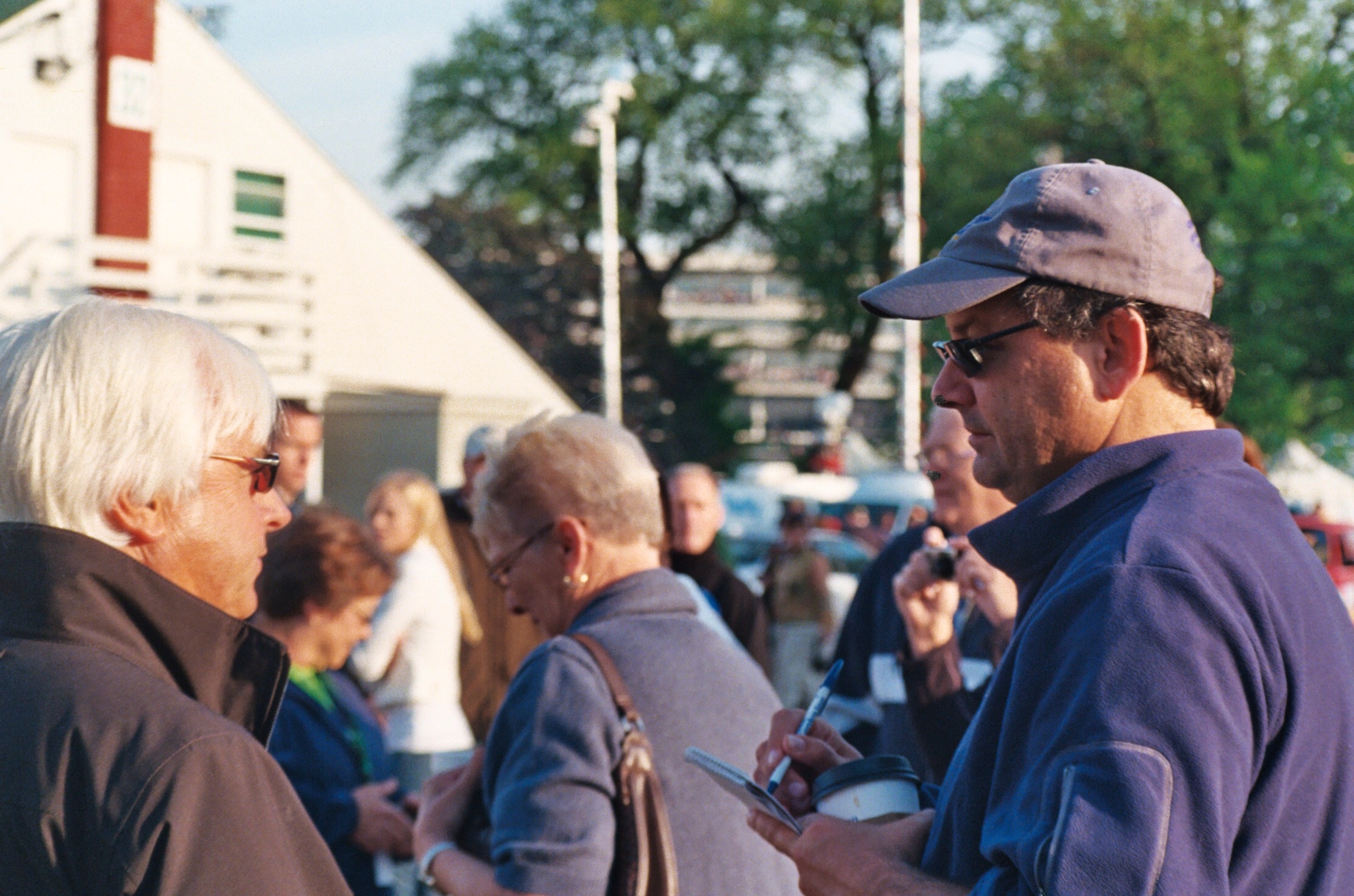
Bob Baffert (left) and Joe Drape
Then Baffert appeared, wearing pressed jeans and wearing his trademark sunglasses. After posing for a photo with some fans, Baffert began talking with Joe, who had concluded his interview with Gomez. Joe introduced me to Baffert, and the three of us talked for a couple of minutes. We talked about Lookin at Lucky’s unlucky post position, No. 1, on the extreme inside, where he was likely to get squeezed as the outside horses pushed toward the rail. We talked about the weather forecast — heavy rain — and how Lookin at Lucky might handle a sloppy track.
As the conversation began to lag, I decided on the spur of the moment to ask Baffert a question about the horse that I liked — Noble’s Promise. Like Lookin at Lucky, Noble’s Promise prefers to run toward the front of the pack, and he would break from the No. 3 hole, just one spot removed from Lookin at Lucky.
And so I spoke up: “Where do you think Noble’s Promise will be?”
Baffert looked at me squarely in the eye and without missing a beat, replied, “I don’t have the slightest idea, and I don’t care.” And with that, he turned and walked away. I turned to Joe, smiled and said, “Sorry I killed your interview.”
* On Derby morning, I went to the track by myself. The Derby is always sold out long before Derby Day, and I always try to buy tickets on track grounds for less than face value. My track record is good: I’m cheap, but I’m a pretty good negotiator, and I work various angles.
In the Derby ticket game, I’ve found, marketing is very important. The people who stand around holding up their fingers, seeking, one, two or three tickets, usually don’t do that well. People who have extra tickets to sell tend to give prospective buyers a good looking over (in many cases, the buyer will be in a six-person box with the seller) and simply ignore a lot of would-be buyers.
I always try to dress relatively well (although it was sprinkling Saturday, and I wore a green rain jacket over my shirt), and I always have a home-made sign. On Saturday, my sign read, “Need 1 or 2, for me (Jim) and my wife (Patty).” I thought the personal touch might be a plus, and it also achieved another purpose: It told sellers that I did not intend to buy the tickets and then resell them at a higher price.
I staked out a position about 150 yards from the clubhouse entrance, away from an area closer to the entrance, where a few other buyers were lurking. To my left, people were streaming by on foot. To my right, cars full of people edged toward the valet parking area. Both lines of traffic — foot and vehicular — had a good view of me and my sign. I stood there smiling, not saying much. As the people came by, almost all of them looked at me and read my sign. A couple of people said something like, “Hey, what if you only get one ticket — who goes in, you or Patty?”
After half an hour or so, a head popped up from the sun roof of a black SUV, and the person whistled and gestured at me. I slowly walked to the vehicle, and the woman seated in the front passenger seat displayed two first-floor clubhouse tickets — on the rail about 100 yards past the finish line. The face value was $162 each. “I’ll take $200 for them,” she said. “Will you take $200 for both of them?” I asked. “Yes,” she said. “That’s what I meant. I wouldn’t try to sell them for more than they’re worth.” Just like that, we had a deal. The family had two boxes, each with six seats, and they happened to have two more tickets than they had people.
As I was walking away, the woman’s husband said, “Now, you’re not going to sell those, are you?” I assured him that I was going back to where I was staying to change clothes, pick up my wife and return to the track. I would be sitting with members of his family, and friends of theirs, for the 136th running of the Kentucky Derby.
* Late Saturday afternoon, as the field of 20 Derby horses hit the top of the home stretch, I thought I had the Kentucky Derby winner. I let out a shriek as my horse, Noble’s Promise took the lead from two front-running horses who were slowing down. For several strides, Noble’s Promise, who had gone off at odds of 24-1, led the race. But just as quickly as he had taken the lead, he, too, slowed and relinquished the lead. Joe Drape had told me that Noble’s Promise, bred more for speed than distance, would not be able to survive the stretch run. He was right.

Super Saver wins the Derby
Super Saver, the eventual winner, passed my horse. So did Ice Box, who finished second; Paddy O’Prado, who finished third; and Make Music for Me, who finished fourth. But not Lookin at Lucky. Oh, no, he finished sixth, one spot behind my horse. But, at that point, as the horses flashed by the finish line, I didn’t have the slightest idea where Lookin at Lucky was. And I didn’t care.

 JimmyCsays: At the juncture of journalism and daily life in KC
You must be logged in to post a comment.