The man who propelled Jackson County government into the 20th century has died.
A Kansas City Star obituary, published today, said that Charles E. Curry died Dec. 13 at his home in Key Largo, FL. He was 92.
The Sunday Star did not have a news story about Curry’s death.
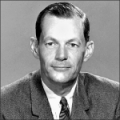
Charles E. Curry
In the 1960s, while presiding judge of the old Jackson County administrative court, Curry began reforming the county, which had fallen deep into a spoils and patronage system.
Among other things, the county can thank the Curry administration for home-rule government, the Harry S. Truman Sports Complex, a modern Truman Medical Center, the Little Blue Valley Sewer District, upgraded juvenile facilities and expansion and improvement of the parks system.
The building boom came from a massive (at the time) $102 million bond issue that voters approved in 1967. Voters approved each of seven specific proposals, including the sports complex, by more than the required two-thirds majority. (Back then, bond issues to be paid for with property-tax increases, required two-thirds voter approval.)
The sports complex alone was a $43 million proposal. Former Mayor Charles B. Wheeler said Sunday that when construction bids later came in above estimates for the twin stadiums, Royals’ owner Ewing Kauffman and Chiefs’ owner Lamar Hunt pledged $10 million each to make the complex a reality.
It turned out to be a spectacular deal for the county and a tremendous boon for the region. In recent years, more than $600 million has been spent on sports complex improvements.
The 1967 bond issue had been approved for a public vote by the three-judge county court consisting of Curry; Wheeler, who was western judge; and Alex Petrovic, eastern judge, who also is still alive.
“He (Curry) was very important in Kansas City history,” said Wheeler, who served as Kansas City mayor from 1971 to 1979. “He really stepped forward and did the whole thing.”
Wheeler said that, before the bond issue, county court inhabitants “hadn’t spent a nickel on improvements in Jackson County for years.”
Wheeler credited a Curry ally, the late John E. Kelley, with putting together the $102 million bond issue. Kelley, who died several years ago, was county counselor at the time.
One of Curry’s major, lasting contributions to the county political scene was his founding of the Committee for County Progress, a progressive, Democratic organization that remains influential in county politics to this day.
Wheeler said that when the C.C.P., as it is known, fielded its first slate of candidates, in 1964, Wheeler was the only one of seven C.C.P.-backed candidates to win. Wheeler’s first post was county coroner. He was elected western judge two years later.
In 1966, however, it was a different story. With one exception, the entire C.C.P.-backed team soared to victory. The lone survivor from the “machine” era was public administrator Bill Morris, who two years later was elected lieutenant governor under Gov. Warren E. Hearnes.
The biggest single reform that the Curry court set in motion was the changeover to “home-rule,” charter government. A charter commission, headed by lawyer Harold L. “Fritz” Fridkin, wrote a proposed charter, and voters approved it in 1970.
The charter, which took effect in 1973, gave the county the ability to create its own laws, instead of depending on the state. In addition, the three-judge court was succeeded by a county executive and a 15-member “county legislature.”
Under the charter, the late George W. Lehr, the last presiding judge, automatically became the first county executive. He served as presiding judge in 1971 and 1972 and then as county executive in 1973 and 1974.
Several years after the advent of charter government, voters approved a reduction of the legislature from 15 to nine members.
Curry later held other political posts, including treasurer of the Democratic National Committee in the early 1980s, but his greatest contribution remains his indelible stamp on Jackson County.
Fridkin, who is 84 and still practicing law, said he believed the key to Curry’s success was attracting capable and dedicated people to the government to carry out the reforms that he envisioned.
“He brought in people who believed in what they were doing,” Fridkin said.
 JimmyCsays: At the juncture of journalism and daily life in KC
Thank you for the wonderful comments about Charles. I was privileged to have spent 25 years with that remarkable man. He was a true Renaissance man, with so many accomplishments, leadership qualities, acute intelligence and interests. I will always be grateful to have shared his life.
Charlotte Curry