The issues of conventions (can Kansas City be competitive?) and development (where’s it gone?) took center stage tonight at a mayoral forum sponsored by the American Institute of Architects of Kansas City.
More than 100 people attended the forum at the AIA’s comfortable, cutting-edge space at 1801 McGee. Those in attendance sat in black, hard-back chairs under a wide, red, runway-type ceiling. The five mayoral candidates who participated sat at a table in the front of the room, against a red wall that presents as a vertical extension of the ceiling.
The candidates took turns answering questions put to them by Kevin Collison, The Star’s development writer.
Participating candidates were Jim Rowland, Henry Klein, Sly James, Mayor Mark Funkhouser and Mike Burke.
An AIA official said Deb Hermann had informed the group that she would arrive late, but she failed to show. Later, she said she had attended a long-scheduled campaign event at a home in the Brookside area. “You can’t just hit everything,” Hermann said, referring to the many mayoral events.
The seventh mayoral candidate, Charles B. Wheeler, said later when reached at home that he didn’t know about the forum. The AIA official said she had either e-mailed or called the Wheeler campaign but had not heard back. “That’s possible,” Wheeler said, adding that he was enjoying a Laurel and Hardy movie on TV.
Wheeler and Hermann missed a good show. The discussion was energetic, for the most part, and sometimes intense.
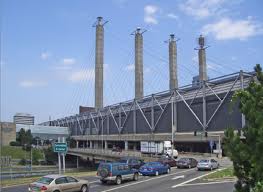
Is the party over?
For example, on the issue of a proposed $300-million-plus convention hotel, Funkhouser essentially wrote Kansas City off as a major convention destination. “We do not need this hotel,” he said forcefully. “…This is a huge (financial) risk. We are probably not going to be a high-end, national convention city…This is a bad, bad idea.”
In surveys and elsewhere, he said, few city residents cite a convention hotel as a high priority.
Sitting to Funkhouser’s left and answering after Funkhouser, Burke, a former Convention & Visitors Bureau board member, took a sharply contrasting position. Convention business is critical to the city, he said, and the need for a downtown convention hotel is great.
At the same time, he said, “we cannot put the city’s general fund at risk.”
Klein said he was “very skeptical” about the feasibility of a convention hotel and pointed to the bankruptcy of a downtown hotel in St. Louis (apparently a Sheraton property that failed last September) as good reason to be skeptical.
Rowland urged patience, saying “a process is in place” that probably would determine whether the city should provide significant financial incentives and backing for such a project. He was referring to a steering committee that has been studying the issue and could make a recommendation to the City Council as soon as March.
Like Burke, James said the city needed a new convention hotel but that it should not come at the expense of a lower bond rating for the city or increased debt level. (As a practical matter, there’s virtually no way the city would be able to provide significant financial backing without taking on new debt.)
Earlier in the forum, Collison asked the candidates to rate, on an A-to-F scale, how the city was doing in recent years in terms of “development and investment activity.”
Starting off, Burke handed out a grade of “D,” citing the “collapse” of the Plaza’s West Edge project and the loss of the Wizards soccer team (going to KCK) as evidence of significant slippage. He offered optimism, however, saying “we’re coming out of this recession” and that the city needs to take advantage of the improved situation.
Funkhouser gave a grade of “C” and said the city had lost thousands and thousands of middle- and upper-income residents in recent years to the suburbs. A turnaround, he said, will hinge on “slow, organic growth.”
Like Burke, James issued a grade of “D,” and Klein, while he took his full quotient of time, didn’t give a specific grade. He said, among other things, that incentives the city handed out in earlier years (presumably for projects like the Power & Light District) might have created the illusion that things were significantly better back then.
Rowland gave the city the lowest grade — ”D-minus, at best” — charging that Funkhouser and the council had established “an environment that is toxic for development and business.”
“There are too many road blocks, too many barriers, too much red tape,” he said. Later, answering a related question, he said: “I would change fundamentally the tone at City Hall.”
The evening had its funny moments. At one point, for example, Rowland found himself agreeing with Funkhouser on an issue, after having agreed with him on another issue minutes earlier.
“This is twice,” he said, “and I’m not going to do it again.”
The last question of the evening — from an audience member named Tiffany Miller — made all of the candidates, except Burke, squirm. As a prelude to her question, which had to do with a HUD home-repair program, Miller said she had e-mailed her question to each of the candidates, using e-mail addresses on their web sites. Burke was the only candidate to respond, she said.
The candidates — except Burke, who was smiling contentedly — scrambled to come up with reasons why they had either missed the e-mail or failed to respond.
Funkhouser covered himself by saying he had spoken with Miller about the issue in the past. James said Miller’s e-mail was in a queue of 200 or 300 messages that he hadn’t read yet.
Then came Rowland with a real head-scratcher.
“I haven’t been home or slept the last 48 hours,” he said.
That was greeted with tittering from the audience.
Minutes later, after the forum had ended, I asked Miller what she thought about Rowland’s explanation.
“Yeah, my dog ate it,” she said.
 JimmyCsays: At the juncture of journalism and daily life in KC
You must be logged in to post a comment.