The mayoral candidates took their road show to the Crossroads District Friday evening, and the setting — a part of Kansas City that has been thriving for a decade or more — energized the discussion.
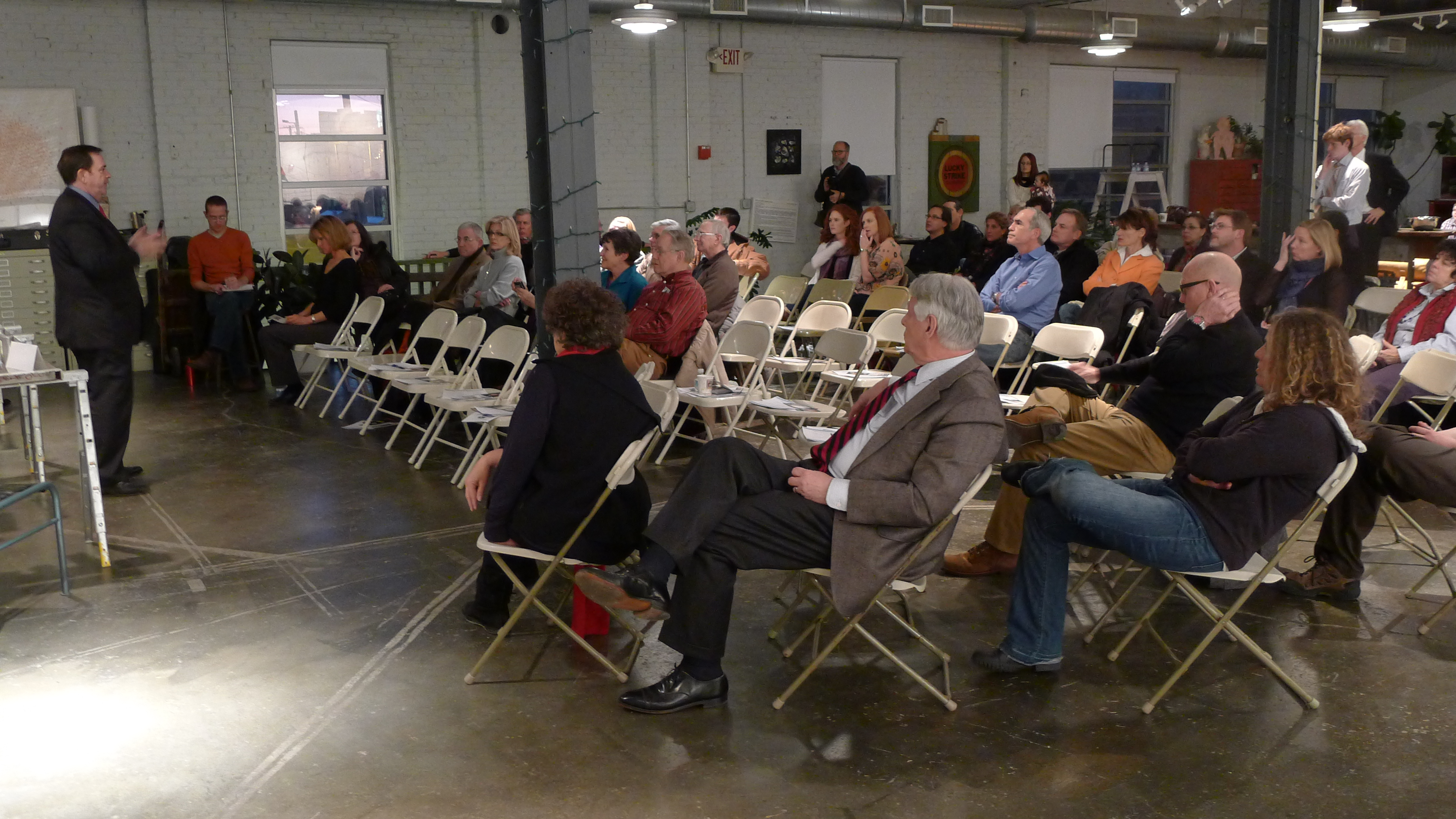
It was interesting to see the approach that five main candidates — Mike Burke, Sly James, Deb Hermann, Mayor Mark Funkhouser and Jim Rowland — took with the crowd of about 75, who gathered on the second floor of a two-story building at 122 Southwest Blvd.
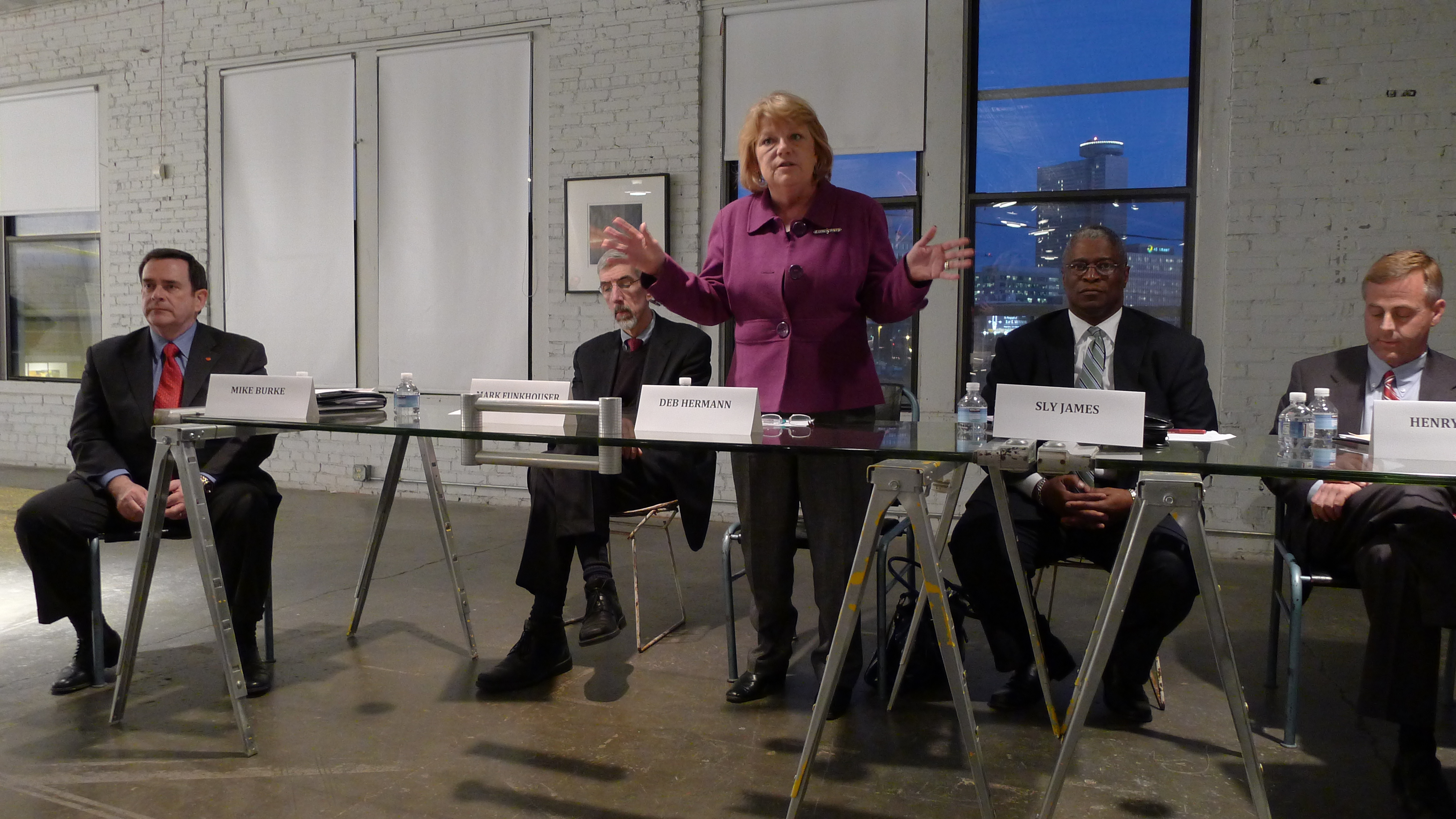
Burke, Funkhouser, Hermann, James and Klein (the Hyatt, background)
Hermann struck the right note immediately by saying: “First, I want to commend you; there’s no way anyone could have envisioned what you have created here.”
She was referring, of course, to the thriving district of restaurants, small and eclectic businesses, lofts and galleries.
Sly James picked up on the theme, saying, “The arts cut across all conceivable lines. It’s one of the things that can be used as a catalyst to bring people together.”
Oddly, Funkhouser didn’t say much about the arts or the Crossroads District in his opening statement, focusing, instead, on his oft-stated contention that city finances are in much better shape than they were when he took office four years ago.
Burke (whom I support and have contributed to) had a big advantage with this group, and he pressed it all night long. For months, a key part of his platform has been to create an Arts Office within the mayor’s office. The office, he said, would explore public funding for the arts and devise a plan to help sustain arts organizations for many years.
Rowland, while he didn’t say anything particularly interesting about the arts in his opening statement, hit on the issue during the course of the evening, saying, at one point, “The arts is a tool to drive economic development.”
Both Rowland and another candidate, Henry Klein, graciously acknowledged, however, that Burke was the front-runner on the arts issue.
Funkhouser, on the other hand, was considerably less deferential, saying: “We don’t need a mayor’s office of this, a mayor’s office of that…We need to integrate them.”
As usual, Funkhouser took more shots than he handed out. The challengers, particularly Herman, Rowland and Burke, have become adept at building themselves up by slapping him down.
Hermann, who is chairman of the council’s Finance and Audit Committee, said, “Of all the candidates up here, I’m the one who knows the budget.”
She said she had led the council to a consensus on the last three budgets “in a thoughtful, dignified manner, with no hair pulling and no gnashing of teeth.” She was alluding, of course, to the hair pulling (not literal) and gnashing of teeth (possibly literal) that Funkhouser’s wife, Gloria Squitiro, caused while working in Funkhouser’s office as a “volunteer.”
Before contrasting himself with Funkhouser, Burke talked about some of Kansas City’s great successes of the past, including Crown Center Redevelopment Corp.’s construction of the Crown Center Hotel and the Crown Center Shops.
“Hallmark built a hotel into a bluff, and it was a masterpiece,” Burke said.
Back then, he said, city leaders heralded Kansas City’s achievements throughout the country, and, partly as a result of that strong promotion, the city became one of the nation’s top convention destinations. (In recent years, it has fallen out of the top tier.)
Burke pledged to take “the Kansas City story” on the road again and concluded by saying, “I want you to be proud of your mayor. I want people to be proud of Kansas City.”
James, who seems to be finding a stronger voice with each passing day, also used Funkhouser’s long shadow to shine a light on himself and his vision of leadership.
“You have to set the example, and they (the council members and others) have to be willing to follow,” James said. “If you can’t bring people together to get something done, then you will get nothing done.”
The primary election is now 10 days away.
 JimmyCsays: At the juncture of journalism and daily life in KC
Just curious Fitz, if Gloria had run off with the pool boy the day after Funky got elected, would he have been a good mayor in your opinion?
I watched some of Burke’s videos. Have him drink some coffee or something. No diss, really, I mean the guy is a politician and he needs to project.
He needs Eli Gold.
Sly James is a charismatic guy, and maybe, even though he is another lawyer (Sheeesh…) he can acquire consensus from the city council better than the others.
Obviously, after the last administration, personality, as superficial as it sounds, should be a consideration for office.
You bring a different, uh, perspective to the marketplace, Chuck. Pool boy? Fetching image. I don’t know what to say to that. I wrote that Jim Rowland has beady eyes, and he accused me of being unchristian for that, so I think I’d better steer away from speculating about possible retrospective infidelity.
Burke is not the most charismatic candidate, I grant you, but he’s very steady and has treated people with respect and dignity for as long as I’ve known him. I think that will help him immensely on Election Day.
Sly is not only charismatic but also funny and articulate. My big concern about him is that he would have a very steep learning curve. We need somebody who knows the players in the various arenas, can pull them together and step on the gas to get the city moving again. That’s Burke.
Jim
Sorry, I didn’t really mean to insult Gloria or Funk, I was only curious about what he might have accomplished without his wife around.
(:
What the mayoral candidates should really be bringing away from the Crossroads is the great success of a grass-roots, organic development that has grown because numerous small business people and entrepreneurs risked there own money and future and built places that have become successful. Just like 39th Street, these areas should be studied very carefully, and local tax policy and small-business regulations should be adjusted to recognize and support the importance of this type of local, organic development.
The contrast with the Potemkin Power and Light District couldn’t be greater!
Good point on the “organic” development of the Crossroads District, Bill. And while I love the use of the term “Potemkin” (fake village, for those not familiar), I am extremely grateful for the tandem of Sprint Center and the P&L District. Those facilities have enabled us to compete, once again, with other cities in the region for conventions and athletic tournaments, such as the men’s and women’s Big XII basketball tournaments and the NCAA volleyball championship.
At least on event nights, Downtown truly does come alive. I don’t know about you, but I want to live in a city with an active Downtown, where people hang out at night. Can you imagine what Downtown could be like without Power & Light? Geez, there wouldn’t be any lights to turn out.
Jim
For many many years, the suburbs have been evolving into their own “Edge Cities” and that has certainly been true in Kansas City. And having grown up on the East Coast, I really enjoy vibrant high-density urban environments myself. But a taxpayer-subsidized movie set that costs the public $12 million a year doesn’t really create that. And pining for the good ‘ol days doesn’t get us anywhere either.
The greater metro has a population of over 2 million; around 18,000 residents live downtown.
Of the many hundreds of thousands of jobs, less than 10% of them are downtown. If you commute on a workday from Lee’s Summit, I-470 is packed and most of the traffic goes to I-435. If you continue on 71 Highway, by the time you get to the 11th Street exit, you find yourself all alone.
Tearing down old buildings and having something new that may generate more activity is fine, but in KCMO we never seem to reach the tipping point where the NEXT project doesn’t have to be subsidized. That’s mostly because the elected officials are easily manipulated by the developers and their attorneys, but it may in fact also be financially the case. I agree, too, with some of the architects in the city that urban spaces on a human scale are what’s needed, yet much of the new construction is cold and uninviting.
Finally, building with an eye on the past can result in only financial ruin and disappointment. Given the demographic and socioeconomic facts that surround downtown KCMO, we should be happy for the increasingly numerous little pockets of interesting, diverse, and financially successful small businesses that can be enjoyed by all.
The days of publicly funded grand dreams, where the private sector gets the profits and the taxpayers are left servicing the debt, should be over.