For a decade or more now, people in and out of the newspaper business have been trying to figure out what caused the bottom to drop out of the industry.
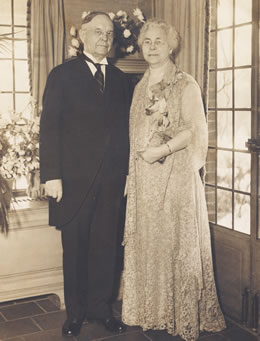
Gardner Cowles Sr. and Florence Cowles
Was it the rise of the Internet? The cashing in by all but a couple of the renowned newspaper families, such as the Binghams in Louisville, the Cowleses in Des Moines, the Chandlers in Los Angeles? The rapacious demands of Wall Street after many major newspapers were snapped up by publicly owned companies?
All of those and other factors have been fingered by various experts as the bogeyman that did in a lot of top-tier newspapers.
And now comes another viewpoint, presented by Jim O’Shea, a former top editor at both The Chicago Tribune and The Los Angeles Times. O’Shea’s new book, “The Deal From Hell: How Moguls and Wall Street Plundered Great American Newspapers,” was reviewed in the SundayBusiness section of this week’s New York Times.
The reviewer, Bryan Burrough, says this:
“Mr. O’Shea argues that what’s killing newspapers isn’t the Internet and other forces, but rather the way newspaper executives responded to those forces.”
Burrough goes on to quote from O’Shea’s book: “The lack of investment, the greed, incompetence, corruption, hypocrisy and downright arrogance of people who put their interests ahead of the public’s are responsible for the state of the newspaper industry today.”
Now that’s an angry and eloquent sentence.
O’Shea backs up his assertion largely by chronicling a newspaper deal that went terribly wrong and wrecked what once had been two great chains — Tribune (Chicago Tribune and others) and Times-Mirror (Los Angeles Times and others). Suffice it to say the papers ended up in the hands of a goofy Chicago investor named Sam Zell, who knew nothing about newspapers and who hired a bunch of former radio DJs and executives to run the chain.
He’s now out, but the Tribune chain is in bankruptcy, and the 10 daily papers in the Tribune chain are a shadow of their former selves.
Papers like The Kansas City Star, the Omaha World-Herald and the St. Louis-Post Dispatch are lucky in that they have managed to avoid the clutches of thoroughly greedy people…although they, too, have fallen far and fast.
I have a different perspective on the implosion of newspapers. I think the crumbling of demand for the daily, local paper was as inevitable as the rise of “riverboat casinos.”
The winds of change started rather slowly but accelerated to the point that we in the newspaper business (I’m a 37-year veteran) were swept up and away, and there was little we could have done to prevent it.
The advent of the Internet? Yes, that definitely played a part. But what set the stage for that?
The pace of society was already gaining steam before the Internet came along. More people were relying on TV for information and entertainment, people were working longer hours, more and more women were going into the work force, people had less time to read newspapers and they were less interested in reading newspapers.
Ask any circulation supervisor at just about any paper in the country and he or she will tell you this sentence is what they hear most often when people call in to cancel their subscriptions: “I don’t have time to read it.”
We in the business couldn’t grasp the climate change because writing the paper and reading it was our business; it was what our lives revolved around. You bet we had time to read the paper; that’s where most of our story ideas came from.
Yes, some greedy people got in there and made the situation a lot worse and sullied the reputations of some formerly high-class papers. But, in retrospect, I don’t think anything could have stopped the overall implosion. Even if we had reacted quickly and embraced the Internet and started charging for online content at the outset, I think circulation, advertising and readership still would have plummeted.
I mentioned that it was the demand for the local, daily paper that hit the skids. Meanwhile, national papers like The Times, the Wall Street Journal and USA Today are still doing relatively well. And even though the New York Times Company (NYT) is a public company, the Sulzberger family still holds a majority interest and has the resources to run the paper as it should be run, putting lots and lots of money into the editorial side.
Many people, like me, who still need a substantive paper with a heavy emphasis on world and national news have gravitated to The Times. I take The Star, which I read first, and then I turn to The Times. I’ve got the time (retired five years ago), and my interest in newspapers has never flagged.
But the time is a luxury that most people don’t have, and the interest is… well, it’s an interest that many people just don’t have any longer.
I’m not saying that’s bad, that’s just the way it is, and that’s what’s responsible for the state of the newspaper industry today.
 JimmyCsays: At the juncture of journalism and daily life in KC
I would also contend that reading as a pastime fell out of favor somewhere back in the 80s. The number of co-workers and acquaintances who barely read 1 book a year continues to amaze me.
There also seems to be a dearth of desire to learn; education for its own sake has become passé.
Entertainment, that’s the ticket.
I want my MTV.
Amen to the “entertainment” aspect, which has caused a great trivialization of news in favor of giving readers what editors perceive they want at the cost of information they need to function in a democracy.
Take a look at today’s (July 1) front page. The huge flag includes a photo of actress Julia Roberts teasing the review of her latest movie, plus photos of three Royals teasing a story about potential trades that may or may not happen.
There is a huge picture, with no story, of a guy laying asphalt at Park University and mopping sweat, so as to remind us that it was hot yesterday. Then below the fold, the page is dominated by a feature about the janitor at the Lyric Opera who won’t be going to the Kauffman Center.
Meanwhile, we have a Missouri River flood bearing down on us, and a huge debate in Congress concerning raising the debt ceiling.
And we wonder why people say, “I don’t have the time to read a newspaper”?
Dear JimmyC,
I’ve heard for over 20 years that virtually no one under 30 years of age reads a newspaper any more. That would make the daily paper a rare adventure for anyone under 50 unless you count the sports page of the amazingly insipid USA Today, another reason Rupert will burn in hell forever.
Throw in the disaster of 40 years of sell-out, compromise and cowardly behavior by politicians messing around in public education that have made verbal, historical and geographic illiteracy the norm, and you have the state of our now second-class culture. Anyone who blames teacher’s unions for the lousy state of education is too dumb to be allowed to leave the house.
Almost everything one can bitch about in our country goes back to 60 years of the mere existence of television, the Devil’s spawn. It has lobotomized at least the last five generations.
Yours For A Better Life, Possibly in Costa Rica,
Hubartos
Now, now, Hubartos, I must remind you that when we were growing up, back in our beloved hometown of Louisville, Ky., some of our most magical times were spent together on Saturday mornings watching “The Lone Ranger,” “Roy Rogers,” “The Cisco Kid” and other, thrilling, enthralling, early TV fare. So, stop whining about “the Devil’s spawn.”
Kevin — Burrough’s review of O’Shea’s book touched on the transition that many major American dailes made a decade or so ago, when they began de-emphasizing the substantive news that readers needed to know and, instead, turned to “the hyperlocal standards of local television news.”
I thought it was a terrible mistake when we followed suit at The Star, and we’re still seeing the results, as you demonstrate with your description of today’s front page…However, even if we at The Star had continued giving the readers the news they needed instead of what we thought would sell, I don’t think it would have made much of a difference overall. I’m convinced that the newspaper industry was swept up in a wave that was destined to send it crashing to the surf.
Check out the Wall Street Journal. Regardless of what the Murdoch haters say it has grown since he took over. For example, their reporting on the gulf oil spill was fantastic. They took the time and resources to understand and explain the technical and business details in a way that the NYT didn’t.
One of the key reasons many newspapers are having difficult times is a rarely mentioned one–lousy and foolish management decisions. Many of the large groups of papers took on huge debt in making acquisitions before the recession, assuring their demise. Zell and company saddled the Tribune with $13 billion in debt, which would have sunk the company even in good times. Lee acquired The Post-Dispatch, an underachiever for 40 years burdened by unenlighted labor unions, by borrowing $1 billion, which sent Lee’s stock south to under $1 a share. McClatchy borrowed more than $2 billion to buy 20-some Knight-Ridder papers, including The Star, and is still paying for it. Many other news companies are in the same boat. If they had not buried themselves in debt, most would be in much better financial shape today, internet or no internet.
Readers, many of you undoubtedly will remember Mike Waller. He was executive editor of The Kansas City Star and Times before moving on to the Hartford Courant, which was part of the Times Mirror chain before Tribune got ahold of it. Mike moved up to publisher and CEO of the Courant before becoming publisher of The Baltimore Sun, also a part of Times Mirror. He retired several years ago and now lives in South Carolina. He recently completed his second book, “Blood on the Out-Basket: Lessons in Leadership from a Newspaper Junkie,” published by Kansas City Star Books.
Thanks for the insight, Mike, and the facts and figures on those three transactions.
JimmyC,
You watched a lot more of that crap than I did and who says any of that crap was worth a crap? I can’t remember one cowboy show that was the least bit accurate historically or one that didn’t glorify the slaughter of Native Americans. Let’s not even talk about the lousy, shallow sit-coms which have only gotten worse as the decades roll on.
TV news sucks also and always has.
Yur Ole Sidekick,
Hubartos
I vote for Hubartos vanDrehl’s perspective.
Jimmy, I think you should have thrown in a comment regarding many of the traditional American companies, aside from newspapers, who have been raided in the same way as the newspaper industry.
When finance capital supercedes industrial capital, greed and ignorance is all that’s left.
[a] while I do not disagree with much of the main article, I do have another spin on the 21st Century
[b] while there is lots of opinion in the e world, the internet has ‘made it’s bones’ by providing facts!
[c] Before I went out of town on education and military ventures, I took the Falling Star as a reasonable take on the world. I was a big time ‘Star Beams’ fan.
[d] it is a big globe out there folks, and not a whole lot big minds in the J – School fraternity, yet lots of authoritative opinions, roundly resented by readers
donlake@ymail.com, award winning author, ‘Ruskin, UMisery’
Good point, Ray…And, yes, Hubartos is a damn genius, no doubt about that. He could have been in Mensa, but, as you can surely detect, he’s not the clubby kind.
Several former Star employees told me that things started going downhill when Art Brisbane decided that it was the job of the Star to shape and influence the news, not just simply report it.
Art was/is just another watered down Slobodan Milosevic wannabe, desirous of imparting his thoughts, ideas, social mores and values on all of us ’cause he’s just so damn smart.
I read the dead tree form of the NYT and WSJ daily. Despite the obvious opposing social and political agendas of each paper they do still for the most part cover a lot of news with little bias.
The Star is just an awful-dreadful-disgusting attempt at news, much less journalism. Thanks Art! Hopefully Mi-ah Parrish will get a chance to unravel your commie lib handiwork and restore some credibility to what was a once damn fine newspaper.
Smartman — It’s Mi-Ai (but pronounced like you have it, phonetically)…
As for Art, I never heard that complaint or suggestion before — that he sought to “shape and influence the news,” and I never saw any indication of that. (I was there the entire time he was there.) In any event, he should not be blamed for the state of the paper today. It has been a collective effort by top management…Personally, I think the turning point was when Mac Tully was brought in as publisher, and he, a Johnson County resident, began tilting the paper strongly toward Johnson County.
I was in charge of the Johnson County Bureau back then, and our marching orders were to have at least one story a day to offer for Page 1. Well, as you know, there isn’t enough real news in Johnson County to warrant Page 1 once a week, much less every day. And yet we forced a lot of La-La Land stories onto Page 1 to please the boss. It was absolutely maddening…Then Zieman came along in 2008, and, as far as I know, he never articulated a news philosophy that guided the day-to-day decision making. And so, here we are, hoping that Mi-Ai will find a way to turn the ship around and make the paper consistently interesting again.
You nailed it, Fitz. It was a combination of many things. U.S. daily newspaper circulation reached its peak in about 1950 and then began to decline. It’s a new world and we have to make the best of it. Thank you for sharing your insights.
I would comment, but no one of any real power to turn around newspapers is reading this.
Thanks, Julius. As these comments reflect, opinions about the reasons for the slide of metropolitan dailies cover a wide swath…Whatever, the results sure left a lot of reporters, editors, publishers and others disillusioned and somewhat dumbfounded.
Ah, c’mon, Ned, don’t wash your hands of it…Your Daddy would want you to register your opinion…Tell the readers who you are and what you think.
Who is this Art Brisbane? Is he related to the mid western Copleys, arrogant Catholic (University of San Diego stealth patrons) and under educated know-it-alls? Is he a wage slave of same, with their multitude of Heart Land dailies and weeklies?
This is exactly the attitude I sensed after I became acquainted with other news outlets. Kinda like knowing Jackson County Advocate was not much more than the ‘Grandview Times.’ Then you meet folks who confirm your earlier suspicions.
Sam Zell is still chairman of Tribune Co., though his shock jock minions, like Randy Michaels, are no longer in charge. If you’ve not read David Carr’s takedown of Micheals and Co., it’s a must-read: http://www.nytimes.com/2010/10/06/business/media/06tribune.html
It should be noted that O’Shea founded the Chicago News Cooperative, a nonprofit news organization covering public affairs (and sports, for some reason), and is published twice a week in the Times.
As for Parrish, I think a big part of her mission is to reconnect the Star with the community. I’m 30, and none of my friends in KC read the print edition. And they find most of the news that matters to them online, much of it from other outlets. The challenge is to make the Star relevant again to a younger generation (not unique to Kansas City).
It goes to community engagement and great storytelling (I would like to have known, for instance, how this arrest in a decades-old murder came about – http://www.kansascity.com/2011/07/01/2987451/arrest-in-30-year-old-leawood.html – something the Star neglected to report, as far as I can tell. A similar arrest came this week in Chicago, where I live, and the papers have written stirring, in-depth accounts of how the arrest in Seattle happened.). What can the Star do that other news organizations cannot?
Good to get your input, Chicago, especially since you’re a young person who is obviously interested in journalism…As for the arrest in the decades old murder case here, I saw that the reporter, Joe Lambe, said, “Authorities would release no information on evidence they used to charge Holcomb.”
So, he probably didn’t have much to go on, and the reporters are spread so thin now (Lambe covers cops and courts in both Wyandotte and Johnson counties, for example), that developing and keeping sources probably is very difficult.
Oh, good catch. I missed that in my initial reading of the story. Too bad; it’s a compelling story. I guess the authorities don’t care about selling papers.
@Hubartos –
Television is merely a mirror.
I hate what TV has become as much as you do. Especially that, with just a little imagination, I can envision what a truly amazing medium it could be. However, people dive into a fantasy world of pulp fiction and romance novels just as easy as a lobotomized TV viewer. Just because its television or book doesn’t mean the consumers lack of reality is any different.
I am a 15 year veteran of broadcasting, working for FOX, CBS and NBC at various market levels, before ditching the ridiculous industry for web development. I used step over the National and Local Newspapers early in the morning (as I was one of the first of the production crew to start the day) and think “There are my scripts!”. Sure enough, a few hours later, the regurgitated AP wire stories were there in front of my computer slashed to fit the time between commercials.
It’s sad what the state of Journalism is today in America. Jefferson is spinning at about 10,000 rpms. I’ve lived in foreign countries and seen what our media looks like over my shoulder and it wasn’t a pretty picture. I think of some of what the BBC has done in global reporting is very impressive, and with a lot less commercials. See a pattern there?
Everything is not lost though, because we’re reading and responding to a really great blog right now aren’t we?
Thanks, Bryan. High praise. I’ve sure got a lot more confidence in my voice than I ever did at the paper, and I’m glad to be making a contribution to the discussion in what’s left of civilized society.