In an appearance at the University of Missouri-Columbia last night, a distinguished editor and publisher gave more than 100 journalism students a lot to think about as they mull career options in an ever-changing field.
Mike Waller, former editor of The Kansas City Star and former publisher of the Hartford Courant and the Baltimore Sun, told the students that despite the waning influence and prospects of major American dailies, newspapers still offer great opportunities to young people seeking careers in journalism.
“I was in the business 42 years, and I didn’t have 42 bad days,” said Waller, now retired and living in South Carolina. “…I still don’t think you can go wrong working for a newspaper. You will learn in two to three years the skills of the way to do reporting that will hold you well for the rest of your life.”
Among the qualities and skills that young reporters can develop at newspapers, Waller said, are honesty and integrity and how to relate to and work with people.
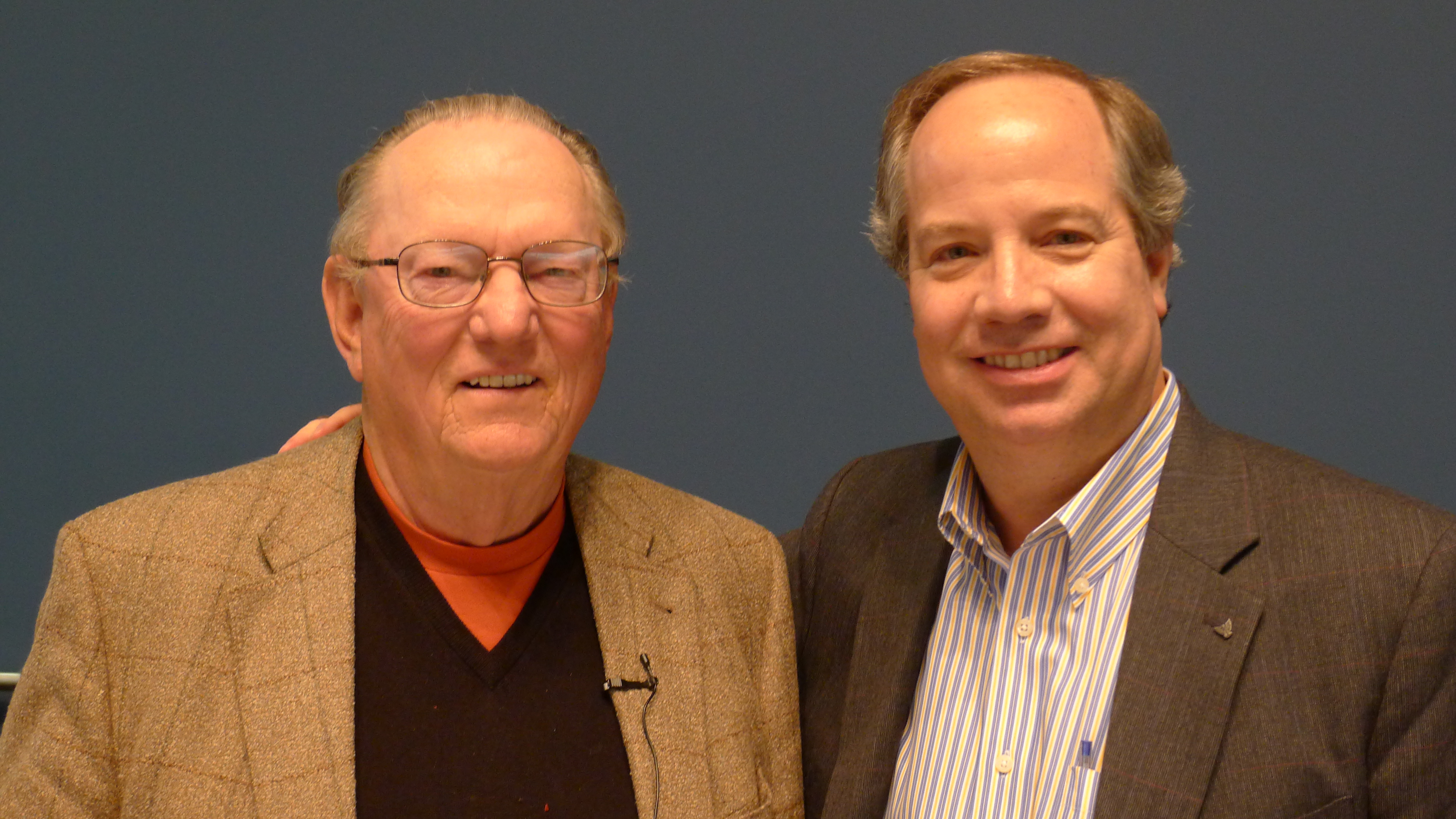
Mike Waller and Randy Smith
He also cautioned the students, assembled at the Donald W. Reynolds Journalism Institute on campus, not to try to rush up the career ladder. It is vital, he said, for young journalists to learn the basics — reporting, verification and solid writing — before seeking to advance.
“Don’t cut corners in your career,” Waller said. “They (the fundamentals) are all building blocks to something; you don’t know what.”
Waller, 70, spent yesterday and today on campus as the guest of Randy Smith, professor and Donald W. Reynolds Endowed Chair of Business Journalism at MU. Smith spent many years at The Star, including about 10 as deputy manager editor-metro. Smith and I both worked with Waller before he left for Hartford in 1986.
While still bullish on careers in journalism, Waller voiced significant concerns that should give pause to prospective journalists thinking about careers at major metropolitan dailies.
After one student asked him if he thought there was any correlation between the credibility of a newspapers and their ability to generate revenue, Waller noted that The New York Times has held those up as its twin goals since its founding.
He added, however: “Today almost nobody operates on that premise…I don’t really believe most (major metropolitan) papers are pursuing excellence. They’re pursuing survival; they’re pursuing cash flow and revenue.”
Those aren’t encouraging words for students thinking about working for what used to be “destination” papers, such as The Star, the St. Louis Post-Dispatch, the Louisville Courier-Journal, the Denver Post, the Chicago Tribune or any of dozens of other second-tier papers. (By second tier, I mean those right under the “Big Three” national papers — The New York Times, the Wall-Street Journal and USA Today.)
But if students are willing to start out at any number of small- to mid-size dailies, Waller said, opportunities abound.
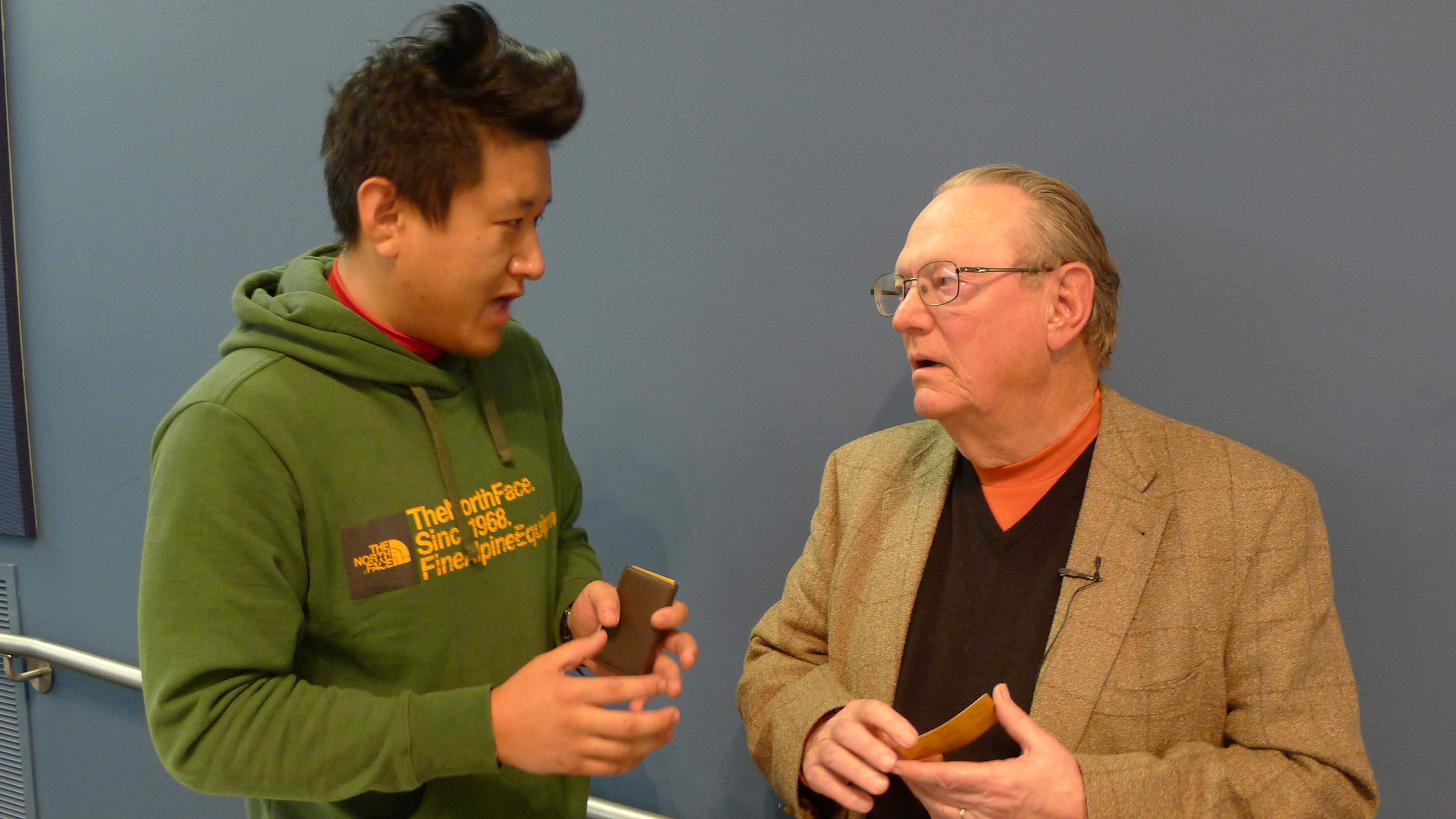
Waller with visiting scholar Thomas Gao of China
There are about 1,200 such papers that are doing quite nicely,” Waller said.
“The big thing about those papers is that the Internet is not a big threat to them.”
If residents of small- to mid-size towns don’t take the local paper, he said, they “haven’t got a prayer” of finding out what’s going on in their areas.
“Those small papers, I think are going to be with us forever,” Waller said.
Circling back to the subject of the major metropolitan papers, Waller said it was the loss of classified advertising to the Internet that thrust them in a persistent downward spiral.
“That revenue is never going to return,” he said, adding that, right now, no one appears to have the answer as to what it might take to revive the fortunes of the bigger papers.
“Somebody’s going to come up with the answer, I’m convinced,” he said. “Will it be too late for a lot of papers? Probably, probably.”
***
Editor’s Note: Waller’s most recent book, Blood on the Out-Basket: Lessons in Leadership from a Newspaper Junkie, is available online through The Kansas City Star Store, Amazon or any of several bookstores, including Rainy Day Books in Fairway. The 135-page paperback sells for $16.95.
 JimmyCsays: At the juncture of journalism and daily life in KC
You left out the closer:
After giving the students this message of eternal hope, Waller left the building and was struck by lightning. Post tributes on Legacy.com
You can’t go wrong building horse buggies or learning to repair carburetors, either, YOU JUST CAN’T MAKE A LIVING. To suggest to a room of 100 young skulls full of mush that you might be able to pursue the AMERICAN JOURNALISM DREAM is INSANE and NEGLIGENT.
For every Woodward and Bernstein in that room there were two Beavis and Buttheads. In the REAL WORLD for every Matt Drudge there are 1000 Tony Botellos. For every Mike Royko there are 10,000 Mike Hendricks.
Newspaper reporter is just a few spots ahead of kamikaze pilot in terms of careers with longevity.
If these kids have a true passion for journalism and reporting and are willing to sacrifice financially and materially to pursue that, WONDERFUL. If not I’d suggest HVAC repair. Easy to make $100K a year within 3 years of starting out, if you’re GOOD.
With the exponential growth in communications technology even the Pixley Gazzette isn’t going to be a safe haven. Hell, Mr. Haney has already opened up an online store.
As for Thomas Gao from China, two words to remember when you return home: POLITICAL PRISONER.
Wow. That guy is totally out of touch with reality. You can tell he hasn’t had to worry about finding a job for years. This is the problem with J-Schools. These people have their heads up their asses. And I can say this because I’m an MU graduate, thank you very much.
I’ll give it to J-School for preparing me for grad school, though. Research and writing papers don’t scare me.
If you want a job in newspapers, kids, move to Great Britain where folks still read them.
I’m starting to feel glad that I played this story right down the middle…just reported the facts and didn’t express any opinions one way or the other…I sat here for five minutes trying to think of a rejoinder to Smartman but finally gave up. I guess that says something.
A buddy e-mailed me a few minutes ago, asking where I stood on journalism as a lifelong career, and I wrote back that I didn’t know if I’d go into journalism if I was starting out now. I said you’d probably have to want to go in that direction really, really badly to make it work.
I met with a sociology professor the other day for a project I’m doing. He asked why I was studying social work, and I said that among other more noble reasons, I’m studying it because It’s a wide-open job market. The poor are always with us, you know. Plus I said that as a newspaper journalist, I felt like a blacksmith.
And he said that he can’t stand to read newspapers anymore because they pander to the lowest common denominator. “Who cares if Michael Jackson’s doctor murdered him?” he said (on the day that The Star played that on the A1.)
Waller talked about the proliferation of entertainment and celebrity coverage at major dailies, at the expense of narrative and investigative journalism, but there are times when celebrity news deserves big headlines. Take the O.J. Simpson murder case, for example; that was a huge, legitimate news story. I feel the same way about Dr. Murray’s trial. That was a big story: One of the nation’s top entertainers loses his life because of a totally irresponsible medical provider. If you’re sociology professor isn’t interested in that story, I question whether he’s in the right field.
His point was that it’s overkill. It was a big story, but there are more important stories out there. Did we need that much coverage? I don’t think we needed that much coverage of the OJ trial, either. And ever since that trial, everythink of a similar nature gets covered ad nauseum. I’m sick of the coverage of celebrities.
Personally, I think anyone who can convey accurate information in even a fairly unbiased manner has a future. What I con’t understand about many papers is that the one thing they can do that bloggers can’t is provide detailed, hopefully objective reports of local events (and they’re all local events somewhere) and yet this is where the Star is cutting staff.
Why would The Star waste money on a DC bureau when we can go online and read the DC newspapers? Even more ridiculous is the continued practice of maintaining a highly paid editorial staff when they could simply link (as they already do on Prime Buzz) to local bloggers and destroy in the process the perceived link between the editorial and news side that always seems to be in the back of peoples’ minds.
Journalism, real journalism, is reporting factual information in an objective manner stripped as bare of bias as humanly possible. Any other definition simply waters down the product and reduces its value to the consumer.
Lately I’ve heard newspapers (and magazines) being described as “curators” of information. That is, the editors sift through content to determine what’s important for the readers to know and then further communicate the importance of stories by choosing the size/weight of the headline, graphics and photos, and placement within the paper.
The problem for the general-interest newspaper aiming to have 200,000-plus circulation is many of us have already read breaking news long before the newspaper goes to press. Plus, the value judgments that are made in a newsroom can’t always reflect the values of a vast, diverse audience that a newspaper is aiming for. I personally find the notion that an editor in a newsroom is “curating” the news for me to be a tad patronizing. Plus I find soooo many choices objectionable: football stories on A1, the need to send a GA (general assignment) reporter to “cover” a festival or other event that has interest only for the people involved, and yes, the celebrity gossip.