On Monday, I met Mi-Ai Parrish and heard her speak for the first time since she arrived in Kansas City last August to succeed Mark Zieman as Kansas City Star publisher.
Parrish spoke to the 40 Years Ago Column Club at the Plaza III restaurant. A crowd of about 35 was on hand, including longtime society writer Laura Rollins Hockaday and Guy Townsend, president and publisher of Townsend Communications. (Townsend will be the featured speaker at the club’s February meeting.)
It was an interesting and informative session, and Parrish demonstrated that her leadership style is much different than Zieman’s.
The last Star publisher, in my experience, who had a strong personal appeal was the late James H. Hale, who brought a Texas-sized personality from the Lone Star State after Capital Cities Inc. bought the employee-owned paper in 1977. (That was the first in a series of transactions that ended up six years ago with The Star in the hands of The McClatchy Company.)
It appears to me that with some aggressive profile building, the 40- or 41-year-old Parrish also has a chance to establish a strong personal appeal and, in so doing, push the paper toward renewed stability and greater profitability…Just because the newspaper industry is in the tank doesn’t mean that every paper has to fare poorly.
Financially, The Star reached its apex under Hale; for years, it was a virtual money-disgorging machine. Of course, the environment for newspapers was much, much stronger back then, but I think it was not just favorable economic conditions that enabled The Star to flourish under Hale. He was a reporters’ and editors’ publisher — a colorful guy who was accessible, funny and didn’t hesitate to take on the established powers, even though he drank and ate barbecue with them.
Hale was succeeded by a series of arched-back publishers, including Robert Woodworth, Mac Tully and Zieman, all of whom thought The Star was a cut above the other major businesses in town and that they, personally, didn’t need to sell the community on the value of the paper.
They knew they needed to sell papers; they just didn’t understand that, like selling cars, a key ingredient is a good salesman or saleswoman.
They ran it like it was on autopilot, and then, almost overnight, the motor stopped, thanks to the rise of the Internet and the Great Recession.
So, against the backdrop of an insipid entity (The Kansas City Star Co.) and in the worst newspaper environment we have ever seen, along comes Parrish.
She can do one of two things:
Present the same cool, presumptive demeanor that her immediate predecessors did and watch the paper’s fortunes continue to decline, or…
Let down her beautiful hair (figuratively, because it’s already down literally) and push “my Star,” as she calls it, with demonic persistence throughout the community.
After lunch yesterday, when Parrish stood up and began to speak, I was worried.
She proceeded to read a prepared speech, in which she traced the tired history of The Star. (Sorry, that doesn’t even excite many members of the 40 Years Ago Club.) She also talked about how, in the future, we’d be reading the paper on all sorts of electronic gadgets. We’re already doing that, of course, but I guess she meant there’d be even more, fancier gadgets down the road.
Not only did she read the speech, she read it fast, like she wanted to get through it as quickly as possible. In the process, she made no connection whatsoever with the audience.
The only line that really caught my ear was this:
“When people ask me, ‘Why should I care about the newspaper?’ I say, ‘If you value democracy, you damn well better.’ “
After the prepared speech, however — when she began taking questions — she showed another, more open side of herself.
Among other things, she said that:
:: The Star remains profitable. (Reassuring, for sure.)
:: We were seeing the “infancy” of the new Star model develop before our eyes. (Put that way, it sounded a lot more interesting than what gadgets we might be using to access the paper.)
:: Printed newspapers would be around “for many, many, many, many years.” (Encouraging to me and, I’m sure, many other dead-tree devotees.)
:: The Star generates about 85 percent of its revenue from advertising and 15 percent from circulation. Before the precipitous decline of the newspaper industry, starting in 2005, ad revenue accounted for about 90 percent of revenue, she said. (As surely as Obama is going to kick Romney to the curb, the percentage of revenue from circulation must continue to rise.)
:: Even at $1 a copy on newsstands, the daily Star remains a bargain. (Probably true.)
:: The Star is among the top three properties in the McClatchy chain. “We’re a big dog,” she said. (See next graph.)
Like the prepared speech, the “big dog” comment bothered me because that dog, while it’s still pretty big, doesn’t have nearly the bite that it used to. And it’s by no means safe to assume that most or all of its teeth will stay around “many, many, many, many years.”
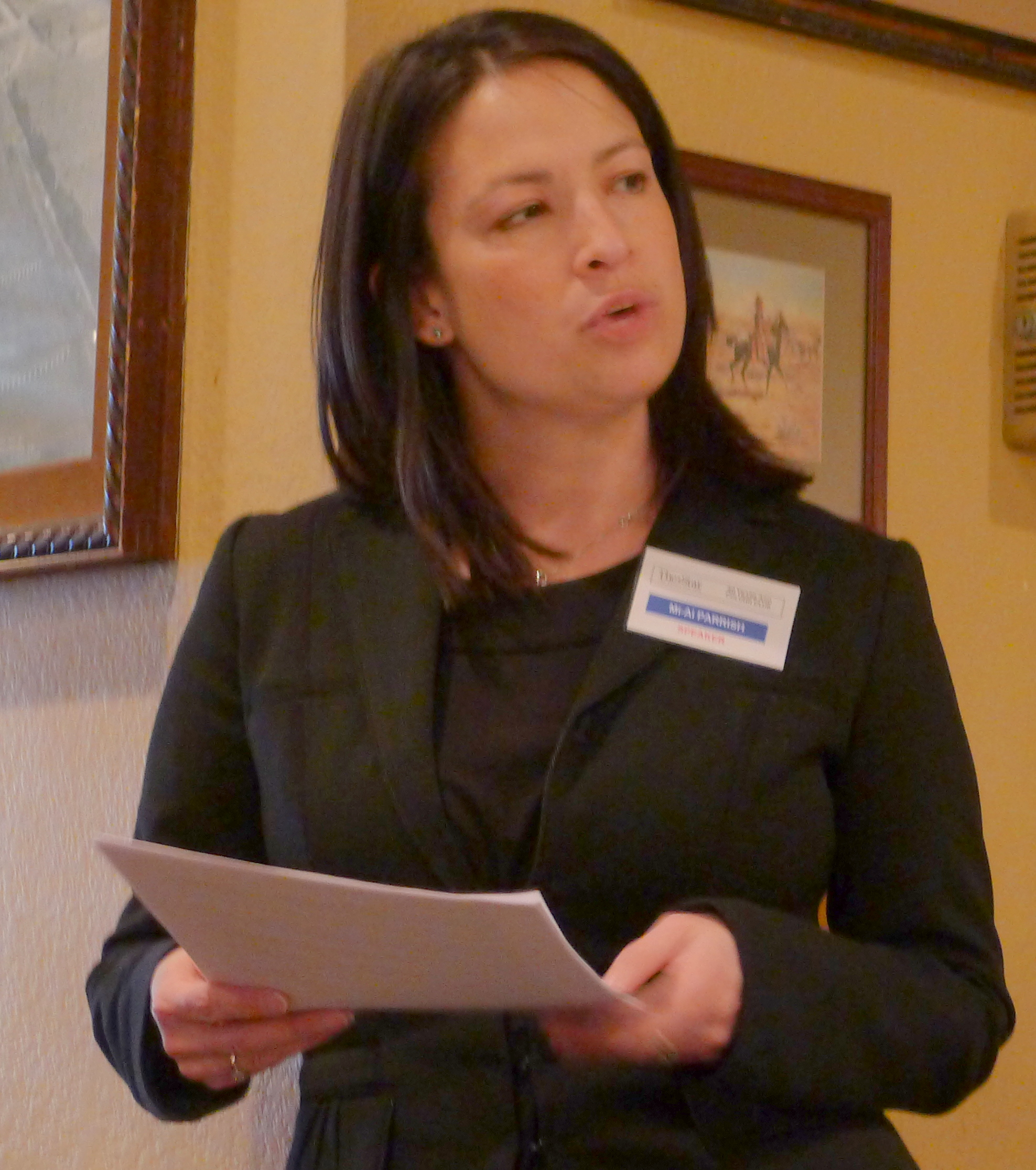 All in all, I saw more positives than negatives in Parrish. For one thing, she talked about a specific story and mentioned a specific reporter, demonstrating that she’s closely in tune with the product and that, like Hale, she might be a reporters’ and editors’ publisher. (Which, in my opinion, translates into a readers’ publisher.)
The reporter she mentioned was Steve Kraske: “Steve Kraske?, she said, illustrating her assertion that the paper was still a bargain. “He’s totally worth a dollar a day.”
The story she mentioned was Kent Babb’s fabulous but disturbing Sunday take-out on the brainwashing and intimidation that Kansas City Chiefs’ employees are being subjected to under Chiefs’ owner Clark Hunt, president Mark Donovan and general manager Scott Pioli.
Other general, positive indications were that Parrish answered questions directly, for the most part, and made it clear that she is taking personal responsibility for The Star’s future.
In addition to referring to it as “my Star,” she said, in explaining why the paper remained a good deal for customers: “I put the whole darn thing together for you, and I deliver it to you.”
She wasn’t looking for a pat on the back there; it seemed to me that she was simply accepting responsibility for keeping the presses running and making sure the paper got to people’s front yards.
And since she is willing to put that responsibility squarely on her shoulders, I say this:
Mi-Ai — Get out there every chance you get; attend every luncheon you possibly can; do every TV and radio interview you’re asked to do; attend every major civic function you can weasel your way into; don’t miss an opportunity to mingle with members of the public and tell them who you are and what your vision is for the hometown paper.
In short, make your presence felt; let the Kansas City area know who you are and why “your Star” is important to us…True, The Star isn’t what it used to be, but you’re right about it still being important and a good deal.
Sell it, lady!
 JimmyCsays: At the juncture of journalism and daily life in KC
The Star’s been here longer than me and it is a treasure. Hopefully it will regain its luster. In-depth news stories are the key to increasing circulation, imo.
I think you’re right about the in-depth stories, Harvey, although I would also like to see a better balance of international, national and local stories.
Unfortunately, the way things have gone in the newspaper industry, most papers’ news holes are too small to go very far beyond local. That means The Star can no longer serve as the sole source provider of news; if you want to be informed on all fronts, you’ve got to go elsewhere. Still, I think they could boost circulation significantly with a strong front person, an effective marketing campaign and, like you say, a consistent flow of good enterprise stories.
Nice take Fitz. Unfortunately the Star has been disengaged from “democracy” for quite some time. The raison d’etre seems more about social engineering, shaping and influencing the thinking of its readers. Not fair and unbalanced comes to mind.
I’m sure that even you would agree that there are more than a handful of reporters or columnists at the Star that need to be shown the door in the name of “quality.” The op-ed section is a joke.
Ad revenue may be up but it’s my understanding that’s because ad rates are so low. As I look at the ads in The Star I always wonder why half of the ads are in it since they don’t really sell products or services that would be of interest or benefit to the average Star reader. You know the old saying, half my ad dollars are wasted, I just don’t know which half.
The Star has light years to travel journalistically to get my attention, or more importantly, my money. Like the Chiefs and the Royals, The Star is a once-great organization that promises to show promise but is mired in the mediocrity and delusional mindset of its owners and operators.
As Mary Antone from Independence said, “Let ’em eat barbecue”
Jim – I enjoyed your report on the luncheon yesterday and specifically the valuable insight you displayed in analyzing the comments made by Mi-Ai Parrish. I’m sorry I was unable to join the Nichols-Hockaday-Fitzpatrick party at the Plaza III, but in observation of Martin Luther King, Jr. Day, I was picking up trash in the park near my home in Leavenworth. It’s nice to know, then, that the three of you and the rest of your fellow diners weren’t treated to any “trash talk” by The Star’s new No. 1, and, in fact, heard someone who has a chance to be the next Jim Hale of sorts, although in this case a female version of the much-admired Texan. Whether or not she feels comfortable with the role, she is the new face of The Star just the same and, as you so eloquently observed, needs to make herself very visible in the community if she is indeed seriously committed to a reversal in the newspaper’s fortunes.
Thanks, Rick. I would like to have seen you, but your “alibi” is more than satisfactory…It was great to spend time with and be the guest of your mom (Peg Nichols, writer and widow of the late Dick Nichols, longtime Star copy editor). Many of the old-timers, like Laura and Peg, are dedicated to The Star and long to see it prosper. It’s not just good memories; it’s wanting our community to have the best paper possible for the good of future generations.
Smartman — I would say that among the reporters and editorial writers remaining at The Star, only a few aren’t earning their keep. Most of the deadwood, of which there was much, is gone. And, looking at the glass as half full, they have a dozen or more truly top-rung newsroom reporters and editorial staff members. (Now, if you happen to disagree with The Star’s liberal bent, one might tend to dismiss the editorial writers as no good, even though they are quality writers.)
Also, this is not a black and white situation. (Good one, eh?) The Star is neither all good nor all bad. It’s not as good as it used to be, but it remains, by far, the most powerful, honest and far-reaching news source in the Midwest, Including St. Louis and Denver. It still is the best watchdog of government and politicians, pushing relentlessly to keep government and the pols honest and accountable. God forbid if The Star went away; local politicians inclined toward larceny and self-interest would run wild. For example, can you imagine what firefighter pensions would look like if it weren’t for Yael Abouhalkah? Why, they’d be making more in retirement than they did on the job.
You nailed it, Jim. And I believe Mi-Ai Parrish can make it happen.
Thanks for the compliment, Julius…You should still be at The Star. Laying you off was one of the biggest mistakes The Star made. Proportionately, the business desk has suffered much more than the metro desk under the downsizing. I hope Mi-Ai can find a way to better finance that operation.
Jim:
Good, immediate job on your 40-Year-Ago Club report. Your reporting skills are still tops.
It’s exciting to have the first woman president/publisher in the 132-year history of The Kansas City Star. Mi-Ai Parrish has a warm and winning way about her, I believe, but wish she had let it shine through more yesterday. I met her for the first time, briefly, at the Kauffman Center for the Performing Arts, and she was outgoing and charming. Jim Hale knew how to communicate with reporters and editors by simply coming down from his office on the third floor and talking to those in the newsroom on the second floor.
From what I hear, Mi-Ai does the same thing, constantly, and those in the newsroom appreciate her for it. Because The Star is in the business of communicating, it is important that the leader of the paper communicates with the staff. From all reports, Mi-Ai is doing that. And that injects life-saving blood into morale, which is sorely needed at The Star after so many layoffs of outstanding news men and women.
Sincerely,
Laura
Good observations, Laura. One of the ad sales people told me recently that Mi-Ai is great at remembering names, which is always a plus.
However, to sell herself and re-sell The Star to Kansas City, she’ll have to make that an absolute priority. She’ll have to push herself to be charming and gregarious all the time, whether she feels like it or not. Look at Col. Sanders…That son-of-a-buck is still selling chicken from his grave! Same for Ray Kroc with Big Macs and Dave Thomas with Wendy’s double cheeseburgers. Never underestimate the power of personality.
I’m on my annual sabbatical in Naples, Fla., where I repeatedly wonder why the Naples Daily New is so much more paper. Naples is not that big and I don’t know what the paper’s circulation is because all that matters is me. It prints a tabloid-sized television programming section for Sunday, plus a full page of TV listings every day. It has three pages of comics, printed in what I consider normal size. It carries a full selection of comics, of course, in color, on Sunday.
The News has an array of puzzles, columnists, love-lorn, op ed and the like, and two substantial pages of letters to the editor. There are multi-page sections for the A section, Sports, Community and the Arts. My subscription rate is comparable to The Star’s. (You don’t have to pay 50 cents for a TV section, comic section or a second checked bag.) The Web site is solid as well as its other electronic offerings. The local reporting is adequate in coverage and writing, though tending to refuse to let go of a running “sensational local story.” It doesn’t take much to be sensational in Naples.
As in Weston, I supplement my news addiction with The New York Times and The Star online.
Just did a little checking on the Naples Daily News in light of your interesting report, Ridge. It’s one of 15 papers owned by the E.W. Scripps Co., a communications conglomerate founded in 1878.
On its website, Scripps says this about the Naples Daily News:
“The Naples Daily News was founded in 1923 as the Collier County News, a weekly newspaper published in Everglades City. By the 1940s, it was obvious that Naples, 40 miles to the north, was going to be the county’s boom town, so the News moved its operation there in 1948. In 1963, the paper began publishing the daily, changing its name to the Naples Daily News.
“With the area’s rapid population growth and the sensitive ecosystems of the Gulf of Mexico and the Everglades, the News focuses much of its coverage on land development and the environment. Other important topics include tourism, agriculture, and recreation. In 1990 the Naples Daily News was one of 10 newspapers with under 50,000 circulation cited for excellence by the American Society of Newspaper Editors.
“In 1995 it won the Charles E. Scripps Award for support of literacy. The newspaper received Best Use of Photographs in the 1996 Pictures of the Year competition sponsored by the National Newspaper Photographers Association.”
Some nice credentials there…Enjoy the sun and the Daily News, Ridge!
P.S. On its website, Scripps reports the Daily News circulation as 54,000 daily and 65,000 Sunday.
Fitz, we will agree to disagree.
The Star, more than any person, business, organization or union is primarily responsible for the decay and decline of KCMO. If only by the default reason that they championed and endorsed so many bad people for elected office.
Like The theme song from Love Story, Where Do I Begin?
The KCMOSD debacle, the homo-erotic love affairs with Manny Cleaver and Kay “TIF” Barnes, the lack of any criticism during the downtown arena debate, the cash sucker that is Power and Light, Yael’s man crush on Mark Funkhouser.
I would prefer a newspaper that is feared as opposed to being respected as some sort of genteel compliment. Sphincters should tighten when a Star reporter walks into City Hall or a Chiefs/Royals post game presser.
The Star doesn’t even come close to accurately reflecting the thoughts, values and ideals of the majority of people in the metropolitan area. That small step alone would probably increase subscriptions by 30%.
You can’t teach an old dog new tricks, but old dogs eventually die. Perhaps when this schitzu passes, we can get a new bloodhound, more interested in sniffing out news then eating the other dogs poo!
Distinctive and entertaining, as always, Smartman…Love the “man crush” on the Funk. So true.
Correction: The dog is not a Shits-You; it’s it’s a Shih-Tzu.
Your rose-tinted glasses or maybe they are beer goggles are clouding your misty water-colored memories of James Hale. Because he talked like a Texas honcho, it may have seemed that he was a tough guy who didn’t hesitate to take on the established powers; the actual printed record of the newspaper shows that very few established powers were taken on during his tenure.
I have a story for you, Harwood…During the decade (1985-1995) when I was covering City Hall, the council Finance Committee once held a secret, illegal meeting at the former Fedora’s restaurant on the Plaza. It was an extremely important meeting because the three committee members who were present — Chairman Bob Lewellen and members Katheryn Shields and Joanne Collins — were “cutting up the pie” that constituted the upcoming annual budget. Outside of public view, they were talking about how to appropriate millions and millions of taxpayer dollars.
When I found out about the meeting (Councilman Dan Cofran blew the whistle at a council legislative session), I was furious. It was late on a Thursday. I raced back to 18th and Grand, wrote the story, and it made the front page the next day.
That wasn’t nearly enough to satisfy me, though. I didn’t sleep very well that night, and first thing the next morning I went down to 18th and Grand again and sought out Hale in his third-floor office. Mind you, I was leap frogging several levels of the chain of command. But Hale invited me in, and I sat down and said, “Jim, the City Council Finance Committee held a secret meeting at Fedora’s earlier this week, and I think we should sue them.”
He sat forward with a start and said, “I think you’re right, Fitz!” Then, he summoned our in-house lawyer, Scott Whiteside, and told him to put the wheels in motion. A few minutes later, we had a meeting in the newsroom with managing editor Monroe Dodd, At that point, I began feeling stupid and vulnerable because I had us headed to court and the managing editor didnt’ even know about it! Dodd kept glancing at me during the meeting — which worried me — but afterward he took me aside and said, “Fitz, why don’t you let me in on a little of the fun sometimes?” With that, I knew my job was safe.
We went on to win the case — slam dunk. A Circuit Court judge fined Lewellen $300 and Collins and Shields and $100 each. Shields took the case to appellate court, where a three-member panel of judges headed by Hal Lowenstein almost literally laughed Shields and her lawyer husband Phil Cardarella laughed out of the room.
While the fines weren’t significant; the publicity was terrible for the three council members.
That’s a case where the publisher, on principle alone, was willing to take on “the established powers,” even though it cost the paper thousands of dollars in legal fees. You don’t often see things like happen at newspapers any more.
Julius, we’ll know Mi-ah is on the right track when she brings you back on board, lets you actually report what’s in front of you, and gets rid of some of the deadwood.
I do have to agree with her assessment of Kraske; he is truly a star. I would also add Steve Everly on energy issues as a bright light in the line-up and also the work that Kent Babb just did on the Chiefs. More articles of that caliber would indeed be worth a dollar a day.
I’m not as familiar with the publishers and lack the institutional memory that you bring to the table, Fitz, but I do have to agree with Mr. Harwood’s suggestion that a major problem with The Star is its refusal to take on the powers that be (and perhaps I’ve phrased that more sternly than he would; my apologies if I have).
This problem seems to have arisen at least somewhat during the Cap Cities era, when, as one well-placed wag put it, “The Mouse has needs.” What those needs were was never elaborated, or clarified, but I always felt like Art Brisbane during his stint as publisher was little more than the lawn jockey at the River Club, And does it help KC journalism to give the editors memberships at the Kansas City Club (don’t know how widespread that was, but it just seemed tacky to me)?
Anyhow, another informative post.
Thanks, John, I appreciate the compliment. (As I suspected, this post got a lot of views and a wide range of comments. Good to see the interest.)
If you’re talking about “the mouse” having needs, I think you’re referring to the year, 1996 to 1997, when Disney owned the paper. (Disney bought it from Cap Cities/ABC in 1996 and sold it to Knight Ridder the next year.)
I wasn’t aware of Art having a membership at the River Club, but I agree that it doesn’t look good. When you’re heading a paper that its founder billed as “a Paper for the People,” you ought not appear to stand above the crowd.
Art belonged to the Carriage Club. Big difference. Not very hoity-toity.
Very true, Hearne.
Sorry, I was thinking that Disney and Cap Cities were one and the same. My mistake. As for the memberships, when I was discussing writing a column for The Star, I was taken to lunch at the Kansas City Club, and I recall the discussion that the mid-range guys had memberships there while the honchos got memberships at The River Club. I’ve also chatted with folks who dine at The River Club who indicate that Art frequented the joint. Art seemed to spend a lot of time cavorting with the folks at the Greater Kansas City Community Foundation and the Partnership For Children among other establishment haunts, and that would seem to create conflicts with objective reporting. C. Wright Mills could have had a good time writing about Art and the local establishment, I’m thinking.
John — As I said in the post, I think that Parrish should certainly rub elbows with the insiders, but I think it’s more important that she take her case to the public, such as on TV and radio shows; in magazine stories; and at public events, such as concerts and parades. I mean, why shouldn’t The Star have a “float” in the St. Patrick’s Day Parade? Parrish would look good giving a queen-like wave up and down Broadway.
I had the privilege of representing The Star for 20 years. I was there when Gerald Garcia was brought in to hand out pink slips. Most notable was the case of Elsie Allison, the society editor, who subsequently sued for age discrimination. We tried the case in federal court and won, but Hale always felt kind of guilty about it.
He knew how to make a newspaper profitable. He had done the same thing at the Fort Worth Star Telegram. But with all due respect, the paper didn’t have the competition it does today. He really did take on the establishment. Remember one of the first features was about the Kansas City 100? That kept him out of the Kansas City Country Club. (But, hey, Ewing Kauffman couldn’t get in either.) His philosophy was get good department heads and stay out of their way.
Quirks: He had the first paper off the press delivered to his home every morning. He personally signed every check, except payroll checks. Brand of scotch: Usher’s Green Stripe. Funniest episode: the firing of Michael (O.J.) Nelson, who kept coming to work until Hale forgot he had fired him.
I remember the story about O.J., my roommate for several years, supposedly being fired, but O.J. never said anything to me about it. I think it was one of those things where everybody knew it was just Hale spouting off in frustration about one thing or another.
This might have been about the O.J. “firing,” or perhaps somebody else, but then-editor Mike Waller told me that he put a stop to the foment by telling Hale, “If you’re going to fire anybody, you’re going to fire me.”
Fascinating.
I once had The Star’s attorney (not White) complain that a column I had written had too much factual content (thus removing it from the protections of an opinion column) and the other memory I had was when Lathrop and Gage (then The Star’s attorneys) went to court to oppose some Freedom of Information requests I submitted to YouthFriends and the Greater Kansas City Community Foundation regarding the expenditure of a state grant. The irony was that the information was to be used for my column at The Star.
If you want to read a fascinating account of how journalism was once practiced in these parts, specifically during the general period that encompasses the founding of The Star, there is a work in the reference room at the Leavenworth Library that is well worth your time. It is titled “Fighting Words: Pistol Packin’ Dan Anthony and Frontier Journalism” and was done as a thesis by a fellow named Jason Schwartz (I believe I have the name right), who apparently is an acquaintance of Tom Palmer, son of the late Cruise Palmer, former Star editor.
Tom told me about the work when he was here in mid-October for his mother’s service. Anyway, while I certainly don’t want to see Mi-Ai have to pack pistols because she fears for her very life like Susan B. Anthony’s older brother did, I do want to see The Star take on the evils of society, including corruption in government, in a vigorous manner while exercising good judgment in the process.
Smartman blames The Star for the current state of affairs in Kansas City. By extension, then, does that mean that the current mess in America as a whole can be blamed on the Fourth Estate? I would remind Smartman that it was no less an authority on government than Thomas Jefferson himself who once stated that if he ever had to make a choice between a country with a government and no newspapers or a country with newspapers and no government, he would not hesitate to choose the latter.
And I am reminded of the true story of the folks in Olathe who complained so much about the two weekly papers that served the county seat prior to 1960 that the proprietors once asked them what they would do if both papers suddenly went out of business one day. Their response in so many words was: “We’d start another paper.” By itself, The Star can only do so much in trying to make Kansas City a better place to live, work, and play. I want the leading newspaper in the area to pose the tough questions to the powers that be, but that certainly doesn’t prevent the rest of us from picking up the litter we find in our neighborhoods, doing volunteer work through the churches or civic organizations, attending prayer vigils for victims of violent crimes, and, of course, showing up at City Council and School Board meetings and asking the tough questions ourselves.
Moreover, we need to remember that while The Star is in the news business, it’s still in business to turn a profit, which was ultimately Mr. Anthony’s No. 1 concern in 1880, as Mr. Schwartz reminds his readers in “Fighting Words.”
Eloquent comments, Rick…Let me tell you something about Smartman: He masterfully wields a very broad brush and somehow manages to do the cutting in without smearing paint everywhere. He’s never pleased with the local state of affairs, though, and wouldn’t know what to do if he didn’t have a lot to rail about.
Well then, let’s provide some specificity. Certainly, one cannot blame the Chicago Tribune for all of the corruption in Chicago, but there are many cases in the metro area where the Star can be blamed for aiding and abetting the area’s sizable sleaze element.
For instance they recently endorsed a candidate who was a felon convicted of public corruption, in another case they endorsed a judicial candidate when the opposition to his candidacy was his alleged drunkenness on the bench. Or take for example the looting of a local health care foundation where local charities who actually provided medical services to the poor and downtrodden where denied funds only to then have funds given to left-wing “advocacy” projects, some of which aren’t even in the metro area. Even after an advisory board member resigned in disgust and tried to write a letter to the editor The Star ignored the story, providing one minor comment as dicta in a column written months afterwards. Today I suspect the looting continues unabated protected by The Star’s silence. (Incidentally, I’m not blaming the reporters for these lapses.)
Our two Kansas side community colleges are both hotbeds of unethical conduct. A reporter once indicated to me that they felt like taking a shower every time they left the building at KCKCC and yet The Star denounced reform candidates at both institutions with as troublemakers and supported status quo slates.
We’ve talked about the UG. presently, the UG has raised the mill levy 8.9% in selected parts of the community. Which selected parts you might ask. Can’t tell you, and requests for a map showing the various areas is not to be found. And yet The Star is mute on this cover-up.
Let me add that this isn’t just conservatives that bring these issues up. I know activists on both sides of the reform fence and they all have the same experience. This community desperately needs an honest newspaper. We need more Babbs and Everlys and fewer Shellys and Peppers and Hendricks.
Given the opportunity to view the current states of both government and newspapers I’m wondering if Mr. Jefferson might not opt for a country without either.
Unfortunately, news, like education, medicine, governance and justice have become “businesses” as opposed to “professional arts”. That transfer alone makes them all subject to the abuses derived from the self copulatory effect.
It was once considered the job of the Fourth Estate to protect the collective us from the collective them. They failed miserably, opting to thrown in with the charlatans, pimps, whores, doctors, lawyers, teachers, preachers and politicians who in better days feared them like the Inquisition. So yes, the Fourth Estate is responsible for the clusterf*ck we’ve become.
Why do you think that Rush LimBaugh, Bill O’Reilly and Glenn Beck have become so damn popular? The huddled masses of publicans are looking for something, anything, that looks, smells and sounds like the truth, cause it sure as hell isn’t coming out of the nightly news or any newspaper. Sometimes reality CAN influence your perception.
As with all former great civilizations we just need a simple watering of the tree of liberty to get our train back on the track. Diplomacy and politics will no longer work when idiots like Sarah Palin and Nancy Pelosi are allowed access to the sandbox and bigger idiots like Sean Hannity and Chris Matthews are allowed to report on it.
One more thing. I’m not sure whether you complimented or insulted me Fitz. I’m calling it a draw. Remind me not to send you a Christmas card again next year.
You realize, Fitz, if this keeps up you’re going to have more hits than Hearne, and you’ll probably get a better reception from musicians and wait staff than he does these days.
Ah, so you have been reading KC Confidential. Good dog!
I do, in fact. Not often, but occasionally. Heard your stuff on the weather guy got rave reviews.
Now I’ve got the two big dogs — Hearne and Altevogt — right where I want them: exchanging barbs on my website!
Just saw the carriage club comment and I have no doubt you’re both correct. However, Brisbane was also known to frequent the River Club. I can’t say that from experience since I’ve never been in the joint, and obviously he didn’t drag either one of you two along when he went there.
As I’ve said elsewhere before, Art seemed to mimic his namesake, known for mouthing socialist platitudes out of one side of his mouth while being servile to the establishment through the other. Apparently Art’s choice of dining establishments also somewhat reflected that yin and yang (although I’ve never been to the carriage club either, just the Kansas City Club when I was recruited to write my column).
Who knows, Fitz, perhaps you’ll get a trifecta going here and Brisbane will come and join the argument as to his dining habits. After all, this is certainly a more prestigious haunt than his current gig.
Jim, given your earlier reference to Mike Waller in discussing days gone by at The Star, I would be curious to know what you think about his book “Blood on the Out-Basket.” I’m getting ready to read it once I finish “War Drums and Wagon Wheels,” the tale of the Russell, Majors & Waddell freighting firm.
Oops, Jim. My mother tells me you recently blogged about the Waller book, so i will look through your archives and see what you had to say about it then. At any rate, I am looking forward to reading the book.
I really enjoyed it, Rick. It’s not a tome, by any means — a light read but very incisive and enlightening. As I think I said in that earlier blog, I wish I would have had some top-notch training, tutoring and tips before I went became an assignment editor in 1995. I would have been a much better editor and manager of people…That said, I was so full of myself back then that I probably would have waved off any tutoring opportunities. Hard-headed people like me just have to learn the hard way.
I think that’s the way most of us have learned most of what we know, Jim. I know it’s true for me!
Jim, just finished reading “Blood on the Out-Basket” by Mike Waller. Valuable lessons in leadership (e.g., the importance of teamwork and integrity) learned during the coverage of the Hyatt tragedy can certainly be applied in the coverage of similar events such as the Joplin tornado, although obviously that was not a man-made disaster per se. The Waller book being a Kansas City Star Book, though not available recently at the Kansas City Store, it would be interesting to know whether Mi-Ai Parrish has read the book and, if not, plans to at some point. The enemy of leadership Waller identifies as “Missing in Action” has already been attributed to Mi-Ai by at least some Star insiders if one is to believe what Bottom Line is reporting. From what little I’ve heard she has been getting away from her desk on a regular basis to talk to the reporters and editors in the newsroom, but I would certainly agree with you that she needs to make herself much more known within the community at large. It’s a delicate balancing act, as she needs to be reasonably visible inside the castle at 18th and Grand and yet frequently present out on the street, so to speak, “selling it,” as you say. And here I will refrain from making any comments, positive or negative, regarding her physical features, hair included, lest someone get the wrong impression. Enough said.