You know how it sometimes seems to take forever to bring criminal defendants to trial?
Well, the delays in criminal cases sometimes pale beside U.S. Tax Court cases, which play out away from the headlines, in the complex machinery of tax law and IRS rules and regulations.
One case that I’ve been tracking is now 10 years old and still not decided. With any luck, a trial or settlement will take place in 2015. I am anxious to see this case resolved in favor of the government because the defendant, a former Kansas City resident, owes the federal government millions of dollars in income taxes and needs to be forced to pay up.
The defendant is Keith Tucker, a former chairman and chief executive officer at Waddell & Reed, an Overland Park-based mutual fund company.
I don’t like Tucker, who now lives in Texas with his wife Laura, for two reasons: First, because of his tax dodge, and, second, because he largely concealed from public view perhaps the most beautiful home in Kansas City — a Louis Curtiss-designed residence on the northwest corner of 55th and Ward Parkway.

Tucker
Surely, you’ve seen it…I hope it was before the Tuckers ensconced it with veritable walls of tall shrubs on the east and south sides.
The man who commissioned construction of the home for himself and his family was Bernard Corrigan, who built his fortune partly as a streetcar developer. Work on the home at 55th and Ward Parkway began in 1912. Two of the home’s outstanding features are the reinforced-concrete foundation and the gray limestone exterior walls, with a medium-rough, or “shot-sawed” finish.
Considered to be one of the best examples of Prairie Style architecture in the Midwest, the home also features beautiful, leaded-glass windows, antique exterior light fixtures and an unusual, L-shaped footprint.
The Tuckers bought the house and surrounding 2.4 acres in 1998 for $1.65 million. The home sold for $6 million in 2005. To the best of my knowledge, it has been owned since then by Ann Dickinson, former chairwoman of a holding company that formerly owned Bank Midwest.
But back to Tucker and his financial shenanigans.
Under his watch at Waddell & Reed (1992 to 2005), the company was often entangled in litigation. Just before he resigned, the firm agreed to pay $7 million in fines and up to $11 million in restitution to settle charges that it aggressively pressured customers into buying unnecessary annuities.
In 2004, the U.S. government charged Tucker with tax fraud, alleging that he and his wife owed more than $22 million in income taxes and penalties. The IRS contends that the Tuckers claimed $39.2 million in sham tax-shelter deductions. The shelters, which many people took advantage of, were put together by the accounting firm KPMG.
For years, the Tucker case lay dormant while charges against KPMG executives were being resolved. KPMG admitted in 2005 that it sold bad shelters, but it took years for elements of the case to play out in courts. In a pivotal decision late last year, the U.S. Supreme Court sided with the IRS and said that the government could collect a 40 percent penalty — over and above the taxes owed — from a taxpayer who had used the illegal shelter.
Seemingly, that precedent-setting case has opened the doors for trial or settlement of many similar cases.
So, on March 17, after years of rote entries delaying the Tucker case, a U.S. Tax Court judge signed an order, which said: “Upon due consideration…the Court has determined that these cases will be tried during the first half of 2015. ”
The judge also ordered the parties to file a report by June 2, saying which month they would like the case to go to trial.
I hope the government is able to clean Tucker’s clock. But given his proven ability to dodge and weave and work the system, that probably won’t happen. In addition, 90 percent of Tax Court cases are settled before trial. Still, the government should be able to extract several million bucks from the Tuckers.
I’ve believed all along that Tucker erected those shrubs around that beautiful home on Ward Parkway because he had something to hide. Looks like the government is about to smoke him out.
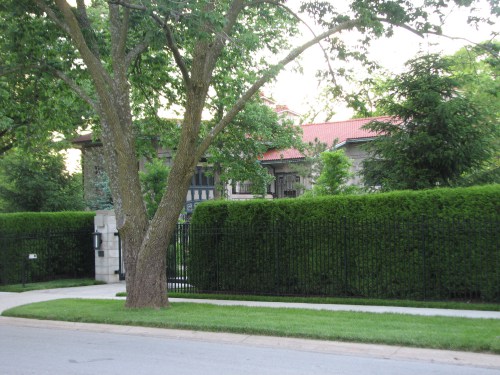
Four years ago I took this photo of the home (and enclosing shrubbery) on the northwest corner of 55th and Ward Parkway. It looks about the same now.
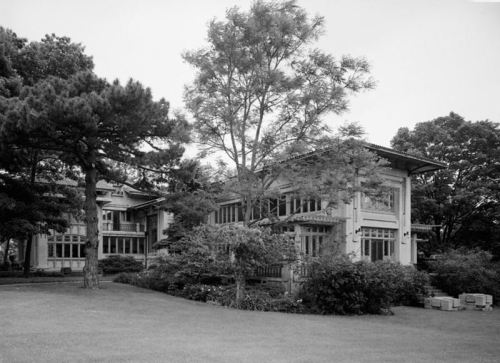
Here’s a better view of the L-shaped house from many years ago.
 JimmyCsays: At the juncture of journalism and daily life in KC
He poured a ton of money into that joint. I bid on some work there back when he moved in. Really cool home. I always heard it was the Sutherland Mansion and it was Haunted!! Really.
Great to hear from you, Chuck! Don’t be a stranger; the JimmyC staff needs your guidance and insight.
…Here’s some more history about the house. (Too bad you didn’t get the job, or you could have told us a lot more about the place.)
The house was completed in 1913, but Bernard Corrigan, the streetcar magnate who commissioned it, died suddenly in January of that year, two months before he was supposed to move in. One of the early residents of the house was Joseph J. Heim, who owned and operated Heim Brewery in the East Bottoms.
Robert Sutherland, founder of what is now Sutherlands, acquired the home from Heim in 1923 for $90,000.
I believe — but am not completely sure, that Jackson County Circuit Court Judge H. Michael Coburn and his wife Linda bought the home from Sutherland in the late 70s or early 80s. I heard that they paid something like a few hundred thousand dollars for it — the last time it sold for a song.
Coburn was one of the most admired and best-liked judges on the Jackson County bench. He was decisive, smart and funny. He once told a reporter about the time he and his wife awakened to noises in the house and, upon investigating, he came upon a burglar. The judge said he wrestled with the guy a while; they rested for a few minutes; then wrestled some more, and the guy finally gave up and left.
Tragically, Coburn died in December 1994 in a freak accident, after falling into unsecured elevator shaft of an abandoned building that he was inspecting as part of a court case. Maybe you remember that; it was part of the snake-bit Citadel Plaza project. A dentist who was building the structure left it unfinished and the neighbors were trying to get it finished or removed.
Coburn’s widow, Linda, continued living in the Corrigan house until July 1998, when she sold it to the Tuckers. As I said, the Tuckers bought the house and surrounding 2.4 acres in 1998 for $1.65 million. Laura Tucker sold it to Ann Dickinson for $6 million in 2005. Who knows what it would go for now? I’ve heard the stained glass alone is worth into the seven figures.