During my 35-plus years in journalism I worked with some reporters and editors who left the field and went on to become well known in other arenas.

Copy editor/Kansas Supreme Court Justice Carol Beier
One such person is Carol Beier, who was a copy editor at The Kansas City Times for two years back in the early 1980s. It was her first job after getting a B.A. in journalism from KU…What I remember most about her is that she wore an ankle bracelet and turned the heads of the male reporters in the newsroom. In 1983, she bagged journalism and entered law school. She worked in criminal and civil law for several years, and in 2003 former Gov. Kathleen Sebelius appointed her to the Kansas Supreme Court. She is still there.
Another defector was Elizabeth “Betsey” Solberg, a Kansas City Star reporter when I arrived at The Kansas City Times in 1969. Betsey was spunky, effervescent and ambitious. For reasons I don’t know, she bore the nickname Betsey Two Shoes. Her husband, Rick, was a Star photographer.
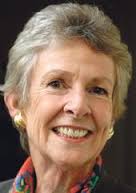
Reporter/P.R. executive Betsey Solberg
In the mid-1970s, Betsey Two Shoes was recruited away from The Star to open the Kansas City office of FleishmanHillard, which went on to become either the biggest or one of the biggest public relations firms in the country. Betsey had a tremendous business career and held many civic leadership positions, including chairman of the Chamber of Commerce of Greater Kansas City and the Civic Council of Greater Kansas City, an organization of the city’s leading businesses. Betsey is mostly retired. She and Rick, who left The Star not long after Betsey, live in Kansas City’s Sunset Hill area. (Thanks to Laura Hockaday for update.)
But the person I worked with who made the most startling transformation — at least to me — is Miriam Conrad, leader of Boston Marathon bomber Dzhokhar Tsarnaev’s defense team.
I vaguely was aware that she was on the Tsarnaev defense team, but it didn’t hit me hard until today, when I saw a photo that ran with a New York Times story in today’s edition.
Here’s that photo. Miriam is on the left (dark hat with crimson trim), and Judy Clarke, an anti-death-penalty lawyer whom Miriam recruited to handle most of the courtroom duties, is at the right.
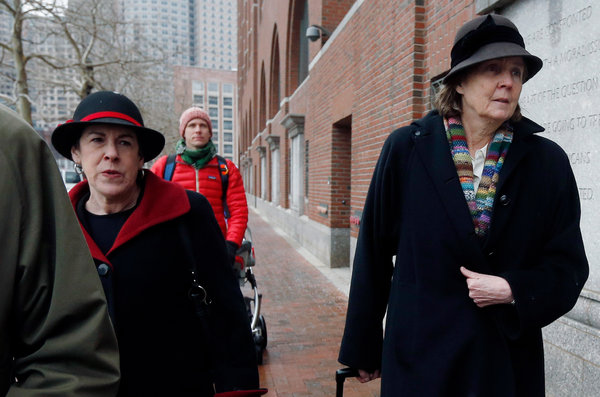
Miriam Miriam worked in Kansas City a year or two in the mid-1980s and then entered Harvard Law School. After law school she went to work for the state public defender’s office in Boston. Since 2005 she has been chief of Boston’s Federal Public Defender’s Office, which represents indigent people accused of federal crimes in Massachusetts, New Hampshire and Rhode Island.
Tsarnaev isn’t the first terrorist Conrad, who is either 57 or 58, has represented. Previous clients include convicted shoe-bomber Richard Reid and Rezwan Ferdaus, a U.S. citizen serving 17 years for his role in a 2011 plot to bomb the Pentagon and U.S. Capitol with remote-controlled model airplanes.
I didn’t get to know Miriam very well. She had come to The Times from the Miami Herald, about the same time that another Herald reporter, Ernie Torriero, came to Kansas City. I did become close friends — and still am — with Ernie, who is an editor at the Voice of America in Washington.
What I remember about Miriam was that she was intense, hard-working and gritty. I say gritty partly because she walked with a noticeable limp, the result of a shattered ankle from a 1982 auto accident. In Kansas City, she was always in pain, to varying degrees, from the ankle injury.
A Detroit Free Press reporter named Brian Dickerson, also a former Herald colleague, profiled Miriam in a 2013 story and related details of the accident and how it changed the course of Miriam’s life:
“Conrad was on her way home from a party at my apartment one night in 1982 when her car struck a median that the Florida Highway Department had installed days earlier with no notice to motorists.
“There followed repeated surgeries to repair her shattered ankle, months of litigation and eventually a modest insurance settlement. Conrad used the settlement money to finance her first two years at Harvard Law School, graduating in 1987.”
Like I say, she was gritty. She’d have to be, not only to go through what she has physically but also to take the slings and arrows that go along with representing some of the most nefarious, cold-hearted criminals to ever walk the face of the earth.
More important, however, as my friend Ernie said of Miriam in the 2013 newspaper profile, “She was a real street journalist, and smarter than the rest of us.”

 JimmyCsays: At the juncture of journalism and daily life in KC
You must be logged in to post a comment.