Feeds:
Posts
Comments

Archive for the ‘journalism’ Category

Perhaps you saw in The Star on Wednesday an item about a 16-year-old youth being charged with involuntary manslaughter in the death of Zach Myers, who died from injuries he suffered in a Dec. 1, head-on collision in Olathe.

That’s the case where I stirred a batch of hot coals after I called Zach’s parents to try to find out what happened that Wednesday morning on North Iowa Street.

Zach

What happened, I discovered through some straightforward reporting, was that the driver of the car was going at least twice the posted 25 mph speed limit when the car he was driving crossed the center line and collided with a car being driven by a 20-year-old woman.

The woman, Ashley Poage of Olathe, apparently edged across the center line about the same time as she maneuvered around a truck that was parked on the street. Poage told police she was traveling about 20 mph.

Poage was out on an errand; the boys were traveling from a vocational school in downtown Olathe to their home school, Olathe Northwest.

Neither Poage nor the two front-seat occupants of the car in which 16-year-old Zach was riding was seriously injured. But Zach, seated behind the driver, suffered a massive head injury and died a day later.

A witness who got to the scene a minute or two after the crash told me that Zach did not have his seat belt on when she got to the car and opened the back door. She said it appeared, from blood stains on the lap portion of the belt, that he might have been wearing the lap portion of the belt but not the shoulder harness, which bore no blood stains. The police report was ambiguous on the seat-belt issue.

Joshua Pena, the driver of the car in which the boys were riding — a borrowed car — told police he was going 50 to 60 mph. The other boy in the front seat told police that shortly before the crash “he looked at the speedometer and noticed that they were traveling 70 mph.”

So, now, Pena is charged not only with involuntary manslaughter but also two counts of reckless battery in the injuries of Poage and the third boy.

The formal “complaint” — the charge sheet — that the Johnson County District Attorney’s office filed on Monday does not reveal any details of the case. It does not mention speed, and it does not reveal the results of blood tests conducted on samples taken from Pena and Poage. The police report on the crash says there was no indication that drugs or alcohol were involved.

This is an incredibly tragic and upsetting case all the way around.

One boy is dead. Another is charged with manslaughter and has to live with the death of his companion. The third boy is either kicking himself for not doing anything to try to slow Pena down, or, if he did try to slow him down, is asking himself if he could have done more. And Poage has to be thinking about how things would have been different if that damn truck hadn’t been in her path or if she had arrived a few seconds earlier or later.

And Zach’s parents, Kimberly and John Myers, and Zach’s brother, John Myers Jr. — as well as grandparents, other relatives and friends — are left with a void that will never be filled or a memory that will never be erased.

My deepest sympathy goes out to all parties involved in the case.

I’m sure the Myerses told Zach about the inherent danger of speeding, how to wear his seat belt and to wear it at all times. (John Myers Sr. is a captain on the Olathe Fire Department.)

But it’s a warning to the rest of us — parents, relatives, friends of young people — to remind youngsters, over and over, to obey the speed limit and to tell them, even demonstrate, how to wear their seat belts properly.

If they try to wave us off, we need to tell them about Zach Myers.
Read Full Post »

Step aside, Deb Hermann. At least for now.

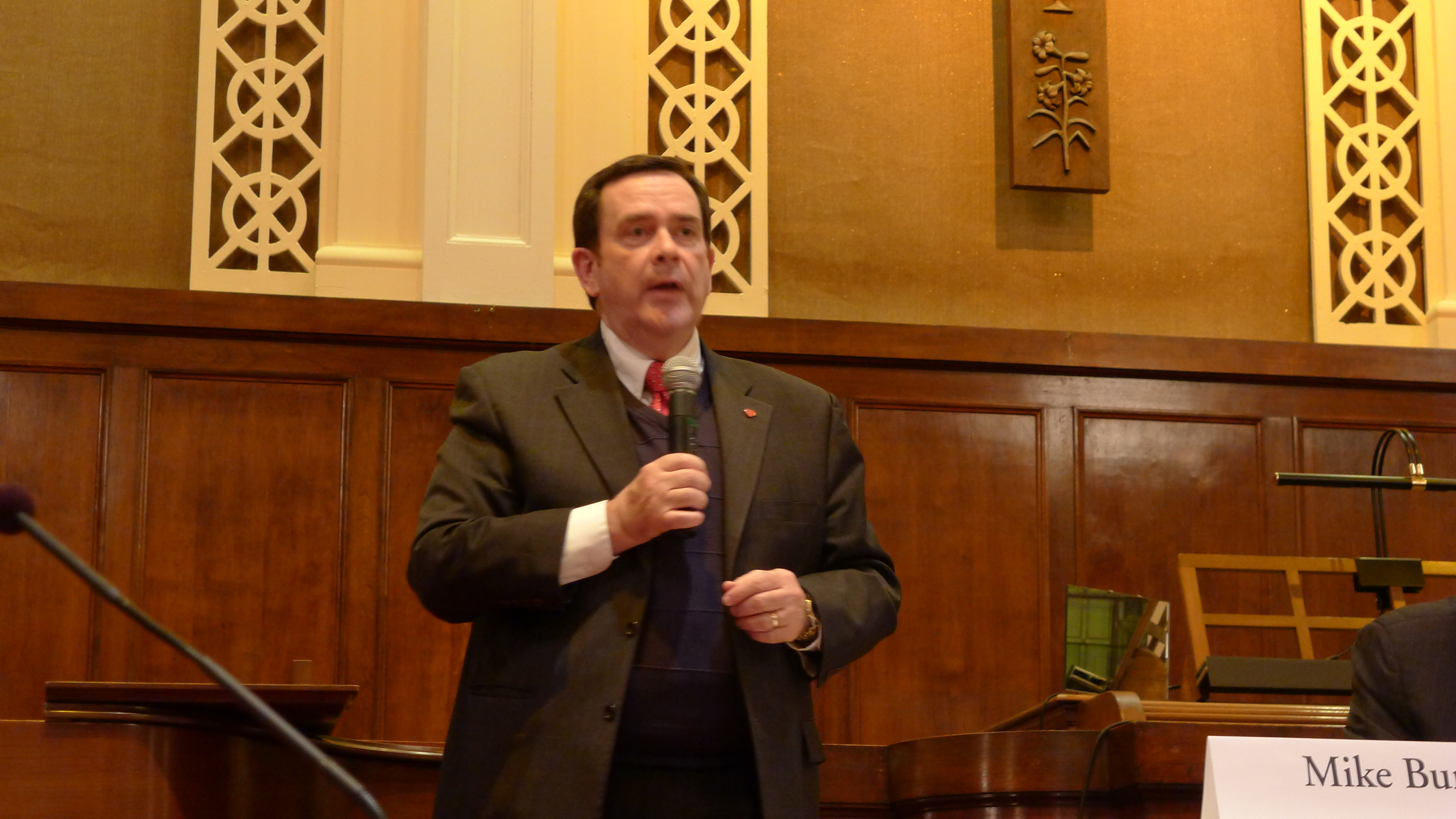
The Star’s endorsement tonight of Mike Burke and Sly James in the Feb. 22 mayoral primary struck a blow to Hermann, who had rung up some key endorsements in recent weeks.

Even with The Star’s errant endorsement of Mark Funkhouser four years ago — and his subsequent election because of it — this is the best possible endorsement a citywide candidate can have. Better than the Citizens Association (which Burke has), better than Freedom Inc., (which Jim Rowland has), better than the firefighters (whom Funkhouser has), better than the downtown business interests (which Hermann has).

James

James was the first person to declare his candidacy; he raised a lot of money early; and he presents clearly and confidently at candidate forums. Now he’s in an enviable position — a position that Jim Rowland and Deb Hermann would love to be in.

The Star said: “Many Kansas Citians know little about James, a lawyer, partly because he has never sought political office. But as he shows in personal conversations, he would be the kind of impressive, charismatic and knowledgeable mayor Kansas Citians deserve.”

I still say he won’t win and shouldn’t win. In my opinion, to be an effective mayor, there is no substitute for service on the City Council, where, if you want to get something significant done, you have to figure out how to get the votes of six other council members.

Burke

Burke has been there. He served out an unexpired term in the late 1980s and, although he didn’t seek a full term the next time around, he learned the ropes. Then, he went out and served in leadership positions on just about every significant economic development agency in the city, including the Economic Development Authority and the Port Authority.

On top of that, he founded KC Riverfest, the annual Fourth of July festival at Berkley Riverfront Park.

The Star gave a nice nod to his experience, saying, “Burke…has an extremely accomplished resume…It’s evident he could be a well-rounded mayor working for the good of Kansas City.”

As for his supposed big drawback, being a development attorney, the city hasn’t had any development the last four years. The Great Recession and The Myopic Mayor made sure of that. This is just the time that Kansas City can use a mayor who knows a thing or two about development. This city needs to get back on track, for God’s sake!

So, bring it on. The race is coming into clearer focus.

If you want to see the mayoral candidates in action, here are the forums (that I know of) that are taking place this week:

10 a.m., Tuesday, Feb. 8, Kansas City Industrial Council, Sprint Center.

4:30 to 6 p.m., Tuesday, Feb 8, Kansas City Business Journal/Greater Kansas City Chamber of Commerce. RSVP at http://www2.bizjournals.com/kansascity/event/40321

11:30 a.m. to 1 p.m., Wednesday, Feb. 9, Downtowners, Town Pavilion, 1111 Main.

7 to 9 p.m., Thursday, Feb. 10, League of Women Voters, 10842 McGee.

5:30 p.m., Friday, Feb. 11, Crossroads Community Association, 122 Southwest Blvd., Second Floor.

Read Full Post »

Wednesday was a big day for journalism…I think.

News Corp.’s Rupert Murdoch and Eddy Cue, Apple’s vice president of Internet services, rolled out “The Daily,” the first news application written and designed specifically for the iPad.

Let me make that clear: This is an online “newspaper” — consisting of six sections a day — written and produced exclusively for the iPad. It’s not copy and photos generated by Murdoch’s Fox News, Wall Street Journal, New York Post or The Times of London (he owns them all) and repackaged for the application. No, it’s original content channeled directly to subscribers.

The subscription price is 99 cents a week, $40 per year, or — as Murdoch put it — “14 cents a day.” The first two weeks of The Daily will be free through a sponsorship arrangement with Verizon.

Among The Daily’s features are 360-degree photos, video clips and interactive timelines.

“Simply put,” said Murdoch, “the iPad demands that we completely reinterpret our craft.”

FoxNews.com said that News Corp. officials have been tight lipped about such things as how many subscribers The Daily will need to be considered a success, how many people have been hired to produce the content and how much money News Corp. has spent to develop the service.

So, what to make of this newfangled news product?

The New York Times, in an online story Wednesday, said Murdoch was aiming to “put his News Corporation front and center in the digital newsstand of the near future.”

My favorite journalistic blogger, Alan D. Mutter of Reflections of a Newsosaur, said The Daily “could be a captivating hit, a spectacular miss or something in between.”

“But one thing is sure,” Mutter said. “Rupert Murdoch, the last swashbuckling publisher of our time, will shake up the media world” with The Daily.

(Footnote: Today (Thursday), Mutter posted another blog entry saying The Daily’s debut was a flop. )

Murdoch and Cue unveiled The Daily at the Guggenheim Museum in Manhattan, where Murdoch told an audience of reporters, employees and advertising partners, “There’s room for a fresh and robust voice” in the tablet era.

The target audience, said The Times, is “a generation of consumers who did not read national newspapers or watch television news, but did consume media.”

A News Corp. official said The Daily would produce up to 100 pages a day. While it will come out once a day, he said, the editors would be able to “break into the app at any time” to add breaking news stories.

In his post, published Monday, Mutter outlined several key factors in why The Daily might succeed…and why it might fail.

On the up side, he said, it can pull from the resources of all the Murdoch properties; it can be marketed on all those properties “every hour of every day, around the world and around the clock”; and it will have the full weight of the Murdoch financial empire behind it.

“With $33 billion in sales and $5.7 billion in operating profit, News Corp. is well positioned to subsidize the Daily for as long as Mr. Murdoch cares to pursue the project,” Mutter said.

On the down side, Mutter cited the fact that it’s not free; widespread competition from many well-established news brands; the finite market potential of the iPad; and what he called “the chasm challenge.”

Regarding the market potential, Mutter estimated that there would be about 40 million iPads in the hands of consumers by the end of this year. If 2 percent of those users subscribed to The Daily, he said, the project could generate about $40 million a year in subscriptions alone. But if only .5 percent of iPad users signed up, the project would bring in only $10 million in subscription sales, perhaps not enough to be viable.

Explaining “the chasm challenge,” Mutter said The Daily “will have to cross the chasm of anonymity and consumer indifference in order to amass the critical number of readers it needs to generate adequate subscription and advertising revenues.”

“The longer The Daily takes to break even, the more expensive the venture will be for News Corp.,” Mutter said. “While the 79-year-old Mr. Murdoch likely is prepared to underwrite many millions in losses, his patience and lifespan are not inexhaustible.”

My opinion? I don’t know what to say. I don’t have an iPad and don’t intend to get one anytime soon. I’m still yoked to the print product, although I’ve learned to navigate the electronic pathways, too.

One thing I will not do is dismiss the Murdoch initiative as folly. Shortly after I started this blog last year, I reprinted a speech that Arthur Ochs (Punch) Sulzberger, former publisher of The New York Times, made in Kansas City in May 1994. In that speech, he dismissed the fledgling Internet as so much folderol.

Here’s an excerpt from that speech:

“It is my contention that newspapers are here to stay. They are not going the way of the dinosaur – rendered extinct, in this case, by the wonders of a new technology that will speed us down an interactive information superhighway of communications.

“I’ll go one further. I believe that for a long time to come this information superhighway, far from resembling a modern interstate, will more likely approach a roadway in India: chaotic, crowded and swarming with cows. Or, as one might say, udder confusion.”

Ha, ha, Punch. Very funny…No, I won’t be making any jokes about The Daily.

Read Full Post »

In two recent New York Times columns, Arthur Brisbane, whose journalistic ribs were tempered in Kansas City, has some good advice for news outlets that are hell bent on being first with The Big Story.

Brisbane

Brisbane, who served two stints at The Kansas City Star — one as a columnist and later as editor and then publisher — is now The Times’ “public editor.” In that capacity, one of his duties is to comment when he thinks The Times excels and when he thinks it falls short.

In Op-Ed columns on Jan. 16 and last Sunday, Jan. 30, Brisbane put the magnifying glass to The Times’ coverage of the Tucson shootings that left six people dead and several others, including U.S. Rep. Gabrielle Giffords, seriously injured. His conclusion, essentially, was that The Times should have been content to provide the most authoritative coverage of the tragedy instead of trying also to be among the first outlets to report breaking developments.

What fed Brisbane’s reflection was a major reporting snafu the day of the shootings.

For about 10 minutes that day, Jan. 8, The Times reported in its online story that Giffords was dead. In going with that, The Times was relying on reports from NPR and CNN, not its own reporters, who were not yet on the scene.

Brisbane described how the ignominious error occurred:

“It was hectic in the newsroom with many news reports flowing in as Kathleen McElroy, the day Web news editor, was trying to decide whether The Times was ready to report Giffords’ death. She decided against it and was telling Web producers to hold off reporting it in a news alert when J. David Goodman, who was writing the story, told her he had a few changes he wanted to make.

“Ms. McElroy said, ‘I should have looked at every change,’ but she thought Mr. Goodman was referring to small stuff. Mr. Goodman…erred by reporting Representative Giffords’ death in the lead as though The Times itself were standing behind the information. In any event, Ms. McElroy had said O.K. without seeing that change, so Mr. Goodman pushed the button.”

Now, let me interject here that for Goodman to tell his editor he had “a few changes to make,” without telling her that one of the changes was that Giffords was reportedly dead (if, in fact, that’s what Goodman told McElroy) is unbelievable. If I had been writing that story and heard or read a report that Giffords had died, I would have been yelling so loud that passersby on the street outside would have heard me.

At any rate, the result for The Times, Brisbane said, was a news story “with changes that were not edited.”

Which is also inexcusable.

Philip B. Corbett, The Times’ “standards editor” (he’s in charge of corrections, among other things), told Brisbane, “Everything should go through an editor. Ideally, it should go through two editors.”

In the rush these days to get the story “up” as soon as possible, however, the copy-review process — even at a great paper like The Times — sometimes  gets truncated. (And haven’t we all experienced, perhaps only on the basis of e-mails, how easy it is to “push the button” before we’ve thought everything through and are sure that our electronic message will come across as we intended it?)

Just as the pitfalls of casual correspondence have gotten deeper for everyone, for journalists the rush to be first has made the reporting and publishing process significantly more problematic.

As Brisbane said in concluding his Jan. 16 column: “Whether covering the basic facts of a breaking story or identifying more complex themes, the takeaway is that time is often the enemy. Sometimes the best weapon against it is to ignore it, and use a moment to consider the alternatives.”

The italics are mine because I think what Brisbane said is so important for today’s journalists.

On Sunday, Brisbane returned to the same theme in a column titled “Speed and Credibility.”

Noting the incredible volume of digital news, Brisbane said that news organizations, like The Times, that built their reputations on being authoritative are now being forced to reconsider how much of their reputations they should lay on the line in the name of being first with the news.

For Brisbane, the call isn’t too difficult.

“Put me down as a skeptic,” he wrote. “It’s understandable, given the gung-ho mentality that journalists adopt, to want to blow right by the choice (between what is known and what is uncertain) — to try to be both first and most credible. But for The Times, which arguably brings the top-rated brand for authoritativeness to this battlefront, the approach is fraught with danger.”

Everyone he talked to, he concluded, agreed that it was “always better to be second and right than first and wrong.”

Now there are words that should be displayed above the doors of every newsroom in the country.

Read Full Post »

A lot of topics came up for discussion at last night’s mayoral forum at Central Presbyterian Church, 35th and Campbell. Crime, education, the earnings tax, city services, the Plaza, urban blight, subsidized housing. And others.

But the undercurrent of the night — the palpable feeling that wove around, under and through all the talk — was the burning desire of the six challengers to see the incumbent, Mayor Mark Funkhouser, turned out of office.

Funkhouser

I think it’s fair to say that not only do the six challengers — Mike Burke, Deb Hermann, Sly James, Jim Rowland, Henry Klein and Charles B. Wheeler — want Funkhouser out because they want in, but because they think Funkhouser has poisoned the well at City Hall.

Not only was that the sense of the challengers; it carried over into at least one prominent audience member, Fourth District Councilwoman Jan Marcason.

Marcason sat in the second row of  the audience, listening closely, eyes studying the people on the stage.

It might seem odd that Marcason, a first-term council member, has become a flash point for the election, but that’s the way it is.

Through her dogged battle to boot Funkhouser’s wife, Gloria Squitiro, out of City Hall — where Squitiro was a pesky and unwanted presence in the eyes of many residents and city employees — Marcason has become the face of the oust-Funkhouser movement.

For her perceived impertinence, Funkhouser reciprocated by tossing Marcason off the council Finance Committee (where she was vice chairman) and the Transportation and Infrastructure Committee.

And, so, against that backdrop, a question arose last night about what was at the root of the “disdain” that some council members have exhibited toward each other, and about what it might take to get a semblance of “civility back to City Hall.”

Burke

Burke went first. A former councilman and a former chairman of the city’s Public Improvements Advisory Committee, he talked about the importance of team building — of the implied need for the next group of council members to build a rapport so they could work together effectively.

Then it was Funkhouser’s turn. “I’m not sure it’s a lot less civil than it ever has been.” As an example, he recounted an incident when a former councilman came close to physically attacking longtime City Hall baiter Clay Chastain.

When the stakes are high and the issues are large, Funkhouser said, “There’s going to be an argument; there’s going to be a fight. Some people call it drama.”

Rowland

Using the word “drama” could well have been a jab at Rowland. Twice Tuesday night, Rowland, executive director of the Jackson County Sports Complex Authority, noted that he had overseen the $700-million renovation of the sports complex “on time, on budget and with no drama.”

As the candidates went down the line, answering the civility question, Klein turned the thermostat up several degrees. It’s time, he said, “to take some of the egos down.” One person, he said pointedly — without specifying who but leaving no doubt who it was — had “usurped all the attention.”

Then it was Rowland’s turn. He stood up, made a complimentary comment about Marcason’s service on the council and then asked her, “How many (council) committees are you on?”

“None,” she said.

To which Rowland rejoined, “There has been four years of distraction and dysfunction.”

It was a square shot to the Tall One’s teeth, and everyone got it: Because she dared to take on the mayor, Marcason is not on one, single committee.

Marcason

A few minutes later, the forum ended, and I went over to get a word with Marcason.

“How strong is your desire to see the mayor turned out of office?” I said.

“I think we deserve new leadership,” she replied. “Positive leadership that can help move the city forward.”

I asked her if she had endorsed any of the other six candidates. No, she said, but added that, in her opinion, there were four strong candidates — Burke, Hermann, James and Rowland.

We returned to the subject of Funkhouser having denied her a spot on any council committee.

“It’s unprecedented,” she said. “He’s just a mean-spirited person.”

Read Full Post »

In the wake of the tragedy in Tucson, The New York Times has published several news stories, letters to the editor and Op-Ed columns on the subject of gun control.

I have read most of them and would like to pass on some quotes that grabbed my attention.

Here goes.

King

U.S. Rep. Peter King, a New York Republican, who has proposed a bill that would outlaw taking a firearm within 1,000 feet of a member of Congress:

“This kind of legislation is very difficult…The fact is Congress has not done any gun legislation in years. Once you get out of the Northeast, guns are a part of daily life.”

U.S. Rep. Carolyn McCarthy, a New York Democrat, who has proposed a bill that would ban large-capacity ammunition magazines, like the one Jared Loughner used:

“This is not a gun control bill. I like to use the word ‘gun safety bills.’ And this one just addresses the narrow issue of these clips.”

McCarthy, again:

“Any kind of bill the N.R.A. is against is always a problem.”

U.S. Rep. Mike Pence, an Indiana Republican:

“I maintain that firearms in the hands of law-abiding citizens makes communities safer, not less safe.”

Erich Pratt, director of communications for Gun Owners of America:

“I think after the November election it’s going to be very tough for Carolyn McCarthy and even the Peter Kings (to get legislation passed). Why should the government be in the business of telling us how we can defend ourselves?

“These politicians need to remember that these rights aren’t given to us by them. They come from God. They are God-given rights. They can’t be infringed or limited in any way. What are they going to do: limit it two or three rounds. Having lots of ammunition is critical, especially if the police are not around and you need to be able to defend yourself against mobs.”

Carol Delaney, professor emerita of cultural and social anthropology at Stanford University, in a letter to the editor:

Delaney

“Bills have been proposed to allow students and professors to take guns to school. What professor won’t worry about giving failing grades when an angry student can march into his office and shoot him? Is this a civilized society or a resurgence of the Wild West?”

Nicholas D. Kristof, New York Times columnist:

“The only country I’ve seen that is more armed than America is Yemen. Near the town of Sadah, I dropped by a gun market where I was offered grenade launchers, machine guns, antitank mines, and even an anti-aircraft weapon. Yep, an N.R.A. dream! No pesky regulators. Just terrorism and a minor civil war.”

Kristof, again:

Congress on Wednesday echoed with speeches honoring those shot in Tucson. That’s great — but hollow. The best memorial would be to regulate firearms every bit as seriously as we regulate automobiles or toys.”

Gail Collins, New York Times columnist:

“Different parts of the country have very different attitudes about when it is appropriate for citizens to carry guns. There is nothing that would make me feel less safe while shopping than the knowledge that my fellow bargain-hunters were packing heat.”

Collins, again:

“If Loughner had gone to the Safeway carrying a regular pistol, the kind most Americans think of when they think of the right to bear arms, (Gabrielle) Giffords would probably still have been shot and we would still be having that conversation about whether it was sane idea to put her congressional district in the cross hairs of a rifle on the Internet. But we might not have lost a federal judge, a 76-year-old church volunteer, two elderly women, Giffords’ 30-year-old constituent services director and a 9-year-old girl….”

Bob Herbert, New York Times columnist:

Herbert

“More than 30,000 people die from gunfire every year. Another 66,000 or so are wounded, which means that nearly 100,000 men, women and children are shot in the United States annually. Have we really become so impotent as a society, so pathetically fearful in the face of the extremists, that we can’t even take the most modest of steps to begin curbing this horror?

“Where is the leadership? We know who’s on the side of the gun crazies. Where is the leadership on the side of sanity?

Herbert, again:

“If we were serious, if we really wanted to cut down on the killings, we’d have to do two things. We’d have to radically restrict the availability of guns while at the same time beginning the very hard work of trying to change a culture that glorifies and embraces violence as entertainment and views violence as an appropriate and effective response to the things that bother us.”

Read Full Post »

Last Sunday, The Star’s reader representative, Derek Donovan, wrote a column about the number of corrections in the paper having dropped between 2009 and 2010.

He wasn’t bragging, just laying out the raw numbers. Deep in the column, he also put forward a weird idea: To create two tiers of errors — significant and insignificant.

Maybe they could be presented under the headings “mortal” and “venial.” (That’s my idea, mind you, not his.)

Seriously, I have a couple of thoughts on this. (Are you surprised?)

First, if Donovan is looking, in his low-key way, for a gold star for the decline in corrections, he’s not going to get it from this here blogger. In fact, in my book, The Star’s treatment of corrections has earned them a big, scarlet “C” that the paper should be forced to put on Page 2 every day for the next year.

Page 2 is where The Star used to run all the news-related corrections. Every day, you could go to Page 2 and see how the paper had screwed up. A few years ago, they changed it, though. Now, the corrections run somewhere, but the editors often make the reader guess which shell the pea is under.

There are two main reasons that the number of corrections is down at The Star.

:: The news hole has gotten smaller, and circulation continues to dwindle.

Donovan reported that the paper published an even 300 corrections in the print edition, out of about 41,000 separate stories. That compared with 383 corrections in 2009, when the paper ran about 46,000 stories.

So, that’s an 11 percent drop in stories and a 22 percent drop in corrections. Donovan rushed over the story-count dip like it was a beaten-down speed bump, but, frankly, that should be a much greater source of concern to the paper and the readers than the correction rate.

How often do you hear people say, “There’s nothing to The Star anymore?” It’s not an illusion; it’s simply not offering the readers as much for their money as it used to.

As the story count has dropped, so has the number of subscribers and readers. And when fewer people are seeing the paper, not as many corrections are caught. It’s the readers who report most of the corrections. The reporters tend not to self-report their own errors for fear of getting dinged in their annual performance evaluations — and maybe even their paychecks.

:: The Star has made corrections a lower priority.

By depriving the corrections of a permanent home (as Page 2 was), The Star has signaled that it does not place as high a value on the corrections as it once did. Believe me, the reporters get that message, and most of them probably aren’t complaining.

During my many years at The Star, I lived in constant fear of winding up on Page 2. And, unfortunately, I made it there quite a bit. Once, in fact, I made a reporting error that, naturally, required a correction. But then I made an error in the correction. And so we published a correction to a correction.

Talk about mortification!

As tough as the policy was, though — and as conspicuous as the corrections were — we knew that our feet were being held firmly to the fire. It was good for the paper and good for the readers: full disclosure; no slip-sliding around.

I’m not saying The Star wouldn’t run a correction to a correction now. I’m sure it would. But now that it’s under siege, financially and otherwise (like many other metropolitan dailies), I think the handling of corrections has been allowed to drift a couple of rungs down on the priority ladder.

And now Donovan is tossing out the possibility of dropping corrections to an even lower level. In his column, he proposed two tiers of corrections — one for “significant factual errors” and one for “mundane, often mechanical mistakes.” As examples of insignificant mistakes, he cited the misspelling of celebrities’ names and erroneous TV listings.

Now, Donovan is certainly right that some errors are more significant than others, but establish separate tiers? No way. The first and perhaps biggest problem would be who decided which category the errors fell into.

Well, I guess that would be our helpful readers’ rep. But that’s an awful lot of discretion to give to one person, or even a committee, and I could foresee constant battles with readers and “error victims” over whether a certain error qualified as significant or insignificant.

Can you envision a correction that said: “Yesterday’s correction on the misspelling of Harry Truman’s name was improperly placed in the insignificant error category. We regret both errors.”

So, what’s the answer: Treat all corrections the same. And, please, go back to putting them in the same place every day.

Read Full Post »

The seminal photograph of Jared Loughner is one that will be seared in the minds of many Americans for years to come.

You know the one I’m talking about: The police mug shot, in which his head is shaved, he’s wearing a quirky smile, and his eyes are aglow with madness and vacuousness.

That picture is one of several things that have stood out for me in the newspaper and online coverage that I have seen about the Loughner case.

Here are some other highlights of the coverage I have seen:

:: The New York Times’ very focused, wall-to-wall coverage.

:: A David Gergen, CNN column urging Americans not to jump to conclusions about political forces that might have factored into Loughner’s mindset.

:: A Kansas City Star story about the political “roar” surrounding the case.

First, regarding The Times’ coverage, which starts with that memorable photo.

When I first saw that picture on CNN’s home page Monday, I caught my breath. The photo depicted perfectly, for me, the separation from reality that I expected in Loughner from having read about him. It was one of those instances where a photo went far beyond anything that could be put into words. Even though CNN used it just as a mug shot in the upper-left corner of its page, it was arresting.

It took the editors at The New York Times to understand the photo’s impact and to take full advantage. On Tuesday, The Times put that photo at the top of its front page. The photo was three columns wide (half the width of the paper), below a four-column headline that read, “In Arizona Court, Suspect Waives Bail.”

What The Times has done so well in its coverage is to focus relentlessly on Loughner — his background, his family and his movements before the attack outside the Tucson Safeway. Unlike other papers, The Times can throw a fantastic amount of firepower at the epicenter of its coverage — Loughner — and still not short shrift any of the other story facets, such as fleshing out portraits of the victims.

The Times started boring in on Loughner on Monday with a front-page story about the disturbing behavior — “hysterical laughter, bizarre non sequiturs and aggressive outbursts “– that got him kicked out of Pima County Community College. Another photo, a mug shot, of a loopy-eyed Loughner accompanied that story.

Although no other news agency has the wherewithal to handle a story of this magnitude like The Times, some other outlets are doing good work.

I mentioned Gergen’s CNN article. An adviser to four presidents and director of the Center for Public Leadership at the Harvard Kennedy School, Gergen is a person whose political observations should be heeded.

Addressing the conservative-liberal foment that mushroomed immediately after the shootings, Gergen said: “The country would be well served now if we cooled the accusations until we learn more about…Jared Loughner. He appears to be mentally unhinged, someone who has threatened others. Why he targeted one of the most admired and popular political leaders in Arizon is unclear.”

He went on to say, however, that the “climate of hatred” has grown worse in recent years “during the George W. Bush years, when the left was intensely alienated, and now during the Obama years, when the right has become vitriolic.”

I agree with Gergen that it’s far too early to know how, or even if, the political atmosphere might have spurred Loughner, but I agree with a point that my friend and former K.C. Star colleague Dan Margolies made at lunch the other day. He said that regardless of how nutty some people are, in most cases they are influenced by “the Zeitgeist.” I had to look up “Zeitgeist” just to make sure I understood. Wikipedia defines it as the “general cultural, intellectual, ethical, spiritual and/or political climate within a nation or even specific groups.”

In this case, that would be within Arizona, which, to me, has found its way to the bottom of the well among these United States.

I also want to credit The Star, which, to its credit, has originated at least one front-page story about the case.

The Star wisely put Dave Helling, one of its most experienced political reporters on the story, and he came up with a compelling report for Tuesday’s edition. The headline was “Silence, Then a Roar.” His lead — the first sentence — was attention grabbing: “The farther you traveled from U.S. Rep. Gabrielle Giffords’ hospital room, the louder it got across America.” That sentence captured both the heartache of the story and the furor surrounding it.

Helling went on to quote the plainspoken, gutsy sheriff of Pima County, Clarence Dupnik, who suggested that “vitriolic rhetoric” might have been a factor in the violence. Helling went on to talk about efforts and suggestions to tamper the political rhetoric, but he tempered that with an insightful comment from UMKC law school professor Doug Linder. “The natural instinct is to try and figure out some way to prevent these things from happening,” Linder said. “There isn’t any simple solution that involves restricting free speech.”

The only weak part of The Star’s Tuesday package was its centerpiece photo, which showed Cleaver and other Congress members and congressional staff members observing a moment of silence in Washington.

Underneath that amorphous, four-column photo was the mug shot of the crazy-eyed Loughner. But at an inch deep and less than an inch wide, the mug shot came nowhere close to delivering the punch that it did spread high and wide across the top of The Times the same morning.

Read Full Post »

I hate to say this, but I am losing confidence in Mark Zieman as publisher — and ultimate leader — at The Kansas City Star. 

My colleague John Landsberg of Bottom Line Communications reported yesterday that there will be another round of layoffs at The Star. I can’t keep track of how many rounds there have been in the last few years, but I think this will be at least the fifth.

This latest news is particularly maddening and frustrating not because The Star’s staff apparently will get even thinner, but because of Zieman’s optimistic tone when he announced the previous round of layoffs last September.

Back then he said The Star was approaching the end of the year “financially strong” and that the industry was at a “turning point.”

To me, that not only was irresponsible, it was misleading and showed Zieman was indulging in wishful thinking. While such words might buoy employee morale temporarily, the words make it all that much harder for employees to swallow another round of layoffs. The real danger of statements like that is that they spread a sense of false hope and paint the publisher as someone trying to buy time before something even worse happens.

Employees of every organization like to hear words of encouragement and hope from their leaders, but, more important, they want a candid assessment of where things stand. Zieman has failed miserably on that front, not just in September but with unrealistically optimistic words with each round of layoffs.

So, now, unfortunately, it’s like the boy yelling fire in the theater. Except it’s the reverse because there is a fire and Zieman keeps trying to convince his troops it’s just about extinguished, when it’s obviously out of control. 

I mentioned that something big could happen. Like what? Well, how about a decision to drop the print edition several days a week. That seems like the next likely step to me.

Zieman probably won’t admit it until it happens, because he’s obviously reluctant to take off the rose-colored glasses. But it could easily happen, and it wouldn’t surprise me to see one or two weekday papers — maybe Monday and Tuesday — dropped within a year or two.

Several papers around the country have already dropped some or all print editions, and the St. Louis Post-Dispatch took a step in that direction last year, when it dropped single-copy sales — in boxes and convenience stores — of the Saturday paper. It still puts out a Saturday paper, but it goes only to subscribers.

In reporting the story last October, the Riverfront Times, the St. Louis alternative paper, asked Editor Arnie Robbins how long it would be before the Post-Dispatch would cease putting out a print publication altogether.

“I’m not feeling particularly clairvoyant this morning,” Robbins replied. “But I think in the next 10 years you could see the elimination of the weekday paper, with the Sunday still coming out in print. The rest of the week would be online or delivered through niche products and phone and e-reader apps. We’re working on a few of those projects right now that we’re excited about.'”

Well, let’s credit Robbins with some degree of candor. Ten years very likely is an overestimation of how much longer the daily P-D will survive, but at least he doesn’t have blinders on.

Now, compare that statement with what Zieman told employees in the September memo announcing that round of layoffs:

 “I know that weathering this recession has been exceptionally hard for each of you. But we will begin next year with a steadily improving revenue trend. We are posting record online traffic and revenue, we remain the dominant media company in our region, our presses and readership metrics are among the best in the country and our news products are recognized nationally for their journalistic excellence. The Star won’t die, but this recession will.”

Metrics. Journalistic excellence. The Star won’t die. Uh huh.

This is really a desperate situation in my view. I think The Star’s owner, McClatchy Co., is headed for bankruptcy.

As I reported in June, Morningstar, the independent investment and stock research company, had a grim outlook for the company. An article in Morningstar StockInvestor, a periodical available to Morningstar members by subscription, said this:

“Our fair value estimate on McClatchy shares is $0.”

Are you listening, Mark? That’s zero. Nothing. Worthless shares for the stockholders.

At the time, McClatchy’s stock was selling at $4.28 a share. The stock closed Friday at $4.89 a share, but that’s no indication of a significant upswing. Sprint, as difficult as its situation is, has a much better chance of surviving than McClatchy does.

The company paid too much for KnightRidder in 2006 and bought the KR papers at precisely the wrong time.

Do you remember when Payless Cashways senior managers, led by then-chief executive officer David Stanley (fondly known to some as Minnesota Dave because he flew back to his home in Minneapolis every weekend) took the company private in 1988? They paid too much ($900 million); the company muddled along for about 10 years and then rolled over and died.  

McClatchy, too, is going to roll over and die, I believe…or get bought out for a song. I can hear the late “Dandy” Don Meredith singing from heaven, “Turn out the lights; the party’s over.”   

And what will happen with the papers McClatchy owns? I don’t know. But it isn’t a bright picture, and I hope Zieman doesn’t weigh in with more irrationally optimistic statements when he officially announces the newest round of layoffs.

Read Full Post »

I know…’tis the season to be jolly. But it’s hard for me to be jolly when I see what my old employer, The Kansas City Star, is up to these days.

Or isn’t up to, to be more precise.

In recent days, two stories that The Star has chosen not to do have really surprised and disappointed me.

Take a look.

:: On Sunday, The Star ran a long obituary on former Jackson County politician Charles E. Curry, who died Dec. 13 in Key Largo, FL. He was 92.

I looked for a news story that day, but there was none. I wrote a blog on Curry that day and fully expected a news story in The Star on Monday. But nothing. Nothing again Tuesday, nothing Wednesday and nothing today, Thursday.

To me, the oversight (and slight) is inexcusable and reflects the poorest of news judgment.

Charles E. Curry

Charlie Curry was a giant in Jackson County politics. He, along with the two other administrative “judges” who ran Jackson County from 1962 to 1970, ushered in perhaps the greatest era in county history.

A $102-million bond issue that his court put to voters (and which voters approved in 1967) gave us the Truman Sports Complex, a modern Truman Medical Center, the Little Blue Valley Sewer District, upgraded juvenile facilities and expansion and improvement of the parks system, among other things.

Then, his court approved the creation of a Jackson County Charter Commission. The commission drew up a proposed home-rule charter, which voters approved in 1970, the last year Curry served.

The charter, which took effect Jan. 1, 1973, replaced the three-judge administrative court with a county executive and county legislature and instituted a merit system of employment. Since 1973, Jackson County has been much more professionally run, with less patronage and more accountability by elected officials.

Curry was a quiet but effective operator. His successor, on the other hand, George W. Lehr — the first “county executive” under the new system of government — was blessed with a big personality and the ability to fill reporters’ notebooks, and he quickly capitalized on the spotlight cast on the fledgling “charter” government.

He capitalized so well that was able to get himself elected state auditor in 1974, two years after becoming county executive. In about 1978, he left politics and took a cushy job as executive director of the Teamsters Central States Health and Welfare Fund in Chicago.

Why do I bring up Lehr, whom I covered during my seven years as county courthouse reporter, from 1971 to 1978?

Because when Lehr died of a brain tumor in March 1988, The Star gave him a front-page send-off. I remember it well because my first child, a daughter, had been born on March 17, and I was called in from paternity leave to write the story.

Spring forward to the present. Now, we have the death of Charlie Curry, who did immeasurably more for Jackson County than Lehr did, and what does The Star do? Nothing. Not a word, besides the family-paid-for obit.

On Tuesday, I sent an e-mail to Managing Editor Steve Shirk, saying:  “Have you decided, God forbid, that Charlie Curry’s death does not merit a news story?”

I haven’t received a response. Well, maybe Steve isn’t working this week. Maybe he’s ducking me. Maybe he’s afraid of an “anti-Star blogger,” as readers representative Derek Donovan has labeled me.

Or maybe he’s ashamed…I hope that’s it.

:: God knows, I’ve already stirred up enough dust reporting the Zach Myers story, but a bit more has to be said.

Zach was the 16-year-old Lenexa boy who died Dec. 2 as a result of injuries he received in a head-on collision a day earlier in Olathe. A police report released on Tuesday said the car in which he was riding was traveling at least 51 miles an hour when it collided with a car being driven by a 20-year-old woman.

The Star had one, and only story, about the wreck. It ran on Saturday, Dec. 4, and reported, essentially, that Zach was one of three boys in the car; that the crash took place shortly before 10:30 a.m. in the 600 block of Iowa Street; and that none of the other people involved in the crash was seriously injured.

The story did not attempt to explain:

–Why the boys were out of school on a Wednesday morning.
–Where they were going.
–Who was driving.
–If speed was involved.
–If Iowa is a residential street or major thoroughfare.
–If the boys or the woman were wearing seatbelts.
–Where the boys were seated in the car.
–What type of injuries Zach suffered.
–If toxicology tests were being conducted.

It didn’t even say that police were investigating. As feeble and vacant as the story was, The Star should have written a two- or three-paragraph brief and let it go at that, instead of writing a relatively long story, with a photo, that agitated reader interest but provided no answers. 

I have written four stories about the case (see blog entries for Dec. 6, 9, 15 and 21) and have given a complete account of the tragedy. I have also been the object of considerable criticism from people who think I imposed on the Myers family and that I went overboard on coverage.

To the critics, I say, fine. If you’re not interested in the case, don’t read about it. To those readers who wanted to know more and supported me in the reporting effort, I thank you. 

To The Star, I say: Shame on you for abdicating your responsibility to make any effort to report the circumstances of the wreck — circumstances that show how easily the tragedy could have been avoided and how important it is for parents to impress on their children the proper use of seatbelts and the inherent risks of speeding.

The many self-respecting reporters and editors at The Star should be embarrassed at their paper’s ineptitude on the Curry and Myers stories.

Read Full Post »

« Newer Posts - Older Posts »