Staffs and mitres probably will be flying like graduation caps Sunday, when Pope Francis formally canonizes two of his predecessors.
Oh, my…Oh, my.
One of the “Holy Men” to be enshrined will be none other than Pope John Paul II, who, as New York Times columnist Maureen Dowd put it yesterday, “presided over the Catholic church during nearly three decades of a gruesome pedophilia scandal and grotesque coverup.”
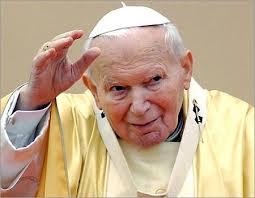 John Paul, who reigned from 1978 until his death in 2005, also stacked the deck with bishops and cardinals who managed to turn back the hands of time, which had begun moving relatively quickly as a result of the Second Vatican Council.
The other man to be canonized will be Pope John XXIII, who convened the Second Vatican Council in 1962. He served from 1958 until his death in 1963, but the council continued until 1965.
Dowd, who appears to be a conflicted Catholic, summed it all up very well at the end of her column, which ran in Wednesday’s printed edition.
“John Paul may be a revolutionary figure in the history of the church, but a man who looked away in a moral crisis cannot be described as a saint. When the church elevates him, it is winking at the hell it caused for so many children and young people in its care. A big holy wink.”
I couldn’t agree more.
In March, Spiegel Online — a popular, German-language news website — said, “Rarely has the Vatican been in such a hurry to complete a canonization.”
Some papal authorities have speculated that the unprecedented dual canonization is an attempt to bring Catholics closer in line, especially those who might look askance at John Paul II but embrace Pope John XXIII, who was known as “the good pope.”
As Dowd pointed out, John not only convened the Second Vatican Council but “embraced Jews and opened a conversation on birth control.”
One of the interesting prerequisites for sainthood is that the Vatican’s Congregation for the Causes of Saints (now that’s a club I’d like to belong to) must certify that at least two miracles have taken place through the, uh, good offices of a candidate for saint. But in a rare break from that precedent, Pope Francis waived the requirement of a second miracle for John XXIII. (Nothing could be attributed to him after 1965.)
In addition, Pope Benedict XVI, who succeeded John Paul before resigning last year, waived a prerequisite for his predecessor — a rule that requires a candidate for sainthood be dead for at least five years. The push for John Paul’s canonization got underway almost immediately after his death.
Now, tell me, when does the Catholic Church ever waive rules on anything that doesn’t suit its conservative agenda?
Never.
There’s been absolutely no discussion, for example, about the rules forbidding priests to marry or women to become priests.
Oh, no, those rules are set in stone. In fact, I think those rules have been declared “infallible.” That means no way, no day, Jose –and that’s final!
…But I’m also kind of interested in those miracles.
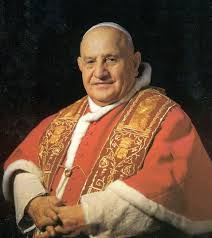 In John XXIII’s case, the Congregation for the Causes of Saints (how do I apply for membership?) certified that a dying Italian nun recovered after praying to him in 1965.
In the case of John Paul II, the first miracle involved a French nun who is believed to have been miraculously cured of Parkinson’s disease after praying to John Paul in 2005.
The second miracle occurred in 2011, when a Costa Rican woman was inexplicably cured after suffering a cerebral aneurism, which doctors said was inoperable.
An article in the Huffington Post a few days ago drew several skeptical comments about the purported “second miracle” attributed to Pope John Paul.
For example, Steven B wrote this:
“And a Stork delivered a nice healthy 6 lb. baby boy to a couple in Louisiana.”
For all I know, the three miracles attributed to the two popes could be perfectly legitimate. But I do know that many Catholics (and other Christians) are going to have a hard time swallowing the canonization of John Paul II, despite his kindly manner and inspirational perseverance in the face of physical decline.
I agree unequivocally with Maureen Dowd’s eloquent conclusion:
“He ain’t no saint.”
In fact, I think I’m going to state that infallibly...Yes, if they can roll it out on their own initiative, I don’t know why I can’t.



 JimmyCsays: At the juncture of journalism and daily life in KC
You must be logged in to post a comment.