Feeds:
Posts
Comments

Archive for the ‘Uncategorized’ Category

Over the next few weeks, the campaign for mayor will get increasingly interesting, and probably more pointed.

With the holidays in the rear view mirror and baseball season a long way off, the mayor’s race is about the only excitement on the immediate horizon. By default, if nothing else, people will begin taking a closer look at the seven candidates heading toward the Feb. 22 primary, when the field will be whittled to two.

Several mayoral forums are scheduled to be held this week. All are open to the public.

The times, days, sponsoring agencies and locations are as follows:

— 8:30 a.m. to noon Tuesday, Kansas City Regional Transit Alliance, City Stage Theatre, Union Station. Each candidate will have 30 minutes to answer questions on mass transit.

— 6 to 7:30 p.m. Tuesday, American Institute of Architects, Kansas City Chapter, 1801 McGee, Suite 100.

— 8 p.m. Thursday, UMKC’s Pierson Auditorium, 5000 Holmes. (A council candidates’ forum will be held from 6 to 8 p.m.)

— 11 a.m. to 12:30 p.m. Saturday, The Call, Bruce R. Watkins Cultural Heritage Center, 3700 Blue Parkway.

While waiting for the action to intensify, here are some observations on the candidates:

** Jim Rowland. The “corridor kid” made good points at the Central Presbyterian Church forum last week when he reminded the audience what a jerk Mayor Mark Funkhouser has been. He’s the first mayor in at least 40 years to banish a council member (Jan Marcason of the Fourth District) from all standing committees. But Rowland has a couple of major problems: Beady eyes and a sour personality.
Burke

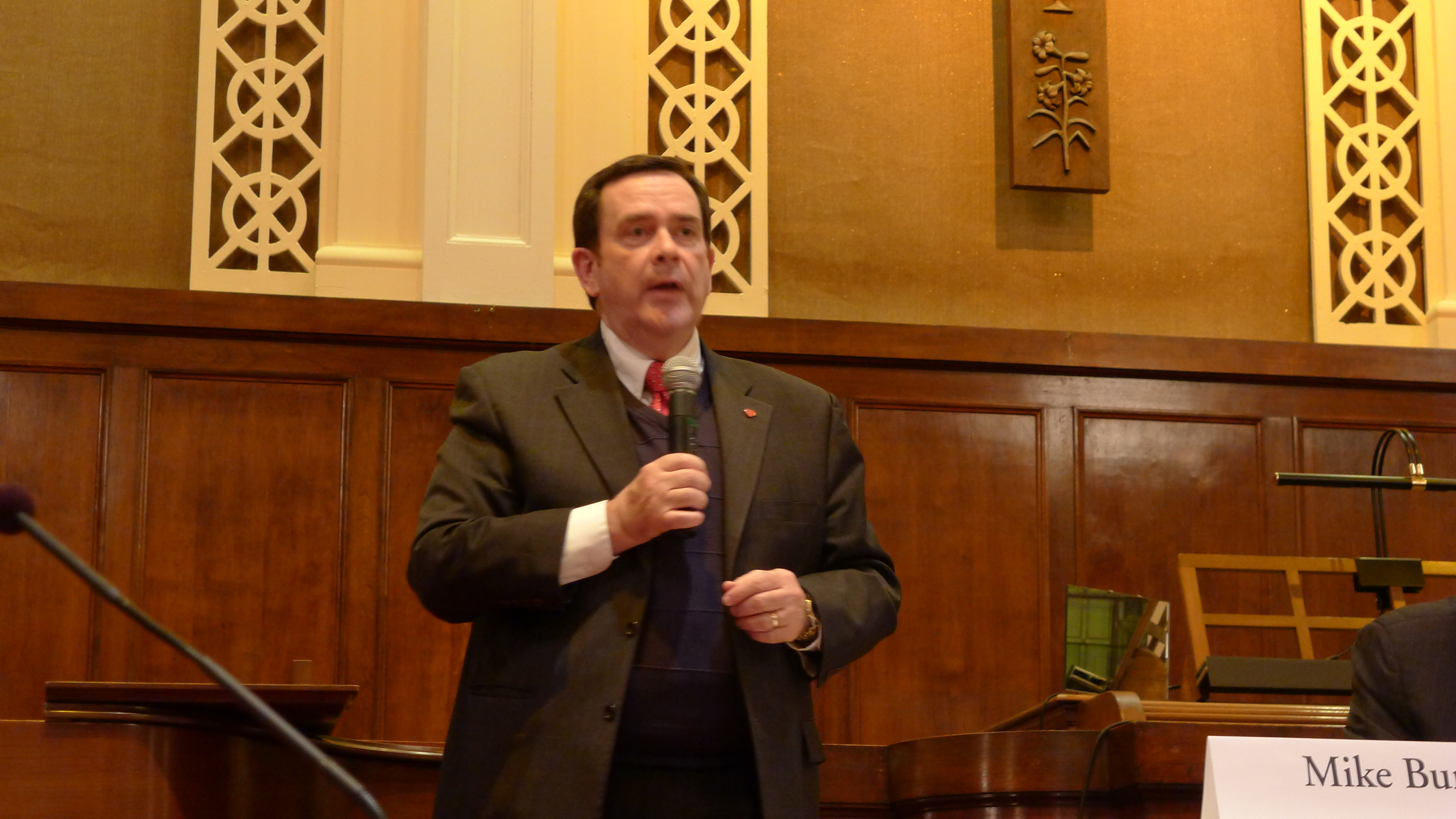
** Mike Burke. Has the deepest, broadest background in civic matters and projects confidence. Needs to sharpen his message, however, and tell people clearly why he is the best candidate and paint a sharper picture of where he would lead the city. (He also needs to drop his “perfect storm” explanation for why things have gone so badly at City Hall the last four years. It wasn’t the jet stream that wreaked havoc at City Hall; it was the mayor and his spouse.) Burke hurt himself by initially refusing to publicly talk about the Port Authority scandal, citing attorney-client relationship. (He was general counsel at the time.) Documents unearthed by The Star, however, show that after learning about the $9.7-million contract between the company developing the Richards-Gebaur site and a company owned by another Port Authority attorney, Burke wrote a scolding letter to the attorney, William Session.

Hermann and James

:: Deb Hermann. Straight shooter. Easy to talk to. Has guts. (Stood up to Local 42’s demand that the city include the former MAST employees in the city pension system at an estimated cost of $30 million.) Her kindly grandma appearance and non-threatening manner stand as appealing contrasts to Funkhouser’s bashing, avenging ways. Leadership is a question, though. She’s led the Finance and Audit Committee, but is that enough?

:: Funkhouser. Speaks knowledgeably and authoritatively about the issues, as you would expect of an incumbent, and almost makes you forget what a disaster he’s been. That’s why Burke and Rowland have to keep reminding the voters. (Hermann probably would like to slide through without going negative, at least in the primary.)

:: Henry Klein and Sly James. Well-meaning and well-spoken individuals who add a lot to the discussion. However…these and similar pretenders from past elections (Stan Glazer, Gomer Moody, etc.) who wake up one day and think, “Hey, I could be mayor,” need to go back to investing, the law, show business, liquor sales and whatever else it is they do and stay there. The last 40 years of Kansas City history shows that you can’t get elected mayor unless you’ve held another major elective office (Charles B. Wheeler); served on the council (Richard Berkley, Emanuel Cleaver and Kay Barnes); or been hand-picked by The Star’s Yael Abouhalkah.

:: Charles Wheeler. The most candid, accessible and entertaining mayor we’ve had during the last 40 years. (Held the office from 1971 to 1979.) I’ll never forget when he wrestled a bear in the mayor’s office and then regaled the press with the details: “The bear sat right over there on that couch and drank a Pepsi.” That said, he might not even get on the ballot. It takes 1,000 signatures of registered voters to qualify for the ballot, and, at this point, that translates into supporters willing to stand outside supermarkets, in the cold, approaching shoppers and saying, “Excuse me…are you registered to vote in Kansas City?”

Suggestion: If you really want on the ballot, Charlie, hire Clay Chastain to get your signatures. He needs something constructive to do to take his mind off himself.


Read Full Post »

Ordinance No. 110056 popped up at the last minute Thursday, too late, as the clerk said, to be included in the printed docket.

It didn’t involve a lot of money, relatively speaking — $125,000 — and it generated virtually no discussion.

But it sure packed a political wallop.

Yes, it did. It could hardly have come at a worse time for Mayor Mark Funkhouser, who has spent the last year or so trying to put “the Gloria thing” behind him. The Gloria thing, of course, was the long-running flap over wife Gloria Squitiro’s presence at City Hall, when she worked there as a full-time volunteer in his office.

Worked, as in scorched the walls of the old Art Deco building with a blowtorch and breathed fire down the throats of  many regular, salary-earning employees.

A little background:

You’ll recall that Squitiro refused to leave City Hall and that her husband — uh, the mayor — didn’t have the good sense, or maybe the courage, to tell her to do so. The council had to pass an ordinance, later thrown out by a judge, forcing her to do so.

Of course, it goes a lot deeper than a domineering wife getting her way and a deferring husband nodding to the status quo.

The city had to pay out $550,000 to a former mayoral aide, Ruth Bates, who sued Funkhouser, Squitiro and the city for Squitiro’s alleged harassment of her and discrimination against her. The city paid the money after settling with Bates, while Squitiro’s insurance company paid Bates an additional $45,000.

Let’s think about that again, as we approach the Feb. 22 primary election, in which Funkhouser is one of seven announced candidates...Five hundred fifty thousand dollars of taxpayer money was lost to the city because of Mrs. Funk’s tart tongue and poor judgment.

And she wasn’t even a full-fledged city employee. She was a squatter!

That brings us to Thursday and Ordinance No. 110056.

Bates’ lawsuit wasn’t the only one filed as a result of the Squitiro rodeo at City Hall. Shawn Pierce, a former aide to Funkhouser, filed a suit last January alleging that Funkhouser fired him because he had sided with Bates in that fracas.

There must have been something to Pierce’s claim because last month the city agreed to pay Pierce $125,000. “We have an agreement in principle,” Pierce’s attorney said at the time.

On Thursday, it was time for the council to approve the settlement.

And who introduced the ordinance? None other than Deb Hermann, a second-term council member who appears, on the basis of endorsements and momentum, to be the leading contender in the Feb. 22 primary.

Hermann, chairwoman of the council’s Finance and Audit Committee, was in a difficult position Thursday. I would think that, to some degree, she relished the prospect of sticking it to the mayor at this time, when the public is starting to pay attention to the mayor’s race.

On the other hand, Funkhouser, Mrs. Funk and all the bad stew that has been served up at City Hall the past few years have undoubtedly turned some members of the public against the council as a whole. As a result, Hermann — the only current council member running for mayor, besides Funkhouser — could suffer from association.

Earlier Thursday, I asked Hermann if she would vote “yes” for the Pierce payout through gritted teeth.

“I’m certainly not happy about this, but I would be much less happy if we had to pay more,” she said.

And, so, when it came time for a vote on Thursday, there was very little discussion: Just one question, directed to city staff, to confirm that the $125,000 would come specifically from money budgeted for the mayor’s office.

After the city attorney confirmed that was the case, the clerk proceeded with a roll-call vote. There were 11 “ayes,” one person absent (Councilman Bill Skaggs) and one abstention — the mayor.

Now, let’s do the math. Five hundred fifty thousand plus one hundred twenty-five thousand equals six hundred seventy-five thousand.

That’s $675,000 in taxpayer funds that has been paid out as a result of Mrs. Funk’s wonderful foray at City Hall.

Think about that when you go to the polls five weeks from Tuesday.

Read Full Post »

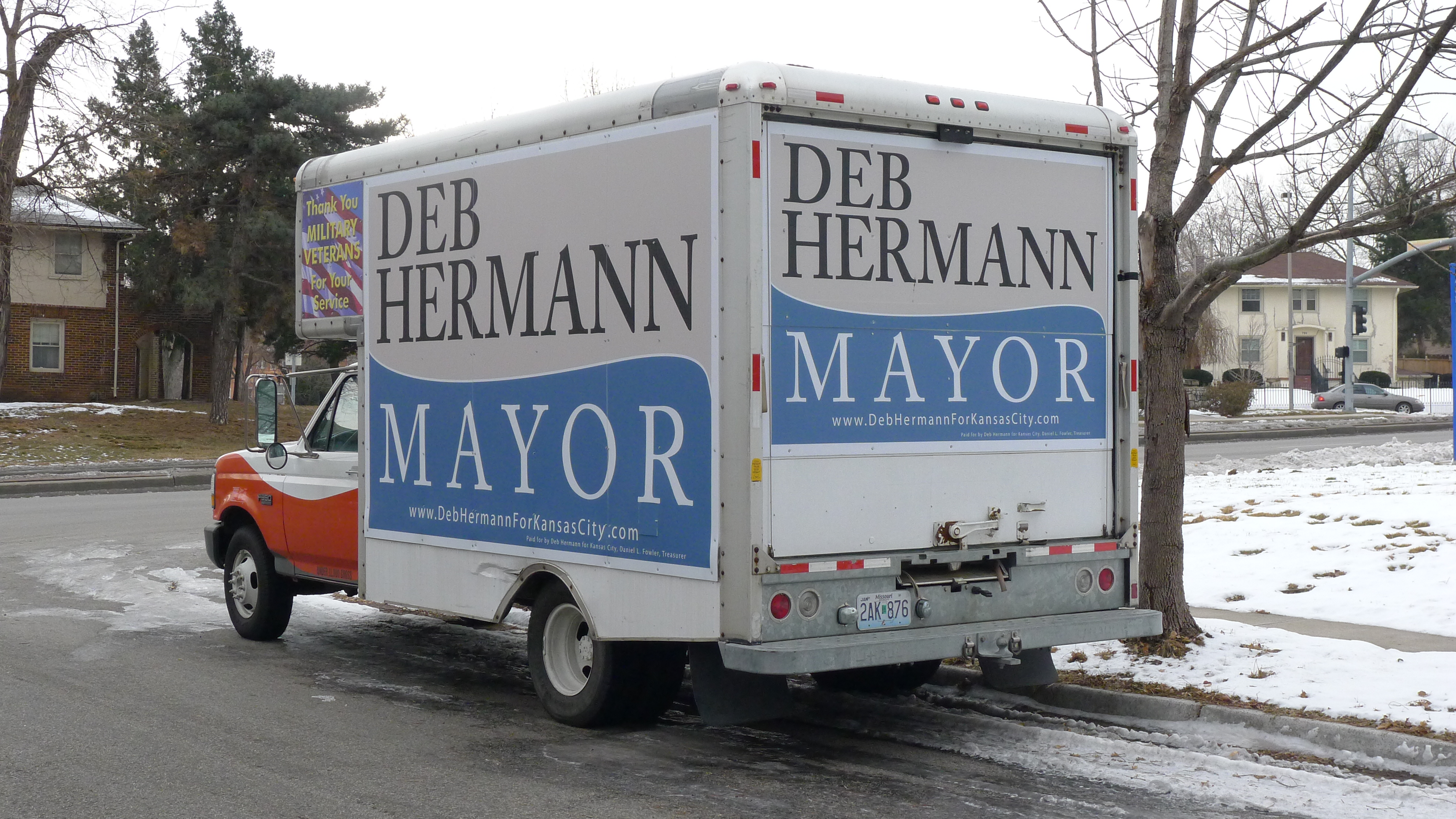
Besides picking up some key endorsements in recent days, such as mortgage banker James B. Nutter Sr. and Jackson County Executive Mike Sanders, another reason that Deb Hermann is coming on strong in the mayor’s race, in my opinion, is her creative use of signage.

I’m not referring to her yard signs, which are good, but to two mobile signs that are being rolled out for maximum exposure.

The billboard-type signs, essentially giant yard signs, cover the sides and backs of two U-Haul-type trucks, one of which has been parked along Southwest Trafficway and the other along Burlington Avenue in North Kansas City.

The one on Burlington, just past the the north end of the Heart of America Bridge, has been in a parking lot outside Bridge View Hall. Hermann’s campaign needed approval of the Bridge View Hall owner to park the truck outside his building.

The other truck has been parked on 36th Street, just off Southwest Trafficway.

I’ve been around politics a long time, but I’ve never seen truck advertising of this quality. I’ve seen a lot of second-rate truck advertising, including the use of homemade signs and irritating bull horns blaring the candidate’s message. But nothing this sophisticated…if you can call truck advertising sophisticated.

Hermann and her campaign staff are justifiably proud of the gimmick. “I think it’s certainly unique to get my name out there,” Hermann said. “I think it’s a good idea.”

But Hermann doesn’t take credit for it. She referred me to campaign coordinator Megan Tallman, whose roots are in Westport and who has been involved in many grassroots-type campaigns.

Tallman said she saw similar truck-side advertising used in a Northland campaign last year, and she said she mentioned it at a campaign staff meeting. From there, the idea took off. The person who implemented the plan is a sign-company owner who is a supporter of Hermann. The man ordered the signs and had them affixed to the trucks, which he owns, Tallman said.

As a result, it’s not costing the campaign much money. It’s a so-called “in-kind” service, where the sign-company owner donates his cost to the campaign. It would be nearly cost prohibitive, at least in a local campaign, to rent two trucks for a month or more.

So, congratulations to the Hermann campaign for its ingenuity and for adding a capricious touch to the mid-winter campaign. As Tallman said, even if you’re not for Hermann, the gimmick “still makes you smile.”

Read Full Post »

A lot of topics came up for discussion at last night’s mayoral forum at Central Presbyterian Church, 35th and Campbell. Crime, education, the earnings tax, city services, the Plaza, urban blight, subsidized housing. And others.

But the undercurrent of the night — the palpable feeling that wove around, under and through all the talk — was the burning desire of the six challengers to see the incumbent, Mayor Mark Funkhouser, turned out of office.

Funkhouser

I think it’s fair to say that not only do the six challengers — Mike Burke, Deb Hermann, Sly James, Jim Rowland, Henry Klein and Charles B. Wheeler — want Funkhouser out because they want in, but because they think Funkhouser has poisoned the well at City Hall.

Not only was that the sense of the challengers; it carried over into at least one prominent audience member, Fourth District Councilwoman Jan Marcason.

Marcason sat in the second row of  the audience, listening closely, eyes studying the people on the stage.

It might seem odd that Marcason, a first-term council member, has become a flash point for the election, but that’s the way it is.

Through her dogged battle to boot Funkhouser’s wife, Gloria Squitiro, out of City Hall — where Squitiro was a pesky and unwanted presence in the eyes of many residents and city employees — Marcason has become the face of the oust-Funkhouser movement.

For her perceived impertinence, Funkhouser reciprocated by tossing Marcason off the council Finance Committee (where she was vice chairman) and the Transportation and Infrastructure Committee.

And, so, against that backdrop, a question arose last night about what was at the root of the “disdain” that some council members have exhibited toward each other, and about what it might take to get a semblance of “civility back to City Hall.”

Burke

Burke went first. A former councilman and a former chairman of the city’s Public Improvements Advisory Committee, he talked about the importance of team building — of the implied need for the next group of council members to build a rapport so they could work together effectively.

Then it was Funkhouser’s turn. “I’m not sure it’s a lot less civil than it ever has been.” As an example, he recounted an incident when a former councilman came close to physically attacking longtime City Hall baiter Clay Chastain.

When the stakes are high and the issues are large, Funkhouser said, “There’s going to be an argument; there’s going to be a fight. Some people call it drama.”

Rowland

Using the word “drama” could well have been a jab at Rowland. Twice Tuesday night, Rowland, executive director of the Jackson County Sports Complex Authority, noted that he had overseen the $700-million renovation of the sports complex “on time, on budget and with no drama.”

As the candidates went down the line, answering the civility question, Klein turned the thermostat up several degrees. It’s time, he said, “to take some of the egos down.” One person, he said pointedly — without specifying who but leaving no doubt who it was — had “usurped all the attention.”

Then it was Rowland’s turn. He stood up, made a complimentary comment about Marcason’s service on the council and then asked her, “How many (council) committees are you on?”

“None,” she said.

To which Rowland rejoined, “There has been four years of distraction and dysfunction.”

It was a square shot to the Tall One’s teeth, and everyone got it: Because she dared to take on the mayor, Marcason is not on one, single committee.

Marcason

A few minutes later, the forum ended, and I went over to get a word with Marcason.

“How strong is your desire to see the mayor turned out of office?” I said.

“I think we deserve new leadership,” she replied. “Positive leadership that can help move the city forward.”

I asked her if she had endorsed any of the other six candidates. No, she said, but added that, in her opinion, there were four strong candidates — Burke, Hermann, James and Rowland.

We returned to the subject of Funkhouser having denied her a spot on any council committee.

“It’s unprecedented,” she said. “He’s just a mean-spirited person.”

Read Full Post »

In the wake of the tragedy in Tucson, The New York Times has published several news stories, letters to the editor and Op-Ed columns on the subject of gun control.

I have read most of them and would like to pass on some quotes that grabbed my attention.

Here goes.

King

U.S. Rep. Peter King, a New York Republican, who has proposed a bill that would outlaw taking a firearm within 1,000 feet of a member of Congress:

“This kind of legislation is very difficult…The fact is Congress has not done any gun legislation in years. Once you get out of the Northeast, guns are a part of daily life.”

U.S. Rep. Carolyn McCarthy, a New York Democrat, who has proposed a bill that would ban large-capacity ammunition magazines, like the one Jared Loughner used:

“This is not a gun control bill. I like to use the word ‘gun safety bills.’ And this one just addresses the narrow issue of these clips.”

McCarthy, again:

“Any kind of bill the N.R.A. is against is always a problem.”

U.S. Rep. Mike Pence, an Indiana Republican:

“I maintain that firearms in the hands of law-abiding citizens makes communities safer, not less safe.”

Erich Pratt, director of communications for Gun Owners of America:

“I think after the November election it’s going to be very tough for Carolyn McCarthy and even the Peter Kings (to get legislation passed). Why should the government be in the business of telling us how we can defend ourselves?

“These politicians need to remember that these rights aren’t given to us by them. They come from God. They are God-given rights. They can’t be infringed or limited in any way. What are they going to do: limit it two or three rounds. Having lots of ammunition is critical, especially if the police are not around and you need to be able to defend yourself against mobs.”

Carol Delaney, professor emerita of cultural and social anthropology at Stanford University, in a letter to the editor:

Delaney

“Bills have been proposed to allow students and professors to take guns to school. What professor won’t worry about giving failing grades when an angry student can march into his office and shoot him? Is this a civilized society or a resurgence of the Wild West?”

Nicholas D. Kristof, New York Times columnist:

“The only country I’ve seen that is more armed than America is Yemen. Near the town of Sadah, I dropped by a gun market where I was offered grenade launchers, machine guns, antitank mines, and even an anti-aircraft weapon. Yep, an N.R.A. dream! No pesky regulators. Just terrorism and a minor civil war.”

Kristof, again:

Congress on Wednesday echoed with speeches honoring those shot in Tucson. That’s great — but hollow. The best memorial would be to regulate firearms every bit as seriously as we regulate automobiles or toys.”

Gail Collins, New York Times columnist:

“Different parts of the country have very different attitudes about when it is appropriate for citizens to carry guns. There is nothing that would make me feel less safe while shopping than the knowledge that my fellow bargain-hunters were packing heat.”

Collins, again:

“If Loughner had gone to the Safeway carrying a regular pistol, the kind most Americans think of when they think of the right to bear arms, (Gabrielle) Giffords would probably still have been shot and we would still be having that conversation about whether it was sane idea to put her congressional district in the cross hairs of a rifle on the Internet. But we might not have lost a federal judge, a 76-year-old church volunteer, two elderly women, Giffords’ 30-year-old constituent services director and a 9-year-old girl….”

Bob Herbert, New York Times columnist:

Herbert

“More than 30,000 people die from gunfire every year. Another 66,000 or so are wounded, which means that nearly 100,000 men, women and children are shot in the United States annually. Have we really become so impotent as a society, so pathetically fearful in the face of the extremists, that we can’t even take the most modest of steps to begin curbing this horror?

“Where is the leadership? We know who’s on the side of the gun crazies. Where is the leadership on the side of sanity?

Herbert, again:

“If we were serious, if we really wanted to cut down on the killings, we’d have to do two things. We’d have to radically restrict the availability of guns while at the same time beginning the very hard work of trying to change a culture that glorifies and embraces violence as entertainment and views violence as an appropriate and effective response to the things that bother us.”

Read Full Post »

Last Sunday, The Star’s reader representative, Derek Donovan, wrote a column about the number of corrections in the paper having dropped between 2009 and 2010.

He wasn’t bragging, just laying out the raw numbers. Deep in the column, he also put forward a weird idea: To create two tiers of errors — significant and insignificant.

Maybe they could be presented under the headings “mortal” and “venial.” (That’s my idea, mind you, not his.)

Seriously, I have a couple of thoughts on this. (Are you surprised?)

First, if Donovan is looking, in his low-key way, for a gold star for the decline in corrections, he’s not going to get it from this here blogger. In fact, in my book, The Star’s treatment of corrections has earned them a big, scarlet “C” that the paper should be forced to put on Page 2 every day for the next year.

Page 2 is where The Star used to run all the news-related corrections. Every day, you could go to Page 2 and see how the paper had screwed up. A few years ago, they changed it, though. Now, the corrections run somewhere, but the editors often make the reader guess which shell the pea is under.

There are two main reasons that the number of corrections is down at The Star.

:: The news hole has gotten smaller, and circulation continues to dwindle.

Donovan reported that the paper published an even 300 corrections in the print edition, out of about 41,000 separate stories. That compared with 383 corrections in 2009, when the paper ran about 46,000 stories.

So, that’s an 11 percent drop in stories and a 22 percent drop in corrections. Donovan rushed over the story-count dip like it was a beaten-down speed bump, but, frankly, that should be a much greater source of concern to the paper and the readers than the correction rate.

How often do you hear people say, “There’s nothing to The Star anymore?” It’s not an illusion; it’s simply not offering the readers as much for their money as it used to.

As the story count has dropped, so has the number of subscribers and readers. And when fewer people are seeing the paper, not as many corrections are caught. It’s the readers who report most of the corrections. The reporters tend not to self-report their own errors for fear of getting dinged in their annual performance evaluations — and maybe even their paychecks.

:: The Star has made corrections a lower priority.

By depriving the corrections of a permanent home (as Page 2 was), The Star has signaled that it does not place as high a value on the corrections as it once did. Believe me, the reporters get that message, and most of them probably aren’t complaining.

During my many years at The Star, I lived in constant fear of winding up on Page 2. And, unfortunately, I made it there quite a bit. Once, in fact, I made a reporting error that, naturally, required a correction. But then I made an error in the correction. And so we published a correction to a correction.

Talk about mortification!

As tough as the policy was, though — and as conspicuous as the corrections were — we knew that our feet were being held firmly to the fire. It was good for the paper and good for the readers: full disclosure; no slip-sliding around.

I’m not saying The Star wouldn’t run a correction to a correction now. I’m sure it would. But now that it’s under siege, financially and otherwise (like many other metropolitan dailies), I think the handling of corrections has been allowed to drift a couple of rungs down on the priority ladder.

And now Donovan is tossing out the possibility of dropping corrections to an even lower level. In his column, he proposed two tiers of corrections — one for “significant factual errors” and one for “mundane, often mechanical mistakes.” As examples of insignificant mistakes, he cited the misspelling of celebrities’ names and erroneous TV listings.

Now, Donovan is certainly right that some errors are more significant than others, but establish separate tiers? No way. The first and perhaps biggest problem would be who decided which category the errors fell into.

Well, I guess that would be our helpful readers’ rep. But that’s an awful lot of discretion to give to one person, or even a committee, and I could foresee constant battles with readers and “error victims” over whether a certain error qualified as significant or insignificant.

Can you envision a correction that said: “Yesterday’s correction on the misspelling of Harry Truman’s name was improperly placed in the insignificant error category. We regret both errors.”

So, what’s the answer: Treat all corrections the same. And, please, go back to putting them in the same place every day.

Read Full Post »

The seminal photograph of Jared Loughner is one that will be seared in the minds of many Americans for years to come.

You know the one I’m talking about: The police mug shot, in which his head is shaved, he’s wearing a quirky smile, and his eyes are aglow with madness and vacuousness.

That picture is one of several things that have stood out for me in the newspaper and online coverage that I have seen about the Loughner case.

Here are some other highlights of the coverage I have seen:

:: The New York Times’ very focused, wall-to-wall coverage.

:: A David Gergen, CNN column urging Americans not to jump to conclusions about political forces that might have factored into Loughner’s mindset.

:: A Kansas City Star story about the political “roar” surrounding the case.

First, regarding The Times’ coverage, which starts with that memorable photo.

When I first saw that picture on CNN’s home page Monday, I caught my breath. The photo depicted perfectly, for me, the separation from reality that I expected in Loughner from having read about him. It was one of those instances where a photo went far beyond anything that could be put into words. Even though CNN used it just as a mug shot in the upper-left corner of its page, it was arresting.

It took the editors at The New York Times to understand the photo’s impact and to take full advantage. On Tuesday, The Times put that photo at the top of its front page. The photo was three columns wide (half the width of the paper), below a four-column headline that read, “In Arizona Court, Suspect Waives Bail.”

What The Times has done so well in its coverage is to focus relentlessly on Loughner — his background, his family and his movements before the attack outside the Tucson Safeway. Unlike other papers, The Times can throw a fantastic amount of firepower at the epicenter of its coverage — Loughner — and still not short shrift any of the other story facets, such as fleshing out portraits of the victims.

The Times started boring in on Loughner on Monday with a front-page story about the disturbing behavior — “hysterical laughter, bizarre non sequiturs and aggressive outbursts “– that got him kicked out of Pima County Community College. Another photo, a mug shot, of a loopy-eyed Loughner accompanied that story.

Although no other news agency has the wherewithal to handle a story of this magnitude like The Times, some other outlets are doing good work.

I mentioned Gergen’s CNN article. An adviser to four presidents and director of the Center for Public Leadership at the Harvard Kennedy School, Gergen is a person whose political observations should be heeded.

Addressing the conservative-liberal foment that mushroomed immediately after the shootings, Gergen said: “The country would be well served now if we cooled the accusations until we learn more about…Jared Loughner. He appears to be mentally unhinged, someone who has threatened others. Why he targeted one of the most admired and popular political leaders in Arizon is unclear.”

He went on to say, however, that the “climate of hatred” has grown worse in recent years “during the George W. Bush years, when the left was intensely alienated, and now during the Obama years, when the right has become vitriolic.”

I agree with Gergen that it’s far too early to know how, or even if, the political atmosphere might have spurred Loughner, but I agree with a point that my friend and former K.C. Star colleague Dan Margolies made at lunch the other day. He said that regardless of how nutty some people are, in most cases they are influenced by “the Zeitgeist.” I had to look up “Zeitgeist” just to make sure I understood. Wikipedia defines it as the “general cultural, intellectual, ethical, spiritual and/or political climate within a nation or even specific groups.”

In this case, that would be within Arizona, which, to me, has found its way to the bottom of the well among these United States.

I also want to credit The Star, which, to its credit, has originated at least one front-page story about the case.

The Star wisely put Dave Helling, one of its most experienced political reporters on the story, and he came up with a compelling report for Tuesday’s edition. The headline was “Silence, Then a Roar.” His lead — the first sentence — was attention grabbing: “The farther you traveled from U.S. Rep. Gabrielle Giffords’ hospital room, the louder it got across America.” That sentence captured both the heartache of the story and the furor surrounding it.

Helling went on to quote the plainspoken, gutsy sheriff of Pima County, Clarence Dupnik, who suggested that “vitriolic rhetoric” might have been a factor in the violence. Helling went on to talk about efforts and suggestions to tamper the political rhetoric, but he tempered that with an insightful comment from UMKC law school professor Doug Linder. “The natural instinct is to try and figure out some way to prevent these things from happening,” Linder said. “There isn’t any simple solution that involves restricting free speech.”

The only weak part of The Star’s Tuesday package was its centerpiece photo, which showed Cleaver and other Congress members and congressional staff members observing a moment of silence in Washington.

Underneath that amorphous, four-column photo was the mug shot of the crazy-eyed Loughner. But at an inch deep and less than an inch wide, the mug shot came nowhere close to delivering the punch that it did spread high and wide across the top of The Times the same morning.

Read Full Post »

I hate to say this, but I am losing confidence in Mark Zieman as publisher — and ultimate leader — at The Kansas City Star. 

My colleague John Landsberg of Bottom Line Communications reported yesterday that there will be another round of layoffs at The Star. I can’t keep track of how many rounds there have been in the last few years, but I think this will be at least the fifth.

This latest news is particularly maddening and frustrating not because The Star’s staff apparently will get even thinner, but because of Zieman’s optimistic tone when he announced the previous round of layoffs last September.

Back then he said The Star was approaching the end of the year “financially strong” and that the industry was at a “turning point.”

To me, that not only was irresponsible, it was misleading and showed Zieman was indulging in wishful thinking. While such words might buoy employee morale temporarily, the words make it all that much harder for employees to swallow another round of layoffs. The real danger of statements like that is that they spread a sense of false hope and paint the publisher as someone trying to buy time before something even worse happens.

Employees of every organization like to hear words of encouragement and hope from their leaders, but, more important, they want a candid assessment of where things stand. Zieman has failed miserably on that front, not just in September but with unrealistically optimistic words with each round of layoffs.

So, now, unfortunately, it’s like the boy yelling fire in the theater. Except it’s the reverse because there is a fire and Zieman keeps trying to convince his troops it’s just about extinguished, when it’s obviously out of control. 

I mentioned that something big could happen. Like what? Well, how about a decision to drop the print edition several days a week. That seems like the next likely step to me.

Zieman probably won’t admit it until it happens, because he’s obviously reluctant to take off the rose-colored glasses. But it could easily happen, and it wouldn’t surprise me to see one or two weekday papers — maybe Monday and Tuesday — dropped within a year or two.

Several papers around the country have already dropped some or all print editions, and the St. Louis Post-Dispatch took a step in that direction last year, when it dropped single-copy sales — in boxes and convenience stores — of the Saturday paper. It still puts out a Saturday paper, but it goes only to subscribers.

In reporting the story last October, the Riverfront Times, the St. Louis alternative paper, asked Editor Arnie Robbins how long it would be before the Post-Dispatch would cease putting out a print publication altogether.

“I’m not feeling particularly clairvoyant this morning,” Robbins replied. “But I think in the next 10 years you could see the elimination of the weekday paper, with the Sunday still coming out in print. The rest of the week would be online or delivered through niche products and phone and e-reader apps. We’re working on a few of those projects right now that we’re excited about.'”

Well, let’s credit Robbins with some degree of candor. Ten years very likely is an overestimation of how much longer the daily P-D will survive, but at least he doesn’t have blinders on.

Now, compare that statement with what Zieman told employees in the September memo announcing that round of layoffs:

 “I know that weathering this recession has been exceptionally hard for each of you. But we will begin next year with a steadily improving revenue trend. We are posting record online traffic and revenue, we remain the dominant media company in our region, our presses and readership metrics are among the best in the country and our news products are recognized nationally for their journalistic excellence. The Star won’t die, but this recession will.”

Metrics. Journalistic excellence. The Star won’t die. Uh huh.

This is really a desperate situation in my view. I think The Star’s owner, McClatchy Co., is headed for bankruptcy.

As I reported in June, Morningstar, the independent investment and stock research company, had a grim outlook for the company. An article in Morningstar StockInvestor, a periodical available to Morningstar members by subscription, said this:

“Our fair value estimate on McClatchy shares is $0.”

Are you listening, Mark? That’s zero. Nothing. Worthless shares for the stockholders.

At the time, McClatchy’s stock was selling at $4.28 a share. The stock closed Friday at $4.89 a share, but that’s no indication of a significant upswing. Sprint, as difficult as its situation is, has a much better chance of surviving than McClatchy does.

The company paid too much for KnightRidder in 2006 and bought the KR papers at precisely the wrong time.

Do you remember when Payless Cashways senior managers, led by then-chief executive officer David Stanley (fondly known to some as Minnesota Dave because he flew back to his home in Minneapolis every weekend) took the company private in 1988? They paid too much ($900 million); the company muddled along for about 10 years and then rolled over and died.  

McClatchy, too, is going to roll over and die, I believe…or get bought out for a song. I can hear the late “Dandy” Don Meredith singing from heaven, “Turn out the lights; the party’s over.”   

And what will happen with the papers McClatchy owns? I don’t know. But it isn’t a bright picture, and I hope Zieman doesn’t weigh in with more irrationally optimistic statements when he officially announces the newest round of layoffs.

Read Full Post »

My New Year’s resolution (actually, it just occurred to me) was to be calm and composed in 2012, but I guess that’s not going to happen. Maybe next year.

I apologize to you non-sports fans, but I’ve got to get these outrages out of my system. Then, no more sports for a while…unless The Star does a 180 and hires Jason Whitlock back.    

So, here goes:

:: What is with these bowl games? Will they ever end?

Used to be, all the attention was focused on four big New Year’s Day games — Cotton, Sugar, Rose and Orange bowls and you could sit around and eat your Hoppin’ John, enjoy a nice beverage and then the football season was over.

But not anymore. Oh, no! Now, there are 35 bowl games, which start a week before Christmas and go until it’s time for that clarion call, “Pitchers and catchers report.” Well, that’s a bit of an exaggeration, but the national championship game, Auburn vs. Oregon, doesn’t take place until next week.

The bowl season has become so diluted and strung out that the games have become about as riveting as a flatlined electrocardiogram. I watched a total of about 10 minutes of football on New Year’s Day. Just couldn’t get excited about any of the games. 

And you know what? I’m not even sure that a playoff system, which many people advocate, would be an improvement. It might end up as a big, long slog extending into the pro football playoffs.   

On top of the bowl bog, the Rose Bowl Stadium is going to be renovated. And suites –what else? — will be added. Now that’s a double outrage!

:: On Tuesday, I was reading Sam Mellinger’s KC Star story on new KU athletic director Sheahon Zenger when I came across a passage that had me spluttering over my oatmeal.

Mellinger’s story revolved around the true face of KU athletics, basketball coach Bill Self. It seems that Mellinger had been able to get some up-close and personal  time with Self, so Mellinger found himself driving around campus with Self. He wrote: “His Lincoln Navigator cuts through campus one night, and even in the twilight, at least a few students point and smile.”

What??!! Bill Self driving a Navigator — one of the biggest road and gas hogs of all — in Lawrence, Kansas, one of the greenest cities in America?

Un-believable. The Navigator is a vehicle I would expect to see Lew Perkins driving, or Mark Mangino. And we all know where they ended up driving.

But Self? He seems like a perfect fit for humble, laid-back, non-ostentatious Lawrence.

He’d be much better off driving a hybrid. In fact, he should have the first Volt in Lawrence.

:: Tom Cable is out as head coach of the Oakland Raiders.

Raiders’ owner Al Davis has lost his mind…Well, he lost it a long time ago, he’s just showing it more these days.

Cable

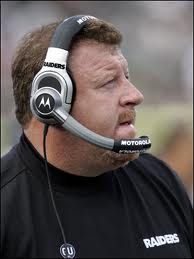
I certainly haven’t been a big fan of Cable, especially when allegations surfaced in 2009, a year after Cable was named head coach, that he had broken an assistant coach’s jaw in an altercation and that he had physically abused a former girlfriend and at least one former wife.

I thought he should have been fired then. But I guess those allegations didn’t bother Boss Davis; he probably thought he’d hired a really tough guy. 

So, Cable managed to weather that storm, and the Raiders have been on the upswing the last two years. This year, they went 8-8, which isn’t great, but a big improvement over last year’s 5-11 record. The main thing, though, is that this year the Raiders won every AFC West Conference game that they played. They beat the Chargers twice, the Broncos twice and the Chiefs twice, including Sunday’s 31-10 demolition of the Chiefs. (I was there, and the Raiders had the distinct look of a team on the rise.)

His firing would be the equivalent, in my eyes, of Turner Gill’s Kansas Jayhawks beating both Missouri and K-State in back-to-back years and Gill getting handed the pink slip.

It’s an outrage, that’s all you can say.

Read Full Post »

Yo Yo-ing through the years

My old Army buddy, former Cpl. Richard Arthur, has come up with a fine piece about his long-time affinity for the yo yo, one of the most enduring toys (?) ever invented. 

Here’s Richard’s story: 

While Christmas shopping a few weeks ago, and looking for grandkid-type toys, I happened upon a yo yo display at Walmart.

I have a history with the yo yo and selected a semi-translucent, green Duncan Imperial model after perusing the entire selection. Didn’t I owe myself a little Christmas present, after all?

It was like a magic time capsule, taking me back to the early 60s and vivid memories of endless fun, transistor radios and virtually no responsibilities, other than keeping the grass mowed at our home and maintaining proper tire pressure in my old Schwinn.

Here’s the backdrop to Yo Yo Redux:

In the summer of 1960 or 1961, our next-door neighbor, Anita, who attended college out of town during the school year, was managing a Kansas City Parks and Recreation site in Hyde Park. My brother and I often accompanied her on the ride to work in her aunt’s ’56 Chevrolet, and we would spend the day playing with all the sports stuff the city furnished to keep kids occupied. (It was strictly daytime activity; no midnight basketball in those days!) I was either 11 or 12 at the time.

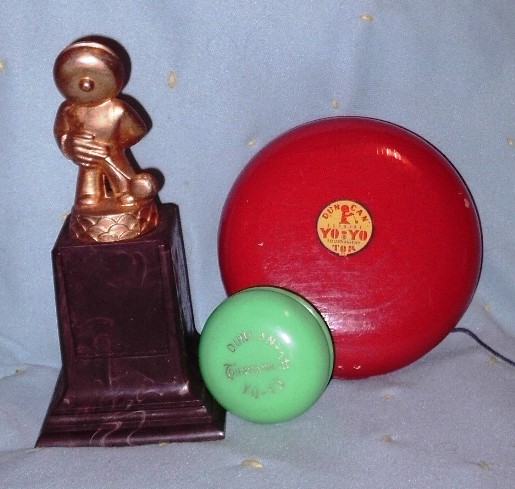
One day, a big, green, city truck arrived with a large box of Duncan yo yo’s, and Anita passed them out to everyone there. I was thrilled to be given a toy that cost nearly a dollar at that time. I took a special liking to the one I got, which I believe was ivory, with an airbrushed, lemon-yellow stripe. It was made of wood and fit my hand perfectly.

Later, park officials announced there would be a yo yo contest, and they distributed a one-page sheet bearing the rules of the contest and showing what tricks would be included. I learned as many of the tricks as I could and took special note of the fact that any ties would be decided by who could do the most loop-the-loops and still recover the yo yo into their hand.

The contest day arrived, and I didn’t see anyone at the park who could do the basic tricks other than me. Those basic tricks were the spinner (freewheeling the yo yo at the end of the string), walk the dog, around the world, loop the loop, the trapeze, and the universally dreaded rock the cradle.

At the last possible minute, like a scene from a movie, an unknown kid rode up on a bike and entered the contest. I had never seen him at the park and suspected he was going all over town getting into the different contests. He was a sinister-looking character dressed in black.

It was like the Grim Reaper had arrived to dash my hopes of being a yo yo champion!

In very short order, it was plain to see that he and I were at the same level of yo yo skill. The contest proceeded, run by a Parks and Rec employee. At the end, the Grim Reaper and I were tied. I tightened my string to lessen the freewheel effect, and somehow fooled around until they had him do his loops first to break the tie. He did about five, and I did at least a dozen (it’s all about string tension and wrist control), winning first place in the Hyde Park division.

I received a trophy and a first-place patch, shaped like a Route 66 sign, and was told I was eligible to advance to the citywide contest the next week.

Many more guys showed up for that contest, but, again, most entrants couldn’t do all of the basic, required tricks, much less original tricks.

One of the prerequisites of this contest was that the contestants had to have an original trick to advance to the final stage. I named mine “The Scissors.” The Grim Reaper wasn’t there, which was a big relief. Again, loop-the-loops decided the winners. I did well and got third place.

A trophy and prizes to cherish

I seem to remember the winner being a little older than me, but I’m pretty sure there were age groups, so he probably wasn’t very much older. I think he got a larger trophy than the ones we got, but I got a big, red, oversized Duncan yo yo and another patch that said Third Place. I kind of remember getting a T-shirt, too, but I’m not certain about that.

Later, back at Hyde Park, Anita wanted all the yo yo’s out of her way and gave me the whole box of tangled, and sometimes-stringless, used yo yo’s. I don’t know what ever happened to them, but at the time, it seemed like a priceless treasure. I sewed the badge-shaped patches on a lightweight jacket, which has long since disappeared.

Over the years, I’ve managed to keep the trophy but have misplaced the little plastic insert that dropped into the grooves on the front of the trophy. As I recall, the insert had the name of the contest and the placings. I also still have the red yo yo, but I never really used it much because it doesn’t free wheel and weighs a ton.

Now, fast forward to the new yo yo that I got a Walmart…When I got it home, I was surprised to find that I could still perform the basic tricks, plus my special “Scissors” trick. So, now I’m looking for an old-timers contest and hoping the Grim Reaper isn’t lurking in the shadows.

At this stage, I’m only good for about six loop-the-loops.

Read Full Post »

« Newer Posts - Older Posts »