Feeds:
Posts
Comments

Archive for the ‘Uncategorized’ Category

I was thinking about George Steinbrenner yesterday as my daughter and I watched the Oakland A’s drub the Royals 9-6 at Kauffman Stadium.

The combination of the 95-degree heat, still air and Brian Bannister pitching something akin to batting practice (There goes another A’s home run!) put us in close to a catatonic state. Fortunately, however, along about the fifth inning, my daughter had the good sense to suggest that we get some water. The $4.25-each investments brought us around a bit.

But, like I was saying, when I was reasonably conscious I was thinking about Steinbrenner. I was thinking particularly about a letter to the editor that appeared in The New York Times last Thursday. The writer, Paul Kaplan of Roswell, Ga., said that Steinbrenner was responsible for diminishing baseball for about two-thirds of the fans.

“That is roughly the percentage of teams that start each season with no realistic chance of becoming champions because they can’t afford the best players under the twisted system that Mr. Steinbrenner exploited,” Kaplan wrote. “Yes, he was a brilliant businessman, but he spoiled the sport that so many loved back when it was played on a level field.”

What can you say, other than “Amen”?

*******

Maybe you read last week about the Missouri General Assembly approving — and Gov. Jay Nixon signing — a bill that will give $150 million in tax breaks for automakers and aimed at Ford Motor Co.’s assembly plant in Claycomo. 

Part of the money to finance the tax breaks will come from changes in the state pension system. The reforms — all good, in my opinion — will raise the retirement age for most state workers from 62 to 67; require a 4 percent contribution from employees toward their pension funds; and require them to work 10 years before becoming eligible for retirement benefits, instead of the current five years. 

Nixon called the pension changes ” a fiscally responsible measure to modernize the pension system for future state employees and ensure the solvency of this retirement system.”

John Burnett

I just about jumped out of my chair, however, when I read what state Rep. John Burnett, a Kansas City Democrat, had to say about the pension reforms. 

“We just did some brutal, brutal revisions to the pension system,” Burnett said.

I understand that Burnett represents an area — northeastern Kansas City — that has a lot of blue-collar workers and many government employees. But, my God, hasn’t Burnett hasn’t been reading about the international financial crisis? The one that has been fueled by overly generous pension systems in southern European countries, including Greece, Portugal and Spain? 

Here in the States, our governments — state, local and national — have been doling out extremely generous pension benefits for decades, and it’s catching up with us, like it did with the European countries.

Wake up, John! The fabric in the golden parachute of government employment is fraying and about to tear asunder.

*******

Overheard at Sutherlands…..A man with a piece of corrugated tubing asks the checkout clerk if the store has a type of corrugated tubing similar to what he has. The clerk shuffles through some product paperwork and replies, “We don’t have no corrugated nothing.”

Six words, four negatives. Gotta be a record. I didn’t know whether to applaud or cry.

Read Full Post »

Today I want to send out a big plum to The Star’s Kevin Collison for his A-1 story Wednesday on the city acknowledging that it will be subsidizing the Power & Light District to the tune of $10 million to $15 million for the foreseeable future.

This wasn’t a “gotcha” story, however; it was a “that’s-the-way-it-is” story. And it’s been developing for a couple of years. The city’s subsidy, as the story pointed out, was $4.8 million in 2008, $11.5 million last year and is projected to be the same this year. So, the trend has not been good.  

I also want to applaud Collison, The Star’s development reporter, for the tone that he took. It wasn’t like, “Ah, see there, the city screwed this up horribly.” He pointed out that the revenue projections were overly optimistic, and then, of course, along came that thing called the Great Recession.

The story is devoid of “the-sky-is-falling” comments, as it should be. The vast majority of people realize that the Power & Light District has been a great thing for Kansas City. After decades of looking at dilapidated buildings and crumbling sidewalks downtown, we can now take pride in our downtown. From the entertainment standpoint, we stack up well against several other midwestern cities, including St. Louis and Louisville. We are a few steps behind places like Indianapolis and Denver, but at least we’re within shouting distance. 

Did the Cordish Co., the developer, cut a fat hog here? Probably. But what were city officials supposed to do — drive a ridiculously hard bargain and watch Cordish take its proven model (see Baltimore and Louisville) somewhere else? We needed them more than they needed us. So, it’s done, and, as City Councilwoman Deb Hermann said in the story, “Regardless of what the projections were, we need to make it a success.”   

We Kansas Citians like to look over our shoulders at Omaha and try to gauge if it is catching up with us and — God forbid — if it has a chance to surpass us. Well, I’ll tell you, without the Power & Light District, we would have Omaha at our side, and we’d probably be glancing back, with concern, at Lincoln — the proud home of the newest member of the Big Ten Conference.

Read Full Post »

The Star’s Mike McGraw and Glenn Rice had a riveting, A-1 story Sunday about one of Kansas City’s greatest murder mysteries — the July 1970 slaying of civil rights leader and politician Leon Jordan.

The slaying, in which Jordan was gunned down outside his Green Duck Tavern at 26th and Prospect, occurred 10 months after I had arrived in Kansas City.

To tell you the truth, I didn’t pay a lot of attention to the murder at the time. I was a general assignment reporter for The Kansas City Times, the morning edition of The Star, and had not been exposed to Kansas City politics. I was busy writing all manner of stories, including a June report on Janis Joplin’s last appearance in the Kansas City area. (I interviewed her in the stands, between shows, at Memorial Hall in KCK. Four months later, she died of a heroin overdose in a Hollywood, Calif., motel.)

Soon enough, however, I got involved in political coverage and in 1971 I was assigned to the Jackson County Courthouse, covering politics and courts. (These days, papers generally have political reporters and courts reporters, and they don’t have the same reporters covering both “beats.”)
As a result, I got deeply interested in both politics and the court system, and I came to understand the significance of the Jordan case. 

Jordan was a co-founder of the renowned political group Freedom Inc., which controlled much of the black vote in Kansas City. The other founder was Bruce R. Watkins, a former city councilman who, in the 70s, was Jackson County Circuit Court clerk. He later ran for mayor but lost to Richard Berkley, who served three terms, from 1979 to 1991.

The two prosecutors who served during my years at the courthouse — first Joe Teasdale and later Ralph L. Martin — each took a stab at bringing the case to resolution. Both failed. Two days after the shooting, Teasdale announced first-degree murder charges against two men, Reginald Watson and Carlton Miller. He dropped the charges 10 days later because…well, he had the wrong guys.

Three years later, Martin announced the indictments of James A. Willis, Maynard Cooper and James “Doc” Dearborn. Willis was later acquitted when his alibi — that he was out of town the day of the murder — held up. The charges against Cooper and Dearborn were dropped. I later covered a case in which Willis, a career criminal, was charged; I think it was bank robbery. I spoke with him several times during the trial, and he was a slick operator, a flatterer. He told me, for example, that he had deduced that I wasn’t a cop because I was “too well dressed.”

There were all kinds of rumors about who killed Jordan and why — everything from politics to sexual indiscretions. Unlike many unsolved murders, however, there was never a prevailing theory about what happened, and there was never an “off-the-record” prime suspect, as far as I knew.

It was just a mystery. One thing wasn’t a mystery, though — how well the murder was planned. The crime occurred about 1 a.m. in steamy weather — temperature 86 degrees — as Jordan left the tavern and walked to his car. As McGraw and Rice reported, three black men drove up in a brown, late-1960s-model brown Pontiac. One of the men fired a shotgun at Jordan, bringing him down. Then, the shooter got out of the car and shot Jordan in the groin and chest as he lay on the sidewalk.

Both the gun and the car, which were found later, had been stolen. Police found partial fingerprints (I guess at least one of the assailants didn’t wear gloves), but a match was never made.

Now, Alvin Sykes, a well-meaning and effective civil rights activist, is pushing hard for police to reopen the case. One problem, however, is that physical evidence, including the murder weapon, has gone missing from the Police Department’s evidence room. Also, there’s no new information.

No less an anti-crime figure than Alvin Brooks, a former police officer and city councilman, is against reopening the case. “Forty years later, do you want to do some things, say some things, and have some things come out that would cause embarrassment, when there is a good chance that the perpetrators are deceased?” Brooks was quoted in the story.

Reading between the lines, I think it’s clear that Brooks doesn’t want to see allegations of sordid affairs and infidelities mar Jordan’s reputation as a civil rights leader and political pioneer. 

I agree. This is one case that, in my opinion, will never be solved. I would sure like to know, however, everything that James Willis knows about that case. For the record, Willis, who is alive, still denies any involvement.

Read Full Post »

Great front page

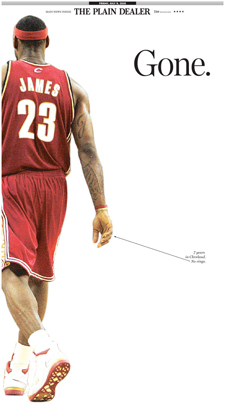
Having no interest in the National Basketball Association, I tried to avoid reading anything about the LeBron James sweepstakes, which culminated last week with the superstar leaving the Cleveland Cavaliers and signing with the  Miami Heat.

The most memorable part of the whole thing for me will be the brilliant front page that editors of the Cleveland Plain Dealer came up with to mark the occasion.

Here it is: 

That’s what greeted the readers of The Plain Dealer (weekday circulation, 268,000) when they opened their papers last Friday morning.

Besides the telling photo, the page consisted of one word in bold print and then a small text block, which you can’t make out here, pointing to James’ finger. The words are: “7 years in Cleveland. No rings.”

In a Poynter Online piece, writer Charles Apple described the front page as “the ultimate salute to the man to whom Cleveland had poured out its collective heart, only to be left hanging.”

If you want to read more about the creative process that led to this one-in-a million front page, you can read Apple’s piece here.

Bravo, Plain Dealer!

Read Full Post »

Last week, My Ol’ Army Buddy, Corporal Rikard Arthur wrote about his days, many years ago, throwing the Westport Reporter in Midtown neighborhoods.

Now he’s back with another tale from the same era, and it, too, has its roots in his newspaper experience.

Here’s his story….

The Reporter was a source of quite a few friendships during the two or three years that I threw the little paper. When they picked pairs of boys for each route, you rarely worked week-to-week with the same person. There were older guys who threw the paper, and you would see them at school quite often. Eighth graders and freshmen like me rarely mingled with guys above us. So by throwing a three- or four-hour route with a guy, you would often create a rudimentary situation that resembled friendship, even if they didn’t have much use for us guys in the lower ranks. Some of those friendships would later prove to be very valuable.

Westport High had a twice-a-month dance – called Tiger Den (since we were the Westport Tigers, of course) – which was held at the school in the girls’ gym. I rarely missed that event.  Eighth graders and freshmen must have looked like little kids hanging around in that gym with juniors, seniors, and the like. But that didn’t deter me in the least. The gym would just overwhelm you with the aroma of dime-store cologne and bubble bath, and there was simply an electric atmosphere that permeated every square inch of the huge room.

This was a place where you wore your H.I.S. Blades, which were the super narrow slacks with no belt loops, and the pockets were hidden horizontally along the waistband. Pair those up with a candy-stripe, oxford, button-down shirt (ironed and spray starched to total perfection) an inch-wide black tie with fake pearl tie tack (the tie tack absolutely had to have the little chain that hooked into the buttonhole behind it), and your best pointy-toe Flagg Bros. shoes, and you were ready to hit the big time.

Splash on some English Leather, Canoe, Jaguar, or Hai Karate to slay the babes, and carefully tuck away the fresh roll of peppermint Certs for up-close insurance. Put the unbreakable ACE comb in the back pocket and slide on that gold and onyx signet ring like every other guy on earth had. No gum allowed at Tiger Den, and no taps on shoes…gotta protect that nice oak floor in the gym.

There was a Tiger Den Committee, which I later joined, that decorated the gym with copious amounts of crepe paper streamers (blue and gold) and many of the Tiger Den events were themed such as Homecoming, Dream Girl, King and Queen of Hearts, etc. My favorite was Sadie Hawkins Tiger Den, a once-a-year event where the girls asked the boys to dance and sometimes even asked boys to take them to the dance. At this event, the “brutal truth” really became evident.  You might be asked to dance by a girl you never dreamed even knew you existed…wow!  Also, if some girl that you thought might have an interest didn’t ask for a dance or two, you might as well cross her off your hopeful list.

At all Tiger Den events, a disc jockey – usually a parent – played 45 rpm, Top 40 records on a stone-age rollaround setup probably produced in shop class. About every fourth or fifth record was a slow song.  I can still conjure up the tunes of  “Theme from a Summer Place,” “April Love,” “Earth Angel” and “Oh, Donna.” Critical strategy came into play here, because you needed to get into position one song early to ask the girl you wanted to slow dance with, or miss out when some guy who was nearer beat you to the punch…bummer. I perfected this move by the second or third Tiger Den I attended and never shared the secret of the song timing, and it rarely varied.

Anyway, somewhere along the way at one of the Tiger Dens, I got crosswise with a member of the very small hoodlum element that, sadly, populated a very small part of the school. A few words were exchanged and he informed me that we would be seeing each other after the dance outside. This guy was pretty well known as a bully, and his friends were all there egging him on, as if he needed any encouragement.

Luckily for me, I had thrown the Reporter several times with a guy named Joey and had always deferred to him on the paper routes and had bought him a few Cokes along the way. He was a good paper thrower and we always finished very early regardless of what route we were given because we worked well as a team and really pushed it along. When I threw routes with him, it raised my performance to much higher levels of speed because I wanted to keep up.

Joey had the “hair” and the dark mood; he was the complete thug package, including sleepy eyes that were truly scary. He lit up a cigarette at any opportunity and carried a hair brush in his back pocket.  I found out later what a horrid life he was living with the deadly combination of an alcoholic mom and dad and every other disadvantage imaginable. Although he was just a sophomore, I could see that he had tons of street sense.

So Tiger Den concludes, they push the crowd out the door, and I’m face-to-face with the guy from the dance who thinks he needs to boost his creds by going after me. I’m trying to concoct some defense or strategy to minimize my injuries that are most certainly going to be administered by this punk, when, with impeccable timing, Joey slides right in there after apparently reading the situation from afar. I’ll never forget the punk’s menacing demeanor fading when this game-changing event took place.

It was almost like something you might see in a movie. The punk immediately gets real friendly and turns into a teddy bear in the presence of Joey. He forgot all about mixing it up with me and concentrates intensely on verbally massaging Joey, who was obviously way above him in the thug pecking order. Joey slipped me the “get-out-of-here” look with those sleepy eyes, and I didn’t need a second clue. I was gone in a flash, and escaped certain death!

We threw the Reporter several times after that, but neither of us ever mentioned the Tiger Den incident. I’m sure that to him, it was just business as usual. Joey quit school on the first possible day that he could sign himself out, and I later heard that he caught a good job with KCPL or the Water Department, or some utility. I always hoped that he did well, and I’ll never forget how a fellow paper thrower saved my ass that night at Tiger Den.

Man, buddy, can I ramble on, or what???

Read Full Post »

I read with pleasure and pride last week that Rick Armstrong, who had held a variety of leadership positions with the Kansas City, Kan., police department had been named police chief at age 50.  

To many area residents, the name probably won’t mean anything, but he is well known in law enforcement circles, and he served patiently and steadfastly while keeping an eye on the top spot.  

I first met Armstrong in the mid-1990s, not long after I took over as editor in The Star’s Kansas City, Kan., bureau. Our office was in the Security Bank building at Seventh and Minnesota, a block away from police headquarters, which then was in the basement of City Hall, on Seventh Street. (Police headquarters later moved to the old BPU building on the northwest corner of Seventh and Minnesota.)  

At the time, Armstrong was a captain, working closely with then-chief James Swofford, whom I rarely dealt with. It was one of those deals where, if you had questions, Armstrong was the guy to go to.  

Rick Armstrong

Another reason I got to know Armstrong is that his wife, Allison Armstrong, did some freelance work for the bureau, writing feature stories. 

I always liked Armstrong because he was thoroughly professional, straight up and didn’t seem like he wasn’t trying to hide anything. He was in his late 30s at the time and wore a serious expression. I got the impression even then that I was talking to the future chief.  

One case in particular cemented my impression of Armstrong as an officer who cared and wanted to do the right thing. It was the Pamela Butler case – the awful, almost unspeakable case of the totally innocent 10-year-old who was abducted on Oct. 12, 1999, by 24-year-old Keith D. Nelson while roller skating near her Armourdale home. Before racing away, Nelson taunted friends and relatives of Butler by shouting out the window of his truck, “You’ll never see her alive again.”   

Nelson drove Pamela to a field in Grain Valley, where he raped her and killed her by strangling her with speaker wire. Three days later, police fished Nelson out of the Kansas River, alive, near the 12th Street Bridge.  

He later pleaded guilty to kidnapping and murder in U.S. District Court in Kansas City, Mo., and was sentenced to death. He remains on death row in federal custody.  

There were several maddening aspects to the case: First, a man named Paul Wilt, who was close by the abduction scene, pursued Nelson along the streets of southern Kansas City, Kan., in his own vehicle but lost track of him near Rosedale Park. Second, Wilt called police with the truck’s license number — and presumably its location at that point — but KCK police didn’t apprehend him. And, finally, it took KCK police about 20 minutes to call KCMO police to tell them to be on the lookout for a white Ford F-250 pickup.   

A month after the murder, I wrote a column suggesting that the KCK police department had not been on its toes that night and that faster action and smarter decisions could have averted the rape and murder.   

In an interview in his office, Armstrong fielded all my questions and provided me with a lot of details about the department’s response, including that dispatchers had notified the Roeland Park Police Department at 5:54 p.m., about 10 minutes after the abduction, and that it had begun calling Missouri law enforcement agencies at 6:08 p.m.  

Unfortunately, KCMO did not get notified until sometime between 6:30 and 7, by which time Nelson probably had been in an out of Kansas City on Interstate 70.  

Armstrong did not argue that Kansas City should not have been contacted sooner, but he took some of the wind out of my second-guessing by saying that “you always have to look at what (information) is available at the time.”  

And what was available at the time, he said, was ambiguous. “The truck was lost in southern Kansas City, Kan., ” he said. From there, he added, Nelson could have stayed in Wyandotte County or gone into Jackson County or Johnson County in a matter of minutes.  

What struck me most about Armstrong that day, however, was his heartfelt regret that Nelson got away. His attitude wasn’t, “Those are the facts, let’s close the book on it.” He felt deep remorse. He said that many times he had replayed the events of that evening in his mind, working out various scenarios where Nelson would have been apprehended.   

In one of those scenarios, Armstrong envisioned himself pursuing Nelson at high speeds, never letting the truck out of his sight. “The only thing that would have stopped me would have been if I’d wrecked,” he said.  

***  

Congratulations, chief, I believe you will be very good for Kansas City, Kan.

Read Full Post »

Maybe you saw a comment on the home page yesterday from my friend Gus Buttice, a St. Louis resident, about an Associated Press story he read in the St. Louis-Post Dispatch.

The story, Gus said, essentially was about how the Kansas City suburbs were growing and how Kansas City seemed to be turning into a giant suburb.

I was able to track down that story, and while it’s interesting, it’s a bit misleading. It’s true that Kansas City, like many metropolitan areas, is becoming more and more suburban, but, fortunately, the city itself continues to grow.

Last week, Yael Abouhalkah of The Star’s editorial board wrote a column in which he laid out the population trends for our area. While some suburban cities, such as Shawnee, enjoyed the sharpest growth rates between July 1, 2000, and July 1, 2009, Kansas City’s numbers were impressive. According to the Census bureau, the city’s population went from 441,612 residents in 2000 to 482,299 last year — a 9.2 percent increase.

I would love to see us hit 500,000 in the 2010 Census, but that’s probably not realistic. However, I think the recession and its aftermath are prompting some people considering a move to think twice about moving farther out. If Kansas City can figure out a way to reduce its expenses — such as bloated pensions to retirees — and put more money toward improved city services, our future would be quite promising.

Oh, and by the way, a key element of the AP story was that some Johnson County folks are planning — well, maybe talking about — a “National Museum of Suburban History.” They contend that with more than 50 percent of the country living in places like Shawnee, “it’s past time to take the suburbs seriously.”

Perfect. The National Museum of Suburban History right here in suburban Kansas City. I wonder how big of a convention and visitors draw that would be. Do you think it a couple of caravans from Liberty and Lone Jack would hazard the westward journey?

*****

Like most journalists, current and former, I love a good quote. Here’s one I think you’ll enjoy.

In Sunday’s New York Times, reporter Jeff Sommer wrote about a stock market forecaster named Robert Prechter, who said he is convinced that “we have entered a market decline of staggering proportions — perhaps the biggest of the last 300 years.”

His advice to individual investors is move completely out of the market and hold cash and cash equivalents, like Treasury bills, for years to come.

To balance out the story, Sommer interviewed another market analyst, a man named Ralph Acampora, who has more than 40 years experience in the market. When Sommer asked Acampora if he agreed with Prechter’s long-term theory, Acampora said he did not and added: 

“I don’t want to agree with him, because if he’s right, we’ve basically got to go to the mountains with a gun and some soup cans, because it’s all over.”

Read Full Post »

I know I don’t have a corner on the market of fascinating stories about newspaper experiences. But I was surprised to hear recently from My Ol’ Army Buddy – Corporal Rikard L. Arthur (retd.) — whom I’ve known for 40 years but never realized had the printer’s ink seeped in his hands.

Before we begin his story, let me put Cpl. Arthur in context for you. He grew up in Midtown – lived with his family off Knickerbocker Place — and attended Westport High. He later graduated from Friends University. He has sold cars and motorcycles, run a baseball card/comic book shop and now works for the state of Missouri, helping military veterans. He lives in Lee’s Summit.

Cpl. Arthur and I met in the Army Reserve, in about 1970. We were “Weekend Warriors” in a petroleum supply unit in Kansas City, Kan., and our mandatory two-week “summer camps” took us to such exotic places as Fort Lee, Virginia, and Camp McCoy, Wisconsin.
  
But, like I say, Cpl. Arthur has deep Midtown roots, which led to his entry into the newspaper business. And with that, Cpl. Arthur’s story begins…

“My one and only foray into the newspaper biz was with a publication called the Westport Reporter. It was the only job a sub-16-year-old kid could get back in the day. The paper, which had its offices at 39th and Walnut, was basically an advertising rag for local merchants and apartment-rental postings, but did carry a bit of news and a photo or two in every issue.

“We threw the paper on Thursday, after school. When Westport High dismissed, the first 20 guys who ran the two blocks to the Reporter office were “hired” to throw the paper that day. I always made that group. During the summer vacations, we just showed up about a half hour early to ensure employment, normally travelling to the paper office by Schwinn.

“We carried those big shoulder bags and walked every step of the route with a giant wad of red rubber bands in our cheeks like Nellie Fox with his chaw. At each residence, you rolled the paper, banded it and tossed it within a few feet of the front door.  For lengthy shots in big yards, we cheated by rolling two papers together for the weight needed to make the long throw. Throwing two papers to a single residence was a serious violation of policy and cause for instant dismissal, but we were rule breakers, of course.

“The routes were covered by teams of two paper boys, and to get the due respect of your fellow route man, you needed the occasional “direct hit” sound of a double-rolled paper hitting squarely – and loudly — on the shiny aluminum panel at the base of somebody’s front storm door, which usually carried the family’s last name initial. I’m sure you remember those doors. Everybody had ’em.

“It was a very rewarding sound, and I’m sure it irritated anyone who happened to be home. The noise was about twice as loud if the door behind the storm door was open, so we looked for that situation at all times, keeping a nice double roller right in the front of the bag for immediate use. The double roller was also there for any dog who might challenge, and I smacked more than one right on the nose with a Westport Reporter, which changes their mind in a big hurry. This was in the days long before anyone knew about Mace or protective chemical sprays.

“It took us about three hours to deliver the paper, which was 12-to-20 pages, depending on advertising. We covered the area from 31st Street down to the Plaza, from Troost on the east to a couple blocks past State Line (Adams, Eaton, and I forget the rest). After finishing, we got as little as $2.50 or as much as $4, depending on the length of the route we had thrown.

“Don’t forget, by today’s standards that pay scale equated to roughly 10 to 16 gallons of gas, or about $25 to $40 dollars! In the early 60s, a young man could do a lot of things with that kind of money. A hamburger, fries and thick malt at Joe’s at 39th & Wyandotte (right on my way home) didn’t total a buck and would provide a welcome treat and recovery from the labor just performed. Next stop would usually be Crown Drug or Parkview Drug for a couple comic books (Army at War or Fighting Forces) and perhaps the current issue of MAD, and then back home with my reading materials.

“While I have you reading this ramble, I’ll tell you about the big deal that happened with the Westport Reporter at the end of the school year in 1962, I think. Some of the “chosen” paper throwers (I guess I was one) were secretly told by the staff that “something big” was going to happen right after the last week of school, and to be available if the call came. Well, that’s the summer that the Landing Shopping Center opened at 63rd and Troost, and the paper produced a 15-page special edition, full of coupons and merchant news to promote the grand opening of this major shopping venue.

“The Reporter was contracted to deliver the special paper all over KC. This involved a full week of work for us the first week of summer vacation. We threw the special landing edition more than eight hours a day Monday through Wednesday, the Westport Reporter and the Landing special together on Thursday, and finished up delivering the Landing special on Friday.

“I got sixty-five bucks on Friday and thought I should have a police escort home with that kind of money!  Most of that loot lasted all the way through the summer as my “stash money” for fireworks (which were outlawed in KC, and we rode 10 miles each way to Merriam, Kan., on bicycles to smuggle them back) and other things of great importance, like 45 rpm records and swimming at Fairyland.

“It was truly a dream come true, financially. I don’t think I even told my Mom and Dad how much they had paid me because it was so much, and I didn’t want word to get out. By my standard of $2.50 per gallon gas, that was equal in today’s money to about 260 gallons of gas, or $650 dollars!!!!

“How about those apples, buddy?”

Read Full Post »

For me, the most uncomfortable part of The Star’s afternoon news meetings — held every day at 4 p.m. to assess how the next day’s paper was coming together — occurred at the end of the meeting.

It was part of the wind-down, after the various editors had spoken on behalf of their stories and after everyone had weighed in with their opinions regarding which stories should go on the front page.

That’s when the managing editor, or whoever was presiding at the meeting, would say these words: “Any corrections?”

Whenever I  had to acknowledge that I, or someone on the desk I was representing, had a correction for the next day’s paper, I always wanted to curl up in a ball and not be seen. That being impossible, however, I would try to keep my voice steady and state quickly and concisely what the error was and how it occurred. Then I’d try to beat the crowd out of the room. 

In the newspaper business, the journalist who errs — and, by extension, his or her editors — bathes in the waters of ignominy. It is the grade-school equivalent (although no longer imposed on children) of sitting at the front of the room wearing the dunce cap.

With long schooling in the matter of errors, then, I read with great interest readers’ representative Derek Donovan’s column on the editorial page on Sunday, June 27.

It was a very informative column, for readers and reporters alike, because it summed up The Star’s approach to corrections at this point in its history. Donovan made at least two basic points:

1) Readers who are paying attention to such things want to see the corrections run in the same spot every day;

2) When it comes to corrections caused by bad information from a source, the paper should consider changing its style and say that the problem was source related. 

I don’t have a strong opinion about his second point — telling the readers when misinformation from sources was the root of a problem — but I do think that if The Star decided to do that, reporters would be working very hard to convince editors that “sources” were the cause of many problems.

Reporters will do just about anything to stay out of the corrections column. I know because more than once I didn’t self-report errors that no one but me knew about in my stories. 

On the other major issue that Donovan addressed — the placement of corrections — I have very strong opinions.

Donovan was careful — I don’t know why — not to say whether he thought the corrections should always be in the same place. As I see it, when the corrections do not run on the same page every day, when the editors make the readers go looking for them, it tends to devalue the corrections. 

The Star used to run the corrections on A-2 every day. Some time ago — months or maybe a year or more — the corrections began moving around. Donovan explained the variance by saying that the Page 2 design “doesn’t always allow room for the complete list.”

Well, let me tell you, if The Star really wanted to run the corrections on A-2, the page designers could make it happen. They don’t need rulers anymore; the computer does all the math, so don’t give me any page-design excuses.

Taking my basic point a step further, when the paper devalues the corrections, I believe it sends a subtle signal to the journalists that acknowledging errors isn’t as important as it was when they were in the same conspicuous place every day. It reduces the pressure on the journalists to police themselves. 

On Tuesday, I sent an e-mail to Donovan, laying out my theory and asking him if he had any comment. He wrote back: “Nope, I don’t have any comment. I learned the hard way that interacting with anti-Star bloggers is a losing game for me.”

Hmmm. Anti-Star? Me? I don’t think so. Do you sense some defensiveness there? If that’s the prevailing view at The Star — the enemy is right outside the door! — it could go hand in hand with devaluing the corrections. The line of thought (unspoken, of course) could be: “Well, circulation is down, and we’re not getting read by as many people as we used to, so why should we do all these mea culpas on Page 2 every day?”

If that’s the thinking, it’s misguided. I believe it’s important for a paper to own up to its mistakes and to do so very publicly and conspicuously. Put them on the same small platform (Page 2) every day. That’s responsible journalism.

That’s what The New York Times does — puts them on Page 2. Sometimes The Times’ list of corrections takes up 15 or more column inches. But taking responsibility is good for the soul of a paper. Its’ humbling but, at the same time, ennobling.

The Star could stand to follow suit.

Read Full Post »

As it should, The Star is pushing hard to keep the Karen Pletz story alive and moving forward. 

In its zeal to stay ahead of the game, however, I think The Star made a big mistake in its latest story, published Sunday, by granting anonymity to three sources who didn’t deserve it.

The story essentially reported the contents of four letters, written three to five years ago, and sent to Kansas City University of Medicine and Biosciences board members about Pletz’ $1.2 million salary and her questionable expenditure of university funds.

Only one of the letter writers, physician Maureen Dudgeon, who led the university’s bioethics program, was willing to go on the record. She wrote an anonymous letter to several board members in April 2007 and resigned after the board took no action on her complaints.

Reporter Alan Bavley, The Star’s medical writer, built his story around Dudgeon precisely because she was willing to go on the record. From there, however, the story loses momentum because it devolves into anonymous sources.

The first letter to board members, for example, was written by a university employee in 2005.  Bavley does not say whether the employee signed his name to the letter, although I think we can assume that he did. The letter was sent to two board members, the IRS and the Missouri attorney general’s office.

Bavley wrote: “The writer asked to remain anonymous because of continuing ties to the medical community.”

To that, I say balderdash. If you think about it, it means that the writer of the letter would rather have the medical community regard him as discreet about outrageous conduct rather than someone courageous enough to expose reprehensible conduct. Furthermore, I’m sure that just about everyone who is intimately familiar with the Pletz situation is well aware of the letter writer’s identity. So what’s to hide?

To me, Bavley and his editors should have pushed the letter writer hard to go on the record…or the story should have run without the information.

Same for the third and fourth letters, one of which was sent by a student to board members and the other by a whistle-blower to the university’s auditing firm.

Now, the whistle blower has got to be widely known, otherwise she wouldn’t be a whistle blower. And yet, Bavley granted her anonymity “because of continuing relationships in the Kansas City health care community.”

Cop-out, that’s all you can say — by the whistle blower, Bavley and the editors. Everybody washes their hands and walks away.

As for the student — now a medical resident — she asked that her name not be used “because she feared reprisals.” That’s the oldest, tiredest excuse in the book.

Feared reprisals? From whom? People who would make life difficult for her because she had stood up for what was right? Because she saw obvious problems at her school and wanted to see them corrected? 

Ridiculous.  

Yet, I’ve been in Bavley’s shoes, and I know how difficult it is for a reporter to withhold anonymity. When you’ve got a source talking and the information is flowing — and you’ve already granted anonymity — the last thing you want to do is shut off the spigot.

Nevertheless, Bavley and his editors should have pulled in the reins on their eagerness to get the big, six-column story that they wanted. From the outset, they should have talked about the conditions under which they would grant anonymity, and that issue should have been re-evaluated every step of the way, depending on what the sources were saying and why they wanted to be off the record. Anonymity is not carte blanche; you can seek to change the terms along the way.  

If Bavley could have gotten just one of the three anonymous sources to agree to be on the record, along with Dudgeon, the story would have been much stronger and less gossipy.

Often, a reporter has to become a salesperson — first selling a story idea to an editor, then selling the idea to sources so they will want to participate and, finally, selling sources on the importance of putting their names behind what they believe in. 

In my book, Bavley gets a B-minus for the story and an “F” for salesmanship. Likewise, his editors get an “F” for failing to shepherd the story responsibly.

Read Full Post »

« Newer Posts - Older Posts »