Feeds:
Posts
Comments

Archive for the ‘Uncategorized’ Category

My wife Patty and I had a great time in Louisville, my hometown, last week. Derby week always yields thrills, disappointments and interesting experiences. 

Here are three that stood out for me. 

* On Thursday, I went to the track with Joe Drape, a Kansas City native who is the turf writer for The New York Times. Joe and I had exchanged some e-mails and a few phone calls the last couple of years, but, to the best of my recollection, we had not met before Thursday. 

After meeting at 7:45 a.m. at his hotel not far from Churchill Downs, we drove to the track in his rented SUV. The barn area, open to the public most days, was crowded with people who had come to watch the Derby horses gallop. Outside the barn of trainer Bob Baffert, a three-time Kentucky Derby winner, Joe first interviewed Garrett (sp?) Gomez, who would ride Derby favorite Lookin at Lucky, trained by Baffert. Gomez spoke quietly, in a near monotone, and maintained a blank expression, which seemed to soften in the rays of the early-morning sun.  
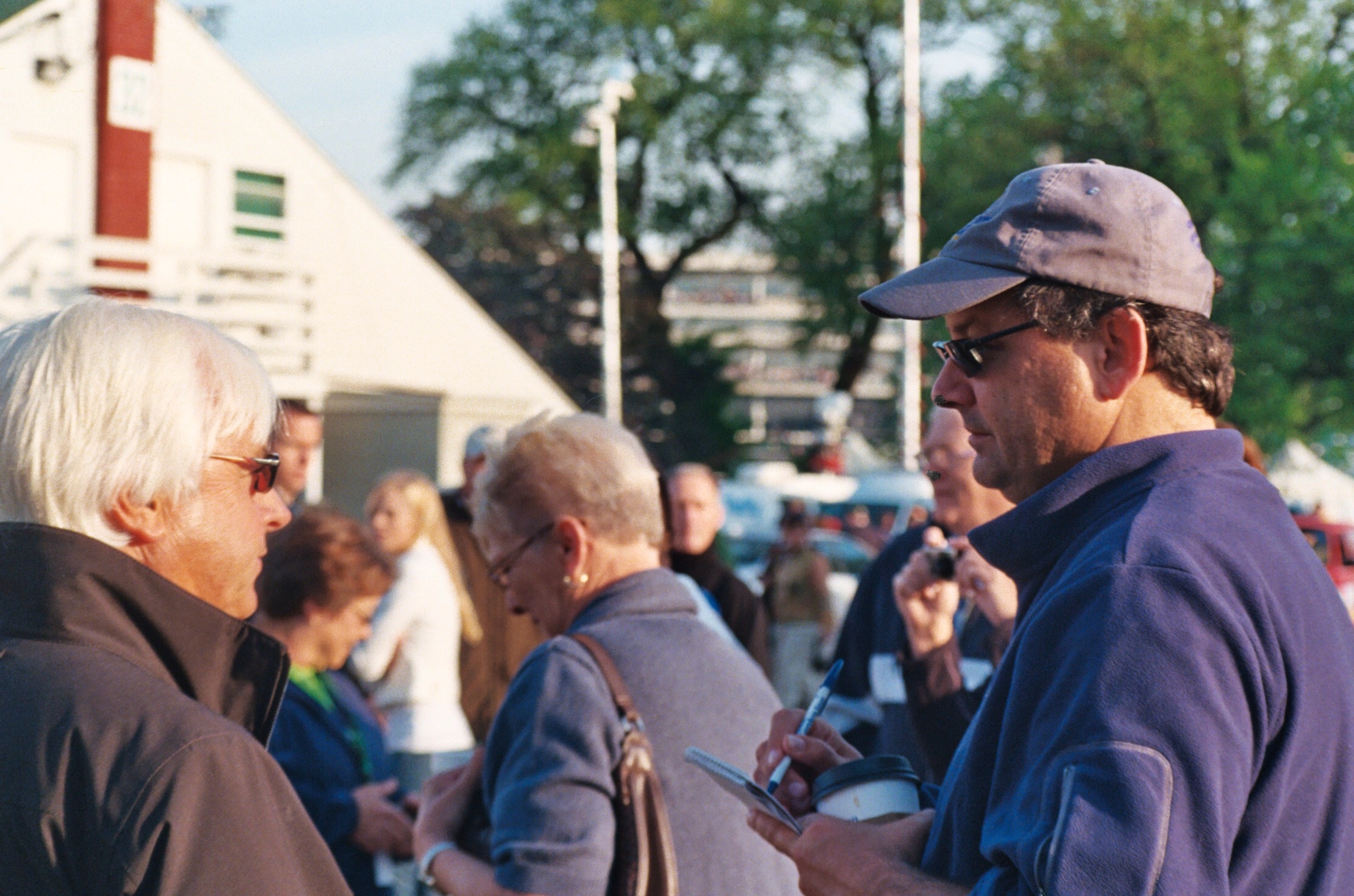
Bob Baffert (left) and Joe Drape


Then Baffert appeared, wearing pressed jeans and wearing his trademark sunglasses. After posing for a photo with some fans, Baffert began talking with Joe, who had concluded his interview with Gomez. Joe introduced me to Baffert, and the three of us talked for a couple of minutes. We talked about Lookin at Lucky’s unlucky post position, No. 1, on the extreme inside, where he was likely to get squeezed as the outside horses pushed toward the rail. We talked about the weather forecast — heavy rain — and how Lookin at Lucky might handle a sloppy track.  

As the conversation began to lag, I decided on the spur of the moment to ask Baffert a question about the horse that I liked — Noble’s Promise. Like Lookin at Lucky, Noble’s Promise prefers to run toward the front of the pack, and he would break from the No. 3 hole, just one spot removed from Lookin at Lucky. 

And so I spoke up: “Where do you think Noble’s Promise will be?” 

Baffert looked at me squarely in the eye and without missing a beat, replied, “I don’t have the slightest idea, and I don’t care.” And with that, he turned and walked away. I turned to Joe, smiled and said, “Sorry I killed your interview.”   

* On Derby morning, I went to the track by myself. The Derby is always sold out long before Derby Day, and I always try to buy tickets on track grounds for less than face value. My track record is good: I’m cheap, but I’m a pretty good negotiator, and I work various angles. 

In the Derby ticket game, I’ve found, marketing is very important. The people who stand around holding up their fingers, seeking, one, two or three tickets, usually don’t do that well. People who have extra tickets to sell tend to give prospective buyers a good looking over (in many cases, the buyer will be in a six-person box with the seller) and simply ignore a lot of would-be buyers. 

I always try to dress relatively well (although it was sprinkling Saturday, and I wore a green rain jacket over my shirt), and I always have a home-made sign. On Saturday, my sign read, “Need 1 or 2, for me (Jim) and my wife (Patty).” I thought the personal touch might be a plus, and it also achieved another purpose: It told sellers that I did not intend to buy the tickets and then resell them at a higher price. 

I staked out a position about 150 yards from the clubhouse entrance, away from an area closer to the entrance, where a few other buyers were lurking. To my left, people were streaming by on foot. To my right, cars full of people edged toward the valet parking area. Both lines of traffic — foot and vehicular — had a good view of me and my sign. I stood there smiling, not saying much. As the people came by, almost all of them looked at me and read my sign. A couple of people said something like, “Hey, what if you only get one ticket — who goes in, you or Patty?”  

After half an hour or so, a head popped up from the sun roof of a black SUV, and the person whistled and gestured at me. I slowly walked to the vehicle, and the woman seated in the front passenger seat displayed two first-floor clubhouse tickets — on the rail about 100 yards past the finish line. The face value was $162 each. “I’ll take $200 for them,” she said. “Will you take $200 for both of them?” I asked. “Yes,” she said. “That’s what I meant. I wouldn’t try to sell them for more than they’re worth.” Just like that, we had a deal. The family had two boxes, each with six seats, and they happened to have two more tickets than they had people.    

As I was walking away, the woman’s husband said, “Now, you’re not going to sell those, are you?” I assured him that I was going back to where I was staying to change clothes, pick up my wife and return to the track. I would be sitting with members of his family, and friends of theirs, for the 136th running of the Kentucky Derby. 

* Late Saturday afternoon, as the field of 20 Derby horses hit the top of the home stretch, I thought I had the Kentucky Derby winner. I let out a shriek as my horse, Noble’s Promise took the lead from two front-running horses who were slowing down. For several strides, Noble’s Promise, who had gone off at odds of 24-1, led the race. But just as quickly as he had taken the lead, he, too, slowed and relinquished the lead. Joe Drape had told me that Noble’s Promise, bred more for speed than distance, would not be able to survive the stretch run. He was right. 

Super Saver wins the Derby


Super Saver, the eventual winner, passed my horse. So did Ice Box, who finished second; Paddy O’Prado, who finished third; and Make Music for Me, who finished fourth. But not Lookin at Lucky. Oh, no, he finished sixth, one spot behind my horse. But, at that point, as the horses flashed by the finish line, I didn’t have the slightest idea where Lookin at Lucky was. And I didn’t care.

Read Full Post »

As some of you know, I was in Louisville, my hometown, all last week for the Kentucky Derby and related activities.

Despite a lot of rain on Saturday, Derby Day, it was a great time, and the city was throbbing with action and anticipation. On Sunday, the day after Derby, there’s always a bit of a letdown, a communal hangover, as people float back down to earth and try to return to their normal routines.

One thing almost all Louisvillians, as well as out-of-town visitors do on Sunday is read The Courier-Journal’s special Derby section, where people can read about all facets of Derby Day, from the race itself to the fashion on display and the celebrities who attended. The special section — usually 20 pages or more — takes weeks to plan and involves thousands of hours of work by editors, reporters, photographers, artists, designers, copy editors and others. It is always well done and as much a part of the Derby aftermath as rumpled suits and dresses and soiled Derby hats.

But this year there was a problem, a really big problem. For most of the Courier’s 240,000 Sunday subscribers, the paper — the news and Derby sections, anyway — did not come out on Sunday morning. Just after the presses began to run Saturday night, an unusual and fatal press failure occurred. Sunday morning, tens of thousands of people woke up and found only the pre-printed sections — opinion, the arts, features, etc. — in their boxes or on their doorsteps.

The “live sections” — the main news section, the Metro section, the regular sports section and, of course, the Derby section — were missing. Understandably, the calls began pouring in to the paper. I was staying at my uncle’s house, and he began calling before 8 a.m., getting a recording that said, “All circuits are busy.” 

Thousands of people, undoubtedly, went to their local convenience and grocery stores in search of papers, but what many of them found was what my wife Patty and I found — hand-printed signs on the doors saying, “No papers.” About the only place where some full papers were available were hotels relatively close to downtown and Churchill Downs. 

Later in the day, Courier-Journal President and Publisher Arnold Garson said at a news conference that the paper received “tens of thousands of calls.” The press failure, which Garson said involved “complex electronic circuitry,” did not affect the paper’s online presentation. The Derby stories and photos, and all the other “live” stories, were there. But it wasn’t the same.

“This is the worst possible time” for a press failure to occur, he noted. The paper had planned a run of 270,000 papers, Garson said, which would have allowed for single-copy sales of about 30,000. To learn more about the press failure and to  highlights of Garson’s press conference, click here

Almost all newspapers, including The Star, experience routine problems that interrupt the press run, but a catastrophic problem like the one The Courier-Journal experienced is extremely rare. And, unfortunately, it happened on the paper’s best-read, most-anticipated edition of the year.     

On Sunday afternoon and evening, the live Sunday sections were being printed in Indianapolis, as were copies of today’s paper. This morning, subscribers got Sunday’s live sections along with today’s paper. 

As a result of the press failure, The Courier-Journal suffered significant monetary losses. The greater potential threat, however, is a loss of confidence among subscribers. Even though newspapers have suffered significant circulation declines in the last decade or so, the bond between many communities and their daily newspaper is very strong, and it’s not due primarily to the online product — not yet, anyway. It’s because of the newspaper that people pick up in their yards, hold in their hands and read with their eyes. It’s one thing they count on every day. They might complain about the product, but they’ve come to expect it to at least arrive.   

Hopefully, most Courier-Journal subscribers will understand that the weekend debacle was an aberration. The incident should not significantly dent subscribers’ confidence in the company, but that doesn’t mean it won’t. These are tenuous times in the newspaper business, and readers have many more options. The Courier-Journal would be wise to reach out in some way to its subscribers to try to make amends for Derby Debacle 2010.

Read Full Post »

Plums & Prunes (5)

I have a quick anecdote to relate. Recently, I judged high school debates at Shawnee Mission North High School. The “bullpen,” where we waited for assignments, was the school library. 

In the morning, at one point, about 70 or more people were sitting at tables in the library, killing time while waiting. I knew that there would be some dead time, so I had brought The Star and The New York Times. It struck me early on that very few people were reading newspapers, even though stacks of the Thursday and Friday Wall Street Journal sat atop the library check-out desk (still wrapped in plastic until I ripped the stacks open).  

I decided to do some reconnaissance. I walked around the room and checked out what the judges-in-waiting were doing. Many (probably teachers) were doing paperwork; some were reading paperback and hardback books; some were playing with their cell phones; a few were listening to iPods; and some passed the time chatting. Only four people, including me, were either reading newspapers or had one nearby. 

This was my reaction: If you flashed back 30 years — same setting, same number of people — more than half probably would be reading a newspaper. 

Left me with an empty sort of feeling.

But, as keen observers all over the U.S. now like to say, it is what it is. I can’t change it, and neither can KC Star Editor Mike Fannin nor my many current and former journalistic friends and colleagues. All we can do is enjoy print journalism here in Kansas City for as long as it lasts and hope that’s many years to come.   

This week’s edition is truncated, due to the fact that I’m in Louisville, Ky., my hometown, for Derby Week activities. In fact, in putting the hurry-up on this week’s edition, I didn’t come across any obvious prunes. So, rejoice, Star staffers, my magnifying glass caught no blemishes.

Plums

~ “Little rest for West” (A-1, Friday, April 23) — Timely and in-depth profile of Kansas City’s foremost up-and-coming politician, Airick Leonard West, who recently was elected president of the Kansas City school board. This guy might be running for mayor in four or eight years. Story by Joe Robertson. Photos by Jill Toyoshiba.

~ “Connection revealed in KU ticket controversy) — (A-1, Friday, April 23) — Investigative reporters Mike McGraw and Mark Morris made sense out of the puzzling state of affairs surrounding the ticket-sale situation in Lawrence. McGraw and Morris relied on anonymous sources, but they cited sound reasons for granting anonymity: “speaking publicly about the matter could affect (the sources”) long-standing friendships and business relationships, or could disrupt the criminal investigation.” 

~ “Surprise! Downtown is back at the trough” (A-4, Friday, April 23) — Mike Hendricks made a case for not building a new downtown hotel: It would sap vital funds that otherwise could be used to improve neighborhoods in disrepair. He makes a good point, but this sure is a tough call because, to remain competitive as a convention and tourist destination (think Big 12 basketball tournament, among other things), Kansas City badly needs more close-in hotel rooms. With the Power & Light District, we crawled within striking distance of Denver and Indianapolis, and now the challenge is to remain competitive.

~ “It’s RIP for MAST in KC area” (A-1, Saturday, April 24) — Sara Shepherd brought the readers up to speed on the K.C. Fire Department’s takeover of Metropolitan Ambulance Services Trust, which had operated the ambulance service the last 30 years. Good photo by Mike Ransdell of “KCFD” letters being applied to the side of an ambulance.

~ “Campaign maneuver lets donors stay secret” (A-1, Saturday, April 24) — Reporter Dave Helling did his best to unravel the spaghetti junction of nonprofit organizations that are legally circumventing campaign disclosure laws in a bid to change the law to have Missouri judges elected rather than appointed by the governor. In this case, both the bad guys (those pushing for election of  judges) and the good guys (who want to keep Missouri’s nonpartisan court plan) are taking advantage of the legal loopholes.

~ “Arizona enacts stricter measure” (A-1, Saturday, April 24) — Good call by the editors to lead the page with the story about Arizona enacting a controversial law that comes down hard on illegal immigrants. Arizona’s action could accelerate Congress’s consideration of immigration reform.

~ “Stagnant government stalls quest to save pond” (A-1, Sunday, April 25) — Environmental (and investigative) reporter Karen Dillon recounted the maddening story of Sharon Berten of Gallatin, Mo., whose farm pond has been polluted by a nearby livestock sale barn. (For “the story behind the story,” see post from Tuesday, April 27.)    

~ “He put KC’s art museum on the map” — (A-1, Sunday, April 25) — Fitting and well-written retrospective on Marc Wilson’s 28-year tenure as director of the Nelson-Atkins Museum of Art…One caveat: Writer Alice Thorson should have told the readers how old Wilson is. In a “bio box” accompanying the story, she said he was born in 1941, which would make him either 68 or 69. But, as an editor told me long ago, “never make the reader do the math.”

P.S. In the story, Wilson gave a very fitting tip of the hat to the late Donald D. “Casey” Jones, a long-time Star editor and member. Wilson said the museum’s American Indian gallery would not be what it is without a generous bequest of art works and money from Jones, who died several years ago. Like the Nelson, I’m indebted to Casey: He hired me 1969,when I was a 23-year-old cub reporter.

Read Full Post »

Routine story? Hardly

One of the joys of a casual, thorough reading of the daily paper (the kind of reading you don’t do online) is the occasional story that makes me stop and admire the effort and creativity that went into the piece.

Such was the case with a Sunday, April 25, story that was ensconced on Page 4 of the Local section.

The headline was “Tina Porter testifies for child protection bill.” The writer was Jason Noble, who has been The Star’s Jefferson City correspondent the last few years.

This could easily have been a routine, ho-hum story, but Noble wasn’t about to let opportunity slip through his grasp.

Come. Take a closer look, through my eyes, as I read it and re-read it.

Here’s the lead, or first sentence of the story:

Tina Porter’s voice is too soft for this place where volume so often trumps substance, but when she begins her story, everyone falls silent.

In just one sentence, Noble has set a tone that says: Are you ready for something you don’t see at the State Capitol every day? He establishes a contrast between Tina Porter’s soft voice and the customary hubbub of the Capitol. And I know that a story is coming. Noble just told me so. How can I resist reading on? 

She is in a hearing room in the Missouri House, telling once more the story of how her children were taken from her.

“Hi,” she begins her testimony before the Crime Prevention Committee. “I want to respectfully acknowledge all of you.” But before she gets much further, the chairman reminds her to speak up, to speak into the microphone.

Noble lets me know the story is going to be gripping because, for God’s sake, it’s about Porter’s children being taken from her. At the same time, he requests my forbearance; she’s telling her story “once more.” And almost imperceptibly, without disturbing the flow of the story, Noble frames the backdrop for this day’s action: Porter is speaking to the House Crime Prevention Committee; she’s testifying. Also, notice that Noble doesn’t bother naming the committee chairman. It’s not important; it would just get in the way. The spotlight must be on Tina Porter.

Kansas Citians know her story well — how in 2004, Sam, 7, and Lindsey, 8, disappeared during a weekend with their father, Dan Porter, how he refused for more than three years to tell what happened to them, how he finally led authorities to their bodies, and how he ultimately was tried and sentenced for their murders.

In four precise phrases, Noble summarizes the story that most Kansas City area residents, including me, are very familiar with. And even I’ve heard it many times before, I appreciate the recapitulation. It’s been a while since I’ve thought about it. And for those who aren’t familiar with the story, Noble just gave them the gist of it, too, setting the stage for whatever new direction the story is taking with Porter’s testimony.

But these state representatives from eastern and southern Missouri don’t know her story. They need to now because Tina Porter has a request for them:

Subtly, through the unknowing eyes and ears of those state reps from eastern and southern Missouri, Noble has ushered me to the front door of this day’s story. Tina Porter has a request…I’m on the edge of my chair. What is it that this woman who has been through absolute hell wants? Just like those state reps who are hearing Porter’s story for the first time, I want to know. 

Don’t let it happen again.

She might as well have been swinging a sledgehammer. Don’t let it happen again. God forbid. Now I want to know specifically what does she want the legislature to do to prevent a similar horror from happening to others.

And with that, Noble has locked me up for the remaining 15 paragraphs of the story. He’s got handcuffs on my attention that are so strong and so tight that George Foreman couldn’t break them and Houdini couldn’t slip out of them.

Now…if you, too, are interested in knowing what Tina Porter wants the legislature to do, you can find out right here.

Read Full Post »

The story behind a story

For the most part, readers can’t tell what reporters go through in the course of gathering information for stories. A lot of times, there’s very little difficulty — just make a few phone calls, do some checking of previous stories and, bam, it falls into place.

Not so on others, however. And such a one was a long, investigative-type story by environmental reporter Karen Dillon that ran on the front page of The Star last Sunday, April 25.

The story, titled “Stagnant government stalls quest to save pond,” recounted the sorry experience of 69-year-old Sharon Berten of Gallatin, Mo., whose farm pond has been polluted by a nearby livestock sale barn. Everything was fine on Berten’s property until 2006, when a fellow named Danny Froman began operating a cattle sale barn across the highway from Berten.

Then, storm water began carrying chunks of manure into her pond, and the pond slowly went to pot. Adding insult to injury, one federal and two state agencies have dragged their feet, and a frustrated Berten says that local, state and federal governments have “thumbed their noses at me.”

The story stands on three legs: Berten, the government agencies and Danny Froman, the sale barn operator. Dillon carefully and fully documented Berten’s and the government agencies’ sides of the story. As I read through the story, I badly wanted to hear what Froman had to say. Early on, Dillon said, “Froman could not be reached for an interview over a period of several weeks.” That’s always frustrating to the reader — and usually the reporter, too.

Toward the end of the story, Dillon quoted some friends and employees of Froman as saying Froman wasn’t getting a fair shake. “Danny’s got a big, big heart,” Dillon quoted one employee as saying. “He did have a little manure get away from the barn. You know manure does that.”

From a pure reading of the story, without any input from Dillon, I wondered how hard Dillon had tried to get ahold of Froman. It seemed as if she might have just made a few phone calls before resorting to the “could not be reached” line, which is the standard whenever reporters can’t get through to someone on the phone. 

So, I sent an e-mail to Dillon asking if she had gone beyond phone calls. She responded promptly, and here’s what she wrote…

“I called Froman numerous times, but he didn’t return calls. So I and a photographer went to the sale barn a couple Mondays ago during the auction. Froman came out into the arena, and I tried to get him to answer some questions. He asked me politely to call later. While I was trying to talk to him, I was standing in a narrow aisle next to the arena with the photographer.

“A couple of his buddies pushed the photographer down the aisle to the door in what I now call a ‘belly sweep.’ I managed to avoid it by jumping into a corner. When it became clear Froman wasn’t going to talk, I looked around and by then the guys had my photographer outside the door of the barn. They agreed to talk, and that’s where the quotes about the big, big heart came from. It was a bit intimidating at the time, but I’ve been through worse.”

So, the most dramatic part of Dillon’s effort to get the whole story didn’t get in the paper. I wish it would have. Appropriately enough, reporters usually try to keep themselves out of their stories, but sometimes it serves readers’ interests for the reporters to involve themselves more deeply.

I think Dillon could have presented that incident in such a way as to show the extra effort she made to get Froman’s side of the story, without calling too much attention to herself. It would have made the story more interesting, and it would have satisfied the reader that Dillon had done everything within reason to try to get to Froman.

Read Full Post »

Circulation up slightly

Here’s some good news for local newspaper fans: Statistics released today by the Audit Bureau of Circulations — “the gold standard in media audits” — shows that The Star’s Sunday circulation rose 2.1 percent between Sept. 30, 2009, and March 31.

Saturday circulation was up by 1.3 percent, and weekday circulation was virtually unchanged.

Sunday circulation stood at 314,449 at the end of March, compared with 307,974 as of last September. Despite the period gain, circulation remains down significantly from March 31, 2009, when it was 333,006.

Saturday circulation, meanwhile, rose from 229,993 to 233,090 during the most recent reporting period. (Like Sunday circulation, that figure remains down from a year ago.)

Weekday circulation came in at 216,446, versus 216,226 as of last September. Daily circulation stood at 234,667 a year ago.

ABC issues new circulation figures every six months.

Read Full Post »

Plums & Prunes (4)

Before heading into the garden, I have a big thank-you to send out. Yesterday was a huge day here at JimmyCsays. The month-old blog had nearly five times its previous high number of viewers, and it was all because of a fellow blogger named Alan D. Mutter, whom I contacted a few days ago about blogging advice. 

In his blog, Reflections of a Newsosaur, Alan wrote about my Monday post, where I printed verbatim a 1994 speech by Arthur Ochs Sulzberger, then chairman of The New York Times Co. In the speech, given here in Kansas City, Sulzberger essentially dismissed the “information superhighway” as so much folderol. 

Jim Romenesko, who runs a blog on the website of the Poynter Institute, a nonprofit journalism school, then picked the story up from Mutter’s blog and linked to JimmyCsays. With that, the floodgates opened. 

So, my head is bowed and hat off today to Alan Mutter and Jim Romenesko…and also to Julius Karash, a friend and fomer Kansas City Star colleague, who had the presence of mind 16 years ago to save a copy of the speech he covered that night at the Westin Crown Center hotel. 

Now, as I waft slowly back to earth in my parachute, here’s this week’s edition of Plums & Prunes, a constructive critique of recent material in The Kansas City Star.  

Plums  

~ “He showed class for them; now they show class for him” (A-1, Friday, April 16) — If you can read Lisa Gutierrez’s story about cancer-stricken, wheelchair-bound Connor Olson and not choke up, you need to have your emotional meter checked. The school arranged a spur-of-the-moment graduation ceremony for Connor because his condition had worsened , and everyone was afraid he might not make it to the scheduled graduation. The last line struck like a head butt. Having made it through the ceremony, Connor was in pain. “We’re going home,” his Dad told him. “We’ll be there in a minute.” Tremendous photos by John Sleezer. The bad news: Connor died Wednesday night, surrounded by friends and family.   

~ “To youths, the Plaza is no place like home” (A-4, Friday Aril 16) — Columnist Mike Hendricks forced the reader to stop and reflect on the Plaza situation: It’s more complicated than meets the eye. The long-term fix involves “making…neighborhoods safer, more prosperous and filled with more opportunities” for young people.     

~ “A threat to children’s learning” (A-1, Saturday, April 17) — Another winner in the ongoing series about cuts to the Kansas and Missouri budgets. In this one, Jefferson City correspondent Jason Noble reported on reductions to the Parents as Teachers program in Missouri.  

~ “Dancing with the stars” — (A-4 photo, Saturday, April 17) — Sleezer scored again with an energetic, effervescent  photo of professional dancers leading Shawnee Mission West High School dancers in steps from “A Chorus Line.”  

~ “Community of mourners meets online” (A-1, Sunday, April 18) — Mara Rose Williams wrote a compelling report on how people, hundreds of thousands of them each month, write to the dead  on the website Legacy.com. Thomas Fahey, a 26-year-old Johnson County horse trainer who died in a plane crash in 2006, is one who gets a lot of “mail.”   

~ “For kite fanciers, to live is to fly” (B-1 photo, Sunday, April 18) — Fetching, horizontal photo of huge “creature kites” being flown a day earlier at the Longview campus of Metropolitan Community Colleges. Photographer Fred Blocher captured the fanciful image.  

~ “Health reform for the disabled” (A-1, Monday, April 19) — Business writer Diane Stafford, who serves up a regular regimen of reader-service stories, unveiled a little-known facet of the health care reform act — an insurance pool to help workers who become injured or ill pay for long-term care.     

~ “A mission for music in KC” (A-8, Tuesday, April 20) — In a “tribute” obituary, Brian Burnes unveiled the interesting life path of former Kansas City Symphony cellist Norman Hollander, who died April 7 in Greenwich, Conn.  

Target Field

~ “Twin Cities’ pride is also KC’s” (D-3, Tuesday, April 20) — Business writer Kevin Collison took the readers behind the facade of the new Target Field, which looks inviting on TV. Designed by Kansas City-based Populous, the field has many environmental features, including “a massive cistern system buried under the warning track to contain storm water that will be filtered and reused to wash down the seating bowl and for irrigation.”  

~ “Reform debate ropes in all sides” (A-1 Wednesday, April 21) — A good, explanatory story by Dave Helling on the financial reform package that Congress is grappling with. Helling gave it a “local” touch by quoting Missouri Sen. Claire McCaskill.    

~ “Earth Day finds itself in a pickle, politically” (A-1, Thursday, April 22) — Winning headline and story about Earth Day turning 40. Reporter Matt Campbell applied a light and breezy touch to the political storm that is global warming. The story was accompanied by a snappy help box listing simple things people can do to help the environment…like giving up bottled water and driving less.

Prunes  

Bag of prunes

#% “Ire rises as fees hit new altitude” (A-1, Sunday, April 18) — Transportation writer Brad Cooper certainly had me worked up…until, that is, I looked behind the front wall of his story on Spirit Airlines announcing that it would charge $45 for carry-on luggage starting in August. If you go to Spirit’s website, you find that the $45 applies only if you check your carry-on at the gate. If you do it by phone or online, it’s $30, and if you become a member of the Spirit “club,” the fee is just $20.  This is a case of selective reporting, presenting the readers with limited facts that make the story as dramatic as possible. Poor form. (Cooper also didn’t bother to tell readers whether Spirit charges for checked bags. It does.)  

#% “Truman Medical puts the gourmet in hospital grub” (A-1, Tuesday, April 20) — Nothing wrong with this story about a Truman Medical Center pilot project to improve the quality of patient food; it just doesn’t deserve front-page “play,”  at least not on this day. This is an attempt by the editors — often valid — to give readers some relief from the tide of heavy, serious stories that roll off the front page. However, some days, it doesn’t pay to put formula over function. A good substitute for this story would have been a New York Times offering about how hackers broke into Google’s password system that controls access by millions of users worldwide. 

Etc. 

:: “Spark is lost” (B-1, Wednesday, April 21) — Sam Mellinger captured the perseverance, adventurousness and energetic spirit of former Kansas State quarterback Dylan Meier, who died Monday in a hiking accident in the Ozark National Forest in Arkansas. But I, along with many others who have hiked in Newton County, would like to have had a better fix on the location. At the very least, the editors could have ordered up a locater map. 

:: Congratulations to The Star for winning the Robert F. Kennedy Journalism Award for its five-part series last year on human trafficking in the United States. Last month, Investigative Reporters and Editors Inc. honored the series, which was reported and written by Laura Bauer, Mike McGraw and Mark Morris.

Read Full Post »

Today, I have a special treat for you. It’s the transcript of an amazing speech that Arthur Ochs Sulzberger, known as “Punch,” gave in Kansas City on May 25, 1994.

In the speech, Sulzberger essentially dismissed the “information superhighway” that was careening full speed at print journalism’s front end. He comes off, alternately, as naive, confused, insightful, smug and wary. As an example of his naivete, he refers twice to America Online (now AOL Inc.)as American Online.     

Arthur Ochs Sulzberger

At the time of the speech, Sulzberger was chairman of The New York Times Company. Two years earlier, he had stepped down as publisher of the newspaper that bears the company name, passing the publisher’s mantle to his son, Arthur Ochs Sulzberger Jr., who remains publisher of the paper and also is chairman of the company. 

The elder Sulzberger, now 84 and retired, was the guest speaker at Midwest Research Institute’s 50th annual dinner, held at the Westin Crown Center hotel. 

I got a copy of the speech from an old friend and former Kansas City Star colleague, Julius Karash, who covered the speech for the business desk and wrote an article for the next day’s paper. Julius had the presence of mind to save the speech, and the subject came up when we had lunch last week. I got it in the mail today. (Thank you so much, Julius.)

Here’s the speech, as taken from the transcript.   

“Thanks you for that generous introduction.

“A number of years ago, in a speech at the Rochester Institute of Technology, I noted that a disproportionate number of this country’s fine newspapers were family owned. My conclusion was simple. Nepotism works.

“This evening I should like to try out another old-fashioned view. It is my contention that newspapers are here to stay. They are not going the way of the dinosaur – rendered extinct, in this case, by the wonders of a new technology that will speed us down an interactive information superhighway of communications.

“I’ll go one further. I believe that for a long time to come this information superhighway, far from resembling a modern interstate, will more likely approach a roadway in India: chaotic, crowded and swarming with cows. Or, as one might say, udder confusion.

“While this information highway remains ill-defined, there are, nevertheless, many players wanting to become involved. Such companies include regional and long-distance carriers, cable companies and newspaper organizations, to name a few. But the risks can be high and some big players such as Cox Enterprises, Bell Atlantic and Southwestern Bell recently announced grand schemes only to later call them off.

“There are few, if any, clear road signs, and many would-be players share in the dilemma of not knowing which way to move, while, at the same time, fearing to be left behind. The costs of entry can be heavy and many organizations still remember being badly burned by betting on the wrong technology.

“James Batten, chairman and CEO of Knight-Ridder, owners of the ill-fated Viewtron Information System, recently was quoted in Business Week as saying Knight-Ridder still remembered and wasn’t ready at this time to take any mega-multimedia gambles. “If we were enthusiastic about one of these technologies,” he noted, “we would not be afraid of stepping up to the plate.”

“It’s a dilemma. Some years and many dollars ago, my company struck a deal with Mead Data Central to take over The New York Times Information Bank, our money-losing retrieval system. Mead had by that time developed a retrieval ability with its Lexis System used by law firms. For years our relationship was a sound one, rapidly turning us a profit after many years of loss. Suddenly, to our surprise, the electronic part of Mead is put up for sale, confusing the scenario.

“Like young bucks we had felt a springtime urge to participate in the new information-based explosion. Like others, we were fearful of seeing competitors speeding down the information superhighway as we were left stranded on a service road. But, like Knight-Ridder, we see no clear path at this time which calls for a major commitment to a single technology.

“We have, therefore, hedged our bets. We cut a deal with an old protagonist – Dow Jones, publishers of the Wall Street Journal – to distribute via p.c. The New York Times News Service with theirs. At the same time, we are working on a service with American (stet) Online to make available our cultural and entertainment report. CBS and The Times are working together on an interactive CD-ROM of the Vietnamese War. Our sister paper, the Boston Globe, is having discussion with American (stet) Online. And Prodigy is talking with our Magazine Group.

“But as we search and hope that some of these technologies, alone or combined, will click, we realize that we are a long way from saying goodbye to our newsprint suppliers.

“To the contrary. We have renewed our faith in the written word by acquiring for more than a billion dollars in stock one of the country’s great newspapers – The Boston Globe.

“But let me at the same time assure those among you who…may be shareholders. We are not complacent in our belief. We recognize that a newspaper to survive must meet the needs of readers and advertisers. In a world filled with information and almost unlimited reader and advertiser options, one can no longer rely on customer understanding and goodwill (to allow) for poor quality or early deadlines and incomplete stories. Nor will the advertiser long sit still if his ad does not pretty quickly jingle the cash register.

“Frankly, neither the reader nor the advertiser is particularly interested in our problems. Nor should they be. They just want results – the kind of results that basically flow from good journalism rather than technology. Alas, one thing is clear: new technology alone won’t improve a lousy newspaper. Only an editor can do that.

“Nor do I see news on demand substituting for a daily newspaper. Reader Jones might well have a deep interest in ice hockey, grain futures and foreign policy issues affecting China. A computer can easily assemble such information from many sources. But this compilation is a far cry from a newspaper.

“When you buy a newspaper, you aren’t buying news – you’re buying judgment. Already in this low tech world of instant communications there is too much news. That’s the problem. Raw news will do just fine if you’re a computer buff and want to play editor. But I, for one, would rather let a professional take the first raw cut at history and spend my leisure time fishing.

“And while you’re thinking about newspapers, don’t forget serendipity. How many times has one opened a newspaper to discover some fascinating tidbit you never would have had the wit to search for in a computer?

“Judgment, serendipity and something left over to wrap the fish, all neatly folded, in living color, and thrown at no extra cost into the bushes. All for just a few cents a day. It’s called a newspaper. And when you add a wee bit of ink for your hands and top it with a snappy editorial to exercise your blood pressure, who needs that elusive interactive information superhighway of communications.

“Just point me to the fishing hole! Thank you.”

Read Full Post »

At 130 years old, The Kansas City Star is a “mature” company. In recent weeks, however, it is showing signs that it is developing a broader, more mature view of its journalistic mission than it exhibited in the immediate wake of the newspaper implosion a few years ago. 

It has been encouraging to me — and I trust to other serious readers — that The Star has been giving readers a broader array of front-page stories, aimed at informing readers not only about developments in the Kansas City area but also the nation and the world.

Several years ago, top managers at The Star, following the lead of many other metropolitan dailies, got it into their heads that revitalization hinged on local coverage and appealing to younger readers. Before I retired in 2006, the newsroom rule was that there had to be at least three locally written stories on A-1 every day. That artificial quota only served to push a lot stories out front that were not worthy of Page 1.

In addition, it didn’t stem the downward spiral of circulation and advertising. Now, I think, Star editors have come to the realization that they can’t lure the younger set with puff pieces that don’t appeal to core readers, those 50 and over. For now, at least, the vast majority of young people have given up newspapers in favor of the Internet and social media.

As the paper lost money, laid off employees and literally shrank in size, circulation continued to drop. The most frequent complaint I have heard about the paper is, “There’s nothing in it.” I believe, however, that people can and will adjust to the lower page count and smaller news “hole,” provided that The Star will give the readers substantive and interesting content from front to back. 

Lately, it seems to me, the paper is returning to its roots and emphasizing solid content. It may still go down in flames, but if it does, it won’t be because of gimmicky, goofy front-page stories.

Here are just three recent examples of prominent front-page stories that served Star readers well:

Wednesday, April 7 — At the top left part of the page was a large, riveting photograph of police officers in Kyrgyzstan trying to ward off an attack from people protesting the country’s repressive rule. Even if you have trouble pronouncing the name of the former Communist bloc country, the story is important to Americans because the upheaval could pose a threat to the American military supply line into nearby Afghanistan.   

Thursday, April 15 — The “lead” story (upper-right part of the page) was about the drug-related murder spree in Ciudad Juarez, Mexico, across from El Paso. While the problems there don’t pose a direct threat to us in Kansas City, the specter of uncontrolled violence in a border city of 1.3 million people is cause for great alarm anywhere in North America. Moreover, if the bad guys win in Ciudad Juarez, more drugs will be coming into the U.S. 

Friday, April 16 — The lead story, under an eery, horizontal photo, was the ash cloud that grounded thousands of flights in northern Europe and left tens of thousands stranded in airports. Why is that important here? Try these: The volcanic eruption in Iceland was unique and visually captivating; thousands of Americans are in northern Europe every day; and at any particular time lots of Kansas Citians are likely to have relatives or acquaintances traveling in Europe. Again, it’s not just the situation itself but the linkage that contributes to the story’s appeal throughout the U.S.  

I have always believed that the mission of a major metropolitan daily is to give readers cogent, interesting reports of the most important news — and news analysis — at the local, state, national and world levels. You shouldn’t have to take The New York Times to get a solid picture of what’s going on at the upper tiers.

I started taking The Times more than a year ago because I wasn’t getting all the news that I needed and wanted from The Star. And even with what I see as The Star’s broadening scope, I won’t stop taking The Times. I have the time to read it, and now, having become accustomed to getting a truckload of information and analysis about national and international events, I’m not about to retrench.

But I think it’s fair to say that The Star has been shedding its hyper-local blinders and is making a bigger effort to give its readers, if not All the News That’s Fit to Print, at least A Better Front Page.

                                                               *****

Etc. — One piece of news, two different interpretations

On Friday, Gannett Co., the nation’s largest newspaper publishing company as measured by total daily circulation, reported its first-quarter earnings. A story on the website of Editor & Publisher, the newspaper industry’s leading trade publication, bore this headline: “More evidence of newspaper turnaround: Gannett doubles Q1 profit as revenue decline moderates.”

The E&P story began by saying that Gannett reported a first-quarter profit that was double its first-quarter earnings in 2009. More than halfway into the story, the readers got this piece of information: “Overall operating revenue was off 4.1 percent.”

Morningstar, an investment-research company that analyzes stocks and mutual funds, put a different spin on the same set of numbers. Its one-paragraph summary to subscribers began with this: “Gannett’s first-quarter sales fell 4 percent from the prior-year period, supporting our thesis that the newspaper industry is in perpetual decline.”

Would the following be a fair interpretation of the difference in the reports? Where E&P was looking at the trees, Morningstar was looking at the forest.

Read Full Post »

Plums & Prunes (3)

Before launching into Round 3 of Plums & Prunes, I want to tell you about an e-mail exchange with Mike Fannin, editor of The Star.  

Fannin

In a message last week, I told Mike, a fellow Kentucky native, about my blog, saying it was mostly about journalism and inviting him to check it out. He wrote back: “Jim: I appreciate the invite. No offense intended but I generally don’t have time to waste on things like this. Good luck and stay in touch.
Regards, Mike.” 

Well, now, you probably wonder, did that make me mad? Nahhh. After 38 years in journalism (37 as a reporter and assigning editor at The Star), it takes more than a brush-off from an editor to raise my hackles. But it does make me wonder why the top editorial person at the paper would be so dismissive of a constructive critique of his product. If I were in Mike’s shoes, I think I would want to know what others thought about my product, especially at a time when the public increasingly has been turning its back on the paper.      

Onward and upward, then! 

Plums 

~”That’s two lives with one liver’ ” (A-1, Friday, April 9) — Fascinating story about how a man named Richard Gross, whose liver was creating a particular health problem for him, donated his liver to another fellow, who should be able to get decades of use from it. Meanwhile, the donor also got a new liver, and his prospects look bright. Story by Donald Bradley.  

~ “A new tone amid further disclosures” (A-1, Saturday, April 10) — It took a month, but The Star finally got the reignited priest sexual-abuse scandal on the front page. The packaging was outstanding, with the latest developments being “teased” (guiding to inside stories) under a photo of a somber-looking Pope Benedict XVI. The reader’s eyes then track down to a top-notch, bottom-of-the-page story about Kansas City-based National Catholic Reporter, a weekly that has doggedly been reporting on the scandal for 25 years. Story by Laura Bauer of the metropolitan staff and Eric Adler of the features department. 

~”Public payrolls weathering recession” (A-1, Sunday, April 11) — Only the newspaper can and will do this kind of story. The Star analyzed a database of more than 160,000 area public employees’ pay in 2009 and came out with a cogent report that  must have left many readers seething. Among other things, Michael Mansur reported that more employees are making $100,000 a year and more also have moved into the $50,000 to $100,000 range.  Let the good times roll.  

~ “$506 million in budget cuts” (B-1, Sunday, April 11) — Extremely clear and well-written budget-cut story by Jason Noble of the Jefferson City bureau. After noting that Gov. Jay Nixon and the Senate Appropriations chairman were pleased that the cuts would keep expenditures in line with revenue, Noble wrote, “But, oh, at what a cost,” and proceeded to detail the painful cuts. 

~ “County gets tough on keeping people in jail” (B-3, Sunday, April 11) — Police reporter Christine Vendel kept up the good work on revoked drivers, reporting that prosecutors are following up on their pledge to crack down in the wake of sixth-grader Damien Slayton’s death at the hands Clayton (Revoked and Dangerous) Dunlap.        

~ “Joyful winner is good for golf” (A-1, Monday, April 12) — Edgy column, painting Tiger Woods as villain, by Jason Whitlock on Phil Mickelson’s victory at The Masters golf tournament.  

~ “A lifeline is languishing” (A-1, Monday, April 12) — Another strong entry in the paper’s occasional series examining budget reductions in Kansas and Missouri. This one, by Lee Hill Kavanaugh, is about cuts to the Missouri Kidney Program.  

~ “Police seeking Plaza solution” (A-1, Tuesday, April 13) — After dragging its feet for a day, The Star got aggressive on the Plaza melee story. (For more on this, see post from Wednesday, April 14.) 

~ “Ignoring danger signs” (A-1, Wednesday, April 14) — A gut punch of a story about the increased risk of irreparable heart damage that patients without health insurance run. Written by Alan Bavley. Accompanied by a bold and beautifully framed photo by David Eulitt. 

~ “Speculation still stirs over horses’ deaths” (A-1, Wednesday, April 14) — In a piece that made me want to kick something, reporter Grace Hobson probed the death of 18 horses, some of them former Thoroughbred race horses, who died while in the possession of the daughter of former Woodlands’ trainer Jim McCoy. McCoy died last August. Neighbors and others contend the horses died because they did not get enough to eat. 

~ “A hunt to behold” (B-1, Wednesday, April 14) — Outdoor writer Brent Frazee weighed in with a touching and inspiring story about a blind 14-year-old, Charlie Wilks, who was able to shoot a 24-pound turkey.    

~ “In twilight of his career, Sen. Bond keeps active” ((A-1, Thursday, April 15) — Washington correspondent David Goldstein beckoned the reader into this story with an inviting first sentence, “The calendar says spring, but for Sen. Kit Bond, it’s autumn.” 

 ~ “A new era begins for Kansas City School Board” (A-1, Thursday, April 15) — Centerpiece photo of the new king of the educational hill in K.C., Airick Leonard West. Photo by Eulitt.  

Prunes  

#% “Seizing the moment” (B-5, Friday, April 9) — Mike DeArmond story about the introduction of Robin Pingeton as the new women’s basketball coach at the University of Missouri seemed innocuous…unless, that is, you also happened to read the Associate Press account. The AP story said that Pingeton went out of her way, at the news conference, to emphasize her Christianity and family values. That raises the specter of putting her at odds with people who don’t drape themselves in those values, including gay women supporters of the team. It was a significant omission by DeArmond. (For more on this, see the post from Monday, April 12.) 

#% “Some smell the coffee, crusade for Folgers plant” (A-1, Saturday, April 10) — There’s nothing wrong with the thrust of this; it’s a legitimate front-page story about an attempt to keep the Folgers plant from closing. My gripe is that in two front-page stories about the announced closing, business writer Randolph Heaster has yet to quote a single plant worker. (I chatted with a worker for 10 minutes while shooting photos outside the plant Tuesday. He’s 60 and going to retire.) It’s long past time for Heaster to get the phone out of his ear and put his shoes on the pavement. 

P.S 

* “Meche has a bad day in first start” (B-2, Monday, April 12) — It’s a good column by Sam Mellinger, but he didn’t get any help from the copy desk (the quality control center) when he wrote, “That jives with what Meche calls…” Should be “jibes.” Jive” has several meanings, but none has anything to do with being in accord.

Read Full Post »

« Newer Posts - Older Posts »