Feeds:
Posts
Comments

There’s nothing like bad news in the newspaper business to make a semi-retired blogger forgo golf on a beautiful Thursday in Kansas City.

But this is really big and unpleasant news for The Kansas City Star.

(I hate to be ghoulish, especially the day after Halloween, but, as you know, it’s still the bad news — arson convictions, super storms and the like — that prompts some of us to jump out of bed every morning.)

On Tuesday, the Audit Bureau of Circulations came out with its circulation numbers for the period from March 1 to Sept. 30.  The numbers show that, over the last year, The Star has lost at least 8 percent of its subscribers in the three major circulation categories — Sunday, Monday-Friday, and Saturday.

To me, that is a breathtaking loss, even in these days of a relentless circulation retreat for major metropolitan dailies throughout the country.

It has to be terrible news for publisher Mi-Ai Parrish, who told readers in a recent column that The Star would implement in December charges for online access to The Star’s content.

As an aside, Parrish foolishly teased readers in her column by laying out absolutely no specifics. For instance, she didn’t say if print subscribers would have to pay for digital content, and she gave no idea how much subscribers and others might be charged for online access. To me, that is the equivalent of telling an employee that he or she is going to get a pay cut at the end of the year and then saying, “We’ll tell you in December just how much your paycheck is going to be slashed.”

But back to the new numbers…

As of Sept. 30, The Star’s average Sunday circulation was 275,784, including online subscriptions. That compares with 300,450 at the same time in 2011.

Not only is that an elevator-crashing percentage (8 percent), but the paper also now appears to have lost any chance to stay at or above the 300,000 mark for Sunday.

That 8 percent decrease will either force The Star to drop its advertising rates or almost certainly will drive some advertisers away.

Average daily circulation also plummeted 8 percent, from 199,222 to 183,307. Saturday circulation fell 8.5 percent, from 204,919 to 187,343.

For the daily paper, 200,000 is another key benchmark that The Star has been clinging to and which now appears out of reach.

What makes these new numbers even more disturbing is that just six months ago, ABC’s statistics for the six-month period ending March 31, showed average Sunday circulation at 310,500 and average daily circulation at 200,365.

Search me as to what went haywire the last six months, but it would appear that April stats were simply an aberration.

I suppose the new numbers shouldn’t be too surprising because a recent Pew Research Center study showed that the percentage of Americans who read printed newspapers has fallen from 41 percent in 2002 to 23 percent now. In addition, a New York Times Co. survey found that just 22 percent of 18- to 34-year olds read print newspapers, compared to 53 percent in the over-55 age category.

In the past, however, The Star, has been relatively fortunate because its circulation dipped less rapidly than that of many other papers. I attribute that partly to Kansas City being a good, deep-rooted newspaper town (thank you, William Rockhill Nelson) and The Star having maintained a quality product while the content of many other metropolitan dailies has slipped badly.

Now, though, it looks like the whirlpool has The Star firmly in its grasp.

To a blogger who spent 37 mostly happy years writing and editing for the powerhouse (still) at 18th and Grand…that is very disappointing.

Way back in the days of Watergate, most newspaper-business watchers would have said that The Washington Post and The New York Times were neck-and-neck as the two top general-interest papers in the country.

Some people would have said, based on the Post’s astonishing scoop that eventually brought down President Richard Nixon, that the Post was the superior paper.

No more. Oh, no. In horse racing parlance, The Times has proved to be the equivalent of the great Secretariat, while The Post has been exposed as a sprinter that folds after three-quarters of a mile.

Consider:

:: While The Times has had some employee buyouts, The Post is in its fifth round of buyouts since 2004.

:: Based on a flexible “pay wall,” The Times last year launched a well-thought-out campaign to increase online subscriptions. Since then, the paper has added more than 450,000 digital subscriptions.

:: The Post, on the other hand, “hasn’t jumped into the world of online subscriptions and has suffered for it,” The Motley Fool, a multimedia financial-services company, said in an online story Thursday.

:: In reporting its first-quarter results last week, The Post reported a 10 percent drop in weekday subscriptions between the first quarter of 2011 and the first quarter of 2012, and a five percent drop on Sunday. “On the plus side,” said The Motley Fool, “newsprint costs dropped 11 percent because no one is buying the paper anymore.”

:: Between last Friday and yesterday, The Post Co.’s stock price fell 10.4 percent, while The Times Co.’s price rose 7.4 percent.

The Post is also showing signs of stumbling on the journalistic side.

Yesterday morning, The Post ran online a 5,500-word story by reporter Jason Horowitz about some of Mitt Romney’s high school escapades, including an incident when he and some friends held down a student they thought was gay and cut his hair off, while the student screamed for help.

Horowitz recounted another incident, based on accounts of students who witnessed the events, in which Romney shouted “atta girl” to a different student at the all-boys’ school.  That student later declared that he was gay.

The story generated huge attention and comment on Twitter and other social media, and as of last night the story had drawn more than 5,000 comments under The Post’s online story.

And yet, The Post did not run the story in Thursday’s print edition, although it clearly was ready to go Wednesday night.

The Poynter Institute, a non-profit school for journalism located in St. Petersburg, FL, quoted Kevin Merida, the Post’s national editor, as saying that President Obama’s historic declaration on Wednesday that he favored same-sex marriage same-sex marriage was a factor in the decision to hold off on running the Romney story in print.

Poynter also quoted Merida as saying, “It’s also just a very long and involved tale, sensitive and complex, and it needed to be edited to our collective satisfaction.”

However, Michael Calderone of The Huffington Post got a slightly different explanation from Steven Ginsberg, the Post’s political editor.

“We’re mindful of the news going on this week, particularly yesterday,” Ginsberg told The Huffington Post. “We thought it was better not to have it in today’s paper.”

“The (Obama and Romney) stories aren’t really about the same thing,” Ginsberg added, “but the perception among some might have been that putting them together would have created an impression we didn’t want to create.”

Ginsberg did not say, as Merida did, that the story needed more editing.

All in all, print subscribers had good reason to be irritated, at the very least, that they didn’t get Horowitz’ story in the printed edition.

As Andrew Beaujon, who wrote The Poynter Institute, said:

“I can’t be the only Post subscriber wondering why I’m paying for the print edition of the Post when something this important flies onto my porch a day after the political world has chewed it over and reacted already.”

Horowitz’s story was scheduled to run in today’s printed edition of the Post.

It’s not enough to prompt the staff at 18th and Grand to start singing “Happy Days Are Here Again,” but the latest figures from the newspaper Audit Bureau of Circulations do offer hope for better times — digitally speaking, anyway.

The figures, released yesterday, show that instead of dropping below the key 300,000 threshold, which seemed likely six months ago, The Kansas City Star’s Sunday circulation rose to nearly 310, 500.

In addition, Monday-to-Friday average circulation got its head back above 200,000 after falling below that benchmark in ABC’s September 2011 report.

That news on both fronts — Sunday and daily — must have Star publisher Mi-Ai Parrish and the other business-side executives breathing easier because those big, round benchmark figures are extremely important to advertisers. If The Star can stay above 200,000 daily and 300,000 Sunday and continue a gradual rise, it should be able to hold the line on print advertising prices, while waiting for digital-side circulation and advertising prices to move up.

Tuesday’s report showed that most newspapers across the country gained readers in the last six months, compared to the same period a year ago, primarily on the back of rising digital subscriptions. Nationally, average daily circulation was up nearly .7 percent for digital and print at the 618 papers reporting; Sunday circulation was up 5 percent at the 532 papers reporting.

In its report on the latest report, the Poynter Institute, a newspaper think tank in Florida,  said that digital circulation now accounts for 14.2 percent of newspapers’ total circulation, compared to 8.7 percent in March 2011.

The New York Times reported a 73 percent year-to-year gain in circulation, propelled by the growth of its online subscription business, which it launched last year. In fact, The Times’ daily digital subscribers exceed its daily print subscribers.

The nationwide jump in circulation is partly explained by new ABC reporting rules. A paying subscriber who accesses The Times on different digital devices — everything from a smartphone to a tablet to a desktop computer — could be counted three times in a single day.

Come on, Bill, how 'bout a little smile?

At The Kansas City Star, Sunday circulation still has a long, likely impossible road back to the glory days of the 1950s, when Sunday circulation probably was between 400,000 and 500,000.

In this day and age, however, it’s good to be able to cheer even minor newspaper-circulation achievements.

The Star owes its Sunday statistical improvement to a combination of higher print sales and higher digital subscriptions. Surprisingly, print sales rose by nearly 5,000 over the September 2011 reporting period, while digital subscriptions went up about 5,000. The digital increase was not a surprise.

You must keep in mind, of course, that digital subscriptions are not nearly as profitable as print subscriptions because the bulk of newspaper revenue is in print-side advertising.
On the daily front, print-edition sales of The Star dropped by about 3,400 from the September 2011 report, but digital subscriptions rose by 4,300, pushing total weekday average circulation to 200,365.

Saturday circulation stayed about the same — about 205,000 — from September to March.

The March report marks the one-year anniversary of ABC rules changes that allowed papers to include in their figures newspapers distributed through Newspapers in Education (NIE) programs and copies sold in bulk to places like hotels and restaurants. Those changes gave all daily papers a boost at a point when circulation had fallen sharply for at least a decade.

There’s always plenty of good journalistic fodder in sports.

Today, I have three things I want to call to your attention.

1) Last night, we saw a great example of a college athletic director — Jeff Long of Arkansas — putting principle above expediency.

Long announced at a press conference in Fayetteville that football Coach Bobby Petrino would not be returning next season, after Petrino witheld key details of a motorcycle accident he was involved in last week.

At the news conference, Long said that Petrino had “knowingly misled” the Razorback athletic department and the residents of Arkansas.

Petrino

The 51-year-old Petrino had been on paid leave after failing to tell Long that a 25-year-old female football program employee — a beautiful blonde — was riding with him when his motorcycle went into a ditch outside of Fayetteville. Petrino, who is married with four children, also admitted to “an inappropriate relationship” with the football program employee, Jessica Dorrell.

Petrino didn’t tell Long that Dorrell was on the bike with him until minutes before a police report was released last week. The police report disclosed Dorrell’s presence at the accident. Petrino suffered head and neck injuries, while Dorrell was uninjured.

Petrino recently completed his fourth season at Arkansas, and he had compiled a 34-17 record. He had a long-term contract paying him an average of $3.53 million a year. His contract contained a clause, however, that allowed the university to fire Petrino for “engaging in conduct, as solely determined by the university, which is clearly contrary to the character and responsibilities of a person occupying the position of head football coach or which negatively or adversely affects the reputation of the (university’s) athletics programs in any way.”

He certainly did adversely affect the school’s reputation. Because he violated that clause, the university will not have to buy out his contract.

In a story posted on ESPN.com last night, reporter Tim Keown noted that character questions about Petrino had begun long before Arkansas hired him in 2007.

Long

Keown wrote: “Long had to ask himself some simple questions leading up to Tuesday evening’s decision: How many different ways did this guy embarrass the university and play his bosses for fools, and how many wins would it take to forgive them? Apparently, the answers were equally simple: There aren’t enough wins on anybody’s schedule to keep Petrino on board and wonder what might come next.”

Hiring Petrino was Long’s first major move after he became athletic director in January 2008. Firing him on Tuesday was an even bigger move. Congratulations to Jeff Long. He’s taken a big step toward undoing the damage that Petrino did to the university’s reputation.


2) On the morning of the KU-UK championship basketball game in New Orleans, The Star had a picture of a KU player (at least I think it was a player) on the newspaper’s front page. Well, actually, it wasn’t on the front page; it was the front page. Took up the entire cover.

Subsequently, two or three authors of letters to the editor took the paper to task for dedicating the entire front page to a sporting event, even a very big one. I had been mulling over the wisdom of that editorial decision, but, then, another letter writer came along and said something to the effect of, “Hey, folks, it’s only one front page.”

So, I thought, “OK, I can buy that.”

But yesterday, however, a photo of KU star Thomas Robinson and his little sister took up about half the front page. The photo linked to an article on the front of the sports section about Robinson announcing his decision to turn pro, even though he has another year of collegiate eligibility.

I’m sure that the editors rationalized their decision to put the photo on the front page by the fact that Robinson and his sister Jayla endured tremendous personal losses when their mother and maternal grandparents died within several weeks of each other in late 2010 and early 2011.

That accounted for the headline above the photo: “Brighter Days Ahead.” That story was fleshed out all season long, however, and didn’t need to be highlighted again. I think that photo was inappropriate for the front page, especially coming on the heels of the all-KU front page a week earlier.

Why should The Star glamorize the fact that a basketball player, as good as he is, has decided to forgo his opportunity to graduate with his class and in favor of a mammoth contract with an NBA team? Don’t get me wrong; I’m not quarreling with Robinson’s decision — just with the editors’ decision to feature the story on the front page.

Air ball!

3) Unbelievable. That’s all I can say about New York Times’ golf writer Karen Crouse’s description on Monday of the shot by Bubba Watson that won the Masters golf tournament Sunday.

If you watched the two-hole playoff between Bubba and Louis Oosthuizen, you know that Bubba made an unbelievable shot from way off the 10th fairway. He hooked an iron shot around a tree line and onto the green. It was a spectacular shot that curved an estimated 40 yards.

Crouse

In Monday’s paper, however, Crouse wrote: “After driving into the woods, he sliced a shot onto the green.” For Bubba, a left-handed player, a slice would have been cutting the ball from right to left, not drawing it from left to right.

There’s a huge, huge difference between hooking a ball and slicing a ball; they go in totally different directions.

I wrote to the Times’ sports desk, saying, “What in the world was Karen thinking about? Certainly she knows the difference between a hook and a slice?!?!?”

So far, no reply. And no correction in today’s paper.

What a disappointment from my favorite newspaper.

Air ball! Oops, make that out of bounds. Go back to the tee and hit again, Karen.

Note: The Times ran a correction in today’s edition.

Got back yesterday from a three-day trip to Denver, where I saw the Women’s Final Four.

This was the first time I spent any considerable time in Denver, and I was impressed. I was all over the downtown area Sunday, Monday and Tuesday, from the land of tall buildings — office buildings, hotels, banks, etc. — to the distinctive LoDo area (lower downtown), with its bars, restaurants and storefront businesses.

One thing that makes downtown so accessible is that there is an abundance of street parking, with thousands of metered spots where you can park any time of night or day. There’s none of this “no parking 7-9 and 4-6,” like we’ve got here. In addition, paying is as easy as sliding your credit card into a slot and paying $1 an hour, maximum of two hours in most places.

I think the city makes a tremendous amount of money on parking violations, too. I saw several yellow envelopes containing citations under windshield wipers…In fact, two of those yellow envelopes ended up under the wiper of my rental car. (Not even grudgingly, I’ll make my $50 contribution to a city where parking is hassle free.)

Anyway, take a look at my latest travelogue…

The Pepsi Center

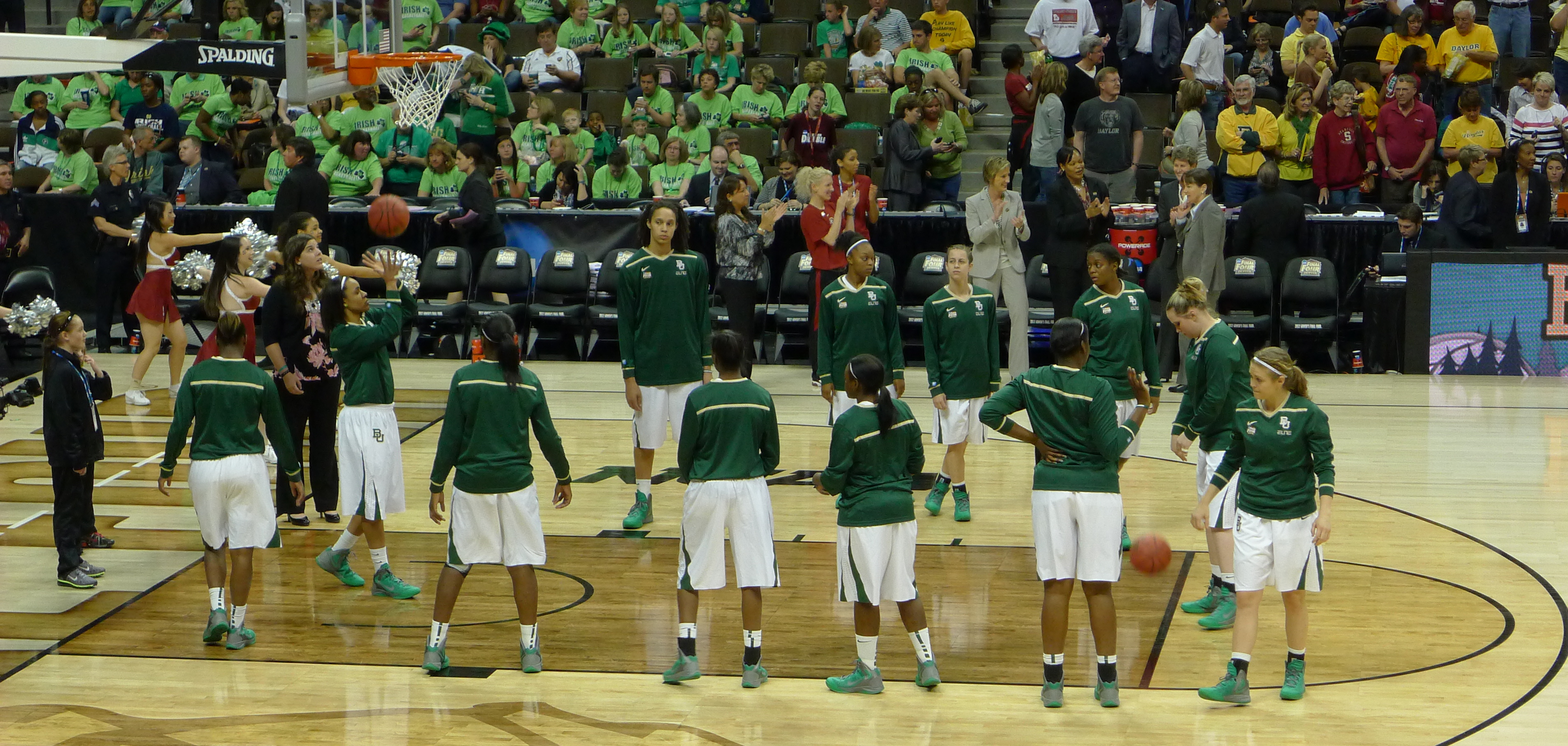
Baylor warming up before Sunday's semifinal game against Stanford. Brittney Griner, who ended up being the tournament's most valuable player, is at top center.

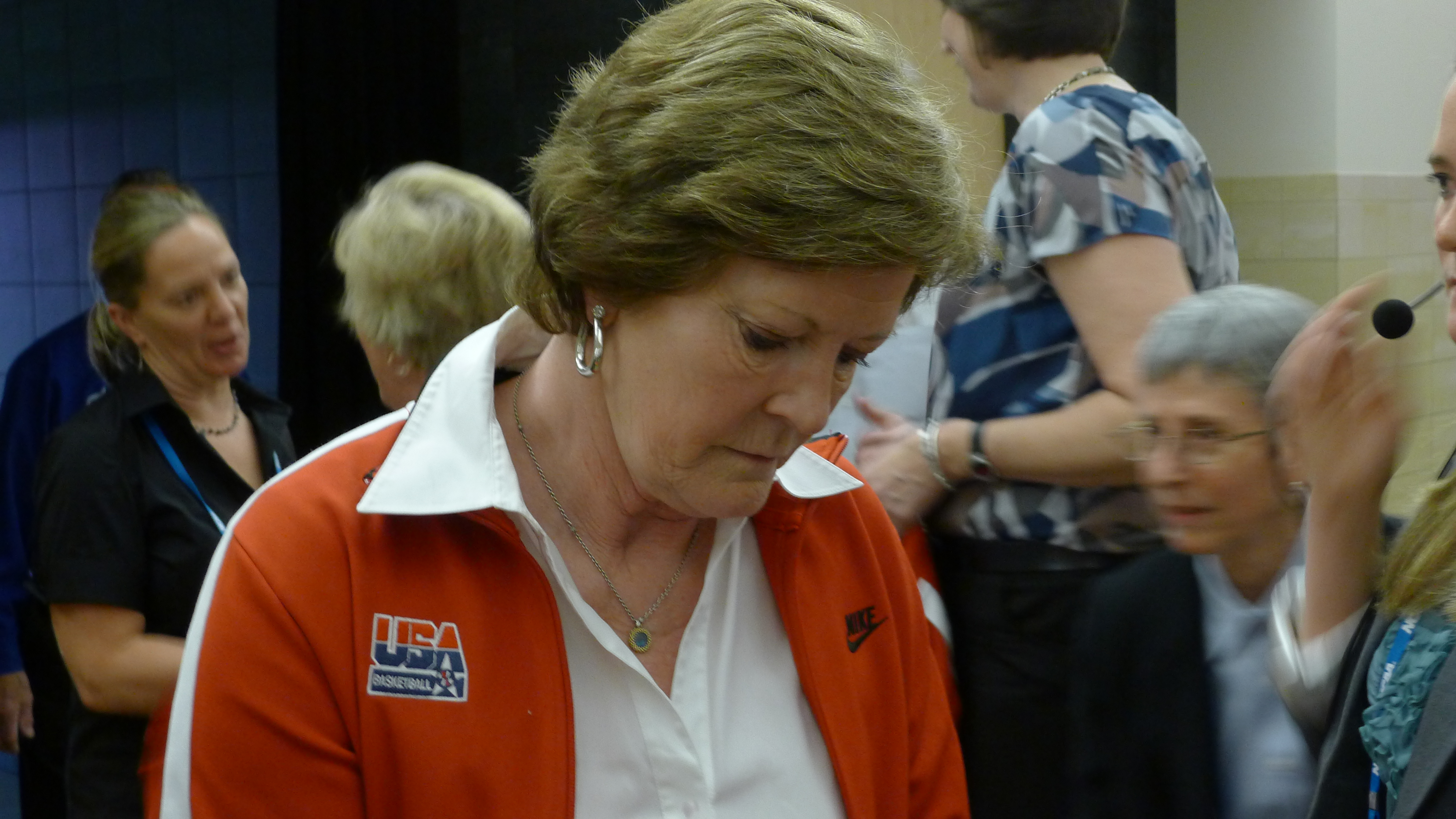
Pat Summitt, whose Tennessee Volunteers were not in the Final Four, drew more attention than anyone except Griner

Out on the streets...a snowy 16th Street Mall on Tuesday morning

The first part of customer service...

The Brown Palace Hotel, the second-oldest operating hotel in Denver (built, 1892). Harry Truman liked the Hotel Muehlebach but he also stayed at the Brown Palace.

The City and County Building (not City Hall, mostly courts)

A nice cigar store, Palma Cigars, in LoDo...Clay Carlton, proprietor and roller

I spent an hour on that couch, smoking a Don Pepin

Back to the action...The Sheraton lobby was the place to see and be seen Tuesday afternoon.

These ladies weren't in the Final Four, but they were my favorite trio by far...From left, Erika of Northwest Florida State, Stacey of New Mexico State and Lauren of Arizona State.

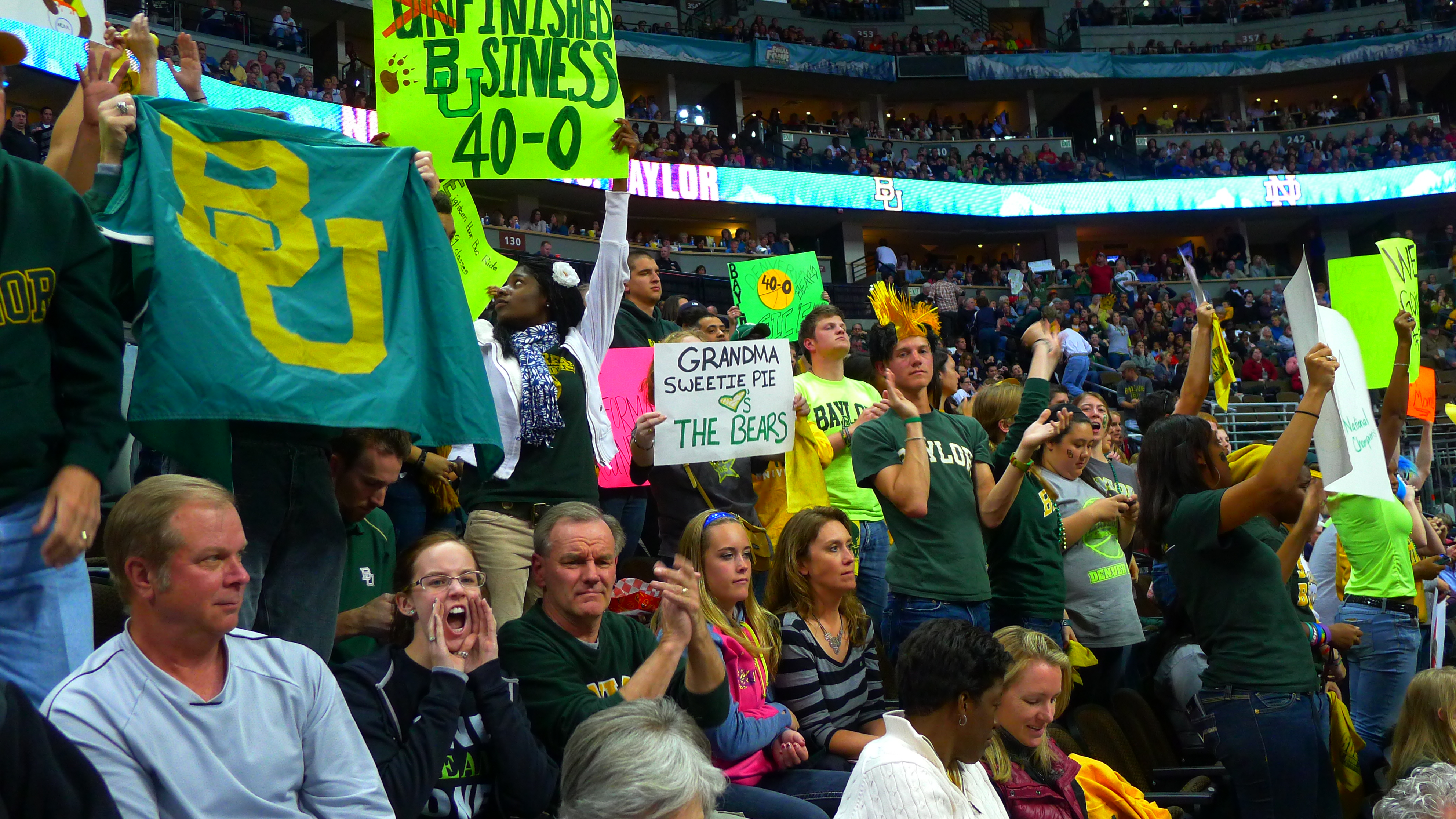
Baylor fans had a lot to cheer about in the championship game against Notre Dame.

I managed to talk a very nice usher into letting me sit in the lower-level, even though I had a third-floor ticket. My reward, besides getting a great view of the game, was to sit in front of these two ladies from Houston -- Heather (left) and Denise.

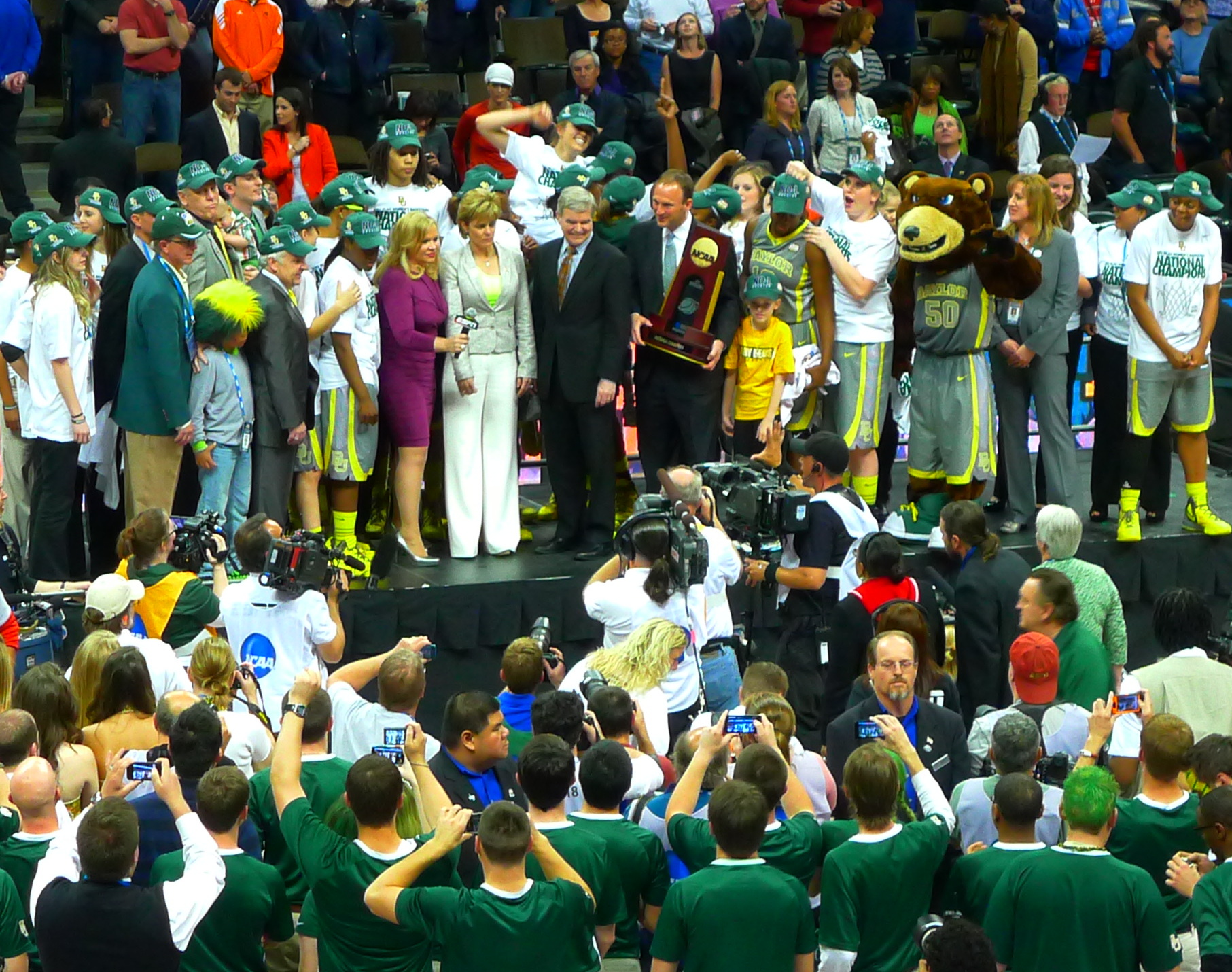
Baylor celebrates the 80-61 win over the Irish. (Coach Kim Mulkey is at left center.)

After the game, after the fans disperse, LoDo goes quiet. If there's a celebration, it isn't around here.

*******

Just to show Smartman that I also take photos of the beautiful woman who makes my life joyful and fulfilling, here’s Patty…

Central California coast, 2011

It’s always been interesting to me to see how two reporters covering the same event can come up with such different accounts — how one reporter can completely miss the mark while another takes deadly aim.

Such was the case with two newspapers’ coverage of Southeastern Conference Commissioner Mike Slive’s appearance Tuesday at the Kansas City Tiger Club meeting at the Westport Flea Market.

Fortuitously, I am in a position to compare The Star’s account against that of the Columbia (Mo.) Daily Tribune. I say fortuitously because, while driving around on Tuesday, I happened to hear, on the radio, either a lengthy excerpt of the event or a portion of live coverage.

When I tuned into the event, already in progress, I thought I was listening to a news conference, but the crowd was so boisterous and there was so much laughing and joking that I was thrown off balance. Only later, when I heard or read news coverage online, did I realize that it was an appearance before a large group of Missouri fans.

It was apparent from what I was hearing that Slive, who has been the SEC commissioner for almost 10 years, had the crowd in the palm of his hand.

Slive

He was answering questions confidently, and he was often droll and funny. It seemed like every other answer he gave drew a big, embracing laugh. It was clear that the crowd was enthralled.

So, when I saw a story about the event in The Star on Wednesday, I was eager to see if the reporter, Terez A. Paylor, would be able to re-create the energetic and enthusiastic atmosphere that permeated the Flea Market’s back room a day earlier.

I have to say, I was terribly disappointed.  Here’s how Paylor, who recently succeeded Mike DeArmond as Missouri athletics reporter, started his story:

It didn’t take Southeastern Conference commissioner Mike Slive long to realize the passion of Missouri Tigers supporters in Kansas City.

Slive was greeted warmly by a crowd of a couple of hundred fans Tuesday, as he served as the guest speaker at the Kansas City Tiger Club’s weekly meeting at the Westport Flea Market.

“If this is the energy from the University of Missouri that’s going to come to every one of our events, I’m gonna have to go home and warn our guys to be careful,”  said Slive, shortly after he was greeted with a standing ovation. “The energy in this room is phenomenal.”

And it remained that way over the course of an hour, as Slive, who came to Kansas City from the SEC’s offices in Birmingham, Ala., took questions and spoke about a number of pertinent issues, including the possibility of Kansas City playing host to the SEC men’s basketball tournament, the status of his conference’s television deals and the status of cross-division rivalries in football.

Paylor

It was a lame start, and Paylor went on to report, blandly, what Slive had to say about some of those issues that arose in the wake of Missouri’s decision to switch from the Big XII to the SEC.

Exactly where and how did the reporter fall on his face?

:: He talked about the passion of the fan club and the energy in the room, but other than noting the standing ovation, Taylor failed to show the reader how the interaction between the fans and the commissioner established the energy in the room.

:: He did not relate a single question that the fans posed to Slive, and he made no attempt to establish the humorous and convivial tone, which is what distinguished the event and spawned a strong bond between crowd and speaker.

Now, let’s set The Star aside and pick up the Columbia Daily Tribune.

Matter

Covering the event for the Tribune was a sportswriter named Dave Matter. I don’t know him, hadn’t read a thing he had written until I saw his story online this morning.

Here’s how Matter began his story:

Southeastern Conference Commissioner Mike Slive couldn’t have expected his biggest applause line yesterday to be a one-word answer.

A Missouri booster in the middle of a jam-packed crowd at the Westport Flea Market Bar & Grill asked Slive a perfectly reasonable question at the Tiger Club of Kansas City luncheon that sounded like this: Could you explain how the decisions were made to put Texas A&M in the SEC West and Missouri in the SEC East?

Slive’s reply came without hesitation.

“No,” he said.

The crowd, and Slive, erupted in laughter.

The 71-year-old Slive had the boosters rolling, but do not mistake the man for a court jester. Yesterday, he was feted like a king.

With several university and civic dignitaries in attendance, the SEC commissioner made his first public appearance in Missouri since November’s announcement that MU was joining Texas A&M as a 2012 addition to the SEC. For the 250-plus fans crammed into the booster club’s weekly watering hole, the buzz was still raging.

Look at some of the words and phrases that Matter uses to show, tangibly, how the bond developed and the energy burst forth.

— “…a jam-packed crowd”

— “The crowd, and Slive, erupted in laughter.” Note, it was a shared laughter.

— “…had the boosters rolling.”

— “…feted like a king.”

— “…the buzz was still raging.”

Raging.

And about that standing ovation…Paylor simply had it happening spontaneously, without explanation. But Matter…well, he framed the greeting by reporting that Missouri athletic director Mike Alden introduced Slive, calling him “the finest commissioner in all of college athletics and one of the most respected folks in all of sport.”

Now the reader can understand how a biased crowd could be catapulted into a near frenzy, can’t he?

Slive, as Paylor reported, later returned the favor to Alden, saying in answer to a question about the SEC’s $3 billion TV contract, “I am optimistic that we can make Mike Alden very happy.”

Another burst of laughter.

Everybody left happy…except those who weren’t there and had to rely on Terez Paylor’s reporting.

Today, a quickie…

Tell me — honestly — how much are we going to miss this guy?

(For the record, I don’t approve of a guy wearing a bow tie to be screaming at the top of his lungs, unless his life or the life of someone else is in danger.)

I’m sorry to see that in the face of opposition to a proposed daytime curfew for school-age children, the Kansas City Council has folded like a flimsy tent in a thunderstorm.

As you probably know, a City Council committee on Wednesday put the proposed curfew on ice, partly because home-school advocates have launched a full-scale assault on it.

I have a suspicion, however, that racial politics is the main reason the proposed curfew is not headed to the full council. The home-school bit looks to me like a big smokescreen.

It’s preposterous that the council would back down to the home-school “community” or that the home-school contingent could even be much of a factor in this issue. What’s to worry about? That a group of wild home schoolers are going to cut Mommy’s algebra class, go down to the Nelson Art Gallery and egg Henry Moore’s bronze sculptures?

Come on…

The main thing fueling my suspicion is Lynn Horsley’s Kansas City Star account of Wednesday’s Public Safety Committee meeting. She reported that Councilman Michael Brooks, a committee member who is African-American, took a strong stand against the curfew, which would affect all 12 or 13 school districts located wholly or partly within the city.

Horsley’s story said that Brooks “wanted to see more intervention programs from the public schools, such as alternative schools and social workers, before the city adopts a potentially punitive approach.”

To me, that sounds not just like putting the idea on ice but putting it at the back of the deep freeze and forgetting about it. What is the likelihood of the Kansas City School District establishing more alternative schools just to find out if they helped reduce truancy?

No, Brooks wants the idea to go away. And I would suspect that most of the other black council members do, too. It’s got to do with this: “Don’t stick your nose in my business; how I choose to monitor my children is my business.”

(For the record, the other members of the Public Safety Committee are John Sharp, Scott Taylor and Jermaine Reed. I don’t know if a vote was taken or if the measure was held by consensus.)

Now, let me say…I don’t like announcing that racial considerations are the reason I think the ordinance stalled, but, in my opinion, racial politics has been a major factor in the Kansas City School District having been mired in quicksand for 40 years. And it just keeps getting thicker.

A council majority ought to tell the home-school advocates to go back to their three-hour-a-day teaching schedule and stay out of the truancy issue, which has about as much to do with home schooling as T-ball does to fast pitch.

A council majority ought to stand up to what little is left of Freedom Inc. and Brooks and any other council members who are dragging their feet and vote the curfew into law. I’ll bet Mayor Sly James would resist the expected, conventional back peddling on this issue and would vote for it.

Remember the flash-mobs-on-the-Plaza scare last year, when James had to go to the ground after shots were fired on a Saturday night? He came out a day or so later and said, in so many words, “Parents, take responsibility for your children’s whereabouts.”

Passing the truancy-prevention ordinance would hold parents more accountable for the whereabouts of their children (parents of truants could be fined up to $100 per occurrence, after the first violation) and, yes, it probably would reduce property crimes caused by bored kids.

Let’s give credit, however, to freshman Councilman Scott Wagner, who lives in the Northland, for bringing this controversial proposal forward. He has said he is motivated by one goal — to get kids back in school…I can’t imagine any  ulterior motives he might have.

What’s to be lost by putting a daytime curfew in place?

The kids should be in school during school hours, shouldn’t they?

***

Editor’s Note: Today marks the second anniversary of the First Post on JimmyCsays. Since March 23, 2010, I have posted 251 blogs. It’s been a fun run so far, and I want to thank all of you for your readership, your support and, most of all, your comments, which are the lifeblood of any interesting blog. With that, into year three we lurch!

The foremost question on the minds of millions of Americans, Afghans and others these days is this:

What prompted 38-year-old Staff Sgt. Robert Bales to leave his Army post in the middle of the night, walk a mile to an obscure village and slaughter 16 Afghans, including nine children?

Did he simply snap under the pressure of four tours of wartime duty? Did stress from domestic and financial troubles push him to violent sublimation? Did he lose his mind?

Staff Sgt. Robert Bales

The question is profound because there is little in his background — military and personal — that points to a logical conclusion. There’s no “ah-ha” pinpointing of a past experience or criminal history that satisfies one’s curiosity.

In an Op-Ed column published in The New York Times yesterday, David Brooks, a learned and reflective man, posed a general hypothesis that, in my opinion, comes close to yielding the answer.

The column, titled “When the Good Do Bad,” says that Bales’ actions should not be totally surprising because people who seem “mostly good” frequently commit monstrous deeds.

Brooks cites a study conducted by a University of Texas professor who asked his students if they had ever thought seriously about killing someone, and “if so, to write out their homicidal fantasies in an essay.”

Brooks says Professor David Buss was “astonished” to find that 91 percent of the men and 84 percent of the women “had detailed, vivid homicidal fantasies.”

Brooks writes:

“These thoughts do not arise from playing violent video games, Buss argues. they occur because we are descended from creatures who killed to thrive and survive. We’re natural-born killers and the real question is not what makes people kill but what prevents them from doing so.”

That deep-seated instinct clashes, Brooks says, with the commonly held view that most people are innately good. But an earlier worldview, Brooks goes on to note, was that “people are a problem to themselves.”

“The inner world is a battlefield between light and dark, and life is a struggle against the destructive forces inside.”

Brooks notes that John Calvin, a 16th Century,  French theologian and pastor during the Protestant Reformation, believed that “babies come out depraved.”

Brooks concludes by saying:

“According to this older worldview, Robert Bales, like all of us, is a mixture of virtue and depravity. His job is to struggle daily to strengthen the good and resist the evil, policing small transgressions to prevent larger ones. If he didn’t do that, and if he was swept up in a whirlwind, then even a formerly good man is capable of monstrous acts that shock the soul and sear the brain.”

The phrase — “policing small transgressions to prevent larger ones” — really struck home with me.

Don’t we all struggle with that? Another way of putting is that we try to hide and shackle the demons within. Normally, when we screw up in a relatively small way — like offending a friend or saying something mean to a spouse or partner — we try, afterwards, to think it through and figure out how we could have avoided the offense, how we should have exercised patience to circumvent a regrettable course of action. And, normally, we say to ourselves, “I won’t let that happen again. Next time, I’m going to be think through my options and refrain from lashing out.”

The Bales case — and the question “Why?” — reminds me of a local case, perhaps the most shocking and notorious murder in the history of Olathe.

It was the early-morning hours of Feb. 28, 1982, killing of 25-year-old David Harmon, who was married to a woman whose father was superintendent of this area’s Church of the Nazarene.

Harmon, a loan officer at a bank, was bludgeoned while he slept in the duplex that he and his wife, Melinda Harmon, rented. He was beaten mercilessly and viciously, struck more than a dozen times, full force, by an attacker wielding a crowbar. It was so bad that one of David Harmon’s eyeballs popped out of its socket and landed on the floor several feet away.

Police completely botched the case, partly because Melinda’s father, William Lambert, intimidated detectives; threw a fit at police headquarters and refused to let them interview his daughter, even though she was an adult and police could have persisted.

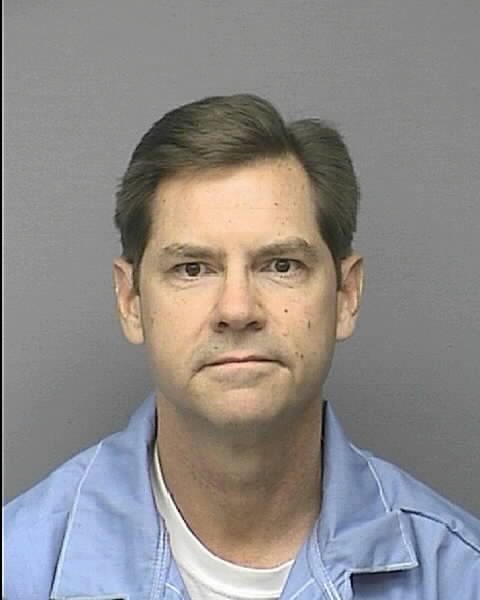
Mangelsdorf (KS Dept. of Corrections photo, 2011)

The person wielding the crowbar was a 21-year-old man named Mark Mangelsdorf, who was either conducting an affair with Melinda or wanted to. Melinda aided and abetted the murder, and, in fact, was in the room when the beating started.

Because the investigation was “a board certified disaster,” as Marek Fuchs wrote in his 2009 book about the case, “A Cold-Blooded Business,” Harmon and Mangelsdorf got away with murder for 23 years.

After the murder, Harmon and Mangelsdorf went their separate ways, with Harmon marrying an Ohio dentist, Mark Raisch, and having children with him.

As for Mangelsdorf — here’s where the analogy to Robert Bales comes into play — he became a big executive, first with Pepsi and later with a couple of other companies and ended up in a $1.3 million, three-story house in an area abutting Long Island Sound. He was married to another executive, and they were respected members of the community.

Melinda Raisch (KS Dept. of Corrections photo, 2010)

In 2005, however, the case was reopened, and both  Raisch and Mangelsdorf ended up coming back to Kansas and pleading guilty to second-degree murder. (An interview that Harmon gave to two resourceful Olathe detectives  proved to be the turning point.)

Each was sentenced to 10 to 20 years in prison. Both remain in custody — she in Topeka, he in Lansing — but both apparently are now eligible for parole.

Where Bales was able to contain his demons until he was 38, Mangelsdorf lost control of his at age 21 but then managed to corral them and go on to live an exemplary life.

In his book, Fuchs uses a different metaphor for the Mangelsdorf case — a lion getting out of its cage.

“Mark managed to put the lion back,” Fuchs wrote. “And keep him locked up. This was not a crime committed at a distance, but close-up, one that sent a man’s eyeball flying across the room. And while it was partially a crime of passion, he had planned it for months, lying in wait with a crowbar in his possession for a full week. But the lion was, forever afterward, caged and gentle.”

Unfortunately for the world, and particularly for the victims and for the United States’ world image, the lion in Sgt. Bales got out, too.

Unlike Mangelsdorf, though, Bales probably won’t be getting a chance to re-cage the lion and redirect his life in conventional society.

Last year, if some of you will recall, I was in the St. Patrick’s Day Parade, promoting my friend Mike Burke, who was running against Sly James in the mayor’s race.

We all know how that turned out, and Sly seems to be doing a fine job. So, this year, instead of being in the street, I was off to the side.

Oh, well…it was a good time, and I thought you might enjoy a few of the sights, even if you were there…

You've got to look the part, as well as feel it

Looking north on Broadway from the Vietnam Veterans Memorial

The queen on her throne -- the back of attorney John Gordon's Irish Mustang

One of several politicians in the line-up, the county prosecutor

Retired architect Kite Singleton and bored grandson

Sometimes it takes connections to get in the blog...Daughter Brooks and wife Patty, both cutting a fine figure

Top Hat

Attention, please!

A skinny Miami Dolphin sneaked into the parade

Green is nice, but there's a lot to be said for auburn

Everybody needs a break...

My pin