Feeds:
Posts
Comments

Today, we switch gears, dramatically.

Richard Arthur, my good friend and former comrade in the Army Reserve, occasionally writes pieces for the blog, and he has come up with one that stirred me deeply. I hope you enjoy it as much as I did.

Here’s Richard’s story.
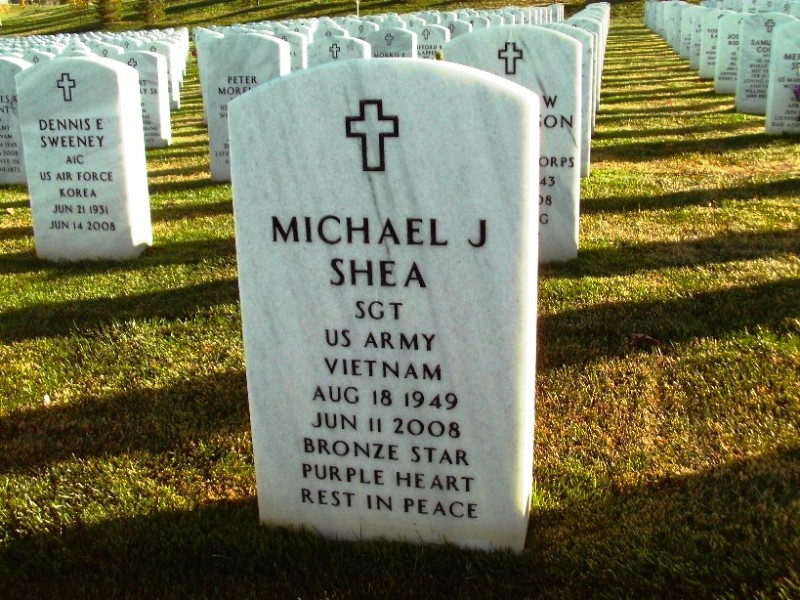
Walking up to the stark white, marble tombstone, among the hundreds of other tombstones, at Fort Logan National Cemetery in Denver and seeing my old friend’s name perfectly carved into it, I damn near went to my knees. I’ve been in dozens of cemeteries, but I always feel the solemn and cold finality of a grave marker. This time the feeling was painfully strong.

A recent, job-related trip brought me to Denver, and I had planned to pay my respects while there. I brought a camera to document the trip and got there late in the afternoon with the sun sitting low in the West, causing long, dark shadows to fall from the headstones. I spent about 15 minutes there, snapping pictures and hoping I could navigate my way back to the hotel across town without too much confusion.

Mike Shea and I went into the Army early in 1968, but that’s about the only commonality in our life experiences. I was yanked in, as an Army reservist activated by President Lyndon Johnson in the spring of 1968, while he rushed in headlong.

Mike enlisted in the Army with a guarantee in writing that he would be trained as an infantryman and also be sent to airborne training (parachute school) prior to deployment to Vietnam. That’s just what he wanted.

The summer of 1967 was the time I got to know Mike. He was a year behind me in school, and we didn’t really know each other until we played pool at a local “recreation” hall near 39th Street and State Line, called Rex’s Pool Room. Neither of us was anywhere near a true pool hustler, but we could hold our own with the novices who wandered in from time to time.

The main thing we liked to do, as I remember, was ride around town in our cars and drink Coors beer, which at that time could only be purchased on the Kansas side. Many trips to Los Corrals restaurant downtown were included to provide nutritional fuel for these treks.

We covered a lot of miles that summer and a good deal of it was in his old ’51 Chevy that used oil and had a tube-type radio that took forever to warm up and then didn’t work reliably. These were the days before FM radio hit the scene hard, when AM radio – specifically WHB and KUDL — ruled the airways in Kansas City. At night, you could also pick up WLS in Chicago and KAAY in Little Rock.

Enlistment

In the middle of that summer, Mike told me he’d been talking to an Army recruiter about joining the service. He wanted to serve, and he wanted to fight. He wanted to be an airborne Ranger and go to Vietnam.

I would be entirely untruthful to say that any part of his plan appealed to me. 

He joined the Army with a reporting date scheduled for more than six months out, and then he and another guy hitchhiked to California to see the Haight-Ashbury district of San Francisco, the hippies and the music scene there. They then hitched all the way back across the U.S. to Florida a month later. He sent me a few postcards along way, making me wish I had made the adventurous trip myself. When he returned, he said that he and his buddy had spent many hours sitting at highway entrances in rain and heat, waiting and hoping for rides.

Mike reported to the Army sometime in early 1968, and I met up with him at Fort Leonard Wood in the spring, where he was nearly finished with basic training (the first eight weeks of training), and I was just starting my first or second week.  Being that far ahead of me in training, he seemed like a wise old owl, giving me some pointers for getting through this time of great adjustment to military life.

Mike was a very good correspondent and wrote to me from his advanced infantry training post and later from “jump school,” where he made five parachute jumps in a week’s time to earn the coveted sterling silver wings worn above the left pocket. He would soon have plenty more awards to adorn his uniform.

Vietnam

By summertime, he was in Vietnam doing exactly what he had enlisted to do. He was in an airborne infantry unit, the 173rd, and walking point on combat patrols. Very soon, he volunteered for LRRP (long range reconnaissance patrol) duty and further immersed himself into war. LRRPs, called “lurps” for short, had unenviable job of patrolling enemy territory in small groups, normally consisting of five to seven men.

The main job of a lurp is to observe and report enemy movement and strength. The mission requires great stealth, and the overriding goal is to avoid combat or enemy contact, due to the small the size of the group. If discovered, these lurp crews were often wiped out at once. Their main weapons were the radio and an escape plan with a helicopter in the vicinity.

Mike liked lurp duty because their outfit was housed in a secluded corner of the base camp and lurps never got assigned mundane chores like KP (kitchen patrol) or guard duty. Most of the regular troops didn’t dare enter their area, as they were considered secretive and very dangerous soldiers. At the same time, they were on the Vietcong’s hit list, complete with bounties offered.

A few months into his Vietnam tour, Mike sent me a letter with exciting news – exciting for him: He had been invited to attend Ranger school! This was a dream come true for him. Being a Ranger was another level of service that he had wanted but had not gotten the opportunity to try in the States. The Rangers had only recently started an in-country (Vietnam) qualification school, and it was already known to be far more difficult to pass than the state-side version.

His letters stopped for several weeks while he gave his full energy to Ranger training, and then he wrote that he had indeed graduated and was entitled to wear the elite Ranger tab on his shoulder. Having read in-depth about the rigors of Ranger School, I knew how great an accomplishment this was. The letters started flowing again, and we exchanged mail for the rest of his tour.

Back home

On his return to the States, Mike got assigned to some unproductive garrison duty, and he quickly decided not to stay in the Army. His last year in the service was uneventful and consisted mainly of answering phones and other mind-numbing work, which he hated.

We basically lost contact at that point. I finished the active-duty phase of my enlistment and returned to Kansas City to be an Army Reservist for several more years. I guess you could say I fulfilled my goal of being a part-time soldier, slogging through college and attending weekend drills.

Mike had returned to Kansas City, started dating a former high school classmate, got married and moved to Denver to work for the railroad.

In 2003, a high-school classmate hatched the idea of promoting an all-class-years, informal reunion at T.G.I. Friday’s at the Ward Parkway Shopping Center. Someone located Mike in Denver, and he came to Kansas City for the event. We got to spend some time catching up on the last 30-plus years, and we swapped e-mail addresses. For a few months, we exchanged e-mails, but then, for whatever reason, he stopped responding.

Our same classmate arranged informal, all-class reunions almost every two years after that, but Mike didn’t come back for any of them. At the 2009 reunion, I mentioned to a mutual friend that I wished Mike would come to another one. I was floored when the guy told me that Mike had died almost a year and a half earlier.

A quick Internet search and a look at the Denver Post obits verified what I had been told: Mike had passed away in the summer of 2008. I also learned he was buried in the national cemetery. 

Saying goodbye

Before leaving Kansas City for the Denver trip, I looked up a phone listing for his widow. I was hesitant to contact her because we had never met, and I suspected she might have no idea about my long-ago friendship with Mike. I didn’t call when I was out there, but on Veterans Day, after I had returned home, I made the call and had a very gratifying chat with her.  

She was Mike’s second wife. He and his first wife divorced in the 80s and had remarried in 1985.  

His widow told me how happy she was to hear from one of his old friends and that she had been thinking about him on that Veterans Day. It only took a few minutes on the phone for her to recall my friendship with her husband, including some stories he had shared with her over the years about our military and personal experiences.

In our half-hour conversation, she told me a lot about Mike’s years at the railroad and about raising a family. She still operates a small business that they started together. We agreed to talk again after the holidays.

As I stood next to Mike’s tombstone with the shadows lengthening that October afternoon, I thought about how I admired Mike as a soldier – aggressive, fearless and dedicated to the mission. To me, he was a hero. I felt privileged to have known and befriended Mike Shea.

I’ve always had a problem with how to respectfully depart from the gravesite of a friend or loved one. It seems sort of cold to just turn and walk away, so this time I gave the engraved stone the best military salute I could muster, then headed for the car.

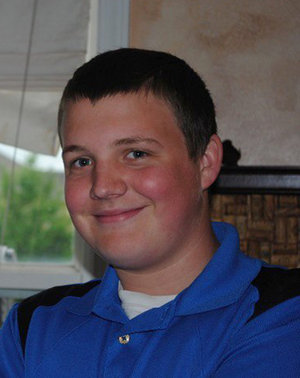
Eight days have passed since the head-on car crash that resulted in the death of 16-year-old Zach Myers, a junior at Olathe Northwest High School.

And the public is still without an official explanation regarding the circumstances of the crash, which occurred on a narrow residential street about a mile north of a downtown trade school where Zach took some classes.

So, taking up where I left off on Monday — trying to get answers about this tragedy — I spent part of Wednesday surveying the crash scene and interviewing neighbors.

But first, here’s the latest from Sgt. Johnny Roland, public information officer for the Olathe Police Department. Roland said Wednesday afternoon that he did not expect the traffic unit’s report to be ready at least until next week, and perhaps later. (When it is finished, it will be a matter of public record.)

“There’s tons of data and information to gather,” Roland said, adding that it was “not uncommon” for a fatality investigation to take two or more weeks.

He said he did not know if toxicology tests were being conducted on any of the three survivors —  the two boys that Zach was with and the 20-year-old woman who was driving the other car. No one was seriously injured besides Zach, who suffered a head injury. 

The head-on collision occurred shortly before 10:30 a.m. Dec. 1 in the 600 block of North Iowa Street. Zach was in the back seat of what a neighbor said was a grey Hyundai Elantra, which was northbound, apparently headed from the technical school to Olathe Northwest on College Boulevard. 

The woman, southbound toward downtown, was driving a small red car, the neighbor said.

Everyone involved in the crash apparently was wearing a seatbelt, including Zach. 

The neighbor who described the cars, 35-year-old Kathleen McElliott, said she heard the crash and thought that her parked vehicle had been struck. She hurried outside, while her domestic partner was on the phone with a 911 operator. When McElliott looked inside the boys’ car, Zach was struggling to breathe. At that point, the belt was off Zach, she said, but she noticed that blood was on the lap part of the belt. “It looked like he was (had been) wearing at least the lap part of the seat belt,” she said.

She saw no blood on the shoulder harness, however, raising the possibility that that part of the belt was not around Zach’s torso at the time of the crash.

McElliott said she did not remember or notice if air bags deployed in the boys’ car but that the air bag in the woman’s car did deploy.  

Zach did not have an open head wound, McElliott said, adding that an emergency medical technician who was at the scene and visited her house a day or two later told her that his injuries were internal.

McElliott said she strongly suspected that excessive speed was a factor. The posted speed limit on that part of Iowa is 25 mph.

“It’s my opinion that at least one of them (the drivers) — I don’t know who — had to be speeding,” McElliott said. “There’s no way that a collision at 25 miles per hour would take a life.”

Like everyone else who has come in close contact with the case, McElliott said her heart went out to the Myers family. “I am deeply sorry for their loss,” she said. “Our kids to go school with them (the boys who were involved.)”

Wednesday, looking south on Iowa

The crash occurred on a section of Iowa that is two lanes, divided by intermittent yellow lines, and where Iowa curves and rises slightly. At the crash site, narrow gouges are visible in the street on both sides of the yellow line. The roadway had been cleaned with a solution that left a large, bleached-out-looking spot in the road.

McElliott said that on the morning of the crash, a large truck was parked on the west side of the street and that the woman who was southbound in the red car could have been trying to navigate around the truck. 

McElliott said a lot of drivers exceed the speed limit on Iowa. Indeed, as I was interviewing another neighbor, a car sped by at 45 miles an hour or more. “That’s part of the problem,” said the man I was talking to at his front door.

McElliott said that although she did not know Zach, she is haunted by the incident. “I wish I could have done something more,” she said.

The reason she didn’t, she said, is that the 911 operator had told her partner — who, in turn, had told McElliott — not to move him and to wait for emergency responders to arrive.

Zach Myers’ soft, beckoning smile jumped out at readers from Page 8 of Saturday’s Kansas City Star.

The vitality of that smile — the glimmer in those happy eyes — stood in stark, awful contrast, however, to the news that accompanied the photo: Myers, a 16-year-old junior at Olathe Northwest High School, had died from injuries he suffered in a car crash last Wednesday.

Zach

The story, which did not bear a by-line, said Zach had been in a vehicle with two other boys; that a head-on collision had occurred on Iowa Street in Olathe about 10:30 a.m. Wednesday, Dec. 1; that neither of the other boys nor the woman driving the other vehicle suffered serious injuries 

The story said that Zach, in addition to being a student at Northwest High, attended the Millcreek Center, a career and technical school in Olathe. The story quoted a statement from the district that described Zach as a well-liked student “with a caring heart whose wit and charm touched many lives.”

As far as it went, the story was satisfactory. But it left so many questions unanswered. 

Not just unanswered, but, worse, apparently unasked.

As a former reporter, as a parent, as a curious human being, I wanted to know more. 

For example, were the boys in school that day? And, if so, why were they out driving on the street at 10:30 a.m.? Where, exactly, did the crash occur? Was speed a factor? Were drugs or alcohol involved? Did one of the vehicles cross over into the path of the other? Were the occupants of both vehicles wearing seatbelts?

The Star’s story addressed none of those questions. 

It’s not every day that the life of a beaming, 16-year-old student is snuffed out in the Kansas City area, and when it does happen, in my view, it deserves more than a cursory story from the area’s leading news-gathering force.

Readers should expect a lot more than what they got on Page 8 of Saturday’s paper.

So, I set out to expand the record and set it as straight as I could. Here’s what I did and what I found. 

:: I checked the school calendar, which indicated school was in session that day.

:: I called the school district public relations office to verify that school was in session and to try to find out why the boys might have been out on the streets. I was told that the district spokesperson was not in but that someone else would call me. That was about 9 a.m. I haven’t heard back.

:: I went to Mapquest and discovered that Iowa Street is a north-south street that runs from Santa Fe, near downtown Olathe, to just south of 119th Street, west of Woodland.

:: I called the police department and spoke with Sgt. Johnny Roland, police spokesman. 

Roland said he believed the boys were on their way from Millcreek Center, near downtown Olathe, to Northwest, which is about five miles from Millcreek, at College Boulevard and South Lone Elm. He said Iowa, a logical route for the trip north, was a two-lane street, where cars parked on either side.  

Roland said the crash was under investigation and that he had not seen a report. Knowing the street, he said he could understand how a head-on crash could happen there, but he said he didn’t know if either vehicle crossed over.

He also said he did not know what kind of car the boys were in; if Zach or the other boys — or the woman driving the other vehicle — were wearing seatbelts; and if excessive speed was a factor. When I asked him if drugs or alcohol were involved, he said, “I don’t believe so.”

:: I called the Myers’ home in Lenexa. At first, I spoke with Zach’s mother, Kimberly Myers. I explained to her who I was and what I was doing, extended my sympathy and asked her if she was willing to talk about the crash. Before turning the phone over to her husband, John, she told me that Zach had been in the back seat of the vehicle and that he had been wearing a seatbelt.

When John Myers, a 21-year- veteran of the Olathe Fire Department, got on the line, I again offered my sympathy and explained who I was and why I was calling. We talked — amicably, I thought — for about five minutes.

He said all three boys were wearing seatbelts and that the other two suffered only scrapes and bruises. Like Sgt. Roland, that he didn’t know what kind of vehicle the boys were in. The other boys were classmates, he said, but he didn’t believe Zach was particularly close friends with them. Myers said he had not spoken with family members of the other boys.

He said Zach customarily spent part of school-day mornings at Millcreek and then went to Northwest about 10:40 a.m. or 11. So, the timing of the crash, as well as the route they were taking, he said, would indicate they were on their way to Northwest. He said the crash occurred about a mile north of Millcreek. 

Myers said that Zach, whose survivors include an older brother, suffered a head injury, but Myers said he didn’t know how he struck his head or on what. I noted that it sounded rather flukish — that everyone else walked away from the wreck, while Zach, buckled in the back seat, suffered mortal injuries. 

Myers agreed, saying: “We’re curious as well. We’re at a loss as to how this could happen.”

He said that the family was eager to get answers to their questions, but, at the same time, he did not want the investigation to be rushed.

“Frankly, I want them to take their time,” Myers said. “I want them to investigate this thoroughly.”

So, the Myers family and other people who would like to know more about this tragedy must wait. I certainly hope The Star will follow up. The loss of what appears to be a fine, 16-year-old boy should not be allowed to drift out of public awareness without explanation.

*****

A post script is in order. 

As I said in the text, I thought my conversation with John Myers was amicable. He spoke with understandable sadness in his voice but never gave an indication he wanted to cut off the conversation. Before we signed off, I again expressed my sympathy and sorrow on his behalf.

About an hour afterwards, however, I got a call from Officer Michael Bussell of the Lenexa Police Department who told me to stop harassing the Myers family. I told him that John Myers had spoken freely and had given me no indication that he wanted to end the conversation.

Bussell took my “information” — name, address, d.o.b., telephone numbers, blog address — and said that if I attempted to contact the Myers family again, I could be charged with harassment.

…Such is the lot of a blogger who dusted off his reporter’s hat and tried to satisfy his curiosity — and perhaps the curiosity of members of the public –about a case that got short shrift from “the paper of record.”

The beauty of running a blog or a web site is getting to write or post whatever you want.

The flip side, for some bloggers and operators, is what might be called the scourge of the troll.

A troll is someone who anonymously (or pseudononymously) posts inflammatory, derogatory or downright ridiculous messages in public forums.

Fortunately, I don’t have that problem on JimmyCsays. Maybe it’s because I have relatively few readers. (I’m a teacher, and I tell people a full classroom is all the audience I need.) Maybe it’s because I have a sophisticated following. (Of course, that’s it!)

But it’s a big issue for a lot of  sites, including several local ones, and an op-ed column in Tuesday’s The New York Times explored the issue in depth.

Writer Julie Zhuo, a product design manager at Facebook, used her column to urge content providers to put their feet down and click the “delete” button on anonymous comments. She deplored trolling, essentially, as aberrant behavior under the cover of darkness. To me, she hit the nail on the head when she said, “…most trolls wouldn’t have the gall to say to another person’s face half the things they anonymously post on the Internet.”

She called on site operators to moderate their comments and forums and to do whatever they could to “improve the quality of engagement on your site.”

All of us bloggers and web site operators crave feedback and engagement, but we have varying views on how to best monitor and manage that engagement.

Being a relative newcomer (nine months) on the blogging scene, I did some research and solicited the views of others who have a lot more experience with anonymous comments than I. 

Here, then, are observations from Derek Donovan, readers representative at The Star; John Landsberg, operator of Bottom Line Communications (bottomlinecom.com); and Hearne Christopher of KC Confidential (kcconfidential.com).

Derek Donovan

Donovan hasn’t responded to my e-mails since I quoted an e-mail from him in which he tabbed me — a 36-year, former Star reporter and editor — as an “anti-Star blogger.” However, he has addressed the comments issue several times in his Ad Astrum blog.

Several months ago, he wrote that the No. 1 complaint he gets as readers rep is “about bad behavior” in the comments.

“It’s a Catch-22,” Donovan said. “People want to make their thoughts heard, but not many are willing to attach their real names to it, and there’s no way to force people to — especially in these days where so many are waking up to very real concerns about online privacy.

“So the imperfect system goes on. I know it’s frustrating, but I don’t see a better solution anywhere else. My personal hunch is that anonymous online comments may continue to exist around the Web, but fewer people will pay attention to them as time goes on. I know I never even glance at them any longer unless a reader points one out to me as problematic.”

John Landsberg

At Bottom Line, readers cannot directly post comments on the site. Instead they can send e-mail “feedback,” which John monitors and decides whether to publish.

I solicited John’s views in an e-mail, and this is how he responded.

“I will allow anonymous comments on my site because many journalists and very credible sources do not want to jeopardize their employment, but I will not simply allow trolls to come on and take cheap shots. To me, my site (and me) lose credibility when I allow some folks to simply spew personal venom.

“It is a tough call sometimes. I think anonymous comments can lead to some very honest discussions, but sometimes they can be destructive.  It is a balancing act.”

Hearne Christopher

Hearne, who, like me, is a former Star employee, has a particularly interesting situation at this time. With the help of a designer, he recently changed from a blog to a Web site.

(Disclosure: Hearne publishes a lot of my posts. My only requirement is that he include a tag line crediting JimmyCsays, where my posts almost always appear first. I receive no payment from him.)

Under Hearne’s former format, commenters could parachute in with virtually no restrictions or filters and say whatever they wanted and have their comments appear moments later.

Now, they have to register first, using their e-mail addresses (not displayed, of course) and establish a user name and password. Then, they have to write headlines for their comments, and they are limited to one paragraph. Granted, the paragraph can be as long as the writer pleases, but it does tend to reduce mush-mouthed rambling. Commenters can still uses pseudonyms, and most do.

Hearne doesn’t like the new comments format and has been prodding his designer to change it back to the old, fast-and-loose system.

In an e-mail, Hearne said: “Our comments section doubles as content for arguably some of our less sophisticated (but still important) readers.

“Filtering out comments robs those readers who find snarky retorts and opinions entertaining and/or informative. Believe it or not — and as writers we’d undoubtedly prefer not to — readers have told us on a number of occasions that they often find the comments more entertaining than the stories.

“So, rather than eliminate them as some who find them distasteful or insignificant suggest, our feeling is that the same standards apply to would-be comment killers as to the rest of the readership. If you don’t like something, don’t read it. In other words, turn the channel. It’s not like comments are required reading.”

Unlike bottomline.com and JimmyCsays, KC Confidential accepts paid advertising, and Hearne looks at the issue through a different lens. 

Since going to the new format several weeks ago, he said, “our traffic went down by nearly 20 percent. The comments themselves plummeted probably by 70 to 80 percent.”

Obviously, when the number of views goes down at his site, ads could follow suit. 

Yet, I believe — and I’ve told him this — that the designer did him a favor by making the commenters more accountable. I think the caliber of his site, as well as the caliber of the comments, is much improved and that his viewership numbers will rebound. 

He still gets some boring commenters who insist on writing three, four, five or more messages on the same post — more afterthoughts than genuine engagement in many cases — but, overall, the tone is not as reckless and ugly as it frequently was.    

My posts have been — and continue to be — the object of some vitriolic messages on Hearne’s site, but that’s not the reason I favor a more restrictive comments environment, at his site or elsewhere.

To put it simply, I’m in favor of conversation, personally and online, that is as substantive and high-road as possible.

I side with Julie Zhuo, who said: “Raising barriers to posting bad comments is…a smart first step. Well-designed commenting systems should also aim to highlight thoughtful and valuable opinions while letting trollish ones sink into oblivion.”

At The Star, the Thanksgiving Day paper is the biggest and one of the most important of the year. 

It’s big because it waves the green flag on Christmas ads, and it’s important because it’s so big it had better be good.

This year, the Thanksgiving Day paper had two stories that particularly caught my attention. One was national editor Darryl Levings’ “Ode to Thanksgiving” on the front page. The other was Randy Covitz’ sports-front update on former Chiefs’ General Manager Carl Peterson.

Levings’ story, a beauty, made me laugh, smile and reflect. 

Covitz’ story, on the other hand, was so poorly constructed and edited that it made me clench my teeth.

Join me in taking a closer look.

First, Levings, who sticks to editing the majority of the time, is one of the most talented and experienced editorial employees at The Star. The paper is lucky to still have him after more than 35 years of duty. And the top editors were smart enough to turn his creative juices loose for the paper’s Thanksgiving retrospective. 

Levings came up with a spoof on the well-known carol “The Twelve Days of Christmas,” converting it to “The Twelve Hours of Thanksgiving,” with his true love giving him something every hour. 

On the fifth hour of Thanksgiving, for example, his true love gave him her iPhone.

“More family checking in,” wrote Levings. “Americans are so far-flung by opportunity, not everyone can make it home this time. Perhaps, God willing and if the creeks — or, these days, airfares — don’t rise, we’ll see them next month. Sadly some places at the table cannot be filled. Many of the old ones — and some too young, as well — have passed on. They were the ones that got you here, who believed in you despite all the indicators, and who won’t be here to hug the grandkids and laugh at your stories. Ah, we do miss them so.”

On the sixth hour of Thanksgiving, his true love gave him the remote, and, it’s off to the couch to watch some football.

“This is the time to rejoice,” Levings said, “that the Chinese, though they may have taken a bunch of our jobs, have not mastered the building of the 260-pound, quicker-than-a-cheetah linebacker. Nor do they have the gating of the tail.”

(I laughed out loud at that.) 

And what did he get on twelfth hour of Thanksgiving? Levings concluded with a crisp and quick kicker: 

“Pie. Any way you slice it…is this a great country or what?”

Now on to Covitz’ story. Covitz is another 30-year-plus Star employee, but he wrote the Peterson story like he was a greenhorn. And his editors didn’t have the good sense to flag him down.

The story opens with Peterson in the press box at the Edwards (yes, that’s the way it appeared in print) Jones Dome in St. Louis “with one eye on the field below and another focused on the FanVision mobile device in his right hand.”

He goes on to talk about how Peterson clicks buttons on the device that give him a flood of information, replays, etc., on several games at a time.

OK, so I guess this device is somehow important to the story. Care to share that information now, Randy?

Nope. Instead, he veers off into the highlights of Peterson’s many years in Kansas City. After 12 column inches of historical rehash, Covitz returns to the subject of FanVision and notes, still without explanation, that Peterson’s “clients” include “three BCS games, the universities of Michigan and Miami and the PGA Tour.”

OK. It appears that Peterson has some significant connection with this FanVision operation, but we’re 16 inches into the story, and that connection is still not clear. Not clear at all.

The next paragraph nudges closer to an explanation, informing the readers that Peterson is a partner in FanVision with the owner of the Miami Dolphins.

All right. Now, after this long slog through weighted verbiage, I’d like to know such things as how long FanVision has been in business, where it’s based, how many employees it has, how Peterson got involved and what the firm’s goals are.   

But wait! Covitz has other things in mind. Then and there, he jerks the reader in yet another direction — how much Peterson misses game days as g.m. “Every time I go to a game,” Covitz quotes Peterson as saying, “it’s like old home week.”

Excuse me; I have to puke.

…I’m back to the story now, and Covitz shares a nugget: FanVision is based in New York! 

Now we’re getting somewhere…BUT we’re three paragraphs from the end, and, all of a sudden, Covitz has to hurry. So, he starts tossing out important information, the stuff we’ve been waiting for, like a football-throwing robot. Peterson lives in New York…but he maintains a home in Kansas City…where his wife, Lori, works  for the sports architectural firm Populous…the firm that designed the Arrowhead improvements.

With that, it’s almost time to say goodbye, but not without one more 45-degree turn: Peterson is considering attending the MU-KU game at Arrowhead on Thanksgiving weekend. “That was something we really worked hard to make happen, because Lamar (Hunt) wanted it,” Peterson is quoted as saying.

Maybe so. Maybe so. But Lamar, Carl and the gang couldn’t have worked any harder than the readers who stuck with Covitz and tried to make sense out of this story.

Taken together, a series of stories in The Star and a Sunday take-out in The New York Times offer up a volatile cocktail that makes the future of our country look loopy. 

The Star’s three-part series, “A Generation in Free Fall,” began Sunday and concluded today. It explores, in troubling detail, the diminished career opportunities that people in their early 20s are facing.

As writers Scott Canon and Diane Stafford put it, “It’s a generation stalled, exiled from an economy hung over from a crash set off by house-flippers, mortgage scammers and Wall Street shell games.”

The unemployment rate for Americans 20 to 24, Canon and Stafford report, is 15 percent — twice as high as 10 years ago.

The counterpoint to Canon’s and Stafford’s fine stories is Matt Richtel’s front-page centerpiece, in Sunday’s Times, headlined “Growing Up Digital, Wired for Distraction.”

The photo above the headline tells the story: Three California school girls are sitting shoulder to shoulder at an outdoor table during lunch, but they are not eating and they are not talking. Each is texting. 

Richtel gets to the guts of the matter in the fifth and sixth paragraphs:

“Students have always faced distractions and time-wasters. But computers and cellphones, and the constant stream of stimuli they offer, pose a profound new challenge to focusing and learning.

“Researchers say the lure of these technologies, while it affects adults too, is particularly powerful for young people. The risk, they say, is that developing brains can become more easily habituated than adult brains to constantly switching tasks — and less able to sustain attention.”

Richtel knows this subject well. Earlier this year, he won a Pulitzer Prize for National Reporting for a 2009 series called “Driven to Distraction,” which is about the problems inherent in driving and multitasking, including texting.

For his latest piece, Richtel interviewed a 14-year-old girl who sends and receives 27,000 texts in a month and can carry on as many as seven text conversations at a time.

Another student, a boy, said  the lure of the Internet kept him from finishing either of his two summer reading books. “My attention span is getting worse,” he admitted.

So, look at the deadly dilemma here: Fewer jobs available for the foreseeable future and millions of kids who can’t, or choose not to, focus on their school work.

Now, I realize that the distraction of the Internet, video games and cellphone usage is not causing the job shortage. But it seems to me that distracted youths are at a distinct disadvantage when they have the chance to interview for the jobs that are open. And when the job tourniquet eases, many youths might find themselves complaining not that jobs aren’t available, but that they just can’t land them. Or, if they’re able to land them, they can’t hold onto them. 

Anyone who has a college degree can testify that higher education requires great focus. And everyone who has ever had a good job knows how important focus and attention to detail are to success in the workplace.

So, what’s going to happen with this generation of young people with their 15-second attention spans? It’s not promising, is it?

It is a part of the decline, in my view, of the American culture. Other evidence of that decline is the ebbing of manners and the rise of road rage and boorish behavior.

I’m a substitute teacher in the Shawnee Mission School District. I frequently catch students texting in class — a prohibited activity, of course. I tell violators to put the phone away. The second time I catch someone, I usually send him or her to the office with a referral slip.

Is that going to change their behavior? Probably not. I understand that. But teachers and other responsible adults have a responsibility, in my opinion, to try to get students to practice self-control and to tune out the distractions. 

Frequently, I ask students how they like whatever book they’re reading in their English classes. (That’s the subject I usually teach.)

“Boring!” is often the refrain that comes back at me.

I’ve heard students say that about Mary Shelley’s “Frankenstein,” Mark Twain’s “The Adventures of Huckleberry Finn,” Truman Capote’s “In Cold Blood” and other great works. Why do they say such books are boring? It has nothing to do with the stories, of course; it has to do with many students’ inability or unwillingness to sit still for 10 minutes and give themselves a chance to get into the stories.

It’s easier and more tempting to fire off another text, or turn to a video game, or search for something light and breezy on YouTube. 

I hate to overstate this, and I sure hope I’m wrong, but when I look down the road — at the future of our country and the prospective caliber of our citizens – I don’t like the view.

In the last few days, I’ve read two online stories about what newspapers might do — either online or in print — to make themselves more relevant to  many people.

One of the pieces was written by Robert Niles of OJR: The Online Journalism Review. Niles is a web site creator and a former newspaper web editor. He suggests that papers focus on five “beats”: food, education, the workplace, business and faith. 

Those are the beats, he says, that “best reflect the activities of readers’ daily lives – the ones most likely to elicit a connection between reader and publisher.”

In his revolutionary approach, Niles’ would have newspapers jettison their sports sections, which he says are not moneymakers, and “leave the pro and major college teams to ESPN.com and the many team bloggers now covering them.”

As for government coverage — long a hallmark for newspapers — Niles says: “Yes, we need journalists to cover government, but assigning government (or politics) as a distinct beat segregates government from the communities it serves. A local news publication needs to cover government by having each of its reporters cover government within the context of his or her beat, and not by leaving that task to an individual reporter or team.”

Niles’ ideas are interesting, but I don’t think I’d run to the yard every morning to get a paper that had food and faith as two of its main coverage areas. I’ve got to hand it to Niles, though, he’s steering sharply away from the old Gutenberg.

The other writer, Alan D. Mutter,  is a former newspaper man who now specializes in corporate initiatives and new-media ventures. He writes a consistently interesting and informative blog called Reflections of a Newsosaur. 

In his most recent blog entry, which first appeared in the October issue of Editor & Publisher Magazine, Mutter says that newspapers should stop chasing the national, international, entertainment and sports stories “that ricochet around TV, radio and the Internet” and focus on “unique, local stories that distinguish their products from all other competitors.”

Here’s the formula that he urges publishers to adopt: “Pick stories of sweeping significance to your community, report them completely, tell them compellingly, pursue them relentlessly and play them effectively. Repeat as necessary.”

I can relate more easily to Mutter’s theory than I can to that of Niles. And it seems to me that our daily paper, The Kansas City Star, is moving in the direction that Mutter suggests.

Consider three recent stories that The Star has featured on its front pages.

:: Mike McGraw’s and Glenn E. Rice’s sensational piece on Sunday, Oct. 31, laying out their theory on the 1970 murder of civil rights and political leader Leon M. Jordan. As I said in a Nov. 1 blog entry, I think that piece — and a follow-up on the man the reporters believe engineered the killing — will get consideration for a Pulitzer in investigative reporting. However, I think the odds-on favorite for the investigative Pulitzer will be the Memphis Commercial Appeal’s Marc Perrusquia, who was able to establish that a friend and close associate of Martin Luther King Jr. was also an FBI informant.

:: Joe Lambe’s and Don Bradley’s Nov. 13 story about the goofy scheme that four young men concocted to steal more than $62,000 from a U.S. Bank branch in Overland Park. One of the participants was a 20-year-old teller who agreed to be “kidnapped” and punched in the nose to make the job look authentic. This is not the kind of story you get very often out of Johnson County, and The Star didn’t let the opportunity slip away.

:: Laura Bauer’s reflective and uplifting weekend stories on what it’s like to be a teenager these days. This is the most creative and insightful look I have seen about this generation of youngsters. The first of what will be three installments over the next several months kicked off Sunday, straddling the front page and Star Magazine.

Bauer’s front-page story examined the various pressures that young people are under to be constantly connected with and fully accepted by their peers. It opened with the courageous account of a 13-year-old Independence girl who recently got a text message that said: “You don’t belong at this school. You need to go back…Get your own life and stop trying to be one of us.”

Among other things, the story cited a recent study that said nearly half of high school students reported having been bullied in the past year. Another study said that one in four teens reported having a mood, behavior or anxiety disorder.

Even though I am a substitute teacher and see a lot of young people, the story was eye-opening to me. I had no idea that so many students are being bullied and struggling desperately for acceptance. 

But then, in the Star Magazine component, Bauer gave us the flip side — the joy of being a teenager. Bauer homed in on nine students. She asked them, among other things, what a passerby might say about them — what the stranger’s assessment of them might be. One girl said she thought the stranger would see her as “vulnerable.” A boy said he thought he would be seen as “very confident.” A Muslim girl said the stranger might wonder if she was a terrorist.

In keeping with the freewheeling feel of the story, photographer Jill Toyoshiba let the students recommend where and how they wanted to be photographed. One girl, the one who said she would be seen as “vulnerable,” was photographed in a tree. Another boy, a 14-year-old Rockhurst student who designs dresses, was holding a woman’s pink, high-heeled shoe in his right hand.

(Unfortunately, I couldn’t locate the individual photos and profiles in The Star’s electronic library and was not able to link to them here.)

In my opinion, this story was wildly unconventional and wildly successful. It could have been goofy, but it wasn’t. Bauer and Toyoshiba allowed the students to reveal themselves, but they created parameters within which the students could frame themselves. 

All three of those stories — the Jordan killing, the US Bank heist and the teen profiles — hit Mutter’s benchmark of a story of “sweeping significance” to our community, in my opinion. 

The first gave us the answer to a 40-year-old mystery that has haunted many Kansas Citians. The second made us worry about what’s going on in the heads of some of our younger people. And the third gave us hope that a majority of our teenagers will grow up to reshape our community in dynamic and unpredictable ways.

For years to come, maybe decades, KU fans will tell each other where they were the day of the Mount Oread Miracle, as The Kansas City Star aptly called it.

It will go down as the day the lowly Jayhawks scored five touchdowns — five touchdowns — in the fourth quarter and came from out of nowhere to beat the Colorado Buffaloes 52-45.

Well, I want to be one of the first to tell you where I was and how I spent my day, because I was there. I was there until the very end of that incredible event. 

First, the context.

I have no strong ties to any of the three regional Big 12 schools, other than the fact that my wife Patty is a 1978 graduate of MU. I follow all three schools in football and men’s and women’s basketball, and I root for all three. When they play each other, I vacillate.

Over the years, as you might imagine, I’ve had to mute and moderate my cheering for KU because of my wife’s affiliation with MU. This weekend, though, I had a pass: My wife was out of town on business. Shortly after waking up Saturday morning, following a choppy night of sleep battling a cough and sinus drainage, I began entertaining the idea of driving over to Lawrence for the game.

The idea grew on me, no impediments arose, and about 11:30 I headed west on I-70. Still congested, I felt woozy on the drive and wondered if I had made a mistake in committing myself to an entire afternoon in Lawrence. I pushed on, however, and when I got to Iowa Street, I stopped at The Community Mercantile, known as The Merc, for lunch. Cauliflower and red pepper soup, along with a wheat roll and a big oatmeal raisin cookie, helped lift me out of my fog; things were looking up.

I had to park several blocks west of the stadium, at Harvard and Sunset, and it struck me that there must be a pretty good crowd, despite the fact that both teams were winless in Big 12 play. (The announced crowd was 40,851.)

When I got to the stadium, with the game already underway, I began soliciting other late arrivals, asking if anyone had an extra ticket. After a few minutes, I bought a ticket ($80 face value) for $15  from a Lee’s Summit man named “Don,” whose friend had canceled at the last minute. When we got to Don’s seats, on about the 10 yard line on the west side of the stadium, the score was 7-3 Colorado.

Colorado quickly ran the score to 28-3, however, and Don turned to me and said, “Are you sorry you bought the ticket?”

“No,” I replied, “I made a good deal.” Besides, it felt good, sitting in the sun, enjoying the beautiful afternoon.

By halftime, the score was 35-10, and everybody around me was fairly disgusted with KU’s performance. To his credit, though, Don, a 1971 KU grad, was holding out hope. “It’s still early,” he said.

About the time the half ended, the sun dipped behind the west-side press box and suites, and a chill set in as the shadows began falling over the west-side seats.

One of the things I love about KU football games is watching and listening to the KU band, which is consistently great. The band put on an excellent halftime show, which included a rousing version of Aerosmith’s “Walk This Way,” and then headed back to its east-side seating section, which was bathed in sun.

I took the break as an opportunity to bid so long to Don and headed over to a lower-level section adjoining the band. With the game seemingly out of reach, I decided I’d just sit in the sun and watch the band up close.

When I got to the other side, the stands had thinned out considerably; thousands of people had departed. No one was around me on the aluminum benches, and I focused not on the game but on the band, as it punctuated the atmosphere and rallied what was left of the crowd with horn-blaring, drum-snapping, musical bursts.

As the score reached 45-17, however, my attention began to flag, and the warm sun made me drowsy. I leaned back, rested my shoulders on the bench behind me and soon was almost asleep, chin on chest.

But then I heard a commotion. KU had scored a touchdown with a little more than 11 minutes left in the game. That made it 45-24. I thought, “Well, three touchdowns, with extra points, would tie it, but…nah, isn’t going to happen.”

A minute and a half later, they scored again, cutting the margin to 45-31, and I raised my back off the bench behind me. Two and a half minutes after that, a KU player recovered a Colorado fumble and ran the ball in for another touchdown. 45-38.

By then, some of those who had hung around had joined me down in the lower rows, and we stood cheering and talking excitedly, thinking and hoping we just might be part of something very special.

When KU tied the game at the 4:30 mark, everyone around me was jumping up and down, “waving the wheat” and exchanging double high-hand slaps. KU scored the go-ahead touchdown with 52 seconds left in the game, and, looking across the field into the lowering sun, I took in the beautiful bedlam taking place on the KU sideline and in the chilly-looking, west-side stands.

After a last-ditch Colorado scoring threat, it was over. A delirious, almost incomprehensible victory was in hand.  

I turned my attention back to the band, which played a couple of high-energy songs as the fans headed for the exits. With the stadium emptying, the band took a short break. The student director stepped down from the ladder and turned the elevated spot over to a faculty member, immaculately dressed in white shirt and tie, dark slacks and, of course, crimson sport coat.

As the director raised his arms and held them aloft for several seconds, the band members collected themselves and positioned their instruments. As his arms fell, the band struck the first notes of its traditional finishing song, “Home on the Range.” The arrangement was distinctive and featured a high, extended trumpet note that stood in captivating counterpoint to the recognizable refrain.

When the song ended, the director, using a portable microphone, congratulated the band on an outstanding performance. He reminded them that a rehearsal was scheduled for 10 a.m. Sunday but also reminded them that they would get an extra hour sleep because Saturday was the night to turn back the clocks. The weary band members cheered.

Then, in what must be a ritual, the director turned off the microphone and yelled, “What kind of day is it today?”

In unison, the band members — leaning forward, faces flushed — shouted back, “IT’S A GREAT DAY TO BE A JAYHAWK.”

And, oh, at that moment, how I longed to be a Jayhawk, too!

After four decades, we have the probable answer as to why black political leader Leon M. Jordan was killed outside his Green Duck  tavern early on July 15, 1970.

We also know now, in all likelihood, who arranged the killing.

Did the answer come from police? No.

The FBI? No.

It came Sunday from Kansas City Star reporters Mike McGraw and Glenn E. Rice, who have spent months, if not years, examining the case and clawing for answers.

Their riveting, almost breathtaking story (breathtaking if you love a murder mystery entwined with great journalism) appeared on Sunday’s front page. Today (Monday) the Star will have a follow-up story.

The Jordan case has long frustrated and intrigued politicians, law enforcement officials and devotees of Jackson County politics. Part of the frustration ended Sunday with McGraw’s and Rice’s conclusion that Jordan’s murder was the product of a “freelance” hit job by a lower- to mid-level mobster who may have been seeking “to curry favor with the leaders of organized crime.”

The reporters’ theory is that the person who commissioned the crime — an inner-city liquor store owner named Joe “Shotgun Joe” Centimano — hired black men for the job to make the killing look like something other than a mob killing. Traditionally, of course, the mob doesn’t entrust such work to outsiders because 1) they usually get caught, and 2) they usually talk.

The local Mafia kingpin was Nick Civella, who ended up in prison and died in 1983. He is not believed to have ordered the hit but might have taken satisfaction in Jordan being killed. Civella’s political arm in Kansas City’s North End was the late Alex Presta, who would not have been in a position to order a killing.

It is likely that Presta — and Civella by extension — would have viewed Jordan as an irritant, at the very least, as he organized black voters under the umbrella of the Freedom Inc. political club. Jordan and the late Bruce R. Watkins founded Freedom Inc., which remains a political force, in the mid-1960s.

In a September story, McGraw and Rice reported that a month after the murder, Orchid Jordan, Jordan’s widow (now deceased), told FBI agents that she thought her husband was killed because Freedom Inc. could deliver 12,000 votes and threatened the power of some potentially violent members of white political groups. She told police that whoever arranged the killing could easily have hired blacks as the triggermen.

We still don’t know who fired the fatal shotgun blasts that morning: Witnesses said three lack men in a late-1960s-model Pontiac comprised the killing corps. But McGraw and Rice might yet put the entire puzzle together.

Their September story prompted police to reopen the investigation.  

McGraw, a career investigative reporter, already has one Pulitzer Prize under his belt for an early 1990s examination of shoddy practices at the U.S. Department of Agriculture. Rice, who has been a reporter at The Star at least 25 years, covers the Northland primarily, but he also has spent a lot of time working in the inner city.

This story should put McGraw in the hunt for a second Pulitzer and Rice in the running for his first.

What is so wonderful and exciting about this, to me, is that it’s rare these days to see journalists putting forth theories on unsolved murders.

It wasn’t so unusual in the 30s, 40s and 50s, when journalism was played more dangerously and, yes, recklessly. Over the years, newspapers pulled back on their risk-taking, largely because of  fear of libel cases, and started to defer to officialdom — police and prosecutors, mainly.

To its credit, The Star has really gone out on a limb with this story. But McGraw and Rice put the paper on sound footing. A major reporting breakthrough occurred recently when The Star asked the Independence Police Department for a 1965 report on the theft, in a burglary, of the shotgun that later was used to kill Jordan.

The report, The Star said Sunday, “came with an unexpected bonus. Attached was a supplemental report filed a few months after the burglary.”

The report said that a confidential informant told police the shotgun was sold through a “North End Italian fence.” The story goes on to quote two named persons who had given statements previously and one new, anonymous source as saying that Centimano later obtained the shotgun and gave it to the men he hired to carry out the killing.

McGraw and Rice cited a report in the original investigation that characterized Centimano as “a small time hoodlum who associated with both the North End and criminal elements in the black community.”

Today’s story will shine a spotlight on Centimano, the man who, at last, can be considered the main culprit in the murder of Leon M. Jordan.

For the first time in the modern newspaper era, The Kansas City Star’s Sunday circulation has fallen below 300,000.

In all probability, Sunday circulation has not been below 300,000 since it crested that number, perhaps around 1950 or earlier.

According to the most recent report, issued Monday, by the Audit Bureau of Circulations, The Star’s Sunday circulation fell to 290,302 for the April-September reporting period.

That represented a 5.7 percent dip from the previous year (when Sunday circulation stood at 307,974) and a 10.6 percent drop from 2008.

The Star has been battling desperately to prop up Sunday circulation. In recent years, for example, the company has been providing Sunday papers to subscribers of The Olathe News, which The Star bought several years ago. More recently — and more surprisingly — it  began providing Sunday papers to subscribers of a competitor, The Examiner, which distributes in Independence and the fast-growing suburbs of Blue Springs and Grain Valley.

This coming Sunday, The Star is starting a special promotion — featuring 3-D images in parts of the paper. Each copy will contain special glasses. 

The Star has good company in falling circulation, of course. The Audit Bureau showed that average weekday circulation at 635 newspapers declined 5 percent compared with 2009.

The St. Louis Post-Dispatch was another major paper to fall beneath a long-time Sunday benchmark — 400,000. Its Sunday circulation fell 8.9 percent, from 401,425 to 365,589.

If there’s any good news in the overall report, it’s that circulation is not falling as fast as it was a few years ago.

The “decreasing decrease” in circulation mimics the trend in advertising, which also fell off a cliff a few years ago and is still trending downward, but not as sharply. 

The Newspaper Association of America, a trade group, reported recently that newspaper advertising revenues were on track this year to hit a 25-year low of about $26.5 billion. That would be less than half the revenue ($49.4 billion) that newspaper advertising generated as recently as 2005.

The only truly hopeful sign for publishers is that online advertising has climbed almost 50 percent, to $1.5 billion, during the last five years. 

Circulation, of course, is the horse that pulls the advertising cart. When circulation falls, it puts downward pressure on ad rates.

The fact that circulation and advertising losses are diminishing — and that online advertising is increasing — offer the only light at the end of what has turned into an extremely long tunnel for newspapers. Had circulation and advertising continued to drop the way they were a few years ago, a lot more newspaper companies would not be publishing print editions at this point.  

Regarding The Star’s situation, I sent K.C. Star publisher Mark Zieman an e-mail Wednesday morning, seeking a comment, but I got no response.

A former Star executive told me a year or so ago that Zieman sees his overriding mission as saving the The Star’s print edition. If that is the case, his relative youth — he’s about 50 — could work against him. 

The Star’s weekday and Saturday circulation also fell. Daily circulation was down 4.5 percent — to 206,441 — and Saturday circulation was off a whopping 7.8 percent.

As recently as 2000, The Star mounted a marketing campaign designed to propel weekday circulation above 300,000. My, how aspirations have changed in the last decade.

The ABC figures include electronic, as well as print, subscriptions. Electronic subscriptions now comprise 12 percent of The Star’s total weekday circulation.

According to ABC, a trade group, The Wall Street Journal has the highest average daily circulation, with slightly more than 2 million papers sold daily. USA Today is second, at 1.8 million, and The New York Times is third at 876,638.

Rounding out the top five were The Los Angeles Times (600,449) and The Washington Post (545,345).

The New York Times has the highest Sunday circulation, at 1.3 million. The Wall Street Journal and USA Today do not publish on Sunday.