Feeds:
Posts
Comments

It’s time once again for a journalism news round-up — all the news that Fitz can print.

Let’s start with The Star and a couple of significant developments there.

** First, the big, white letters identifying The Star’s home on McGee Street came down last week.

A friend passed along this photo from Twitter.

Even though this was not a surprise, it still took the wind out of me. It was hard enough when the paper sold its longtime headquarters at 1729 Grand several years ago, but now it is losing its last significant downtown foothold.

The Star announced back in November that it would leave the green glass building its former owner, Knight Ridder, commissioned in the early 2000s, just before the internet started taking big bites out of the traditional newspaper business.

The Star is now being printed in Des Moines, and the editorial staff is being relocated to who knows where.

The Privitera family, which owns Mark One Electric, now owns the building, built at a cost of $200 million, but has not said what they plan to do with it.

I sure hope it doesn’t fall into disuse and become known, down the line, as “the green monster.”

** The Star last week lost another good journalist — City Hall Reporter Allison Kite, who joined up with the Missouri Independent and the Kansas Reflector, two free, nonprofit, online operations that have quickly found niches with people looking for substantive coverage of state government. She’ll be based in Kansas City and focusing on environmental coverage.

Allison Kite

Kite, who had been with The Star three years, bowed out graciously, saying on Twitter…

“I loved every minute here, even the ones I hated. This industry can be rough, but The Star is a really special place with ambitious journalists. It constantly punches above its weight, and I’m proud to have worked with the wonderful staff here.”

It’s a hell of a thing to have to say The Star is punching above its weight when, a few decades ago, it was making a profit of 30 or 40 cents on the dollar and setting the civic and governmental agenda in Kansas City.

Kite’s departure marks the second loss of a key reporter in recent weeks, with The Star having promoted education reporter Mara Rose Williams to the editorial board.

I said then that I wondered what the paper would do about an education reporter, and now they’ve also got to find a City Hall reporter. My guess is they’ll promote one or more of the young people they hired not too long ago to cover gun violence.

The shuffle and the scramble goes on at 1601 McG….Check that. Wherever they call home now, or will call home.

** On the national level, Alden Global Capital, the hedge fund that is far and away the king of cost-cutting journalism, is poised to take over Tribune Publishing, which has been on a long slide since 2007, when former radio executive Sam Zell bought the chain for $8.2 billion and promptly ran it into the ground.

(A good friend, Ernie Torriero, a former colleague of mine at The Star, resigned from the Chicago Tribune several years ago, before things got really bad. He later touched down safely and securely at Voice of America in D.C. and now has a nice salary, regular hours and the prospect of a satisfying retirement.)

Some of Tribune’s other papers, besides the Tribune, are the Orlando Sentinel, the Sun-Sentinel in Fort Lauderdale and the Hartford Courant and Baltimore Sun, both of which were formerly run by former KC Star editor Mike Waller, who is now retired in Hilton Head, SC.

Alden has a deal to buy Tribune Publishing for about $630 million. The deal is supposed to close within the next three months, but Alden might be selling one of the papers, the Baltimore Sun, to a hotel magnate named Stewart Bainum Jr. for about $65 million.

Alden already owns 60 dailies through its MediaNews Group, which was founded by the original journalistic shyster, William Dean Singleton, who earned the nickname “Lean Dean” for his penurious operations.
William Dean Singleton

Wikipedia says, “His tight-fisted methods were later adopted as the preferred model by Alden Global Capital and other hedge funds that took over near-bankrupt newspaper companies.”

**

It’s a tough time to be a journalist working for any company owned by a hedge fund, including The Star, which is owned by Chatham Asset Management, out of New Jersey.

I’d say Allison Kite made a damn good move.

One of the Kansas City area’s two biggest criminal cases is set to go to trial soon, while the other continues to go nowhere.

Here’s an update on the murder cases of Kylr Yust in Cass County and David Jungerman in Jackson.

Kylr Yust

Yust, 32, has been in custody since October 2017, charged in the strangulation murders of Kara Kopetsky in 2007 and Jessica Runions in 2016. The women’s remains were found in a wooded area south of Belton in April 2017.

Now, though, Yust’s day in court is almost at hand. Jury selection is set to begin a week from tomorrow, March 29, in St. Charles County.

After a jury is chosen there (picking a jury in Cass County was ruled out because of pre-trial publicity), the jurors will come to Harrisonville, with trial scheduled to begin Monday, April 5.

Credit for moving this case along goes to Circuit Judge William B. Collins, who relentlessly plowed through motion after motion as the defense attorneys — a sharp team out of the St. Louis Public Defender’s Office — have jockeyed for delay, a guilty defendant’s best chance for acquittal.

One of the defense’s last-ditch motions was to disqualify Collins on the strength of an anonymous assertion that Kopetsky’s parents, Rhonda and Jim Beckford, had been in contact with Collins. Collins asked the Missouri Supreme Court to assign a senior judge to hear the motion, and the appointed judge overruled it after the Beckfords took the stand and denied ever speaking with Collins.

This promises to be a challenging trial logistically because of Covid-19. Public interest is very high, and I’m sure Collins’ Div. 1 courtroom will be full every day — at least as full as Covid-19 restrictions allow. I expect there to be one or two overflow rooms with video coverage provided.

For court appearances, the defense attorneys have had the heavily tattooed Yust looking like a calm, polite young man, belying what witnesses are expected to characterize as a violent man with an explosive temper. Even in gray and white jail garb, his tattoos have been covered by high-necked T-shirts. For the trial, he will be in civilian clothes, and I expect, again, there will be no trace of tattoos.

David Jungerman

This case seems to be mired in quicksand. Not only is there no trial date, but not a single motion has been filed since Feb. 1.

Jungerman has been in jail since March 8, 2018, when he was arrested for threatening at gunpoint a man whom Jungerman believed had stolen some piping from his business in northeast Kansas City.

He was soon charged with the Oct. 25, 2017, murder of Kansas City lawyer Thomas Pickert, who was gunned down in the front yard of his Brookside home while talking on his cellphone. Pickert had just returned home after walking his two sons to a nearby school.

Jungerman and his family have already lost a civil suit related to the killing. In August, a Jackson County judge approved a confidential settlement brought by Pickert’s wife and parents against the Jungerman Family Irrevocable Trust. Jungerman’s daughter, Angelia Buesing, signed off on the settlement as the trustee of Jungerman’s trust.

Whenever the trial begins, testimony will show Jungerman had it in for Pickert because Pickert had successfully represented a client who sued Jungerman for more than $5 million after Jungerman shot him for prowling on his northeast Kansas City business property.

The Jackson County Prosecutor’s Office has a strong circumstantial case, and if prosecutors can prove that Jungerman’s distinctive white van had been moved from Jungerman’s property in Raytown and was in the vicinity of Pickert’s home that fateful morning, Jungerman is probably toast. Jungerman, who thinks he’s the smartest guy in every room — and every cell — told police the van did not move that day.

…My contention all along has been that the prosecutors, like the defense attorneys, are in no rush to bring the case to trial. Jungerman is safely behind bars, and he turned 83 on March 3.

Lead defense attorney Dan Ross has probably been paid well over $200,000, and two or three other defense attorneys are also in on the action. Jungerman, who’s worth has been estimated at more than $30 million, most of it from land he owns in southwest Missouri, is obsessed with his money, and I’m sure the outflow of money bothers him just as much as being in jail.

I think we can assume he’s miserable behind bars, and it’s somewhat comforting to the public at large, and particularly Pickert’s family, to know that with each passing day Jungerman is moving ever closer to his ultimate mark on the horizon.

It was a lively news day on the journalism front.

First, there’s The Star’ promotion of two high-profile journalists — Melinda Henneberger, who has been named editorial page editor, and Mara Rose Williams, longtime education reporter, who has been promoted an editorial writer and editorial board member.

Second, there was the strange case of the Des Moines Register reporter being acquitted of misdemeanor charges related to her coverage of a civil protest against racism and police violence.

Henneberger and Williams

These were two excellent moves, in my opinion. Henneberger was one of the top two internal candidates (along with Dave Helling) to succeed Colleen McCain Nelson, who left to become executive editor of The Sacramento Bee.

Henneberger has a fine resume and was a finalist for a Pulitzer Prize each of the last two years. She is a couple of years younger than Helling, who also would have been a very worthy successor to Nelson, and age may have been a factor in her selection.

I have not been a big fan of Henneberger’s writing style — it’s a bit quirky and flip at times — but she has grown on me. She and Helling have done a good job of prodding Mayor Quinton Lucas (unsuccessfully so far) to stand up to Police Chief Rick Smith and the mostly Republican, mostly state-appointed police board. The fact that she has not given Lucas a pass indicates she will push for what is in the best interests of Kansas City residents.

Star president Mike Fannin’s decision to add Mara Williams to the editorial board is an inspired one. In addition to being a top-level staff writer the last two decades or more, Williams came up with the idea for The Star’s 2020 series investigating its flawed and inadequate coverage of race in Kansas City over the decades.

That Williams came to Kansas City in the first place was a bit of luck. Her late husband, Ceasar Williams, had been hired as an assistant metro editor in 1997, and for a while Mara and their young son remained in Atlanta, where she and Ceasar worked at the Atlanta Journal-Constitution. I remember overhearing a phone conversation she and Ceasar had one day, when Ceasar was encouraging her to come to join her in Kansas City. “You need to get up here,” he said.

She did get here…to the benefit of The Star and its readers. I trust she will finish her career here.

…The only down side of this is that the paper is losing another experienced reporter. So many have been lost it’s hard to believe — replaced, for the most part, by young people who don’t know the town and may not stay around long enough to learn where Smithville and De Soto are.

McClatchy’s new owner, the hedge fund Chatham Asset Management, certainly will not provide funds to hire someone of Williams’ caliber to replace her. In fact, she might not be replaced at all. Someone who already has a heavy assignment load may be asked to pick up secondary and higher education, as well.

Des Moines Register reporter

The story of Andrea Sahouri, a 25-year-old police reporter for the Register, being acquitted of misdemeanor charges stemming from last spring’s protests made today’s New York Times, getting 24 column inches in the Business section.

She was also interviewed on NPR.

What are we to conclude? I guess that it’s an outrage that a journalist was arrested for allegedly “failing to disperse” and “interferring with official acts.”

I’m not outraged; I’m just scratching my head at certain aspects of this situation.

Consider:

:: Sahouri took her boyfriend to the protest.

She said he wanted to accompany her for her protection. Come on, now. What kind of reporter takes their boyfriend or girlfriend to work with them? We used to have “take-your-kid-to-work-day” at The Star, but taking your boyfriend to work is outlandish. If a reporter thinks he or she needs protection on an assignment, they should ask their editor to send someone with them, like a photographer.

:: She did not have an i.d. badge.

What?! Her excuse was she was a new employee and hadn’t bothered to get one. That’s insane — both on her part and her editors. She should have known she might be misidentified as being part of the protest, and her editors should have made sure she had i.d.

Reporter Andrea Sahouri being arrested

:: She was wearing a tank top and jeans.

That is beyond ridiculous. Put on a dress or some slacks and a blouse, girl, and act like a reporter!

…I don’t have any problem with the jury acquitting her. At the same time, the Register should have fired her for incompetence and terrible judgment. And then the Register should have taken stock of how it prepares reporters for duty, especially for challenging assignments.


Let’s look at three big stories that have been in the headlines the last few days:

:: KU fires football Coach Les Miles but keeps, for now, the idiot athletic director, Jeff Long, who hired him.

(Update: At 2:46 p.m. today, The Star posted a story saying Jeff Long had resigned.) 

:: Roy Blunt decides to retire from the U.S. Senate, and spineless Kansas City Mayor Quinton Lucas says he is considering a bid for the Democratic nomination to try to succeed Blunt.

:: The (new) Clay County Commission drops an appeal of a Sunshine Law ruling in favor of The Kansas City Star, and county government promptly starts handing over newly requested documents.

Only the last of those stories constitutes good news, so let’s start there.

**

Clay County Commission

Back in 2019, when the three-member Clay County Commission was controlled by two dunderheads, The Star filed suit after a private lawyer representing the county said a reporter would have to pay $4,200 to review legal invoices that his law firm submitted to the county.

A judge last year ruled in favor of The Star, saying that by charging such an outrageous fee, Clay County was subverting the Sunshine Law’s intention to give the public access to most government records.

At the time, commissioners Luann Ridgeway and Gene Owen held sway, and they decided to appeal the judge’s ruling to the Missouri Court of Appeals.

Jon Carpenter

Beyond that case, Ridgeway and Owen were making a mockery of the Sunshine Law. They were so bad and had fallen into such disfavor with county residents that they decided not to seek another term in office and left office last year. Replacing them were Jon Carpenter, a former state representative, and Megan Thompson, who had been the Clay County clerk.

Recently Carpenter and Thompson joined Commission Chairman Jerry Nolte in voting to withdraw the appeal. In a story posted Tuesday on The Star’s website, reporter Steve Vockrodt, who had written extensively about the abuses of Ridgeway and Owen, posted a story that provided evidence of the satisfying end of this ordeal:

“On Tuesday morning, a Star reporter requested commission spending in December 2020 through a Sunshine Law request. Most of the records were produced before noon.”

For the first time in years, the political winds appear to be at the backs of Clay County residents.

Megan Thompson

**

Quinton Lucas for U.S. Senate

This man is dreaming. Missouri has steadily been turning redder and redder the last 20 years or so. Democrat Claire McCaskill was the best senator and best campaigner the state has had in a long time, and she lost to that empty suit Josh Hawley 51 percent to 46 percent in 2018.

Missouri has never had a black U.S. senator, and Lucas will not be the first.

Lucas is all about keeping his powder dry and not crossing any special interest groups, like the firefighter and police unions, that helped get him elected mayor in 2019. In that regard, he has refused to lead a push to fire Police Chief Rick Smith or to rid the city of state control of the department — a situation that borders on the criminal.

Where Hawley is an empty suit, Lucas is a glib lawyer who likes to hear himself speak. He does speak well. The problem is he fills the air with more air.

He seems to have a nice, safe, political future, though. He will probably be re-elected in 2023 and then succeed Emanuel Cleaver as 5th District U.S. representative. Cleaver has cruised along for eight and a half terms in the House with precious little too show for it, and I would expect the same from Lucas.

So who’s going to succeed Blunt? This is Missouri, right, which has been getting more conservative every year. The next senator from Missouri will be Eric Greitens, who will get to Washington by playing the role of the martyr, following the lead of almost every conservative’s hero, Donald Trump.

**

Hand holders Les Miles and Jeff Long

This is an appalling story. After being hired in 2018, Long, former University of Arkansas athletic director, hired Miles to replace the previous bad coach, David Beaty. Long and other KU administrators agreed to pay Beaty $2.55 million to settle his contract, and now the school will be paying Miles $2 million to go away.

Jeff Long

The hiring of Miles is mind boggling. Not only were Miles’ best years far behind him, but Long, in hiring him, either failed to discover or conveniently overlooked the fact that Miles had been accused of sexual harassment by multiple women who worked in the athletic department while Miles was coach at Louisiana State University. It stands to reason that a prospective employer making such a significant hire would get out the shovel and turn over the soil to see what lay beneath the surface. Somehow Long failed to do that, or, like I say, he knew what was under the surface and ignored it.

Long and Miles had worked together years earlier at the University of Michigan, and the friendship they formed was apparently the main factor in Long’s decision to bring Miles to KU.

During Miles’ two years as coach, the KU football team won three games: They went 3-9 in 2019 and 0-9 last year.

In a column posted on the Star’s website today, Sam Mellinger called on KU Chancellor Douglas Girod to fire Long and not give him a second chance to hire another bad coach.

Mellinger wrote: “KU football’s problems cannot be solved simply by finding a more credible AD. But they sure as hell can’t be solved by keeping Long.”

…I’ve said several times before that KU should just drop football and Memorial Stadium should be used for marching band performances and competitions, high school and college. Almost overnight, Lawrence and KU could become the marching band capitol of the nation. KU could charge $10 admission and probably draw 30,000 people a performance — more than they’re getting for football.

Yes, it’s kind of quaint, but what the hell, the nation can use a throwback to a time when marching bands took center stage at the Super Bowl, instead of rappers, mumblers and lip-syncers.

I’m right, aren’t I?

The Eagle Scout Tribute Fountain, pictured here, has a special place in my memory.

The fountain and monument are located on the northeast corner of 39th and Gillham, just a few blocks from where I rented an apartment when I first moved to Kansas City in 1969, a year after the monument was completed.

But it wasn’t the proximity to my apartment that makes it stand out in my memory. I associate the fountain with a particular story I wrote back in the early 1970s and with a certain photographer who took the main photo that accompanied the story.

So let me tell you the story behind the story — and a few other stories about the photographer.

The photographer was George “Wes” Lyle, who was legendary at The Kansas City Times (the morning edition of The Star) before I arrived. He was a handsome, leathery-looking guy who had a beautiful shock of white hair, even then, when he was in his 30s.

Wes was an outstanding photographer. He took big, bold pictures that captured mood, personality and setting. But he was just as devoted to his vices — drinking, smoking and sex — as he was to photography.

He not only indulged himself in all three categories while off duty but also during and at work.

Of course back then you could smoke in any and all office buildings, and at 1729 Grand some employees kept bottles of liquor in their desks or, in Lyle’s case, in the photo lab. And some employees, including the then-managing editor of The Times, would drink their evening “lunch” at a bar/restaurant named Labruzzo’s, on Grand Avenue just south of 18th Street. (It’s now the Green Lady Lounge.)

**

When I arrived at The Star, I had less than a year’s experience in journalism and had no idea how things went at a big-city newsroom. Wes Lyle showed me one dimension of it.

Often back then, the night city editor — an erudite man named Don D. “Casey” Jones, who collected art — would send reporters out with photographers to “cruise,” that is, look for news. It’s the dumbest way in the world to try to find news, but, in Casey’s mind, it was better than having reporters sitting in the newsroom with their feet on their desks and photographers lounging in the lab.

One of the first times I went “cruising” with Wes, he said, “I gotta make a stop at a friend’s house.” I thought that a bit odd, but then the photographers always drove so they were in charge of the cruising expeditions.

Straightaway, we headed for a house on a street just east of Theis Park, where, Wes said, a lady friend lived. Now this was before long before cellphones, so Wes had either called her from the office or was just dropping by on the expectation she was home. She was.

So, for about 45 minutes, I sat in the car doing absolutely nothing while Wes was inside getting his jollies and undoubtedly downing a few more drinks. When he came out, he said nothing, and we proceeded to drive around killing time. He was relaxed, though…

Turned out Wes, who was single, had other lady friends he’d pop in on, and, in addition, he was sometimes on the make at work. I remember hearing one day that he’d had sex with a newsroom receptionist on a back-of-the-building elevator. Seventeen-twenty-nine-Grand had only three stories, so no ride was ever very long, but I presume either Wes or the receptionist depressed the “close door” button until that particular ride was over.

Knowing him, and the receptionist, I have no doubt it happened.

**

Now, onto the story behind the Eagle Scout Fountain story…

In frequenting the Midtown bars, around which my social life revolved in the early ’70s, I had come across a band called The Stoned Circus, led by a guitarist named John Isom. (Many years later he had a band called Johnny I and the Receders.)

I wanted to do a story on the band and pitched the idea to the Star Sunday Magazine editor, who went for it.

The Stoned Circus frequently played at a bar called the Inferno Show Lounge at 40th and Troost. That’s where I first approached Isom and asked if he would be game for a story about the band. He was.

Wes got the photo assignment, and one night I agreed to meet him at the Inferno so he could take photos. It was smokey in the bar and so dark, as I recall, you had to watch every step. The only part of the decor I remember was red velvet wall covering.

Wes had had a few drinks before he arrived, and then he sat down and drank a few more while listening to the band and taking in the scene. After a while, I said, “Wes, when are you going to take some pictures?” He looked at me with a long face and glazed eyes and said, “I can’t do it; I’m too drunk.”

“What?” I said. “We’ve gotta get these pictures!”

“Not tonight,” he said. “I can’t do it.”

Right there, for some reason, I thought of the Eagle Scout Fountain. I proposed that we meet there the next day and take the main photo there. The next morning, then, everyone showed up at 39th and Gillham (Wes was sober), and we situated the band members around and among the figures in the monument.

The photo was fantastic. It was on the cover of the Feb. 28, 1971, edition of the Sunday magazine. All these years I have kept a copy of that story but not of the cover itself. I wish I would have asked Wes to make me a print of the photo.

**

I’ve been thinking a lot about that story, and about Wes, the last couple of days. When I went to The Star’s online obituaries Sunday morning — as I do every Sunday morning — I saw that Wes had died Feb. 21.

For years, he’d lived in the Cathedral Square Towers Apartments downtown, where, for years, he shot photos of the morning sky out of an apartment window.

He was still drinking, I feel sure. He was, anyway, the last time I saw him, which was at a KC Star reunion at the Kansas City Country Club several years ago. I had chatted with him for a few minutes after he arrived, when he suddenly excused himself, saying, “Gotta get a drink.”

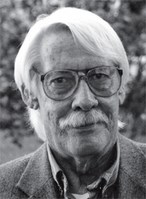
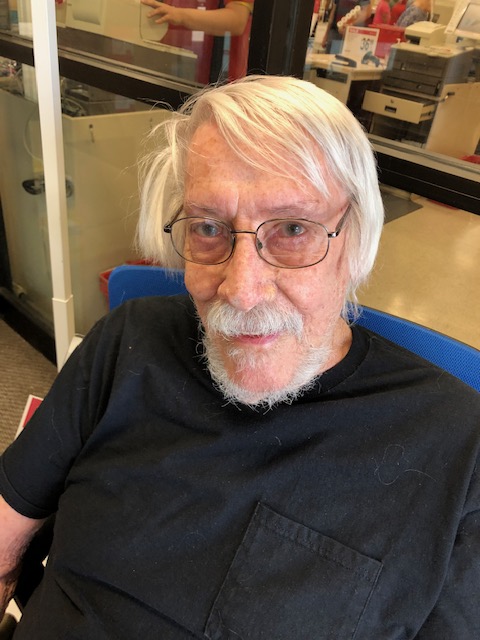
Somehow, Wes made it to age 86. Here are two photos — one from the obit and one from 2019. Former KC Star photographer Ginzy Schaefer took the 2019 photo. (Thanks, Ginzy!)


Below is an image of a secondary photo Wes took for that Sunday Magazine story…We had gone back to the Inferno at some point for this photo, which ran inside the magazine, with the text.

The caption that went with the photo read: “THE STONED CIRCUS…Members of the group pose stoically on stage. From left to right are Joe York, Donna Isom, Robin Davis, John Isom and, at bottom, Nancy Lake.”

We returned to KC last night after a month in Florida.

It’s the longest period Patty and I have ever been away from home. Five days were devoted to driving — three on the way down, two on the return — and 26 days relaxing.

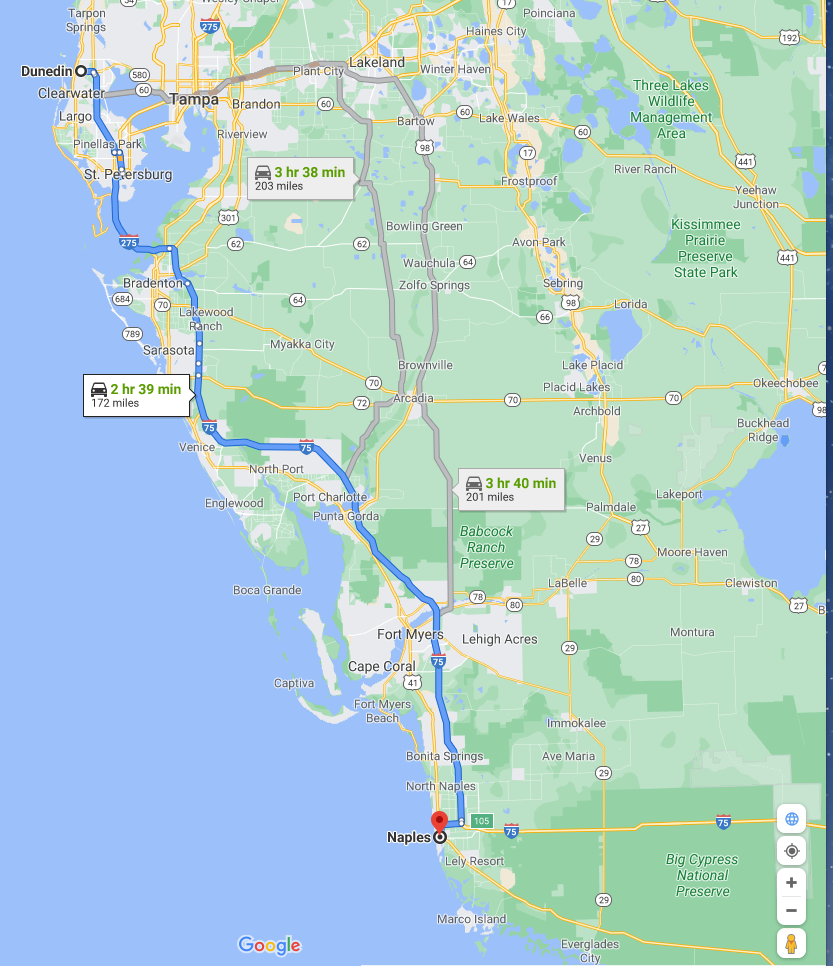
We spent the first week in Naples (I’m sure some of you saw my photos from there) and the next three in Clearwater and Dunedin, which is 175 miles north of Naples. To give you perspective, here’s the map…

Naples is about as far down as you can go on the west coast, while Clearwater and Dunedin are part of the fabulous Tampa Bay area. It’s warmer in Naples, of course, but overall we much prefer the Clearwater, mainly because it is much more of a “regular” city than Naples, where the wealth is over the top.

This one fact will tell you all you need to know about the difference between Naples and Clearwater: Where you pay $110 plus tax to play 18 holes on a good golf course in Naples, you can play the Clearwater Country Club (open to the public) for $50 plus tax.

Now, here are some photos from the second leg of our trip.

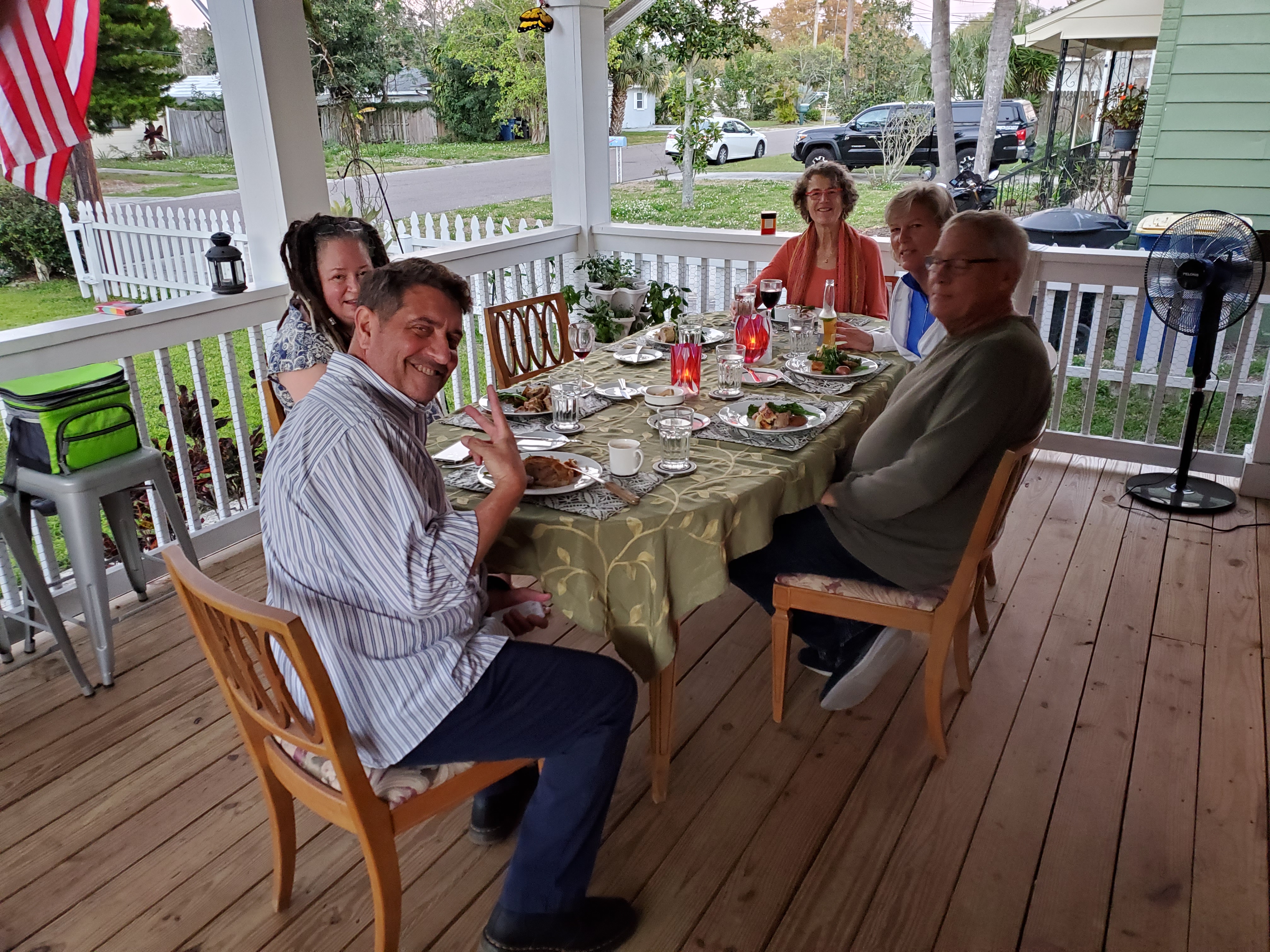
In Clearwater, we spent two weeks at an Airbnb and then moved to a house owned by Kansas City friends Jim Gottsch (right) and his wife Julie Koppen (to his right). They’ve become friends with another couple on their block, Luther Hendricks (making gang signs) and his wife Becky, to his left. (That’s Patty at the far end.) This picture was taken at Luther and Becky’s house, which is two doors from Jim and Julie’s house (by the black truck in the driveway).

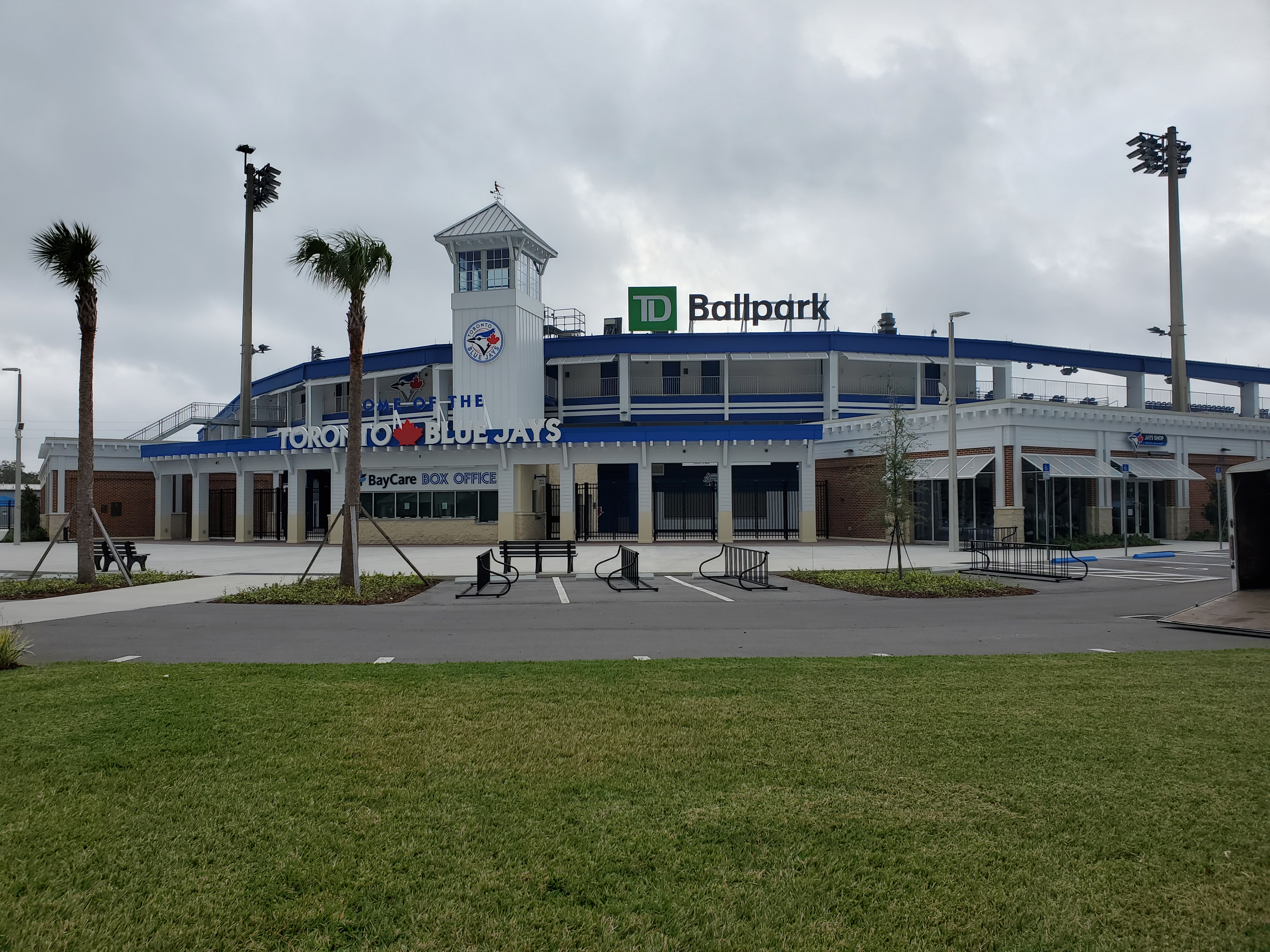
A few blocks from Jim and Julie’s house is TD Ballpark, where the Toronto Blue Jays have spring training. This year, because of Covid, they will be playing several regular-season games there, too. We took in a spring-training game last Tuesday.

Clearwater Harbor — adjacent to the Gulf of Mexico — is several blocks west of Jim and Julie’s.

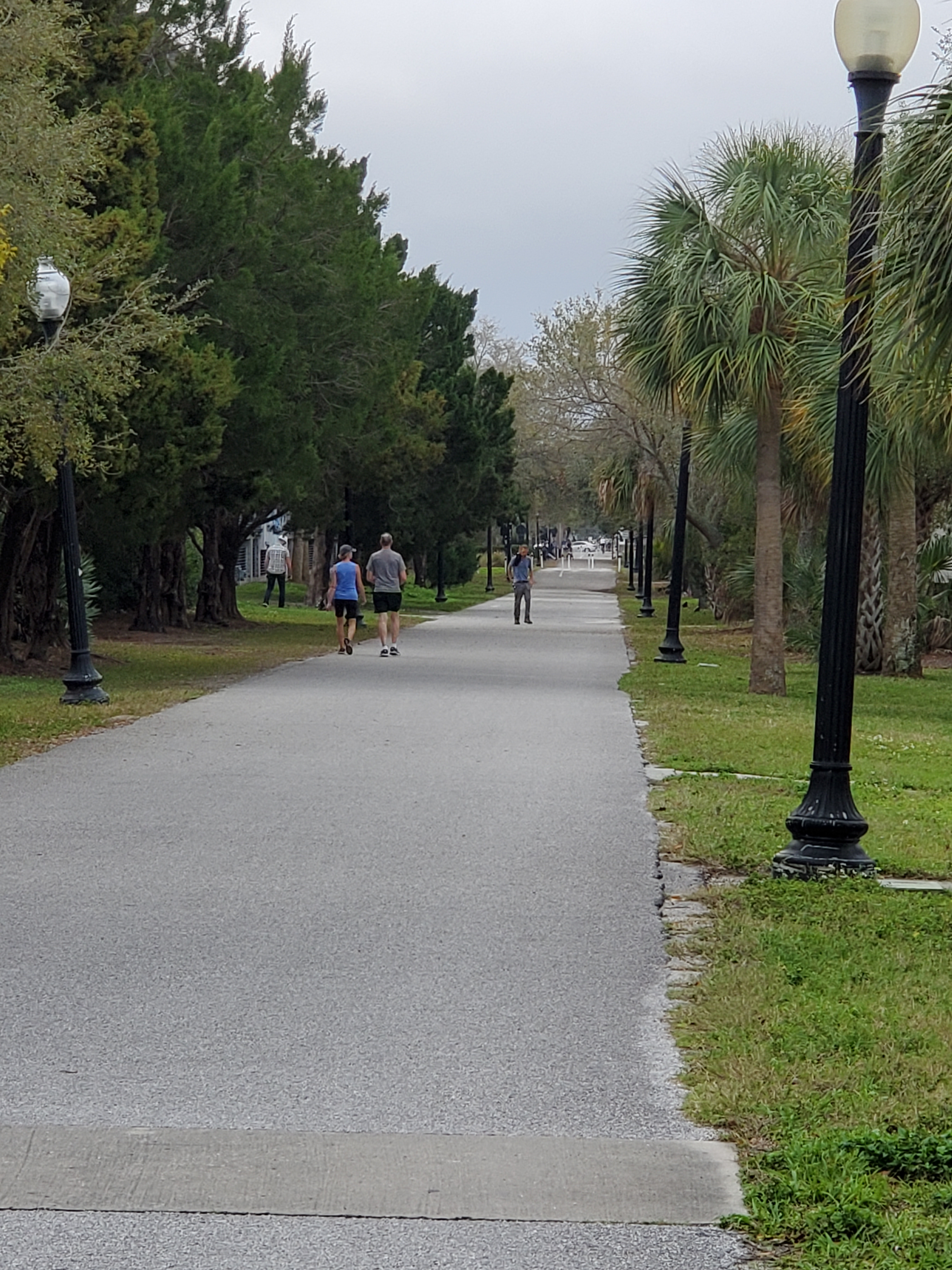
Within 100 yards of Jim and Julie’s house is Pinellas Trail, a reclaimed rail line that extends 45 miles, from Tarpon Springs to St. Petersburg.

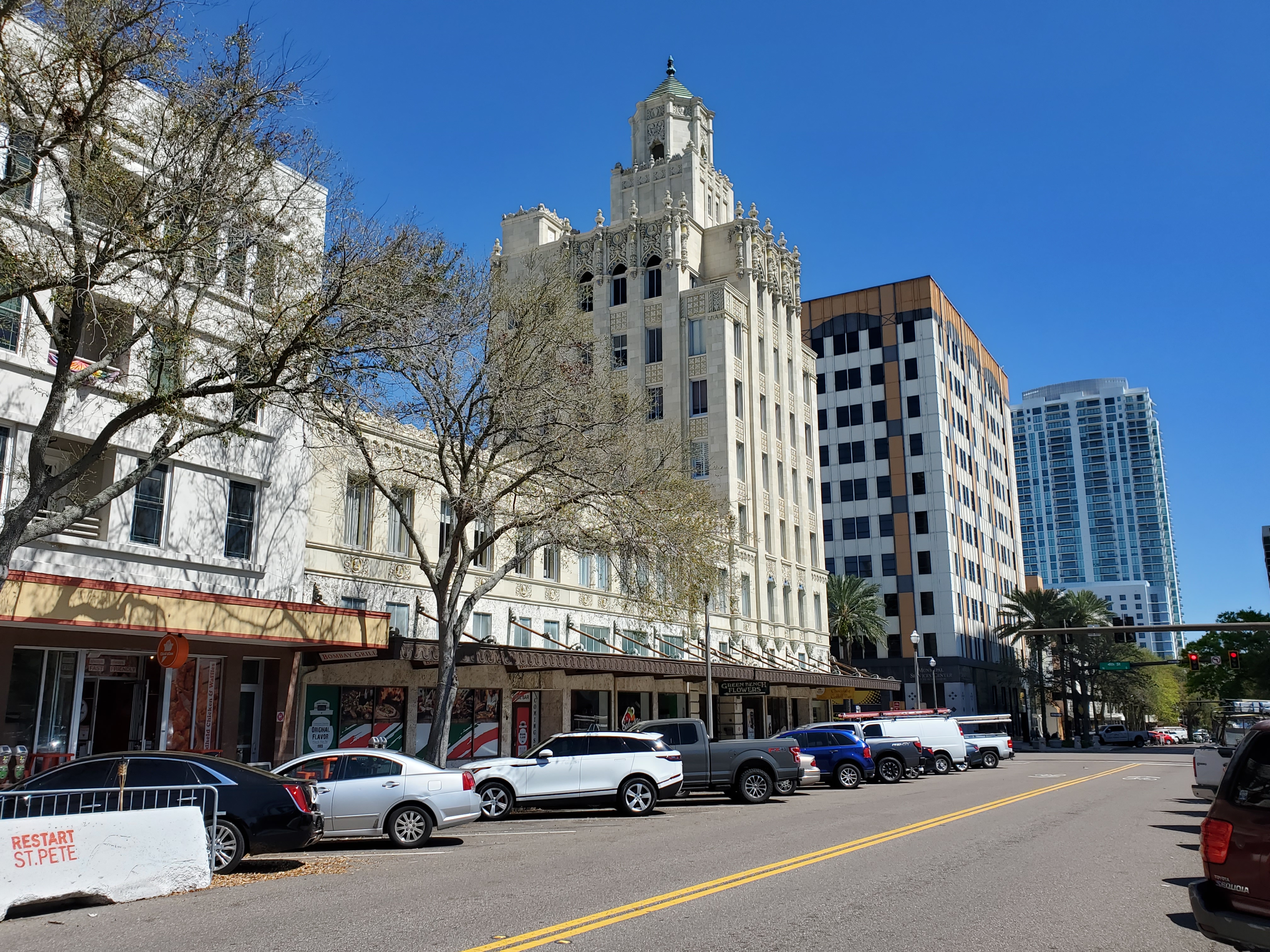
Just south of Clearwater is St. Petersburg, where we went last Thursday. I took this photo and the following ones in the city’s Central Arts District, which is similar in theme to our Crossroads Arts District…Above is the Snell building, which dates to 1928.

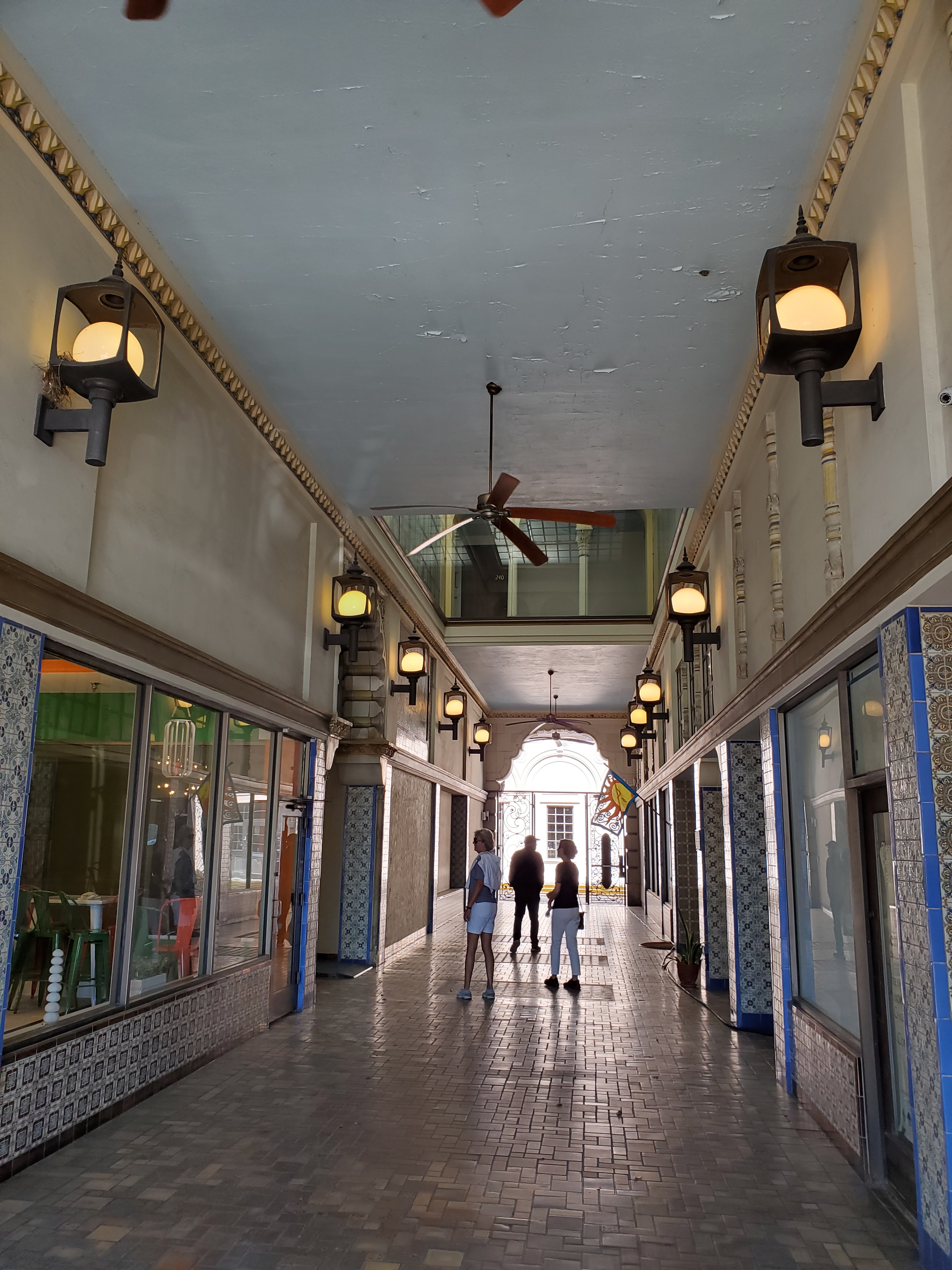
This is the Snell building arcade, open at both ends.

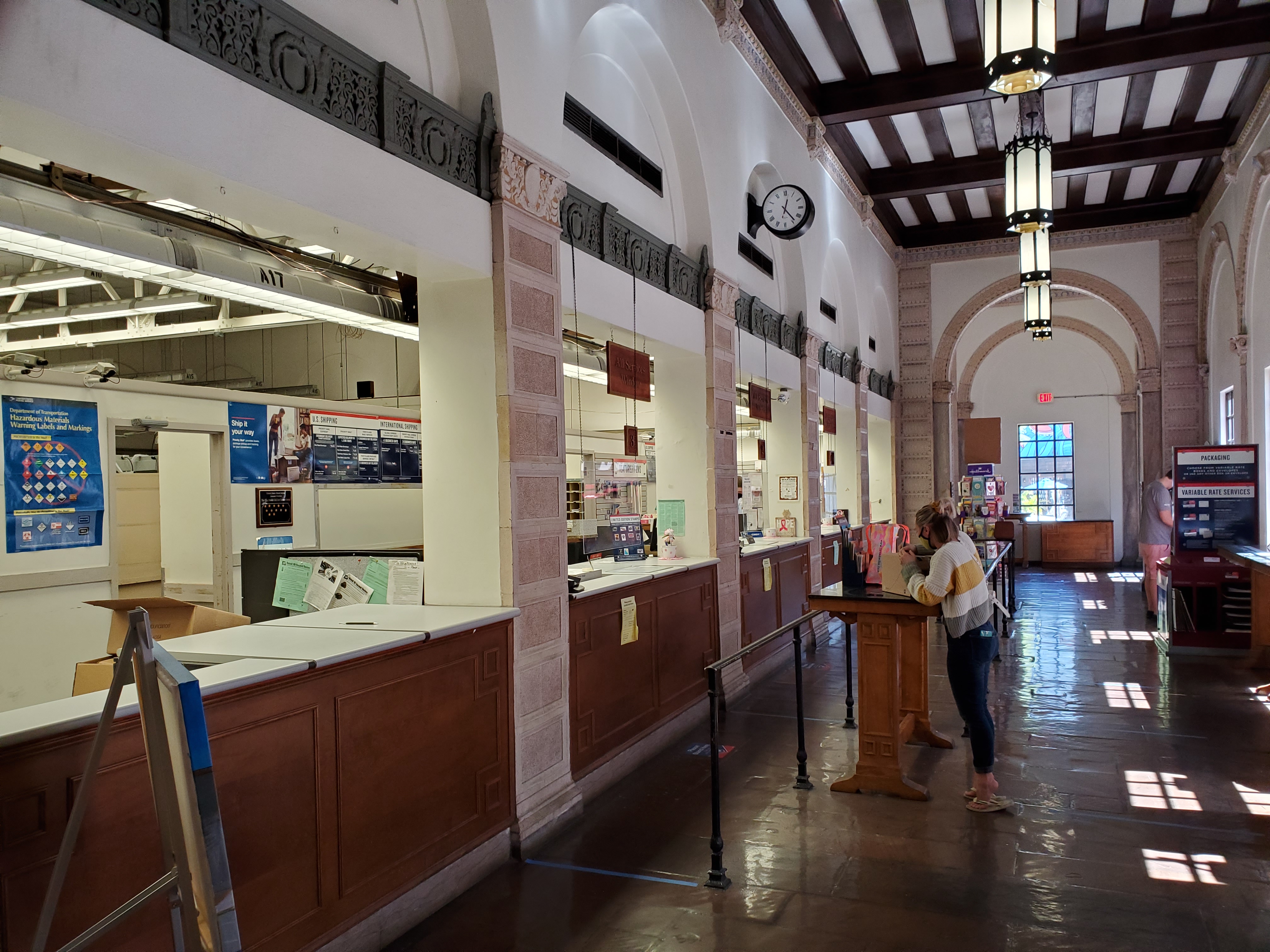
Next to the Snell building is the downtown Post Office. The Post Office was built in 1916. Both are examples of Mediterranean revival architecture.

The Post Office counter

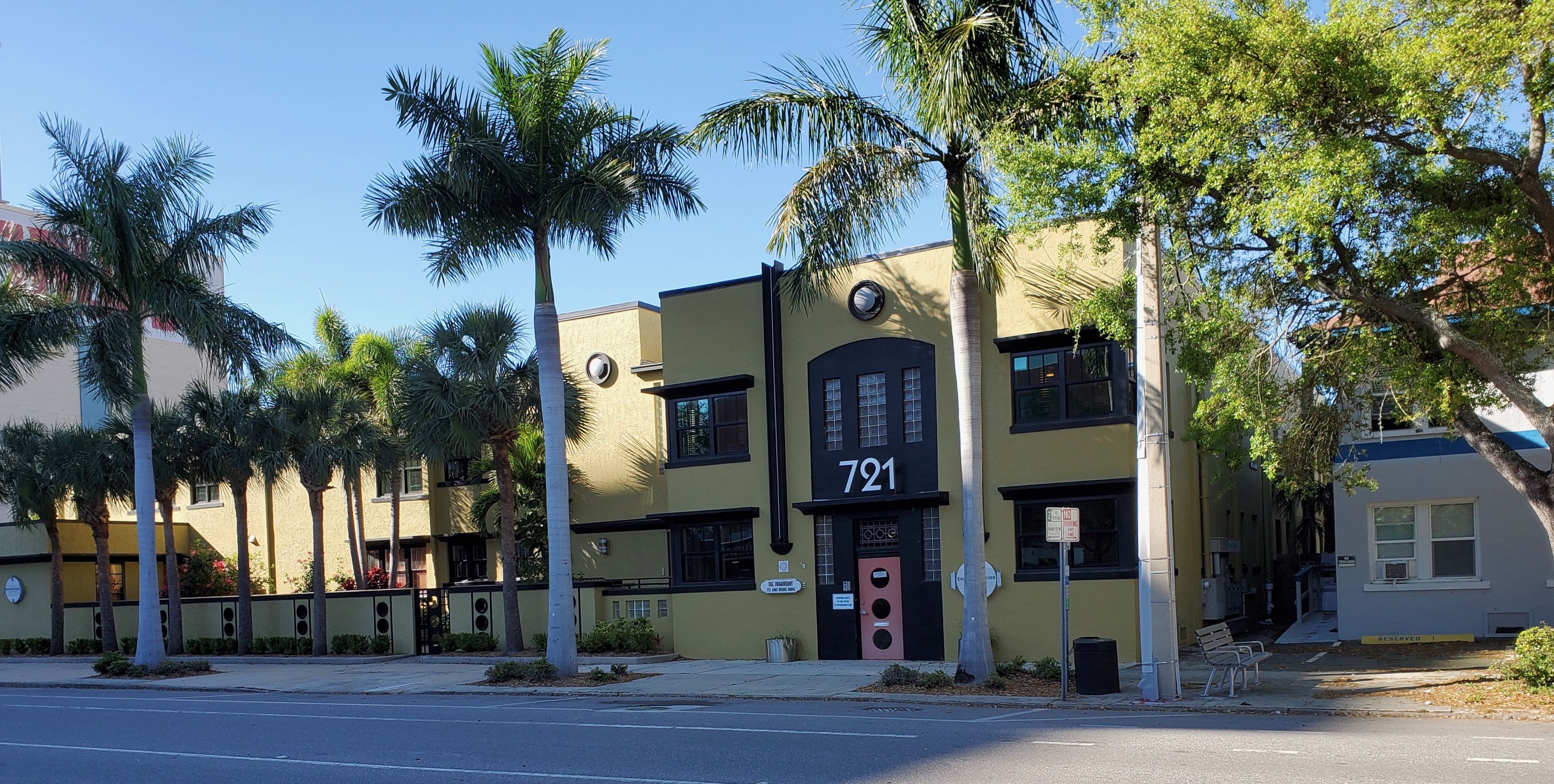
Here’s another eye-catching building, this one fronted by palm trees…When you’re visiting South Florida from the Midwest, you should never take a palm tree for granted. If you do, it’s time to go somewhere else.

As you’ve probably noticed, I no longer write much about The Kansas City Star.

The main reason is there isn’t a lot to say. The paper’s website is mostly a wasteland — mainly sports and restaurant comings and goings — and the investigative work it undertakes often doesn’t relate to the Kansas City area.

(For example, the paper has been on a tear the last year or so regarding abusive operators of outstate boarding schools. While that’s important and certainly newsworthy, it has limited appeal to core readers; I never hear anyone talking about those stories.)

Today, though, while reading the “e” edition — the electronic version of the printed paper — I noticed that The Star recently suffered a major loss: The name of Colleen McCain Nelson, who since 2016 had been The Star’s vice president and editorial page paper, was missing from the masthead.

A Google search turned up that she resigned last month to become executive editor of The Sacramento Bee and to oversee McClatchy’s five other California papers, as well.

I am pretty sure The Star did not play the story of Nelson’s departure prominently. I’m an online subscriber, and I check the website several times a day and did not see the story there — although it’s possible I missed it.

Checking the search bar on the website, I found that reporter Kevin Hardy had a Jan. 7 story about her resignation. The story quoted Star president and editor Mike Fannin as saying…

We’re thrilled about Colleen’s well-earned promotion but sad to lose the best editorial page editor in the country. She has built a world-class team in Kansas City, reinvigorated our opinion journalism and set a very high bar for her successor.

Nelson

Let me put this more explicitly: During her four years at The Star, Nelson was the most pivotal and important employee at the paper. The Star could carry on more easily without Fannin than without Nelson. At a time when many newspapers were thinning out their opinion pages, Nelson was rebuilding and fortifying The Star’s opinion pages.

I have been particularly impressed during the last year, when Nelson turned The Star toward endorsing local control of the police department and called for Chief Rick Smith to resign or be fired. She saw clearly how poor the police department relations are with the African American community and how ludicrous it is for the biggest police department in a Democratic county to be run by do-nothing political appointees of a Republican governor in a Republican state.

So what happens with the opinion pages now?

It’s a good question, and Fannin didn’t address it in the Jan. 7 story. He said nothing about choosing a successor for Nelson, which leads me to believe that her successor will be promoted from within. I seriously doubt that the hedge fund that owns McClatchy — Chatham Asset Management out of New Jersey — will give the green light to hiring an experienced, highly paid editorial page editor. Chatham will be looking to reduce payroll and to direct the savings into return on investment.

If a successor is chosen from within, the options are somewhat limited.

With Nelson gone, the editorial board now consists of Fannin, who writes no editorials; Derek Donovan, who mostly handles letters to the editor; Toriano Porter, who writes almost exclusively about racial issues; Michael Ryan, the token conservative board member; Dave Helling, a versatile journalist with a strong reporting background; and Melinda Henneberger, a two-time Pulitzer Prize finalist who is married to a Star mid-level editor named Bill Turque.

Clearly, Helling and Henneberger would be the top two internal candidates. However, both are nearing retirement age. Helling is about 65, and Henneberger is about 63. Would either want to take on that much responsibility at this stage of their careers? On the other hand, one of them could take the job with the intent of maintaining, in the short term, the well-oiled operation Nelson put together.

However this goes, though, I think The Star’s editorial-page operation has seen its best days and that we will see a gradual decline from here…And I say that hoping the decline is gradual rather than precipitous.

For Nelson, on the other hand, the view is up. She’s only 46 and should have many great years ahead of her. It would not surprise me if she wound up working for the opinion section of either The Washington Post or The New York Times.

The Star and Kansas City were lucky to have her the last four years. I met her only once and never got to know her, but I will miss her strong and inspired leadership at The Star.

The king is dead. Long live the king — whoever the next king of conservative, talk radio may be.

Oh, yes, there will be one. And we Democrats will be hanging on the edge of our chairs to see who will succeed Rush Limbaugh, a Missouri native (Boot Heel, fittingly enough), who died today at age 70 from complications of lung cancer.

Now, I’m sorry for his family and friends, but I’m sure not going to miss his ridiculous, ditto-head ruminations.

Got to hand it to the guy, though, he went down full tilt, throwing haymakers even while succumbing to a larger force than his grating personality.

His last broadcast was Feb. 2, just 15 days before he died.

If it was me — if I was lucky enough to have several months notice, like Rush did — I’d be preparing for a happy death, not taking every last opportunity to skewer enemies, perceived or real.

But not Rush. Just to show you how much he was “in form” while not far from his deathbed, here are two excerpts from his last broadcast and, as a bonus, his last social media post.

**

The ruler of Michigan, Governor Gretchen Whitmer, is graciously and generously allowing restaurants to resume indoor dining. She took credit for the state’s COVID numbers dropping, due to the “targeted and temporary pause” that she ordered in November. The governor thanked all those who made “incredible sacrifices and did their part.” She said she knows the pandemic has hurt restaurant owners, workers, and their families. Governor Whitmer, the pandemic hurt those who got the coronavirus. What hurt restaurant owners, workers, and their families was the tyrannical response to the pandemic from Democrat governors like you.

Fifteen days before leaving this mortal coil, and what was on Rush’s mind? The “tyranny”of a governor trying to protect the 10 million residents of her state.

**

Then, there was this, in response to a caller named Darlene, from Colorado, who wanted to talk about former President Trump’s second impeachment….

They (Democrats) don’t have the votes to convict him. So he’s gonna be acquitted. But that’s not why they’re doing this. They’re not doing this to actually convict him. They’re doing this to continue the smear…

They’re looking at this as an opportunity to shape public opinion even more against Trump. They have an opportunity here to continue to impugn, to criticize, to make up whatever they want about the guy. They’ve got the mainstream media in their back pocket to amplify whatever they say. So this is just an ongoing effort…

Fifteen days before the Grim Reaper came knocking, and what was Rush preoccupied with? Why, the evil Democrats allegedly trying to “impugn” a former president with neither morals nor character.

**

And, finally, in his last social media post (also on Feb. 2) he lit into President Joe Biden, saying…

Biden canceled “a major foreign policy speech,” folks, over two inches of snow. I kid you not.

Fifteen days before “lights out,” and Rush was swinging so wildly that he went after Biden for delaying a speech that would be given two days later.

**

Now, I’m assuming Rush is in heaven, because God is not mean and God harbors no resentment. But I suspect that, for the first time in his life, Rush, tonight, is feeling humble.

I don’t want to tell you what the temperature is today down here in Clearwater, or yesterday in Naples.

You have to trust me when I say we are not gloating about missing the coldest spell in Kansas City in many years. We feel a bit guilty. That we missed the frigid front was just dumb luck.

When we left a week ago Friday, it was normally cold, not ridiculously so. It took us three days to get to Naples, and the temperature didn’t hit 70 until we got well south of Gainesville, where we spent the second night. But when we got to Naples, our destination for the first week of our winter sojourn, it was close to 80. It stayed that way, during the daytime, much of the week.

Yesterday was moving day. We departed in the early afternoon, drove through some rain and got to Clearwater about 5 p.m.

Today it’s cloudy and muggy. Patty and our good Kansas City friend Julie, who with her husband Jim, owns a house in Clearwater, have gone to the beach. Jim, a retired contractor, is working on their house. And me? I’m writing this winter letter to my readers, friends and relatives back home.

Tomorrow, I play golf…I played twice in Naples with our Louisville friends, Bill and Denise. To show you the difference between Naples and Clearwater, it cost $120 to play 18 holes in Naples, and it will cost about $55 to play at the Clearwater Country Club, which isn’t really a country club in the true sense because it’s open to the public.

Anyway, I know that some nice hot-weather photos will help tide you over to the weekend, when it’s due to get bearable again back home. So away we go…

Here’s the house we stayed in while in Naples. It’s owned by a Louisville physician, who rents it out to friends for part of the year. Our friends Bill and Denise have rented it for three weeks each of the last several winters. It looks rather small from the front, it’s got a large addition on the back. Altogether, it has four bedrooms and four baths.

For the most part, Naples has become a retreat for people of phenomenal wealth. Every day we saw or heard numerous big, private jets flying overhead on their way out of Naples. Homes like this are the exception. Modest houses are being bought, scraped and replaced with enormous new ones all the time.

To give you an idea of what’s been going on, this house stands next to the one in the previous picture. Both are on 11th Avenue South, several blocks from the beach, in an older area of Naples.

Many streets are lined with large palm trees, the seminal sign you have found your way to the Sunshine State.

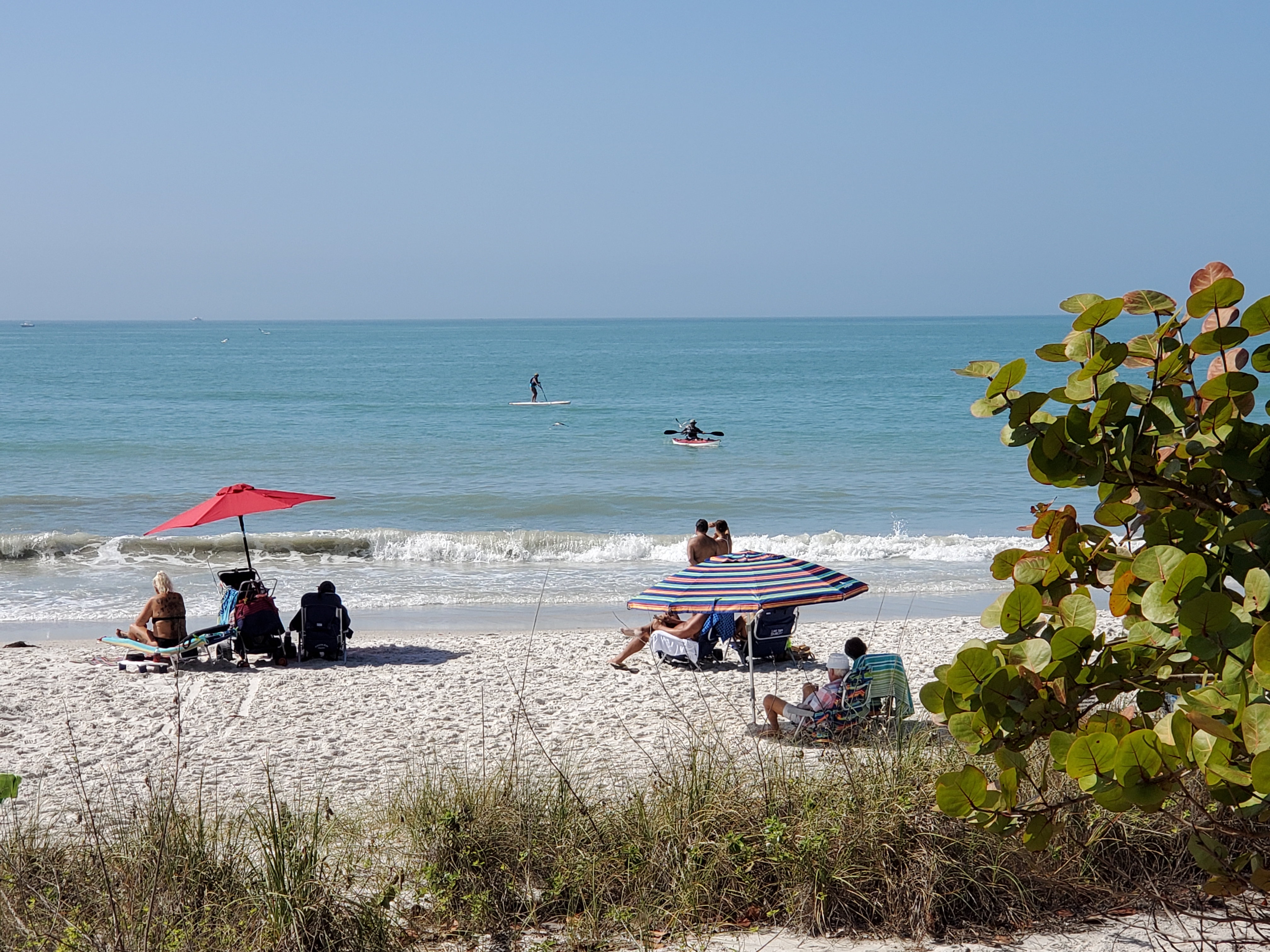
The beach

This is the Naples pier. At one time, Naples was accessible only by water. (The big breakthrough was completion of a railroad line in December 1926.) In the 1880s, a 600-foot-long pier was built as a lifeline to the outside world. It was washed away by a hurricane in 1912, rebuilt and then burned by a carelessly dropped cigarette in 1922. It was repaired and lengthened to 1,000 feet in 1924 but was wrecked again by storms in 1926 and in 1960. After Hurricane Donna in 1960, two local philanthropists donated the money to rebuild the pier, and it reopened in 1961. It has a concession stand at the halfway point, and visitors can fish free of charge…No license needed.

A father and daughter (presumably) frolicked in the water just before sunset.

One day, we made it to the Everglades. While we didn’t go to Everglades National Park, we went to the nearby Big Cypress Nature Preserve, which basically is 729,000 acres of swamp.

A park ranger told us, “If you want to see what it’s like to be out in the swamp, this is it.”

Then there are these guys. This alligator was about 10 feet long…At least it looked that way to me. When I sent this photo to daughter Brooks she was concerned that I had edged close to the gator to get the photo. Not to worry…I shot it from the boardwalk above the waterway.

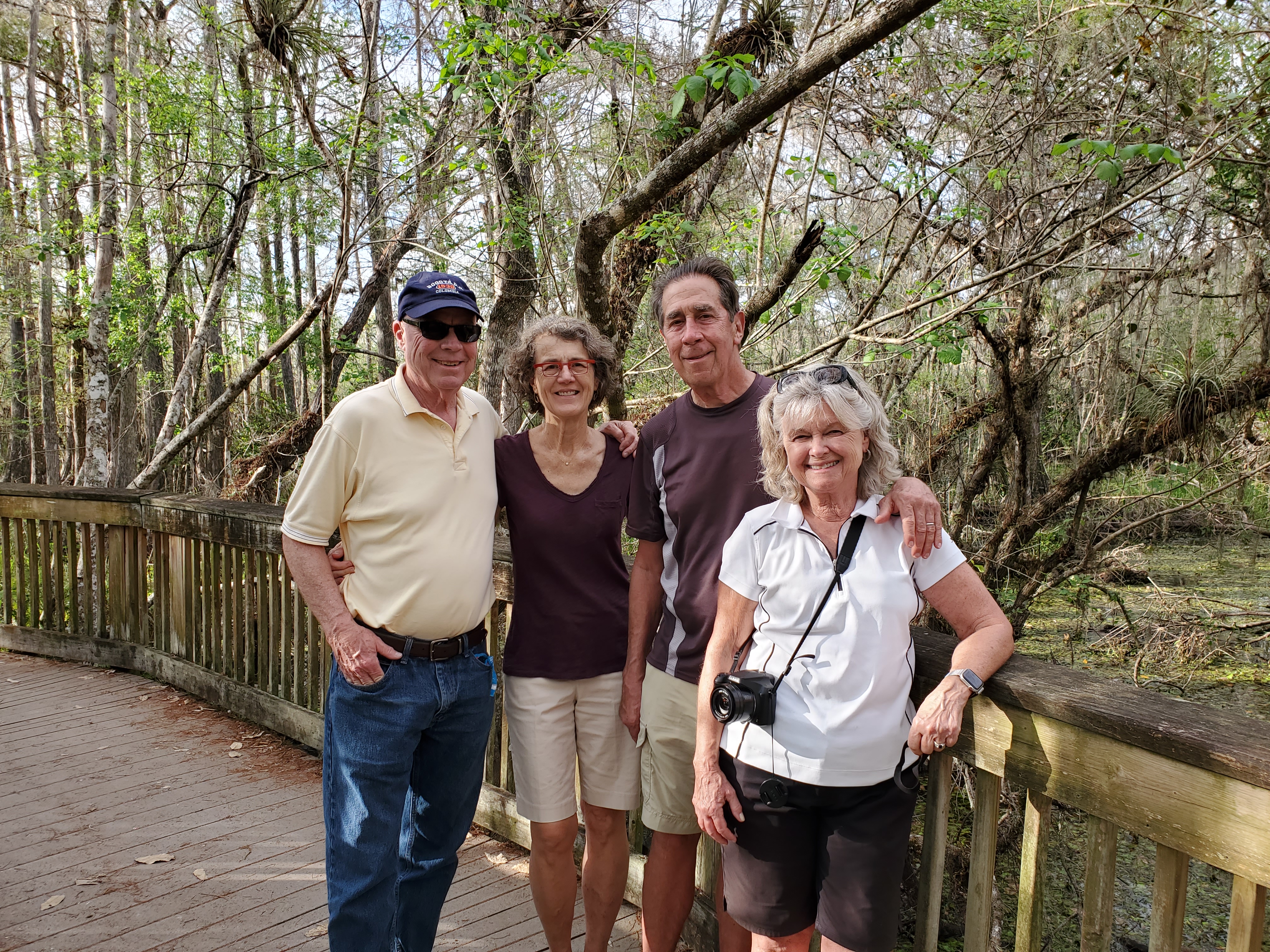
Before we left the swamp (thank God for the boardwalk), the park ranger took our photo. From left, me, Patty, Bill and Denise.

And that brings us to today, and our new place — an Airbnb on Union Street in Clearwater. It’s got two bedrooms and one bath. Everything works, and there are four bikes in the garage. Another bonus: It’s a block from a convenience store named Munchies. We’ve already been there three times. Tally-ho!

From experience, I know a lot of people are already  frustrated about the scant information that has come out about Britt Reid and the curious and shocking wreck he was involved in that critically injured a 5-year-old girl.

The police have said the investigation is going to take weeks. Well, don’t be surprised if it takes months.

I’ll bet a lot of people are thinking that Reid will be getting preferential treatment and that police will drag out the investigation in an attempt to let the case get stale in the minds of the public.

If I hadn’t followed another horrific case three years ago, I would think the same thing. But mainly because of that earlier case, I believe the police investigation into the Reid case genuinely will take a long time. There are many factors involved, including toxicology tests, exactly how the crash occurred and witness accounts. While the public is eager to know things like Reid’s blood alcohol content and if he was on the phone when the wreck happened, the police will be painstakingly assembling all the facts and preparing a case file. Once that is done, they will present it to the Jackson County Prosecutor’s Office.

Don’t expect information to be leaked in dribs and drabs. If the police department let information come out piecemeal, it would probably damage the case. What we should all want here is for the police to do a thorough job and submit a complete and coherent file to Jean Peters Baker. And I can assure you of this: If Baker gets a complete and coherent file, she will play this case absolutely straight. Neither Britt Reid nor Andy Reid will be getting a break from this fearless prosecutor.

The key to this case will be the police investigation. If it’s done right, I believe justice will be served. If the police screw it up, justice won’t be served.

Now, let me take you back to the case that serves as a guideline for how long it takes to conduct a thorough investigation of a case involving alcohol, drugs and serious injury or death.

Many of you will remember the case of the guy who, on Sept. 23, 2017, hurtled down the 23rd Street ramp from I-435 at a speed of 90 miles an hour.

The man, who was driving a 2015 Dodge Ram pickup, had been frustrated by the relatively slow pace of traffic on northbound I-435 after a Chiefs’ game. Finally unburdened of traffic in front, he roared down that ramp and slammed into an SUV traveling on 23rd Street. The SUV then plowed into two other vehicles, before the Dodge Ram pickup ended up against a rock wall all the way across the intersection. After the crash, the driver walked around his truck, kicking at it and never looking back at the havoc he had wreaked or bothering to check on the occupants of the other vehicles.

I started writing about that case not long after the crash occurred. I could not understand why the man’s identity didn’t become public and why it was taking the police so long to conduct the investigation. But, as with Britt Reid, drinking and/or drugs were involved, and it’s just a fact of life that the results of toxicology tests don’t come quickly.

It wasn’t until Dec. 1 that I even found out the driver’s name and city of residence — Terry A. Gray of Independence — and that was not because he had been charged but because he was named as defendant in two civil suits seeking damages as a result of the crash.

It was about the same time — more than two months after the crash — that the police department turned the case file over to Baker. Charges were finally filed on Jan. 4, 2018, almost three and a half months after the crash.

Gray was charged with two counts of causing death while driving under the influence and two counts of DWI resulting in serious personal injury. Bond was set at $75,000, but he was able to come up with $7,500, which enabled him to make bond through a bond company.

Then the damnedest thing happened: In early March, two months after being charged, Gray died. He was 51 years old, and it turned out he had cancer — which might have been a factor in his “fuck-the-world” attitude on Sept. 23.

In a March 7, 2018, post about Gray’s death, I wrote: “Sometimes cases don’t end conventionally or neatly. This is such a one.”

**

So, I would urge everyone to be patient regarding the Britt Reid case. The temptation will be to think the fix is in and the case is going to disappear into thin air. It won’t. The facts will come out. Britt Reid has had d.u.i.’s before, and he’s obviously got a drinking and prescription drug problem. KCPD and Jean Peters Baker know full well that the public is watching this case and that it’s going to be remembered as long as this Super Bowl is remembered.

Britt Reid is in serious trouble, and I believe KCPD and Jean Peters Baker will do the right thing. It’s just going to take time to hold Reid to account. I don’t think his father’s lofty status is going to help him this time, especially if little Ariel should die.

We’re all hoping that doesn’t happen. Near the top of every Kansas Citian’s wish list now is that Ariel will regain consciousness and, in time, make a full recovery.