Feeds:
Posts
Comments

The weather forecast for Louisville tomorrow is partly cloudy, a high of 83 degrees and a 10 percent chance of rain.

Sounds like a perfect day for a Kentucky Derby.

The only problem is the Derby isn’t being run today. It’s been scheduled for the first Saturday in September…but there’s even doubt about that.

This will be only the second time since the Derby was first run in 1875 that the Derby will not have been run on the first Saturday in May. The only other time was 1945, when the U.S. government had put a temporary ban on horse racing because of World War II.

Patty and I had planned on going to Louisville for the Derby this year — and we still might — but today we’ll be in Brookside. Not a bad alternative, but, darn!, I hate to see that great tradition disrupted.

I suspect I’m going to be feeling pretty wistful today, and I can only imagine what the emotions are going to be like among Louisvillians. In an ordinary year, they would be culminating two weeks of Derby-related events with “the most exciting two minutes in sports,” the Run for the Roses, in the late afternoon.

I’ve been to quite a few derbies since 1981, and it’s true what Kentucky author and humorist Irvin S. Cobb once said…

“Until you go to Kentucky and with your own eyes behold the Derby, you ain’t never been nowhere and you ain’t seen nothin!”

When Cobb said that, he had in mind, I’m sure, that the best part of the Derby is not the race but the atmosphere — the tidal wave of joy, excitement and energy that comes from an assembly of 150,000 people, all primed to cut loose and have fun and most dressed in the fanciest and most creative outfits they could come up with.

I don’t know what September is going to bring or how long it will take for the Derby to return to what it was, but I’m sure grateful for my Louisville roots and for the good times I’ve had at Churchill Downs on past first Saturdays of May.

On this would-be Derby Day, then, let me show you some of the happy moments Patty, Brooks, Charlie and I have had at past derbies.

At Derby 143 in 2017 — the last Derby I attended — I ran into a guy named Tom, from Indiana, who was wearing the very same hat I had. I’ve still got that hat — straw, by Goorin Bros. It’s good for at least one more Derby.

Derby 140 in 2014 was the last time Patty and I went to the Derby together. When she owned a garment manufacturing business, which she sold last year, spring was her busiest time of year. (She looks just as good now as she did then!)

Here are Brooks and Patty at Derby 137 in 2011. It was the only year all four of us went to a Derby. I bought five single tickets — two in the same box, the others scattered — outside the track, and we rotated in and out of the box all day.

Again from 2011…That’s Charlie on the right and his friend Patrick Schell, who traveled from Oklahoma for the occasion. Charlie had told Patrick, “Come on up; my Dad will get us tickets.” It was a challenge, but I did.
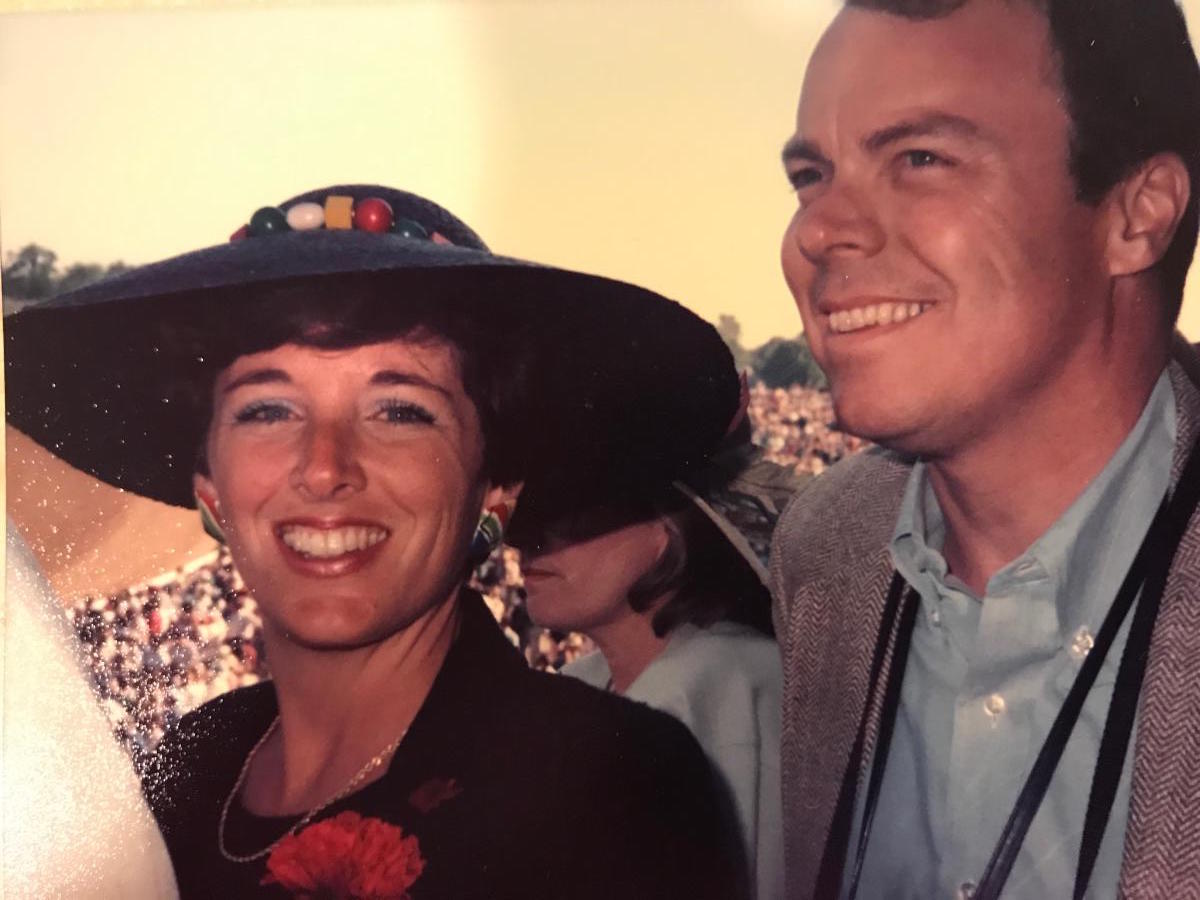
Last but not least, here’s a photo my friend Marcie Blakeney of Louisville sent me a year or two ago. I’m pretty sure it was from Derby 112 in 1986, after I had just turned 40. Marcie’s husband at the time, John Blakeney, had gotten us tickets through the company he worked for, Brown-Forman distillery in Louisville. They were the best seats I’ve ever had for the Derby — third-floor grandstand, just beyond the finish line. A lot has changed since then: Among others, I lost my hair, and Marcie and John got divorced. But I’ll tell you this — Marcie is still beautiful!
 

Things are going painfully bad for The Kansas City Star.

For the first time ever, I’m sure, The Star is seeking charitable contributions as a lifeline.

In today’s print edition and in stories online, the paper is soliciting money to “ensure we continue to report on the coronavirus and all of its impacts across our communities.”

That The Star is reduced to soliciting handouts is shocking to those of us who have deep backgrounds in journalism. At one time, back in the 1980s, when The Star was owned by Capital Cities Inc., the paper profited to the tune of tens of millions of dollars a year. Publishing the paper was a veritable license to print money.

My, how things have turned upside down.

More about the solicitation in a minute, but, in addition, in reading the paper today, I came across a full-page ad for the New Theatre Restaurant promoting a show called the “Million Dollar Quartet,” featuring the music of Jerry Lee Lewis, Johnny Cash, Elvis Presley and Carl Perkins.

What jumped out at me about the ad was two words in big, white letters that said, “OPENS TUESDAY.”

Now, I knew the Kansas shutdown order was in effect until at least May 3, so I wondered what the heck was going on. I soon found out. New Theatre Restaurant had put messages on its website and telephone answering system saying The Star had incorrectly run the ad.

“Rest assured that is not the case (that the show opens Tuesday),” the recording and the website say. “New Theatre Restaurant will reopen, but only when it’s safe.”

I don’t know what that ad cost NTR, but The Star will have to compensate somehow, either by returning the money or maybe running the ad two or more times in the future.

In any event, it’s an extremely embarrassing mistake…

Did no one — NO ONE — look at that ad before the paper went to print and realize the only conceivable way that show could be opening Tuesday was if NTR was in Georgia?

…Now back to the more issue of The Star seeking charitable solicitations.

A story on 4A today solicits contributions for a nonprofit called Local Media Foundation. The story says in part…

“Your tax-deductible gift can ensure we continue to report on the coronavirus and all of its impacts across our communities. We aim to raise $200,000 to keep our reporters reporting, our videographers recording and our editors at work delivering essential news and information to you.”

Oddly and inexplicably, the story provides no background on the Local Media Foundation, which I’d never heard of. From its website I found it is the fund-raising arm of the Local Media Association (which I’d also never heard of), whose members include newspapers, radio and TV stations and digital sites.

Further complicating the solicitation picture, on April 23 The Star ran a story touting its hiring of three full-time reporters — all very young and with little experience — in partnership with a national program called Report for America.

Report for America is a three-year-old nonprofit whose goal is to place young journalists in local newsrooms so they can be trained to cover under-served regions or important issues. It is funded primarily by foundations and institutes but also solicits individual contributions, which the April 23 story noted.

**

This whole thing is puzzling. My first thought on reading the story about the Local Media Foundation was that it must be connected with the Report for America Project. But that’s not the case; the Local Media Foundation solicitation is separate and distinct.

If The Star is going to get into the solicitation business, it should at least offer a thumbnail sketch of each nonprofit it is using as a conduit. The Star has explained the Report for America project well, but so far it has dropped the ball on the Local Media Foundation. What is that? Who’s behind it? How long has it been around?

Most people will not consider giving to a charity without knowing anything about it, and to most people the Local Media Foundation is a blank slate.

Already today two people with longstanding connections to The Star have contacted me about the solicitation campaign. One was Tom McClanahan, who retired several years ago as a member of The Star’s editorial board. Tom summarized the situation succinctly when he said, “Something tells me that for newspapers, trying to survive as charity recipients is not a viable business plan.”

**

Do you remember that The Star’s story said it was seeking to raise $200,000 through the Local Media Foundation? At 5 p.m. today, a link to the donation page cited in The Star said 72 people had contributed $5,540.

I think McClanahan is probably right: Not a viable path forward.

I wish I could see beyond the hilly horizon and get a glimpse of where The Kansas City Star is headed.

I want to think we’re going to have a viable paper five years from now — even if it’s just online — but things are changing so fast it’s impossible to say.

Consolidation in the newspaper industry is moving rapidly. There are now just four major chains: Gannett, McClatchy, Tribune and MNG (Media News Group).

Joshua Benton of the Nieman Lab wrote last week that the number could soon be down to two. That’s because McClatchy, which owns The Star and 28 other daily papers, is in bankruptcy and could be auctioned off, and Tribune could be acquired by MNG.

In addition to consolidation, the COVID-19 epidemic is savaging newspapers as much as about any other industry. Advertising had already plunged over the last 14 years, and now it’s in an even sharper slide. Some newspapers will not survive.

I think The Star will survive in some form — this is too big a metro area to not have a major daily paper — but what that will look like I can’t predict.

McClatchy has banked for years on a “print-to-digital transformation,” but it looks in retrospect like it was all pie in the sky. The Star, for example, now has about 17,900 digital-only subscriptions (up from 12,300 at this time last year), but that’s a very small number considering the metro area’s population is about 2.1 million.

The Boston Globe, by comparison, has more than 100,000 digital-only subscribers.

**

One thing I do know is that The Star’s print product continues to be plagued by poor editing and overall lack of attention, and I believe that’s a factor in the declining print-circulation figures.

The latest figures from the Alliance for Audited Media, an industry-funded organization, show that Sunday print circulation dropped 10 percent between March 31 last year and March 29 of this year, and Monday-to-Friday print circulation fell 6 percent over the same period.

The Sunday numbers:

:: March 31, 2019 — 86,398
:: March 29, 2020 — 77,468

The Monday-Friday numbers:

:: March 31, 2019 — 57,035
:: March 29, 2020 — 53,589

(Note: I incorrectly reported in February that Monday-Friday print circulation had fallen below 50,000 at the end of 2019, but I failed to include single-copy sales.)

Back to the editing problem…With very few display ads, the print edition, while very thin generally, has a huge “news hole.” More than a decade ago, the ratio of ads to news ran somewhere around 60-40, but now I would say it’s about 10-90.

(That’s why The Star and other papers have raised print prices so much in recent years; they’ve had to switch from largely advertising supported to mostly subscription supported.)

Many papers, including The Star, have also slashed their payrolls to the point that they have editorial staffs perhaps 20 to 25 percent of what they used to be — and those numbers might be too high.

At The Star, at least, the combination of a big news hole and a skeletal editorial staff has resulted in a lot of long, boring stories.

I’ve noticed in past weeks 50-, 60- or 70-column-inch stories that, in the past, would have been 30 to 35 inches. In addition to being too long, those stories seldom are accompanied by good photos and informative graphics, which offer the readers breaks from long legs of uninterrupted text and often add to a story’s appeal.

Column after column of text tends to discourage readers, unless a story is particularly important and compelling. Many readers turn away when they see that a story is going to take considerably more time to digest than they had bargained on.

…Until Sunday, I didn’t think the story-length problem could get any worse.

Until Sunday.

The lead story — one about COVID-19 nursing-home deaths — came in at 85 inches. It should have been about half that.

But the blockbuster, so to speak, was a story that appeared under the front-page headline “Overland Park businesses work to adapt to new reality.”

I read the first four paragraphs, which were on the front page, and then turned to the “jump,” where the story continued inside. To my astonishment, the story took up all of page 6A and all of page 7A, except for a 9-inch by 5-inch ad on each of those pages.

The column-inch count? 146. One hundred forty-six precious inches and two full pages of a 12-page section.

That kind of length is reserved for stories like a year-long investigation or a major scandal.

To quote my favorite lawyer — Seinfeld attorney Jackie Chiles — such story lengths are “outrageous, egregious, preposterous.”

In this case, Jackie might have added soporific.

I say: Will the last editor in the building please take a hedge trimmer to these ridiculously long stories before the remaining print subscribers fall into a Rip Van Winkle coma?

Four and a half years ago, Kathy Feist, whose background was in special-interest publications, started the Martin City Telegraph out of her dining room, with the goal of covering south Kansas City.

With The Star in contraction mode and having closed all its suburban bureaus, opportunities were ripe for publications to pop up and report on activities and developments in neighborhoods and communities the The Star once covered.

Feist, who earned an undergraduate degree in journalism from the University of Kansas in 1983, jumped on the opportunity and began publishing The Telegraph every other week, covering school-district news (Center, Grandview and Hickman Mills), crime statistics, business openings and more.

Things have gone well for The Telegraph, which is free and distributed mostly in stores and restaurants south of Bannister Road, between Holmes and State Line Road. On the power of paid advertising, Feist moved the paper to rented office space and hired some freelancers. Interestingly, a regular columnist is former City Councilman John Sharp.

Today, however, Feist experienced, perhaps for the first time, the hazards of relying too heavily on Chamber-of-Commerce-type journalism.

In its March 17 print edition, The Telegraph ran a short story about a new chiropractic business in south Kansas City. The freelanced story, now on The Telegraph’s website, would have been innocuous had Feist and another editor not decided to include in it — and even move up to the first paragraph — a highly suspect assertion by the chiropractor.

The story began like this…

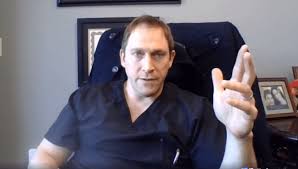
Can intravenous vitamin C infusions knock out COVID-19, the infection caused by the coronavirus? Yes, says Jay Goodbinder, a doctor of naturopathic medicine and a chiropractic internist who recently moved his Epigenetics Healing Center from Overland Park to south Kansas City.

Oh, my.

The story did not quote anyone other than Goodbinder. The reporter did not seek an opinion from a medical doctor or expert, and Feist and the other editor did not direct the reporter to do so.

It was, as we say in the news business, a “single-source” story.

Jay Goodbinder

And as loony as the whole thing sounds, the story might not have gotten much attention, except for one thing: Today, The Star carried on its front page a story about the Epigenetics Healing Center and Goodbinder’s assertion.

High up in the story — before it “jumped” to an inside page — reporter Kevin Hardy noted that The Telegraph had “recently highlighted Goodbinder’s treatment” and quoted the bit about Vitamin C injections supposedly being able to “knock out” the coronavirus.

Hardy had interviewed Goodbinder and Goodbinder did not back down from his assertion. Hardy quoted him as saying, “There’s a ton of anecdotal evidence out there that shows Vitamin C can be very beneficial in any viral concern.”

Now, we all know what Dr. Fauci has said about “anecdotal evidence,” right?

Laughably, Goodbinder went on to say that medical professionals were “kind of flying by the seat of their pants on this.”

So it’s the medical doctors — not him — flying by the seat of the pants!?

Like any reporter worth his or her salt, Hardy contacted a true medical professional, Mary Ann Jackson, a professor and interim dean of the School of Medicine at UMKC. Jackson told Hardy there was no scientific evidence to support the use of Vitamin C as a preventive or therapeutic tool for COVID-19.

Regarding Goodbinder’s intravenous infustions, she said:

You’re still sticking a needle in somebody’s vein and infusing a product. You’re not buying a vitamin at the grocery store. In this particular case, if you’re asking me if there’s a risk, there’s significant risk.”

**

When I talked to Kathy Feist on the phone this morning, she was smarting from the bad publicity generated by The Star’s story.

She vacillated between lashing out at The Star for the “tone” of its story and regret at having emphasized the Vitamin C/coronavirus dimension of her own story. Initially, the reference was down low in the story, but because of the spreading virus, Feist and the other editor decided to elevate it.

Feist said the story was intended to simply profile a new Southland business. She decided to do it after the South Kansas City Chamber of Commerce informed the paper that a ribbon-cutting at the Epigenetics Healing Center was scheduled for early April. (The ribbon-cutting was later canceled because of the virus.)

“It really was just kind of a business profile,” Feist said.

Goodbinder has not advertised with The Telegraph, Feist said, although the paper frequently does publish stories about businesses that buy ads.

(Interestingly, Feist said Goodbinder has had paid advertisements in The Star. I have not seen the ads, but I would suspect they are the kind that resemble news stories but carry disclaimers at the top.)

**

You probably know where I’m going with this…Whenever there is no “wall” between a publication’s editorial department and its advertising department, it is difficult to trust that the reporting is objective.

As editor and publisher of The Telegraph, Feist made two big mistakes with the Epigenetics story: First, she should have cut out any reference to Vitamin C and COVID-19, and, second, she certainly should not have made it the focal point of the story.

Now, because of those mistakes, not only does Goodbinder look like a quack, the Martin City Telegraph look amateurish.

…As we were nearing the end of our conversation this morning, Feist said she had recently hired a full-time reporter. I was glad to hear she had been successful enough to make that investment, but I Ieft her with a suggestion: “Make sure he gets both sides of every story.”


I was shocked to read in today’s obituaries about the passing of Fifi Wiedeman, a former Kansas City school board member and a well-known Brookside area resident.

I only knew Fifi in passing — I would see her walking on the trolley trail occasionally — and by a Visitation Church connection. For decades, a group called Theatre at Vis has staged a musical production at Visitation every summer. Our daughter Brooks and our son Charlie participated in a few of those, as did one of Fifi and Reeves Wiedeman’s children, Sam.

Fifi and Reeves, who is co-founder of the Helix Architecture firm, are best known in Brookside for saving The Dime Store when they purchased it in 2007, after the longtime owner had died. They operated it for three years before selling. Had Fifi and Reeves not bought the store — with its old, familiar, creaking, wood floor — it might have passed from the scene as a Brookside landmark.

**

The opening sentence of the obituary captured Fifi’s essence and how I — and many others — remember her:

“Felicity “Fifi” Bliss Wiedeman, 63, died on Sunday, April 5th. She brought a tremendous energy, passion and enthusiasm to her life that exceeded her tiny frame.”

Her loss is particularly sad and upsetting because she died by suicide. I applaud and admire Reeves and the other family members, including their three grown children, for hitting the suicide issue head on.

Here’s what the obit says about that…

Fifi struggled for many years with severe depression, an illness that afflicts more Americans every year than cancer. She put up a brave fight, seeking medical treatment while trying to lead a full life like the one she always had: volunteering at NourishKC community kitchen; joining a singing group called The Noteables; and continuing to nurture her adult children. She relied more and more on the strength and optimism of her husband, as well as her children and sisters, but the disease eventually became too difficult to bear. The fact that she died by suicide shows the terrible force of this illness.

It takes tremendous courage and honesty to put something like that in the newspaper, and the Wiedemans have both.

Anyone who has struggled with depression knows how debilitating it is. It descends and envelops as a suffocating cloud of hollowness, helplessness and anguish. I can tell you from experience — now behind me, thank God — that, when you’re in the thick of it, it’s hard to envision how you’re going to get from this time today to this time tomorrow.

As they did with me, antidepressants often enable sufferers to turn the corner and recover…but they don’t always work. For some people, there’s little or no relief.

**

Despite her struggle with depression, Fifi achieved a lot, besides raising three children.

She was elected to the school board in 1998 and resigned in August 2000. It was a particularly difficult period for the school board. In the wake of a 1977 desegregation lawsuit, the district spent $2 billion building new facilities and trying to attract white students, only to have the Missouri Board of Education strip KCSD of its accreditation in May 2000. It was also the time when a wave of charter schools was opening and the district was losing tons of students.

In an August 2000 story in The Pitch, Fifi said she was driven to resign mainly because she saw racial and political polarization on the board taking precedence over a commitment to children’s education.

“I believe massive change is needed,” she was quoted as saying, “and it’s not just physical change, it’s not just systemic change, it’s emotional change — you’ve got to have unconditional love for the kids in these schools.”

A year after leaving the school board, Fifi became a sales person and buyer for Brookside Toy & Science, a few doors west of The Dime Store on 63rd Street. She worked at the toy and science store for three years, and then, in 2007, she and Reeves bought The Dime Store and renamed it The New Dime Store.

I remember going in there one day soon after they had bought it, and she and Reeves were behind the front counter, smiling and checking out customers.

I believe the last job she held was in seasonal sales at Pryde’s Old Westport, where she worked for five months in 2014.

I hadn’t seen Fifi in recent years. They must have been difficult years. My deepest condolences go out to Reeves, their three children and Fifi’s three sisters.

The family encourages donations in Fifi’s memory to NourishKC.

If there’s one thing regarding COVID-19 we can be thankful for in the KC metro area, it’s that our case-and-death totals are less than half those of the St. Louis metro area.

I noticed the disparity a day or two ago while checking the Kansas and Missouri statistics.

Of course, the St. Louis metro area has a larger population than the Kansas City area (about 2.8 million versus about 2.1 million), but the COVID-19 gap is much greater than the population difference.

As of Friday, the eight-county St. Louis area had 2,862 cases, while the six-county Kansas City area had 1,163 cases.

On deaths, metro St. Louis was slightly more than double metro KC, with 75 there compared to 37 here.

Like our area, the St. Louis area straddles a state line. The St. Louis area consists, basically, of St. Louis City, St. Louis County, St. Charles County, Jefferson County and Franklin County in Missouri and St. Clair County, Madison County and Monroe County in Illinois.

The Kansas City area consists of Kansas City, Jackson County, Clay County and Platte County in Missouri and Wyandotte County, Johnson County and Leavenworth County in Kansas.

The case-and-death comparison is even more striking when you consider just the two largest jurisdictions in each of the two metro areas. St. Louis City and St. Louis County had a combined 2,047 cases and 46 deaths, while Kansas City and Jackson County had a combined 486 cases and 11 deaths.

Friday afternoon I sent an email to Dr. Rex Archer, Kansas City health director, asking if he had any theories on the disparity.

In his reply, he cited the population difference but added: “Our KC outbreak seems to have started in Kansas, so we got a little head start on social distancing. We seem to be about 7 to 14 days behind St. Louis in our epi (epidemic) curve.”

Another factor contributing to KC’s head start, he said, was Greene County (Springfield) was out front of Kansas City.

Based on Dr. Archer’s assessment, I assume the pandemic will peak in St. Louis before Kansas City and the case-and-death gap will narrow. So far, however, we’ve been relatively fortunate on the western side of the state.

**

One regrettable commonality that both metro areas share is the services of a truly lousy governor — Mike Parson — who, of course succeeded one of the worst governors in Missouri history, Eric Greitens.

I wrote the other day what a great job New York Gov. Andrew Cuomo is doing with his daily briefings/news conferences, providing tons of pertinent information and accommodating reporters with substantive and respectful Q-and-A sessions.

Even President Trump, as pontificating and boring as he is, takes questions from the media at each of his briefings. But not Parson. He has not taken questions from the media at his periodic briefings since before March 10. He used as his excuse for the policy change his order of that day — March 10 — banning gatherings of 10 or more.

Well, how convenient!!

The Star reported Friday that in lieu of spontaneous questions, the governor requires reporters to submit questions by email an hour in advance. Even that is no guarantee he will answer those questions, however.

The Star’s story said, for example, that Parson did not answer a question a Star reporter submitted on April 3 about the governor’s “stay-at-home” order of April 2.

Mark Gordon, president and chief executive officer of the Missouri Broadcasters association, said in a statement it was frustrating and disappointing that Parson, unlike President Trump and most governors, was ducking the media.

“It’s challenging to be transparent when you can’t get follow up questions or be able to ask questions of the governor right on the spot,” Gordon said.

Parson’s reluctance to meet the press will give ammunition to Democratic State Auditor Nicole Galloway, who in all likelihood will be running against Parson in November, but Parson is gambling that won’t be a big issue with Republican voters.

Sadly, he’s probably right. This state has gone from purple to bright red during the last decade or so, and there’s no indication it’s going to change. Trump and Parson should easily prevail in Missouri in November.

I hope some of you have been watching New York Gov. Andrew Cuomo’s daily briefings on the coronavirus.

Where President Trump’s White House briefings are meandering and boring, Cuomo’s are well organized and compelling. Where Trump’s are equal parts wishin’ and hopin’ and recrimination, Cuomo’s are a combination of illuminating facts and exhortations for Americans and New Yorkers to rise to the unprecedented challenge.

Even the settings of the Cuomo and Trump briefings present a striking contrast. Cuomo sits at the center of a long table with three of four aids spaced to his left and right, each of them a safe distance apart. During his opening remarks, he works his way through prepared presentations that are accompanied by slides that he himself controls with a remote. Although the briefings are very structured, Cuomo delivers them with an informality and easiness that reflects his command of the subject matter.

The question-and-answer periods that follow Cuomo’s presentations are marked by a substantive and respectful give-and-take between him and about 10 members of the media.

Cuomo’s press briefing from Thursday, April 2 (Photo from the governor’s office)

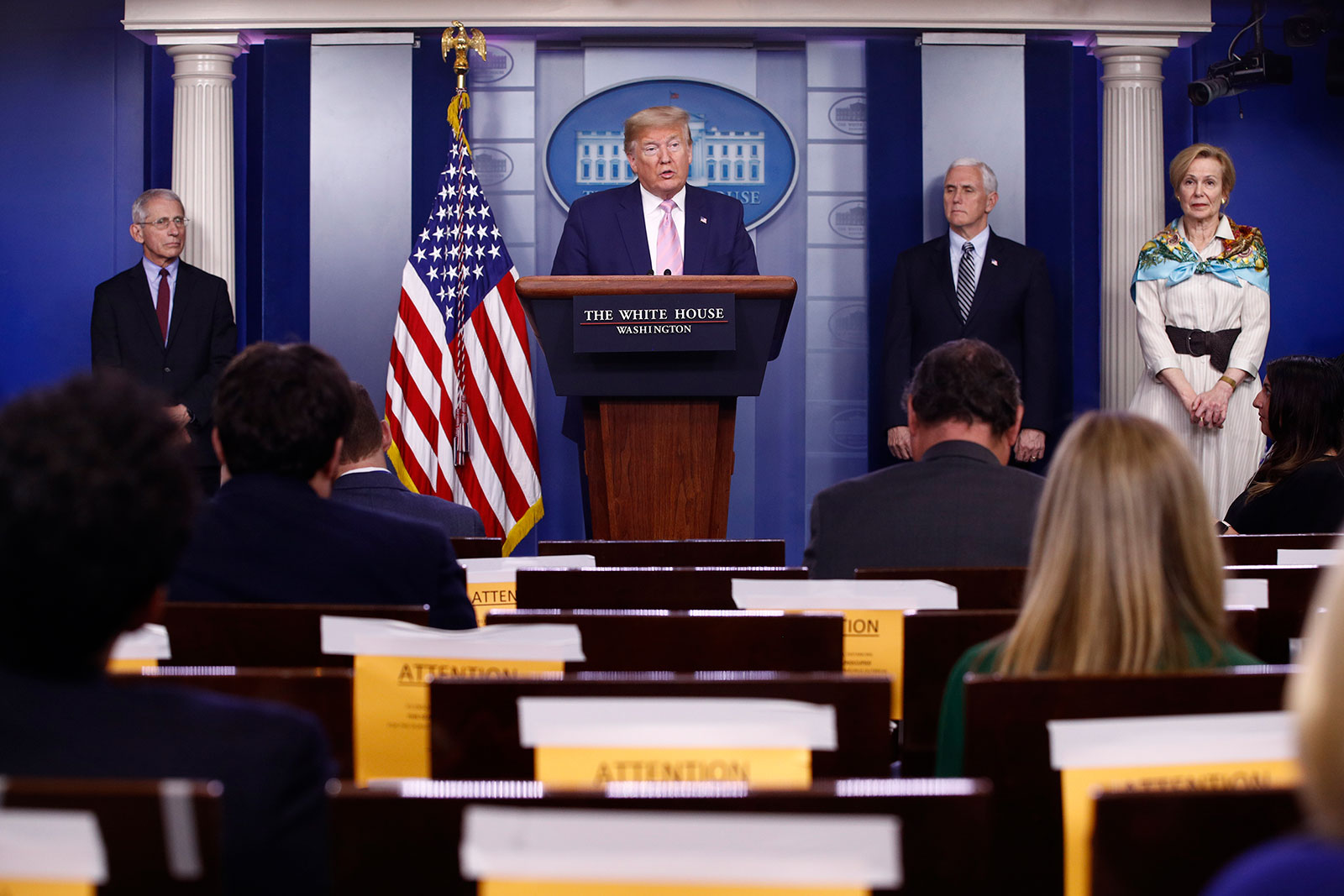
Contrast that with Trump’s briefings, where the principals too often are standing almost side by side (in no way setting a “safe distance” model) while he blathers on like a parrot.

White House briefing on Saturday, April 4 (AP photo)

Then, when it’s time for questions and answers, the room becomes a veritable battleground because Trump sees “the mainstream media” as his enemy. From listening to him, you would think the media was a bigger enemy than the virus.

To give you an example of the difference in the two men’s approaches, I transcribed parts of each leader’s briefing from Saturday, April 4.

Certainly, Trump was very sobering when he talked about the “difficult” week ahead and acknowledging, “There will be a lot of death.” But he reverted to form when he soon segued — illogically — into a foray against his sworn enemy.

Here’s Trump…

Every decision that we’re making is to save lives; it’s really our sole consideration. We want to save lives. We want as few lives lost as possible. It’s therefore critical that certain media outlets stop spreading false rumors, creating fear and even panic with the public. It’s just incredible. I could name them, but it’s the same ones — always the same ones. I guess they’re looking for ratings. I don’t know what they’re looking for. So bad for our country and so bad. The people understand it. You look at the levels and approval ratings and they are the lowest they’ve ever been for the media. It’s so bad for our country, so bad for the world. They ought to put it together for a little while. Get this (pandemic) over with and then go back to your fake news.

Here’s Cuomo…

Personal opinion? Look, I want this all to be over. It’s only gone on for 30 days since our first case; it feels like an entire lifetime. I think we all feel the same. This stresses this country, this state, in a way that nothing else has, frankly, in my lifetime. It stresses us on every level. The economy is stressed; the social fabric is stressed; social systems are stressed; transportation is stressed. But the most difficult level is the human level. It is for me, anyway. It’s every day and it’s everywhere…This is so emotionally taxing. You can’t even quantify the effect on society and the effect on individuals and the burden that we’re dealing with.

So, yes, I want it over. If there was anything I could do to accelerate getting it over, I would. In some ways I want to get to that apex; I want to get on the other side of that apex and let’s just slide down that mountain. On the other hand, we have to be ready for the fight, and we have to handle the fight. And that’s where we are. So, what so we do? You have to get through it. You have to get through it. There is no simple answer. You’re not going to wish this away. You have to get through it, and you have to get through it intelligently, saving as many lives as you can.

That’s hard work, and that’s perseverance, and that’s mutuality, and that’s community, and that’s finding your better self. And that’s finding your inner strength and dealing with a situation that’s almost unmanageable on every level. Because you are out of control. And this is a painful, disorienting experience. But we find our best self, our strongest self. This day will end, and we will get through it, and we will get to the other side of the mountain. And we will be the better for it. But we have to do what we have to do between now and then. And that’s just what we’re doing here.

The vast majority of newspaper stories these days — in print and online — are, of course, about COVID-19.

I’ve been wondering if a particular reporter or publication was out in front of the herd on this story, and yesterday The New York Times provided the answer.

A story in the Business section said a longtime health care reporter identified Helen Branswell as the pacesetter. On New Year’s Eve — almost three months ago, when virtually no one in the U.S. was thinking about a sweeping illness — Branswell referenced in a Twitter post an “unexplained pneumonia” in central China.

On Jan. 2, she tweeted a Chinese newspaper article about the new coronavirus and said, “Not liking the look of this.”

Helen Branswell

Branswell works for a very successful digital publication called Stat, which is based in Boston. Her first article about the new coronavirus appeared in Stat on Jan. 4. Since then, Branswell has written about 50 articles on the pandemic.

Before going to Stat in 2015, Branswell was a health care reporter for The Canadian Press.

Stat is a digital success story. It is owned by Boston businessman John Henry, who bought The Boston Globe from The New York Times for $70 million in in 2013. Like Stat, The Globe has also been very successful under private ownership…It has about 150,000 digital subscribers, by far the most of any major metropolitan newspaper. (The Star, by comparison, has about 12,000 digital subscribers.)

**

The Star’s coverage of local developments and situations regarding COVID-19 has been helpful, but every day I see areas where it could be much, much better.

Yesterday, for example, the lead story bore this headline: “About 200 KC businesses cited for violating virus rule.”

Well, that’s very interesting, but the first question that came to my mind was, “Which businesses?”

But nowhere in the story did reporter Alison Kite name any of the businesses, say where the list could be found or explain why they weren’t being named.

Once again, I say, where the hell are the editors?

I’m starting to think there aren’t any editors other than Managing Editor Greg Farmer and Editor/Publisher/President/Kansas City-area-McClatchy-bankruptcy-manager Mike Fannin.

**

Although many local newspapers are reporting big spikes in digital readership because of the coronavirus, the pandemic will be another gut punch to the newspaper industry.

Newspaper advertising has been in free fall since 2006 (the year McClatchy bought The Star and the other Knight Ridder newspapers), and it’s accelerating with the advance of COVID-19.

Ken Doctor

In his most recent story for the Nieman Lab, newspaper industry observer and analyst Ken Doctor said this…

“The problem is the same it’s been for years: The increases in reader revenue are outmatched by the declines in advertising. So this very welcome swell of support from audiences is being swamped by the much larger evaporation of ad revenue. News publishers nationwide are afflicted with existential gut checks — aches that get a little worse with each day’s new dot on the chart of coronavirus cases…The earliest reports of cuts and layoffs at daily newspapers have begun to seep out. Expect a lot more of them…Layoffs, furloughs, salary cuts, four-day weeks — however it’s framed, cuts to staffing are on the way.”

One major chain, Gannett, announced Monday it would be instituting furloughs and pay cuts at its papers, and The Tampa Bay Times announced it would suspend print publication except on Sundays and Wednesdays and would furlough some non-editorial staff members.

What irony: Newspaper audiences are way up due to one of the biggest stories of the past 100 years, and, for the very same reason, the business is headed further down.

**

As many of us have found, the COVID-19 story takes on greater immediacy and concern when you know someone who contracts it. The person I know is Washington Post columnist David von Drehle, a Mission Hills resident.

In a March 24 column, von Drehle reported that he had “mild to moderate” symptoms — and said that was about all he could stand…”

“Seven days into the waves of fever, I was drifting half in and half out of sleep. I was wearing a down jacket with the hood cinched around my head. I was buried under the covers, teeth chattering. A week like that is a very long time. (Nine days, and counting, is still longer.)”

David von Drehle

I have written about von Drehle, and I met him in late 2018 at a meeting of the Forty Years Ago Column Club. A few days after reading his COVID-19 column, I sent him an email, inquiring how he was doing. On Monday, he replied, saying, “Day 15 is much brighter than before. Thanks!”

Good to hear he appears to be on the mend.

**

Finally, you know how everybody is saying, “Stay safe out there”??

Well, that’s a nice sentiment, but staying safe is, to some degree, out of our control and just doesn’t seem to me to be an accurate “complimentary close.”

Better — and more on target — is the complimentary close that former Kansas City Times managing editor Tom Stites used in an email to me Monday.

“Stay soapy,” Tom said.

Now that I can control 100 percent.

I made a run over to Richmond, MO, today to play golf (by myself, walking, wearing gloves on both hands), and all the way back I listened to the ’60s on 6 on SiriusXM.

Disc jockey Pat St. John was playing “feel good” songs in an effort to lift listeners’ spirits during this time of national and worldwide crisis.

As I rolled west on Missouri 210, a nice ride in the country (at least outside the Clay County part), I let my mind drift back to my high-school and college days, when life was still a battle but those great songs came spilling out of the recording studios, soothing life’s rough edges and planting seeds of hope for love and adulthood.

After getting home today, I researched a few of the songs I had heard and found three, in particular, with interesting stories behind them.

Here are the three I settled on. I hope they make you feel as good as they made me feel this afternoon.

**

“It’s Not Unusual” by Tom Jones

I defy anyone to listen to this song and not start singing along with the horn section and not start bobbing his or her head to the staccato beat.

The song was written by Les Reed (“There’s a Kind of Hush”) and Gordon Mills. Jones was unknown at the time. Wikipedia says Reed and Mills first offered the song to Sandie Shaw (“(There’s) Always Something There to Remind Me”). Jones recorded what was intended to be a demo for Shaw, but she was so impressed with Jones’s version that she recommended Jones release it himself.

It reached No. 1 in the UK singles chart in 1965 and peaked at No. 10 in the U.S. on the Billboard Hot 100, marking Jones’s first hit here. Jones performed it three times on The Ed Sullivan Show — twice in 1965 and once in 1968.

On the day of the recording session, Jones’s group, Tom Jones and the Squires, was missing its regular keyboard player. Someone ran across the street to a coffee house in London’s Tin Pan Alley and recruited a keyboard player named Reginald Dwight.

Dwight later adopted the stage name Elton John.

On “It’s Not Unusual,” Dwight’s (John’s) playing is overshadowed by the horns, strings and myriad other instruments, but you can catch the keyboard from time to time in the background.


**

“This Is My Song” Petula Clark

You would never guess who wrote this song…Charlie Chaplin.

The silent film star wrote the song in 1966 with the intention of using it in the movie A Countess from Hong Kong, which Chaplin wrote and directed. Wiki says Chaplin saw the film as a throwback to the shipboard romances that were popular in the 1930s and wrote “This Is My Song” with the intent of evoking that era. He was determined to have the old vaudeville performer Al Jolson sing it, but, unbeknownst to Chaplin, Jolson had died 16 years earlier.

Chaplin then considered having “This Is My Song” recorded by Petula Clark, who had a home in Switzerland near his residence. Clark’s husband and manager Claude Wolff received a copy of “This Is My Song” in September 1966 and liked it. However, Clark’s regular collaborator Tony Hatch wasn’t taken with it and refused to arrange it for Clark to record.

Eventually, Clark recorded it at Western Studios in Los Angeles. Another interesting side note is that the recording session featured the backing of the Wrecking Crew, a loose collection of Los-Angeles-based studio musicians who were employed on thousands of rock-‘n-roll recordings in the ’60s and ’70s. The cast of the Wrecking Crew included the great bass guitar player Carol Kaye, the only female member of the group.

The song hit No. 1 in the United Kingdom, No. 3 in the U.S. and No. 4 in Canada.


**

“I Can Hear Music” by the Beach Boys

This song was written in 1966 by Phil Spector and the incredible team of Jeff Barry and Ellie Greenwich, who wrote such songs as “Be My Baby,” “Baby, I Love You,” “Then He Kissed Me,” “Da Doo Ron Ron,” “Hanky Panky” and “Do Wah Diddy Diddy.”

It was first recorded by Spector’s group the Ronettes but only spent a week on the Billboard Hot 100…at No. 100.

Three years later, the Beach Boys recorded it, and it went to No. 24. It was also released on the Beach Boys’ album 20/20, with Carl Wilson on lead vocals. “I Can Hear Music” is considered by many to be Carl Wilson’s first taste at being the “leader” of the group, succeeding brother Brian Wilson, who stopped touring in 1965.

A lifelong smoker, Carl Wilson died of lung cancer in 1998 at age 51.

I’ve been meaning to write about Dr. Deborah Birx, coronavirus response coordinator for the White House and an almost daily presence on the Trump coronavirus team’s daily briefings.

Not only is she a straight shooter — like the other day when she called out that idiot Sen. Rand Paul for going about business as usual after he’d been exposed to the virus — this retired Army colonel who has two grown children and grandchildren is the perfect blend of class, authoritativeness and style.

She has caught the attention of more writers than I. For example, Robin Givhan, fashion critic for The Washington Post, said this about her sense of style…

Birx doesn’t dress like a lady politician in jewel-tone suits and statement jewelry. She doesn’t wear power dresses, those sleek sheaths that are a critical part of House Speaker Nancy Pelosi’s professional wardrobe. She doesn’t turn up in a white coat as if she’s there to take the nation’s collective temperature. Birx’s style can be called classically feminine when she wears her shirtwaist dresses and knots silk scarves around her shoulders. She exudes academic wonkiness with her earth tones and tunics and mufflers double-wrapped around her neck. She never looks bland or nondescript. She doesn’t look like an automaton or someone who has lost herself in the data and computer models. And in doing so, she offers a subtle but important reminder to people that while this crisis is serious and meeting it is hard, we are still human. Do not lose yourself. Be kind to yourself.

Kirsten Fleming of the New York Post said this…

In every briefing…Birx has brought her special brand of sartorial serenity and strength to the country. Unlike many women in top perches of American society, who thrive off the fumes of their structured, angular power suits and unimaginative shift dresses, Birx relies on soft silhouettes, feminine frocks and her seemingly unending supply of scarves that she neatly drapes and wraps around her shoulders. Instead of look-at-me reds and electric hues, she opts for muted dark blues and namaste earth tones.

On Friday morning she entered the briefing room in a silver raw silk dress with a fuller skirt and oversize monochrome sash. Her trademark scarf neatly hung over her right shoulder. The retro form could have been plucked from June Cleaver’s closet, but on Birx, it was thoroughly modern housewife — cleaning up our nation’s mess with her brains instead of a vacuum and marigold gloves. It was a testament to the versatility and power of femininity.

Dr. Deborah Birx

Dr. Birx also knows how to handle Trump. On Monday, for example, she was back at the podium after having gone missing over the weekend.

She explained that she had stayed at home because of a low-grade fever. At the mention of fever, Trump made a mock gesture of shock and playfully retreated a few steps. (It was the funniest thing I’ve ever seen Trump do or heard him say.)

Dr. Birx just smiled and waved him off before explaining that she had been tested and the result had come back negative.

…We can’t have Dr. Birx getting sick. No, no, she is one of our most illuminating and inspirational leaders in the war against Covid-19…as well as a testament to the power of femininity.