Feeds:
Posts
Comments

Lockdown, day one

I ventured out into the wild today.

The two main things I was armed with were a long list of grocery items and a sandwich bag that Patty had filled with disinfectant wipes.

I hadn’t been to the store, or stores, since the weekend, which is a long time for me. In ordinary times, we tend to shop nearly day to day, and I’m adjusting to thinking longer term.

On my last trip, over the weekend, I learned that finding everything on a lengthy list meant going to several stores. For example, for wild Salmon and Milton’s crackers, it’s Brookside Market; for reasonably priced, sliced ham and swiss cheese, it’s Price Chopper at 85th and Wornall; and for milk, broccoli, cauliflower, oranges, bread, cookies, Greek yogurt and other basics, it’s Aldi at Meyer and Troost. (The first few times I patronized Aldi, I couldn’t believe how far $20 went.)

I started my odyssey at Aldi and got quite a few items on the list. The store was well stocked and not very busy, unlike over the weekend, when it had closed midday for restocking and a group of people milled outside awaiting the 2 p.m. grand reopening.

Although we didn’t need toilet paper, out of curiosity I went down the paper goods aisle and saw, not surprisingly, there was none.

My next stop was Brookside Market, the most expensive store in town, along with Whole Foods. I got two-plus pounds of Salmon, the crackers and a couple of other items. The tab: more than $50.

Out of curiosity, I went down the paper goods aisle and saw…no toilet paper.

Then I headed to Whole Foods. The only brand of potato chips I like is Boulder, and that’s the only store in Greater Brookside that carries them. I picked up two bags.

I also went down the paper goods aisle and saw…no toilet paper.

My last stop in Brookside was CVS. There I got some Kleenex, two plastic bottles of dish soap and a jar of moisturizing cream for Patty.

I went down the paper goods aisle and saw…empty shelves where the toilet paper used to be.

By this time, I was pretty…pretty proud of my purchases — although I wasn’t finished — and I stopped by the house to drop off what I had before heading out again.

Patty urged me to have lunch before leaving, but I didn’t want to break my momentum. And besides, I didn’t have what I needed for lunch, the sliced ham and cheese for a sandwich.

I was hoping Price Chopper at 85th and Wornall would be my last stop. I still needed a few other items, such as baking potatoes and zucchini, and I thought surely those would be available at Price Chopper. I was wrong.

Before leaving I made a point of going down the paper goods aisle. Yes…I mean no. No toilet paper.

So, as I had planned (damn, I planned this well!), on the way back home I stopped at Hy-Vee, 79th and State Line Road, which is my grocery ace in the hole. It’s big, well stocked and, you know, they’ve got those smiles in almost every aisle.

Sure enough, I found the last items I needed, including the potatoes and zucchini.

I almost forgot to go down the paper goods aisle but did so at the last minute.

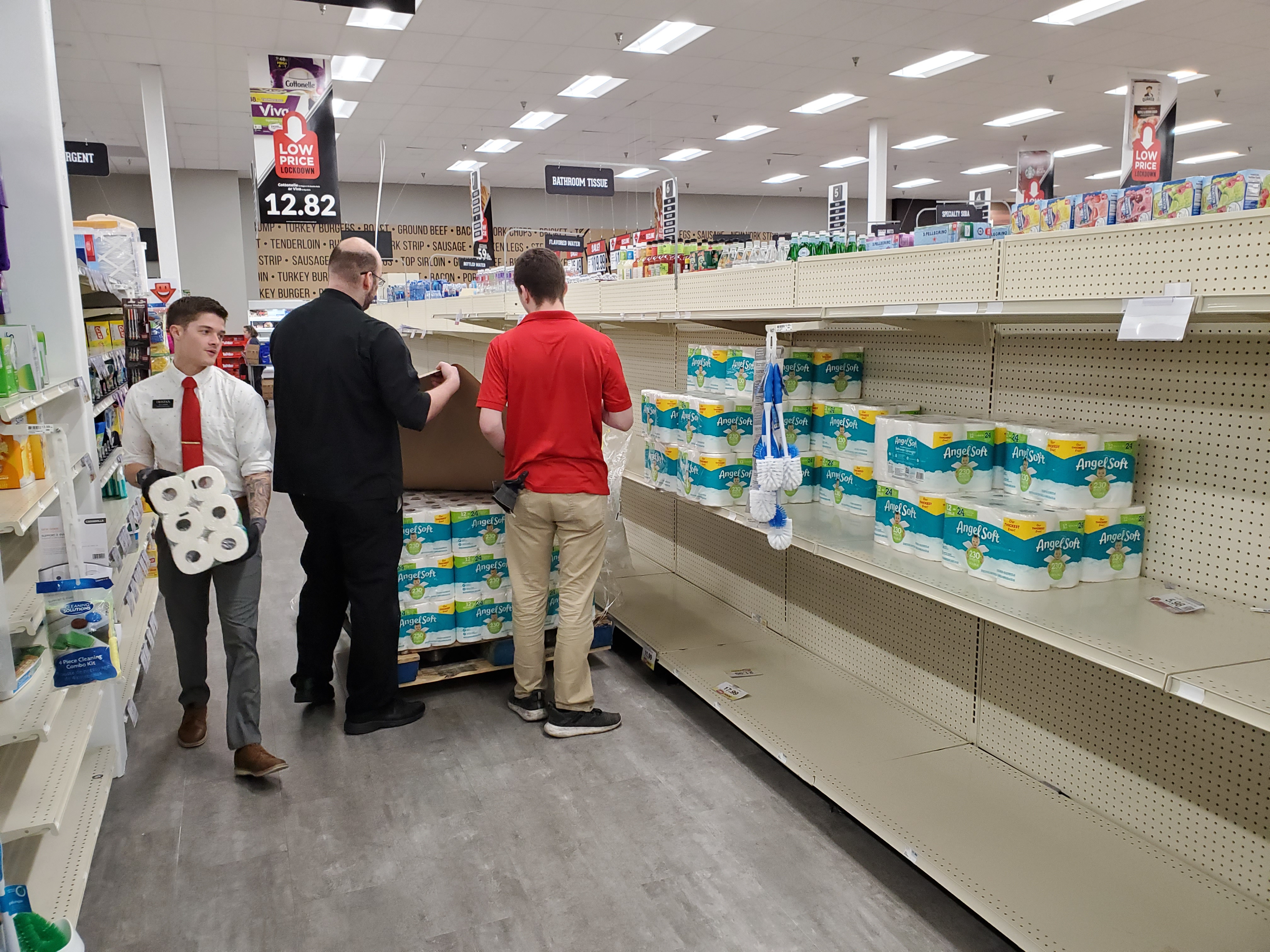
There, to my utter shock, several employees had just arrived with a skid of Angel Soft toilet paper, and they began loading it on the empty shelves. I stood almost transfixed, watching this magnificent sight, which just a month ago would have been totally mundane.

Even though I was pretty sure our toilet paper supply at home was quite good, I called Patty just to make sure. She confirmed that we didn’t need any. As I was about to leave, I heard one of the guys unloading the product say “It’ll be gone in about an hour.”

I didn’t go back to find out, but I took this photo to prove that what I saw today at Hy-Vee was not a mirage.
Countdown to Lockdown

As you know, the Greater Kansas City area Lockdown is scheduled to take effect at 12:01 a.m. tomorrow, Tuesday.

That’s great, but my questions are: Why not today? Why not yesterday?

Covid-19 is just as dangerous today as it’s going to be tomorrow and the next day, and if people think they’ve got some kind of pass to gather in groups today, or participate in activities they should be avoiding, it could easily contribute to the spread of this lethal virus.

As a matter of practicality, not much is going to change come tomorrow…You can still leave your house to get medicine or medical care, food or household supplies, and jog, walk or otherwise exercise as long as you keep your distance from others.

So, I don’t understand the magic of 12:01 a.m. Tuesday, and I haven’t seen an explanation. Anyone got a clue?

**

My own decision to Lock Down tighter than I already had came yesterday when I saw Judy Thomas’s online story in The Star yesterday about Dennis Wilson, a relatively healthy Johnson County man in his 70s who came down with Covid-19 in early March and died Saturday morning.

Until reading that story, Covid-19 had been, for me, primarily a story of escalating numbers and “hot spots,” which, fortunately, have not included Kansas City.

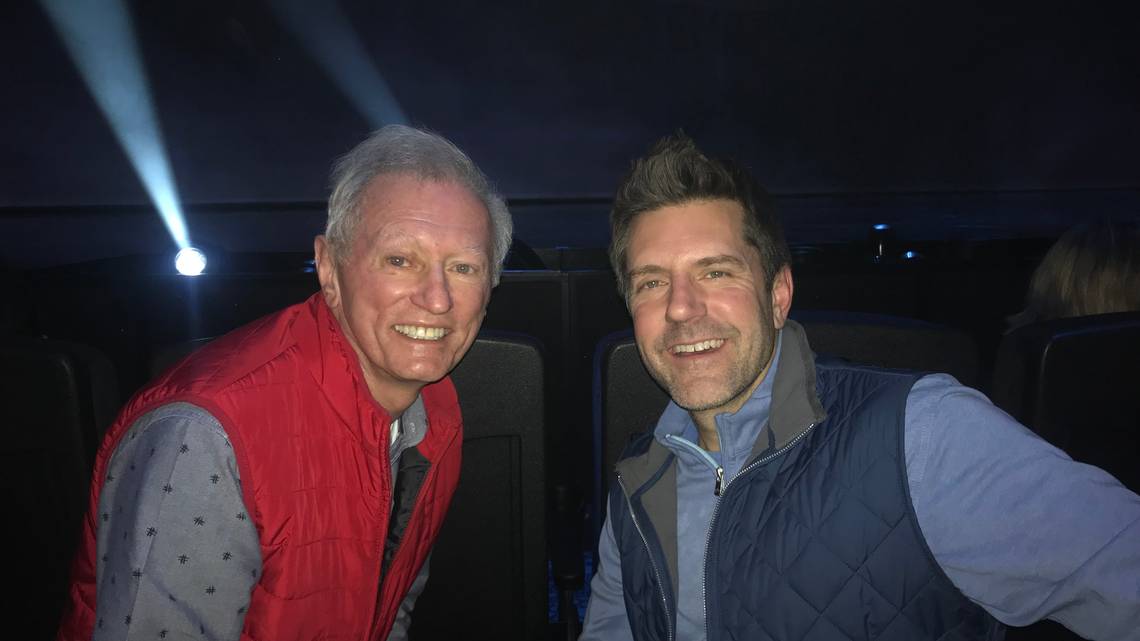
Dennis Wilson and son Luke

But when I read about Wilson, a Lenexa resident and a former school district superintendent in southeast Kansas (Labette) and Missouri (Lamar), it was like a hammer blow to the head. There was Wilson in a photo, sitting across from son Luke, both of them smiling, happy and relaxed.

That was whenever that photo was taken. But the reality of his final days was starkly different. His wife Joanna described those days in a sobering Facebook post…

“It has been an indescribably horrible week of immeasurable suffering on the part of the love of my life and then certainly on the part of our three children and our 6 grandchildren who could only watch helplessly from a distance.”

“…immeasurable suffering”…”watch helplessly from a distance.”

He probably suffocated slowly and then died alone…alone except for the eyeballs of masked nurses and doctors gazing down at him.

Before reading that story, my golf group had hoped to play one final round today at Minor Park. We had been exchanging emails, and it was unclear if the course was going to be open, but if it was, we planned to play.

After reading the story, I immediately went online and wrote to my friends, “I’m going to chuck golf and stay inside as much as possible.” I included a link to the story.

This morning came word that Minor and the other municipal courses were closing immediately and indefinitely.

Good move!

**

It looks like the two places drawing the biggest crowds these days are Costco and gun stores.

A friend went to the Midtown Costco over the weekend, and even before the store opened, the line (undoubtedly prompted by concerns about maintaining social distancing inside) was around the building. My friend left. That’s what I would have done, too. More than a week ago, after seeing videos of “toilet paper mania” at Costco stores, I decided I would stay away.

The mania strikes me as ridiculous, although I understand people’s urge to feel like they’re in control of something at a time when it’s “back to basics” worldwide.

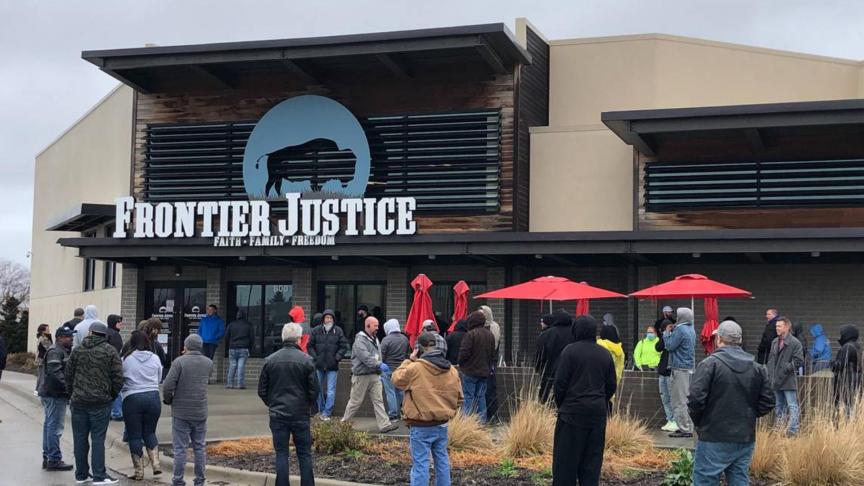
But the guns…the guns…I don’t understand at all. Today, The Star’s Eric Adler has a story about “9-millimeter ammunition, rifles and handguns” flying off the shelves at Frontier Justice, a gun store in Lee’s Summit.

Kansas City Star photo

Adler quoted Bren Brown, president and owner of the store as saying…

“I think the biggest concern in times like this, that are uncertain, is what happens when people lose their jobs and they run out of food. Desperate times bring desperate measures and people want to be able to protect themselves and their loved ones which, of course, is their Second Amendment right.”

That quote conjures up the images that Second-Amendment fanatics see in their heads…And that is — and let’s say it exactly like it is — poor, desperate, East Side Kansas City residents (black!) arriving in hordes, bearing sticks and stones and AK-47s; storming suburban houses; killing and maiming residents; raiding their refrigerators and making off with whatever valuables they can lay their hands on.

It’s a terrible specter for the paranoid. Keeps ’em awake at night.

Where most of us are locking down, they are locking and loading.

The Beacon, which jumped out of the starter’s box Sunday before its planned debut, is continuing to establish itself as a source of interesting and useful local information on the Coronavirus outbreak.

As I reported earlier, The Beacon’s first story was a nuts-and-bolts piece by highly regarded health care reporter Andy Marso, one of several freelance writers that Beacon founder and editor Kelsey Ryan has engaged.

Barbara Shelly

On Tuesday came a story by freelancer and former KC Star reporter Barbara Shelly about how individuals and businesses were stepping up to help people in need. That story was accompanied by photos from a freelancer named Chase Castor.

My in-box today included a Beacon story from Cynthia Gregorian, also a former Star reporter, about the problems facing college students who have been displaced from student housing and whose classes have been converted to strictly online. That story also included photos by Castor and a sidebar — “I was tested for Covid-19” — by a female University of Missouri student.

Ryan also introduced a comprehensive “community resources” roundup.

Even in its early stages, The Beacon is helping fill the journalistic hole that has been created by the ever-atrophying Kansas City Star, and it is a welcome addition to the news/information/entertainment lineup in the Kansas City area.

Ryan is financing her non-profit enterprise through grants, individual contributions and memberships. Memberships can be purchased with a tax-deductible contribution of $50. You can read more about that here.

The biggest gap-filler so far, of course, has been KCUR, one of the nation’s most successful public radio stations.

Donna Vestal

Over the last decade, KCUR has been building a robust staff that now numbers about 60. Its ranks include, by my count, six former Star staff members: Steve Kraske, Donna Vestal, Dan Margolies, Scott Canon, Caitlin Hendel and Kathy Lu.

(Another interesting Star connection is that Traci Bauer, who was hired as KCUR’s director of journalism in 2019, is the sister of Star investigative reporter Laura Bauer.)

Even with a local newspaper that appears to be headed into ownership by a hedge fund, those of us who crave to be accurately and thoroughly informed can be grateful for a terrific information-and-entertainment source like KCUR and a promising, public-service-oriented startup like The Beacon.

The journalism scene in Kansas City is continuing to brighten and diversify. I urge all of you readers to give The Beacon a try. And, by all means, continue (or start) listening to KCUR.

The New York Times headline triggered memories of the Great Recession:

“Here Come the Bailouts, Starting With the Airlines”

Yes, collectively they are asking for more than $50 billion in direct relief, and some carriers are asking for billions more in loans.

This is coming from the industry that has progressively narrowed airplane seats and tightened rows to such an extent that most flights of more than a couple of hours are uncomfortable.

…and from the industry that has steadily raised prices well above the rate of inflation; that is charging customers hundreds of dollars to rearrange flight plans; that has attached high baggage fees; and that has generally made flying an experience to be endured instead of enjoyed.

A few weeks ago, I flew on cut-rate airline Allegiant to and from St. Petersbug, FL, and the gate space at KCI was so tight that people had to step over and elbow by each other to get carry-on bag tags from an agent near the front desk…What that signaled was that Allegiant cuts corners on everything, including gate-space rental.

The only thing good about flying now is that you still get where you’re going fast…most of the time, anyway.

The government and the public learned a lot about inequity in bailouts a decade ago, however, and the government is now in position to at least attach significant strings to bailouts.

In an Op-Ed piece in The New York Times yesterday, Tim Wu, an author and contributing opinion writer, laid out a strong case for holding the airlines’ feet to the fire in return for bailouts.

The commentary had an agreeable title — “Don’t Feel Sorry for the Airlines.”

Wu pointed out that airlines have been incredibly successfully financially the last decade or so, partly because of consolidation and mergers. (The same thing is happening now in the newspaper business, where the two or three big companies left standing will have customers by the throat.)

Tim Wu

Wu posed this John-F-Kennedy-type question: ” As the government considers what we, the public, should do for the airlines, we should ask, Just what have they done for us?”

Wu proceeded to outline some “terms” the government could affix to any bailout agreements:

We cannot permit…airlines to use federal assistance, whether labeled a bailout or not, to weather the Coronavirus crisis and then return to business as usual. Before providing any loan relief, tax breaks or cash transfers, we must demand that the airlines change how they treat their customers and employees and make basic changes in industry ownership structure.

Beginning with passengers, change fees should be capped at $50 and baggage fees tied to some ratio of costs…We should also put an end to the airlines’ pursuit of smaller and smaller seats, which are not only uncomfortable and even physically harmful, but also foster in-flight rage and make the job of flight attendants nigh unbearable.

…Those are excellent suggestions and exactly what the federal government should demand in exchange for relief.

But will this administration show any backbone when faced with pressure from an indispensable industry?

The handwriting is on the wall. In a White House briefing Monday, President Trump said:

“We’re going to back the airlines 100 percent. We’re going to be in a position to help the airlines very much.”

If you take a flight between the upcoming airline bailout and the November election, think about those words when you’re crammed into your seat with your hat on your lap and trying to sleep with your chin on your chest.

In August 2018, just a year and a half after she had been hired at The Kansas City Star, investigative reporter Kelsey Ryan got a 7 a.m. call at home telling her she was being laid off.

I remember her posting on the Kansas City Star Bylines Facebook page (totally independent of the newspaper) that she had a good cry and immediately set about determining what she would do next.

Months later she wrote…

“By 3 p.m., my work email was downloaded and my resume updated. And by 5 p.m., I realized I really didn’t want to ever work for another McClatchy paper. Or Gannett. Or GateHouse. Or (insert name of struggling newspaper company here). That in some ways, going to another newspaper was the easy route, to grab a lifeboat and hope it won’t sink itself in the next year or two. To bury my head in the sand, pretending more layoffs wouldn’t happen. Instead, I decided I would build a new ship.”

Kelsey Ryan

The “ship” she started to build is an online news publication called The Beacon. She’s made tremendous progress and has been meticulously laying the groundwork for a publication focusing on “local, in-depth journalism in the public interest.”

Her plan had been to start publishing stories later this year, but being a good newswoman, she saw a golden opportunity to step up to the plate and start swinging.

So, she accelerated her “soft launch,” and today The Beacon posted its first story — an informative piece full of the basic information I’ve been looking for locally, including how many Covid-19 tests had been run in Missouri (94, with four positive) and Kansas (143, with eight positive) and the fact that two big private labs, Quest Diagnostics and LabCorp, will soon start testing.

Andy Marso

The story’s reporter and writer is none other than Andy Marso, who stamped himself as an outstanding healthcare reporter during his three years at The Star. Marso left The Star last August to become an editor at FPM (Family Practice Management) Journal, which is affiliated with the American Academy of Family Physicians, based in Leawood.

Just three days ago — Thursday — Ryan announced that Marso and another former Star staff member, Cindy Gregorian, would be producing freelance stories for The Beacon. In addition, Ryan said she was hiring a part-time editor to help manage the accelerated roll-out. The Beacon’s first full-time reporter, who will be covering health and the environment, is expected to be on board this summer.

**

Ryan, 31, was able to start publishing today because she had built such a solid foundation.

The Beacon has received funding from the Ewing Marion Kauffman Foundation, Google News Initiative, the Enid and Crosby Kemper Foundation, the Francis Family Foundation, the Gattermeir Family Foundation and the William T. Kemper Foundation.

It has also raised funds from individual contributors through the nonprofit Kansas Newspaper Foundation, which is serving as The Beacon’s fiscal sponsor until its own 501(c)(3) designation is approved.

The Beacon even has office space — donated — in the Plexpod-Westport Commons at 39th and McGee.

In January, Ryan announced the hiring of Jennifer Hack Wolf as audience development manager. Wolf spent 14 years at The Star, first as a photographer and later as editor of Ink Magazine.

Wolf has been leading an impressive community engagement effort, which included several public programs and lately (with the Covid-19 situation) moved online.

Recently, The Beacon started a private Facebook group called Kansas City Coronavirus Updates. Ryan said it has already attracted more than 1,200 members and added, “We are truly taking the questions and feedback from the community and integrating it into the coverage and fiber of The Beacon.”

Another major milestone came last month when Ryan introduced a 12-member board of directors. (Ryan emphasized it is a governing board and that all editorial decisions will be made by The Beacon’s journalists.)

Mark Horvit

One board member is Pam Fine, a former University of Kansas journalism professor and former managing editor of the Indianapolis Star and former managing editor and vice president of the Star Tribune in Minneapolis. Other members include Mark Horvit, an associate professor at the University of Missouri School of Journalism, and local attorneys Brittany Barrientos and David Oliver.

In an email today, Ryan said she was not planning to institute a paywall. “We want to serve the public and sustain on paid memberships over time,” she said.

**

Ryan grew up in Newton, KS, and graduated from Emporia State University, where she was editor of her college paper. She began her newspaper career at The Joplin Globe and later spent four years at The Wichita Eagle before moving to Kansas City for her brief stint at The Star.

…This is a big day not only for Kelsey Ryan and The Beacon but also for Kansas City area residents who have been looking for more in-depth, local news.

Every indication is that Ryan is building a substantive and lively publication that will help many Kansas City area residents stay better informed about community developments and situations.

Congratulations, Kelsey, you’re off and running!

(Note: I posted this Friday morning…Later Friday, the Nelson Gallery announced it will be closed from Saturday, March 14, to April 3.)

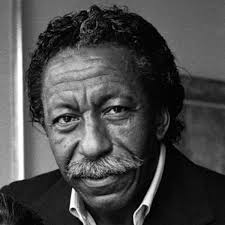
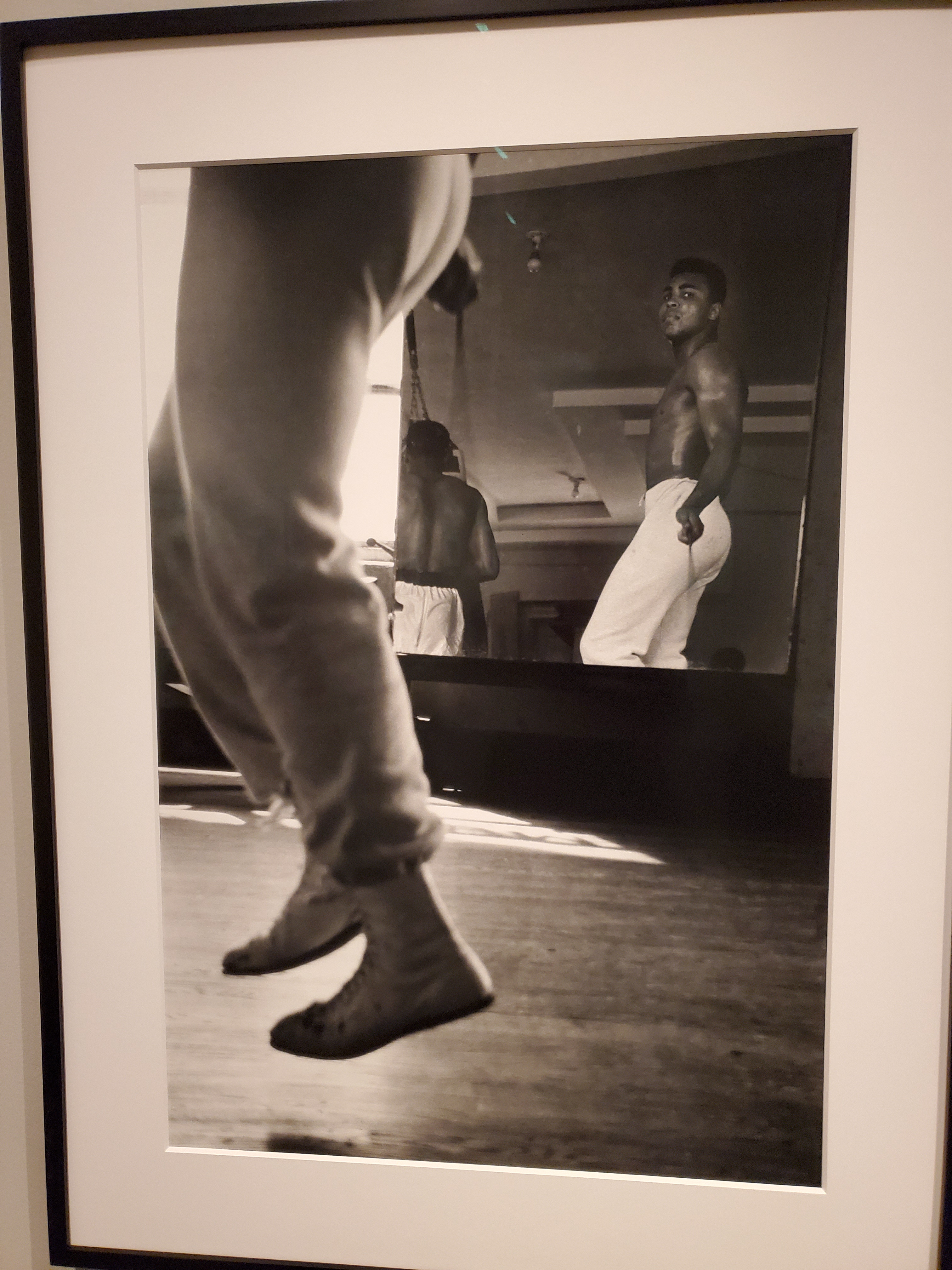
If you’re looking for something fun and interesting to do that doesn’t involve large crowds, I suggest you visit the Gordon Parks X Muhammad Ali photographic exhibition at the Nelson-Atkins Museum.

The exhibition features several dozen photos from hundreds that famed photographer and writer Parks took in 1966 and 1970 while producing two photo/stories about Ali for Life magazine.

(Being a Louisville native — like Ali — I have a special fondness for him…To this day, one of the greatest thrills of my life was watching on closed circuit TV as Ali beat Sonny Liston for the heavyweight title the night of Feb. 25, 1964, when I was a senior in high school.)

Parks

Ali and Parks, a Fort Scott, KS, native who died in 2006, became close friends, but before they did, Ali gave Parks unprecedented access to his training and personal life as Ali prepared in Miami and London for his 1966 match with British boxer Henry Cooper. (Ali won after Cooper began bleeding excessively and the referee stopped the fight in the sixth round.)

Ali, of course, was a magnetic and yet extremely controversial figure from the time he won a gold medal in the 1960 Olympics until the day he died in 2016.

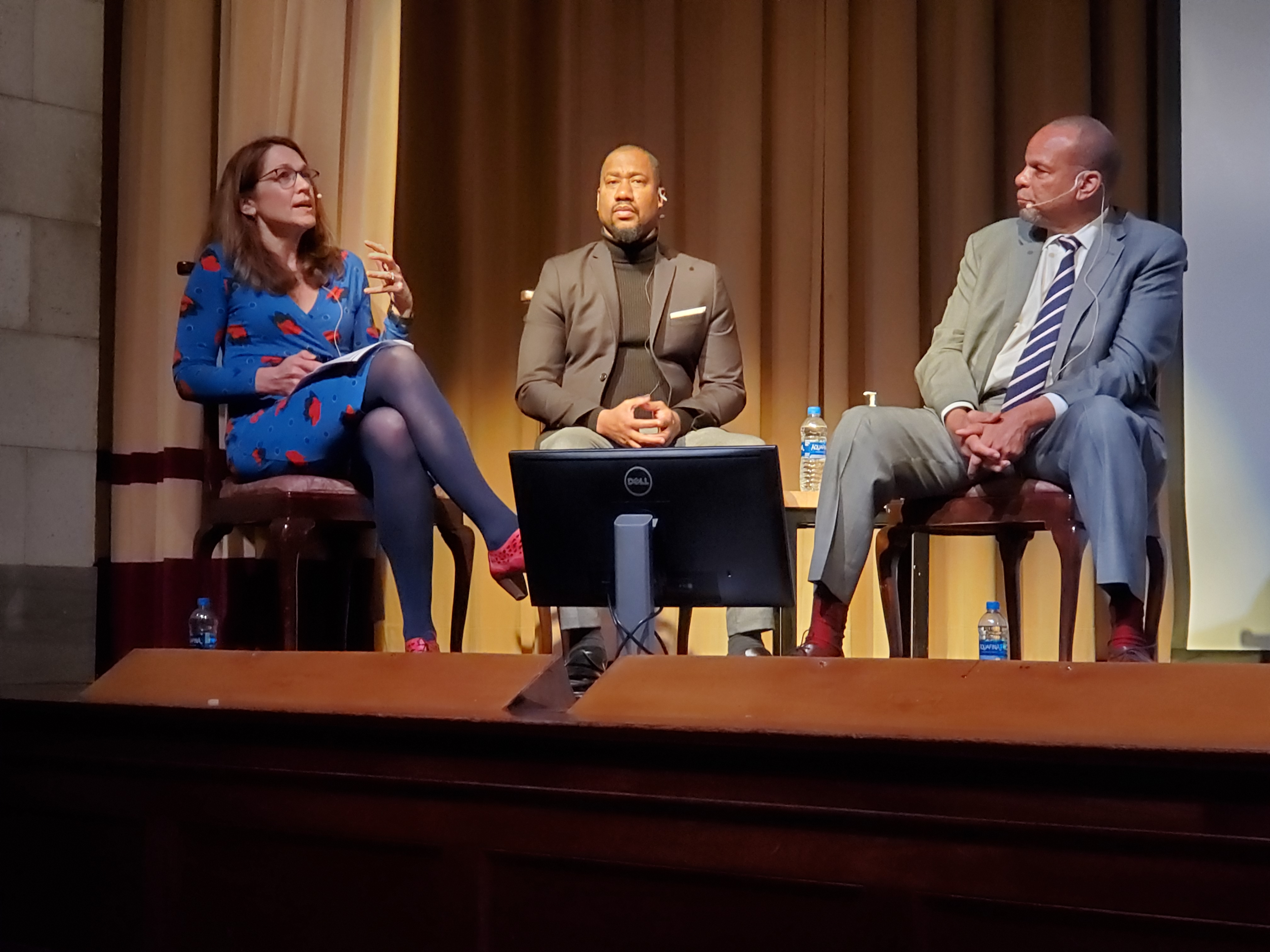
Last night, the Nelson presented an outstanding program on the exhibition. The program featured William Rhoden, an author and former New York Times sports columnist, and Damion Thomas, curator of sports at the National Museum of African American History in Washington D.C.

April M. Watson, who curated the exhibition, led the discussion.

Damion Thomas (center) and William Rhoden participated in a discussion last night about Muhammad Ali and Gordon Parks. April Watson, of the gallery, led the discussion.

Rhoden and Thomas reflected on Ali’s roller-coaster swings, from hero to villain and back to hero, in the public’s perception.

He zoomed to fame with the stunning, 1964 defeat of Liston, but his appeal soon plummeted after he announced he had embraced the Nation of Islam and then refused to be inducted into the armed forces.

As Rhoden, the former NYT columnist, said: “When you renounce Jesus, you are problematic. The entire nation was caught off guard.”

Even before the Supreme Court overturned his draft-evasion conviction in 1971, Ali was on the way to restoring his image and regaining the public’s affection.

Rhoden and Thomas said Parks’s photos and stories in Life had gone a long way toward humanizing Ali and deepening his public appeal, even though only three photos ran with Parks’s story in the Sept. 9, 1966, issue.

Another thing Parks’s first story did was bring certain aspects of African American culture to the attention of white people. The story also had a profound impact among black people because, as Rhoden said, it further elevated him as an inspirational figure and role model for young black people.

But Parks was more than just a chronicler of Ali, Thomas and Rhoden said. His friendship and guidance, they said, helped Ali mature and learn more about dealing with the public. Rhoden said Parks challenged Ali, in effect telling him, “You got to prove yourself” in the court of public opinion.

**

Here are three photos that are included in the exhibition…

**

The Gordon Parks X Muhammad Ali exhibition continues through July 5. Museum hours are 10 a.m. to 5 p.m. Monday, Wednesday, Saturday and Sunday and 10 a.m. to 9 p.m. Thursday. Admission is free every day.

With Coronavirus and the Democratic primary-election campaign getting most of the attention lately, Kansas City Mayor Quinton Lucas must have been feeling overlooked.

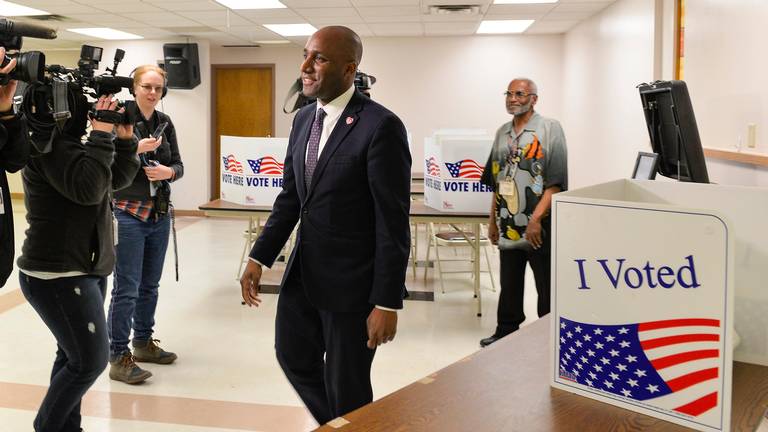
That’s the only reason I can think of why he acted like the sky was falling after a poll worker got his first and last names transposed and initially refused to let him vote at his ordinary polling location Tuesday morning.

Instead of filling out a provisional ballot or waiting the 15 or 20 minutes it would have taken to straighten out the situation through a check with officials at the Kansas City Election Board at Union Station, Lucas chose to walk out and lash the election board all day in media interviews. (He went back Tuesday afternoon and voted.)

He told The Star: “The Kansas City Election Board screwed up. Suggesting to someone they should stick around for 20, 25, 30 minutes while the election board fixes its own mistake because they couldn’t read my name? That’s kind of ridiculous.”

Lucas wasn’t content to write it off as a simple mistake. Oh, no. He conflated a name-transposition issue into a veritable scandal that threatened the sanctity of the nation’s election system.

He even delivered a lecture:

“A lot of us in this region are used to folks talking about voting irregularities, talking about those sorts of issues. I think the biggest threat to American elections is that Americans can’t vote…Unfortunately, that was the situation I ran into this morning.”

Now, if yesterday’s primary had dissolved into problems like what we witnessed with the Iowa caucuses, Lucas would be right to raise holy hell. But this was a case of something less than a mole hill being blown into a mountain.

Mayor Quinton Lucas was all smiles after he got a month’s worth of publicity and went back to his polling place to cast his vote Tuesday afternoon. (Kansas City Star photo)

…A few rational reflections are in order.

:: Americans can’t vote now?

Yes, we do have some problems, but overall the U.S. has  good election system. The biggest problem Missouri has — and something that would warrant a shit fit from our mayor — is the Missouri Legislature’s (and Secretary of State Jay Ashcroft’s) unwillingness to consider legalizing early voting, which many states, including hidebound Kansas, already do. THAT — not transposing a name here and there — is the biggest election-related scandal in Missouri!

(Personal confession: I like to think of myself as an honest person, but every big election, when I know it’s going to be a long ballot, I find myself going down to Union Station and telling the clerks I’m going to be out of town on Election Day and need to vote absentee…I sure hope no election officials are reading this…And, please, don’t alert them!)

:: The 20-minute wait

The average person would not have turned a simple mistake into an international incident and walked out of the polling place and immediately sought to capitalize on the error. It’s Election Day. Things happen and sometimes you have to wait for one thing or another. What makes Lucas think his time is more important than anyone else’s? Confirming it’s not, he proceeded to spend hours milking publicity out of the deal.

Who acts like that? Why, somebody who thinks he’s more important than the rest of us.

:: The Kansas City Election Board

Although this is not the most progressive election board, it is a very solid one. Routinely, KCEB officials get the vote processed in orderly fashion and deliver timely results.

Years ago, I worked as a “deputy election commissioner” at several elections (it’s akin to being a glorified observer), and I never saw a significant problem.

Shawn Kieffer, the Republican director of elections, has been effectively running the show for decades. He’s honest, patient and knows what he’s doing. We’re lucky to have a person of his experience and equanimity at the helm.

My hat is off to Shawn for the diplomatic way he handled Lucas’s whining and complaining. He didn’t pick a fight; didn’t fire back. He just let it roll off his back, content to tell The Star that filling out a provisional ballot would have been an “easy fix.”

…I hope Lucas got a good night’s sleep and gets back to breathing easier today. Yesterday’s puffing, preening and posturing didn’t serve him, or Kansas City, well.

Here are a few things to put in your pipes and smoke…And as the drill sergeants used to tell us in basic training: “Smoke ’em if you got ’em, and if you don’t, get ’em from your squad leader.”

:: For the last two years the Oak Place Apartments have stood, empty and forlorn, like acne, on the UMKC campus.

It was clear from the time the apartments closed (about 10 years after they opened) that they would have to come down. In March 2018, nearly 200 students were forced to move out of Oak Place after the school found significant plumbing and mold issues in some of the apartments.

After that, the MU curators filed a lawsuit against two prominent Kansas City firms — Gould Evans Associates architects and JE Dunn Construction — claiming the firms were reckless in the design and construction. The lawsuit is pending.

Oak Place

This has been a major embarrassment all around, for UMKC, for Dunn and for Gould Evans. I don’t know why UMKC administrators waited two years to announce, as they did Wednesday, that the apartments would be razed, but I have a theory: I think a big reason was simply to let the story and the embarrassment subside somewhat.

Indeed, the story did get stale, so, instead of The Star plastering the story on its front page, it placed it on Page 4 in Thursday’s paper. In announcing the razing, Chancellor Mauli Agrawal said he had authorized a student housing study to determine what is needed.

If my theory about UMKC wanting to save face by delaying is correct, the MU system will pay a significant price for the time lost. During that two-year delay, design and construction costs have gone up, and having that big blemish on its campus sure didn’t boost UMKC’s image, already tarnished by two big scandals in recent years.

:: For those of you (those few of you) you still take The Star’s print edition, tomorrow’s print edition will be the last Saturday edition you will ever see.

You’ll remember Star President/Editor/Publisher/Keeper of the Backdoor Key Mike Fannin’s upbeat announcement in December that the Saturday print edition would be phased out in favor of bigger and better weekend editions. In his note to readers, Fannin said the change was “another step to make progress” toward the goal of The Star providing “independent, fact-based news and solutions for local businesses that help us all thrive and grow for many years to come.”

…These ridiculous less-equals-more announcements have become really old the last decade or so, and they have contributed to The Star’s significant downturn in credibility.

In addition, since Fannin’s December announcement, The Star’s parent company, McClatchy, has filed for bankruptcy, and a New Jersey hedge fund is poised to take over The Star and McClatchy’s 28 other daily papers.

A fine kettle of fish this is.

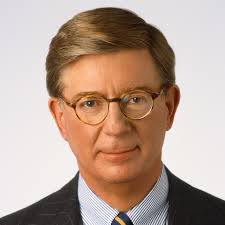
George Will

:: Syndicated columnist George Will of the Washington Post Writers Group had a very witty and pointed column on The Star’s Op-Ed page Thursday. The headline on the piece was “Biden doesn’t hate the U.S. like Sanders and Trump.”

Comparing Joe Biden and Bernie Sanders, Will wrote…

Joe Biden has little to say that is remarkable and he says it in a remarkably meandering manner, but grant his request: Don’t compare him with the almighty; compare him with the alternative. Florid Sanders, with his relentless, arm-waving, high-decibel depiction of America’s history and present as a sordid story of injustices, resembles the woman in the Anthony Trollope novel who scolded “frightfully, loudly, scornfully, and worse than all, continually.

When I read that sentence this morning, I was sitting in the optometrist’s office, waiting for the optometrist, and I laughed so loud that a medical assistant walking by the room looked in at me curiously.

:: And now I have a public service announcement…Can everybody hear me over this cheap, tin-sounding loudspeaker?

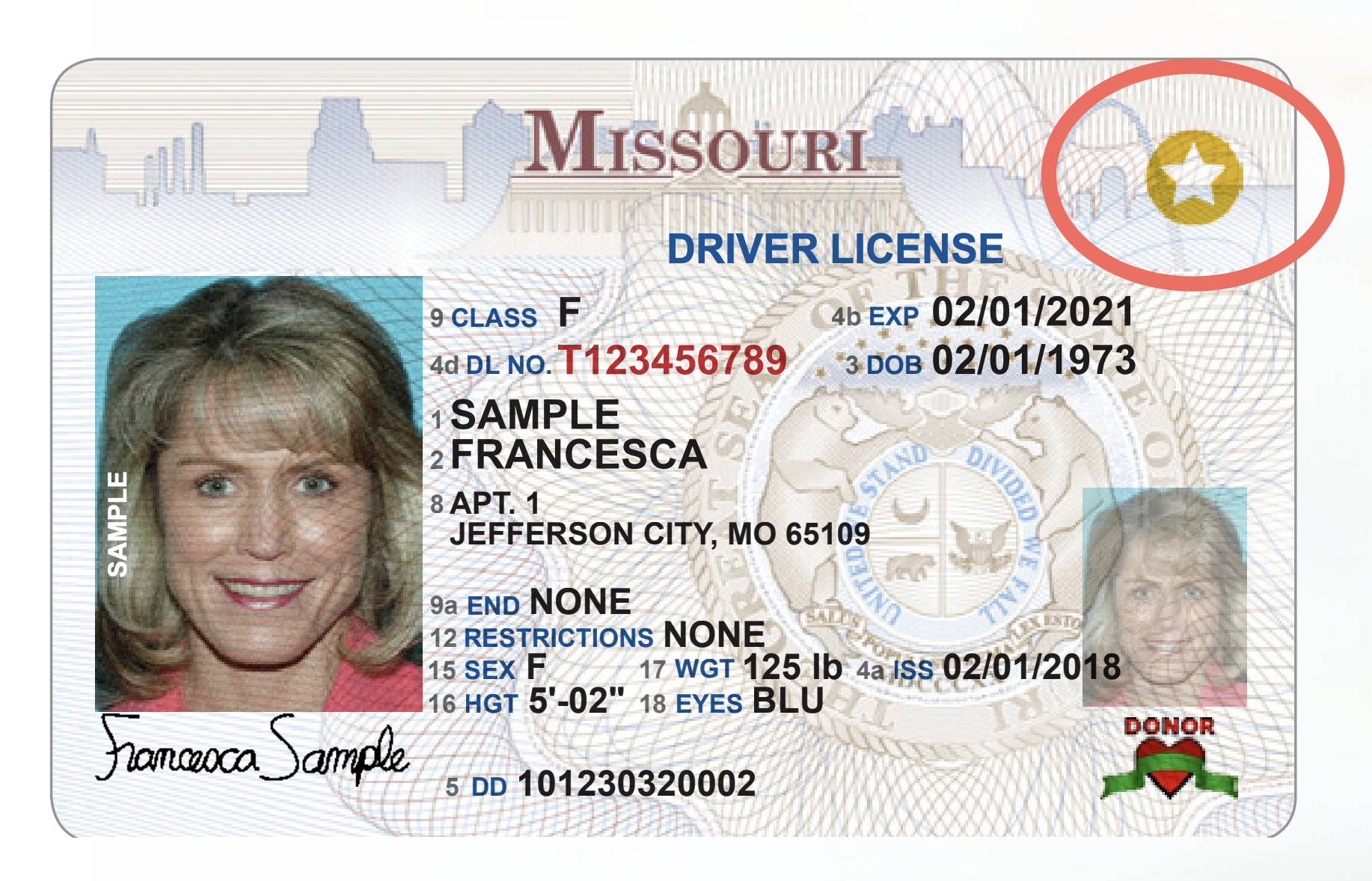
On the way home from the optometrist, whose office is way up in the Northland — like 94th Street north — I stopped by the North Kansas City License Office at 24th and Burlington to apply for my “Real ID.”

I love the NKC office because they almost always have four to six clerks (all friendly, in my experience) working, and although you have to stand in line, the line keeps moving. I’ve never had to wait for service more than 30 minutes, even twice when the line stretched to the front door.

As you probably have heard, Missouri residents will need a Real ID to board airplanes and enter federal buildings beginning Oct. 1, 2020. (The airlines, and I presume federal buildings, will also accept a valid passport.)

I had all my paperwork in order today (you can see which documents you need here), and, to my amazement, only one person was in line ahead of me. I did notice, however, that about a dozen people were seated in a row of chairs next to the stand-up line, and I wondered what they were waiting for.

After confirming I had proper documentation, the clerk told me the wait would be about an hour…All those people sitting down were waiting on the one clerk who was processing Real ID’s. I thought about leaving, but the clerk told me the line was typical and I’d probably have to wait an hour just about any time I showed up.

I decided to stay and asked the clerk if I could go to lunch and come back. “Sure,” she said. So, I went over to Paul & Jack’s at 18th and Clay and had a grilled chicken sandwich and did some reading. I got back to the license bureau about 45 minutes later, and only two people were ahead of me to be processed. (You don’t get the ID on the spot; you get a temporary, and the real one is mailed to you.)

Almost exactly an hour after I had pulled into the lot, I was pulling out and heading home.

So, here’s my public service announcement: If you haven’t applied for a Real ID yet, find out what documents you need and get to one of the license offices. The lines are going to get longer. This summer, I’ll bet, we’ll be seeing horror stories about three- and four-hour waits.

Oh, and take your checkbook; the fee today at the NKC office was $12.

Just four days ago, two friends and I — two brilliant friends who have been around politics for decades — were having coffee in Brookside and talking about the Democratic primary. We concurred on at least one thing: Joe Biden had been lackluster and in all likelihood would not become the Democratic presidential nominee.

Like many other Democrats, we thought then Bernie Sanders was the person who would claim the nomination.

But, my God, how fast things changed! The Biden turnaround has been tantamount, in a sense, to the 1880s engineering feat of reversing the flow of the Chicago River.

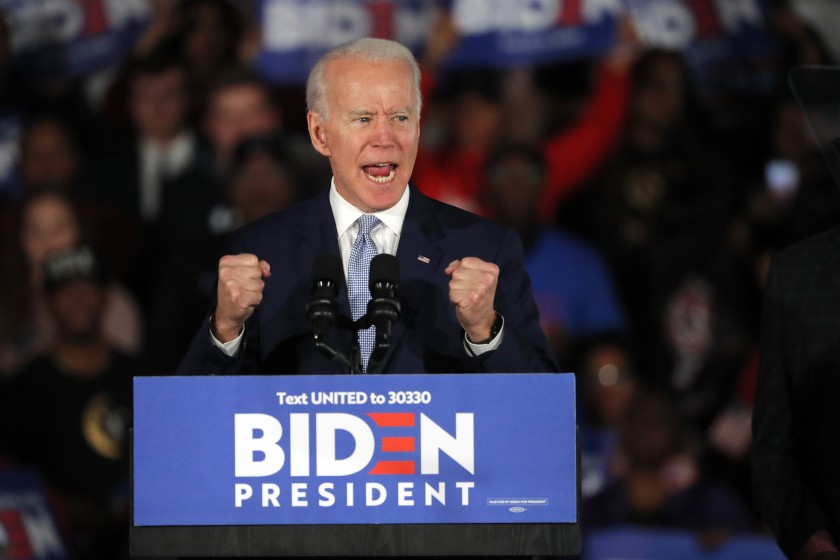
On Saturday, Biden roared to a landslide victory in South Carolina. Then, on Sunday night and Monday morning respectively, Pete Buttigieg and Amy Klobuchar dropped out of the race, and that night they enthusiastically endorsed Biden at a rowdy rally deep in the heart of Texas.

…I think that night could be long remembered by historians and others. It was there, in Dallas, that many Democrats around the country saw that if they wanted to beat Donald Trump in November, it was time to coalesce around the former vice president.

News story after news story, analysis after analysis, had emphasized the hazards of nominating Bernie Sanders…Too far left, too strident, too risky.

Democrats across the country had taken in that message, but until Saturday-Sunday-Monday many of us didn’t see any way around a Sanders candidacy. Many of us were almost resigned to it and were just hoping Sanders’ appeal would expand beyond his core group, young adults. (Our son Charlie, 30, is among that group. Four years ago, while living then in Las Vegas, he met Hillary Clinton while waiting in line to vote in the Nevada primary. Then he went into the polling place and voted Sanders.)

On Monday night, Biden particularly benefited, I thought, from a rousing speech by Klobuchar, who could well end up as the Democratic vice presidential nominee.

Klobuchar had been my favorite, even though she had been unable to make inroads with African-Americans and Hispanics. (I backed up my conviction with my wallet, too, contributing $600 to her campaign.)

In Dallas, Klobuchar talked about it being “time for Americans to join hands instead of pointing fingers.”

She went on to say…

It is time to turn back the division and the hate and the exclusion and the bitterness. And it is time to work together to lift up those who are left out and to bring people with us instead of shoving them away. I believe — and it’s the reason I’m standing up here — that we are never going to out-divide the divider in chief. If we spend the next four months dividing our party and going at each other, we will spend the next four years watching Donald Trump tear apart the country.

But another thing happened Monday: Biden found his best voice, the voice of caring, empathy and common sense that has stamped his long political career.

After Klobuchar spoke, Biden talked about the scourge of Trump and his amorality.

He proceeded to say…

He cannot stay; we all know it. There is no sense of decency: The way he ridicules people, the way he demeans people, the way he talks about and demonizes people who are different, the fact that he’s so self-absorbed…He doesn’t seem to care about anything. Folks, I mean, I knew — I believed — he wasn’t going to be a very good president, but I have to admit to you, I didn’t have any idea just how much it was always going to be about Donald Trump. It’s having a corrosive impact…I’ve said many times in this campaign, this nation will be able to overcome four years of Donald Trump, but if this man is re-elected, he will fundamentally alter who we are as a nation for better than a generation to come. And we CAN-NOT-LET that happen!

**

Then came today. At this writing, Biden has won the primaries in Minnesota, Massachusetts, Virginia, North Carolina, Alabama, Tennessee, Oklahoma and Arkansas.

Sanders won Vermont, Colorado and Utah and is leading in Maine and Texas.

The polls just closed California.

However California turns out, it looks to me like Joe Biden is back and has a good chance to win the nomination.

…Now, some of you are going to remember that last April I wrote that because of the way Biden pulled the rug out from under Anita Hill at the 1991 hearings for then-Supereme-Court nominee Clarence Thomas, that I would never vote for Biden.

Well, most of you have read me long enough to know I tend to be impulsive and sometimes jump to quick, dogmatic conclusions (one reason I never thought I’d make a very good elected officeholder).

Sometimes I have to go back and eat crow, and this is such a time…Not only would I vote for Biden but I would do so enthusiastically. (I would also vote for Sanders, of course, but less enthusiastically.)

This presidential campaign has to be about values and principles.

We CAN-NOT continue with a president who has none.

I was thinking about a 1971 criminal case the other day, and I Googled the principals to see if anything about the case was available online.

Happily, I found a couple of stories that ran in The Kansas City Times — the morning Kansas City Star –before the two papers merged in 1990.

Lou Piniella

It was an interesting case, partly because a Kansas City Royals’ outfielder named Lou Piniella, who later was traded to the Yankees and went on to manage the Yankees, got entangled in it.

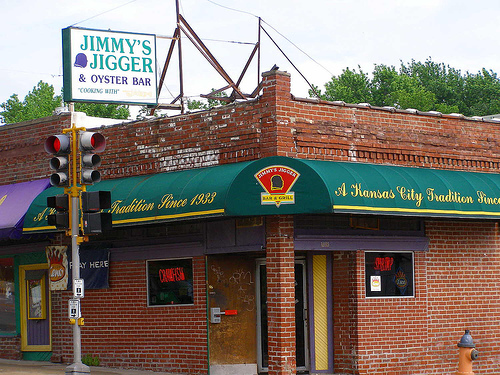
Maybe some of you remember it. A former Kansas City, KS, police officer named Charles L. Forgey was charged with manslaughter for shooting and killing a man outside the old Jimmy’s Jigger tavern at 39th and State Line Road. (It’s now Jazz, A Louisiana Kitchen.)

Forgey, who was in his early 30s, had been at the Jigger with Piniella after a Royals’ game.

Anyway, after a bumping incident in the bar around closing time — then 1:30 a.m. — the tiff moved outside. Forgey and Piniella got in their respective cars, but at least two guys who had gone outside approached Forgey’s car. There was conflicting testimony at trial, which took place in Wyandotte County District Court, but one of the guys, Donald J. Haire, approached the driver’s window, perhaps in a menacing way, and Forgey shot him. (Haire was not armed.)

Forgey testified he then sped west on 39th until he overtook Piniella’s car, and the two cars stopped at an intersection.

“I said, Lou, I think I hit one of those fellows,” Forgey testified.

When asked why he shot Haire, he said, “I thought my life was in danger.”

The old Jimmy’s Jigger, on the southeast corner of 39th and State Line Road

Piniella testified that as he drove slowly away from the tavern, he could see Forgey’s car in his rear view mirror. He testified he didn’t see anyone go down, but he told Forgey if he thought he had shot someone, they should call the police.

With that, they drove to a private club — undoubtedly on the Kansas side — and called police.

The jury-verdict story was not available online, but I remember clearly that Forgey was acquitted.

…I was thinking about the case for two reasons: First, I patronized the Jigger for a while after moving to Kansas City and met one of my first KC girlfriends there, and, second, I later met Forgey at Westport’s New Stanley bar, which I frequented for many years and where I met Patty in 1983. I talked to Forgey two or three times at the New Stanley, mainly because I just wanted to get a sense of what he was like. During those meetings, I didn’t form much of an opinion about him, other than the fact that he seemed pretty self-centered. (From a whitepages search, I think he’s still alive, but I’m not sure.)

Besides giving me a fresh look at that case, those two KC Times stories, from April 11 and April 13, 1972, showed a lot about how much reporting has changed — not for the better — over the decades.

For one thing, few metro dailies cover criminal trials from gavel to gavel any more. When I was first assigned to cover the Jackson County Courthouse with The Times in 1971, we covered the hell out of criminal trials, and I think many readers enjoyed reading about them. (Covering one mob-related murder trial that had been moved to St. Louis County, I had bylines in 10 to 12 consecutive editions of The Times and Star over a week’s period.)

Covering a big case from day to day is a golden opportunity for newspapers to engage readers. Trials are unpredictable events that ebb and flow and often build to suspenseful conclusions. Writing about them only at the beginning and the end, as The Star and most other papers do, robs the readers of the inherent drama and also gives them one more reason not to subscribe.

Another way in which our former way of covering the news helped readers identify with the people we wrote about was that our reports included, whenever possible, not just the names of subjects but also their ages, addresses and cities of residence.

For example, in the April 11 story about the Forgey trial, the reporter (who didn’t get a byline) included the ages and addresses of two witnesses: Robert Louis Beard, 28, of 4624 Mercier, Kansas City, and Bruce Huffman, 35, of 4501 W. 78th Street, Prairie Village.

The reporter included the address of Haire, the victim — 7618 Falmouth, Prairie Village — and the addresses of two other witnesses: Dennis McDaniel, 605 E. 105th Terrace, Kansas City, and Stephen A. Strickland, 4410 Jarboe, Kansas City.

Now, I understand that as times have changed, it’s not appropriate to include exact addresses in most cases, but I think it would be helpful if papers would at least provide ages, when practical, and cities of residence. I mean, isn’t that how we relate to new acquaintances…asking them where they live and either asking or trying to deduce how old they are?

**

Hey, call me nostalgic for “the old days,” but drawing readers into stories is key to holding their attention. Tracking running stories with closely and helping readers relate to people being reported on are two major ways newspapers can establish connections with community residents.

But when people don’t get compelling coverage, and when they only get subjects’ names, absent any defining context, they cannot relate to them and they lose interest. The result — and this has happened with The Star — is that people no longer take a proprietary interest in their local newspaper; they no longer think of it as “my paper, covering my community.”

That sense of a proprietary connection, “left the building” at 1729 Grand, and now 16th and McGee — a long time ago.

As far as the newspaper industry has fallen, The Star and many other metropolitan dailies could easily take a few simple steps to try to remain relevant to readers. But management at many papers, including The Star, just don’t seem to care any more.