Feeds:
Posts
Comments

Tampa Bay…Year II

We just had a week-long getaway to Clearwater, Florida, on the Tampa Bay peninsula.

Brooks and Charlie joined us for a few days — Charlie flying in from Chicago and Brooks from Kansas City — and actually Patty is still there. With the luxuries of free lodging and no pressing matters back home, she decided to stay a few more days.

We went there for the first time last year and spent a week with two close KC friends, Jim Gottsch and Julie Koppen, who have a two-bedroom home in Clearwater. This year, we divided our time between an Airbnb and Jim and Julie’s.

Jim and Julie’s house is a few blocks from the Gulf of Mexico, but it is adjacent to another major attraction — the 38-mile long Pinellas Trail, a former railroad line that has been transformed into a paved walking/running/biking path. The path, which is shaded in parts by palm and pine trees, extends from Tarpon Springs at the north end of the peninsula to St. Petersburg, near the south end.

Another strategic advantage of their house is that it is in northernmost Clearwater, just a block south of the Dunedin (pronounced Dun-EE-din) city limit. We spent a lot of time in Dunedin, frequenting its restaurants and its charming “downtown,” along Main Street. (Dunedin also is home to Julie and Patty’s favorite beach, Honeymoon Island.)

I played golf one day at Clearwater Country Club, which, belying its name, is open to the public. Several other good courses are within half an hour or so of Clearwater-Dunedin.

I hope these pictures will give you a taste of the good time we had…
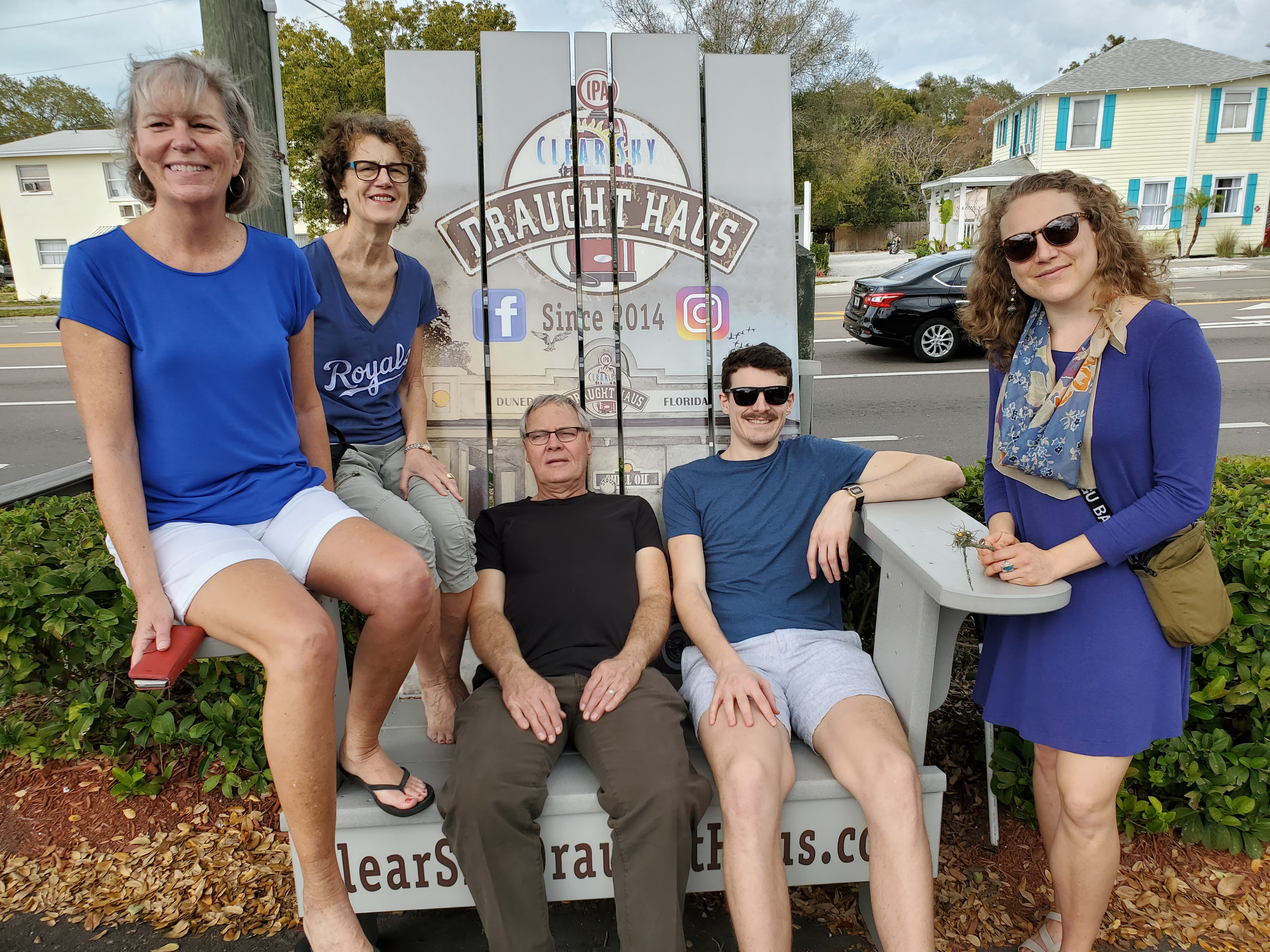
Here’s our group (minus me) at the Clear Sky Draught House in Clearwater. From left are Julie, Patty, Jim, Charlie and Brooks.
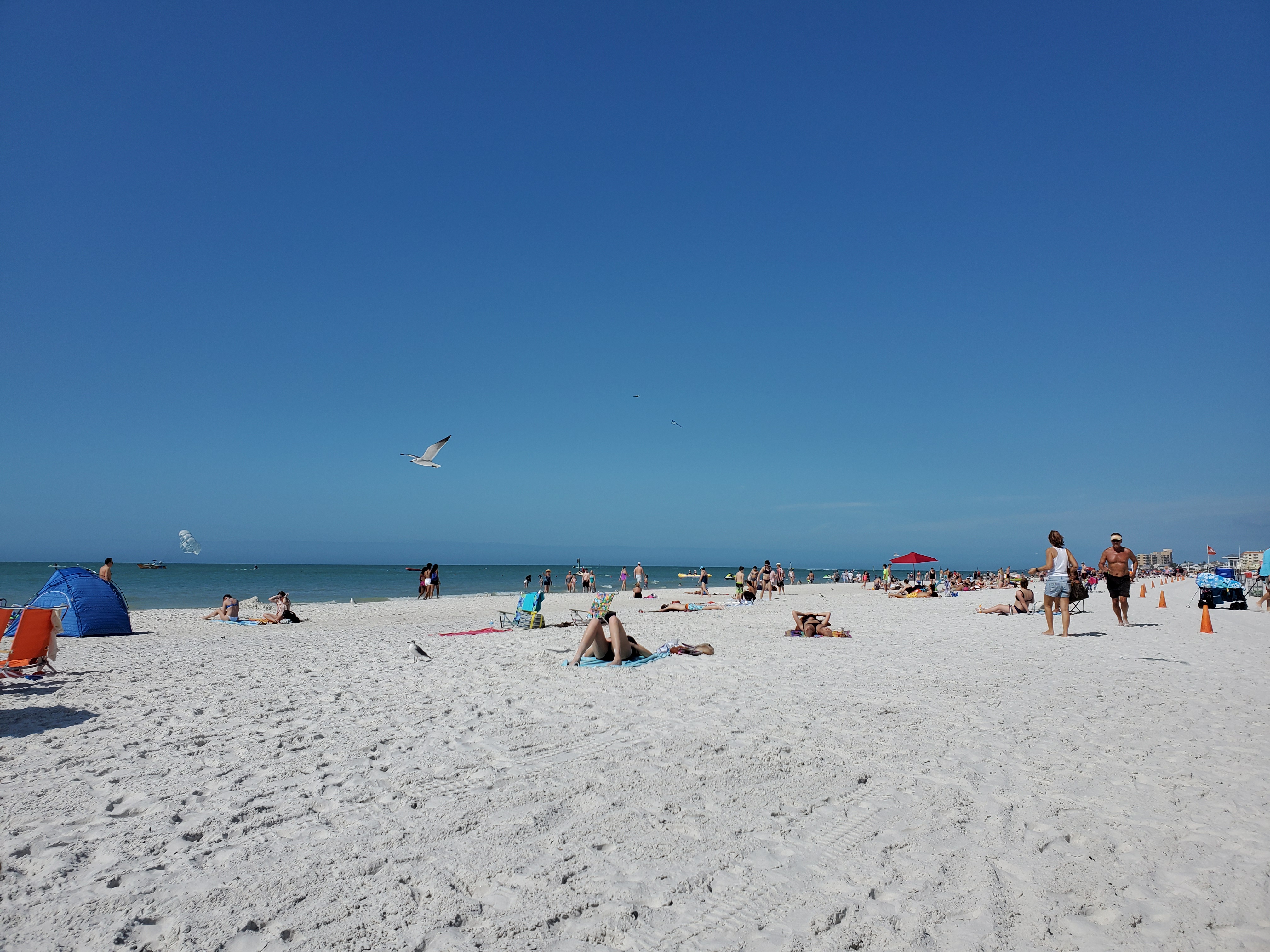
Clearwater Beach, which is deep and features that soft sand that can only be found in the U.S. on the Gulf Coast.
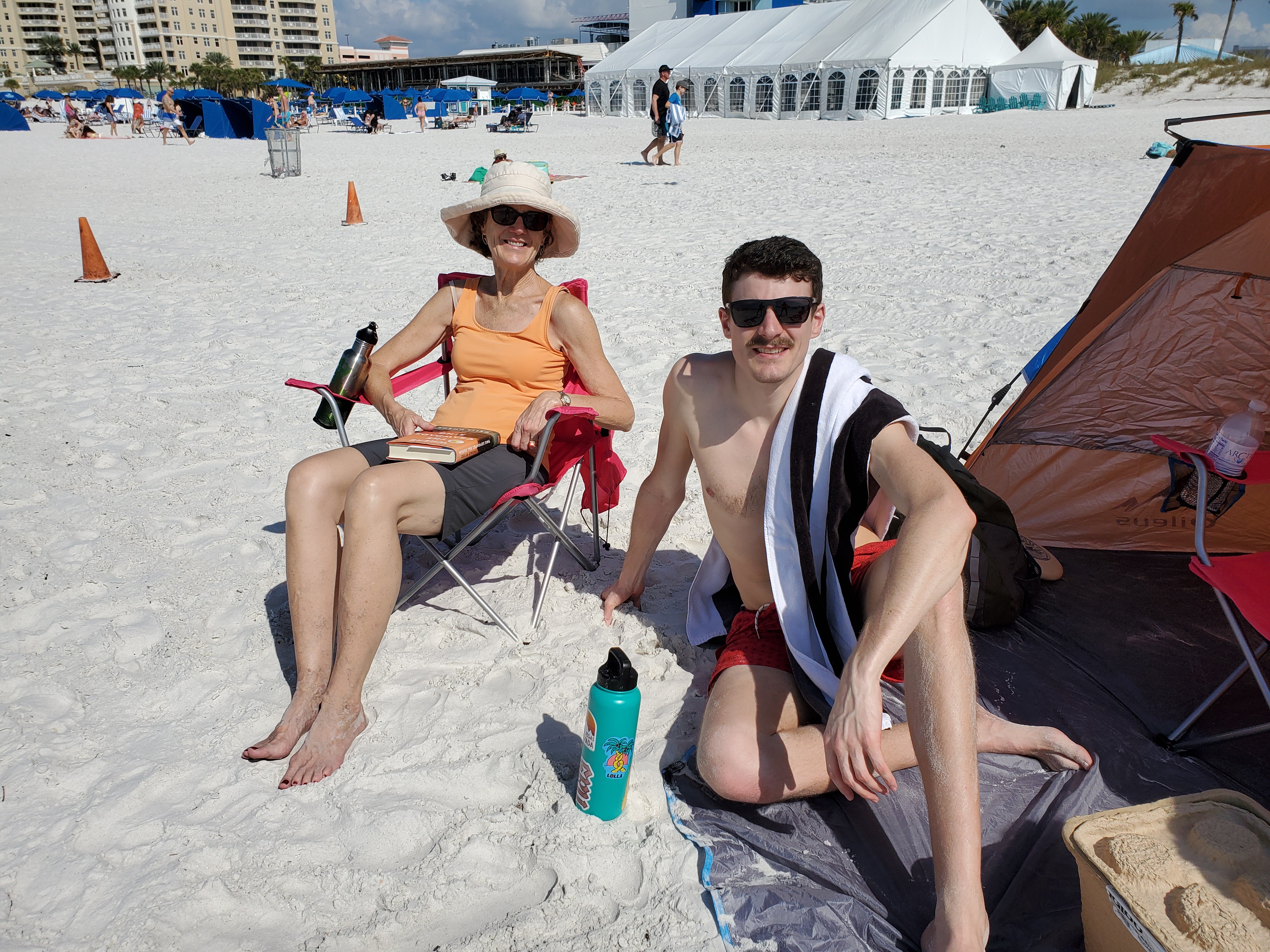
Patty and Charlie. Charlie, who is 6′ 7″ tall, was hoping to find a competitive volleyball game on the each, but he didn’t find one that day.
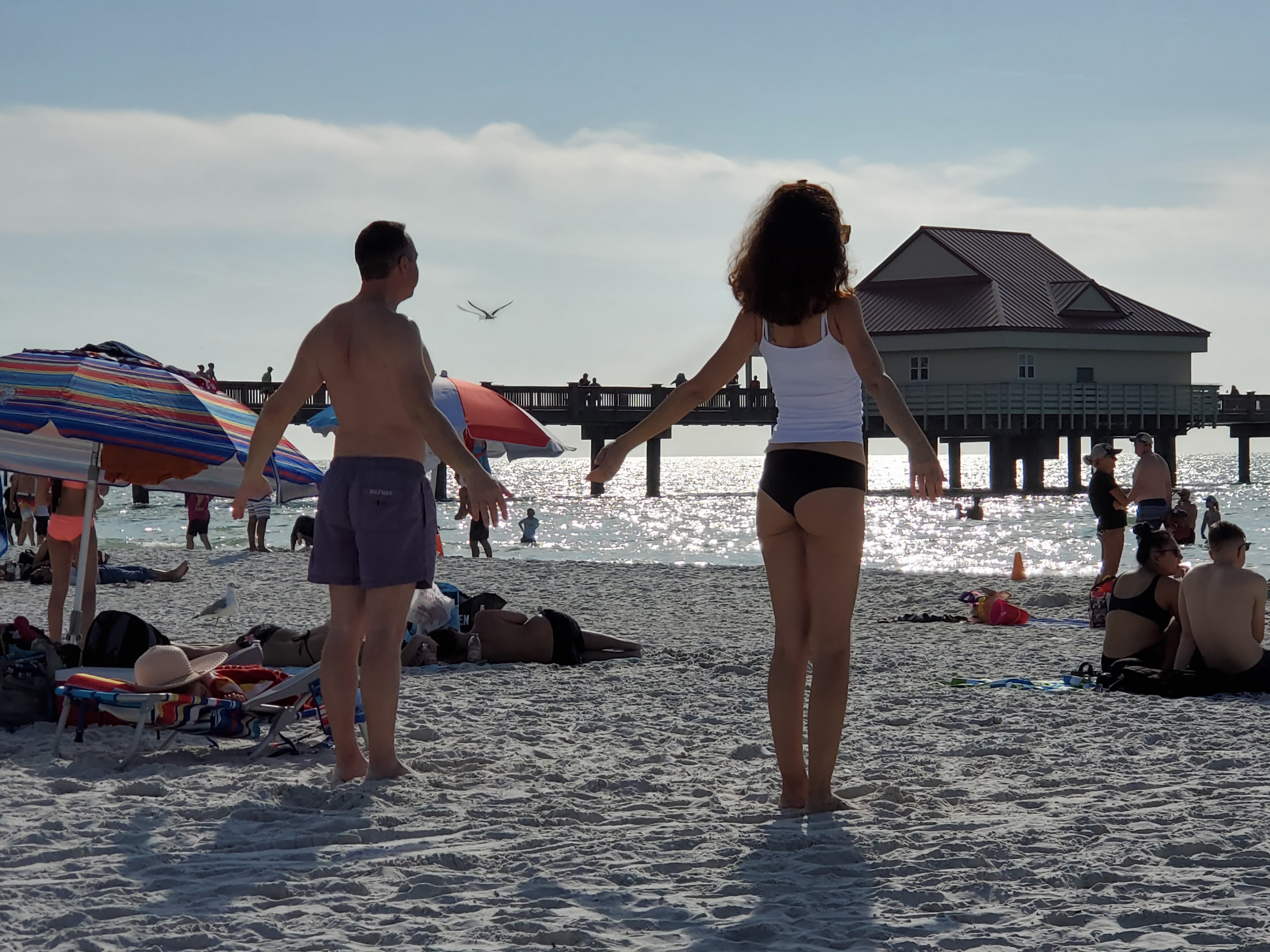
When not captivated by the sun, sky and sand, I happened to notice that women’s swim wear had changed since the last time I went to the beach.
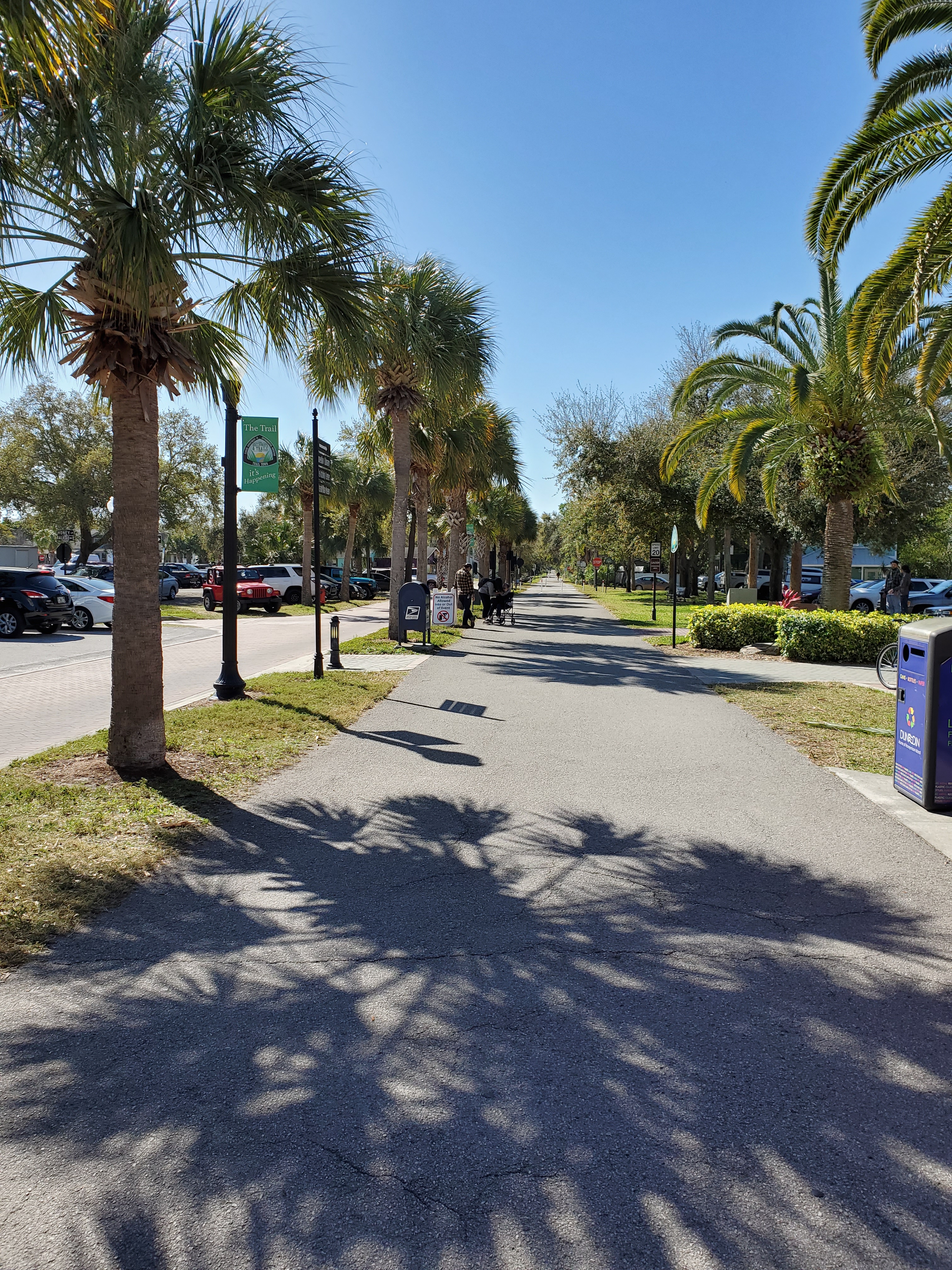
This is part of Pinellas Trail, near Main Street in Dunedin.

A lush, willowy palm tree graces the entrance to the Dunedin Fine Art Center.

Dunedin is home to TD Ballpark, winter home of the Toronto Blue Jays. “Grapefruit League” games got underway a few days ago.
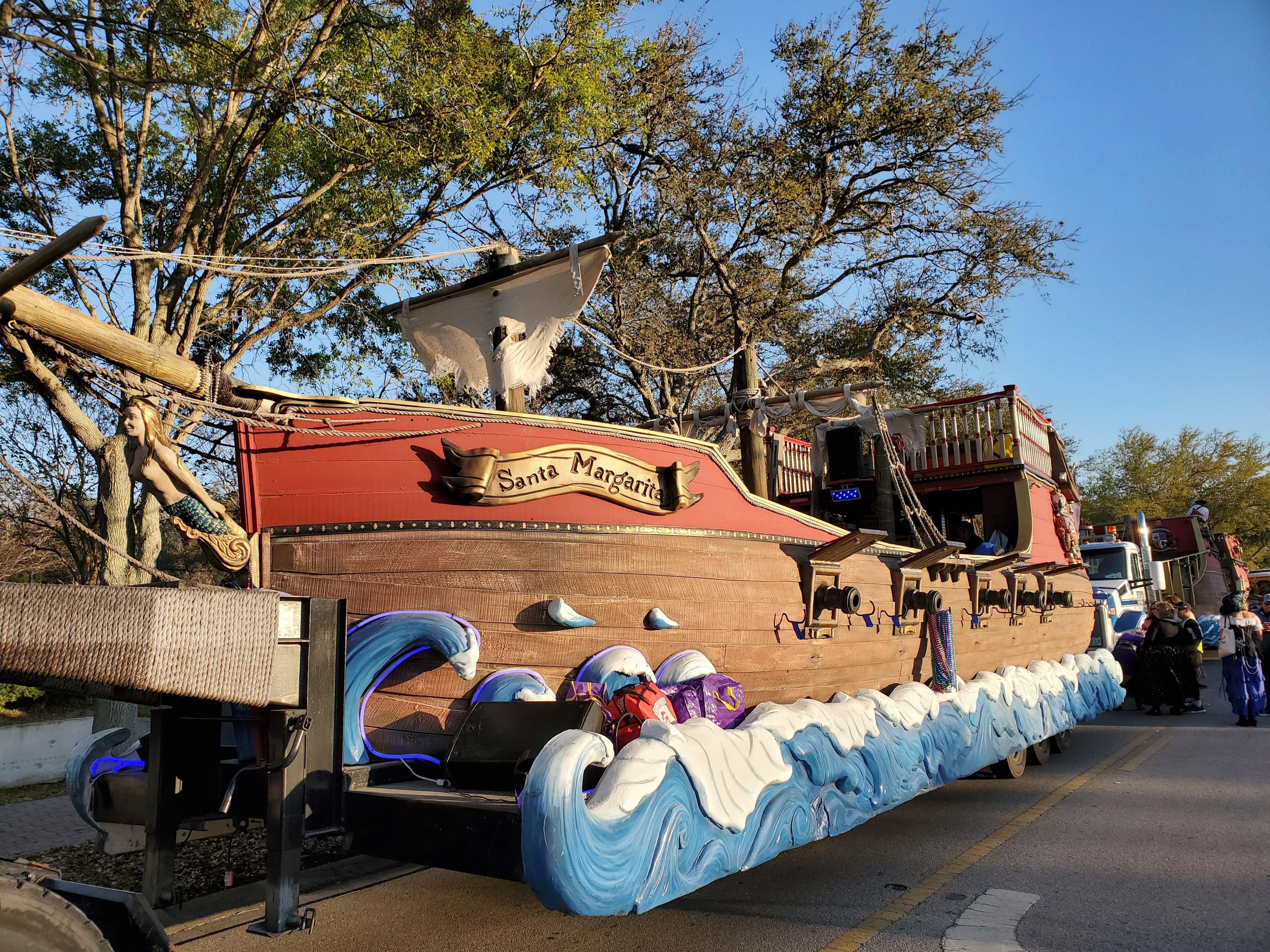
Each year, Dunedin hosts a Mardi Gras parade, which draws scores of big floats and attracts thousands of people. This was one of the floats staging on a city street Saturday afternoon.

Another parade entry — painted in the appropriate color.
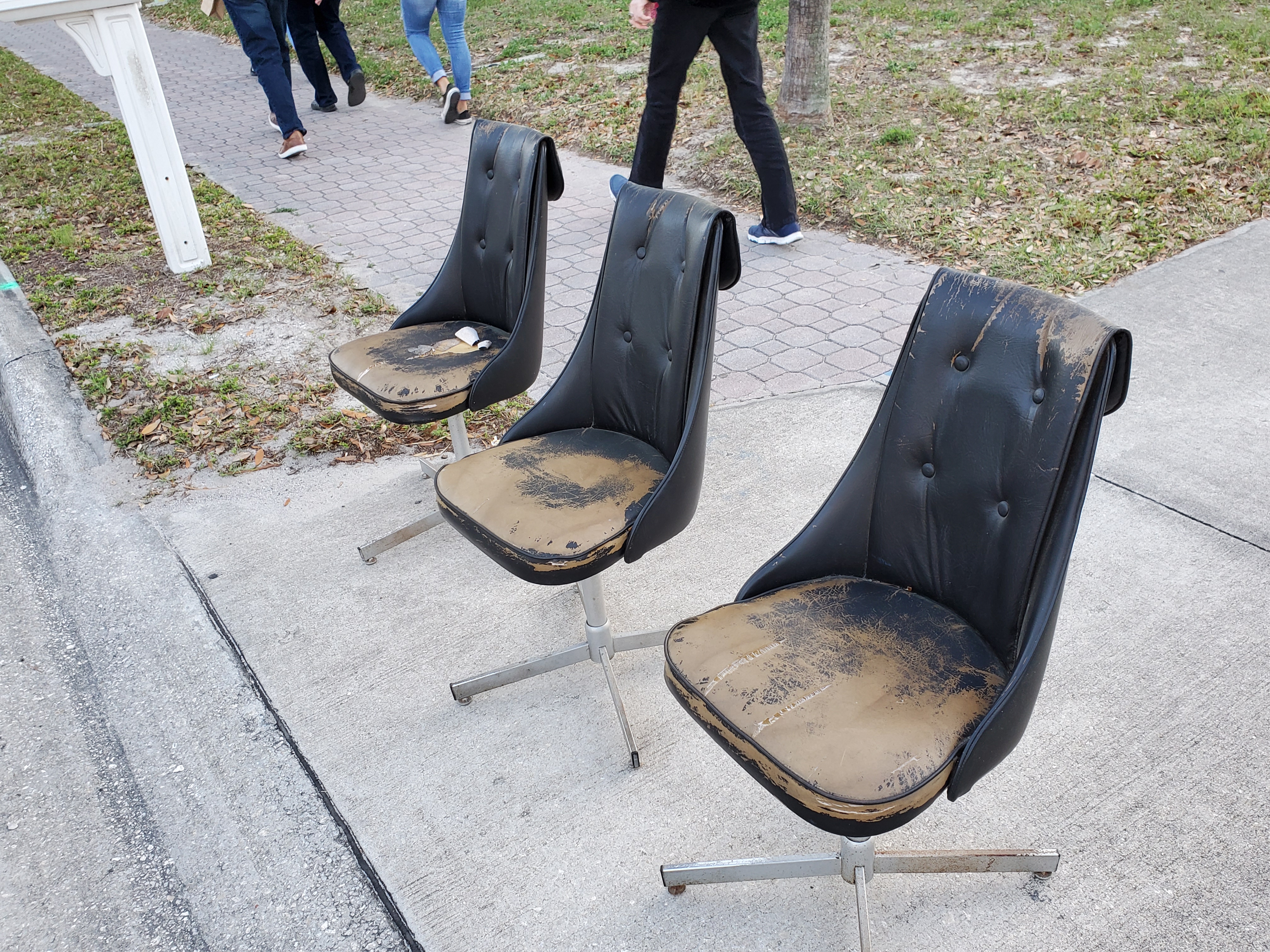
Some finely upholstered chairs strategically placed for front-row, parade viewing.
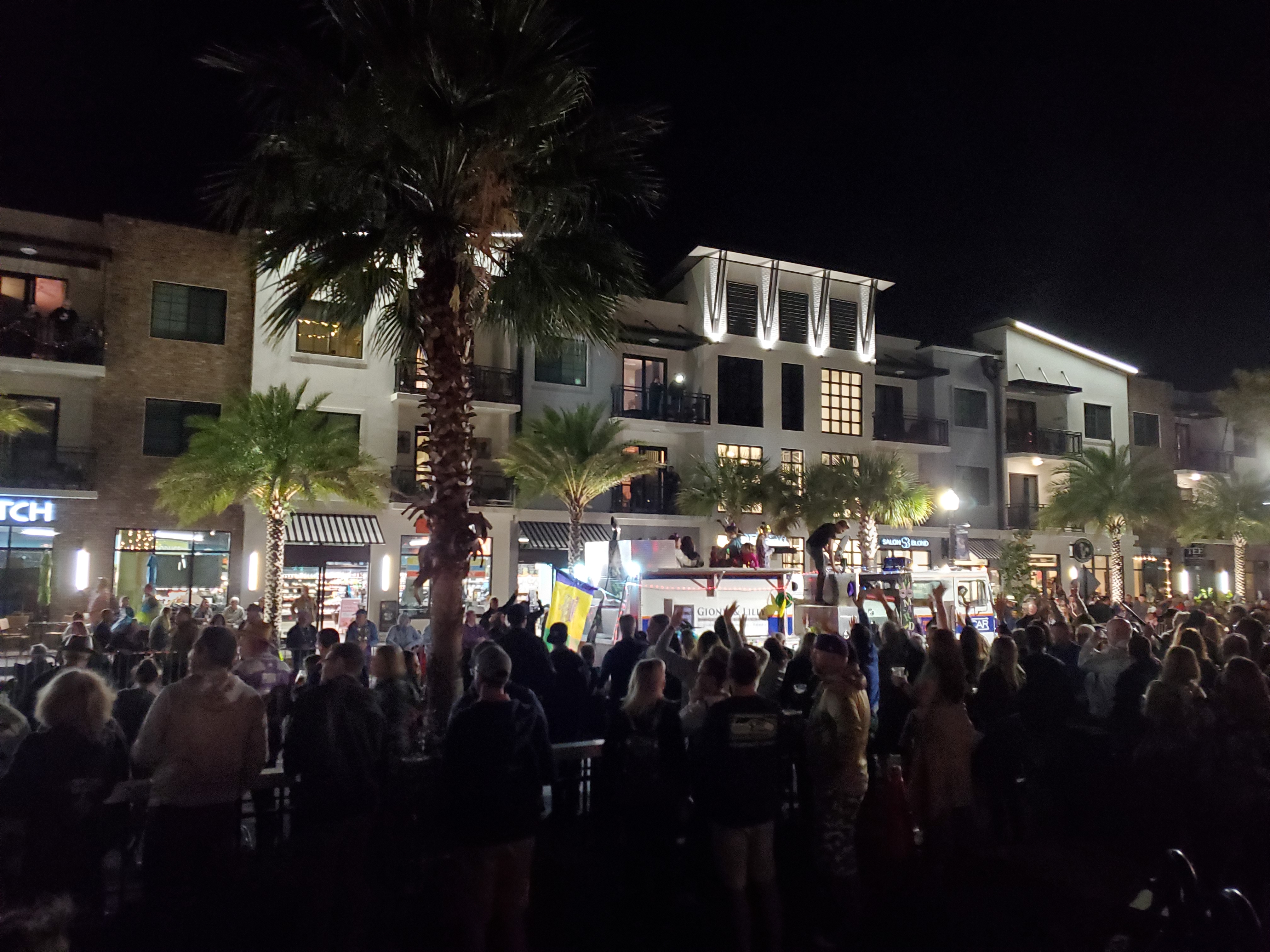
The parade started about 7 p.m…This was the scene along Douglas Avenue, along which the parade runs.

One of the floats that got the most attention was that of the gay nightclub Blur…People on all the floats threw plastic, multi-colored, beaded necklaces — thousands of them — to bystanders. Saturday night saw the revelry; Sunday morning the big cleanup.

The company that is poised to take control of McClatchy and its 29 daily papers doesn’t have a website.

The company’s C.E.O., Anthony Melchiorre, doesn’t give interviews, and no photo of him is available online.

The company’s main office is on the second floor of a nondescript, two-story office building in Chatham, NJ, 28 miles west of the Manhattan skyscrapers.

Why so hush-hush and such a low profile?

Well, this company, Chatham Asset Management, doesn’t do a lot that would make it want to call attention to itself. It doesn’t produce a product or render a significant service to society. It doesn’t employ a lot of people, and I doubt if it sponsors arts organizations and gives to charities in Chatham. What it does, apparently, is make its clients lots of money.

Chatham is a hedge fund, and, like most hedge funds, it is interested in just one thing: Big bucks.

The New Jersey office building in which Chatham Asset Management has its office

Many hedge funds look to acquire companies that, while they may be failing, still generate a lot of cash. After sinking their claws into such companies, they suck out the cash and invest the money elsewhere, where they can get better, surer returns.

Over time, Chatham has increased its investment (and sunk its teeth?) in McClatchy, to the point where it became not only the company’s largest shareholder but also its biggest creditor.

Chatham had waited patiently for Thursday, and now it’s in the catbird seat, waiting for the Chapter 11 bankruptcy proceedings to play out and then take charge.

This is all very bad news for The Kansas City Star and the other McClatchy papers. As weak as these papers are and as far as they have fallen, they still throw off lots of cash. In that sense, they are perfect victims for scavengers.

For the sake of McClatchy’s approximately 2,800 employees (for comparison’s sake, The Star alone had more than 2,000 employees about 20 years ago), I’m sorry to say things could get a lot worse before there’s any chance of getting better.

I can almost guarantee you there will be staff cuts at most or all of those newspapers. Any McClatchy employees hoping that Chatham might not be as bad as the hedge fund Alden Global Capital, which has decimated the Denver Post and other papers in its stranglehold, should consider this: Chatham is the majority owner of American Media, which owns the tabloid National Enquirer — which hardly recommends Chatham as a potential restorer of the 29-paper chain to the newspaper industry’s top ranks.

Like Warren Buffett, Wall Street traders and just about everyone else, Chatham has no illusions about where the newspaper industry is headed; it just wants to bleed them of cash, or, perhaps, sell them at a nice profit to another chain.

The guy who will be drawing the blood, Anthony Melchiorre, apparently is a piece of work.

A March 2019 Fortune magazine story said Melchiorre, who is either 51 or 52, was raised in Chicago, studied economics at Northwestern and got an MBA from the University of Chicago. After working at investment banking firms Donaldson, Lufkin & Jenrette and Goldman Sachs, he went to Morgan Stanley in 1998, where he worked his way up to heading the firm’s junk-bond trading group.

Fortune said Melchiorre wasn’t a particularly good fit at the firm and irritated some senior executives.

“Although not physically imposing,” the Fortune story said, “Melchiorre could be foul-mouthed and loud, and would berate fellow traders as he bopped around the trading floor in his stocking feet.”

Indications are he’s been with Chatham more than 15 years.

**

In the newspaper industry, it is typical after an ownership change for the C.E.O. of the acquiring company to visit the newsrooms of the papers being bought and to speak about the company’s plans for the future and answer employees’ questions.

When Walt Disney Co. bought The Star and its parent company, Capital Cities/ABC, in 1995, Disney C.E.O. Michael Eisner came to the newsroom. (The most memorable thing he said was Disney would not be selling the papers anytime soon, but they were on the block a year later.)

When Knight Ridder bought The Star and three other Disney-owned papers in 1997, I’m pretty sure Knight Ridder C.E.O. Tony Ridder came to the newsroom and spoke, although he was such a stone of a personality I don’t specifically remember it.

And in 2006, when McClatchy bought out Knight Ridder, McClatchy C.E.O. Gary Pruitt came to the newsroom. I remember that very well because by then I was hoping for a buyout and asked him, in front of the crowd, if he was planning on offering any. (The answer was no, and I retired on June 30, three days after the McClatchy deal closed.)

But Melchiorre? No, I don’t think he’ll be visiting the newsroom and talking about Chatham’s plans for the paper. I would bet, in fact, that not one Star employee — not even president-publisher-secretary and head of security Mike Fannin — will ever see him.

But just on the outside chance he does come around, would somebody please take his picture and send it to me?

(Note: This column was posted a couple of hours before news stories began to break saying The Star’s owner, the McClatchy Co., had filed for Chapter 11 bankruptcy protection early this morning.)

For about the past 15 years, I’ve tracked the somewhat parallel paths of The Star and the St. Louis Post-Dispatch.

Both have been on sharply downward slopes, journalistically and financially, since being purchased by their current owners.

Mainly because of developments the last two years, however, the Post-Dispatch is now on much steadier ground than The Star.

Let me show you…

Before it was purchased by Lee Enterprises of Davenport, IA, in 2005, the Post-Dispatch was owned by Pulitzer Inc., a revered St. Louis company that also owned the Arizona Daily Star in Tucson and 12 other papers.

Lee, which owned 44 relatively small papers, bought the Pulitzer group for $1.5 billion and took on $1 billion or more in debt.

Tony Ridder

A year later, Tony Ridder, C.E.O. of the Knight Ridder chain, was pushed into selling by a disgruntled, major stockholder. It turned out to be the best move Ridder ever made because he found a willing buyer with eyes much bigger than its stomach.

The McClatchy Co., based in Sacramento, paid $4.5 billion for The Star and about 30 other Knight Ridder papers, several of which were major metropolitan papers.

McClatchy also took on more than $1 billion in debt.

Both Lee and McClatchy soon realized they had bitten off more than they could chew as newspaper industry fortunes plunged in the face of the internet explosion, with its proliferation of free news and information sites.

From that new, unhappy starting point in their respective rich histories, both The Star and the Post-Dispatch began losing subscribers and advertisers at jaw-dropping rates.

The Star, as I reported last week, has lost 50 percent of its Sunday print circulation since 2016, going from about 158,000 in December 2016 to about 79,000 in December 2019.

The Post-Dispatch is doing slightly better, having suffered a 40 percent loss, going from a Sunday print circulation of about 151,000 in December 2016 to about 91,000 in December 2019.

Here’s the difference, though: McClatchy has not been able to deal with its debt as well as Lee Enterprises.

McClatchy’s debt stands at about $700 million. Unable to adequately lower its debt, the company now is in the position of not being able to make a required pension-plan payment of $120 million this year.

As a result, McClatchy is in imminent danger of being sold, going into bankruptcy or being taken over by its largest shareholder and creditor, a hedge fund. (As I noted at the outset, McClatchy filed for bankruptcy early this morning.)

Lee Enterprises, on the other hand, seems to have been smarter.

It definitely has been luckier, the biggest stroke of luck being the arrival of Warren Buffett on the scene eight years ago.

Here’s a timeline that shows how Lee got to safer financial footing, mostly with Buffett’s help.

:: In December 2011, Lee filed for Chapter 11 bankruptcy protection to refinance nearly $1 billion in debt. Before the filing, Lee had secured agreements with 97 percent of its creditors to refinance what it owed them, and it came out of bankruptcy less than two months later with a deal with all its creditors. “This…provides Lee with a nearly four-year runway to continue improving our balance sheet,” Lee chairman and chief executive Mary Junck said.

:: In April 2012, less than three months after Lee emerged from bankruptcy, Buffett’s Berkshire Hathaway company took a stake in Lee, buying $85 million of the company’s debt from Goldman Sachs. About the same time, Berkshire Hathaway bought $2.1 million worth of Lee stock, representing a 3.2 percent of outstanding shares.

:: In 2013 and 2014, there was more debt refinancing.

:: On June 27, 2018, Lee Enterprises and Berkshire Hathaway reached a five-year agreement to allow Lee to manage Berkshire Hathaway’s newspaper and digital operations. BH Media Group has 30 daily newspapers in 10 states, including The Buffalo News, the Omaha World-Herald, the Tulsa World and the Winston-Salem Journal.

:: Capping the Lee/BH relationship, Lee announced an agreement two weeks ago to buy the BH Media Group for $140 million. As a sort of goodwill farewell to his decades of newspaper ownership, Buffett provided Lee with $576 million in long-term financing, some of which Lee will use to refinance its roughly $400 million in remaining debt. After the deal closes — expected in mid-March — Berkshire will be Lee’s sole lender.

Warren Buffett tried his hand at newspapers for many years but is getting out

Sounding a strong note of confidence in Lee, Buffett said in announcing the sale:

“We had zero interest in selling the group to anyone else for one simple reason: We believe that Lee is best positioned to manage through the industry’s challenges. No organization is more committed to serving the vital role of high-quality local news, however delivered, as Lee.”

Many present and former journalists are sorry to see Buffett getting out of the newspaper business. The big beneficiary, however, is Lee Enterprises and its current largest paper, the St. Louis Post-Dispatch, whose future now looks pretty darn good.

And The Star? It remains squeezed in McClatchy’s suffocating tentacles, its future completely up in the air.

Will the Chiefs’ Super Bowl victory save The Star?

That’s what a friend and blog reader asked me jokingly the other day, referring to The Star’s big spike in sales of special sections and some daily editions leading up to and following the Super Bowl.

We both laughed, and he answered the question with this: “They’re going to come up a few million short.”

Were it an independent newspaper fighting on its own, The Star might be able to come through this newspaper carnage in decent shape. Unfortunately, it’s caught in the tentacles of parent company McClatchy’s plunge toward takeover or bankruptcy.

McClatchy is still carrying a $700 million debt from its 2006, $4.5 billion buyout of Knight Ridder. In addition, McClatchy has already announced it will not be able to make a required pension-plan payment of $120 million, due this year.

This is not to say The Star doesn’t have plenty of trouble on its own. Circulation figures are always the best gauge of a newspaper’s viability, and figures for The Star between 2016 and 2019 tell a frightening story.

For purposes of this comparison, I used “total average individual paid circulation” figures The Star reported to the Alliance for Audited Media, a trade organization. That category includes home delivery, mail and single-copy sales.

The key statistic: Between December 2016 and December 2019, The Star’s print-edition circulation has dropped a full 50 percent.

Sunday print circulation, which was 283,000 a decade ago, is now down to less than 79,000.

Weekday circulation is now below 50,000, which was about the circulation of the small, first paper I worked for in Covington, KY, in 1968-69.

Here are the stats:

December 31, 2016

Sunday print — 157,971
Monday to Friday (average) print — 88,417

December 31, 2017

Sunday print — 118,203
Monday to Friday print — 76,853

December 31, 2018

Sunday print — 97,376
Monday to Friday print — 64,718

December 31, 2019

Sunday print — 78,627
Monday to Friday print — 49,320

…Perhaps even more troubling is the fact that during that same period, the number of digital subscriptions appears to be only about 12,000 — nothing close to what it needs to be to make a successful “digital transformation.”

So, I hope president/publisher/secretary Mike Fannin and the rest of the group down at 16th and McGee enjoy the current bump in sales because later this year, in all likelihood, The Star and the 28 other McClatchy papers are going to be plunged into chaos.

**

On a happier note, I was thrilled to read in today’s paper that a young man whom Patty and I watched grow up played the biggest role in stopping The Great Chase at the Super Bowl parade Wednesday.

When we lived at 56th and Main streets in Brookside, J.T. Hand lived two doors down with his family. He was a good kid, but he had a bit of an edge about him, and occasionally some hijinks on the block would be traced back to him.

His father, Mike Hand, was working his way up the ranks of the Kansas City Police Department (eventually he became deputy chief), and his mother, Nancy Hand, was the principal at St. Teresa’s Academy, at the top of 56th Street.

Patty always contended that J.T. wanted to become a police officer. I don’t know whether J.T. told her that, or Nancy told her that, or it was pure supposition…but she was right. The only surprise was he joined the Independence Police Department instead of KCPD.

…Now on to Wednesday. After this idiot Addae J. Doyle, 41, of Kansas City, KS, drove through a fence at the north end of Grand Boulevard and started speeding south along the parade route, J.T., who was working the parade, apparently on foot, jumped into an unoccupied but running KC police car and began following Doyle.

He followed him all the way to the intersection of Grand and Pershing Road, where Doyle made a right turn and headed toward the mob of people assembled around Union Station.

Other police cars were involved in the chase, too, but shortly after Doyle made the turn, J.T. angled his car into the rear of Doyle’s Ford Taurus and spun it around. On video, it looks like a slow-motion, stock-car collision.

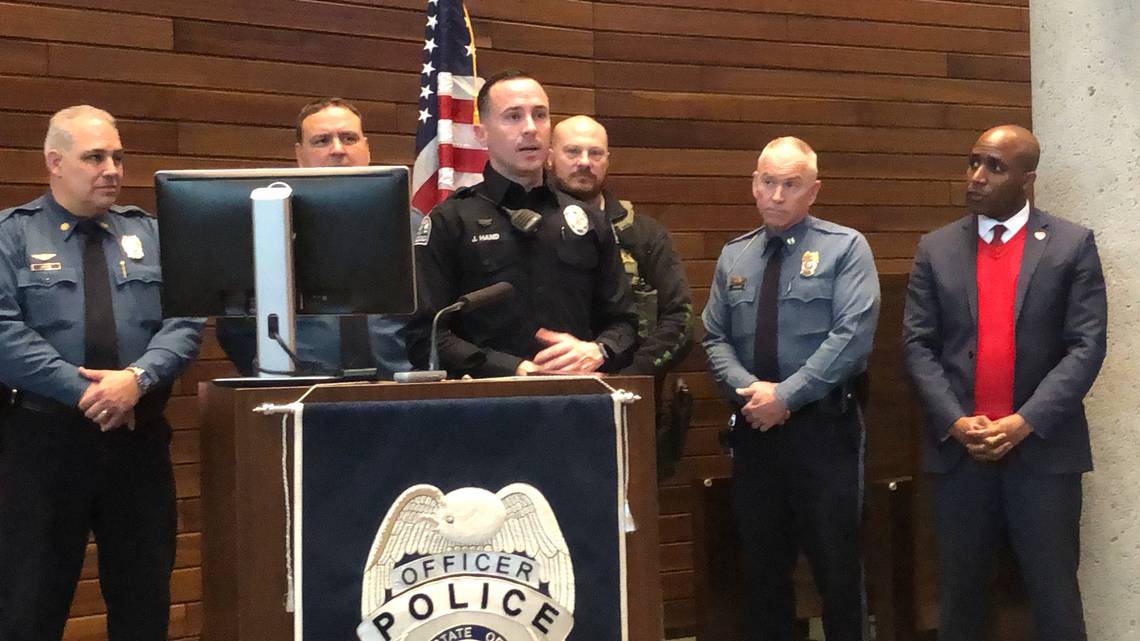
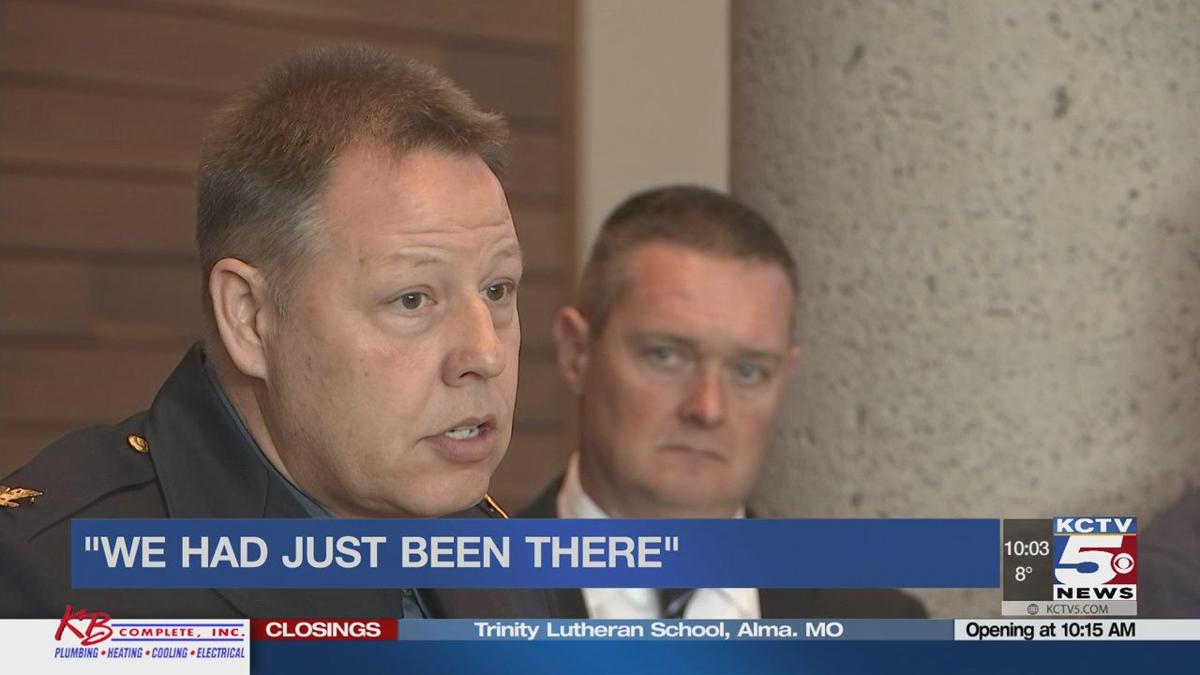
At a news conference Thursday, Independence police officer J.T. Hand talked about his role in The Great Chase on Grand Boulevard before Wednesday’s Super Bowl parade.

Almost immediately, KCPD Major Scott Caron came along and rammed the front of the Taurus with his police car, ending the ordeal.

Yesterday, J.T. was among the officers who got to take a star turn at a news conference where Chief Rick Smith gave a full explanation of what had happened.

J.T. said…

“We got him boxed in and slowed down. When we took that turn onto Pershing and saw all of those people that were basically standing in the middle of the road, we knew we had to end it, and luckily we had an opening.”

Bravo, J.T.! You’re a credit to the uniform, and past and present residents of 56th Street are very proud of you!

The Iowa Caucasses

During my 36 years of reporting and editing at The Star, we had some lengthy waits for election results.

Delays always prompted angst — deadlines approaching, you know — and several times when results were slow coming in, we’d have to prepare two stories, one reflecting one result, the other reflecting the opposite.

But I never experienced an election delay that lasted all night.

Last night, then, I was sure glad I wasn’t a reporter or editor covering the Iowa caucuses and that, instead, I could shuffle off to bed about 11:30.

It certainly was disappointing, though, and still is: At this writing…still no results.

After all that build-up, after all the hype about Iowa being the state that would give the first indication at who might go up against President Trump in November…blah…nothing…a big turd served up on a platter by The Hawkeye State.

Might as well be The Flyaway State.

I had already read a lot about the problems with Iowa getting disproportionate influence in the nominating system because it is first out of the gate. The chief problem is that, demographically, it’s not an accurate representation of the United States.

In a prescient Op-Ed piece last week, New York Times columnist David Leonhardt said the Democratic Party should strip Iowa and New Hampshire of their “special” status and they should be relegated to deeper spots on the primary calendar.

Leonhardt wrote:

The 2020 cycle should be the last time that Iowa and New Hampshire benefit at the country’s expense. The strongest part of the case for change, of course, is the racial aspect of the current calendar. Iowa and New Hampshire are among the country’s whitest states. About 6 percent of their combined population is black or Asian-American. Almost 87 percent is non-Hispanic white, compared with 60 percent for the country as a whole. Demographically, Iowa and New Hampshire look roughly like the America of 1870.

In the wake of last night’s debacle, Leonhardt quickly doubled down this morning. He began several paragraphs with the words, “Iowa should never go first again because…”

One of those paragraphs read…

“Iowa should never go first again because last night it botched its caucus when the entire nation was watching, giving the lie to the state’s longtime claim that it is better at conducting democracy than the rest of us…Iowa has enjoyed a half-century of an outsize role in presidential campaigns, with all of the extra influence and economic activity that has come with that role. It’s time for the special treatment to end.”

Amen. Today, Iowa is bathed in exactly the opposite kind of attention it expected during the months leading up to caucus night. Today, Iowa deserves every one of the rotten tomatoes being thrown at it.

I owe Andy Reid a big apology.

Not because I doubted he could win a Super Bowl, but because of a post I wrote seven years ago, criticizing Reid’s appearance.

In that article, I said, “Just because a guy is fat doesn’t mean he has to look like he’s a fabric salesman’s dream come true.”

Accompanying the post was a photo of Andy in a floppy, ill-fitting suit as he walked with Chiefs’ owner Clark Hunt on, I believe, the day Reid was introduced as the Chiefs’ head coach.

…Next month I will have been writing this blog for 10 years (thankee, thankee), and over that period I’ve written SEVERAL stupid posts, and that was one of the stupidest. Shame on me for criticizing a person’s appearance.

I haven’t seen images of Andy in a suit lately, and maybe he’s spruced up on the non-football attire, but, regardless, the guy looks great on the sidelines in Chiefs’ red.

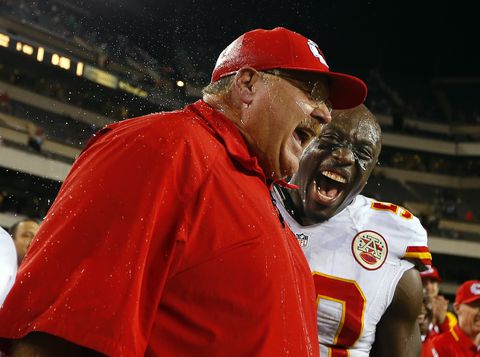
And he never looked better than last night: Unbridled joy becomes everyone, right?

Reid, after getting a Gatorade bath

**

Patty and I watched the game at the home of friends who live in Coleman Highlands. Years ago, my first thought would have been to head to downtown Westport and dive into the frenzy after the game. But last night, the main thing on my mind was getting home safely. So, instead of taking Southwest Trafficway and swinging over to Ward Parkway, we went over to State Line Road and took it all the way to our street in the Romanelli West neighborhood.

At the intersection of State Line Road and Westport Road, we saw cars streaming from west to east, most of the traffic probably coming from Kansas and heading to — where else? — Westport.

As we passed the home of Patrick Mahomes and his girlfriend Brittany Matthews on State Line Road, I honked the horn twice.

**

Our daughter Brooks watched the game at home, and she described the mini-celebration that took place in the neighborhood.

At game’s end, Brooks heard fireworks, of course, but also a lot of shouting and yelling. She went outside and saw people running in the Ward Parkway median toward the Sea Horse Fountain at Meyer Circle. Two other curious neighbors joined her and together they walked down to the fountain.

There, Brooks said, several people were clambering in the dry fountain basin and several others were climbing onto and hanging from various parts of the Sea Horse sculpture. All were whooping and hollering, and people in cars that went by were honking their horns and yelling out the windows.

After 20 minutes or so, the fountain brigade left the fountain area and moved on down the median, still hollering and exulting.

**

Obviously, The Star is reaping a huge financial windfall from sale of today’s paper and special Chiefs sections they have been and will be putting out.

Copies of today’s paper were selling briskly when I went to the Brookside Price Chopper this morning to buy three extra copies — over and above the one I got at home. Smartly, The Star raised the single-copy price of today’s paper from $2.50 to $4.99. It was odd to have to pull out a $20 bill to pay for three weekday papers, but I wasn’t complaining. Thanks to the Chiefs, print journalism is enjoying a temporary reprieve in Kansas City.

**

I was impressed with Mahomes’ composure not only during the game but afterward. He was both thoughtful and articulate, where he would have been forgiven for blubbering and spewing.

I got insight into where he gets that composure while watching post-game coverage on one of the local TV channels. In an on-camera interview from the stadium in Miami Gardens, Mahomes’ father, Pat Mahomes, a former Major League baseball pitcher, spoke in a relaxed, confident and even voice. Patrick got some good genes.

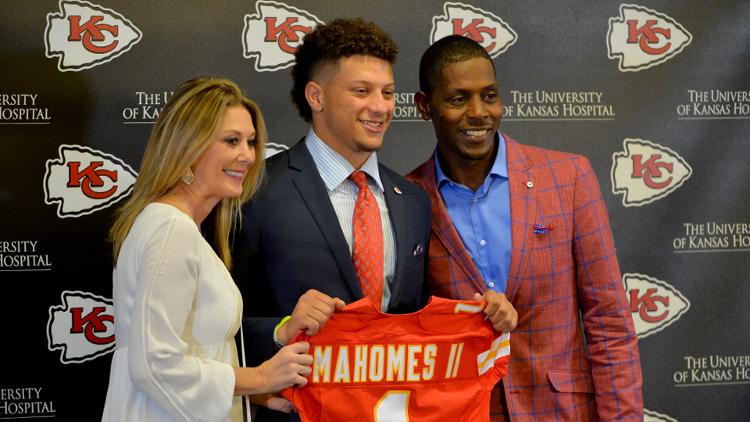
Patrick, with parents Randi and Pat on the day he was selected by the Chiefs, April 27, 2017. (His parents divorced years ago.)

**

Here are a few of my favorite Super Bowl quotes, all from today’s Star.

:: Tight end Travis Kelce on his relationship with Andy Reid — “We’re married together forever now. He can’t get rid of me now. I’ll be over at Thanksgiving.”

:: Running back Damien Williams on the help he got from fullback Anthony Sherman on Williams’ 38-yard touchdown run that iced the game — “Sherm came in the game and was like, ‘Follow me.’ That’s exactly what I did; I followed him. The run was supposed to go inside, he went outside, so I went outside and I said, ‘Screw it, I’m taking it to the house.’ “

:: Center Austin Reiter on watching the long, fourth-quarter pass from Mahomes to Tyreek Hill“I remember seeing the ball go in the air. I remember thinking: ‘Thank God….About damn time.’ “

:: The final quote goes to KC Star reporter Blair Kerkhoff, who assessed the Chiefs’ performance in a “Report Card” on the game.

Under the heading, “Reason to hope,” Kerkoff wrote — “Is this the start of a magical era for the Chiefs?”

Under the heading, “Reason to mope,” he wrote — “None. We had something written here early in the fourth quarter but erased it.”

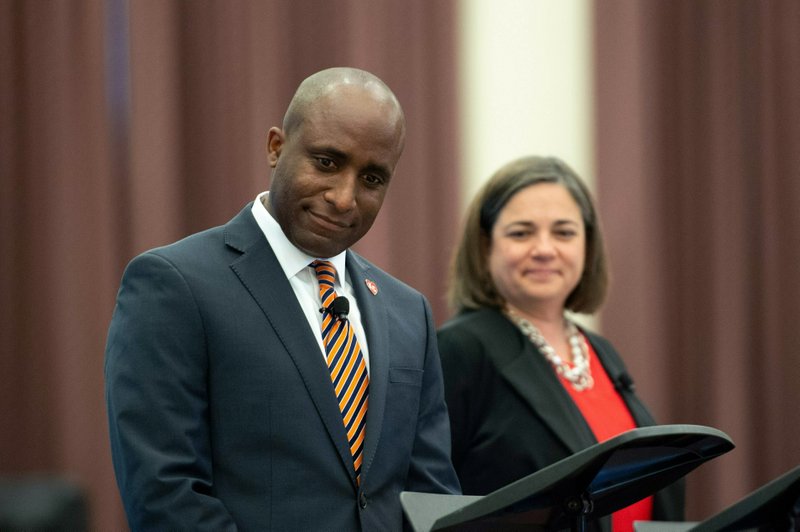
Anyone who thought, during last year’s municipal election campaign, that Quinton Lucas might be a bold mayor when it came to TIF projects and tax hikes should now be thoroughly disabused of the notion.

Less than six months into his first term, it’s clear the special interests — primarily the fire fighters’ union and the big developers and their attorneys — are pulling his chain just as they have been pulling the chains of most mayors and City Council members for generations.

During the campaign against former City Councilwoman Jolie Justus, Lucas made noises like he would rein in the development incentives, and he indicated he would oppose tax-hike proposals. At a debate sponsored by The Star, he said: “There are two things Kansas City doesn’t really need more of — more taxes and more task forces.”

And what have we seen?

Well, in the biggest test so far on development incentives, he voted against a big subsidy for the 25-story Strata office tower proposed for 13th and Main streets, but he declined to veto the measure, which passed with a bare majority of seven votes. A veto — the true test of a mayor’s commitment to principle — would have killed the subsidy.

And then, last week, when the Council voted to put a $21-million, quarter-cent sales tax before voters, Lucas was conveniently out of town. If voters approve the new tax in April, the revenue would be used to fund Fire Department equipment and station improvements.

Reached by The Star after the vote, Lucas sounded nothing like an opponent of new taxes, saying, lamely, that the Fire Department “has asked for an opportunity to explain to the public the rationale for a tax increase.”

The Council’s approval of the sales-tax vote was outrageous for two reasons. First, it is a naked payback to Local 42 of the International Association of Fire Fighters for their support of Lucas and most of the Council members who were elected in June. Second, Council members pushed it through the introduction-discussion-approval processwhich can take weeks or even months — in one week!

An expedited — really expedited — process at City Hall is a sure sign the rails have been greased.

The Council member out front with the grease gun was Katheryn Shields, a longtime friend of the fire fighters’ union. Shields, who was re-elected from the 4th District at large in June, will not face voters again in 2023 because she will be term limited. (Actually, she’ll be term limited for the second time because years ago she served two four-year terms and after that served two terms as Jackson County executive.)

For Shields, then, this was a free shot. For Lucas, the election will take place early enough in his first term that most voters probably will have forgotten it by the time he comes up for re-election in 2023.

It sure does stink, though…Before last week, there was zero discussion about the Fire Department needing new equipment or station upgrades. All this amounts to is Local 42 calling in the chits and the Council ponying up.

The final indignity to the public is that the Council enhanced the chances of passage by putting the sales-tax proposal on a special-election ballot in April, when turnout will be extremely light. They didn’t want to put it on either of the two general-election ballots this year — the August primary or, God forbid, the November general election, when turnout will be at its greatest by far.

**

If some of you have been wondering what happened with the David Jungerman trial — which was scheduled to get underway last week — it got pushed back.

In a recent ruling, Jackson County Circuit Judge John Torrence re-scheduled the trial for May 26 at the Independence courthouse.

In his order, Torrence attributed the delay to “the significant amount of discovery to complete.”

Torrence has also rejected the defense’s motion for a change of venue, which, if granted, would have either moved the trial to another jurisdiction or would have meant selecting a jury elsewhere and transporting the jury back to Jackson County for the trial.

In his ruling, Torrence said, “The defendant’s evidence failed to demonstrate either a ‘pattern of deep and bitter prejudice’ or ‘a wave of public passion’ that would make the seating of an impartial jury impossible.”

…The delay doesn’t surprise me a bit. This is a complicated case, and the defendant is a multi-millionaire with two high-paid attorneys. At first, Jungerman, who is charged with first-degree murder in the slaying of lawyer Thomas Pickert — was squawking about wanting a speedy trial. After he came to realize just how strong the state’s case was, however, he began putting on the brakes.

I don’t think the delay is going to hurt the prosecution. This is primarily a circumstantial-evidence case, and the circumstances aren’t going anywhere. I am confident Jungerman will spend the rest of his life in a small room with bars.

The Democrats are fortunate to have an outstanding team of House managers presenting the case against President Trump at the impeachment trial.

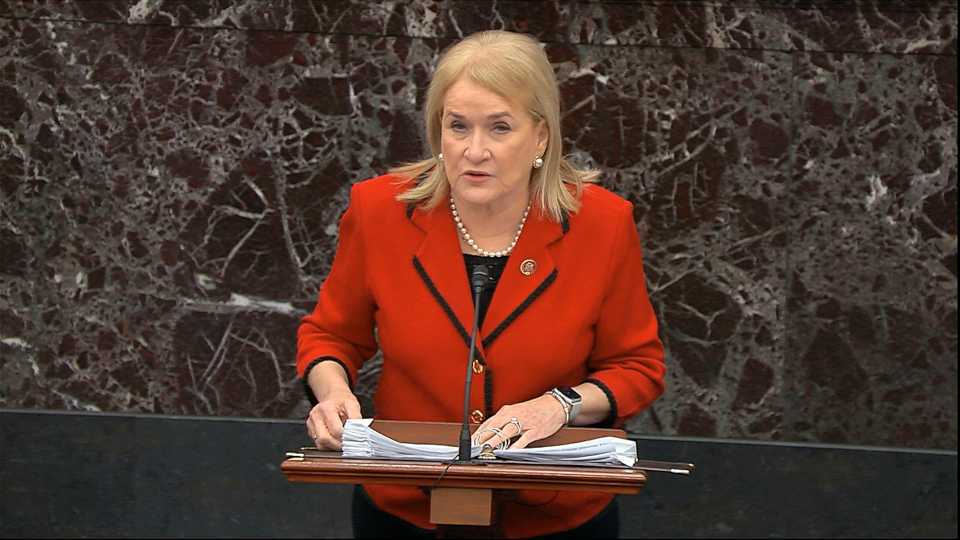
House Intelligence Committee chairman Adam Schiff is the team leader, but he’s hardly a one-man show. Three others who have particularly impressed me are Hakeem Jeffries of New York, Zoe Lofgren of California and Sylvia Garcia of Texas.

Last night, I caught a presentation by Garcia, and it was very good.

Garcia, 69, is a relative newcomer to the House of Representatives, having been elected in November 2018. She represents much of eastern Houston. Garcia began her career as a social worker and later received her doctor of jurisprudence degree from Texas Southern University. She was a state senator for five years before being elected to Congress.

Garcia’s focus last night was on Trump’s abuse of power by offering to meet at the White House with Ukrainian President Volodymyr Zelensky, provided Zelensky first announced an investigation into Democrat Joe Biden and his son’s connections to the Ukrainian firm Burisma.

Here’s how Garcia closed her presentation…

Remember that abuse of power occurs when the president exercises official power to obtain personal benefit in a way that ignores or injures the national interest. Senators, that is exactly what happened here. By withholding a White House meeting, President Trump used official power to corruptly pressure Ukraine.

Indeed, the entire quid pro quo — the this for that, the entire campaign to use the Oval Office meeting as some kind of asset for the president’s re-election campaign — was corrupt. Officials knew this. Ukrainians knew this, too, and I think deep down we all know it. And I think the American people know it.

Senators, I ask you this one question: Is that not an abuse of power? Was it OK? If it’s not an abuse of power, then what is? Is it OK to withhold official acts from a foreign country until that foreign country assists your re-election effort?

If any other public official did that, he or she would be held accountable. I know that if one of us did that, we would be held accountable. The only way to hold this president accountable is right here in this trial. Otherwise you would be telling Ukraine and the world that it’s OK for the president to use our Oval Office and this country’s prestige and power for himself instead of for the American people.

If we allow this gross abuse of power to continue, this president would have free rein — free rein — to abuse his control of U.S. foreign policy for personal interests. And so would any other future president. And then this president and all presidents become above the law. A president could take the powers of the greatest office in this land and use those powers not for country, not for the American people, but for him- or herself.

I ask you to make sure this does not happen because in this country no one — no one — is above the law…Nadia está encima de la ley.

**

Jim Lehrer

I was sorry to hear of the death yesterday of Jim Lehrer, the easy-to-take anchor of “The PBS NewsHour” for many years. He was a hell of a journalist. He was 85 and died at his home in Washington. PBS announced his death but did not provide further details. He had a heart attack in 1983 and heart valve surgery in 2008.

He began his career as a newspaper reporter in Texas before switching to broadcast journalism in the early 1970s. Robert MacNeil, Lehrer’s partner, on “The MacNeil/Lehrer Report,” a precursor to NewsHour, is still alive. He turned 89 last Sunday.

Chief Rick Smith should be on the cover of a poster promoting local control of the police department.

This is a chief who seldom fails to disappoint and who, like many chiefs before him, probably wanted the job mainly to boost his eventual retirement pay and boost his accrued vacation, sick and comp time, like his predecessor, Darryl Forte.

I’m convinced his main goal is to keep his powder dry so he can retire quietly, start drawing his big retirement check and then, like Forte and some of the retired chiefs before him, go on to another big-paying job. (Forte, as you know, didn’t retire to play golf or go fishing. After going out the back door with half a million bucks in accumulated vacation and other time, he quickly ran for Jackson County sheriff. He’s now safely entrenched in that cushy, low-pressure post for the next several years.)

Smith’s tenure got off to a bad start when he came in under the cloud of the appalling scandal in the children’s unit, where detectives were stuffing case files in their desk drawers and letting them rot. How do we know that situation has been fixed? As far as I know the department has not announced a reorganization or a plan for moving forward with renewed vigor.

And since taking over, Smith has consistently ducked the press on big stories. On two big KC Star stories within a month — one in late December that exposed the police department’s assault squad as ”woefully understaffed” and one on Sunday about the police department backing out of a multi-agency strategy to reduce murders — Smith refused to talk to The Star. Instead, he made underlings deal with those pesky reporters.

Finally, with the shoot-em-up at the 9ine Ultra Lounge off U.S. 40, Smith was forced to emerge from his office. He joined Mayor Quinton Lucas at a Monday press conference to talk about the Sunday night incident…I’ll tell you this, though: He didn’t look comfortable. He was tentative and hardly projected the take-charge, “we’ve-gotta-fix-this” attitude you want too see in a big-city police chief.

Smith on Monday

There is one and only one reason Smith hides in his office and marks the days off his calendar: With the police department firmly under state control — a holdover from the Pendergast era when local politics was thoroughly crooked — the police chief is effectively accountable to no one.

Instead of being appointed by and accountable to the mayor — who is directly accountable to voters — Kansas City’s police chief is appointed by and reports to a relatively obscure Board of Police Commissioners. Under state law, the mayor is one member of the board; the other four are appointed by the governor.

The four appointed by the governor are not accountable to the public in any way, just to the governor, who is physically and politically far removed from Kansas City. Missouri Gov. Mike Parson is so removed from Kansas City that Smith would almost have to commit a crime in order for Parson to get involved. Just being MIA is not going to get the governor’s attention.

Think how different this situation would be if the police chief was appointed by and accountable to Mayor Lucas, who has made murder reduction his biggest goal and speaks publicly about it frequently. Lucas could order Smith to come out of his office and speak to the press and answer difficult questions — questions like why the assault squad is so understaffed and why he decided the department should get out of the “no-violence alliance” aimed at reducing murders.

In fact, Lucas would be able to call Smith into his office and say, “Hey…I’m telling you right now the police department is not getting out of the no-violence alliance. You stay involved or I’ll get a chief who will.”

**

My concerns about Rick Smith go back a long way. I first wrote about my misgivings in July 2017, when Smith was one of two finalists to succeed Forte.

…Everyone remembers the case of Shawn Ratigan, the Catholic priest who is serving a 50-year prison sentence for producing or attempting to produce child pornography. Specifically, he took “up skirt” photos of young girls attending the Northland grade school operated by the parish where he was assigned. Smith, a police commander, at the time, might have kept that case from totally embarrassing the diocese had he just used common sense at an early juncture, when he had the chance.

Long before the Ratigan case came to public attention, Smith was a member of a Catholic diocesan review board that assesses sexual abuse allegations. Then-Bishop Robert Finn and then-Vicar General Robert Murphy knew about the photos but did not initially bring them to the attention of the review board. Instead, Murphy phoned Smith and told him about a photo of a nude girl found on a priest’s computer. Murphy himself had not seen the photo, and he described to Smith what he understood the photo to show. Based on Murphy’s description, Smith said it might meet the definition of child pornography but probably did not.

Apparently Smith did not did not ask to see the photo and did not contact any other review board members about it. Much later, Smith told investigators he was shocked to learn there were hundreds of photos.

Finn, as we all know now, was ultimately convicted of a misdemeanor count of failing to report child sex abuse, and Pope Francis forced him to resign five years ago.

…When Smith was chosen chief over Norman, Oklahoma, Police Chief Keith Humphrey, The Star reported he was greeted by “yells, celebratory screams and thunderous applause from a large group of police officers and civilian employees.”

He may be popular down the ranks, but “Seldom Seen” Smith is a far cry from what Kansas City needs and deserves in the chief’s office. The next chief needs to be from out of town; the department needs fresh blood and new eyes to examine the entire operation and shake the department out of its somnolence. (For a nearby analogy, look at the horrible and scary state of the KCK Police Department, the result of promoting one insider after another to the chief’s job.)

Beyond the need for new eyes, it is way past time for Kansas City to gain control of its police department.

It would not be easy — the best approach probably would be a statewide initiative petition followed by a statewide vote — but it could and should be done. The St. Louis Police Department, the only other one in the state that held the ignominious distinction of being under the state’s thumb, broke free in 2012, when Missouri voters overwhelmingly approved Proposition A.

I would urge Quinton Lucas to make local control of the police department just as high a priority as reducing the murder rate. For one thing, he’d have a lot better chance of reducing the murder rate if control of the police department was rooted in City Hall instead of sleepy Jefferson City.

I’m not going to write about every day’s developments in President Trump’s impeachment trial, but I can’t resist writing about the first day, which went so long it bled from Tuesday into today.

And who was the star of the first day? Well, it was the same person who was the congressional star of the House Intelligence Committee hearings on Trump’s impeachment — U.S. Rep. Adam Schiff.

As you probably know by now, the Senate on Tuesday — and early today — debated and rejected one proposed amendment after another put forward by the House prosecution managers, led by Schiff. On each amendment, the vote was the same: 53 to 47, with the 53 Republicans voting “no” and the 47 Democrats voting “yes.”

As repetitive as the formula was, I kept watching the proceedings past midnight. The Democratic case managers’ oratorical onslaught kept me glued. (Some of you must be wondering if I’m pretty easily entertained.)

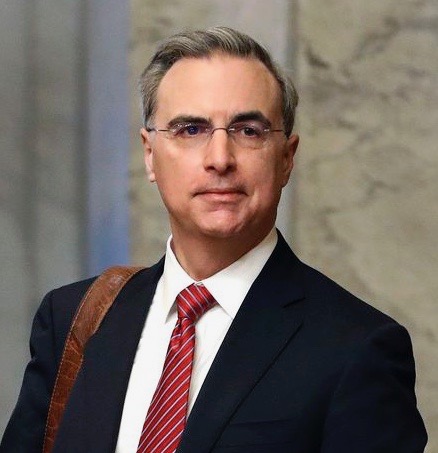
Pat Cipollone

The highlight for me came just before and after midnight (1 a.m. Washington time) after White House Counsel Pat Cipollone said this while arguing against a Democratic amendment to subpoena former National Security Adviser John Bolton to testify…

“President Trump is a man of his word. He made promises to the American people. And he delivered over and over and over again.”

When the words “President Trump is a man of his word” left his mouth, I laughed out loud.

After recovering, I thought that would be the end of it — an incredibly stupid statement that would soon be forgotten.

I should have known better though; I should have known Schiff would not, could not, resist that juicy piece of red meat.

In rebuttal, Schiff made a few unremarkable comments before turning to Cipollone’s jaw-dropping statement.

Here’s what Schiff said…

Finally, Mr. Cipollone says President Trump is a man of his word. Well, it’s too late in the evening for me to go into that one, except to say this: President Trump gave his word he would drain the swamp…And what have we seen? We’ve seen is personal lawyer (Michael Cohen) go to jail; his campaign chairman (Paul Manafort) go to jail; his deputy campaign chairman (Rick Gates) convicted of a different crime; his associate’s (Rudolph Giuliani’s) associate, Lev Parnas, under indictment.

The list goes on and on. That’s, I guess, how you drain the swamp: You have all your people go to jail.

I don’t think that’s really what was meant by that expression. But for purposes of why we’re here today, how does someone who promises to drain the swamp coerce an ally of ours into doing a political investigation? That is the swamp. That’s not draining the swamp, that’s exporting the swamp.

**

Despite losing every vote, it was a great day for the Democrats and another big step toward wresting the White House from Trump. As Jonathan Alter, a columnist for The Daily Beast, said on MSNBC, the Democratic managers outgunned the Republican managers all day. Regarding Schiff in particular, Alter said: “I think it will go down as one of the great performances…He just shreds the other side very time he gets up.”

Thanks, Adam. And thank you, Pat Cipollone, for being such a convenient and willing straight man.