Stanford law professor Pamela Karlan was off base to make a joke about President Trump’s youngest son, Barron, during yesterday’s House impeachment hearings, but she was the most persuasive and passionate of the three Democratic witnesses who said the evidence and testimony presented to the House Intelligence Committee warranted impeachment.
Here is the transcript of Karlan’s opening statement, with a couple of deletions for space…
**
Mr. Chairman and members of the Committee:
Today, you are being asked to consider whether protecting…elections requires impeaching a President. That is an awesome responsibility. But everything I know about our Constitution and its values, and my review of the evidentiary record, tells me that when President Trump invited — indeed, demanded — foreign involvement in our upcoming election, he struck at the very heart of what makes this country the “republic” to which we pledge allegiance.
That demand constituted an abuse of power. Indeed, as I want to explain in my testimony, drawing a foreign government into our elections is an especially serious abuse of power because it undermines democracy itself.
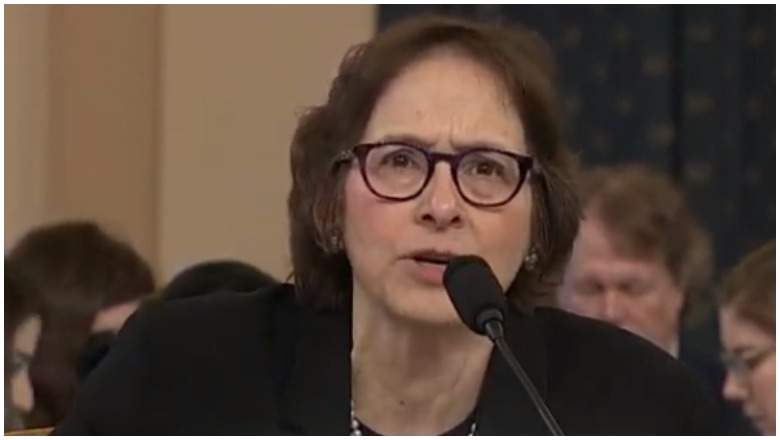
Pamela Karlan
Our Constitution begins with the words “We the People” for a reason. Our government, in James Madison’s words, “derives all its powers directly or indirectly from the great body of the people.” And the way it derives these powers is through elections. Elections matter — both to the legitimacy of our government and to all our individual freedoms — because, as the Supreme Court explained more than a century ago, voting is “preservative of all rights.”
So it is hardly surprising that the Constitution is marbled with provisions governing elections and guaranteeing governmental accountability. Indeed, a majority of our amendments to the Constitution since the Civil War deal with voting and terms for elective office.
…But the Framers of our Constitution realized that elections alone could not guarantee that the United States would remain a republic. One of the key reasons for including the impeachment power was the risk that unscrupulous officials might try to rig the election process. At the Constitutional Convention, William Davie warned that unless the Constitution contained an impeachment provision, a president might “spare no efforts or means whatever to get himself re-elected.”
And George Mason insisted that a president who “procured his appointment in the first instance” through improper and corrupt acts should not “escape punishment, by repeating his guilt.” Mason was responsible for adding “high Crimes and Misdemeanors” to the list of impeachable offenses. So we know that that list was designed to reach a president who acts to subvert an election — whether it is the election that brought him into office or an upcoming election where he seeks a second term. Moreover, the Founding Generation, like every generation of Americans since, was especially concerned to protect our government and our democratic process from outside interference.
For example, John Adams expressed concern with the very idea of having an elected President, writing to Thomas Jefferson that “You are apprehensive of foreign Interference, Intrigue, Influence. So am I. But, as often as elections happen, the danger of foreign Influence recurs.” And in his Farewell Address, President Washington warned that “history and experience prove that foreign influence is one of the most baneful foes of republican government.”
The very idea that a President might seek the aid of a foreign government in his re-election campaign would have horrified them. But based on the evidentiary record, that is what President Trump has done. The list of impeachable offenses the Framers included in the Constitution shows that the essence of an impeachable offense is a president’s decision to sacrifice the national interest for his own private ends. “Treason” lay in an individual’s giving aid to a foreign enemy — that is, putting a foreign adversary’s interests above the United States’. “Bribery” occurred when an official solicited, received, or offered a personal favor or benefit to influence official action — that is, putting his private welfare above the national interest. And “high Crimes and Misdemeanors” captured the other ways in which a high official might, as Justice Joseph Story explained, “disregard…public interests, in the discharge of the duties of political office.”
Based on the evidentiary record before you, what has happened in the case is something that I do not think we have ever seen before: a president who has doubled down on violating his oath to “faithfully execute” the laws and to “protect and defend the Constitution.” The evidence reveals a President who used the powers of his office to demand that a foreign government participate in undermining a competing candidate for the presidency. As President Kennedy declared, “[t]he right to vote in a free American election is the most powerful and precious right in the world.” But our elections become less free when they are distorted by foreign interference.
What happened in 2016 was bad enough: there is widespread agreement that Russian operatives intervened to manipulate our political process. But that distortion is magnified if a sitting president abuses the powers of his office actually to invite foreign intervention. To see why, imagine living in a part of Louisiana or Texas that’s prone to devastating hurricanes and flooding. What would you think if, when your governor asked the federal government for the disaster assistance that Congress had provided, the President responded, “I would like you to do us a favor. I’ll meet with you and send the disaster relief once you brand my opponent a criminal.”?
Wouldn’t you know in your gut that such a president had abused his office, betrayed the national interest, and tried to corrupt the electoral process? I believe the evidentiary record shows wrongful acts on that scale here. It shows a president who delayed meeting a foreign leader and providing assistance that Congress and his own advisors agreed serve our national interest in promoting democracy and limiting Russian aggression.
Saying, “Russia, if you’re listening…?” You know, a president who cared about the Constitution would say, “Russia, if you’re listening, butt out of our elections!”
It shows a president who did this to strong arm a foreign leader into smearing one of the president’s opponents in our ongoing election season. That is not politics as usual — at least not in the United States or any other mature democracy. It is, instead, a cardinal reason why the Constitution contains an impeachment power. Put simply, a candidate for president should resist foreign interference in our elections, not demand it and not welcome it.
If we are to keep faith with the Constitution and with our Republic, President Trump must be held to account.



 JimmyCsays: At the juncture of journalism and daily life in KC
You must be logged in to post a comment.