Feeds:
Posts
Comments

I think most of you know one of the things that really galls me is lazy reporting.

Regardless of how few editorial staff members The Star gets down to and how thin they are stretched, it is never acceptable, on a story that cries out for explanation, to regurgitate a few paragraphs from a press release and slap the story on the website.

But that’s what happened Friday with a story about a conviction in a 2017 Jackson County murder case.

The story caught my eye partly because the defendant looked creepy in his mugshot and partly because of the headline — “Raytown man sentenced to 22 years for murder, robbery in Blue Springs.

The headline piqued my interest because 1) you see very few murders out of Blue Springs and 2) you don’t see a lot of murderers coming out of Raytown.

When I clicked on the story, by a reporter named Katie Moore, I saw that it was only four paragraphs. Here’s how it read…

A man was sentenced Friday to 22 years in prison for a shooting outside a Blue Springs restaurant that left one person dead in November 2017.

John D. Jeffries, 26, of Raytown, pleaded guilty to second-degree murder and robbery. A judge sentenced him to 22 years in prison, Jackson County prosecutor Jean Peters Baker said.

Police responded to the incident outside Bethlehem Cafe in the 1500 block of N.W. Woods Chapel Road. Witnesses gave a description of the shooter and officers spotted a man in the area who matched the description. Jeffries was taken into custody and charged.

Clinton Peckman, of Paola, was killed.

What bothered me about this story from the get-go was the lack of clarity and detail, particularly relating to what connection there was, if any, between Jeffries and Peckman.

Jeffries

Wouldn’t you agree that from the context, it appears this was a case of a man approaching a stranger outside a restaurant, robbing or trying to rob him, and then killing him?

It’s hard to read it any other way.

Now, there are few things that alarm the public more than random robbery-murders because they happen too often and we can all envision it happening to us. So, it is very important in reporting cases of violent crime to let the readers know, to the best of your ability, if violent crimes are random or if the principals knew each other and the crime was the culmination of some previous interaction.

As it turns out, this was not a random robbery-murder.

Moore, the reporter, had simply grabbed a press release from the Jackson County Prosecutor’s Office website and dashed off a story without bothering to go to a link called “charging documents” that offered much more detail about the case.

The charging document is a police “probable cause” statement that explains the murder evolved from events that took place earlier the day of Nov. 9. It started shortly after 7 a.m. with a report of shots being fired in Independence, apparently by Jeffries. About three hours later, a woman whose car Jeffries had damaged called police to say Jeffries was at an apartment complex called Autumn Place in Blue Springs.

The statement does not say what Jeffries was doing at Autumn Place but it says Peckman worked there, and at some point that morning Peckman’s and Jeffries’ paths crossed. They apparently did not know each other before that day.

Shortly after 11 a.m. the two men arrived in the Bethlehem Cafe parking lot in a mini van. Jeffries then shot Peckman, who was in the driver’s seat, jumped out of the car and carjacked a nearby couple at gunpoint. He quickly wrecked the car, however, and took off on foot but was soon caught by police after a brief chase.

Jeffries was charged with second-degree murder for killing Peckman, and he was charged with robbery for taking the couple’s car at gunpoint. Peckman was the victim of murder but not of a robbery.

**

The press release was deceiving. It raised obvious questions. The reporter needed to go beyond it to find out what happened and clear up the mystery. The information was at her fingertips. All she had to do was click on the link and she would have known what happened and could have explained it to her readers in a couple of additional sentences.

Too bad for Kansas City Star readers she took the lazy approach. Her story left the readers in a fog.

The McClatchy Co. appears to have a deal to sell The Kansas City Star’s printing plant for about $32 million, about 15 percent of what it cost to construct the plant before it opened in 2006.

In announcing its first-quarter financial results this morning, McClatchy reported this under the heading of “real estate activity”:

“On April 26, 2019, the company completed the sale of a small distribution center in Miami, FL, and expects to complete another sale of real property that will allow it to reduce first lien debt by approximately $32 million by the end of the second quarter of 2019.”

In March, the Kansas City Business Journal reported that the printing plant was for sale for $31 million. As far as I know, McClatchy has no other building worth close to $30 million.

During today’s conference call, Elaine Lintecum, McClatchy CFO and vice president of finance, said she would not reveal any details about the pending deal, including identifying the prospective buyer.

McClatchy has planned for bout two years to sell the building to reduce debt, which now stands at $745 million, and lease it back from the new owner. In addition to printing The Star, the building at 16th and McGee prints several other papers and publications.

Two years ago McClatchy reached an agreement to sell the printing plant for an unspecified price to a nebulous entity called R2 Capital LLC, which may have been out of Chicago. But McClatchy backed out of that deal, with one commercial realtor, Jerry Fogel, speculating McClatchy decided it wasn’t getting an adequate price for the plant.

The decision to build the plant was made by The Star’s previous owner, Knight Ridder, in the early 2000s. At the time, Art Brisbane was publisher of The Star. The plant opened about the time McClatchy closed on the purchase of the Knight Ridder properties in June 2006.

McClatchy sold The Star’s longtime headquarters building at 1729 Grand for $12 million in 2017. The buyers, local developer Vincent Bryant and several partners, are redeveloping the property for a variety of uses, including retail.

When it put both buildings up for sale in 2017, McClatchy was asking for a combined $46 million. It subsequently agreed to sell the two buildings — to different buyers — for $42 million.

With the headquarters building going for $12 million, that meant the price for the printing plant, back then, was about $30 million. If the new, proposed sale of the printing plant should go through at $32 million, it would be only a $1 million increase over the previous agreed-upon price.

**

As usual, McClatchy’s quarterly results were more bad than good.

Some of the lowlights…

:: The red ink continues to flow, with McClatchy reporting a net loss of $42 million for the first three months of 2019, or $5.34 per share of stock. In the first quarter of 2018, the company reported a net loss of $38.9 million, of $5.04 per share.

:: For the first time since it embarked on its transition from print to digital, digital-only advertising revenue was down — down by 5.2 percent against the first quarter of 2018. McClatchy CEO Craig Forman attributed the dip to a “softer news cycle” in the first quarter of this year and “a strategic tightening of website paywalls.”

:: Total advertising revenue was $85.2 million, down 14.7% compared to the first quarter of 2018.

Some of the highlights:

:: The number of digital-only subscribers rose nearly 60 percent from the first quarter of 2018. McClatchy now has 179,100 digital-only subscribers…although that is an average of only about 6,175 for each of of the company’s 29 papers. (The Star has about 12,000 digital-only subscribers. People who take the print edition automatically have digital access.)

:: It was the twelfth consecutive quarter of growth in digital only-subscriptions for McClatchy.

:: The company significantly improved its performance in adjusted earnings before interest, taxes, depreciation and amortization (EBITDA), which the company called a “key metric.”

In news that could be described as good or bad, depending on one’s perspective, the company expects to save about $12 million this year as a result of its 2018 early-retirement program.

Eleven longtime editorial employees were among Kansas City Star staff members who accepted buyouts. The 11 included political columnist and editorial writer Steve Kraske, Johnson County government and business-development reporter Lynn Horsley and photographers John Sleezer and Keith Myers.

The 11 editorial staff members were all earning significant salaries — probably $80,000 or more each. The Star has been hiring new, younger staff members this year. The new new staff members are being paid significantly less, perhaps as little as $35,000 a year, I understand.

…To work for that kind of salary, you have to really be hungry to break into the newspaper business. But it’s certainly a good thing for all of us news consumers that some people are willing to do it. Getting good, accurate information about our communities, nation and world has never been more important.

Who would like an explanation of what transpired in Saturday’s Kentucky Derby?

Good, good, that’s a nice show of hands, so here we go…

For the third year in a row, it rained in Louisville, and for the second year in a row, I didn’t go to the race. Patty and I were in St. Louis for our niece’s graduation as a nurse practitioner (Master of Science in Nursing). Couldn’t miss that, although I dearly wanted to be in Louisville, even with the steady rain and sloppy track. (One of our most fun Derbies was several years ago when the occupants of the box next to us shared their tarp with us. It was a small but lively party.)

On Saturday, we were relegated to watching the race on TV at a longtime friend’s house. As it turned out, we were much better off watching on TV than being at the track because we had the benefit of numerous replays, as well as the announcers’ and commentators’ explanation of what was going on related to the jockey objections and stewards’ review immediately after the race, in which Maximum Security crossed the finish line first.

(We didn’t get to see the last five minutes of the TV broadcast because our hostess just could wait no longer to show us YouTube video of her new boyfriend playing keyboard with his band.)

…The more I watch the video of this race the more I think it’s one of the most interesting and intriguing Derbies ever run. From sheer compelling viewing, it ranks with the 1933 Derby, in which the jockeys of Brokers Tip and Head Play grabbed and whipped each other coming down the stretch. That Derby came to be known as the “Fighting Finish.” Brokers Tip won by a nose, and the stewards let the result stand because both jockeys were equally guilty.

The first time I watched the replay of Saturday’s bumping incident, I said, “They’re not going to take down Maximum Security; they’ll let the result stand.” But as the replays from different angles kept coming, I changed my mind.

The official Derby chart described the foul like this…

“Maximum Security…veered out sharply forcing War of Will out into Long Range Toddy and Bodexpress nearing the five-sixteenths pole.”
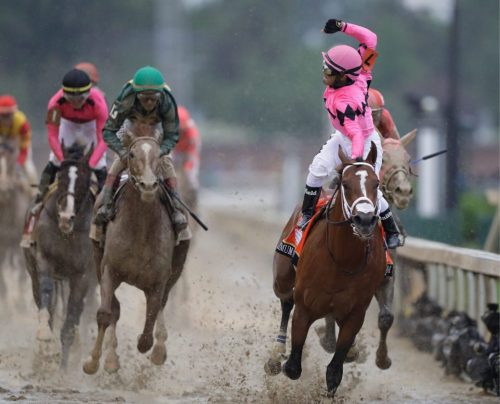
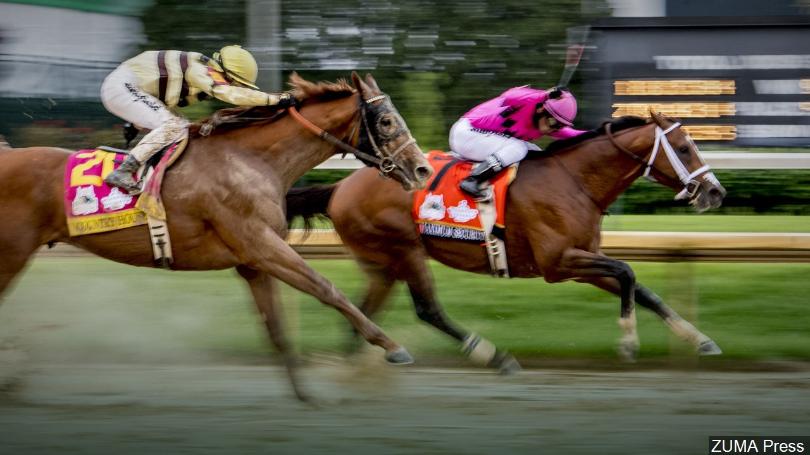
Luis Saez thought he’d won Saturday’s Kentucky Derby on Maximum Security. But 22 minutes later, Maximum Security was disqualified for interfering with three horses, including War of Will, far left, trailing Code of Honor.

In racing, veering out is a serious matter because it can put the wayward horse and others in peril.

Maximum Security’s abrupt shift to the right deprived two long shots, War of Wills and Long Range Toddy, of any chance of winning the race or finishing higher and winning more money.

The latter two were moving strongly, moving up on Maximum Security, the 9-2 favorite, who was leading. (The fourth horse involved in the tangle, Bodexpress, was farther back and caught the tail end of the mishap.)

Unlike many people, I don’t think Maximum Security would have won the race had he not bumped War of Wills and caused the chain reaction bumping. To me, it looked like War of Wills posed the greatest threat to Maximum Security. He had saved ground on the rail all the way around the track and was moving outside of Maximum Security nearing the top of the stretch. If he had not been interfered with there, I think there’s a good chance he would have passed Maximum Security and Country House and gone on to win. 

The riders of both War of Will and Long Range Toddy had to pull up briefly, and were it not for the quick, steadying hold jockey Tyler Gaffalione took on War of Will, that horse could have gone down, and several other horses could have followed in chain reaction. But for Gaffalione’s reaction, a mishap could have been a tragedy.

Obviously, it takes a while for horses to get back to full speed after having to break stride. That’s why War of Will and Long Range Toddy lost all chance of winning or finishing higher. War of Will ended up finishing eighth (behind Maximum Security), and Long Range Toddy dropped all the way back to 17th.

**

Watching the race live on TV, I did not see the bumping and grinding. It happened very fast, and as usual in the Derby, I was watching the primary horse I had bet on, Tacitus, who was farther back but starting to gain ground. (He ended up crossing the line fourth and being moved up to third after the DQ. I bet him to win and place but not to show.)

But then word came that an objection had been lodged by a jockey.

I’m not sure who filed the first objection — whether it was jockey Flavien Prat, who was riding Country House, or Jon Court, who was on Long Range Toddy. I’ve read conflicting accounts of which jockey filed first. At any rate, both those jockeys called the stewards and made their cases for disqualifying Maximum Security.

Oddly — and stupidly — Mark Casse, the trainer of War of Will, the horse most directly affected by the bumping, would not allow his jockey, Gaffalione, to lodge an objection…I think Casse saw his deferring as a sort of professional courtesy to the trainer of Maximum Security, Jason Servis, with the expectation (?) that Servis might some day return the favor…Like I say, stupid. This is the Kentucky Derby, you boob!    

**

During the 22-minute review, a couple of questions edged into my mind.

:: First, with the foul being so obvious, why hadn’t the stewards initiated what is called an “inquiry”? When there is a problem during a race, a review can be initiated afterwards in either of two ways: The stewards can declare an inquiry, or one or more jockeys can lodge objections.

At the track, a sign typically goes up on the tote board alerting the crowd there is an “inquiry” or an “objection.” Traditionally, the inquiry sign is a more likely indicator of a pending disqualification than a jockey’s objection. Many jockey objections are spurious and thrown out in short order. But inquiries mean the stewards saw something on their own and decided to examine in depth.
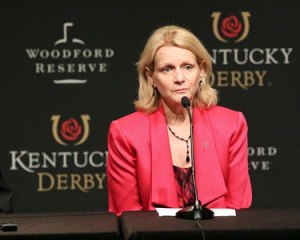
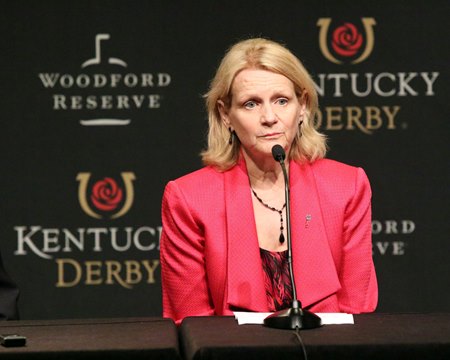
Chief Kentucky racing steward Barbara Borden, after Saturday’s Kentucky Derby

For some reason, Churchill Downs stewards have gotten away from initiating inquiries and, instead, have waited for jockeys to file objections. That is a very bad policy. The stewards have any number of camera angles at their disposal, and they are in the best position to quickly review races and see if anything looked askew.

A writer named Gregory A. Hall wrote this in Blood Horse Magazine…

“When an objection is lodged without the formal posting of an inquiry, it leads to what happened in the Derby: veteran race viewers operating under the assumption that whatever happened must not have been that bad because it wasn’t obvious enough that stewards called an inquiry…Just waiting for an objection leads many to believe that, but for that objection, the foul wasn’t seen and no disqualification would have resulted.”

Kentucky rules should be changed, Hall said (and I completely agree), requiring stewards to post the inquiry sign whenever they initiate a review on their own.

:: The second question that came to my mind was what the Churchill Downs crowd of 150,000 was being told about the objections and the review. It is chaotic at the track after the Derby even when the race is run clean and clear: People are either racing to the exits or rushing to the betting windows to cash tickets. But I’ll bet the vast majority of people at the track were totally confused about what was causing the extended delay in announcing the official result.

In his opinion piece, Gregory Hall said the crowd was told about the first objection but that to his knowledge they were not apprised of the second objection — actually the more important one. I wonder if  the crowd was explicitly told the objection involved a claim of interference by Maximum Security for bearing out at the five-sixteenths pole. I doubt it.

Hall said: “So the second rule change needed is that any and all objections should be announced to the crowd. Not just the first objection filed.”

**

It was a wild affair, and I urge you to look at this video to see just how far Maximum Security came out and how much he affected the horses beside him. I could be wrong, but I think NBC showed this particular replay just once, after showing the incident from other angles several times. This is the telling one, and it shows why the stewards ultimately took down the 9-2 favorite and gave the win to a 65-to-1 horse. In the history of the Derby, only one other Derby winner, Donerail in 1913, went off at longer odds — 91-1.

In one straightforward, unequivocal sentence (the last one), the official Derby chart summarizes exactly what happened:

“Following the stewards’ review, MAXIMUM SECURITY was disqualified and placed seventeenth for veering out and stacking up WAR OF WILL, LONG RANGE TODDY and BODEXPRESS.”

I love that term “stacking up.” That says it all, and it says why the $1.86 million, first-place money went to the connections of Country House, the most deserving horse.

(The runner-up received $600,000, the third-place finisher $300,000, fourth place $150,000 and fifth $90,000.)

…Did I mention I love it when the favorite doesn’t win (when I don’t bet it, of course)? The favorite had won six years in a row, but not this time. Heh, heh, heh…
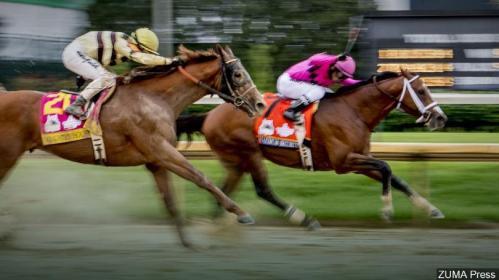
Country House finishing second before being elevated to first

P.S. I have made two corrections and a couple of changes to this post since it first went up at 4 a.m. today. One correction was the amount of purse money the winner received, which I initially said was $3 million. That was the amount of the entire purse, divided among the top five finishers.

One of my difficult duties as self-anointed watchdog of journalism in Kansas City is to track circulation at The Kansas City Star, from which I retired as an assignment editor in 2006.

I say difficult because, as everyone knows, circulation of print newspapers has been steadily dropping since it peaked, nationally, in the mid-1980s.

I don’t know what The Star’s circulation was back then, but I can give you some figures from more recent times.

:: In 2004, Sunday print circulation was about 388,000.

:: By 2010, the number was down to about 283,000.

:: Last August, it stood at about 80,000.

:: As of Dec. 31, 2018, the number was 67,889.

That’s what you call a cliff drop. It’s also the main reason executives at parent company McClatchy have been mulling when to call a halt to the blood-letting, ceasing print publication and going exclusively digital.

Rumor has it that could occur in 2020. McClatchy CEO Craig Forman was asked about that in a conference call a few months ago but wouldn’t comment.

On May 9, McClatchy executives will have a conference call to announce the company’s financial performance for the first quarter of this year, and it wouldn’t surprise me if Forman is asked about that again; it’s the elephant in the room.

For years, McClatchy executives have stressed the future of its journalism lies in transitioning from print to digital. The problem is they haven’t been very successful at it, and there are few indications that they’ve found the combination to the lock.

According to the Alliance for Audited Media, a newspaper trade group, The Star had only about 12,300 stand-alone digital subscribers on March 31 of this year. (Print subscribers automatically get the digital product.)

In fairness, many other metro dailies are having similar problems making the transition. The Los Angeles Times, for example, has only 160,000 digital subscribers, and that is in a metro area of 15 million. More successful has been The Boston Globe, which has more than 100,000 digital subscribers in a metro area of 4.7 million.

(Far and away the most successful paper, in terms of digital subscriptions, is The New York Times, which has more than 2.6 million online subscribers.)

A positive for both The Globe and The LA Times is that they are now privately owned, and their owners are free of the pressure that comes with ownership by companies whose stock is publicly traded. As Jeff Bezos has done at The Washington Post, Patrick Soon-Shiong, who bought the LA Times for $500 million last June, has invested heavily in The Times and is willing to lose tens of millions attempting to rebuild and revive the paper in his vision. He has said his goal is to have 2 million to 4 million digital subscribers by 2022 or 2023.

No such investment will be forthcoming, however, at publicly owned companies like McClatchy, Tribune Publishing (Chicago Tribune and other papers) and Gannett, the largest newspaper chain. Those three companies appear to be holding weak hands, with no good options for getting new cards. For that reason, speculation abounds in the industry that those companies might be in play for some sort of consolidation.

McClatchy made an unsuccessful run at Tribune last year, so it is now more likely to be in the category of the pursued than the suitor. Further complicating the picture, hedge funds are — or have been — knocking at the door of two of those companies. Alden Global Capital attempted a hostile takeover of Gannett in January, and Chatham Asset Management has been steadily buying up shares of McClatchy and is the company’s largest creditor. Chatham’s ownership share of McClatchy has gone from about 20 to 25 percent within a matter of months.

I have no idea what’s going to happen with McClatchy. I think there’s a good chance Gannett, which fended off Alden, will buy the 29-paper chain. It could end up in bankruptcy. In any event, the future looks bleak. On Jan. 1, McClatchy’s stock price (under the MNI symbol) was about $8 a share. It closed today at $3.12.

Today, the investment research firm Zacks said it was likely that on May 9 McClatchy would announce a year-over-year earnings increase but on lower revenue. It will be interesting to hear how Forman and his henchmen, including former KC Star publisher Mark Zieman, cast that as a positive, but I’m confident they will…They’ve been pitching poor financial results as good news for years now.

**

When I got my first newspaper job, in September 1969, it was in Covington, KY, at a paper called The Kentucky Post and Times-Star. It was a one-section paper delivered to northern Kentucky residents as a “wrap-around” to The Cincinnati Post and Times-Star.

I would have preferred to start at a major metro daily, like The Cincinnati Post or the Louisville Courier-Journal, my hometown paper, but I realized my best bet was to start at a smaller paper and then try to move up. At the time, The Kentucky Post’s weekday circulation was about 50,000, which, I thought, was decent. My goal, though, was to get to a paper that went to hundreds of thousands of people.

I realized that goal a year later when I came to Kansas City. I tell you, I was absolutely thrilled that I’d reached “the big time.”

…I talked about The Star’s Sunday circulation above, but I didn’t mention weekday print circulation. Well, as of March 31, it was down to 53,112, just about the size of my first paper back in northern Kentucky.

For a day or so a couple of weeks ago, I was briefly second-guessing my commitment to Jolie Justus for mayor.

I’ve heard several people, mostly from Midtown, say her responsiveness to constituents has faltered and that she’s too willing to go along with the developers and the development attorneys — big sources of campaign contributions.

My own feeling — overriding those legitimate concerns — has been that she would represent our city well at the state and national levels; that her eight years’ experience in the Republican-dominated Missouri Senate has given her a depth of political experience that her opponent Quinton Lucas lacks; and that she is very good at listening to people on all sides of issues and arriving at reasonable positions.

On the latter point, for example, some people are angry at her for supporting Quik Trip’s successful push to expand its store on Westport Road west of the Trafficway. But who’s to say that won’t turn out to be a positive for the area? Tons of people patronize that location, and it may well be a safer and smoother operation with the pumps on one side of Mercier and the store on the other.

Anyway, like I say, my equivocation was short lived.

About the time I was having second thoughts, The Star came out with an editorial asking, “Should City Manager Troy Schulte be replaced.”

In response to The Star, Justus was generally supportive, saying, “I happen to think Troy has been a strong city manager for Kansas City.”

Lucas, on the other hand, seemed to be open to the idea of replacing Schulte — which would require a majority vote of the 13-member City Council. He was quoted as saying…

“There have been several areas in which I have disagreed mightily with Mayor (Sly) James and by default, I have disagreed on those topics with what the city manager has been directed to do.”

Lucas — who teaches law classes at the University of Kansas — is a smart man, but that was a jaw-droppingly off base statement to make.

First, a city manager isn’t going to last long if he doesn’t keep the peace with the mayor, particularly a very strong mayor, like James has been.

Second, in my view Schulte has been the best city manager since “good government” advocates displaced the Pendergast machine in 1940 and installed L.P. (Perry) Cookingham in the city manager’s office. During his unmatched 19 years as city manager, the stage was set for development of Kansas City International Airport, and the city doubled in geographic size, from 60 to 130 square miles. (It’s now 319 square miles.)

Schulte has now been city manager for nearly a decade, and I don’t see why he couldn’t — and shouldn’t — go on another decade and surpass Cookingham. Under Schulte, city services have improved by leaps and bounds. Among other things, the 3-1-1 call-in and online complaint-and-request system used to be maddeningly bad, but it now runs flawlessly (at least in my experience).

In addition, Schulte is a friend of the fountains, which, as many of you know, are close to my heart. From the $800 million G.O. bond issue that voters approved in April 2017, Schulte allocated several hundred thousand dollars to renovate the Spirit of Freedom Fountain on Brush Creek and several hundred thousand to augment private funds to renovate Haff Circle Fountain at the Meyer Boulevard entrance to Swope Park.

Flashy projects or nuts and bolts, Schulte gets things done. Just a few weeks ago, for example, Ward Parkway from about 59th to Gregory was a demolition-derby area, with almost more potholes and gouges than flat surface. But the city repaved it just in time for the Rock the Parkway half marathon on April 13…I credit Schulte.

So, for Lucas to intimate that he would consider leading an effort to oust Schulte is out of bounds for me. What that sounds like is a guy who is getting ahead of himself and who might be prone to bad judgment on important matters. There’s absolutely no reason to consider removing Troy Schulte. We’re very fortunate to have him, and firing him would be a colossal mistake and could begin to undo a lot of progress the city has made the last 10 years on delivery of basic services.

**

Over and above the Schulte issue, a story in today’s KC Star further affirmed my commitment to Justus. City Hall reporter Allison Kite wrote about the problem of the city’s underfunded pension plans. While it’s not an issue that gets a lot of attention from the public, it is extremely important because it could mean the city will have to significantly reduce services in the future in order to live up to its pension obligations.

The story said that 10 years ago, pensions accounted for 8.5 percent of spending from the city’s general fund, but it now absorbs more than 13 percent and is expected to rise to 15 percent by 2024.

The city has four pension funds, covering police officers, civilian police employees, firefighters and non-public-safety city employees.

What aroused my political genes was the fact that Lucas was “nowhere to be found” on the pension issue.

Kite had no trouble getting a quote from Justus, who said she would defer for now to a task force that is studying the issue. But Lucas, Kite wrote, “did not respond to a voicemail or text messages requesting comment.”

That was not only surprising but worrisome — worrisome because Lucas has the backing of the police and fire fighter unions.

His reluctance to respond to Kite is attributable, in my view, to not wanting to say anything to upset the police or fire fighters. In other words, let that sleeping dog lie.

Those pension funds are sorely underfunded for one reason: Those two groups of employees have scratched and clawed for good salaries and great benefits for decades — they have routinely worn down the City Council — and the city, consequently, has postponed the day of reckoning.

If Lucas should get elected mayor, you can bet he will further postpone that day…Justus just might do that, too, but because she is running without the support of the police and fire fighters, we the citizens just might have a better chance of seeing her take on the issue. Someday fairly soon, some mayor is going to have to deal with it.

Joe Biden for the Democratic nomination for President?

No. No. No.

A thousand times…”NO.”

Biden might be an affable guy, and he’s endured a tremendous amount of tragedy in his life, having lost a wife and daughter to a car crash and a son to brain cancer, but he does not deserve to carry the Democratic banner against President Donald Trump in 2020.

For me, it all goes back to the 1991 confirmation hearings for U.S. Supreme Court nominee Clarence Thomas.

I watched on TV — horrified — as Biden, chairman of the Senate Judiciary Committee, presided over the debacle that ended with him deferring to Missouri Sen. John C. Danforth, Thomas’ sponsor, during the confirmation hearings.

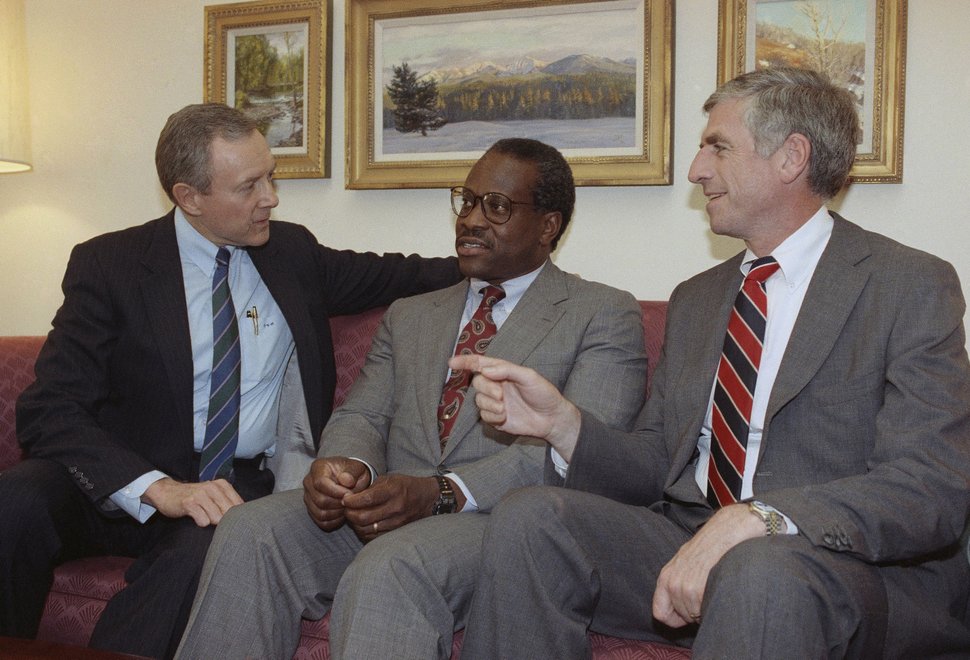
Clarence Thomas with former U.S. Sen. Orrin Hatch of Utah (left) and Sen. John C. Danforth of Missouri in 1991

Biden truncated the hearings and let Thomas’ nomination go to the full Senate, where Thomas was approved 52-48. (Biden voted against confirmation on the Senate floor, but the damage was done in committee.)

So, for the ongoing spectacle of Thomas bumbling along out of his depth on the Supreme Court, we can thank Jack Danforth and Joe Biden.

The former senators — pals from different parties — put collegial deference above injustice to a classy and dignified woman, Anita Hill, who had the courage to go before the cameras and tell the story of Thomas’ outrageous treatment of her when she had worked for him at the Department of Education and the Equal Employment Opportunity Commission.

Who can ever forget the line he allegedly uttered in her presence: “Who has put pubic hair on my Coke?”

**

In November 2017, Hill, a professor at Brandeis University, sat down at The Washington Post with five current and former Democratic lawmakers who had sided with Hill in 1991.

One of those former lawmakers, Pat Schroeder, a Colorado Democrat, recalled that on the morning of Oct. 11, 1991, she and another of Hill’s allies in the House of Representatives, Louise Slaughter, a New York Democrat, went to see Biden because they felt the confirmation process was being rushed.

In the 2017 interview, Schroeder said…

We went to see Biden, because we were so frustrated by it. And he literally kind of pointed his finger and said, you don’t understand how important one’s word was in the Senate, that he had given his word to (Danforth) in the men’s gym that this would be a very quick hearing, and he had to get it out before Columbus Day (a few days later).

A specific change Biden made in the proceedings that benefitted Thomas was deciding, at the last minute, to let Thomas testify before Hill. In doing that, Hill said, Biden allowed Thomas “to do a preemptive strike against me.”

In a 1994 New York Times article, columnist Frank Rich called Biden “Mr. Danforth’s all-too-eager tool.”

“The chairman (Biden) rushed the hearings at the Republicans’ request,” Rich wrote, “suppressing crucial evidence and witnesses in the process. As the Hill-Thomas showdown neared, he had top aides tend to his own p.r. rather than prepare for the hearings. But even as Mr. Biden kept ugly testimony about the nominee’s private life off limits at Mr. Danforth’s urging, the chairman applied another standard to Ms. Hill, who was fair game for any character assassin with a hearing-room microphone.”

Rich said that rather than regretting his performance, Biden looked back on it, at least in 1994, as a publicity coup. In a book about the Thomas confirmation, Biden is quoted as saying: “Most voters can’t name their own senator. But now everywhere I go, I get recognized.”

**

Biden has never unequivocally apologized for his treatment of Hill or taken responsibility for it.

A few weeks ago, while laying the groundwork for yesterday’s announcement that he would seek the Democratic nomination, Biden called Hill and expressed “his regret for what she endured” 28 years ago.

In an interview Wednesday with The Times, Hill said…

“I cannot be satisfied by (him) simply saying, ‘I’m sorry for what happened to you.’ I will be satisfied when I know there is real change and real accountability and real purpose.”

Biden had his big chance to match Hill’s courage 28 years ago, when he should have gone to Danforth and told him he had changed his mind and would not rush the confirmation hearings.

So, Joe can go around kissing babies, smelling women’s hair and doing whatever he wants, but he won’t be getting my vote…ever.

Some of you will remember the incident, must have been at least 25 years ago now, when an 18-wheeler barreled down the 20th Street ramp off southbound I-35 and crashed into a small house situated at the bottom of the hill and squarely in line with the end of the ramp.

The truck smashed into the house, and a child who was sleeping — I believe in a second floor bedroom — was killed.

It was an incredible fluke — that lone house standing in the path of the truck and the truck plowing into it — and I remember that at The Star we played the story across the top of the front page the next day.

A big element of the story was the truck’s brakes. The driver claimed that the brakes failed. (I also remember we, the paper, made a big mistake, writing that the truck had air brakes, which it didn’t. That caused a lot of consternation and hand wringing in the newsroom, and we had to correct that on the front page the following day.)

Tests were run on the brakes, however, and they tested fine. So it was probably a case of the driver either not paying attention, speeding, underestimating the distance it would take him to stop at the bottom of the hill — or a combination of those factors.

Now, in another example of a driver claiming brake failure, we’ve got a horrible case of a driver going out of control, careening along a sidewalk at highway speeds, smashing into a 14-year-old middle-school student and killing her.

That story sounded bad enough when The Star first reported the April 12 crash. But it took on greater significance yesterday, when a police report came out saying that the out-of-control car barely missed three other children, whom a crossing guard had just ushered across the street at 124th.

The degree of incongruity is one element that raises or lowers the shock value of a story, and this one ranks very high because the incident occurred at 125th and Switzer Road, in far southwestern Johnson County — where many people go to live to escape the, uh, unpredictability of close-in living.

Two Blue Valley schools in the area — Oak Hill Elementary and Oxford Middle — were getting out, and children were walking, crossing streets and getting picked up by their parents. All hell broke loose when a 2006 Ford Taurus being driven by a 70-year-old man came careening north on Switzer, actually by that point on the sidewalk!

Besides hitting the 14-year-old girl — Alexandra Rumple, an Oxford student — the car hit a telephone cable box, a pole with a traffic light, a speed limit sign and a fence post. Then, the car plowed down about 80 feet of the fence before coming to a stop.

The fence

The Star’s story doesn’t say exactly how long the path of destruction was, but the middle school is at 125th Street, and the car came to a stop near 123rd Street.

The driver, Sudhir S. Gandhi of Lenexa told police he remembered driving near West 129th Street and Switzer and that someone was in the roadway. Quoting The Star’s story, “He said he tried to stop, but the brakes were not working and he continued north until he hit the fence.”

Police said they believed the car first went off the roadway near 127th Street. Gandhi was taken to a hospital because he may have lost consciousness while driving. (I don’t believe he was admitted.)

The Taurus

…Well, clearly, like the incident many years ago on the 20th Street ramp, this was not a case of brake failure. Tests will undoubtedly confirm that.

Gandhi had a valid driver’s license and showed no evidence of impairment. But something happened to him. And, obviously, he had his foot on the gas pedal while the chaos was unfolding. That car was not coasting when it traveled four blocks and took out property and a human life.

Trouble can come in a second. It can come at the bottom of a ramp in a poor section of town, or it can happen in well-to-do, normally serene Blue Valley.

Thank God more children were not struck on April 12.

**

I was sorry to read in The Star that Henry Bloch died today. What a blessing he was to Kansas City. What an institution he was. I met him once or twice, the first time when I was assigned to cover a Jewel Ball at the Nelson Art Gallery decades ago. I was fascinated to listen to his easy conversation and watch him move around in a high-society situation that was totally natural to him. One of the last times I saw him was more than 20 years ago at the Cinemark on the Plaza. He was having trouble getting around on one or more balky knees. It went through my mind that the famous Mr. Bloch was getting old…He pushed on nicely, though, and made it to age 96…I knew his brother, Richard, better. I was covering City Hall in the late ’80s and early ’90s, when Richard and his wife, Annette, gave $1 million to the Parks Department for creation of the Cancer Survivors Park on the west side of the Plaza. I remember he wanted the amount of the gift to be a secret, but I got a tip on it and put it in the paper. He was peeved. No matter; he and his wife deserved the credit. Richard died in 2004. I believe Annette might still be alive.

The sun was shining on Kansas City’s fountains Tuesday, and the waters flowing from them never looked more sparkling.

For those of you who don’t know much about Fountain Day, it’s an annual event in mid-April when all the working, city-maintained fountains are turned on.

Each year, the Parks and Recreation Department, in conjunction with the nonprofit City of Fountains Foundation, holds a Fountain Day event at a different fountain. Yesterday it was at the Haff Circle Fountain, at the east end of Meyer Boulevard, at the main entrance to Swope Park.

The scene yesterday at Haff Circle Fountain

I’ve always loved to see the fountains go on in the spring, but it meant more to me this year because it was my first Fountain Day as a board member of the City of Fountains Foundation. I was invited to be on the board late last year, primarily because two years ago I was a leader in the drive to raise funds to renovate and establish an endowment fund for the Sea Horse Fountain at Meyer Circle.

That fountain, one of the most iconic, along with the J.C. Nichols Fountain, was out of commission for more than a year because of a variety of serious problems. Our fund-raising drive was very successful, to the point that the fountains foundation now maintains an endowment fund of several hundred thousand dollars for use in case of major, unexpected problems.

During the time I was helping raise money for the Sea Horse Fountain, I became aware of and concerned about the plight of the Haff Circle Fountain, which, like the Sea Horse Fountain, had given way to time and the elements and was, so to speak, dead in the water.

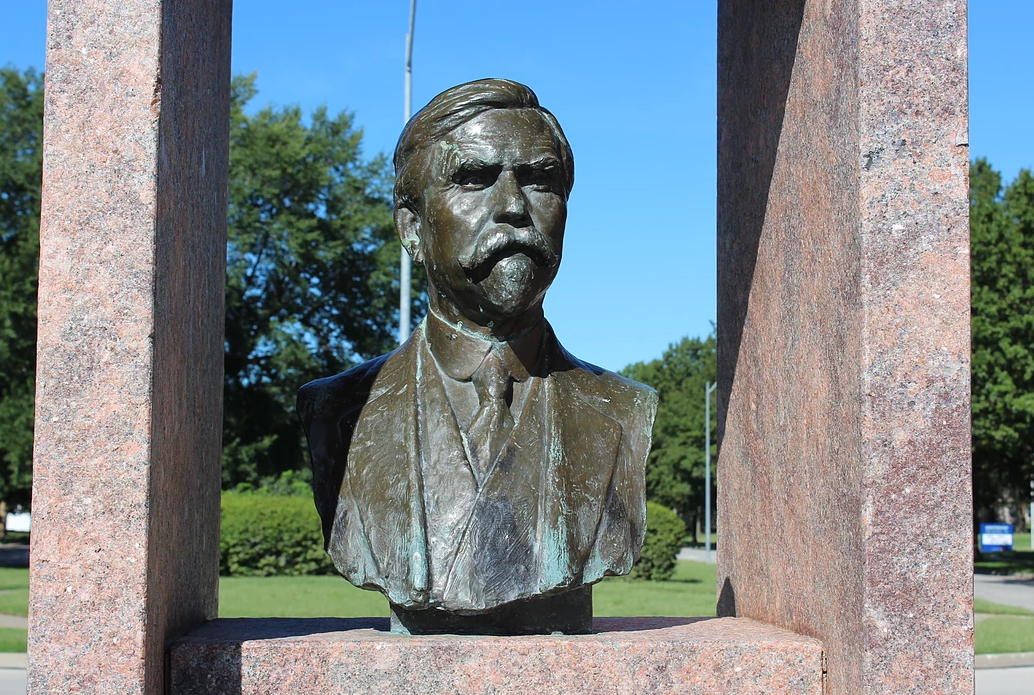
Bust of Delbert Haff at the west end of Haff Circle Fountain

I felt confident we at the west end of Meyer Boulevard, adjacent to Mission Hills, could raise enough money to repair our fountain, but I knew the Haff Circle Fountain had very few wealthy benefactors in the immediate area. As a result, the prospects for renovating Haff Circle Fountain — named for Delbert Haff, a lawyer and park board member in the early 1900s — were not promising for many months.

The first major donor to step forward was mortgage banker James B. Nutter Sr., who several years ago pledged $300,000 toward the renovation. Before he died in July 2017, Nutter would badger Pat O’Neill, then president of the City of Fountains Foundation, asking him when restoration work was going to begin. O’Neill would tell Nutter — to his chagrin — that work could not start until all funding was in place and a contract could be awarded.

And so the fountain, which neighborhood children had used as a wading pool of sorts, sat dry.

But three months before Nutter died, Kansas City voters approved $800 million in general obligation bonds for a variety of uses, and later City Manager Troy Schulte earmarked several hundred thousand dollars each for renovation of the Haff Circle Fountain and the Spirit of Freedom Fountain adjacent to Brush Creek.

After plans were drawn up and the JE Dunn Co. offered to undertake the renovation at cost, serious work began last year at Haff Circle.

The final price tag was $1,445,572. Of that $462,784 was privately donated money, $636,021 came from general obligation bond funds, and $348,767 came from other city sources.

So yesterday, about 100 people gathered at the east end of the fountain for the culmination of several years of fund-raising and work. After a 10-second countdown, the jets were turned on, and water shot upward, triggering applause and cheers from the crowd.

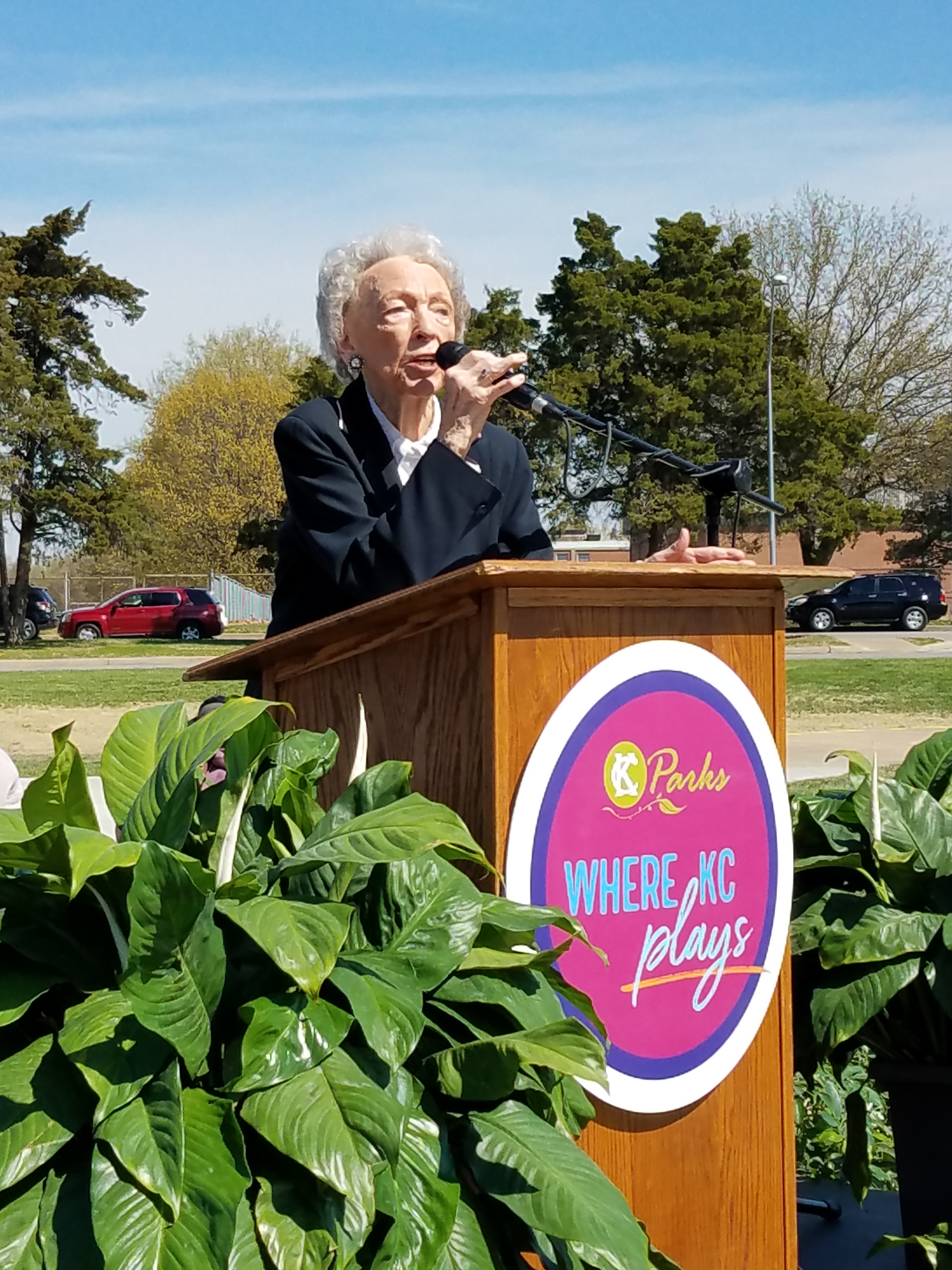
Among those who spoke at the re-dedication were park board member Mary Jane Judy, City Council members Alissia Canaday and Lee Barnes, James B. Nutter Jr., former park board president Anita Gorman and two great-granddaughters of Delbert Haff.

Anita Gorman, at yesterday’s rededication of Haff Circle Fountain

One of the great-granddaughters, Anne Salisbury, talked about how it had been passed down to her how much her great-grandfather cherished open spaces and the nascent parks system. Nutter Jr. talked about his father’s love for Kansas City’s east side. Anita Gorman spoke about Haff’s successful efforts to clear a legal path for the park board to obtain thousands of acres that set the stage for development of the city’s extensive park system.

For parks officials, the City of Fountains Foundation, Kansas City’s east side and, truly, all of Kansas City, it was a grand and gratifying day.

If you haven’t read The New York Times’ special investigation into Donald Trump’s finances, which was published last October, you should: Its authors just won a Pulitzer Prize in the category of explanatory reporting.

The 13,000-word story — one of the longest investigative pieces ever published in The Times — made a mockery of the President’s long-held claim, “I built what I built myself.”

The story, which took reporters David Barstow, Susanne Craig and Russ Buettner 18 months to report and write, revealed that Trump received the equivalent, in today’s dollars, of at least $413 million from his father’s real estate empire. In addition, much of that money was realized through dubious tax schemes he participated in during the 1990s, including instances of outright fraud.

The Pulitzer was the fourth for Barstow, a record for a reporter.

Susanne Craig addressed The New York Times newsroom Monday after she, Russ Buettner, to her right, and David Barstow, to Buettner’s right, won the Pulitzer Prize for explanatory reporting.

The Pulitzer Prizes, journalism’s highest honor, were awarded yesterday. Among the winners was St. Louis Post-Dispatch metro columnist Tony Messenger, who won for a series of pieces that exposed how poor people convicted of misdemeanor crimes were charged fees for their time in jail, sometimes leading to years of debt and imprisonment. As a result of Messenger’s columns, the Missouri Supreme Court ruled that the practice was illegal.

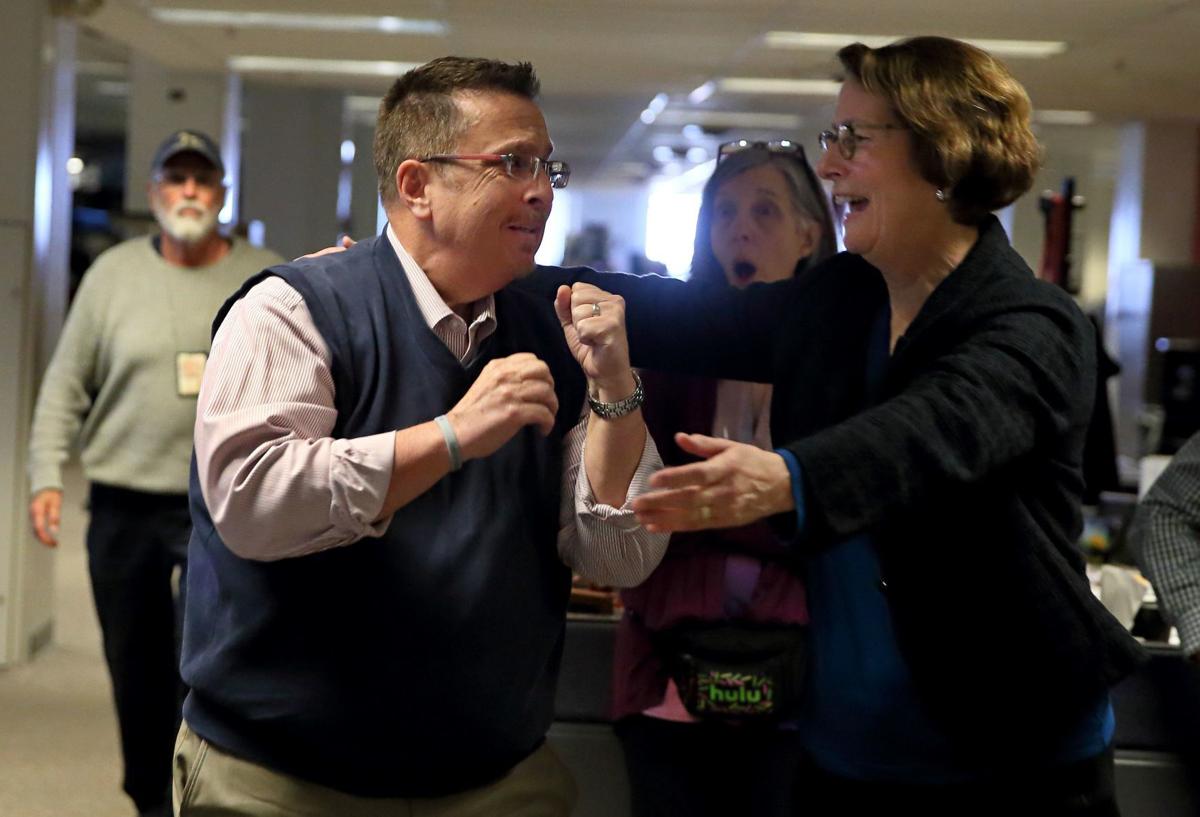
Tony Messenger and his editor, Marcia L. Koenig, reacted to the announcement that he had won the Pulitzer Prize for commentary.

Messenger, 52, is an inspiring person in addition to being an accomplished journalist. In 2015, he was a Pulitzer finalist for the paper’s editorials on unrest in Ferguson. Late that same year he developed throat cancer and had to take a leave of absence while fighting it. When he returned to work, he came back as metro columnist.

The Star’s Melinda Henneberger was a finalist in the commentary category for a series of columns, including several on former Missouri Gov. Eric Greitens and the affair that led to his downfall. Caitlin Flanagan of The Atlantic was the other finalist in the commentary category.

The winner in the public service category was the South Florida Sun Sentinel for its coverage of the causes and consequences of the 2018 mass shooting at Marjory Stoneman Douglas High School in Parkland, Fla. The paper exposed a culture of leniency at Broward County schools, mistakes by the sheriff’s office in responding to the attack and attempts by officials to cover up their failures.

The Pulitzer for breaking news photography went to several staff members of the Reuters news service for a series of photos titled “On the Migrant Trail to America.” Here is one of the photos.


Here is the complete list of this year’s Pulitzer Prize winners.

If you live to be in your 60s and 70s (like many of us have) and you’re a newspaper reader (like some of us still are), mandatory stops in the Sunday Star are the “Final Chapters” segment and the “Remembrances,” better known as the obituaries.

It can be touching, satisfying or sad — or all of those — reading about people who are just a few steps ahead of us as we hurtle toward our ultimate mark on the horizon.

Here’s a sample of some of those who made the “Final Chapters” and “Remembrances” columns today…

Charles Van Doren

He was a college professor who got on the old TV quiz show “Twenty-One” and allowed himself to be talked into cheating his way to winning a then-record $129,000. He confessed before a congressional committee in 1959 and then lived much of the rest of his life in something self-banishment, refusing to grant interviews and even leaving the country for several weeks when the firm “Quiz Show,” about the rigged game, was released in 1994.

On Saturday’s Op-Ed page in The New York Times, columnist Bret Stephens tipped his hat to Van Doren for never trying to capitalize in any way on his name recognition. What a contrast, Stephens said, to the way many people deal now with cheating and lying after being exposed — and how differently society treats them.

As Stephens observed…

Had Van Doren come along a few decades later, there would have been no big scandal in fabricating reality and no great shame in participating in it. The lines between fame and infamy would have blurred, and both could be monetized.”

Stephens’ closed with these sentences: “Van Doren died redeemed. Rest in peace.”

He died April 9 in Canaan, CT, and was 93.

Marilynn Smith

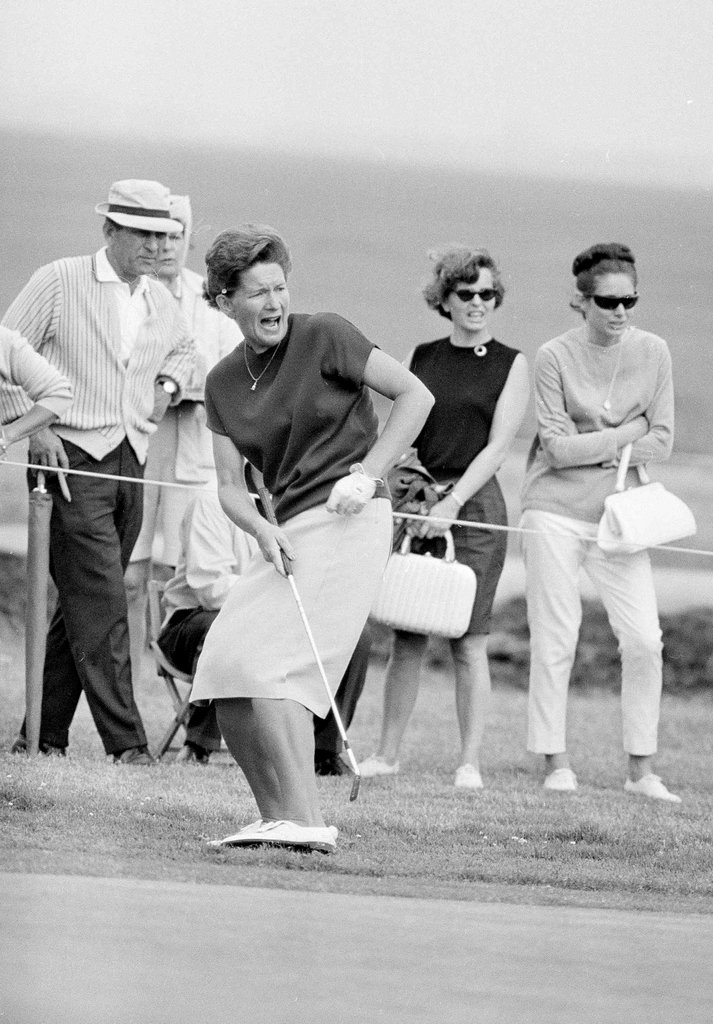
She was a Topeka native who went on to become national golf champion at the University of Kansas and one of 13 founders of the LPGA Tour. She won 21 tournaments as a pro, including two majors. Smith’s obituary in The Times said that when the LPGA was founded in the 1950s, “the women also lacked the funds to fly, so they traveled to tournaments in caravans of four or five automobiles when the interstate highway system was in its infancy.”

Marilynn Smith at a 1965 tournament in New Jersey

The Times described Smith as “an exuberant woman who seemed just right for publicizing the tour” and quoted her as saying…

We would go to major league ball parks, St. Louis, Cincinnati, Washington, D.C., and hit golf balls from home plate out to center field, with a 9 or an 8 iron, and then we’d get on the microphone and ask those baseball fans to come out and see the LPGA play.”

Last year, the LPGA sponsored 32 events in 13 countries and awarded $65.35 million in prize money.

Smith died Tuesday in Goodyear, AZ; she was 89.

Salvatore A. Belfonte

From the nationally known, we move to local people…

Everyone in Kansas City recognizes the Belfonte name, and most have probably purchased Belfonte milk, cottage cheese or ice cream.

Belfonte

Sal Belfonte is the guy who got that dairy business started. Quoting the obit…

Sal’s career in the dairy business began in 1957 with Sealtest Dairy where he delivered milk door to door. In 1967 Sal went into business for himself when he purchased a small dairy distributor selling Meadow Gold dairy products…The young company, rooted in family values, was run by members of the Belfonte family. Sal’s wife handled accounting and his children loaded trucks and answered phones.”

When I go to Price Chopper or Brookside Market and need milk, I always pull a carton of Belfonte from the cooler.

Sal Belfonte died April 11 at age 84.

Michael Thomason

I have no connection with Thomason and had never heard of him. But his obit caught my eye partly because he was only 42 when he died.

The first paragraph of the obit said Thomason grew up in Raytown and graduated from Raytown South. He was employed by the Kiewit Engineering Group and liked to fish and play golf and was a Royals’ and Chiefs’ fan.

The second paragraph took a sharp turn…

After a lifetime of struggling, he was finally overwhelmed by the pain and despair of chronic major depression. His family is heartbroken…”

Thomason

I can’t remember an obit that took on the issue of depression, and, by extension, suicide, so directly.

It took a lot of courage for the family to write that obit that way. My heart goes out to them, and I applaud them.

Michael died April 10. Survivors include his parents and a son and a daughter.