Feeds:
Posts
Comments

Let’s talk about The New Journalism.

No, goddamnit, I’m not talking about the shift from print to the Internet.

I’m talking about the “new journalism” as founded and honed by the likes of Tom Wolfe, Gay Talese and Hunter Thompson — writers who, in the 1960s and 1970s broke out of the “who, what, when, where and why” box and began writing long, powerful nonfiction stories that examined a subject inside and out and had spines consisting of scene-by-scene construction.

Wolfe, one of New Journalism’s trailblazers, died Monday in Manhattan at age 88.

Among other things, he wrote “The Right Stuff,” about the first American astronauts, and “The Bonfire of the Vanities,” a portrait of greed and vanity in New York in the 1980s.

My favorite piece of New Journalism writing, however, was Gay Talese’s “Frank Sinatra Has a Cold,” which appeared in the April 1966 issue of Esquire magazine.

The story forever intertwined the two men, even though they lived on opposite sides of the country and had very little in common.

(Talese is 86 and living in New York City; Sinatra died 20 years ago yesterday at age 82 in Los Angeles.
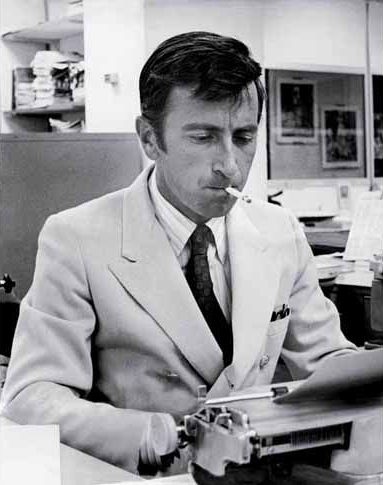
Gay Talese at his typewriter, many years ago

When I first read “Frank Sinatra Has a Cold,” perhaps in my 20s, I was spellbound by it. I always loved Sinatra’s singing and found him to be a fascinating but repulsive person. I was also in the early phase of my writing career and was hungry to read a wide variety of writing styles.

What Talese managed to do in that story was open a window to Sinatra’s life and perch the reader outside the window and let him (her) sit and watch parts of Sinatra’s life and personality unfold.

Today, I want to give you a taste of that story. (If you haven’t read it, here’s the link. Take your time and enjoy it.) Fifty-two years after it was written, it still pulsates with energy and thrives on Sinatra’s prickly personality. Wikipedia describes the story as “one of the most famous pieces of magazine journalism ever written.”

The Lead…

“Frank Sinatra, holding a glass of bourbon in one hand and a cigarette in the other, stood in a dark corner of the bar between two attractive but fading blondes who sat waiting for him to say something. But he said nothing; he had been silent during much of the evening, except now in this private club in Beverly Hills he seemed even more distant, staring out through the smoke and semidarkness into a large room beyond the bar where dozens of young couples sat huddled around small tables or twisted in the center of the floor to the clamorous clang of folk-rock music blaring from the stereo. The two blondes knew, as did Sinatra’s four male friends who stood nearby, that it was a bad idea to force conversation upon him when he was in this mood of sullen silence, a mood that had hardly been uncommon during this first week of November, a month before his fiftieth birthday.

“Sinatra had been working in a film that he now disliked, could not wait to finish; he was tired of all the publicity attached to his dating the twenty-year-old Mia Farrow, who was not in sight tonight; he was angry that a CBS television documentary of his life, to be shown in two weeks, was reportedly prying into his privacy, even speculating on his possible friendship with Mafia leaders; he was worried about his starring role in an hour-long NBC show entitled Sinatra—A Man and His Music, which would require that he sing eighteen songs with a voice that at this particular moment, just a few nights before the taping was to begin, was weak and sore and uncertain. Sinatra was ill. He was the victim of an ailment so common that most people would consider it trivial. But when it gets to Sinatra it can plunge him into a state of anguish, deep depression, panic, even rage. Frank Sinatra had a cold.

“Sinatra with a cold is Picasso without paint, Ferrari without fuel—only worse. For the common cold robs Sinatra of that uninsurable jewel, his voice, cutting into the core of his confidence, and it affects not only his own psyche but also seems to cause a kind of psychosomatic nasal drip within dozens of people who work for him, drink with him, love him, depend on him for their own welfare and stability. A Sinatra with a cold can, in a small way, send vibrations through the entertainment industry and beyond as surely as a President of the United States, suddenly sick, can shake the national economy.”

Sinatra’s temper and his entourage’s desire to please him…

“(W)hen one of his men brought him a frankfurter with catsup on it, which Sinatra apparently abhors, he angrily threw the bottle at the man, splattering catsup all over him. Most of the men who work around Sinatra are big. But this never seems to intimidate Sinatra nor curb his impetuous behavior with them when he is mad. They will never take a swing back at him. He is Il Padrone.

“At other times, aiming to please, his men will overreact to his desires: when he casually observed that his big orange desert jeep in Palm Springs seemed in need of a new painting, the word was swiftly passed down through the channels, becoming ever more urgent as it went, until finally it was a command that the jeep be painted now, immediately, yesterday. To accomplish this would require the hiring of a special crew of painters to work all night, at overtime rates; which, in turn, meant that the order had to be bucked back up the line for further approval. When it finally got back to Sinatra’s desk, he did not know what it was all about; after he had figured it out he confessed, with a tired look on his face, that he did not care when the hell they painted the jeep.”

**

Friends fawning over him and scrambling to be in his orbit…

(This scene took place at The Sands hotel and casino before the November 1965, Cassius Clay-Floyd Patterson boxing match, which Sinatra was going to watch from Row One.)

“Shortly before seven p.m., Jack Entratter, a big grey-haired man who operates The Sands, walked into the gambling room to tell some men around the blackjack table that Sinatra was getting dressed. He also said that he’d been unable to get front-row seats for everybody, and so some of the men—including Leo Durocher, who had a date, and Joey Bishop, who was accompanied by his wife—would not be able to fit in Frank Sinatra’s row but would have to take seats in the third row. When Entratter walked over to tell this to Joey Bishop, Bishop’s face fell. He did not seem angry; he merely looked at Entratter with an empty silence, seeming somewhat stunned.

” ‘Joey, I’m sorry,’ Entratter said when the silence persisted, ‘but we couldn’t get more than six together in the front row.’

“Bishop still said nothing. But when they all appeared at the fight, Joey Bishop was in the front row, his wife in the third.”

The Kicker…

“Frank Sinatra stopped his car. The light was red. Pedestrians passed quickly across his windshield but, as usual, one did not. It was a girl in her twenties. She remained at the curb staring at him. Through the corner of his left eye he could see her, and he knew, because it happens almost every day, that she was thinking, It looks like him, but is it?

“Just before the light turned green, Sinatra turned toward her, looked directly into her eyes waiting for the reaction he knew would come. It came and he smiled. She smiled and he was gone.”
I never thought I would say this, but as of today I’m going to recommend that people stop taking the print edition of The Kansas City Star.

Not only are most editions very thin but much less care is going into their production.

One problem I see is the same story appearing more than once in the same edition, with different headlines and sometimes different content.

Another is copy dumping, that is, stories “jumping” from the front page to the inside with huge blocks of copy consuming inordinate amounts of space inside, with little attention being paid to visual appeal.

In addition, I continue to hear complaints about delivery problems. Executives have been working to fix the problems for a few years, since the previous publisher fired an incompetent circulation vice president.

**

Like everyone else, I’ve been aware of the atrophying and deteriorating print product for a long time. What I am just realizing, however, is that The Star, through its owner McClatchy, is simply taking advantage of subscribers who don’t want to part with their print editions. Some people are hanging on because they’re not technologically inclined. Others just like holding the paper in their hands and reading it leisurely.

Intentionally, McClatchy and The Star have raised print-product prices to unsustainable levels. Oh, you can get a start-up deal on the daily paper for $33.19 for the first four weeks and $23.20 for the ensuing four weeks, but once they get you into their clutches, they want as much as $80 a month for the privilege of continuing home delivery seven days a week. That’s almost as much as the retail rate for the daily and Sunday New York Times, the best paper in the country.

On the other hand, you can get a digital KC Star subscription for $12.99 a month, which, in my view, is very reasonable.

(Disclaimer: As a KC Star retiree, I get an incredible deal on the print product — $10.74 a month — and will continue being a print subscriber unless The Star reneges on that commitment.)

**

Why, you might ask, is McClatchy jacking up the rates for print subscriptions?

It’s simple. Most of the news-consuming world has moved on to the Internet, and McClatchy and the other newspaper chains, seeing the print product fizzling out, are milking the diehard print subscribers to the max.

The Star’s latest circulation figures, for the first quarter of 2018, show the continuing downward spiral of the print product. Between the fourth quarter of 2017 and the first quarter of 2018, average paid Sunday print circulation went from 118,203 to 115,023.

Average Monday-Friday print circulation fell even more, from 76,853 to 72,294.

(At the same time, digital subscriptions don’t appear to be increasing very fast, with the stand-alone digital-subscription figure still at less than 10,000.)

Yesterday I read an article that opened my eyes to exactly what McClatchy and some other newspaper chains are doing. The article, by Jack Shafer of Politico Magazine, likened the average print subscriber to “your grandfather who is on dialysis, has a pacemaker and totes an oxygen tank behind him. He looks alive, but he’s overdue.”

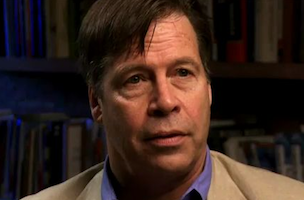
Jack Shafer

Shafer went on to say: “Your grandfather is a pretty good stand-in for the average newspaper subscriber, too. Habituated to his morning newspaper, he’ll resist cancelling his subscription no matter how raggedy the paper gets or how high the owners jack up the price.”

In business circle, there’s a name for the tactic McClatchy and some other chains are using — “harvesting market position.”

Shafer linked to another writer, Philip Meyer, who wrote about “harvesting market position” in his book The Vanishing Newspaper.

Meyer wrote:

“A stagnant industry’s market position is harvested by raising prices and lowering quality, trusting that customers will continue to be attracted by the brand name rather than the substance for which the brand once stood. Eventually, of course, they will wake up. But as the harvest metaphor implies, this is a nonrenewable, take-the-money-and-run strategy. A given crop can be harvested only once.”

**

So, it’s very clear what McClatchy is doing. Buried under $710 million in debt, its executives have decided not to waste any more time than absolutely necessary on the print editions of its 29 daily papers. While print still generates a majority of the company’s revenue, print is much more expensive to produce than digital. By focusing on the transition to digital, the chain can continue to cut employees and still produce a relatively substantive digital product.

The Star is probably the most profitable of McClatchy’s 29 daily papers, and what the parent company is doing is pulling money out of Kansas City and sending it back to Sacramento to try to knock down that debt (which stood at $1 billion after McClatchy purchased the KnightRidder chain for a mind-boggling $4.5 billion in 2006).

The best thing that could happen is for a local group or an individual to buy The Star and stabilize it, or even start guiding it a few steps back up the ladder.

In the meantime, it’s time to stop rewarding McClatchy for ruining the print product and for print subscribers to stop being sucked into McClatchy’s version of a corn combine. From now on, when people complain to me about The Star’s exorbitant retail price for the print edition, I’m going to borrow a line from Royals’ TV color commentator Rex Hudler:

“You got to go!”

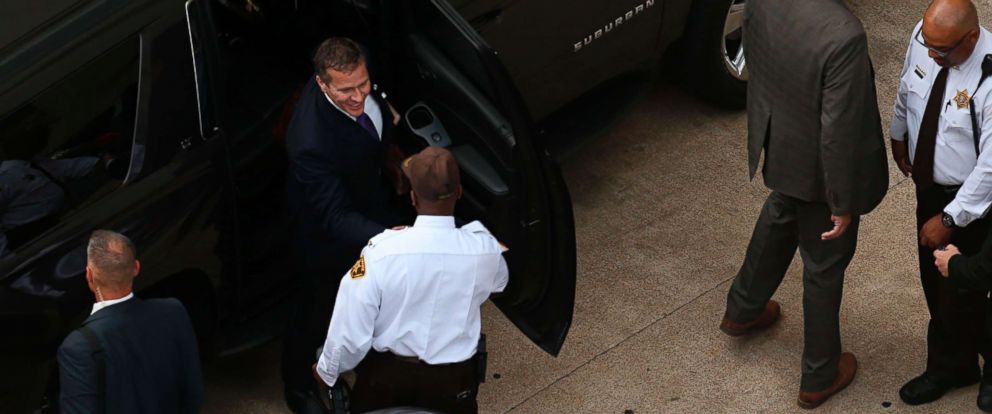
Now we know why our governor showed up for jury selection last week smiling and shaking hands with law enforcement officers.

He knew his lawyers were going to easily defeat the inexperienced, first-term St. Louis City Circuit Attorney who brought against the governor a case that turned on a photograph the prosecution never had.

Today Circuit Attorney Kim Gardner had to drop a felony charge against Missouri Gov. Eric Greitens after the judge upheld a defense motion to call her as a witness, to explain her handling of the case.

My God. Talk about an embarrassment! My guess is Gardner will now join Greitens in being out of political office when her term ends in January 2021 — about the same time his term winds up.

Let’s take a closer look now at the two principals in this case and how things are stacking up for them.


A relaxed-looking Eric Greitens arrived at the St. Louis courthouse last week for the start of jury selection in a case that fell apart today.

Greitens

There’s still a chance the Missouri House will vote to impeach Greitens, but I have no confidence that “seven eminent jurists,” who would be chosen by the Missouri Senate, would throw him out of office. This state is about as red as they get, and the Senate is full of good ol’ boys from rural areas who would probably balk at the prospect of ousting a governor who remains relatively popular with Republican voters.

Today’s development does not raise Greitens’ stock with the general public, however, including, I’m sure, many Republicans who voted for him in 2016.

A Missouri House of Representatives committee report on Greitens’ “affair” with his former hairdresser shows he’s an abusive, sick and dangerous individual. You’ve heard some of the details of the report, I’m sure, but this allegation says all you need to know: Greitens, while married, forced the woman to give him a blow job when she was terrified, crying and lying on her back in the basement of his St. Louis home.

Some Casanova, eh?

Don’t you wonder about Greitens’ wife, Sheena? Very little has been written about her. Can you imagine what’s going on in her world? It must be extremely difficult for her to keep putting one foot in front of the other and trying to shield their two sons, Joshua, about 5, and Jacob, about 2, from the ear-splitting cacophony roaring about them.

Sheena Greitens is a very smart and successful person. The governor’s office website says she graduated from Stanford University and attended the University of Oxford, where she studied as a Marshall Scholar. She earned a PhD in government from Harvard and is an assistant professor of political science at the University of Missouri.

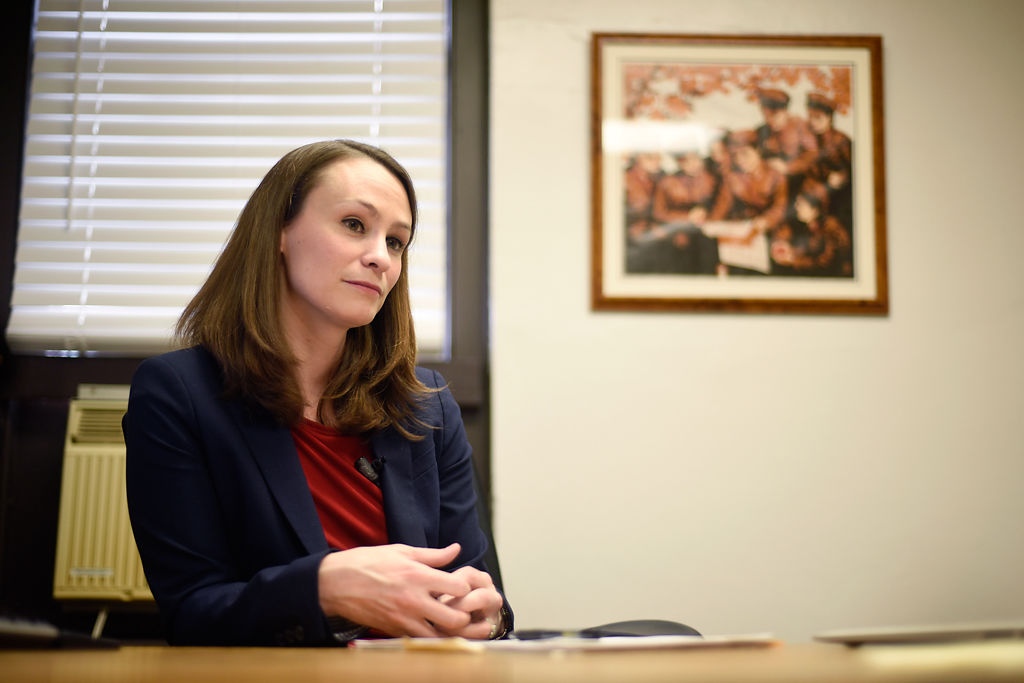
Sheena Greitens in her office at the University of Missouri in Feb. 2017

The Greitens were married in 2011, and four years later Eric was in the basement tying up and attacking the hairdresser, who was also married at the time.

In addition to being a cheat and an abuser, Greitens is a complete phony. Listen to what the governor’s office website says about the couple’s family life: “They enjoy spending time together as a family reading, baking cookies or being outdoors at one of Missouri’s many state parks and hiking trails.”

Really, now, wouldn’t you think somebody would have had the good sense to take that down by now?

In any event, I would be willing to bet Sheena will file for divorce within a year or so after her husband leaves office, whether that turns out to be this year, next year or 2021. Although she took a vow to stand by him “for better or worse,” she didn’t pledge to stand by the worst. 

Gardner

The quote of the day goes to Rep. Kevin Engler, a Republican from Farmington, MO, who told The Star he wasn’t surprised at today’s development because Gardner “pretty well butchered it from the start.”

Gardner was elected Circuit Attorney in 2016. She handily defeated three opponents in the Democratic primary and had no opponent in the general election. Before that, she was a state representative, and earlier she spent five years as an assistant prosecutor in the Circuit Attorney’s office.

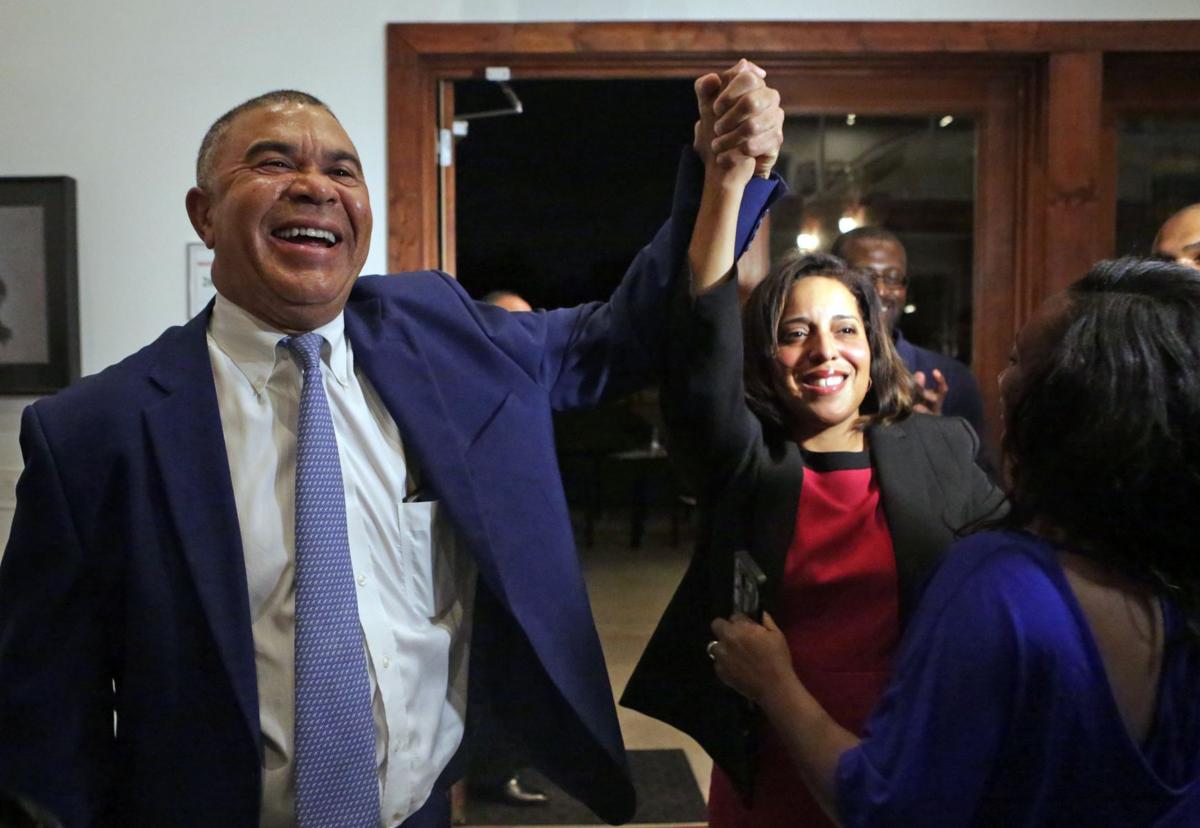
Kim Gardner with U.S. Rep. William Lacy Clay, Democrat of St. Louis, on election night, August 2016

As circuit attorney, Gardner is the second most powerful elected official in St. Louis, after the mayor. She oversees dozens of assistants who handle thousands of criminal cases each year, from misdemeanors to complex homicides.

In the Greitens case, Gardner let political opportunism supersede professionalism. She jumped at Greitens like she was starving in the wilderness and he was the rabbit that came into her crosshairs.

The first mistake she made was hiring a private investigator to investigate the case instead of using the St. Louis City Police Department. It’s a lot easier to point private, contracted investigators toward the desired result than sworn and experienced law enforcement officers.

In bringing an invasion of privacy charge, she filed a list of evidence that misleadingly including the word “photo.” But it wasn’t the photo that Greitens allegedly took of the hairdresser after tying her to exercise equipment in his basement. If Gardner indeed had the photo, it would have been relatively easy to prove Greitens was guilty of invasion of privacy. Without it, though, it was going to be the hairdresser’s word against Greitens.’

Gardner should have dropped the case after realizing she had screwed it up, but I guess the prospect of personal ignominy wouldn’t allow it. All she achieved, however, was delaying the day of ignominy.

**

To sum up, it’s a sorry day in and for Missouri: We’re making headlines around the country because an incompetent prosecutor fumbled the case against a governor who almost certainly sexually assaulted a woman in his basement.

I believe the movement to change the name of The Paseo to Martin Luther King Boulevard is starting to flag.

To me, it’s looking more and more like the new airport might be getting King’s name. Maybe Kansas City Martin Luther King Jr. International Airport.

I would be thrilled to see that happen. A bit surprisingly, no major U.S. airport has adopted King’s name, and the timing couldn’t be more fortuitous, with a terminal to be built at KCI and expected to open in 2022.

**

On Saturday, I attended the last public hearing of the Martin Luther King Jr. Advisory Commission, which Mayor Sly James appointed a few weeks ago. The hearing was at the Marlborough Community Center, 82nd and The Paseo.

Before the commission heard from the speakers, co-chairman Rev. Donna Simon said the commission had narrowed the naming possibilities to three: the new airport; The Paseo; or an east-west street, such as Linwood Boulevard of 63rd Street. The panel will make a final recommendation by May 21.

About eight people, including me, addressed the commission. I told the commission I thought the name The Paseo was one of the great street names anywhere and that I would hate to see it pass from the scene in Kansas City. If any street was going to be renamed for Dr. King, I said, it should be Linwood, partly because it gets a much more diverse group of users and is seen by a wider cross-section of people.

I went on to say that we had a great opportunity, with construction of the new airport, to honor Dr. King’s legacy in a way that would resonate not just up and down the east side of Kansas City but with people from throughout the world who would fly in and out of our city.

In closing, I said: “I urge you not to think parochially. Instead, think big, think broad, think bold.”

That got nods from a couple of commissioners, which was encouraging.

Two or three other people said they favored putting Dr. King’s name on the new airport, and several said they were opposed to renaming The Paseo. One man, originally from Tulsa, suggested that because streets bearing Dr. King’s name in other cities were primarily inner city streets that changing The Paseo’s name to MLK Boulevard could further drive down housing values along that road.

Perhaps the most encouraging comments I heard were from former Councilman Ken Bacchus, a member of a group of black political leaders and black ministers who have started an initiative petition that could result in a public vote to change The Paseo’s name.

Bacchus said he didn’t like the idea of naming the new airport after Dr. King because when an airport has been named for an individual, it usually is because the individual made a big mark in that particular city. One example Bacchus cited was Hartsfield-Jackson International Airport in Atlanta, which is named after two former Atlanta mayors, William B. Hartsfield and Maynard H. Jackson Jr.

I get his point, but that doesn’t mean it has to be that way. Like I said, no other big airport has been named for King, and it seems about time that should happen.

Where Bacchus pleasantly surprised me was when he indicated he was open to renaming an east-west street for King. Up to that point, I had been under the impression that he and the others advocating for a street name change were dead set on The Paseo. Bacchus also mentioned The Paseo but the fact that he opened the door to other streets indicated a possible softening of position by the black ministers and black political leaders.

That softening, if indeed that’s what it is, is probably due to two main factors: First, resistance to renaming The Paseo has been significant, and, second, Mayor James’ decision to roll out a blue-ribbon advisory commission had the dual effect of widening the ways of honoring Dr. King and blunting the momentum the black ministers and black political leaders had seized.

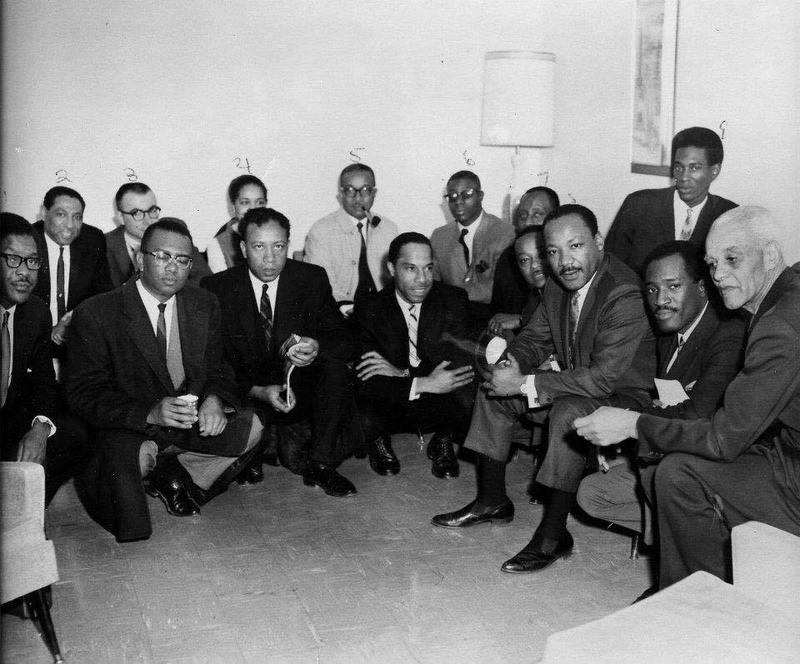
This photo was taken in Kansas City, Kansas, in January 1968. I got it from a story KCUR-FM ran last month. None of those with Dr. King were identified in the caption.

I became more convinced of the wisdom of naming the new airport for Dr. King after reading a letter to the editor in today’s Kansas City Star. Susan Annette Smith of Warrensburg said Kansas City, with its central location, was the perfect place to name an airport for Dr. King.

She went on to say:

“The terminal could house a cultural center for all Americans, sharing the stories of people who faced discrimination yet persisted. Kiosks could be placed throughout the airport to share the stories and artifacts of the Americans who fought and worked for the freedoms outlined in the Declaration of Independence. Welcome to the new Kansas City Martin Luther King Jr. Airport, where travelers celebrate Americans’ history, honor human diversity and share the stories.”

Great idea. Don’t just slap King’s name on the airport; make the airport reflect his soaring ideas and ideals. Imbue the airport with King’s aspirations for a higher level of civility and civilization. Make it a place where people can food for thought…as well as a good hamburger.

With imaginative ideas like those of Susan Smith, we could have a very special airport, with a unique tone and feel. Let’s go for it.

Those of us with ties to The Star and the world of journalism in general tend to wring our hands and grit our teeth when there’s a new round of layoffs at The Star or a new quarterly report from its owner, the McClatchy Co.

For sure, it’s a terrible situation. One scenario that could save The Star from future degredation would be if a local, wealthy individual bought the paper from McClatchy (assuming McClatchy would part with its most profitable property) and gave The Star a fresh start.

The Washington Post was fortunate enough to experience such a change several years ago, when Amazon founder Jeff Bezos, although not local, bought The Washington Post from the Graham family for $250 million. Turns out it was a steal. Bezos invested heavily in the paper, and then along came President Donald Trump, and the fortunes of the Post and The New York Times spiked spectacularly.

That’s not likely to happen here, unfortunately. More probable is McClatchy selling all 29 of its papers to another national chain, one not gasping under the weight of a $710 million debt. I would bet the McClatchy crew in Sacramento would welcome a “white knight” that would come in, disperse the dark cloud hanging over corporate headquarters and send the top executives running to the bank with their golden-parachute checks.

**

With that, here’s a look at two chains that, in my opinion, would continue shaving away at The Star financially and substantively.

Gannett

Gannett, the largest newspaper chain in the nation, is the most likely procurer of McClatchy. Don’t be surprised if you see a headline within the next year or two saying something like, “McClatchy agrees to be bought by Gannett for $xxx million.”

(McClatchy paid $4.5 billion — and assumed $2 billion in debt — for KnightRidder’s 30 papers in 2006, but the sale price for all McClatchy holdings would now be less than $1 billion.)

Gannett’s holdings include a national paper, USA Today, and dozens of local ones, including The Courier-Journal in Lousville, KY; The Arizona Republic in Phoenix; the Indianapolis Star; The Cincinnati Enquirer; The Tennessean in Nashville; The Des Moines Register; the Detroit Free Press; and the Milwaukee Journal.

All of Gannett’s papers are a mess. Stripped down and gutted. Like McClatchy, Gannett has ordered many rounds of layoffs and has replaced a significant percentage of its papers’ veteran journalists with low-paid young people. In addition, most are all of its papers have two to four pages of generic content produced at Gannett headquarters in Virginia, outside Washington D.C. The generic content helps bulk up the papers, but it’s pablum.

Another thing: the Gannett papers’ websites are the most irritating in the land. Fighting off the pop-up ads and promos makes you feel like you’re in a nest of hissing snakes. Go, for example, to The Courier-Journal’s website and try dealing with its Rattlers and Copperheads.

Like a snake, Gannett is always lurking in the tall grass, looking for opportunities to ensnare failing newspapers or chains. Its latest major acquisition came in 2016 when it bought out Journal Media Group Inc. and its 15 daily newspapers, including the Milwaukee Sentinel, the Evansville (IN) Courier & Press; the Knoxville News Sentinel; The Commercial Appeal in Memphis; the Naples Daily News; and the Corpus Christi Caller-Times.

Later in 2016, it made a run at the former Tribune Publishing papers (now known as Tronc), including The Chicago Tribune and The Los Angeles Times, but pulled back after recording disappointing earning reports for the second and third quarters of 2016.

Gannett has debt of about $355 million, compared to McClatchy’s more than $700 million, but it is in an acquisitive mode partly because it has a market capitalization (total dollar market value of its outstanding stock shares) more than 15 times that of McClatchy — $1.3 billion vs. $75 million.

The next to last thing I would want to see is Gannett buy out McClatchy, but keep a lookout for that headline I predicted.

Alden Global Capital

The last thing I’d want to see is McClatchy getting bought by Alden Global Capital, which is…a fuckin’ hedge fund!

The Washington Post’s media columnist, Margaret Sullivan, called Alden “one of the most ruthless of the corporate strip-miners seemingly intent on destroying local journalism.”

Alden’s hostages — I mean properties — include The Denver Post, the St. Paul Pioneer Press (which was briefly a McClatchy paper); The Mercury News of San Jose; and The Orange County Register.

Alden got into the newspaper business in 2010 when it bought Digital First Media after that company’s parent company, MediaNews Group, declared bankruptcy. MediaNews was founded and fueled by William Dean Singleton, another newspaper strip-miner who, at age 66, has been largely sidelined by multiple sclerosis.

The Columbia Journalism Review said that in May a group of Alden shareholders filed a lawsuit alleging that Alden “had sucked money out of the newspapers it owns in order to make risky investments in Greek sovereign debt and a troubled pharmaceutical chain, among other areas.”

Among other things, Alden is alleged to have diverted $158 million into a southeastern U.S. pharmacy chain called Fred’s.

The journalism review quoted news industry analyst Ken Doctor as saying the suit “provides unusual visibility into the nest of secretive vultures.” (Gannett has its snakes, Alden its vultures.)

The same article quoted a columnist for the Minneapolis Star-Tribune as saying Alden “has for years treated one of the biggest media companies in the country like a big ATM.”

On Tuesday of this week, anger at Alden boiled over in Denver, where current and former Denver Post staff members participated in protests against Alden’s cost-cutting and its alleged attempts to influence editorial policy. The protests occurred at the Denver Post production facility in Denver and Alden Capital’s headquarters in New York City.

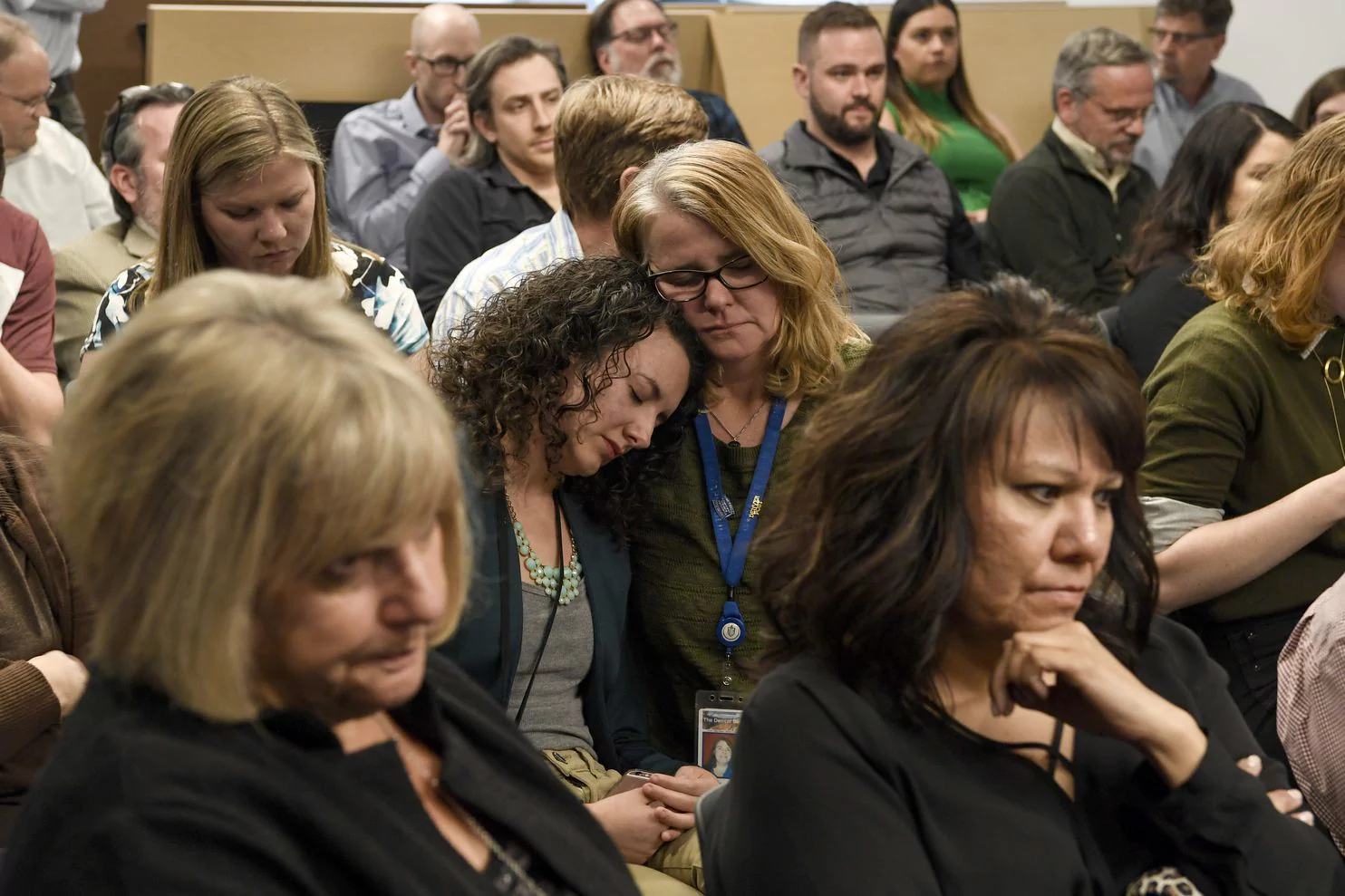
This is what news of more layoffs at the Denver Post looked like earlier this year when staff members got the word.

Earlier this year, 30 employees were laid off at the Post. One report said the announcement of the layoffs was greeted with “sobs, gasps, expletives.”

Naturally enough, Alden, with offices far away in New York City, wasn’t offering any explanation. Sullivan, The Washington Post columnist, wrote that when she tried to talk to someone at Alden headquarters, she was told no one was there to speak to the news media. “When I asked to be connected to managing director Heath Freeman’s office,” she said, “the receptionist hung up on me.”

**

So, while McClatchy looks bad, keep those two outfits in mind when you think about an ownership change at The Star…Gannett and Alden Globe Capital. Whoa.

The call for KC Star suburban editor Tod Palmer came when he was in the shower on May 1, a week ago last Tuesday.

When he got out of the shower he saw that the call had come from the Human Resources Department. That concerned him. He listened to the voice message, and it wasn’t from someone in HR but from KC Star Managing Editor Greg Farmer.

That told Palmer all he needed to know: “Oh, shit,” he thought, “I’m getting laid off today.”

Sure enough, when he called back, Farmer and Star Editor Mike Fannin delivered the bad news: His last official day — and the official last day for nine other Star employees being laid off or taking early retirement — would be Friday, May 11.

Tod Palmer, back when he was covering University of Missouri sports

Just like that, at age 39, Palmer’s 17-year career in the newspaper industry had arrived at a crossroads. Quite possibly, it was finished.

“I didn’t dream my newspaper career would be over before I hit 40,” he said.

**

I had a lengthy and wide-ranging phone conversation with Palmer this morning. His situation — a young person caught in the uncertainty of the newspaper industry’s cloudy future — is emblematic of what tens of thousands of young journalists are experiencing across the country.

But this has happened so much in the industry the last 10 to 12 years — widespread layoffs and reorganizations — that it no longer comes as much of a surprise to anyone.

While not expecting the call at the particular time and particular day it came, Palmer had realized for months he was probably on borrowed time at The Star, considering the precarious situation of its owner, the McClatchy Co., which has carried hundreds of millions of dollars in debt since purchasing The Star and about 30 other KnightRidder newspapers in 2006.

After becoming suburban editor last August, Palmer predicted to his wife Angie Palmer that he would be laid off in six to 18 months. (It was nine months.) So convinced was he of his thread-thin status, he told me today, “I felt like a hospice caretaker for those (suburban) products.”

Palmer’s ongoing sense of job insecurity had spiked recently after McClatchy’s flagship publication, the Sacramento Bee, laid off more than 20 employees and after McClatchy issued its first-quarter financial report, which showed the company with a quarterly loss of $39 million and, more alarmingly, revenue of 10 percent less than the first quarter of 2017.

**

Palmer grew up in south Kansas City and attended Raytown High School. He then went on to William Jewell College, where, in 2000, he got a degree in communications with an emphasis in public speaking. His first full-time newspaper job was at The Chanute (KS) Tribune, where he was sports editor. In 2006, he got a job as a page designer at The Olathe News, which The Star had purchased in 2000. (That was six years before McClatchy purchased The Star and the other KnightRidder newspapers.)

When Palmer went to work at the Olathe paper, it employed more than 50 people. Between March 2008 and April 2009, however, employment plummeted to five employees, and it became an afterthought to The Star’s overall operation.

Palmer landed on The Star’s sports desk in 2009 and in 2013 was awarded one of the most important “beats” on that desk, covering University of Missouri sports. He held that post until late last summer, when Star management decided it wanted its MU sports reporter to live in Columbia. Palmer turned that down, partly because he and Angie have sons 10 and 4, and her family lives in the Kansas City area.

The Star then hired two young men fresh out of MU’s Journalism School, Aaron Reiss and Alex Schiffer, to take up where previous MU beat writers like the legendary Mike DeArmond (retired) and up-and-comer Terez Paylor (former KC Chiefs’ beat writer and who recently became an NFL writer for Yahoo.com) had left off.

To stay in town and remain at The Star, Palmer took the news editing job in which he oversaw publication of the 816 North and 913 publications; The Olathe News; the Lee’s Summit Journal; and the Cass County Democrat. (On the side, he did some contract work for the Sports Desk, helping with coverage of Kansas Speedway races.)

**

Unlike some who have been laid off at The Star — particularly in the early days of layoffs — Palmer is not bitter. He’s not even angry about being laid off over the phone. “I didn’t take it personally,” he said.

He’s grateful for the journalism experience he accumulated and for some of his memorable experiences as a sports writer, including getting to drive a race car 145 miles an hour at Kansas Speedway and having a hand in covering the Kansas City Royals’ World Series appearances.

“I can tell you that champagne burns when you breathe it in,” he said.

Currently, Palmer is applying for writing jobs, but he’s open to changing careers, if he has to. Right now, he’s not extremely concerned about finances. The Star is giving him — and the others laid off — six months’ severance pay plus eligibility for limited, ongoing health insurance under the federal COBRA law. And his wife works full time at a call center.

Looking at the newspaper industry as a whole, he thinks one of the biggest problems is that many people in the upper ranks at newspaper chains are not good business people and are “thinking with their hearts, not their heads.”

Assessing the situation in Kansas City, he said The Star remains uniquely capable of doing something no other local entity or company can do — putting out a first-class daily, printed newspaper.

Problem is, he said, “That’s the thing they don’t seem interested in doing at the highest possible level.”

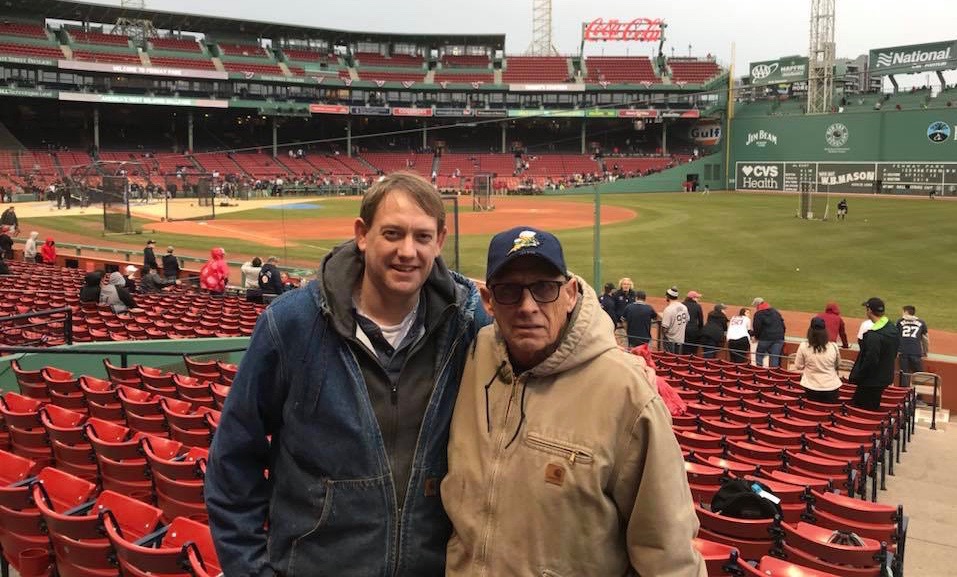
Tod with his father at Fenway Park last month

If I was betting on whom Jackson County Executive Frank White will appoint as interim Jackson County Sheriff, I probably would put money on former Kansas City Police Chief Darryl Forte.

Of the three finalists selected today by an advisory committee, Forte has by far the highest profile and has attained the highest level of law enforcement management.

But this is not an ordinary situation, and it should by no means be an open-and-shut matter, with Forte getting the appointment.

Consider the background…

As we all know, the previous sheriff, Mike Sharp, who recently resigned in disgrace, ran an utterly fast-and-loose operation for the almost 10 years he served. It all exploded on him last month, when reports of sexual and managerial impropriety in recent years hit the news.

As I wrote in an April 20 post, signs of Sharp’s unfitness for office dated all the way to 2008, the first time he was running for the post. My former Kansas City Star colleague Kevin Murphy wrote a story back then, saying Sharp was “once part of an email exchange among city county law officers that included images of nude women.”

The email exchange group included 25 Jackson County deputies, sergeants and other officers.

Nevertheless, Sharp, who had the Democratic machinery behind him, rolled into office by a large margin and was re-elected in 2012 and 2016.

Now, do you think Sharp, once elected, went in and cleaned up the office, strictly prohibiting pornography, sexual harassment and impropriety?

Given what unfolded recently, I doubt it!

Why, just today, Sharp’s former girlfriend and one-time personal assistant dropped her two-year-old discrimination and harassment lawsuit against the county. She did not get any money, but the case has cost the county about $400,000 in legal fees, according to The Kansas City Star, including $67,420 to pay a lawyer representing Sharp.

Clearly, this fish smells from the head down. And what is needed is a thorough house-cleaning at Sheriff’s Office headquarters in Lee’s Summit.

Forte

Even though Forte was police chief for six years and had a spotless record, there are things about him that bother me. Mainly, I have the feeling that some of these guys who have gotten to be chief, including Forte, are motivated mostly by the money. Forte, when he resigned last year was only 55 and, strikingly, came into a $500,000 windfall for accrued vacation, sick and compensatory time. He knew he had that much coming, but the public, as well as many city officials, did not.

I think the windfall contributed to his hasty, out-the-backdoor getaway: He even refused to give longtime KC Star police reporter Glenn Rice a farewell interview.

Something just doesn’t smell right there, so, if I were Frank White, I’d pass on Forte.

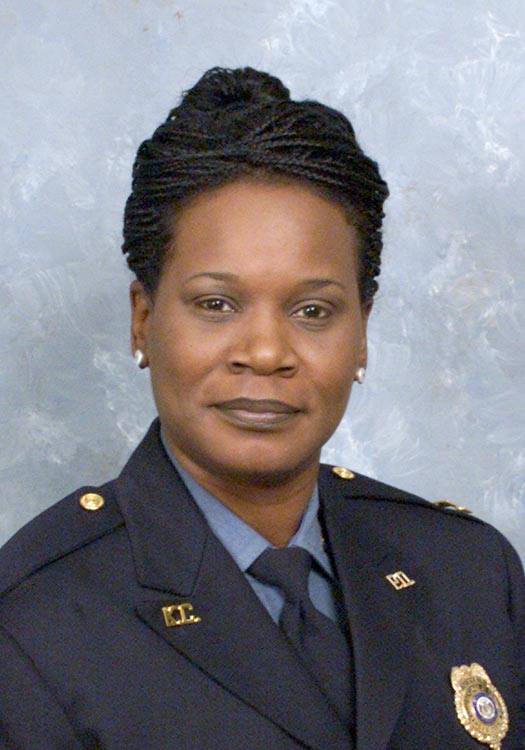
That leaves the two other finalists the advisory committee selected today: retired KCPD Major Rosilyn Allen and Capt. Michael Rogers, who commands the Jackson County Sheriff’s patrol division.

And from that field of two, only one should be given serious consideration because the last thing we need is an insider like Rogers.

KCUR-FM quoted Rogers as saying in his interview with the committee: “The Sheriff’s Department is not broken. We’re essentially at the highest point we’ve ever been.”

All I have to say to that is if it’s at the highest point it’s ever been, it’s about a mile and a half under water.

**

Allen

I don’t know much about Maj. Allen — never heard of her before today — and The Star’s electronic library doesn’t have many stories about her. But here are some things I found out about her from a City Council resolution honoring her upon her retirement.

:: She retired in December 2013 after 30 years of KCPD service. Her last position was commander of the violent crimes division. (Whitepages.com says she’s in her 60s. I would think early 60s.)

:: She is a lifelong KC resident, has a bachelor’s degree in criminal justice and a master’s in public affairs. She is also a graduate of the FBI National Academy, Avila University’s Women’s Leadership Institute, the DEA Drug Unit Commanders Academy and the U.S. Department of Justice’s School of Organizational Leadership for Executives.

:: In 1998, she founded and served as president of the Missouri/Kansas Women in Criminal Justice, and she has served on the boards of the Rose Brooks Center, the Black Police Officers Association and the National Association of Blacks in Criminal Justice.

In her interview with the advisory committee, Maj. Allen said increasing diversity among the Sheriff’s Department ranks was “not a priority, it’s a necessity.”

I’ll say…KCUR has reported that out of 94 sworn deputies, 90 are white, with zero Hispanics or Asians.

**

We need someone who will come in, play absolutely no politics and upend the good-ol’-boy culture that has long prevailed. I’m concerned that Forte wouldn’t go far enough and also that he might be trying to rack up another big salary and a secondary pension.

Maj. Allen looks, to me, like the person we need. I think she’s our best bet to clean up that department, expose the warts and cauterize them.

Come on, Frank, do the unexpected: tap the lady candidate and give her the opportunity to chart a new, progressive course for the Sheriff’s Office.

Yesterday was the first Derby I haven’t been to in several years. And while I really wanted to be there, as the day went on and the rain continued to fall in Louisville, I felt a lot better about being here in Kansas City on a picture-perfect, early-May day.

In case you haven’t heard, three inches of rain fell in Louisville yesterday, making it the rainiest day in Derby history, according to some reports.

I’ve been to the Derby when it rained — including last year, when there were three rounds of rain — and it’s not very fun. With 150,000 people on hand, the premises — most notably the restrooms — get really grungy, and a nice, crisp outfit can easily turn limp and soggy.

In more than 35 years of following the Derby, I have picked very few winners; I could probably count them on one hand. The last winner I had was Big Brown in 2008.

But even if your horse doesn’t win, the Derby is a lot of fun as long as your horse is in the hunt, as long as you can spot him (or her occasionally) and feel like your horse has a chance at some point midway through the race or later.

And yesterday, thrillingly, my horse was in contention for almost the entire one and a quarter miles.

Our son Charlie lives in Las Vegas, where he’s working toward a master’s degree at UNLV, and Patty and I had him place bets for us at one of the many casinos that have “sports books,” which take wagers on all manner of sporting events.

We had a mini-Derby party at our house, with Patty’s sister Vicky and Vicky’s daughter Laura, joining me, Patty and our daughter Brooks, who did not bet.

The field consisted of 20 horses. I had Charlie bet $100 to win and $100 to place on Good Magic, which came out of the No. 6 gate. Patty bet $2 to win, place and show on the No. 9 horse, Hofburg, and $5 to win on Vino Rosso (she lives her wine), which came out of the No. 18 post position.

The favorite was the No. 7 horse, Justify, which went off at odds of 5-2 — meaning if you bet $2 to win, you’d get back about $7, including the $2 you bet.

Good Magic went off at odds of 9-1, which I thought was a bit high, considering he had been the 2-year-old champion (the Derby is for 3-year-olds) and had won his last prep race, the Blue Grass Stakes, run April 7 in nearby Lexington, KY.

Justify broke out second, trailing a horse named Promises Fulfilled, and Good Magic was close up. After the horses hit the 3/4-mile marker, Justify took the lead, and Good Magic moved into second place, running outside Justify.

At the head of the stretch, as they rounded the home turn, it looked like Good Magic might be ready to uncork a challenge to Justify. At that point, I jumped up out of my chair and yelled, “Take him!”

But Justify, which had run all three of his prep races in California, responded to the challenge and started pulling away.

At that point, I needed Good Magic to hold on for second in order to win the “place” money. He just barely did, holding off a fast-closing horse named Audible by a head. Several yards after the finish line, Audible put a head in front of Good Magic, but it was too late.

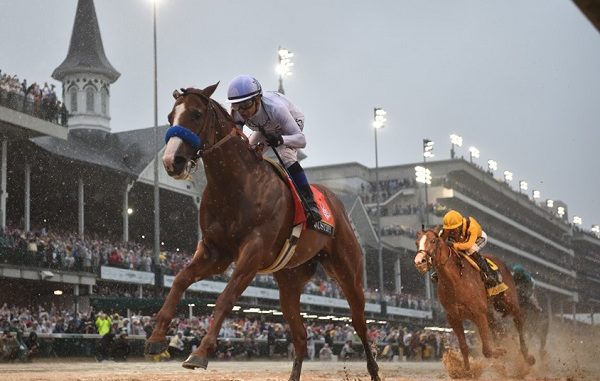
Justify nears the finish line in the slop. Good Magic, in gold, was second.

Patty’s horses, Hofburg and Vino Rosso, finished seventh and ninth respectively, but neither had been a factor in the race.

When the prices were posted, I was surprised to see Good Magic paid $9.20 to place on a $2 bet. That meant the return on my $100 place bet was $460 (50 times $9.20). Subtracting my initial layout of $200, my profit was $260.

Charlie sent me a text saying, “Congrats!” I sent him one back, telling him to keep $25 for himself as a tip. After all, if you’re lucky enough to be able to place a bet when you’re 500 miles away from the track, you need to reward the courier.

**

I’ve always loved reading the Derby “chart,” which is the official description of how each horse fared in the course of the race.

Charts are prepared for every North American race by an organization called Equibase, which is considered “a statistical bible” of horse-race data.

At their best, Equibase’s race charts are written in colorful, descriptive language. Here is how the writer described the fortunes of the top three horses in yesterday’s Derby.

“JUSTIFY came away in good order, shadowed PROMISES FULFILLED under rating three deep, moved alongside with five furlongs (five-eighths of a mile) remaining, spurted clear leaving the three-furlong marker, rebuffed the bid of GOOD MAGIC approaching the stretch, dug in when put to a stern left-handed drive leaving the three-sixteenths and was unwavering to the wire.

“GOOD MAGIC was in hand between rivals in good position, shifted out and made his run at JUSTIFY nearing the quarter pole, continued a valiant chase to deep stretch, flattened slightly late and just held the place.

“AUDIBLE, between foes early, gathered momentum leaving the three-eighths pole while removed from the inside, altered toward the rail midway through the second turn, steadied soon after in traffic, continued toward the rail and found room entering the lane, finished up nicely and just missed nailing GOOD MAGIC for the runner-up spot.

**

At the other end of the action, a horse named Mendelssohn finished 20th and last. Here’s how Equibase described his experience.

“MENDELSSOHN was bumped and forced in at the start, was banged around in traffic, moved up under a hard ride into the first turn, steadied but was pushed along to remain in contact past the five-eighths to the second turn and stopped, was eased to the wire but walked off.”

Ouch. Brutal trip.

Mendelssohn, which had gone off as the fourth favorite in the race, finished more than 50 lengths behind Justify.

Regrettably, I won’t be at this year’s Kentucky Derby, to be run about 5:50 p.m. today, central daylight time, in my hometown of Louisville, KY.

One reason is I had back surgery two weeks ago and am not up to the drive and the output of energy a Derby requires. The other is I’m going back to Louisville the first weekend of June for the 50th reunion of my 1968 graduating class at Bellarmine University.

I’ve been to the Derby every year in recent years, and to the vast majority of them since starting to attend in 1981. During that time, I’ve had quite a few interesting Derby Day experiences, and today I’m going to share one with you.

**

I moved to Kansas City from Louisville in 1969 and after a stay of few months in an apartment on Armour Boulevard, joined a co-worker and three of his MU classmates in a rental house in Brookside.

One by one, the roommates went their separate ways, and in 1977, after Capital Cities bought The Star — with a lot of us making good money on sale of Star stock — I bought two-bedroom house at 5103 Grand.

To christen the house, I decided to host a Kentucky Derby party that spring. I prepared and served mint juleps…tasting every one for quality assurance. We wrote the horses’ names in chalk on half a ping-pong table set on its side, and we formulated a rudimentary betting system in which all pool money was returned to the winning bettors.

Derby party special guest

The party was a big success, and I decided to make it an annual event. People loved them, and some who hadn’t been invited would call and ask if they could come. My answer was always, “Come on over.” One year, the guest of honor was U.S. Sen. Thomas Eagleton, who was Sen. George McGovern’s vice-presidential running mate in 1972. (For the record, Tom declined my offer of a mint julep, but he still started to get into the wrong car when he was leaving with staff aide Woody Overton.)

As good as the parties were, in 1981 I decided it was time for me to go to the Derby. Although I was born and raised in Louisville, I had only been to the Derby once during the 22 years I lived there. As I recall that was in 1963, when a horse named Candy Spots was the favorite but came in second. My boyhood friend Don Huber and I went to the Churchill Downs Infield — the cost was about $5 then ($80 today) — and all I remember is hearing the track announcer calling the race over the loudspeakers and catching glimpses of the horses from the Infield as they circled the track.

**

In ’81, I determined I was not going back to the Infield. So, I and some of my friends got tickets in an area called the Grandstand Terrace, which sounds good but in fact affords the lowest — and worst — vantage point of the track. (Generally, the higher you are, the better your view of the races.) We were at the top of the stretch, however, where the Derby starting gate is located and where we had a tremendous view of the start and could hear the gates slam open for the Derby and feel the penetrating ringing of the starting bell.

I had made a bold and very big bet — big, that is, relative to what I normally was betting back then. I put $50 to win on a horse named Pleasant Colony, a closer, who went off at odds of 7-2.

As the race got underway, I couldn’t see where Pleasant Colony was. These were the days before monitors and big screens for spectators’ convenience, and, as in 1963, about all I could do was listen to the track announcer’s call. That told me enough, however, to know that Pleasant Colony was on the move about three-quarters of a mile into the mile and a quarter race.

As the horses neared the turn into the stretch — where we were standing and straining to see — I picked up Pleasant Colony. He was accelerating and passing horses easily. I let out a whoop, and as the horses turned for home, Pleasant Colony went to the front and powered to a one- to two-length lead…My heart was about to explode from my chest.

Still, a quarter of a mile remained, and the outcome was far from certain. By then, all we could see was the horses’ rumps undulating frantically and rhythmically and getting farther from us with every second.

I could see enough, though, to tell that another horse was moving up on Pleasant Colony. He was gaining — gradually, steadily — and the question was: Would Pleasant Colony be able to hold him at bay? When they hit the finish line, I was pretty sure Pleasant Colony had held on for the win, but I wasn’t sure: I’d have to wait for the numbers to go up on the big electronic tote board in the Infield.

My lifelong friend Bill Russell, who was in the group, didn’t help matters. Instead of assuring me Pleasant Colony had held on, he started saying, “I don’t know, Jim, it looked like that other horse was comin’ on really strong. He might have caught him.”

Bill continued needling me, sowing seeds of doubt — and laughing — as we waited for the numbers to go up. Finally, after what seemed like half an hour but was really only a few minutes, Pleasant Colony’s No. 4 lit up at the top of the tote board…He had held on by three-quarters of a length to defeat a horse named Woodchopper.

I cut loose with some more whoops and throat-threatening yelling and went to cash my winning ticket. I got back $225 — $175 in winnings, plus my original $50.

Full of myself and feeling very large, I treated our group of about eight people to dinner that night, and, as I recall, the $175 in winnings covered the entire tab, including drinks…Of course, that was 1981, the year of my first real and unforgettable Kentucky Derby.

Pleasant Colony, headed down the stretch in the 1981 Kentucky Derby


The Kansas City journalism scene lost another great one this week — former city editor and weekend editor Bob Lynn.

Lynn, renowned and most admired, perhaps, for his refusal to bow and scrape to upper management, died of a massive heart attack Tuesday outside the Lowe’s store in Roeland Park.

Karen Dillon, a good friend of Bob’s, wrote on the Kansas City Star Bylines Facebook page: “A registered nurse happened to be in the parking lot and rushed over to him and began giving him CPR but he had no pulse.”

Lynn, 71, is the fourth titan from The Star’s heyday to die in the last 15 months.  First it was reporter Rick Alm in February 2017. Then it was Laura Hockaday, former society editor, last October, and finally it was Pulitzer Prize-winning reporter Mike McGraw just four months ago.

Because he spent his career as an editor, Bob was not as well known to the public as Alm, Hockaday and McGraw.

He was every bit as legendary in The Star’s newsroom, though.

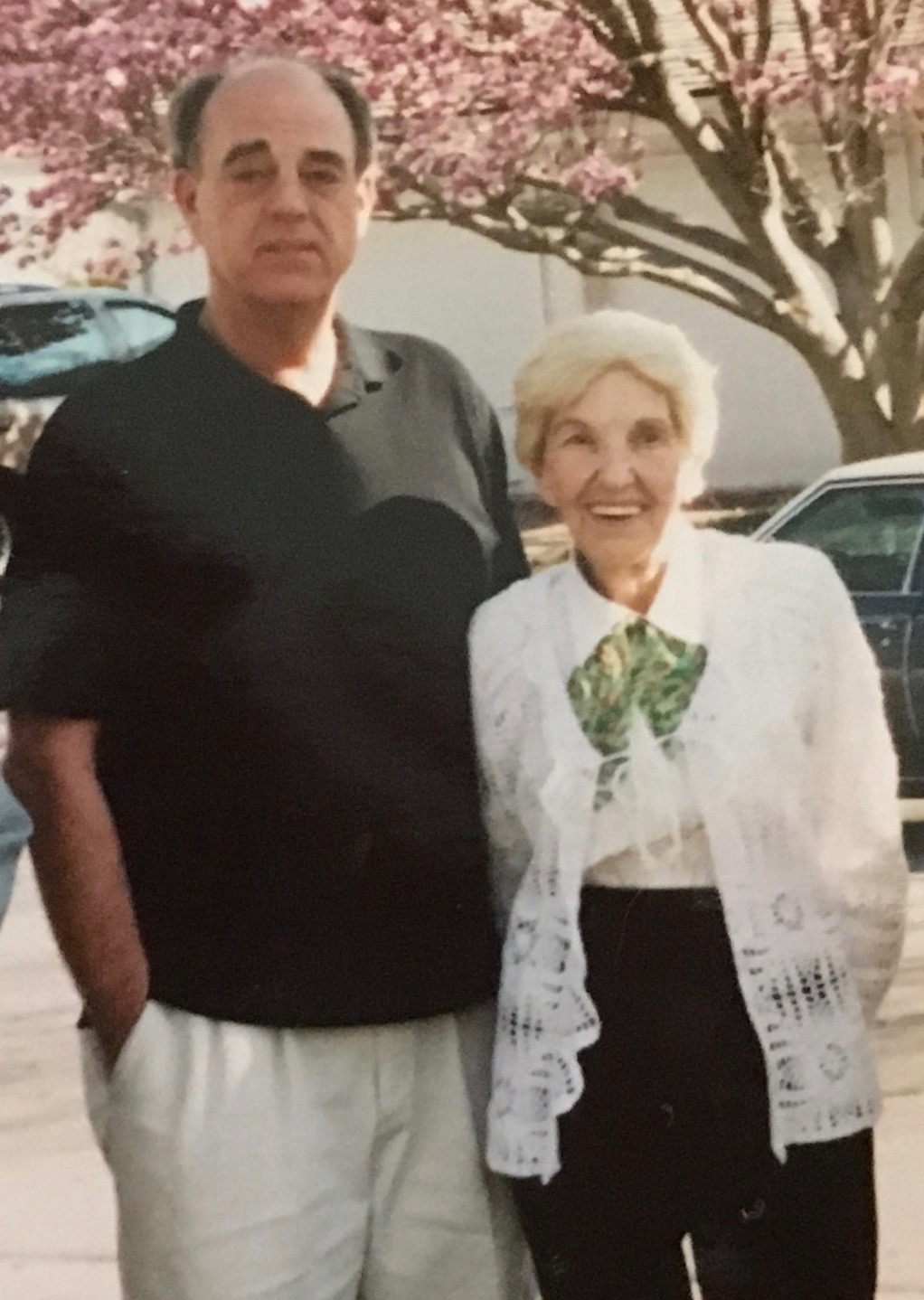
Bob, with mother Betty (2003)

Reporters loved working with him because of his easygoing disposition, lack of ego and the fact that he treated everyone equally, disbursing advice clearly and concisely. Upper managers respected him because they knew he was extremely competent and pulled not punches.

The highest position he attained was city editor of The Kansas City Times, the morning Kansas City Star, until it merged with The Star in 1990. He then worked as an editor on the State Desk and later became the weekend editor.

It was as weekend editor that many reporters got extensive exposure to him and learned to appreciate his skill and lack of ego. All reporters had to work occasional weekend shifts, and it was to Bob they’d report for Saturday or Sunday duty. On the KC Star Bylines page, reporter after reporter wrote Thursday about memories of weekend duty with Bob.

Here’s a sample:

Julius Karash, retired, former business reporter: He was an inspiration! We used to bitch about weekend metro duty, but working Saturday or Sunday with Bob was fun: Journalism, sedition, story-telling and barbecue. I don’t think I realized at the time that those weekend metro duty shifts would turn into great memories some day.

Dawn Bormann Novascone, former reporter: Bob was such a good man and a great editor. I learned so much from working with him on the weekend. I’m sure I owe him $100 or more from all the times he spotted me money for Rosedale (Barbecue) when I could barely make rent.

Ed Eveld, former reporter: Great boss. Great editor. Coolest dude.

Bob was also incredibly insightful and had an excellent feel for the state of the newspaper — that is, if things were going well or slipping. Karash recalls, for example, that after McClatchy Co. purchased The Star and the other KnightRidder papers in 2006, Bob was one of the first to sense that layoffs were on the horizon.

One day, Karash said, he and Bob were reading a note on the bulletin board about a longtime, high-ranking newsroom editor who, to the surprise of many, was moving to the Human Resources division — an exceedingly strange move for a newsroom denizen.

Karash said Bob turned to him and said, “He’s going to be the hatchet man.”

Sure enough, in 2008, when The Star announced the first round of layoffs under McClatchy ownership, the former editor was intimately involved in the layoffs and sat in on every meeting where staff members were given notice.

Bob had such great foresight that he recognized at the time of the first wave of layoffs that The Star was no longer a reliable employer. Karash recalls, again, that with the announcement of the 2008 layoffs and buyouts, Bob went to management and offered to take early retirement, saying he would be willing to go if it meant someone else could keep his or her job.

And that was that. He walked out and called it a career. He later worked as a librarian at the Mid-Continent Library in Riverside.

A minimalist to the end, Bob was cremated, and there will be no funeral service.

…So long, buddy. You were a hell of a newsman.

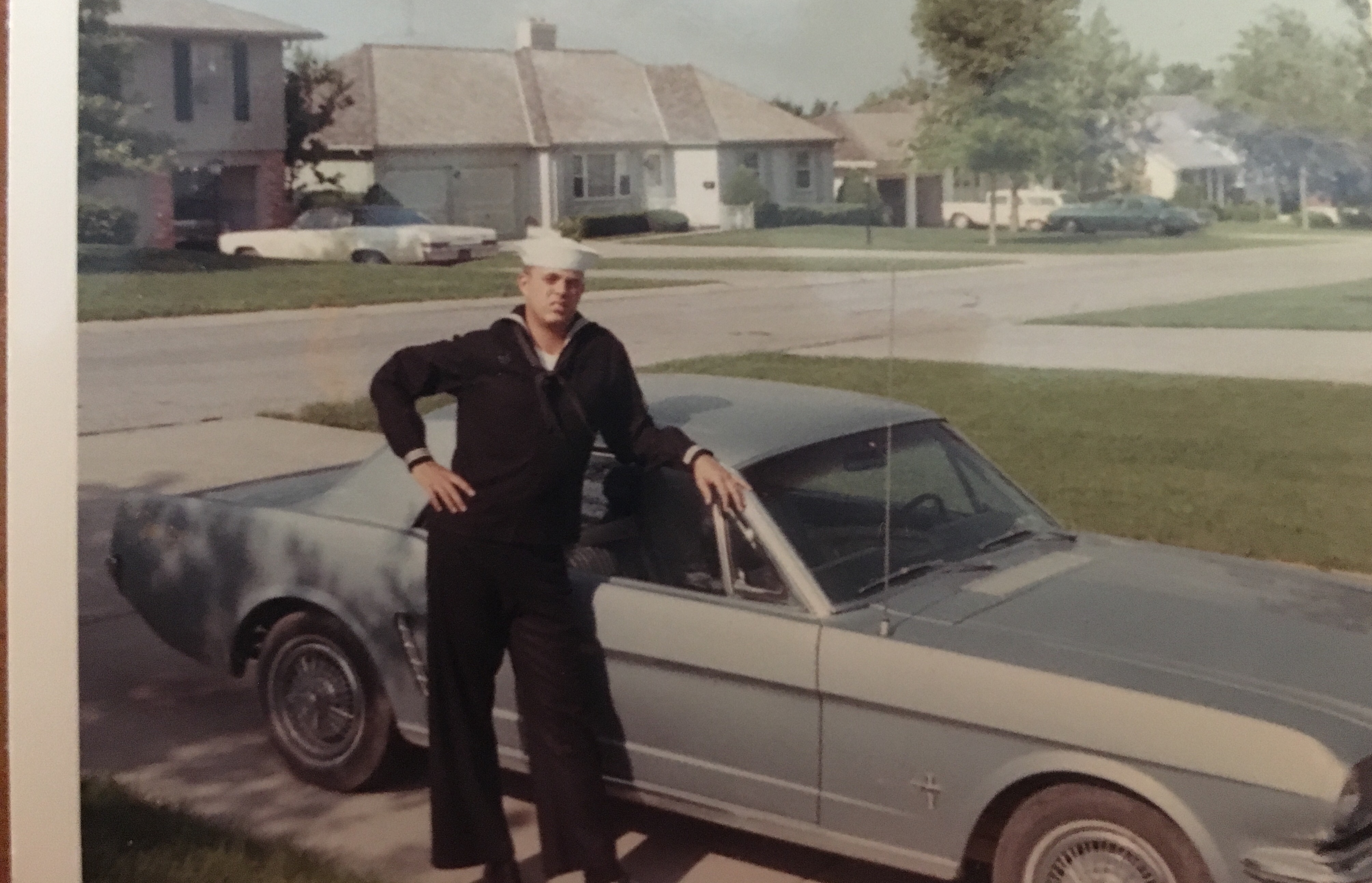
With his 1964 (and a half) Mustang (Photos courtesy of Karen Dillon)