Feeds:
Posts
Comments

I will be interested to see if Jackson County prosecutor Jean Peters Baker brings charges against the man to whom David Jungerman confided in November that he had killed Kansas City lawyer Thomas Pickert.

The probable cause statement that supports the first-degree murder charge filed this week against Jungerman shows clearly that the man — whom I think I know — was aware of Jungerman’s heinous act less than a month after Jungerman allegedly gunned Pickert down in his front yard.

A recording that police obtained of a conversation between Jungerman and the man includes these exchanges:

Jungerman: Hey, you know, uh, people…people uh know that I murdered that son of a bitch.

Man: Why are you saying it like that?

Jungerman: Because that’s what…because of what the media done, see. And but they…they…they just nobody can figure out what’s going on, you know?

Man: (Laughing) Ehhhhh-huh-huh, I hope they don’t never figure it out.”

I suspect that the same man also may have corroborated Jungerman’s statement to police that the white van he allegedly drove to Pickert’s house was parked next to a lake in Raytown at the time of the crime.

…I believe the man to be Leo Wynne Jr., who is about 60 years old and has worked for Jungerman’s baby high-chair manufacturing business more than 30 years.

Wynne accompanied Jungerman to a court hearing I attended in Nevada, MO, in Vernon County, on Jan. 9. At that time, I met and spoke with both men at length before and after the court hearing.

Wynne is such a trusted employee and associate that several years ago Jungerman gave him 400 acres of farmland. Jungerman, a multi-millionaire farmer and baby-high-chair manufacturer, owns several thousand acres of farm land, much of it in southwest Missouri.

The probable cause statement doesn’t identify the individual Jungerman was talking to when he admitted killing Pickert, but it says the recording was made after a Nov. 16 court hearing in Vernon County.

Wynne and Jungerman live in close proximity in Raytown. Jungerman lives in a ranch house on one side of a small lake near 60th and Elm streets, and Wynne lives in a house across the lake.

When he was interviewed by police the day of Pickert’s murder — Oct. 25 — Jungerman said the white van had been parked outside Wynne’s house all day long. That night, police obtained a search warrant for the van and recovered it at Wynne’s home.

I do not know if police interviewed Wynne, but surely they did. Taking it a step further, my guess is that Wynne vouched for Jungerman’s story that the van was parked outside his house at the time Pickert was killed.

Two witnesses described seeing a white van, similar to Jungerman’s, near the scene of the killing. In addition, in the course of their six-month investigation, detectives obtained video from “traffic cameras, businesses, residences and two ATA buses” indicating Jungerman’s van was driven from Raytown to the Brookside area an hour before the shooting and driven back to Raytown after the shooting.

(That is sensational detective work, by the way, and shows again how the proliferation of video cameras has made getting away with a crime a lot harder these days.)

**

So, what could Wynne be charged with, if, indeed, I’m correct on my supposition it was he to whom Jungerman admitted the crime?

From what we know and from my reading of Missouri statutes, he conceivably could be charged with  a Class E felony of concealing an offense.

The pertinent statute says a person commits the offense of concealing an offense if he or she “accepts or agrees to accept any pecuniary benefit or other consideration in consideration of his or her concealing any offense, refraining from initiating or aiding in the prosecution of an offense, or withholding any evidence thereof.”

It might be difficult for police to establish that Wynne accepted any monetary benefit “or other consideration” for keeping his mouth shut, but if I were Leo Wynne Jr., I’d be worried.

Conviction of a Class E felony is punishable, upon conviction, by up to four years in prison.

You know how much I love the Oldies. Well, I think it’s only fitting today that I dedicate a few songs to the man who has taken up many hours of my life in recent months — David Jungerman.

Here are the titles, links and sample lyrics.

:: Western Movies, The Olympics, 1958.

To save my soul I can’t get a date,
Baby’s got it tuned on channel eight.
Now Wyatt Earp and the Big Cheyenne
They’re comin’ thru the TV shootin’ up the land.
Ah um my baby loves the Western movies.
My baby loves the Western movies,
Bam, bam, shoot ’em up Pow.
Ah um my babe loves the Western Movies.”

:: Born to Be Wild, Steppenwolf, 1968

Get your motor runnin’
Head out on the highway
Lookin’ for adventure
And whatever comes our way
Yeah Darlin’ go make it happen
Take the world in a love embrace
Fire all of your guns at once
And explode into space

:: Ramblin’ Gamblin’ Man, Bob Seger, 1969

But I got to ramble (ramblin’ man)
Oh I got to gamble (gamblin’ man)
Got to got to ramble (ramblin’ man)
I was born a ramblin’ gamblin’ man

:: Desert Skies, Marshall Tucker Band, 1977

Won’t you bury me with my chaps on
And my six-gun strapped to my side
So I can watch the moon a-hidin’
In the desert sky
Hidin’ in the desert sky

:: You Talk Too Much, Joe Jones, 1960

You talk too much
You worry me to death
You talk too much
You even worry my pet
You just talk
Talk too much

**

And he’s still talking, undoubtedly, even as he sits in the Jackson County Detention Center, puzzled at how he could possibly have outsmarted himself.

Thankfully, though, his “shoot ’em up Pow” days are over.

The morning of Jan, 9, just outside the only courtroom in the Vernon County Courthouse in Nevada, MO, I looked David Jungerman in the eye and said:

“Did you kill him?”

I was speaking, of course, about Kansas City lawyer Thomas Pickert, who was gunned down in his front yard the morning of Oct. 25, 2017, after having walked his two young sons to school.

Jungerman hesitated just a second and, with a slight smile, replied:

“My attorney has told me not to answer any questions, so I’m not going to say I did, and I’m not going to say I didn’t.”

If I’d had any doubts about his guilt before then — I did not — that answer would have settled it. A man who is alleged to have killed someone when he didn’t would never say something like that.

It turns out, of course, that Jungerman did, indeed, kill Thomas Pickert the morning of Oct. 25. He had said so himself even before I interviewed him. The admission, made to an employee of his, came after another southwest Missouri  court hearing on Nov. 16. It just took a while for the confession to surface.

…Today, in a development that many area residents have waited for a long time, Jackson County Prosecutor Jean Peters Baker charged the 80-year-old Jungerman with first-degree murder in Pickert’s slaying.

He already was being held without bond in connection with two other cases, including the one in southwest Missouri, and it now appears almost certain that Jungerman will never again see the light of day, except out the window of a jail or prison cell.

**

I have contended all along that Oct. 25, 2017, was the luckiest day of Jungerman’s life. He drove his own van to the scene of the murder in Brookside and shot Pickert in broad daylight, as Pickert stood in his front yard talking on his cellphone. My theory is — and has been — Jungerman shot Pickert with a rifle, probably while sitting in the driver’s seat of the van, parked across the street from Picker’s home.

Although two people, including Pickert’s wife, Dr. Emily Riegel, got at least a limited look at him, neither she nor a man who saw him while walking his dog could positively identify him. And no one got the van’s license plate number.

But it turns out, Jungerman was sufficiently dumb and reckless — the latter being his calling card the last 20 years or so of his life — that he incriminated himself.

The charging document says that when police recently executed search warrants at his home and business, one of the items they found was “an Olympus audio recorder with a recording.”

He had recorded himself at the Nov. 16 court hearing but had failed to turn it off afterward.

“Later,” the prosecutor’s office said in a news release said, “the defendant talked to his employee about a .17-caliber rifle and about killing the victim.”

**

Have you heard the term “hoist with his own petard”?

It means blowing yourself up with your own bomb.

That’s what David Jungerman did. Thank God.

**

Here’s what a .17-caliber rifle looks like…

A website called RifleShooter says this about the weapon…

“Seventeen-caliber rifles are just a little bit magic. They shoot whisper-tiny projectiles the same diameter as the BBs we all loved to pop away with as kids. They produce almost no discernable recoil. Even the report of most .17-caliber guns is mild, particularly that of rimfire versions.

“Yet the little pills zipped downrange from .17-caliber rifles shoot with lazer-like flatness and produce surprisingly impressive results on small game and predators. Depending on the size of the cartridge case housing the tiny bullets, performance ranges from mostly suitable for rodents inside 200 yards to deadly on bigger predators out to 400 yards.”

…Just the kind of weapon Jungerman needed for his mission in Brookside on Oct. 25.


Cruising into Greece

Our Adriatic and Aegean cruise has been over more than a week now, and the jet lag and euphoric hangover are gone.

About all that’s left is the head cold Patty caught on the way home and then passed on to me.

Oh, and with your kind indulgence, a few more photos…

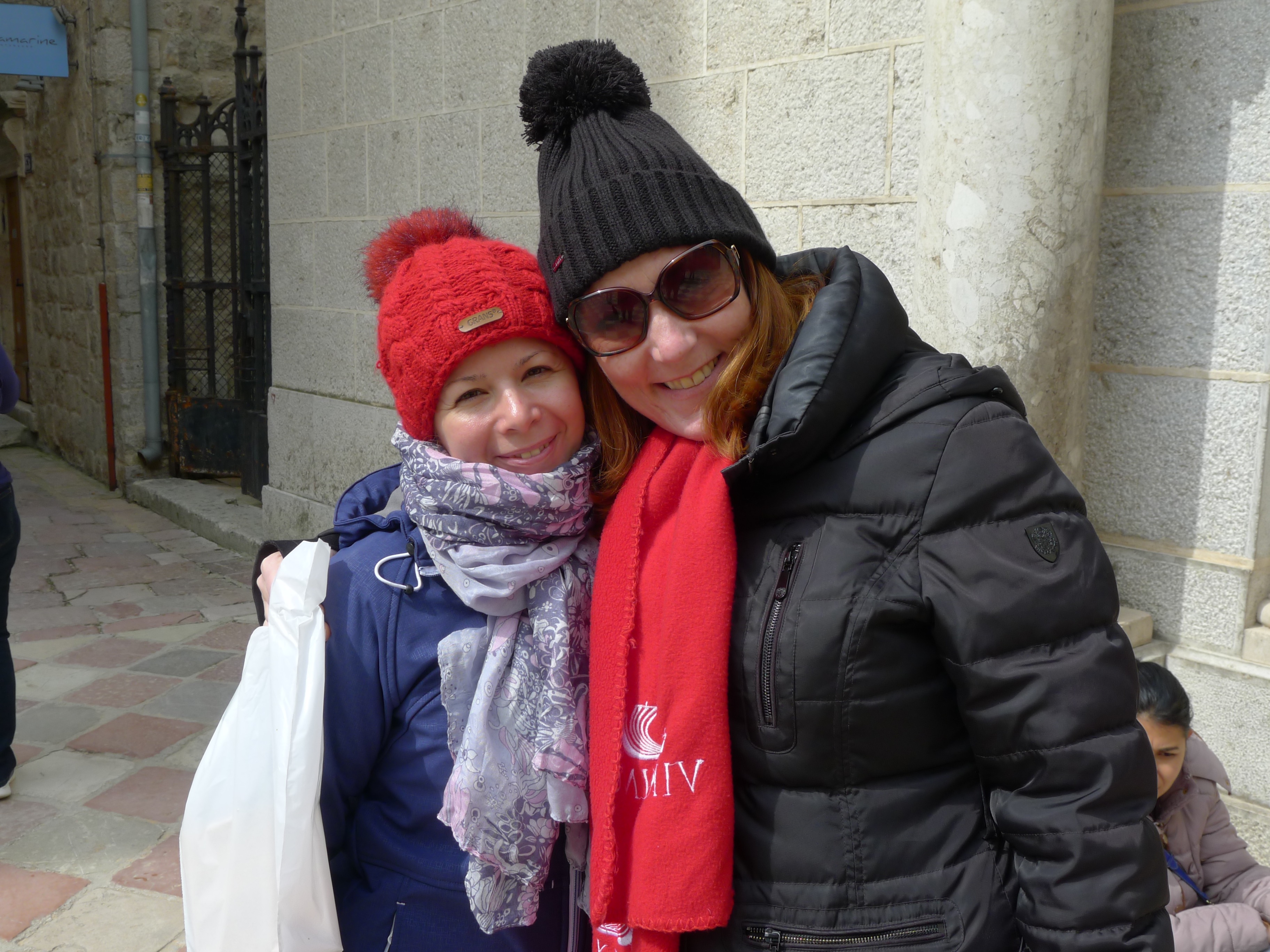
This wasn’t taken in Greece — Montenegro, I believe — but I had to run it. Julia (left) was the shore excursion manager on our Viking cruise, and Jenna was our indefatigable cruise director. (They bleed Viking red!) This was a rare occasion when they got a few free hours and did some touring of their own.

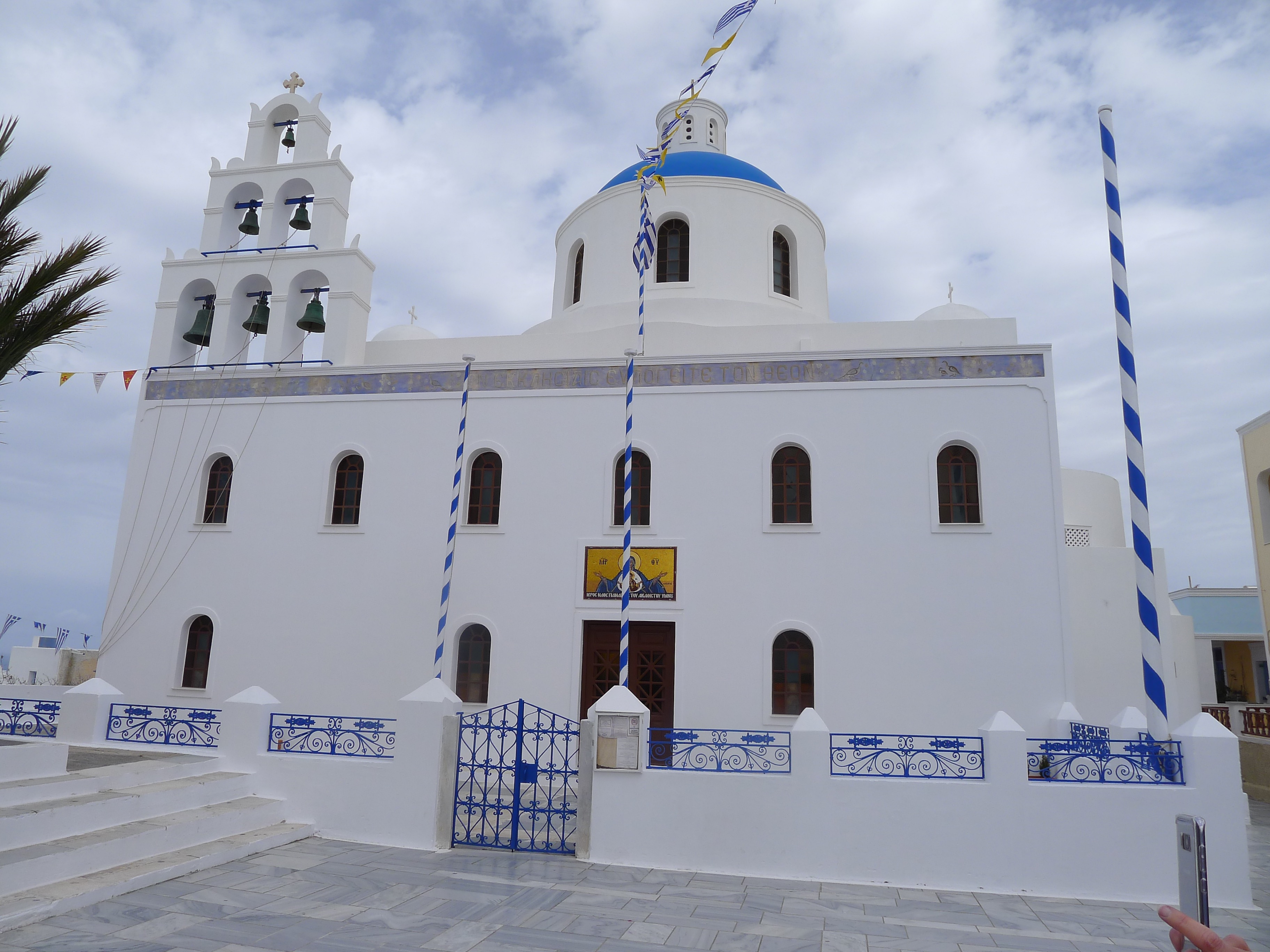
The island of Santorini, off the southern coast of Greece, offers some iconic Grecian scenes. The island has three towns, all perched atop high cliffs.

The domes of many Greek Orthodox churches are painted sky blue, symbolizing their reach to the heavens.

A closer view of one of the three towns on Santorini

One of our best discoveries was the Santo Winery on Santorini. This is the winery’s patio (not a giant Bingo board), in a state of preparedness for high tourist season, which begins later this month. (Patty handed her phone to a Californian who offered to shoot the picture, and, voila, he produced a winner.)

Finally, it was on to Athens, one of the world’s oldest and most intriguing cities.

The Parthenon is the centerpiece of the Acropolis, considered the foundation of modern Western culture and the cradle of Western civilization. The Parthenon was built between 447 and 432 BC during the Age of Pericles, when culture, democracy, art and education blossomed in Athens.

This is another famous Acropolis building, the Erectheion, highlighted by statues of the Caryatids, six women who “hold up” the marble roof of the building’s northern porch.

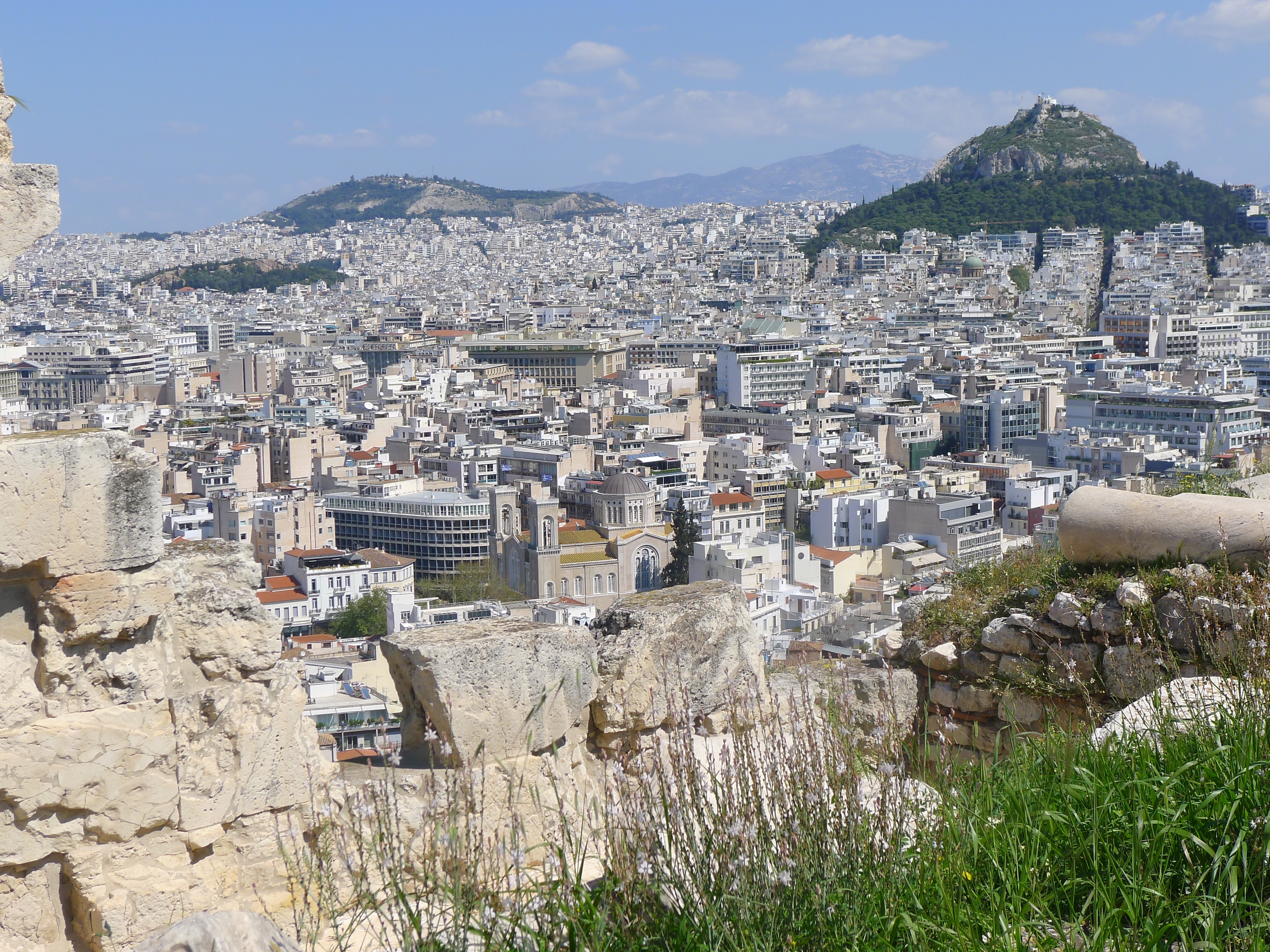
A view of Athens from the Acropolis, which is high above the city.

The Parthenon at night, as seen from the window of our hotel in the Plaka tourist district. I took a final, long look at it early the morning of Friday, March 30, the day we departed Athens for the long flight back to KC.

For this tourist, it’s a wrap.

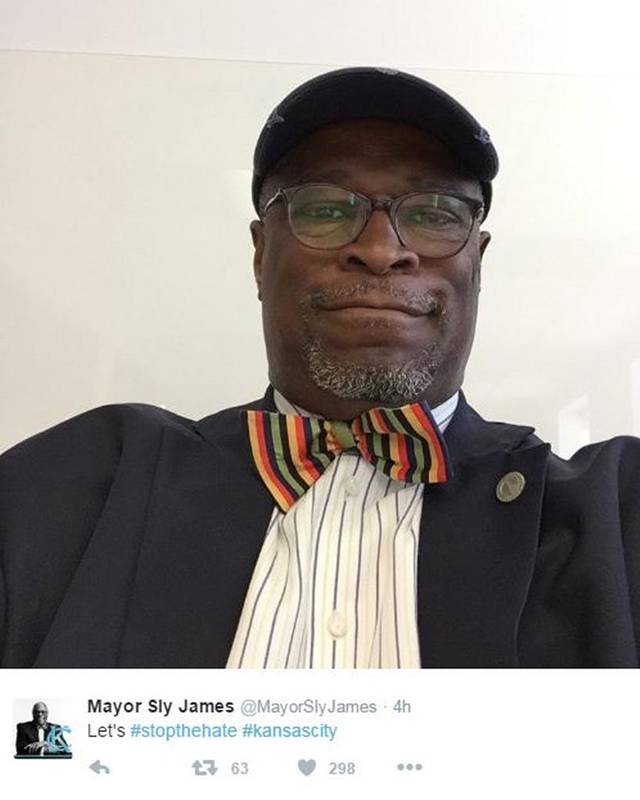
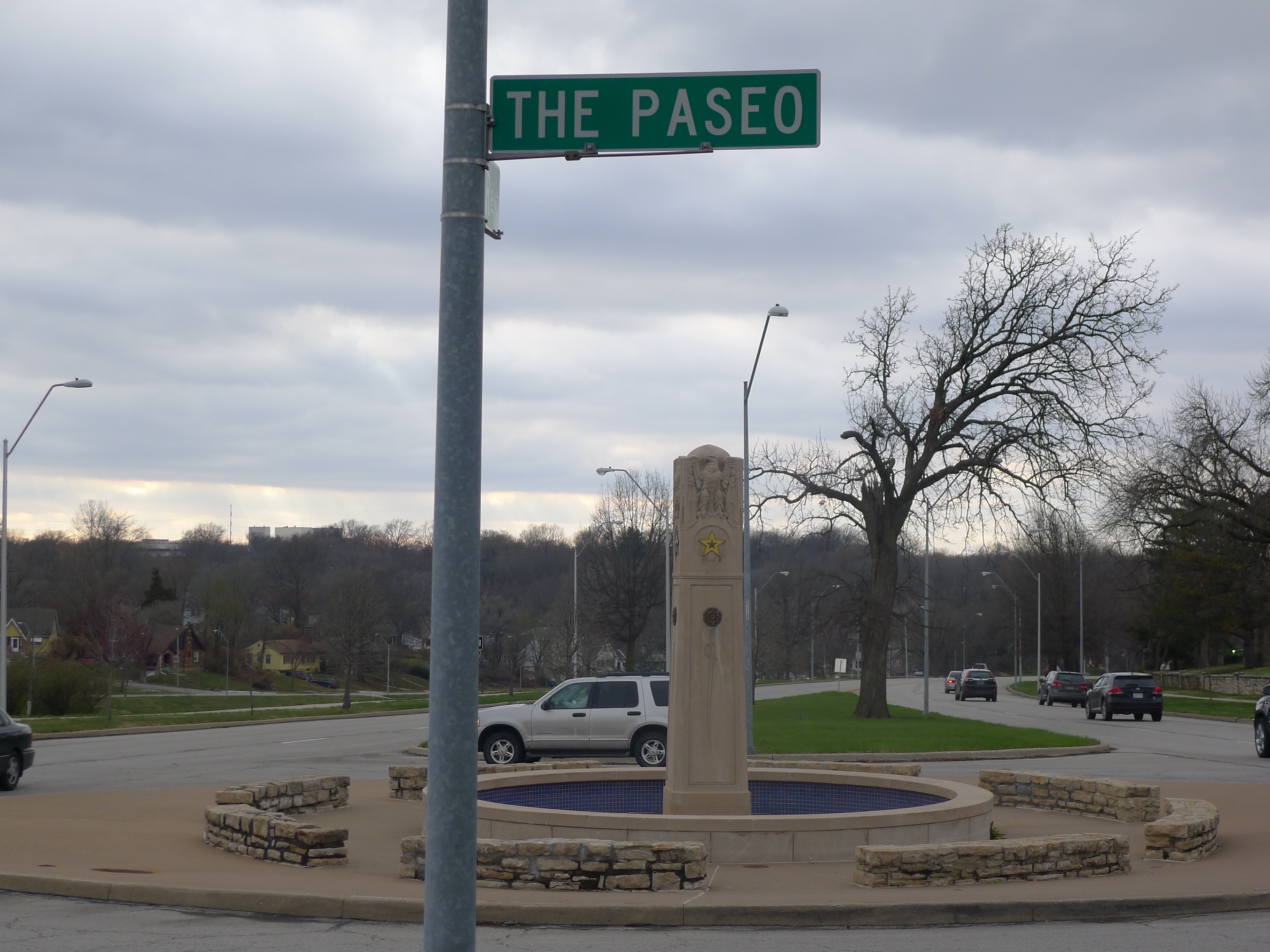
Just as I suspected, Mayor Sly James is not going to be bullied by the ministers and black political leaders, and he opposes renaming The Paseo after Martin Luther King Jr.

After James issued a news release yesterday saying he would be announcing today a commission to determine how to honor King in an appropriate way, The Star’s Bill Turque interviewed the mayor about the issue.

The interview is the subject of the lead story on The Star’s website this morning.

The mayor told Turque he was convinced there was a more meaningful way to honor King than name a street after him — especially a street in what is largely a black residential area.

Among other things, James said:

If Martin Luther King was fighting for equity, inclusion, equal rights and dismissal of segregation, then I think we ought to find a way that does something that actually honors that legacy, as opposed, frankly, to just automatically renaming a street in a segregated part of town and creating yet another dividing line.

…I just don’t know how that honors Dr. Martin Luther King. I don’t say that having a street named after him isn’t an honor. But I’ve been to other cities where there are MLK streets. None of them are in any parts of town that have any economic activity or anything going on that I’ve been able to see. And I just don’t know how that honors the man.
Then he brought down the hammer on those who are advocating the change and — more significantly — have indicated no willingness to compromise.

“The idea of talking about this, which is to some extent a racial issue, is something the city should have a conversation about, instead of having an ultimatum about.”

With those words, James has probably killed the proposal: It doesn’t have a chance of getting through the City Council or past the voters without buy-in from the most popular mayor KC has had at least since H. Roe Bartle more than 50 years ago.

So, today it’s Bravo, Mayor James! You are right on target, and again you have shown exceptional courage in standing up to the fearsome Freedom Inc. and a bull-headed band of black ministers.

I doubt if there’s a handful of people in Kansas City who don’t favor honoring Dr. King in a major way, but I think the vast majority of city voters will trust James’ judgment over that of a self-centered group of people who are acting like kids refusing to share the ball in the schoolyard.

A press release issued this afternoon strongly signals that Mayor Sly James does not support the proposal — being pushed by a group of black political leaders and ministers — to rename The Paseo after Martin Luther King Jr.

In the release, James said he would announce tomorrow the appointment of “a special group of trusted community members” who would be charged with recommending an appropriate Martin Luther King Jr. designation somewhere in the city. The release does not mention The Paseo.

The release goes on to say, “James will ask the group to engage the broader community to find a solution that truly honors Dr. King and his ideals of equity and respect and aligns with the city’s long-term planning goals and vision for an inclusive community.”

The mayor will make his announcement at 1 p.m. at the Bruce R. Watkins Cultural Heritage Center, Blue Parkway and Cleveland Avenue.

In a related development, the group advocating the name change has postponed a march and rally that was scheduled to be held tomorrow afternoon. The march is now scheduled for a week from tomorrow.

…I’m not sure what all this means, but it seems like a momentum stopper for the group advocating the name change. That’s good news for those of us who oppose changing the name of The Paseo, which legendary parks figure George Kessler named after Paseo de la Reforma, a thoroughfare in Mexico City.

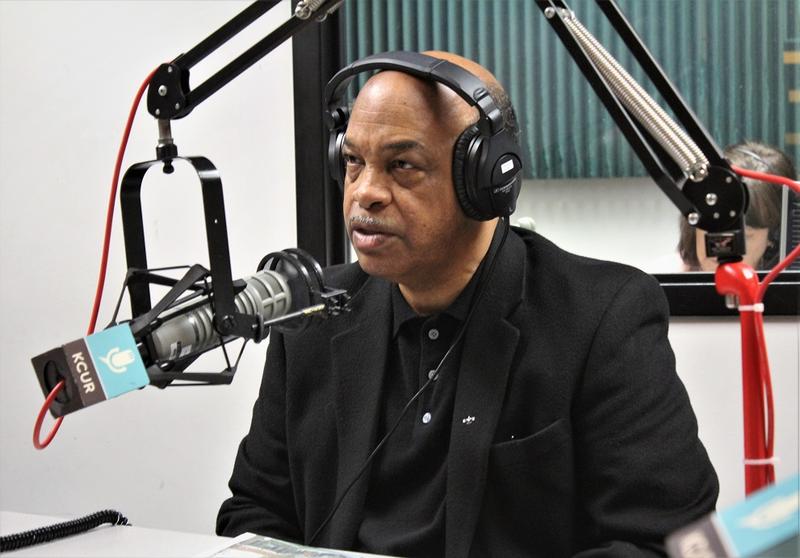
Ken Bacchus, on KCUR’s “Up to Date” on Tuesday

Black leaders say they’ve been pushing the name change for a couple of years, yet the first significant story about it didn’t appear in The Kansas City Star until last weekend. The lack of earlier publicity about the effort suggests to me it is something of an ambush by the advocacy group, which includes former City Councilman Ken Bacchus, U.S. Rep. Emanuel Cleaver and Rev. Vernon Percy Howard, president of the Kansas City chapter of the Southern Christian Leadership Conference.

Reporter Bill Turque’s weekend story said the group planned to start an initiative petition to place the issue on the August ballot. The Star’s editorial board quickly endorsed the idea and predicted voters would approve such a proposal.

(Late this afternoon, The Star’s Steve Kraske posted a commentary related to the issue.)

I’m skeptical that voters would embrace a name change for The Paseo. I think it would be very controversial.

In a Tuesday post, I came out strongly against the proposed name change and suggested that a less historically prominent boulevard or parkway, such as Linwood Boulevard, be named after King. In addition to a few members of the public, one former KC Star reporter and one current reporter weighed in on the subject in the comments section.

Former federal courts reporter Mark Morris, now retired, suggested renaming Main Street after King. (I presume he meant the most prominent section of Main, between the Missouri River and the Plaza.)

Morris wrote: “It’s a great street, loaded with diversity, and burdened with the dullest possible name.”

That’s a good idea.

Campbell, who covers the parks department, wrote:

“My objection to renaming the Paseo is its historical importance to Kansas City, the parks and boulevard system and the City Beautiful movement. I think Linwood is an excellent alternative, also graceful and mainly residential.”

The City Beautiful movement Campbell referred to was George Kessler’s 1893 report on the city’s topography, traffic patterns and population growth. Part of his philosophy was to raise to prominence the city’s most scenic roadways. His report became the foundation of the parkway and boulevard system, and The Paseo became Kansas City’s first boulevard.

**

Today, I heard yet another good alternative…A friend, Jack Holland, a civic and visual-arts community activist, suggested the possibility of combining the names of Dr. King and The Paseo. He proposed either Paseo Martin Luther King Jr. or Martin Luther King Jr. Paseo.

I could buy either of those. One meaning of the word “paseo” is parkway or boulevard, so it would fit like a glove. All that would be lost is the word “The,” and we’d gain a fitting, lasting tribute to Dr. King.

Late this afternoon, I sent an email to Ken Bacchus, the former city councilman involved in the name-change push, to solicit his thoughts on Holland’s idea.

He didn’t say no, and he didn’t say yes. He said he was out of the city and suggested we talk in a few days.

All in all, I think we may be headed away from confrontation and away from a divisive and potentially nasty election campaign.

Happily, it appears the spine of Kansas City’s boulevard system is less in danger of losing its name.

And once again, I applaud Sly James’ independent thinking and refusal to be cowed by special interest groups.

Ole!

And now…back to that nearly 2-week long trip Patty and I took along the Adriatic.

The trip centered around a nine-day cruise on the Viking line, but most members of our traveling group tacked one or more days on at the front end, Venice, and the tail end, Athens.

We generally cruised at night, docked in the morning and had several hours on shore at each stop along our journey. Viking offered a variety of shore excursions, some of which were included in the basic cruise fee and some of which were extra. Patty and I stuck with the included excursions, which usually lasted two to three hours and allowed a few more hours for individual exploration.

Just to get you oriented, here’s a map of the Adriatic, showing our starting and ending points and the countries in between.

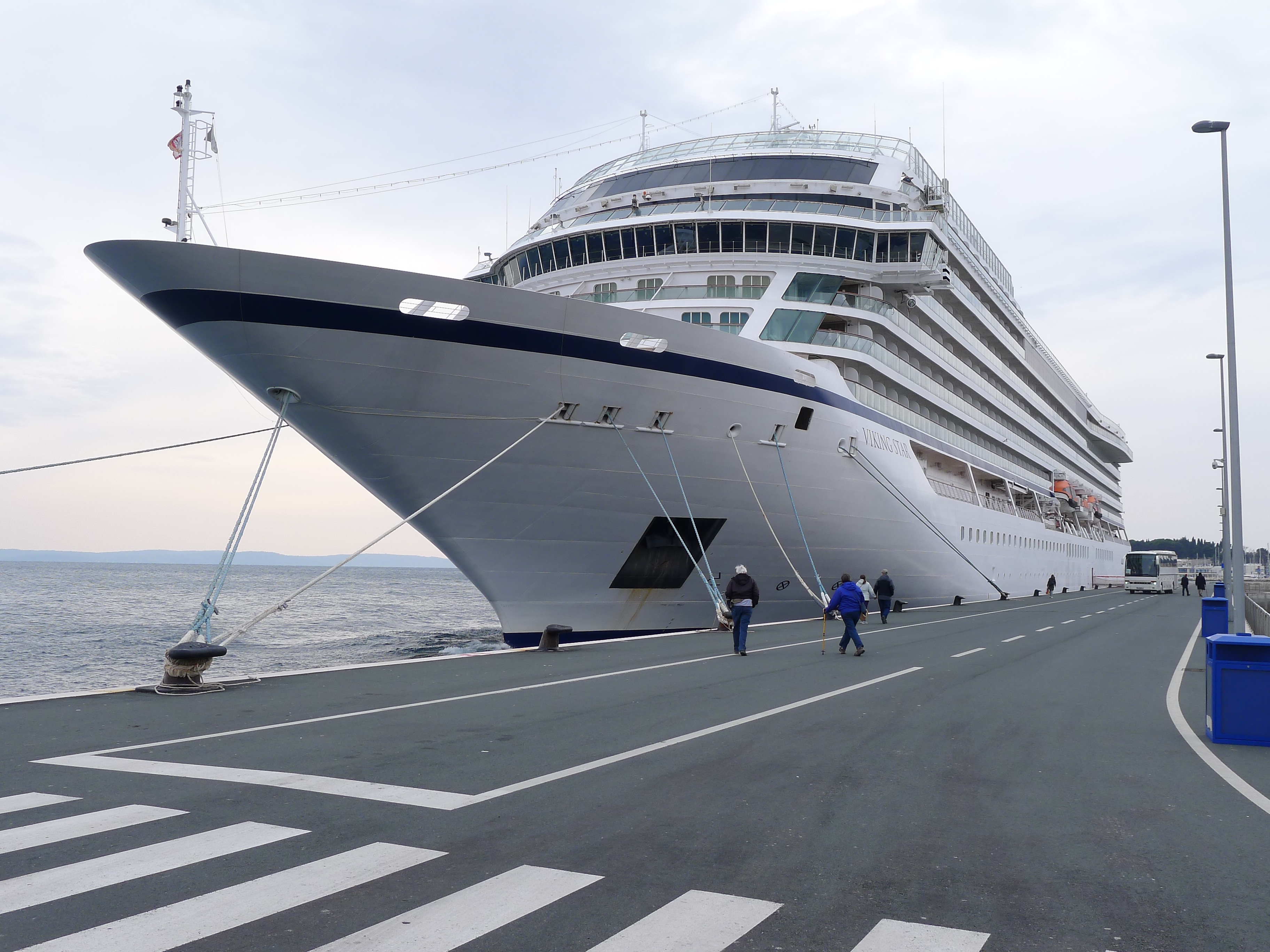
Here’s a photo of our ship, the Viking Star, which carried about 950 passengers and about half as many staff members. (I never saw so many employees smile so much and be so unfailingly cheerful. Viking has trained them well and must be paying them well.)

Here’s a group photo, which a member of our party set up on board the ship and asked someone in the bar to take. Patty and I are second from the top. (We know all of these people from our former church, Saint Andrew Christian Church, Olathe.)

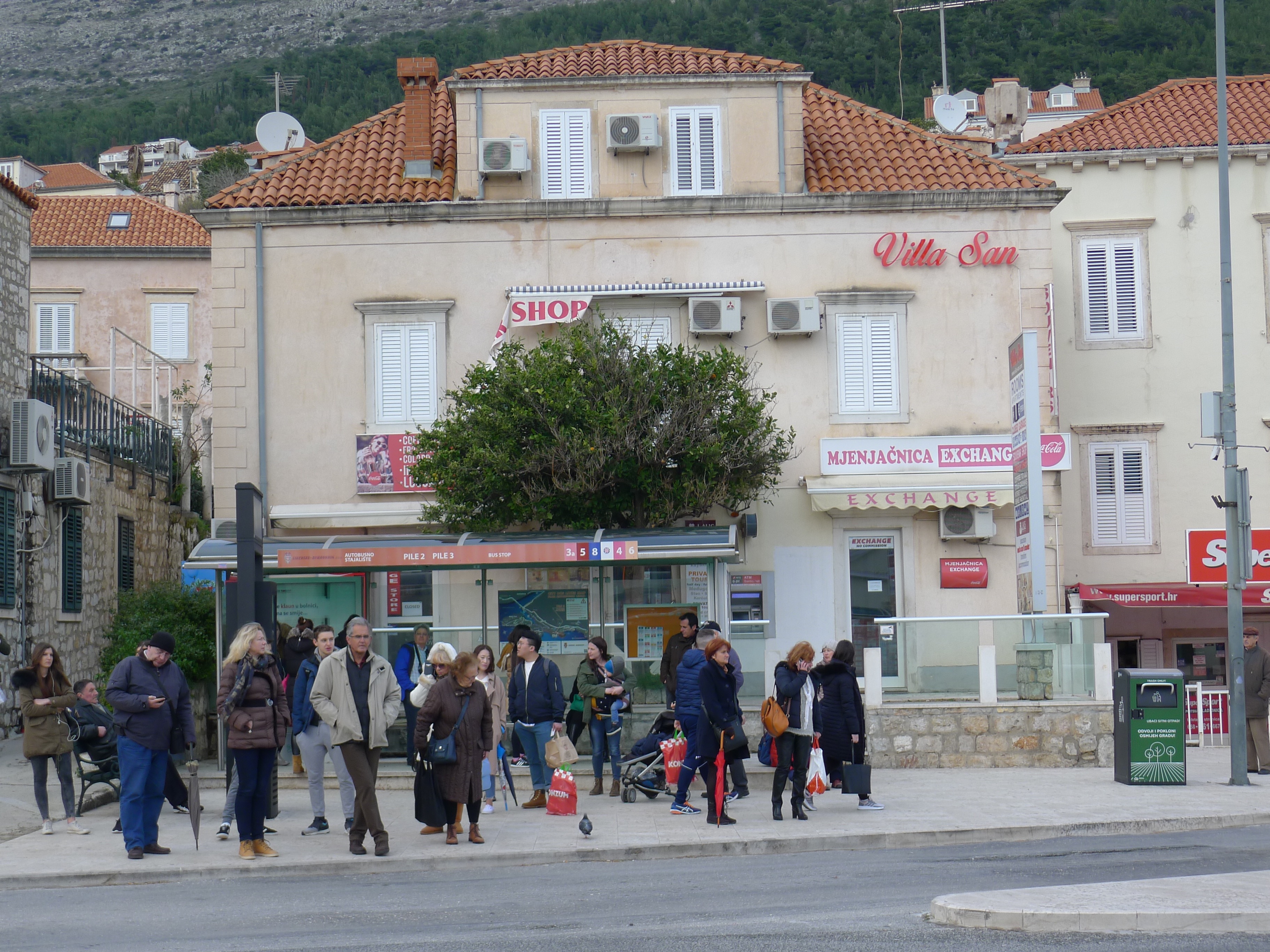
One of the most scenic places where we stopped was Dubrovnik, which is at the southern tip of Croatia, just north of Montenegro. In 1991, after the break-up of Yugoslavia, Dubrovnik was besieged by Serbian and Montenegrin soldiers of the Yugoslav People’s Army and suffered significant damage from shelling. After repairs and restoration in the 1990s and early 2000s, Dubrovnik emerged as a top tourist destination.

With that, here we go…

From below, a section of the towering, old walls that encircled the city

Another view of the walls, this one from a spot along the top. (It was an arduous ascent for several of us, including me, with one replaced knee and the other one needing to be replaced.)

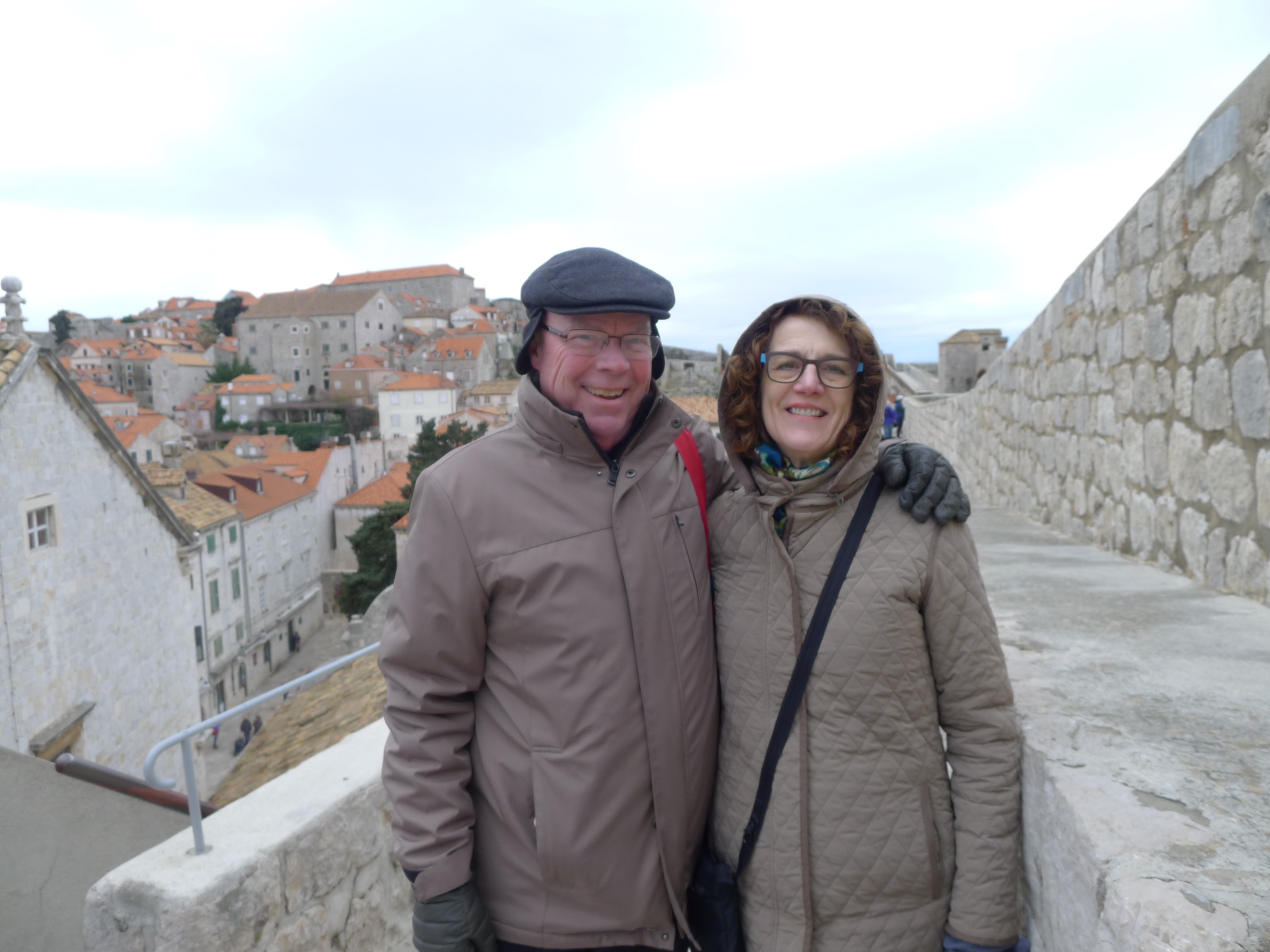
But here we are, happy and on high.

Looking down on “Main Street”

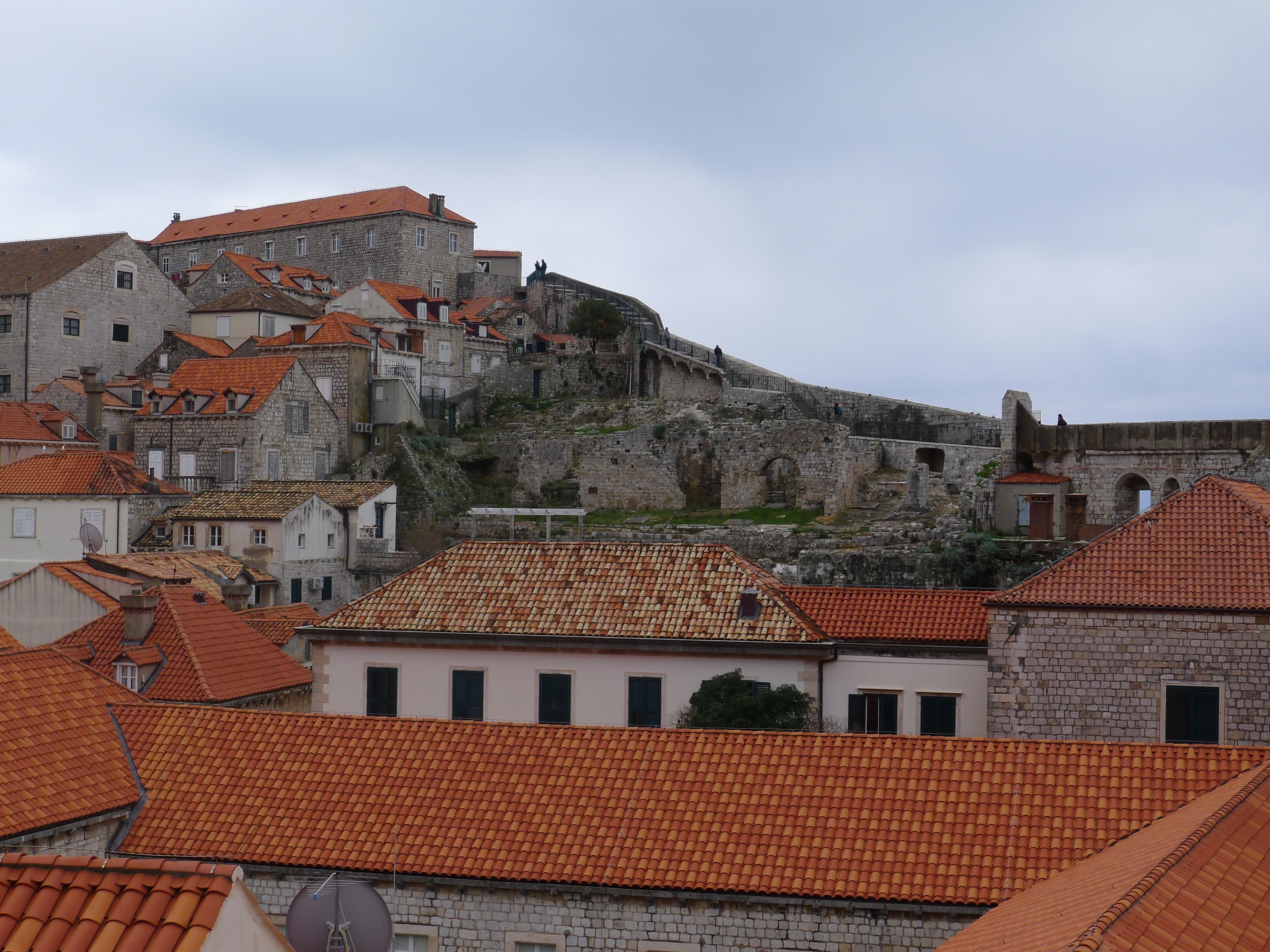
Red rooftops

An inlet

Part of the city outside the smaller, enclosed city

The entryway to the old city

Here’s one I’ll let you try to figure out.

One of those capricious shots I’m fond of — and always looking for

Jodi Dinkins, one of our traveling party, in her new hat…

And with that, today’s installment of “Cruisin’ 2018” is a wrap.

I arrived in Kansas City on a rainy September night in 1969. I had driven all day, mostly in the rain, from my hometown of Louisville, KY, and didn’t have an apartment or a place to stay. All I had was a suitcase and a job with The Star, which I was to start in a few days.

I found a Travelodge downtown and asked if a room was available. Sorry, the desk clerk told me, no vacancies. When I asked for suggestions on where I might get a room, he said, “You might try the Admiral Motel over on The Paseo.”

“On what?” I said.

“The Paseo,” the clerk repeated. “It’s a boulevard divided by a median.”

I had never heard of a street with the word “the” preceding its name, and I had never heard a name like “Paseo.”

(I learned within the last few days it is named for an iconic Mexico City thoroughfare called Paseo de la Reforma.)

The clerk gave me directions, and I drove over to Admiral Boulevard and The Paseo and spent my first night in KC at the Admiral Motel, which last year was renovated and converted to a Rodeway Inn.

Since that first night, I have always loved The Paseo, not only for its distinctive and elegant name but also for its wide and grassy median, its smooth-flowing traffic patterns and the variety of neighborhoods it cuts through.

And so it is with a sense of propriety that I oppose the effort by black political leaders and a group of black ministers to change the name of The Paseo to Martin Luther King Boulevard.

Near Research Medical Center

This has quickly become a contentious issue. The Star’s Bill Turque, who covers City Hall, had a front-page story on it over the weekend, and today three black community leaders spoke about it on Steve Kraske’s “Up to Date” show on KCUR-FM.

On Friday, advocates of the name change will stage a march and a rally to promote the cause. The march is scheduled to start at 5:30 p.m. at 34th and The Paseo. It will proceed north to 27th Street and end at Prospect Avenue, where U.S. Rep. Emanuel Cleaver will be the lead speaker.

Before going any further, I want to say I am totally in favor of renaming a boulevard or parkway after King…just not The Paseo. My preference — which I suggested in an email to Kansas City Parks and Recreation Department Director Mark McHenry yesterday — is Linwood Boulevard.

Unlike The Paseo, Linwood is not a distinctive name with intrinsic appeal. It is, however, a major east-west boulevard, stretching from Van Brunt Boulevard on the east to Broadway on the west. In addition, because of its east-west layout, Linwood (or Martin Luther King Jr. Boulevard) would be seen and traveled by a wider cross-section of Kansas City residents. In straight language, as I told McHenry, “it would get greater exposure to white and Hispanic people than The Paseo would.”

The Paseo, as you know, runs north and south on Kansas City’s East Side, where a majority of Kansas City’s African-American population lives.

**

The main reason this issue has mushroomed into a controversy is that the Kansas City Board of Parks and Recreation Commissioners, which oversees the Parks Department (which has jurisdiction over the city’s renowned parkway and boulevard system) has mishandled the matter.

In a March 23 letter to two black leaders, Park Board President Jean-Paul Chaurand wrote that long-standing naming policy is to honor only those “who have made significant and outstanding contributions of land, funds, goods or services” to the city or park system.

Chaurand went on to say the park board “believes wholeheartedly the work and legacy of Dr. King merit recognition and gratitude,” and he suggested the establishment of a “citizen-based commission to develop, examine and recommend how best the city can pay tribute to Dr. King and his legacy.”

All I can say about that is…worse than lame.

Chaurand should never have said the policy is to honor people who have made significant contributions to the city or park system. That is incredibly short-sighted.

Martin Luther King Jr.’s legacy supersedes any parochial barometer such as whether he personally made a significant contribution to the city or the park system. Hell, he changed the course of the nation and deserves to have a thoroughfare or major building named after him in every major U.S. city!

Compounding the problem is that Chaurand has now apparently decided to duck the issue publicly. Turque was not able to reach him for his story, and he didn’t respond to Kraske’s attempts to get him to appear on, or at least speak by phone on, “Up to Date.”

On the plus side, McHenry, the Parks Department director, opened the door for a compromise in his email to me and also in a conversation we had this afternoon.

For this post, I’ll stick to what he said in the email, which was…

“We agree a major thoroughfare does warrant bearing the name of Dr. King. This has been said to the individuals making this proposal on more than one occasion.”

Regarding my suggestion that Linwood would be a good alternative, McHenry wrote…

“Linwood Boulevard has been suggested for the exact reasons you have mentioned, along with a couple other east/west streets.”

**

The process of honoring Martin Luther King Jr. by naming a boulevard or parkway after him would have been smoother and more amicable if not for Chaurand’s ill-advised March 23 letter. What he did was hand black ministers and black political leaders a megaphone they are now using to bellow that the Park Board is insensitive to and unappreciative of King’s legacy.

The letter gave Paseo-name-change advocates a reason to rail and chant, march and rally, and stir the cauldron of emotions.

That is regrettable, and I hope it doesn’t result in a name change for a very special boulevard, one I have had a strong sentimental attachment with the last 49 years.

As often happens in criminal cases, the scheduled trial in southwest Missouri of David Jungerman has been delayed.

Despite the Kansas City Police Department’s guarded official position regarding Jungerman — that he is not a suspect “at this time” — I believe the 80-year-old Raytown resident is authorities’ one and only suspect in the October slaying of Kansas City lawyer Thomas Pickert.

Jungerman was questioned the day of the slaying, but no charges have been filed.

The southwest Missouri case, in which Jungerman is charged with attempted burglary and harassment, had been scheduled to go to trial this week.

Two developments changed that. First, Judge David Munton decided that another long-standing Barton County case needed to be tried first, and, second, Jungerman was charged last month with several new felonies in Jackson County, somewhat complicating the southwest Missouri case.

David Jungerman, in recent Jackson County Detention Center photo

After the Jackson County charges were filed, Judge Munton revoked Jungerman’s $15,000 bond in the attempted burglary case and ordered him held without bond.

Jungerman, however, is entitled to a hearing on the revocation, and that is now scheduled for Thursday, April 12, at the Barton County Courthouse in Lamar, MO.

A new trial date has not been set.

…As you know, my main concern (and I’m sure this is true for many of you) is seeing Jungerman remain behind bars. In the Jackson County case, a judge set his bond at $1 million, and he has been in the Jackson County Detention Center since Thursday, March 8.

The fact he has been in custody the last three-plus weeks is a good thing. But if Judge Munton should agree to reinstate or raise the bond in the Barton County case, Jungerman seemingly would have the opportunity to post bond not only in Barton County but also in Jackson County.

Remember, Jungerman is a multi-millionaire, and I would think he would be able to come up with $1 million cash bond or the going rate of 10 percent — $100,000 — if he went through a bonding company.

I’m sure the delay in the southwest Missouri case, which has been pending since June 2016, is most frustrating to Pickert’s wife, Dr. Emily Riegel, and other family members, including their two young sons, whom Pickert had just walked to school before being gunned down.

Pickert was shot in his front yard — very likely by someone firing from a rifle inside a white van — the day after Jackson County Circuit Court officials had notified him the court would be seizing property to satisfy a $5.75 million civil judgment a jury had returned in favor of a homeless man whom Jungerman had recklessly shot.

Within the space of a month in 2012, Jungerman shot four people — two in each of two separate incidents — who were only guilty of trespassing on his property. He did not face criminal charges in either of those incidents.

In the new Jackson County case he is charged with confronting and shooting at or near a man he suspected of steeling iron piping from his property.

Oddly, Jungerman was on the phone with Kansas City police during the confrontation, even when he fired what he later described as a warning shot at the victim.

David Jungerman is a very dangerous and unstable man who believes in resolving disputes in his own way, that is, with guns and without police assistance. He needs to remain in custody — now and until he dies.

The last time I had been to Venice was 51 years ago, when I was on a European tour with a group of college students, and all I remember from that trip was being encircled by pigeons in St. Mark’s Square.

I really didn’t even remember the famous square very well. This time it was a lot different.

Venice was the first stop on a recent 10-day cruise that took us down the east coast of the Adriatic, starting in Venice and ending in Athens. Very wisely, we tacked on an extra, non-cruising day in Venice and an additional day in Athens.

On the cruise — Viking line, which a few years ago added sea cruises to its well-known river excursions — we were with 10 other people, all of whom we know through a church we formerly attended in Olathe. (Why we went to church in Olathe is a long story; suffice it to say it was a rewarding experience for the several years it lasted.)

I’m going to be bringing you at least two more sets of photos, but today’s post is dedicated solely to Venice, which tour-book author Rick Steves calls “a fantasy world” unlike anything first-time visitors have ever seen.

Steves sums it up this way:

“The island city of Venice (population 58,000) is shaped like a fish. Its major thoroughfares are canals. The Grand Canal winds through the middle of the fish, starting at the mouth, where all the people and food enter, passing under the Rialto Bridge, and ending at St. Mark’s Square (Piazza San Marco). Park your 21st-century perspective at the mouth and let Venice swallow you whole.”

Before starting in with the photos, here’s a map of that “fish” and its grand canal. (St. Mark’s Square is at the bottom of the “S” shaped canal.)

Now, here are the photos…

St. Mark’s Basilica is the most prominent landmark on the square. When it rains in Venice, the water rises into the square — as well as in the city’s narrow streets — and portable platforms are set up to help people keep their feet dry.

To some people, mostly the young, the water doesn’t pose much of problem.

Here’s some of our group, including Patty (tan coat), huddled under an awning.

Plastic pullovers — of feet — are a popular product, even at an outrageous 10 Euro (about $12) a pair.

The cold, rainy weather kept the gondola business down, but they sure are a beautiful sight.

One of Venice’s many “side streets”

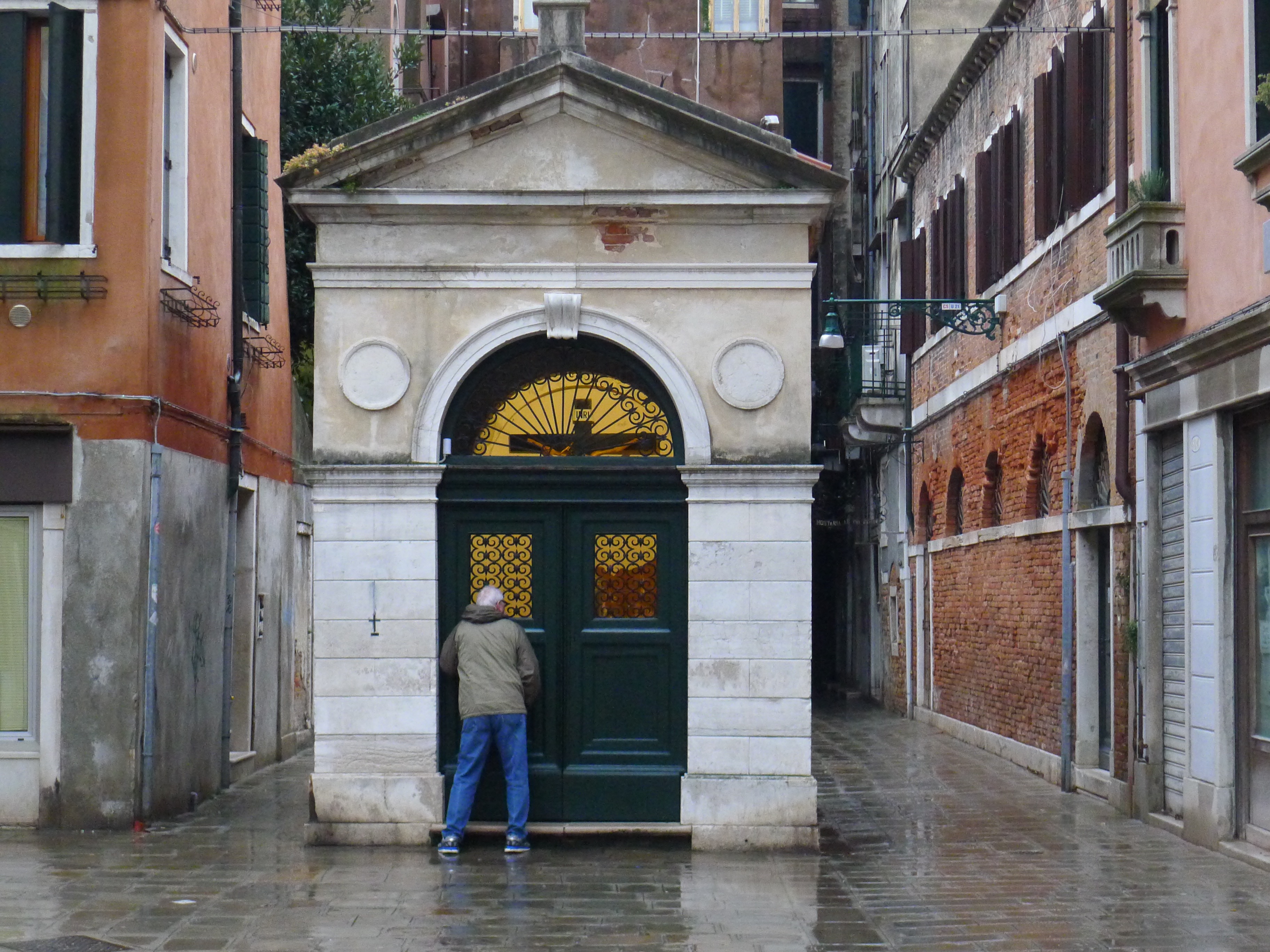
Ron Darst, a member of our group, took a close look at what, I guess, is a tiny chapel.

Many fine homes line the Grand Canal.

Personal vessels, public transportation “buses,” gondolas and delivery “vehicles” compete for space in the canal.

Another St. Mark’s Square landmark is the Campinile bell tower. (That’s a shuttle boat in the foreground.)

Street view from a bridge near St. Mark’s Square

Along the waterfront, also near St. Mark’s Square

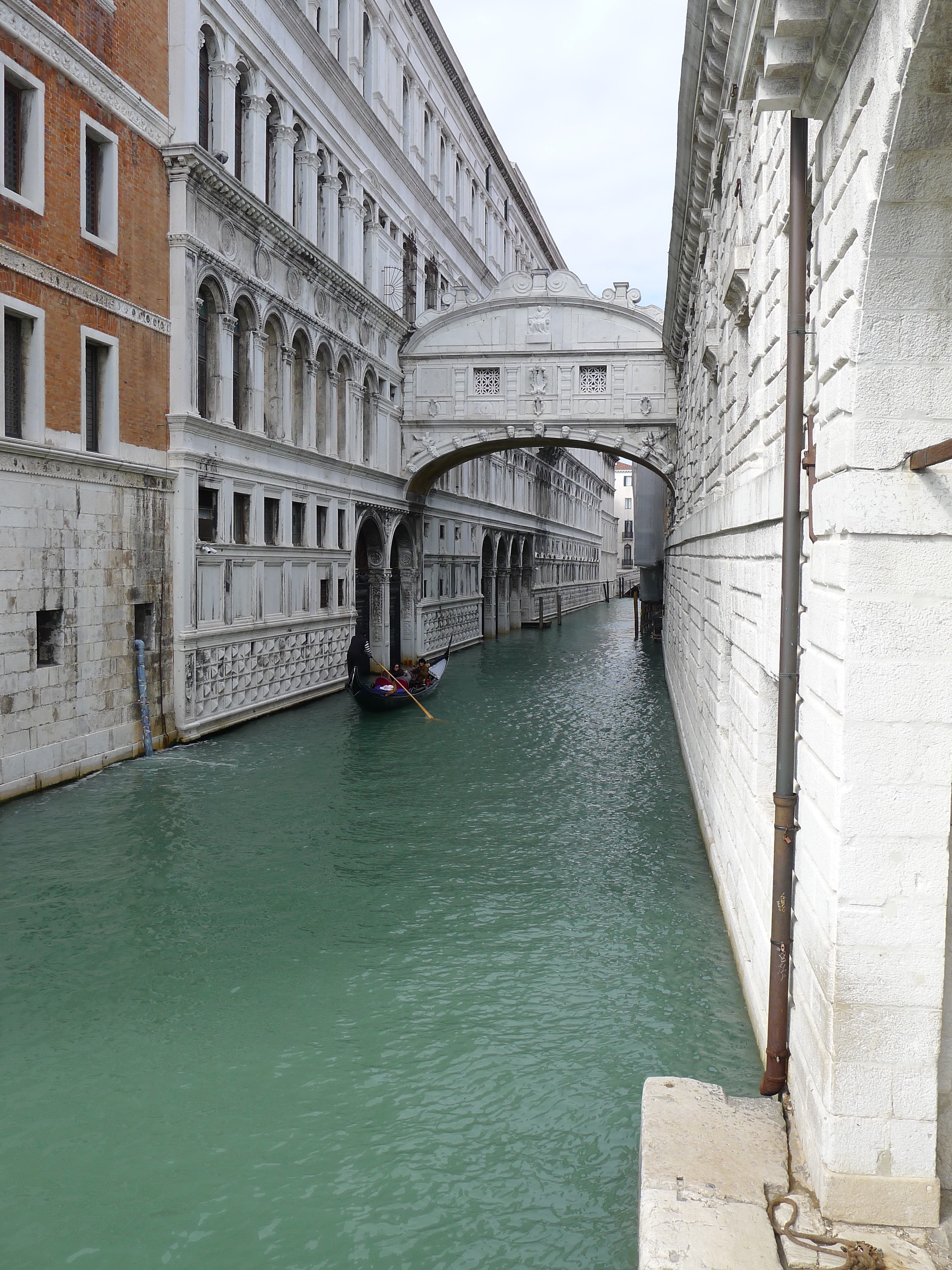
The Bridge of Sighs, so named because it was the last view of Venice that convicts saw before taken down to their cells. (I’m guessing the prison was the building on the right.)

The Rialto Bridge is the oldest of the four bridges spanning the Grand Canal. The stone bridge, with the unusual design of two inclined ramps with a central portico, was completed in 1591. A similar bridge made of wood preceded the stone version.

The centerpiece of this bookstore we stumbled on was a volume-filled gondola. At left is one of the members of our traveling group, Ray Brown.

A side street at dusk

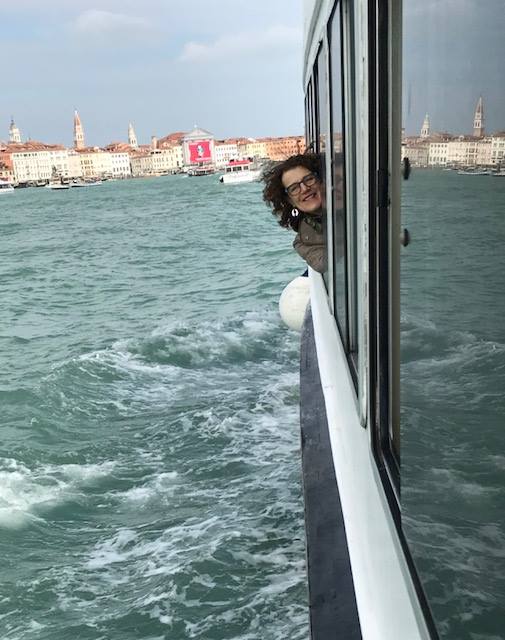
We leave Venice with this creative photo (compliments of Linda Brown) of Patty on a shuttle boat.