Feeds:
Posts
Comments

It’s starting to look like Jackson County Executive Frank White is not only paddling in political waters too choppy for him but also that his inability to manage his personal finances has indebted him to people who could take advantage of him and the taxpayers.

Hendricks

Vockrodt

Those are the two obvious conclusions from the latest Jackson County political expose produced by the kick-ass, KC Star team of Mike Hendricks and Steve Vockrodt.

Two weeks ago, the same reporters blew open a kickback scheme involving former County Executive Mike Sanders, and today they notched another huge scoop with a story about a prominent Independence attorney bailing White out of a mortgage jam last year.

The gist of today’s story is White and his wife Teresa had fallen so far behind on the mortgage payments on their Lee’s Summit home that it was scheduled to be sold on the courthouse steps in April 2016. Hendricks and Vockrodt reported that Ken McClain, a lawyer and who owns or co-owns much of the Independence Courthouse Square, “provided the funds to catch White and his wife up on their mortgage.”

McClain’s involvement was hidden, however, because he has direct business dealings with the county. First, the county rents office space in a building McClain owns on the Square and, second, the county allows McClain to house part of his art collection, free of charge, in the Independence Courthouse.

So, rather than write the check himself to cover the Whites’ back mortgage, McClain got another lawyer to provide the money, Hendricks and Vockrodt said.

Under terms of a new, five-year lease that took effect earlier this year — and which White presumably approved — the county is paying McClain $56,888 a year for the space in the Courthouse Square building. Before that, McClain was paid $49,869 a year.

**

Perhaps as troubling as White’s compromised position in regard to McClain is his inability to manage his personal finances. He had a big-paying, front-office job with the Kansas City Royals until early 2011, when the Kansas City Royals decided to cut his pay because he was giving the team less time due to broadcasting Royals games on Fox Sports. Rather than take the pay cut, White quit, but then later that year he also lost his broadcasting job when Fox Sports did not renew his contract.

Still, he had made very good money when he was playing for the Royals — $1.15 million his final season, 1990 — and as county executive he has been earning a salary of $145,000 a year. In addition, Hendricks and Vockrodt, he was eligible for a Major League Baseball pension of more than $9,000 a month, or more than $108,000 a year, and he has a sales and marketing job with a roofing company and is a paid spokesman for a non-profit agency.

Hendricks and Vockrodt did not report this, but White was previously divorced, and that certainly could have had a significant bearing on his financial situation. Nevertheless, it seems almost certain he and his wife were living beyond their means when they fell behind on their mortgage payments.

**

Now, everybody loves Frank White. He and George Brett are the greatest two players in team history. Each is memorialized with a statue at Kauffman Stadium, along with legendary manager Dick Howser. White was an outstanding commentator while he was with Fox Sports, and he is — or was — first base coach for the Kansas City T-Bones.

That said, the last thing you want in an elected official who is overseeing millions of dollars in taxpayer money — besides being a straight-out crook — is someone who can’t manage his personal finances. This is a bad situation, and it might cost him his job; it will make him vulnerable if he hopes to be re-elected in 2018.

In any event, congratulations are in order to The Star and the team of Hendricks and Vockrodt. Their two Jackson County exposes, along with the paper’s series on secrecy in Kansas government and its hammering on Missouri Gov. Eric Greitens’ clandestine ways, are making for a pretty merry Christmas at 17th and McGee.

**

Note: A point of particular interest to me in today’s story was Hendricks’ and Vockrodt’s reporting that the late James B. Nutter Sr., political kingmaker and mortgage banker, had refused to bail out White, whom Nutter had supported politically. Even though Nutter’s company didn’t hold the mortgage — it was through U.S. Bank — White sought help from Nutter.

Nutter

Nutter probably contributed millions of dollars to political candidates during his lifetime, but from what I’ve seen and read he always played it very straight on mortgages. In White’s case, Nutter drew the line between political supporter and financial savior. He did the same several years ago after former Kansas City Mayor Charlie Wheeler fell behind on his mortgage payments.

Nutter, whose firm held that loan, gave Wheeler a lot of latitude but ultimately foreclosed on the home on West 53rd Street, near Loose Park. Nutter sold the home to an out-of-state company. The home was under renovation for years but remains unoccupied.

I knew Nutter very well and was always impressed with his honesty and above-board dealings with politicians. His main interest in contributing to candidates was not generating more money for himself but seeng elected to public office candidates he believed would work for the betterment of Kansas City, Jackson County and Missouri.

Nutter died in July at age 89, but his legacy of integrity and commitment to community endures.
Sometimes the “oldies” seem to jump up out of nowhere and grab me.

That was the case last night when Patty and I were at another couple’s house and were introduced to the TV series “The Marvelous Mrs. Maisel,” which is available on Amazon. The show is set in the 1950s, and one scene was set to the backdrop of one of my favorite songs, “Teach Me Tonight.”

Many artists have recorded the song, but the best version — the one that reached the highest rank on the pop charts, No. 2 in 1955 — is by The DeCastro Sisters. And that’s the one, wisely, the creators of “The Marvelous Mrs. Maisel” used in that scene.

My heart soared when I heard the first notes of that song, and I was disappointed it was such a brief cut. But no problem; I’ve got it on vinyl…45 RPM. (And, yes, by all means, I do have a working turntable!)

So today I went down to the basement and dug out several 45s that were at the front of a plastic crate, otherwise filled with 33 RPM records.

With the able assistance of YouTube, I’d like to play some of those songs for you now.

We’ll start, of course, with “Teach Me Tonight.” It was written by Gene De Paul, with lyrics by the incredible Sammy Cahn, who wrote the lyrics to dozens of memorable songs, including two big Sinatra hits, “Call Me Irresponsible” and “Love and Marriage.”

Here you go…

“Starting with,
The a-b-c of it.
Right down to,
The x-y-z of it.
Help me solve the mystery of it.
Teach me tonight.”

**

Now let’s pick up the pace and go to a song I bet you haven’t heard in years, maybe decades — “Bony Moronie.”

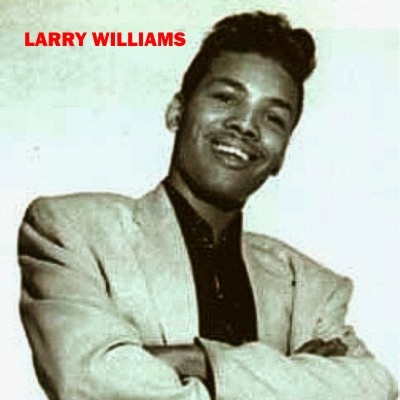
Written and recorded by Larry Williams on the Specialty label, it peaked at No. 14 on the Billboard Hot 100 list in 1957 and got to No. 4 on the R&B chart.

Williams, from New Orleans, was a longtime friend of Little Richard. The Beatles and several other “British Invasion” groups recorded some of Williams’ songs. According to Wikipedia, “Williams’ life mixed tremendous success with violence and drug addiction.” He died at age 44 of a gunshot wound to the head…very likely self-inflicted but “there was much speculation otherwise,” according to Wiki.

“I want to get married on a night in June,
And rock and roll by the light of a silvery moon”

**

Next up is a Roy Orbison classic, “Blue Angel.” It will always be special to me because I got my first kiss to it at a party in a schoolmate’s basement when I was in high school. The girl’s name was Sharon Bridger. We were dancing behind a sheet that was hung out on the line, and somehow, magically, our lips found each other’s. In 1960, “Blue Angel” rose to No. 9 on the Billboard Hot 100 list.

“sha-la-la, dooby wah, dum-dum-dum
yeh-yeh, um, wah-wah-wah-wah”

**

Dionne Warwick and Burt Bacharach were a phenomenal musical team, and one of their big hits was “Alfie,” written by Bacharach and Hal David to promote the 1966 movie by the same name. Wiki says the composers weren’t keen on writing the song because, in David’s words, “Writing a song about a man called ‘Alfie’ didn’t seem too exciting at the time.” The inspiration for the song’s opening words was a line in the film uttered by lead actor Michael Caine: “What’s it all about?”

The song got to No. 32 on the Billboard Hot 100.

“And if only fools are kind, Alfie,
Then I guess it is wise to be cruel”

**

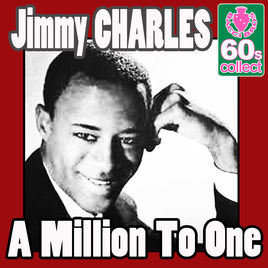
A personal favorite of mine — can’t really tell you why, except I love most of the old the droopy drawers songs — is “A Million to One” by Jimmy Charles and The Revellettes. It was written by Phil Medley, better known for co-writing “Twist & Shout,” which both The Isley Brothers and The Beatles had hits with.

“A Million to One” was released in 1960 and topped out at No. 5 on the Billboard Hot 100.

Interestingly, most of the sites I went to for the lyrics said that one stanza goes like this…

“They’re betting everything that our love won’t survive
They’re hoping
(Hoping)
In time we’ll forget
Each others’ lies”

But that last line makes no sense. For 57 years I’ve been singing it like this “…each other’s alive.”

If Medley was alive — he died at age 81 in 1997 — I’m sure he’d set the “record” straight.

Hope you enjoyed the show! Tell me about some of your own favorites…

For the first time since the city’s renewed effort to get a new KCI got underway, Mayor Sly James has broached the prospect of having to start over on the selection of a contractor.

At 11:01 a.m., James sent out an email suggesting that the selection process might be so mired down now that it would necessitate a do-over. Here’s the seminal paragraph in this seven-paragraph notice.

I’m proposing that the City Manager continue engaging in good faith negotiations with Edgemoor and bring back a revised MOU (memorandum of understanding) for City Council consideration. If an agreement cannot be reached, then the City Manager must report back to the Council why an agreement could not be reached, and the process for selecting a developer will start over. At that point, I would propose that the process be open to the public.

This is very significant, partly because James sees closing a deal on a new KCI as the key to his legacy as the mayor who was able to break ground on a new, modern airport. But if he’s serious about starting over, a deal might not be concluded on his watch. (His second and last term ends in early 2019.)

He would have to swallow very hard to allow that opportunity to get away, but he’s so pissed off at the council’s 9-4 rejection of the proposed Edgemoor MOU last week it just might happen.

His threat is a last-ditch attempt to pressure a council majority to resolve its differences with Edgemoor, the airport construction firm city officials selected. As I said in my previous post, however, I don’t think there’s any chance of salvaging a deal with Edgemoor. The Maryland firm has managed to alienate a council majority — partly with a demand for a $30 million “break-up fee” if a final deal cannot be reached — and I think it’s extremely unlikely that three of the nine members who voted against Edgemoor will reverse their positions…That’s what it would take to turn the vote from 9-4 “no” to 7-6 “yes.”

At the same time, I think it’s unlikely that a seven-vote coalition can be put together for the recently engaged team of AECOM and Burns & McDonnell. Burns & McDonnell keeps scratching at the door, but we must remember that after the Council opened the proposal process to firms other than Burns and Mac, its no-bid proposal was shown to be nearly a half billion dollars higher than what AECOM proposed. In fairness, it’s uncertain a final deal with AECOM would have been nearly $500 million less than what Burns and Mac proposed, but it was apparent, in any event, that Burns and Mac was trying to pull off what amounted to a bank heist.

The only way I see Burns and Mac getting back in the picture is if the first round of proposals is thrown out altogether and the city starts afresh, next time starting with getting a design, then taking construction proposals, based on detailed specifications.

I would prefer one more change: Financing the project with city-issued revenue bonds rather than having the construction firm handling the financing.

That would be a significant change, not in the least because it would require a second election. The ballot language from the November election specifically stated the job would be done “without the issuance of general airport revenue bonds unless such general airport revenue bonds have received prior voter approval.”

**

It’s very difficult to predict what will happen from here. The city put itself at the mercy of the construction firms when it agreed to allow them to propose just about whatever they wanted and to finance the project as they saw fit. It was ridiculous, and it shouldn’t surprise anyone that chaos now reigns. We’ve got chaos because, with the city’s backasswards approach, it is negotiating from a position of weakness and the contractors can call the shots.

The best way to get the best deal — a modern terminal with plenty of amenities built at a fair cost — is to scrub the two proposals still on the table and start over. I hope Sly will swallow his pride and do what is in the best interests of the city, which is this:

When the deal with Edgemoor officially falls through, call not only for a redo but also for commissioning an airport design, then taking construction bids and, finally, issuing municipal revenue bonds (the cheapest financing available by far) to complete the project.

Yes, it would require another election, but — you know what — the hardest part is behind us: Kansas Citians demonstrated by a 3-1 ratio they want a new airport.

The atmosphere enveloping the airport issue is full of toxins. For the good of future generations, let’s go all the way; let’s do what it takes to clear the air completely and get this billion-dollar-job done in a way we can be sure the public, not the contractors, will benefit the most.

What had been controlled friction between Mayor Sly James and several City Council members has now erupted into a gaping fissure, and as a result we might be looking at a delay of several years on any contract for a new KCI terminal.

Here’s my take:

:: Edgemoor is out. Finished in KC and at KCI.

:: AECOM has an outside chance of getting the contract, but probably not.

:: Burns & McDonnell remains on the outside looking in but could get back in the hunt if this round of construction proposals is thrown out and if a “friend” is elected mayor.

But with James charging he was the victim of “an ambush” and saying “you can’t lead people you can’t trust,” the most likely scenario now is no airport deal will be accomplished during the last 16 months of James’ second and last term.

I’m not much of a poet, but I’m going to attempt to put into rhyme how we got to this messy juncture:

When without a design a terminal project goes forth
And a deal no-bid points the course
Trouble lurks afore every tenuous step
Until, at last, beckons the murky depth

Reverting to plain prose, here’s what could well unfold over the next few weeks:

A council majority votes to end negotiations with Edgemoor.

Most of the nine council members who all but eliminated Edgemoor on Thursday (the vote was 9-4), come back with a proposal to begin negotiating a deal with AECOM.

A council majority — but probably not a veto-proof collection of nine or more — approves a measure to engage with AECOM.

Sly James vetoes the measure, and council is unable to override.

The prospect of a new KCI goes dormant until a new mayor and several new council members are elected in 2019.

**

Now, let’s look at some of the people responsible for preparing us for a couple of long winters’ naps.

  • Barnes

    Councilman Lee Barnes Jr. Until KCI came along, Barnes had been a low-key, low-profile council member since being elected in the spring of 2015. But he has been openly agitating against Edgemoor and in favor of AECOM ever since the council decided to solicit proposals from firms other than Burns and Mac. Barnes is the leading advocate of a demand for minority contractors to get 40 percent of all subcontracts, as well as 40 percent minority workforce participation. Those are extremely high numbers, probably the highest ever in any big municipal construction project. Barnes would have more credibility on this front were he not carrying water for his pal and political mentor Kelvin Perry, president of the Black Chamber of Commerce of Greater Kansas City. Perry, a businessman, has never held office, has never had to compromise and always holds to a hard line.

  • Adams

    Clinton Adams. Adams, attorney for the black political group Freedom Inc., is in league with Barnes and Perry, railing against Edgemoor. Because Adams has significant influence with Freedom Inc., some of the council members who either are running for mayor in 2019 or are thinking about that possibility are mulling how their positions on KCI could benefit or hurt them in 2019. Adams has a long history of enmity toward James because he thinks James has not put a sufficiently high priority on East Side economic development.

  • Taylor

    Councilman Scott Taylor and Councilman Kevin McManus. Taylor and McManus were among the nine who voted against Edgemoor on Thursday. Both live in the 6th District in south Kansas City. Taylor, an at-large councilman (meaning he runs city-wide, not just within the district) is not only an announced candidate for mayor but far and away the leader in campaign funds. I am convinced Taylor and McManus are firmly committed to Burns & McDonnell, which has its headquarters building in the 6th District, and were greatly disappointed when the selection committee eliminated Burns and Mac from consideration. My guess is that with this situation plunged back into uncertainty, Taylor and McManus will play a chess game aimed at getting Burns and Mac back in the picture. The only way they win this game, though, is if Taylor is elected mayor.

**

Personally, I don’t care if Edgemoor gets the boot. My indifference to the firm goes back to late October, when my homes association, Romanelli West, hosted a pre-election, issue-education session for our members at The Well in Waldo. The campaign committee person I worked with in arranging the event lined up a top-notch trio of presenters: City Manager Troy Schulte, Councilman Quinton Lucas and Stricker, who, as I said earlier, is Edgemoor’s managing partner.

Stricker

The evening of the event, Schulte and Lucas appeared as scheduled and made informative and impressive presentations. Stricker, however, did not show up. I was irked, and so were some of the 50 people who attended. Stricker made no effort that night to contact either the campaign committee or me to extend his regrets or explain his absence. The next day, I got an email from my campaign contact, telling me Stricker had been “taken ill.” I don’t believe it. I think he stiffed us, so screw him.

…As I have said more than once, this long, troubled dance got off to a stumbling, bumbling start. Six months ago, what was needed was a design RFP (request for proposals). After a detailed design was selected and approved, the city could proceed to advertise and accept construction bids — bids that could be compared, if not line by line, at least element by element. Most important, the city would finance the project with revenue bonds, so the city, not the contractors, would be in the driver’s seat.

It still needs to happen that way. So, let’s just back off for a few years, let the bad taste in our mouths recede, and then make another run at a new, single terminal. And next time, right up front, before we get carried away, let’s see what that terminal would look like.

Lamar, Mo. — Local journalists like myself love to have a dateline at the start of stories once in a while because it means one thing: You’ve gotten out of town and reported from the road!

And so it was that the JimmyCsays journalistic juggernaut roused itself out of the comforts of Kansas City and headed down I-49 early this morning for court business related to the case of David Jungerman, the Raytown man who was questioned in the Oct. 25 murder of Kansas City lawyer Thomas Pickert and is separately facing an attempted burglary charge in southern Missouri.

Everyone who has been following the Pickert case is now focused on the attempted burglary case because it appears to be the best chance the state has to get Jungerman off the streets and into prison.

Despite Jungerman having a strong motive to kill Pickert (Pickert represented a client who won a $5.75 million civil judgment against Jungerman last summer) and despite the fact Jungerman has a history of shooting people, authorities apparently do not have enough evidence to charge Jungerman in Pickert’s slaying. Police questioned him, but the interview ended after he requested an attorney.

Stymied on the murder case, the Jackson County Prosecutor’s Office is cooperating with the Vernon County Prosecutor’s Office — Nevada, Mo. — on the attempted burglary charge. The hope is to gain a conviction and get the 79-year-old Jungerman into prison. Fortuitously for the public as well as the Jackson County Prosecutor’s Office, the attempted burglary charge has been hanging for a year and a half, and now authorities hope to get the maximum seven-year sentence against Jungerman, if a jury convicts him.

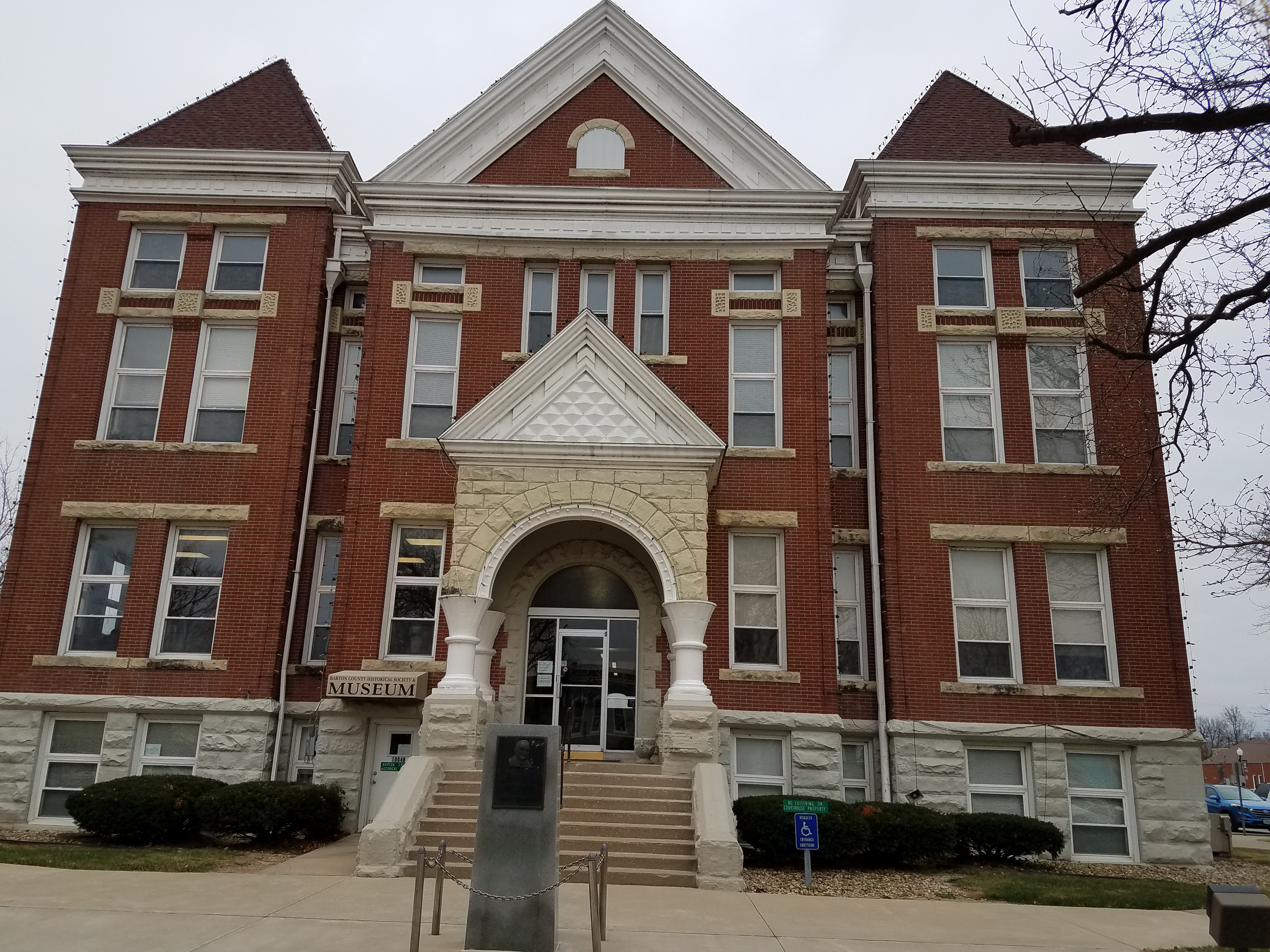
A trial date is not set but appears to be coming early next year. Today a pre-trial conference was held in the Barton County Courthouse in Lamar, where the case would be tried. (Although the Vernon County Prosecutor’s Office is handling the case, it was moved to nearby Barton County last year on a routine “change of venue.”)

**

Barton County Courthouse (JimmyCsays photo)

I said I started out early this morning…but not early enough. The conference was scheduled to start at 9 a.m. at the Barton County Courthouse, and I didn’t arrive until shortly after 10. (If I’d still been working for The Star and had been assigned to cover the case and had missed the conference, I might have been fired, but, you know, I’m on JimmyC time now.)

A bailiff told me the hearing had concluded a few minutes before I arrived. At that point, Judge David Munton, presiding judge of the 28th Judicial Circuit, was hearing subsequent cases. As I’m wont to do, I chatted up various people and found out what had come out of the hearing.

So here’s the development: A hearing was scheduled for Tuesday, Jan. 9, in Vernon County, at which time Judge Munton will take up two motions Jungerman filed recently.

One motion is to dismiss the attempted burglary charge, as well as a misdemeanor charge of harassment.

The other motion seeks the return of a .40-caliber Glock semi-automatic handgun — loaded with hollow point bullets — that Vernon County Sheriff’s deputies recovered from Jungerman’s vehicle the day of the alleged burglary incident, June 28, 2016.

A tenant of Jungerman’s — along with two other witnesses — allege that Jungerman attempted to kick in the door of the tenant’s residence and, while brandishing and touching a gun in his waistband, yelled at the tenant, “When are you getting out of here, you mother fucker?”

From my perspective, it appears Jungerman has zero chance of getting his dismissal motion approved. One reason is that, as in the civil case that resulted in the $5.75 million damage judgment, Jungerman is representing himself — “pro se,” in legal jargon. Judge Munton has strongly encouraged Jungerman to hire an attorney, at one point saying something to this effect in open court: “If you have appendicitis, you can cut yourself open with a knife and remove your appendix, but most people seek help.”

For his part, Jungerman contends he doesn’t have access to adequate funds to hire an attorney — even though he admitted in the civil trial that he was a multi-millionaire– and at one point he asked Judge Munton to appoint an attorney to represent him at state expense. (The motion was denied before the proverbial ink had dried.)

**

To some extent, Vernon and Bates counties are Jungerman country. In the course of the civil trial, he said either he or a family trust owns about 7,000 acres of farmland in those two counties. Several years ago, Jungerman took the opportunity to promote his political philosophy on the side of a tractor-trailer that sits on the west side of I-49 in the southern end of Bates County. The tractor-trailer has been in the same place for at least seven years, and I photographed it today, on the way back from Barton County.

Here it is:

**

Also on the way back from Lamar, I stopped by the Vernon County Courthouse in Nevada, hoping to meet Vernon County Prosecutor Brandi McInroy, who is handling the burglary case. I was not optimistic, primarily because Jungerman has unnerved McInroy to the point she has requested beefed-up security at the Vernon County Courthouse and has asked Judge Munton to order Jungerman to keep his distance from her in court.

McInroy

When I first called McInroy a couple of weeks ago, I left a message, but she didn’t return my call, which further made me think my chances of getting a face-to-face meeting with her today would be slim. I was right. When I got to her office, a receptionist greeted me behind a “top-and-bottom” door that was open at the top. She told me McInroy was eating lunch in her office but took my card, and I sat down in the outer office. About 15 minutes later, the receptionist reappeared at the door and told me McInroy would not see me because she “cannot talk about active cases.”

“But she’s got your card,” the receptionist added, smiling. I smiled back and departed.

McInroy graduated from the University of Missouri School of Law in 2005 and worked for the 28th Circuit’s Juvenile Office before being elected prosecutor in 2014…She’s probably never had a case as sensitive as this.

**

The non-judicial highlight of my day was having lunch at a diner called Cap’s Cabin (“Home of the Crispy Cod”) on the Barton County Square, across from the courthouse. Waitresses were running tray after tray of fried cod from the kitchen to customers’ tables, and oldies from iHeartRadio were playing on the speakers…The place was vibrant.

On the bathroom wall hung a likeness of a fish — a fish that carries a message that could soon be invoked in court and bring David Jungerman’s days as a free man to an end.

In my last post, examining the state of local newspapers, Mike Waller, a former editor of The Kansas City Star, commented on the high quality of a privately owned paper in the state where he now lives, South Carolina.

The paper he spoke of was The Post and Courier in Charleston, SC.

That got me wondering if the remaining big-city newspapers that are family owned are faring better, in terms of circulation, than the papers owned by the three largest newspaper chains — Gannett, McClatchy and Tronc (formerly Tribune Publishing), which are publicly owned.

So, I did a little comparing, based on statistics assembled by the Alliance for Audited Media, an industry-financed trade organization. But before comparing the Sunday circulation statistics at some big-chain and family-owned papers, a little background…

Like many major dailies, The Star was locally owned for much of its history. In fact, it was employee owned for decades, until an up-and-coming media company named Capital Cities Inc. bought it in 1977. Since then, The Star has changed hands three more times, first going to Walt Disney Co., then to KnightRidder and finally to McClatchy in 2006 (which, somewhat coincidentally, is the year I retired).

Over the last several decades, most family-owned papers sold out to one or the other of the big chains, and I would daresay that a significant percentage of employees at those big chains is very unhappy. I can guarantee you that if a private buyer came along and bought almost any one of the chain-owned papers, the employees would be running around hysterically, whooping with joy. (At The Star, they would be doing cartwheels.)

A handful or more of modest- to good-sized papers have managed to hang on and remain in the “family-owned” category. Here are several examples Mike Waller and I came up with:

:: Arkansas Democrat Gazette, based in Little Rock, and owned by Walter E. Hussman Jr.

:: The Post and Courier in Charleston, SC, owned by the Manigault family.

:: The Seattle Times, a majority of which is owned by the Blethen family.

:: The Register-Guard in Eugene, OR, owned by the Baker family.

:: The Spokesman-Review in Spokane, WA, owned by the Cowles family, which is distantly related to the Cowles family that formerly owned The Des Moines Register.

**

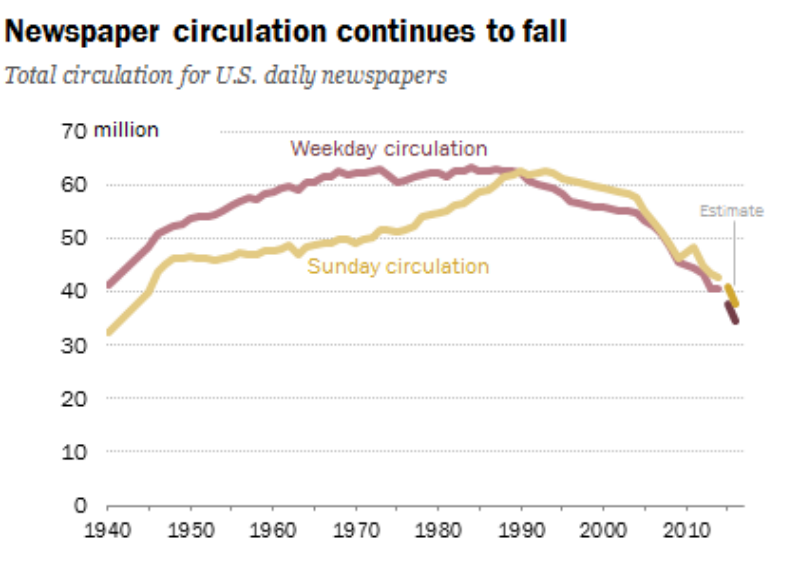
As I said in my earlier post, Sunday print circulation at The Star, owned by McClatchy, dropped a stunning 26 percent between September 2016 and September 2017. A spot check of a leading paper at each of the other two chains, the Los Angeles Times (Tronc) and the Louisville Courier-Journal (Gannett), showed significant losses but not as hefty as those at The Star.

The Los Angeles Times’ Sunday circulation dropped 15.3 percent between 2016 and 2017, and The Courier-Journal’s fell 10 percent.

Now, let’s look at the Sunday losses for the five family-owned papers mentioned above:

— Arkansas Democrat Gazette: Minus 10 percent

— The Post and Courier: Minus 8.8 percent

— The Seattle Times: Minus 6 percent

— The Register-Guard: Minus 5 percent

— The Spokesman-Review: Minus 2.4 percent

Four of those five lost a smaller percentage of subscribers than their big-chain counterparts.

In an email, I asked Waller if the difference might be that residents of cities with family-owned papers felt a deeper loyalty to their hometown papers than residents in cities with large-chain ownership.

Here’s how he answered:

“The difference is that these papers…have had to make cuts, but did it much more carefully than Tribune, McClatchy and other big chains. The family papers tried to limit the damage; the others simply butchered their papers for short-term profits. In doing so, I believe they have effectively killed their papers, because none of them are making much money in the digital world and seem unlikely to do so in the future.

“Unless a miracle business model surfaces somewhere, many of those big-city, chain-owned papers will be dead in 15 to 20 years.  Most of the smaller dailies (with circulations of 10,000 to 40,000) will survive because they have a monopoly on local news and information…and not that much competition from broadcasting and even from the internet. They have already absorbed the loss of classified to the Internet and still are making reasonable margins.”

**

Mike Waller

In my last post, I quoted Warren Buffett, “The Oracle of Omaha,” as saying much the same thing about the difficulty many major metropolitan dailies have had transitioning from print to the Internet. Equally as credible is Waller, whose career also included stints as publisher at the Hartford Courant and The Sun in Baltimore.

For today, then, I’m dubbing Waller “The Sage of South Carolina.”

When I look at my thin and featherweight Kansas City Star Monday through Saturday (Sunday remains an exception), I feel like I’m looking into a freshly dug hole that is waiting to receive the corporate remains of local newspapers.

Sure, things have been going downhill for years, but it struck me with extra force only recently how bad the situation is.

Here in Kansas City, we all hear complaints and grumblings about how The Star has shrunk and its coverage has contracted. But it’s just about as bad in almost every other metro area. As surely as the glaciers are melting, local newspapers are fading and failing.

You can count on exactly three fingers the papers that are prospering: The New York Times, The Washington Post and the Wall Street Journal. But they are national papers benefitting not only from the decline of local papers but also from the upsurge in public interest in the altered political landscape. (Some call it the Trump Bump.)

Many dedicated newspaper readers have either dropped their local papers and purchased subscriptions to one of those three papers, or they have continued to subscribe to their local papers and augmented them with online or print-and-online subscriptions to one or more of The Big Three.

The Star is just a microcosm of the trend. Let me show you some of the ways in which The Star and its corporate owner, McClatchy, symbolize the overall descent of the daily newspaper.

:: I wrote about The Star’s precipitously falling circulation last month, but it warrants a recap. The Star’s Sunday print circulation now stands at less than 120,000, and daily circulation is below 80,000. Sunday circulation fell by a startling 26 percent between September 2016 and September 2017. The drop in daily circulation during the same period was 12 percent. That kind of loss is not sustainable very long, and it prompted a retired, longtime reporter at The Star to analyze it in these words, “What we’re talking about now is a long, ugly drag to the bottom.”

McClatchy Co., based in Sacramento, and the other newspaper chains have pinned their hopes on a transition from print to digital. But it’s just not working; there are too many other places for people to go to get what information they want without paying for it.

According to the Alliance for Audited Media, The Star actually lost stand-alone digital subscriptions between this September and last, falling from 12,288 to 10,219. Either number is paltry in a metro area with 1.7 million people. The transition to digital has gone much better in some cities, such as Boston, but I believe many papers are facing the same struggle as Kansas City.

Source: “The Financial”

:: For years, The Star has been dropping stand-alone sections, such as FYI and Business, and funneling material from discontinued sections into the A section, which, until about 10 years ago, was reserved for national and international news and the editorial pages. Initially, Star management tried to sell the changes to readers as beefing up the A section. For a year or so, the A section did grow, partly with the addition of four pages of “In Depth” coverage several days a week. Now, however, “In Depth” is down to a single story on a single page and might as well be called “In Shallow.”

For thumbnail evidence of what I’m talking about, check out this “bottoms-up” photo I took of Saturday’s A section…

In essence, there are four “sections” — national, local, business and FYI — crammed into the 14-page section. That is a total embarrassment. But, like I say, it’s not exclusive to Kansas City; other papers are doing the same thing. Not all of them are owned by a chain that is drowning in $800 million of debt — McClatchy — but none of the major newspaper chains is prospering.

:: I didn’t realize until last Thursday just how desperate The Star’s chase for readers was. I had heard that The Star had begun evaluating reporters partly on the basis of the number of “clicks” their stories were getting, but I thought that was designed to motivate reporters to go after big, substantive stories. But Thursday I saw on The Star’s website a story that struck me as odd for a number of reasons. Carried under the heading of “latest news,” it was about a white guy who tried to run down a black man in a Wal-Mart parking lot in the Ozarks. But it was written by a local reporter, Max Londberg, who had dressed up and repackaged an old Springfield News-Leader story as if it was original reporting. When I Googled the incident, I found the incident had occurred more than three months ago — and 175 miles from Kansas City.

After I wrote about that, a commenter posted a link to a story that longtime Star reporter Matt Campell had written about a woman in Virginia who saw a house on fire “and immediately went into full TV journalist mode on Facebook Live, creating a video that has made her something of a sensation.” Sensation, yes!

So, it dawned on me that, at least on its website, The Star has its reporters trolling for “clickbait” stories — akin to those you see linked at the bottom of mainstream stories, trying to lure readers with headlines like, “Celebrities that are falling down drunk” and “LiAngelo Ball explains why he shoplifted in China.”

This go-for-the-clicks strategy did not emanate from 18th and Grand — that would be bad enough — but with McClatchy executives, who have directed managers at all 29 of its daily papers to pursue stories that theoretically will attract wide readership. Reporters have been given checklists, and if potential stories don’t meet certain specific criteria, they should not pursue them. I presume that includes grass-roots, no-glitz stories like those a reporter would get covering school boards, city councils and courthouses. Unexciting though those stories are, they have long helped keep politicians and elected officials honest and have provided citizens with important information about what’s going on in their cities.

I can guarantee you that the go-for-clicks strategy will not lead papers to prosperity in the Internet era. Major metropolitan newspapers and newspaper companies that stoop to appealing to the lowest common denominator will quickly lose what credibility they have left, and they will go out of business. I don’t know what the answer is — maybe there is none — but if I had my own newspaper, I would go down swinging, filling my paper (and the website) with a blend of substantive, informative and entertaining stories…It would be JimmyCsays times 10. I might call it The Pizza Report: If you didn’t like it, you could eat it.

**

I will leave the last word to Warren Buffett, the “Oracle of Omaha,” who knows a thing or two about newspapers. His Berkshire Hathaway company owns several papers, including The Buffalo News and the Omaha World-Herald.

I came across this quote of Buffett’s in an August 2016 story on the Politico website:

“Newspapers are going to go downhill. Most newspapers, the transition to the Internet so far hasn’t worked in digital. The revenues don’t come in. There are a couple of exceptions for national newspapers — the Wall Street Journal and The New York Times are in a different category. That doesn’t mean it necessarily works brilliantly for them, but they are a different business than a local newspaper. But local newspapers continue to decline at a very significant rate. And even with the economy improving, circulation goes down, advertising goes down, and it goes down in prosperous cities, it goes down in areas that are having urban troubles, it goes down in small towns – that’s what amazes me. A town of 10 or 20,000, where there’s no local TV station obviously, and really there’s nothing on the Internet that tells you what’s going on in a town like that, but the circulation just goes down every month. And when circulation goes down, advertising is gonna go down.”

Yep, the “long, ugly drag to the bottom” is well underway, and McClatchy, unfortunately, appears to be leading the descent.

“Stunning.”

That’s how Fox4 News is describing The Star’s big story, which went up online yesterday afternoon, about former Jackson County Executive Mike Sanders’ alleged involvement in a kickback scheme that supposedly went on for at least three years.

Indeed, it is a stunning story…And, by the way, Fox4 is the only one of the four local TV stations, as far as I can tell, to have followed up on it — which tells me how useless the other three stations are.

Just reading this 44-column-inch-long story, it would appear the FBI and the U.S. Attorney’s Office have the goods on Sanders. Somehow, reporters Mike Hendricks and Steve Vockrodt got the central figure in the drama, a Northland resident named Steve Hill, to open up about how the scheme worked. It went like this: Sanders would have checks drawn on the account of a political committee he controlled, then would give the checks to Hill, who would cash them, keep some of the proceeds and give the rest to Sanders.

It looks cut and dried…But you can bet it won’t be. Seldom is it easy to prove a kickback scheme against prominent and influential political figures. They usually have money, and they always get top-notch attorneys.

But that’s not the only reason this is unlikely to be a prosecutorial slam dunk. The Star’s story contains two direct suggestions of the difficulty the government is facing, and there are other signals between the lines.

Take a look.

Four years

That’s how long the FBI has been investigating this case. It’s right there in black and white: “The arrangement is the subject of a federal investigation that may be coming to a close after more than four years, The Star has learned.”

If that is correct, it tells you one of two things: The FBI has been moving at an absolute snail’s pace or it’s a lot more complicated than Sanders giving a guy checks and divvying up the proceeds between himself and the stooge. For the FBI’s sake I’m going to assume the latter — more complicated than it appears — and suggest that authorities do not have an iron-clad case.

While we’re on the subject of the length of the investigation, I want to add a journalistic comment: If The Star still had a reporter going to U.S. District Court every day, checking with officials and working sources, it would not have taken four years to discover that a former county executive was being investigated. Hendricks and Vockrodt are two of the best reporters The Star has, but they function primarily as at-large troubleshooters, responding to whatever they hear, wherever. Because of staff cutbacks, The Star has largely abandoned the longstanding, tried-and-true “beat” system, where reporters are assigned to narrow coverage areas and work those areas relentlessly. As a result, The Star doesn’t break nearly as many stories as it did before it started laying off editorial staff members in 2008.

Sanders might not be the only target

Two other people who conceivably could be in trouble are named in the story. One is Calvin Williford, Sanders’ former chief of staff. The other is J. Martin Kerr, an Independence attorney and friend of Sanders, who was treasurer of the political committee that was being used as the cash conduit. Interestingly, Kerr was an assistant Jackson County prosecutor in the 1970s. Both Williford and Kerr have hired attorneys. (I love it when an attorney has to hire his own attorney.) The possibility that at least four people were involved in some manner could lead to a lot of finger-pointing and messiness.

Main witness credibility

The Star’s story does not tell us a lot about Steve Hill, except that he lives north of the river, has been a friend of Sanders since high school, and has used a wheelchair since he suffered a broken neck during an assault 30 years ago. The dearth of information about Hill raises questions, including whether he has ever been convicted of a crime and why he decided to tell The Star his story before charges have even been filed.

If he has been convicted of a crime, or has a history of lying, it would damage his credibility. That’s a given, and I wish Hendricks and Vockrodt would have addressed that.

Regarding his decision to talk to Hendricks and Vockrodt, the story says he came forward “because he wanted the truth to be known and discovered.” I seriously doubt that is the sole reason. I suspect self-preservation is also a major factor. I don’t think he would have gone to The Star unless he felt it would benefit him in some way.

The FBI and the U.S. Attorney’s Office cannot be happy with this turn of events. Investigators and prosecutors strongly encourage witnesses to keep their mouths shut until charges are filed and cases go to trial. They want the damning testimony to come from the witness stand, not from the front page of the daily paper.

A final, significant complicating factor for the government is that unless Hill’s account in the newspaper coincides perfectly — step by step, offense by offense — with what he testifies to in court, a defense attorney will be able to use any disparities to “impeach” his testimony.

In any event, Steve Hill’s credibility is going to be called into question. The easy part was talking to The Star and its very receptive reporters. It’s going to be a whole different story if and when a defense attorney pounces on him like a junkyard dog.

I don’t know what the editors are thinking about down at The Kansas City Star these days, but they certainly appear to be losing their grip on timely news.

At 1:15 p.m. today, The Star posted on its website a headline “Ozarks man used racial slur, tried to run over black traveler at Wal-Mart, police say.”

Not all stories The Star carries under the “Latest News” category are local, but when stories are written by Star staff members, I think it’s reasonable to expect them to be local.

I got a surprise on that front when I clicked on the Ozarks story, which was under the by-line of Star staff member Max Londberg. As I started reading the story, I immediately had questions. The first sentence was, “An Ozarks man targeted an out-of-town truck driver in a racially fueled attack, police records indicate.”

What town? Kansas City? Independence?

The second sentence didn’t help much: “Steve Pennington of Conway, Mo., allegedly tried to run over a black man multiple times with his SUV and then pulled out a knife and pursued him on foot, Lebanon police and several witnesses reported.”

The Lebanon reference was the first indication this was not a local story. Londberg didn’t say where either Conway or Lebanon is, but I checked and they are northeast of Springfield.

So, this incident occurred a long way from Kansas City.

Londberg then went on to describe what happened — Pennington, an obvious racist and loon, tried to run down the black man, whom he’d never met, in a Wal-Mart parking lot after accusing him of stealing some items from the store.

The biggest surprise in this story, however, came in the 12th paragraph — third from the end — when I found the incident occurred in September!

Actually, it occurred on Sept. 3, but Londberg didn’t report that because, I assume, he realized people would quickly compute that the story was more than three months old. In “breaking news” time, that’s synonymous with antiquity.

Not only was Londberg writing about history, then, he was also writing about an incident that occurred 175 miles from Kansas City!

Another galling aspect of this misadventure is that Londberg put his byline on the story, as if he did the original reporting and writing. Not so. A quick Google search showed that Londberg merely rewrote a Springfield News-Leader story from Sept. 7. No way he deserved a by-line. The whole thing is a sham.

**

The ultimate wonder about all this, obviously, is why the hell is The Star wasting time on an outdated, downstate story when there aren’t nearly enough reporters to cover what’s going on in the Kansas City area?

Besides City Hall, The Star has stopped covering other local governments regularly, and its coverage of local school districts is just about zilch. (I can’t remember the last time I saw a story about the Kansas City School Board, which used to be covered religiously.) Crime coverage is haphazard and, for the most part, superficial, and the paper seldom covers appearances by noteworthy authors and national newsmakers.

The focus now is on targeted, in-depth stories, like the secrecy in Kansas series. That’s certainly a valid way to go in the absence of a hefty reporting staff, but it makes it especially curious that editors gave one of their precious few local reporters — Londberg — a couple of hours to waste on a story so old it should be on parchment.

If The Star plans on continuing to dredge up old news and try to pass it off as current, it should at least come clean and put it under a new heading. I suggest this: “Old News, Perhaps of Passing Interest.”

**

Note: Minutes after I published this post, The Star removed the Ozarks story from the “latest news” category and put it under the more general “News” heading.

Why did they have to kill him?

For God’s sake, why did they have to kill him?

He and a companion had handed over their cell phones and wallets Sunday night, and one of the robbers shot him anyway.

I am both angry and heartsick about the senseless death of 24-year-old Zach Pearce, who was accosted while walking to his apartment at 40th and Walnut after a night in Westport.

Zach Pearce

Zach and his friend were within several yards of his building when they were accosted by three occupants of a maroon SUV. A woman was driving. One of the robbers got out of the vehicle and, after the victims had handed over their possessions, the robber who was outside the vehicle shot Pearce. Bang! Down he went…and died on the street.

He had his life ahead of him. I’m guessing he had moved into the city, and out of Blue Springs, to be closer to the urban “action.” But in the blink of an eye, on Kansas City’s mean streets, his parents, Joe and Cora Pearce of Blue Springs, lost a son. He had an older brother. He had a lot of close friends, many of whom attended a candlelight vigil Monday night outside his apartment building, where friends have left candles and flowers in a makeshift memorial.

Attached to a dozen yellow roses in the memorial is a handwritten note from women named Ashley and Hannah. It says: “Zach — I hope these serve as a little reminder of the bright beautiful person that you were. We love you & always will.”

**

The heart of a big city has a special allure for many young people. When I moved here in 1969 from Louisville, I wanted to be in the city. I remember looking at an apartment way out south, somewhere in the Red Bridge area, and thinking, “No way.” I ended up renting a sparsely furnished apartment at Armour and Cherry and being thrilled to be close to The Star and close to singles bars like the Red Apple and Sneaky Pete’s (both long gone) on Broadway.

I never walked to those bars, but scores of times I parked my car on Armour or a side street late at night and made the short walk to my apartment. I was never particularly worried about my safety, but I knew I was vulnerable. Sometimes I was drunk. I would have been an easy target. But I was lucky…

After several months, I moved into a house in Brookside with four other guys. We split the $250-a-month rent five ways. And it was a much safer area. By then I was going to Westport regularly, and I never had a problem. I do remember one night when I was with Patty, probably in the mid-’80s, crossing paths with a couple of men in the Westport Bank parking lot and being very relieved when we were well past them. One of those guys, his eyes…mean, threatening, narrowly focused.

Just as the city called to me, it called to Zach Pearce. Joe Pearce, his father, told a KSHB reporter: “My wife was repeatedly…riding him to move out of the city. She was begging for him to move out of the city, and he would say that he felt safe there and it would be fine if anyone wanted to rob him, he would cooperate fully so he would be fine.”

He should have been fine. He should have been able to feel safe in the city. But American society is fucked up, has been for a long time, and very few of us are safe. Maybe if you’re in Loch Lloyd or Hallbrook and you never leave home…but I don’t know.

Zach Pearce’s apartment building on 40th Street, a block east of Main

I believe the perpetrators will get caught in fairly short order. They may well run their mouths. Maybe the plan was never to fire the weapon, and one of the two who did not shoot will come forward in order to save his or her own skin. If just one of the two comes forward, I would bet on the woman. She, particularly, must be scared to death. Maybe she has told, or will tell, her mother.

It’s just a crying shame, heartbreaking, that Zach will never be able to talk to his mother or father again. And that they will never be able to talk to him again, to hold him, to tell him they love him. God, it’s awful.