Feeds:
Posts
Comments

Laura Rollins Hockaday, an irrepressible cheerleader for The Kansas City Star and a reporter who contributed mightily to expanding the paper’s reach into and standing with minority communities, died last night at St. Luke’s Hospital.

Laura, whom I got to know shortly after arriving at The Star in 1969, suffered from a variety of medical problems in recent weeks, including heart trouble.

A longtime friend of Laura’s, retired reporter John Dvorak, said this in an early-morning email:

“Over the weekend she was removed from various breathing and drug assistance as doctors worked to see if she could move forward on her own. She was doing better for a while and became more alert. But then she declined again and passed away.”

In a story on its website, The Star reported that Laura was 79. She worked at The Star from 1962 to 2000, when she retired. During that time, she held a number of positions, including travel editor, society editor and “people” editor.
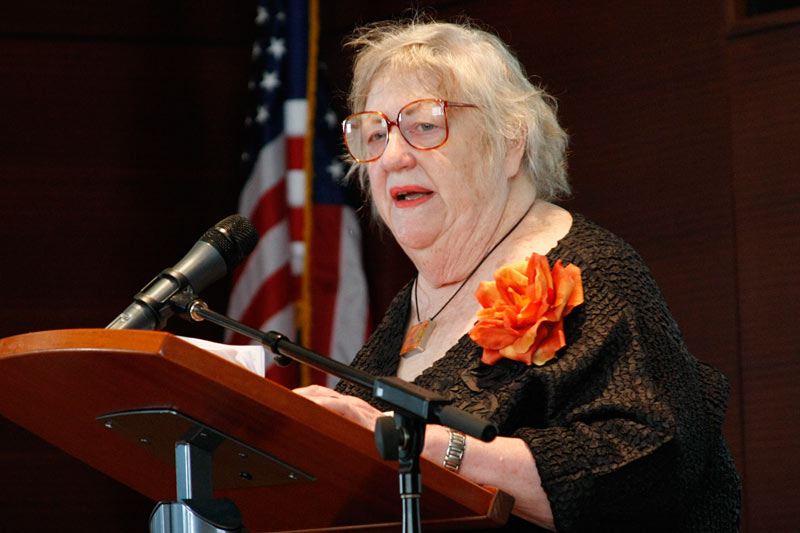
Laura, speaking at a 2010 Kansas City Library event

…This is a sad day for Kansas City, which she loved unconditionally, and for her former Kansas City Star colleagues, whose friendship she nurtured and held dear to the end.

Her death is a personal loss to me. I have written this blog since March 2010, and Laura has been a strong supporter from the beginning. She has offered encouragement both when I have been on target and when I have embarrassed myself. And she has been one of the most frequent commenters on the blog, having weighed in more than 200 times during the last 7-plus years.

Her last comments were posted on Aug. 27. One of two comments she posted that day reflected her unfailing loyalty to longtime Star staff members. In that comment she chided Star editors for moving veteran reporter Lynn Horsley from the City Hall beat in favor of an outsider who was hired at least partly because his wife became a member of The Star’s editorial board early this year.

Laura wrote: “Taking Lynn Horsley away from City Hall, where she has worked her tail off for The Star for years, leaves a tragic void. She is a heroine and a real trooper for staying on and covering Johnson County politics.”

**

Laura made her biggest, most lasting mark on the paper as society editor. She assumed that post in the late ’70, I believe, after the paper was sold to a media conglomerate called Capital Cities Inc., which brought in a Texan named James H. Hale as publisher.

In a 2016 freelance article about “The Star’s glory days,” former reporter Charles Hammer of Shawnee recounted Laura’s mindset when she took that job.

“For the 80 years since The Star’s founding, it had appeared that Kansas City had no black society, people who attend elegant parties and throw lavish weddings for their daughters. With Laura steering the selection, beautiful black ladies in long dresses appeared again and again on our page as they cut tall wedding cakes. She integrated Kansas city society, at least in our newspaper.”

In a 2012 comment on this blog, Laura offered more insight into how she came to become society editor.

“When I was asked to take over as society editor and leave the travel editor post, I refused because I was not interested. The offer came up again and O.J. Nelson, my editor, suggested I better comply the second time. I asked Mr. Hale if I could cover the African-American and Hispanic communities on the society pages, where they deserved to be and virtually had not been previously. He agreed totally and I was allowed to proceed without any rules or direction from him. For 18 years, until retiring I tried to cover the entire community and in the process learned so much and made many friends which I have to this day. It was a blessing.”

**

Laura was born a blue blood — great-granddaughter of a U.S. congressman named James S. Rollins, who helped found the University of Missouri — but she was the most everyday, humble person you could ever come across. Over the years, she sought out hundreds of newcomers to The Star and welcomed them with a handshake and big, warm smile. And once you were her friend, you were her friend as long as you wanted to be. There were very few people she couldn’t abide, and she seldom spoke harshly of anyone.

Not long after retiring, Laura began holding annual reunions — in mid-October at the Kansas City Country Club — for former Star editorial staff members and their spouses. About 100 select people would customarily attend. The main course was always the same — chicken tetrazzini — and Laura always made a short speech. She would single out particular guests who had, say, written a book or received an accolade, and she would always close by saying how much she cherished her years at The Star and how important the relationships she had made there were to her.

Earlier this month, the reunion went on without her. Standing in as hosts were former Star reporter Betsey Solberg and her husband, Rick, a former Star photographer. I didn’t attend this year’s reunion, but now I wish I had. I wish I would have heard what Betsey and Rick said about Laura, who, for once, was the one receiving the plaudits.

Laura never married, and her life revolved around The Star: first working there, later her memories of working there and finally tending to the enduring friendships she made during her remarkable, outstanding career.

Rest in peace, Laura. Those of us who were in your wide circle will miss you dearly.
In 2009, after 74 years of fielding a football team, Northeastern University in Boston dropped football, saying it was too expensive and not a top priority.

The school’s president issued a statement, saying:

“Ultimately it was determined that elevating and sustaining a competitive Division I football program would require additional multimillion dollar investments on an ongoing basis. A broad consensus developed behind discontinuing football and focusing future resources on programs — both academic and non-academic — where the university can achieve and sustain leadership.”

According to Wikipedia, Northeastern is one of 62 Division I schools that have dropped football. The ranks include Creighton University, in Omaha, in 1942, and Wichita State in 1986.

Now I think it’s time for another Midwestern school to make the big jump: The University of Kansas.

And what could be a better time than this week?

Why this week?

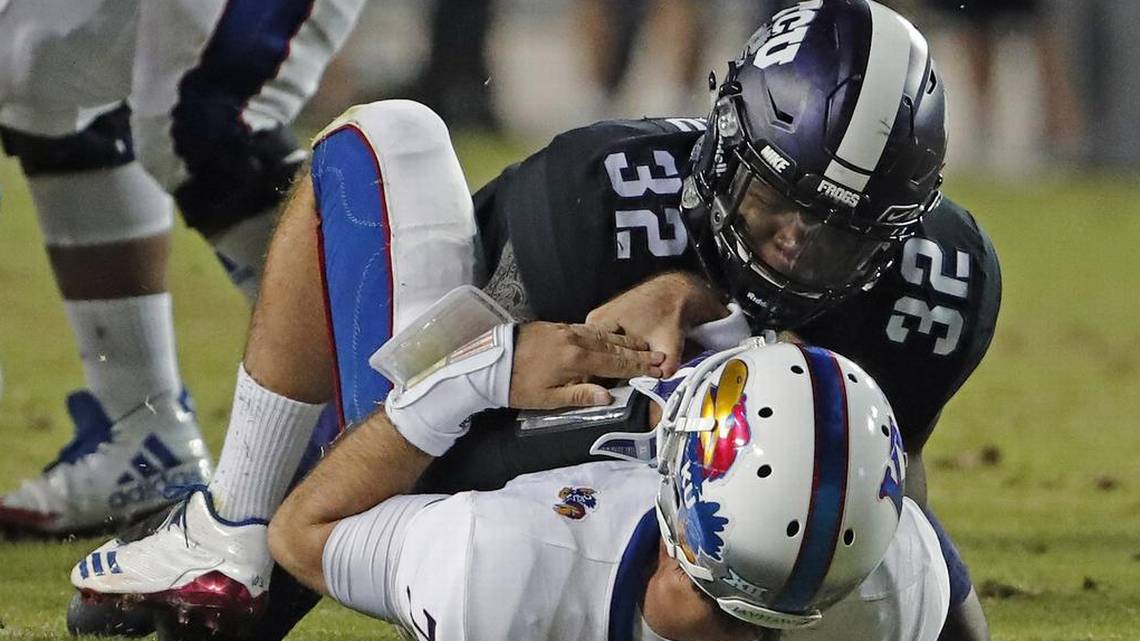
Well, I’ll tell ya…The KU team is so bad (and has been for so long) that with its loss at Texas Christian University Saturday night, the team tied the all-time record for most consecutive road defeats by a major football program.

The 43-0 shellacking was the team’s 44th consecutive road loss, tying a mark set by Western (Colo.) State from 1926 to 1936.

Oh, and the team set another record Saturday night: It gained a total of 21 yards on 49 plays, the fewest net yards recorded since such statistics began being kept 17 years ago.

Like KU quarterback Peyton Bender on Saturday, KU football is flat on its back.

…Now, when an aspiring politician is watching the election results come in and sees he’s going to lose by, say, 10,000 votes in a 15,000-vote election, the honorable thing to do — and what most candidates do — is concede. Make a nice speech, thank your supporters and return to your job and figure out another avenue for civic involvement.

For KU football, though, humiliating losses have become the norm. Their teams have been getting beaten like a snare drum for years. To me, it’s time to GIVE IT UP!

The only period during which KU was any good in the last four decades or so was a few years in the mid- to late 2000s, when Mark Mangino was coach. But, in retrospect, that turned out to be a dark period, too, because it came to light that Mangino’s greatest talent was humiliating and abusing his players.

His idea of motivating players was sticking a finger in front of their noses and saying things like:

:: “Are you going to be a lawyer or do you want to become an alcoholic like your Dad?'”

:: “You’ll be drinking out of a brown paper bag the rest of (your) life.”

:: “If you don’t shut up, I’m going to send you back to St. Louis so you can get shot with your homies.”

Thankfully, Mangino was fired after the 2009 season, but he still walked away with a $3 million payout, representing part of what he would have been paid had he stayed around for the last four years of his $2.3 million annual contract.

With this kind of track record on and off the gridiron, you’d think officials at KU might be considering punting…for the final time.

Wouldn’t it be great to see the university’s new chancellor, Douglas Girod, come out and say something like this…

“After much deliberation, we’ve decided football is no longer a top priority at the University of Kansas. It has become an ever-increasing drain on school finances and detracts our foremost goal — to produce well-educated students who are prepared to compete in today’s fast-paced, demanding world and who will make a positive impact on society. We are also concerned about the long-term, physical and mental well being of our student athletes, and football, it is becoming ever clearer, is a long-term health threat.”

Ah, but sadly we’re not going to hear an eloquent statement like that. (Thank you very much, though, for the standing ovation!) Instead — almost unbelievably — KU recently announced the start of a five-year drive to privately raise $350 million for improvements, mostly to Memorial Stadium.

Three hundred and fifty million! In the pursuit of continued futility!

Wisely, The Star’s editorial board came out strongly against the fund drive, saying the reasoning behind the drive did not include “a clear statement of why these projects help advance KU’s mission, which is to educate students.”

The editorial went on to say: “The effort is even more concerning when you realize it focuses on football. Even the game’s most ardent fans must wince occasionally these days, as uncompensated ‘student athletes’ crack heads on the gridiron.”

…As I wrote last week, with the decline of football — which I think is inevitable — I’m worried about what happens with the great tradition of marching bands.

So, I have a suggestion for an alternate course at KU. Instead of trying to raise $350 million for football-related improvements, set a fund-raising goal of $100 million to make KU the marching band capital of at least the Midwest.

Yes, proceed with improvements at Memorial Stadium, but do so with a view toward accommodating the best college marching bands at an annual exhibition/competition that would draw bands and their followers from throughout the Midwest.

It could be big, I tell ya…And about the worst injuries we would see among competing band members would probably be some cases of dehydration and maybe some muscle strains.

Come on, KU, wise up! Climb out of the ever-expanding football sinkhole.

Is anybody out there as worried as I about the future of marching bands?

I know, I know…Along the spectrum of things to worry about — Little Rocket Man, where we’re headed on medical insurance, mass murder from on high — the future of marching bands doesn’t rank very high on “the things we worry about” list.

Nevertheless, if you’re a marching band fan, like I am, you’ve got to be tossing and turning at night, just a bit.

Reason is, of course, the decline in popularity of football — the bedrock of marching band-om.

If parents continue in growing numbers to refuse to allow their children to play competitive football, the game will atrophy from the inside and could, eventually, go the way of boxing and horse racing, that is, consigned to the margins of organized sport.

As regular readers know, I’ve sworn off football. I don’t watch it and don’t read about it…other than seeing a few scores as I look at other parts of the sports section. Last year, I swore off pro football but continued following college football, mainly because I enjoyed going to University of Kansas games to hear the KU Marching Band.

But this year, I wiped the slate clean. The main impetus was news of a study of 111 former football players’ brains that showed all but one exhibited signs of chronic traumatic encephalopathy, or C.T.E.

I haven’t missed the football at all. But I sure have missed watching the KU band perform at halftime, and I’ve especially missed hearing them play “Home on the Range” at the conclusion of home games.

With the crack in football’s foundation starting to grow, I got to wondering if any leaders of college band programs had begun envisioning a day when college and pro football were no longer headline-grabbing attractions. So, first I put in a call to the associate director of bands at KU. I didn’t get him but another staff member picked up and dutifully took down my name and number and the reason I was calling. (She also got my email address, perhaps thinking that would be an easy way for the director to blow me off, if he wanted to.)

Then I called the director of bands, Brian A. Silvey, at the University of Missouri. “Silvey” said the voice on the other end of the phone.

He was happy to talk about the subject, but, as I suspected would be the case, he wasn’t too worried about the immediate future of marching bands.

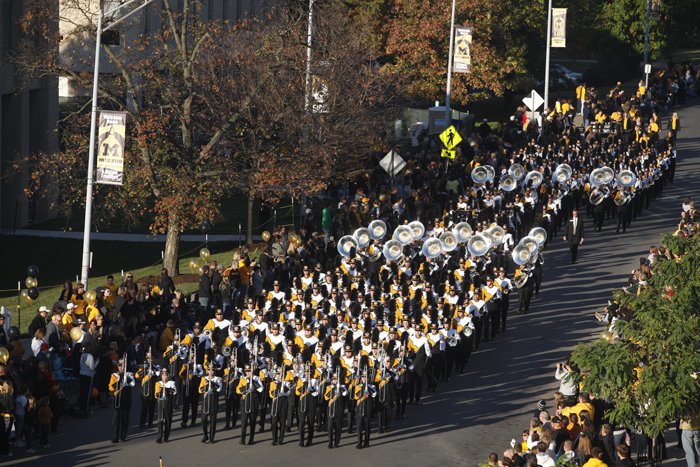
He said he thought the tradition would “continue on as it has for the last 100 years,” with college football being the “prominent showcase” for marching bands.


Marching Mizzou, at “Homecoming 101” in 2012

At the same time, he readily acknowledged the growing threat to football’s popularity and said that if it got to the point where the marching-band tradition also faltered, he envisioned aspiring marching band members swelling the ranks of a non-profit organization called Drum Corps International, based in Indianapolis.

About 5,000 young people participate in Drum Corps International each year, with the competitive season starting in mid-June and culminating with the DCI World Championships in Indianapolis the second weekend of August.

Now, that was eye-opening information for me. In the first place, I can’t tell you how relieved I was to here that if football fades away, the marching-band tradition will likely continue to prosper, albeit perhaps in more modest settings than massive college football stadiums.

And second, I’ve discovered a possible new vacation venue: Indianapolis, second weekend of August.

Road trip, anyone?

Since the early 1970s, Rockhurst High School has had an inspiring slogan: “Men for Others.”

Rockhurst, of course, is known for its rigorous academic curriculum. But its overarching goal is to cultivate in students a desire and sense of obligation to serve others, especially the poor and underprivileged.

I’m sure that philosophy takes root with the vast majority of Rockhurst grads, but not all.

Scott Tucker

One of those for whom the message didn’t take was payday loan shark Scott Tucker, who, on Friday, was convicted in New York on 14 felony charges stemming from a $2 billion payday lending enterprise.

Authorities said Tucker’s multi-dimensional operation exploited 4.5 million consumers, charging outrageous interest rates and deceiving victims about loan terms.

Several other Rockhurst graduates got involved in the payday loan business, including Tim Coppinger and Vince and Chris Hodes, but they have not been charged with crimes.

Of those four, the 55-year-old Tucker apparently was the crookedest and greediest. He and his lawyer, Timothy Muir of Overland park — who was also convicted Friday — set up the business to make it look like it operated on an American Indian reservation and included Native American partners.

Had that been the case, the operation would not have been illegal. But it was a sham. Tucker actually operated the business out of an office building in Overland Park and had as many as 600 employees working in his online, high-interest loan business.

One of the most galling things about Tucker is that he used his ill-gotten gains to live high and conspicuously large. He became a professional race car driver, owned several Ferraris and Porsches and had a Learjet, an $8 million house in Aspen and a 4,400-square-foot home in Leawood. Almost every story that has appeared in The Star about Tucker has been accompanied by a photo of him in racing gear.

Tucker’s career in crime got started within about a decade of his graduation from Rockhurst. In his court-verdict story today, KC Star reporter Steve Vockrodt said Tucker spent a year in prison in Leavenworth after a 1991 fraud conviction. He probably would have been about 29 then.

Instead of using that year in prison to redirect himself toward becoming a man for others, Tucker apparently spent a lot of time refining his avaricious intentions. Vockrodt said Tucker started a consumer loan business in 1997 and went on “to become one of the pioneers in online payday lending.”

“For years,” Vockrodt said, “Tucker’s involvement in payday lending remained hidden behind shell companies and tribal entities.”

I have to think Tucker influenced other Rockhurst grads, at least by example, to get involved in the payday lending business. The others saw the money flowing like floodwater and couldn’t resist jumping in. I’ve also heard that quite a few other Rockurst grads made $100,000-plus investments in the payday lending businesses after being virtually guaranteed of big returns by buddies who were more deeply involved.

Two brothers of Tucker — Blaine and Joel — also followed Scott Tucker into the payday loan business, or offshoots of it.

In recent years, however, the Tucker empire and the easy-money deal Coppinger and several others enjoyed has come crashing down. Consider:

:: Coppinger was ordered to surrender bank accounts totaling $520,000 and to sell a house he owned in Lake Lotawana. He got to keep a house he owned in Mission Hills, but I believe he has sold it.

:: Blaine Tucker committed suicide in 2014, and Joel was recently assessed a $4 million penalty by the Federal Trade Commission.

:: Another payday loan operator, Frampton T. Rowland III of Mission Hills, committed suicide last October. Rowland, 52, was a Shawnee Mission West graduate.

:: Tucker and Muir, whose law practice was in Overland Park, are probably headed to prison. They are now on home confinement, awaiting sentencing on Jan. 5. (Tucker plans to appeal Friday’s verdict, and I imagine Muir will do likewise.)

Being a twice-convicted felon, Tucker may be an inveterate criminal. If he gets out of prison alive, I would give him no more than a 50-50 chance of going straight.

As for the other Rockhurst grads who got into the payday loan business, I have higher hopes. The ones I’m familiar with come from good families, and maybe they will develop — or have developed in recent years — a greater appreciation for the importance of what their teachers at Rockhurst tried to imbue in them.

Being “men for others” remains a  good goal. It’s not too late.

Like many people, I’ve been thinking a lot about Stephen Paddock and where and why he might have gone so far astray from the general human track of wanting to live a good life and be a good person.

Today, with the benefit of an insightful sermon at my church, Country Club Christian (tee times available dawn to late afternoon), I closed in on a theory.

The sermon, delivered by guest preacher Dr. Miroslav Volf, a theology professor at Yale Divinity School, was about the importance of physical touch. “We are hungry for human touch…” Dr. Volf said. “Redeeming touch…A touch of mutual delight.”

Dr. Volf’s springboard to that topic was a New Testament story about a woman, a sinner, who, after learning Jesus was having dinner at the nearby home of a Pharisee, went there to seek him out. Luke’s gospel continues…

So, she came there with an alabaster jar of perfume. As she stood behind him at his feet weeping, she began to wet his feet with her tears. Then she wiped them with her hair, kissed them and poured perfume on them.

When Dr. Volf began talking about the power of touch and the innate human yearning for it, my mind jumped immediately to Paddock.

The most prominent thing we know about Paddock is that he spent hour after hour, day after day, sometimes week after week, sitting silently in front of video poker machines, often winning because of his methodical style and skill level.

A New York Times story said: “The way he played — instinctually, decisively, calculatingly, silently, with little movement beyond his shifting eyes and nimble fingers — meant he could play several hundred hands an hour.”

Although he had plenty of money, he didn’t have much of a life outside the casinos. We know he was unfriendly and uncommunicative with neighbors. Yes, he had a girlfriend, Marilou Danley, who apparently left what had been a solid marriage of about 25 years to take up with the high-rolling Paddock, who had been a customer at a casino where she formerly worked. Danley has told the FBI that in recent months Paddock seemed to be deteriorating both physically and mentally.

…Well, if you don’t like people and your life has revolved for years around machines with blinking lights and electronic playing cards, what else would you expect?

He probably was disposed this way, but my theory is that over time those machines gradually drained and consumed whatever traces of human feeling and innate goodness he ever had. Just sucked it out of him, as steadily as pigs slurp water from a trough.

Again, he had the girlfriend, but I can see how, trapped in the vortex of the blinking machines, he could easily have withdrawn even from her. Very likely, at the start of their relationship they had significant physical contact, perhaps even genuine warmth, but I would be curious to know the last time there was “a touch of mutual delight.”

The fact that he sent her off to the Philippines and sent her, or her family, $100,000 to buy a house certainly indicates a desire to push her away.

Stephen Paddock, in short, had descended into nihilism. Nothing meant anything to him — not family, not money, not his girlfriend, maybe not even the blinking machines. Either that, or the machines’ insidious allure had erased all semblance of emotion and human meaningfulness in him and all he saw when he looked in the mirror was a black void.

Of course, that doesn’t explain how he catapulted to the next step — raining automatic gunfire on thousands of people a week ago today in Las Vegas. All I can think is that, from the recesses of his dimming mind, he decided not only his life was meaningless but so was everybody else’s. And so, in his final, nihilistic gesture, he tapped the only other skill he had kept up with — gun manipulation and usage.

Those people meant nothing to him. They were like those millions of electronic cards that had passed before his eyes on those screens; they were merely images to be manipulated — mowed down, in his demented perspective — to suit his will. His sense of physical touch, of human connection, was long gone.

Does anybody out there remember Fairyland Park? The former amusement park at 75th and Prospect, which was later bisected by Bruce R. Watkins Drive, a.k.a. U.S. 71?

Many of you do, I’m sure.

But one person who obviously doesn’t remember Fairyland is The Star’s music writer, Tim Finn.

Finn has been at The Star about 30 years, and I would have thought he would have heard about Fairyland somewhere along the line but…

In reporting today that 1970s rock’n’roll star Bob Seger was postponing several shows, including one in Kansas City, because of vertebrae problems, Finn wrote the following:

“Seger previously performed in Kansas City in March 2015, a show at the Sprint Center. His history in Kansas City goes back to the mid-1970s, when he played at Kemper Arena, Municipal Auditorium and a place called Fairyland Park.”

I wish he would have at least Googled Fairyland Park so he wouldn’t have made it sound like it was some place in outer space.

…I arrived in KC in the fall of 1969, when Fairyland was well on the way to extinction. I missed the glory days — the 1950s and 1960s, when, according to Wikipedia, Fairyland “boasted 3 roller coasters, an 8 story ferris wheel (which was bent in half during tornado), a swimming pool (double olympic size — closed in late 50s), bumper cars, a shooting range and even a petting zoo at one time.”

In a 2014 KCUR-FM story, reporter Laura Ziegler recounted the long and mostly successful history of Fairyland. It was developed and opened on 80 acres by the late Salvatore “Sam” Brancato, a Sicilian immigrant and blacksmith who had come to the States in 1896.

“After settling in Kansas City,” Ziegler wrote, “he went into the grocery business, then began buying up real estate. He opened Fairyland Park in 1923. It would be in the family until its closing in 1977.”

It quickly became a popular destination, but it was fading by the late ’60s, in no small part because of civil rights protests regarding its largely “whites-only” policy. In the early ’70s, it turned to rock’n’roll shows to try to come back. Performers, according to Wiki, included REO Speedwagon, Dr. Hook, Blue Oyster Cult and Charlie Daniels. Obviously, Bob Seger performed there, too, although I didn’t know that until reading Finn’s story today.

The nail in Fairyland’s coffin, according to Laura Ziegler’s story, was the 1974 opening of Worlds of Fun. Among other things, WOF staged musical acts every Friday evening during the summer, as I recall. I remember seeing an Osmond-Brothers-type group called The DeFranco Family at Worlds of Fun and being enthralled. (A former roommate still trashes me about that. Truth is, after the ’60s, I lost my musical traction and stumbled around in the desert for several years, including being reeled in by disco.)

**


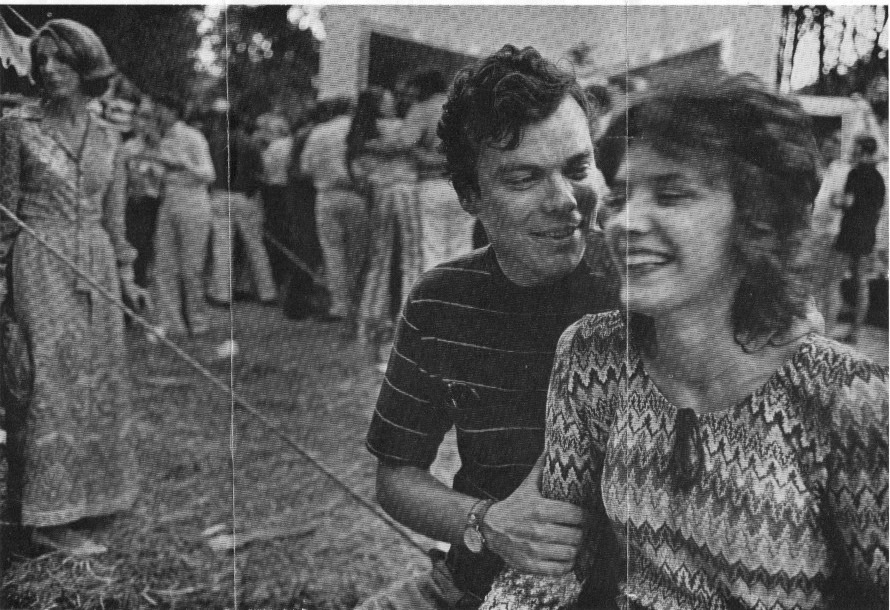
Like I said, I missed Fairyland’s heyday. But I do remember being there once. In fact, I have a photo of me and a young lady who were there on a hot Sunday afternoon. I don’t remember what the occasion was — some kind of gathering or party. At the time, I was a young reporter covering my first beat, the Jackson County Courthouse, where I was assigned from 1971 to 1978.

The woman I was with that day was Susan Reeder, who was administrative assistant to then-Jackson County Executive George W. Lehr.  

While Susan and I never dated seriously, we got together occasionally, mostly out of convenience. There was some mutual attraction there, plus some common interests, like drinking and partying, but nothing ever came of the relationship.

I have no idea what happened to Susan…if she married, if she is still in town, if she is still alive. I do remember that day very well, though, mostly because of the photo, which, in my opinion, is a classic.

I believe it was taken by a Star photographer who was there on assignment. I think we just ran into each other and he snapped the photo. The photographer might have been Vic Damon, who liked to take photos of reporters when they were on the job. (In this one, of course, I wasn’t working!)

In any event, check out this photo of a young JimmyC and his young date, on a Sunday afternoon when neither had a care in the world and were joyous to be at a place called Fairyland Park.

**

Note: Commenter Tim Bross of St. Louis noted the resemblance between Susan and the late actress Jill Clayburgh, who died of chronic lymphocytic leukemia in 2010. Here’s a photo of Jill…


Some stories require a lot of patience and a lot of checking.

This is such a one.

I began following the U.S. Tax Court case of former Waddell & Reed C.E.O. and chairman Keith A. Tucker in May 2010, two months after I started writing this blog and five years after Tucker was forced out at Overland Park-based Waddell & Reed.

I was a Johnny-come-lately because in 2010 the case had already been in Tax Court for six years.

Tucker, who formerly lived in one of the most breathtaking homes in Kansas City — a Louis Curtiss designed residence on the northwest corner of 55th and Ward Parkway — claimed a very questionable tax loss of $39.2 million for the year 2000, the same year he and his wife Laura reported $44.2 million in wages and salaries.

The $40-million-plus windfall came from Tucker having exercised options on nearly two million shares of Waddell & Reed stock two years after the company went public and its stock price rose sharply.

Tucker didn’t want to pay the taxes on the windfall, so he got himself into a tax shelter designed by a former employer, the accounting firm KPMG.

Tucker

The IRS ruled against the shelter, which revolved around foreign-currency options, and billed Tucker and his wife Laura, $15.5 million for a year 2000 tax deficiency, plus a $6.2 million penalty. The Tuckers contested the ruling in 2004, setting in motion a torturous, 13-year journey in U.S. Tax Court.

I thought it might never be resolved. Exceedingly rich people, as we all know, have a knack for forestalling their day in court. Of course, having oodles of money and being able to hire an armada of lawyers helps push the calendar back, back, back. (Tucker hired at least eight lawyers to represent him in the tax case.)

So, the case dragged on through countless motions and counter-motions, through a one-day trial in 2016 and finally through post-trial filings. I have a manila folder headed “Tucker, Keith” that I would pull out every few months and then go to the U.S. Tax Court website to see if there had been any developments.

Yesterday, I pulled out that file, went to the website and — lo and behold — discovered a judgment had been entered on Sept. 20 by Judge Joseph Goeke in Washington.

The ruling: “(T)here is a deficiency in income tax due from petitioners for the taxable year 2000 in the amount of $15,518,704.”

I could hardly believe it…Even though the judge nullified the penalty, it appears the government is going to get its share of taxes from Tucker’s windfall, realized here in Kansas City 17 long years ago.

Tucker is expected to appeal the ruling, and that, too, could take years to resolve.

**

The federal tax case is not the reason I initially homed in on Keith Tucker.

What first stuck in my craw was the fact that after buying the 55th and Ward Parkway home in 1998, he and his wife had tall shrubs erected around the house, effectively blocking the views from both 55th and Ward Parkway.

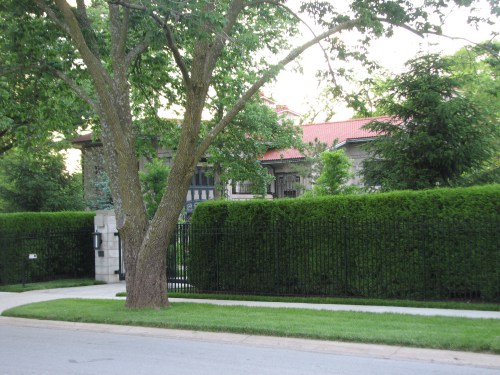
Built for Bernard Corrigan, a Kansas City streetcar developer in the early 1900s, the home is considered to be one of the best examples of Prairie Style architecture in the Midwest. Two of its most prominent features are its leaded-glass windows and gray limestone walls.

The 55th and Ward Parkway home, as seen either from within a shrub line designed to block the street view or before the shrub line was erected.

I used to look at that house every time I drove by. And then, after the Tuckers shrouded it, it took on a whole new connotation for me. Truth is, it made me want to throttle Keith Tucker. (I wrote one blog post about this in April 2010 and another in May 2010.)

But if hiding that jewel of a home wasn’t enough, the tax-scamming Tucker did something else that absolutely galled me.

In trying to evade a $1.2 million bill in city earnings taxes — a tax the city imposes on both residents and people who work in the city — Tucker claimed he never legally resided at that home. He contended he was actually a resident of Dallas, where he and his wife had come from.

Talk about crust…He and his wife bought the house, together, in 1998 and lived in it until it was sold in 2005. During that period, they also hosted cocktail parties, political fund-raisers and even Waddell & Reed board meetings at the home. And — oh, yes — the phone book listed Keith Tucker at that address.

Fortunately, a Jackson Country Circuit Court judge saw through Tucker’s smokescreen and ruled in the city’s favor. In 2008, the Missouri Court of Appeals upheld the lower court ruling, and Tucker had to pay up.


I took this picture from 55th Street, the south side of the home, in 2010.

**

After leaving Kansas City, the Tuckers returned to Dallas, where Tucker heads a company called Century Bridge Capital, which describes its focus as investing in “the growing Chinese real estate sector by forming joint ventures with Chinese real estate development companies.”

Oh, boy…I just hope officials with the Chinese companies Tucker is doing business with get a chance to read Judge Goeke’s 86-page ruling. Actually, all they have to read is one key line, which says the foreign-currency options Tucker purchased in December 2000 “offered no reasonable expectation of any appreciable net gain but rather were designed to generate artificial losses by gaming the tax code.”

Tax gamer, that’s Keith Tucker. I’m glad he’s gone. Now I just wish whoever lives on the northwest corner of 55th and Ward Parkway would rip out those shrubs and let area residents once again delight in the view of that incredible home.

I could have spent years stomping my feet and pounding the walls about football and traumatic brain injury before I would have made the slightest dent in football’s popularity.

But out of left field, so to speak, along came President Trump on Friday to advance by huge strides my personal crusade to kick football to the curb.

Trump didn’t kick with his feet, though. He used his most deadly weapon — his big, fat mouth.

A little more than a year ago, many of us would have been flabbergasted to hear a President, any President, call someone, anyone, a “son of a bitch.” But now that we’ve seen and heard how President Trump talks — i.e., “Grab ’em by the pussy; you can do anything” — whatever insulting language or specific words he uses barely register on the shock meter.

Before Trump spoke out Friday, only a slight crack was visible in football’s institutional bulwark. The increasing awareness and evidence of the link between repeated concussions and chronic traumatic encephalopathy (C.T.E.) has been giving more people, especially mothers of young boys, pause about the hazards of football. But by essentially declaring war on National Football League players who choose to publicly demonstrate their frustration with racial injustice (see white cops killing unarmed black men with impunity), we may well see a lot more people turning their backs on pro football. And that could, in turn, push down to the college, high school and grade school level.

(As an aside, I found it interesting — and a bit cowardly — that Trump made his indictment in Alabama, which does not have an NFL team but has the nation’s No. 1 college team.)

Pro football was at the height of its popularity a year or two ago, just before former San Francisco 49ers quarterback Colin Kaepernick decided he would start kneeling in protest during the playing of the National Anthem before games.

After a preseason game in August 206, he told NFL media…

I am not going to stand up to show pride in a flag for a country that oppresses black people and people of color. To me, this is bigger than football and it would be selfish on my part to look the other way. There are bodies in the street and people getting paid leave and getting away with murder.

On Sunday, we saw that this situation has, indeed, gotten a lot bigger than football.

It was reassuring to me to hear reports that owners, coaches and players alike were banding together and metaphorically locking arms against Trump’s blusterous campaign to purge the NFL of protesters.

In the end, though, I don’t think we’ll look back and see the past weekend as the straw that broke the NFL’s back. There’s too much money on the table, for owners, the league and the players themselves. This will get worked out and we’ll probably see a Super Bowl-winning team back at the White House before the end of Trump’s first term.

In the end, it will be the brain injuries that drags football off its lofty entertainment perch and leaves it in the same category as boxing, which, not that long ago, was America’s favorite sport.

We’ve come a long way. It’s important to keep in mind that as recently as 2010, a neurologist named Ira Casson, who had recently resigned as co-chairman of the NFL’s “Mild Traumatic Brain Injury Committee,” told a congressional committee…

“My position is that there is not enough valid, reliable or objective scientific evidence at present to determine whether or not repeat head impacts in professional football result in long-term brain damage.”

For we who are intent on making more Americans aware of football’s danger to the human brain, we can use all the help we can get — even from a President who often seems deranged.

It’s a go!

We’ll have an airport election on Nov. 7, and things are looking — if not up, up and away — at least up.

After a torturous, four-month process that has tested everyone’s patience and trust in City Hall, the City Council voted 10-2 this afternoon to enter into a terminal-construction contract with Edgemoor of Bethesda, MD.

As you regular readers know, I’ve called at times for dumping the process and starting all over again in a couple of years — next time putting the horse (design) before the cart (construction contract).

Nevertheless, it appears the Council made the right choice. One of the four competing firms, Jones Lange LaSalle, was never seriously in the hunt. Two others, AECOM and Burns & McDonnell, wore out their welcome by being whiny (AECOM) and avaricious (Burns and Mac).

**

Here’s how the council vote went. (You probably won’t get the full rundown in The Star, and it’s important.)

Yes:

Mayor Sly James
Heather Hall
Dan Fowler
Quinton Lucas
Jermaine Reed
Katheryn Shields
Jolie Justus
Alissia Canaday
Kevin McManus
Teresa Loar

No:

Lee Barnes Jr.
Scott Taylor

Absent:

Scott Wagner

**

Here are my observations on some of those votes:

:: For all the criticism Sly James has come under in this blog and elsewhere for supporting Burns and Mac’s flagrant push for a no-bid contract, he made the correct call in the end, getting off the Burns and Mac bandwagon and switching to Edgemoor. As I reported last night, he told me and Mary O’Halloran at Steve Glorioso’s memorial service yesterday he thought there would be nine votes for Edgemoor today. His forecast was pretty much on target.

:: My old friend (although I backed her opponent Jim Glover in the 2015 election) Katheryn Shields was very instrumental in redirecting the process away from Burns and Mac and opening the project up to other competitors. Her deep governmental experience (an earlier stint on the Council, plus two terms as Jackson County executive) was pivotal. Where James’ bold move cowed at least two council members (Wagner and Justus), Shields was one of several who did not flinch.

:: I am proud of Teresa Loar for voting yes, even though she probably still doesn’t believe we need a new airport. She saw the scales tipping strongly in favor of selecting Edgemoor, and she went along. Like Shields, she, too, had an earlier stint on the council, and I feel sure her experience was a factor in her final decision.

:: Lee Barnes Jr. is a problematic council member because he is heavily influenced by a longtime adviser (not going to name him) whose political instincts are not very good.

:: I really like Scott Taylor, 6th District at-large councilman, who is running for mayor. (Disclosure: A few months ago, I contributed $250 to his campaign.) He was in a tough spot here. Burns and Mac built its big, new headquarters right in the middle of his district, at the intersection of Wornall and Ward Parkway. I’m sure he felt a deep loyalty to Burns and Mac, and I can’t blame him for that. It’s notable, though, that Kevin McManus, in-district councilman from the 6th, left the Burns and Mac fold and went over to Edgemoor. Congratulations to Kevin; that took some guts.

:: Where was Scott Wagner? An early supporter of Burns and Mac, along with James and Justus, he was a no-show today. I hope he didn’t “take a walk,” as they say when an elected official ducks a big vote.

**

All in all, the council deserves a tremendous amount of credit for what it did today. The process was ugly, but now that the sausage is made, it looks a lot better. On Nov. 7, let’s chow down. We need a new airport.

As you might expect, more than beer and wine was flowing at Steve Glorioso’s funeral service tonight at the Chamber of Commerce meeting room at Union Station.

Information was in abundant supply, too.

Here are some of the nuggets I picked up:

:: Mayor Sly James told me and Mary O’Halloran, a former panelist on the “Ruckus” show on Channel 19, he believed Edgemoor would get nine votes tomorrow when the City Council meets at 3 p.m. to possibly select a contractor to build a new KCI terminal.

If the council is to approve Edgemoor tomorrow, it will take a minimum of nine votes — a two-thirds majority of the 13 members — because the council will be taking up the ordinance out of the customary sequence. If the council waited another week, it would only take seven votes, but with the airport election scheduled for Nov. 7, every day counts.

This is good news. If Edgemoor is selected tomorrow, Burns and Mac may, at last, slide into the background. If it contested the legality of the Edgemoor selection, or if it decided to campaign against the Nov. 7 proposition, it could do significant and lasting damage to its reputation locally. Its reputation has been dented as it is, and I hope company officials come to their senses and realize the battle is lost and it’s time to unite behind Edgemoor.

:: I heard from another person that James has dropped his push for Burns & McDonnell and is on board with the special airport committee’s selection of Edgemoor, based in Bethesda, MD.

That’s more good news, obviously. The upside-down process the mayor set in motion by agreeing to support Burns and Mac’s push for a quick, no-bid contract has already damaged his reputation and legacy. If he wants to continue his political career after his term expires in 2019, he needs to get back in step with a council majority and then be out front in the election campaign.

:: JE Dunn Construction officials are very disillusioned with Burns and Mac, which recruited Dunn to be on its “team.” The relationship has not gone well.

This is problematic but not fatal for the airport election. It is hard to imagine Dunn not involved in construction of a new terminal. I believe it will happen, but some sorting out will need to take place.

:: James told me and Halloran that Edgemoor won’t have a proposed design until next month. “They can’t do anything until they have a contract,” James said.

Makes sense, but it’s not good, of course. It harkens back to the upside-down nature of the process, where construction proposals were sought before design proposals. Speaking avidly, Halloran told James people would be more likely to get excited about a new terminal if they were shown a design that looked appealing and also appeared to be convenient. Another element that would add excitement, she said, would be incorporating many “green” elements, including numerous solar panels.

**

Tomorrow should be a very interesting day at City Hall. I won’t be able to attend the council session, however. Patty and I are heading out of Union Station on the Southwest Chief tomorrow night, for a weekend at some friends’ cabin in southern Colorado. So, you’ll have to rely on the “traditional” media — The Star, the TV stations and perhaps KCUR — for your news. I’m sorry I won’t be here to try to help sort things out for you.

…As we all know, this has been an ugly process. Nevertheless, I have been convinced for several years we really need and deserve a new airport. We are a first-class city with a second-rung airport. An opportunity to change that appears to be at our fingertips. I hope Edgemoor gets the votes tomorrow and that it quickly produces a design that Kansas Citians will embrace…I hope the residents in other area municipalities will embrace it, too, but for the six-week campaign that appears to be on the horizon, my sole focus will be the town I have called home for 48 years, KCMO.