We live in a wonderful but horribly fucked up country.
The U.S. offers the best quality of life and the best opportunity for people to reach their potential, and yet it is the most dangerous, wealthy country in the world.
It tops that category for one reason: lack of political will to impose reasonable gun-control laws.
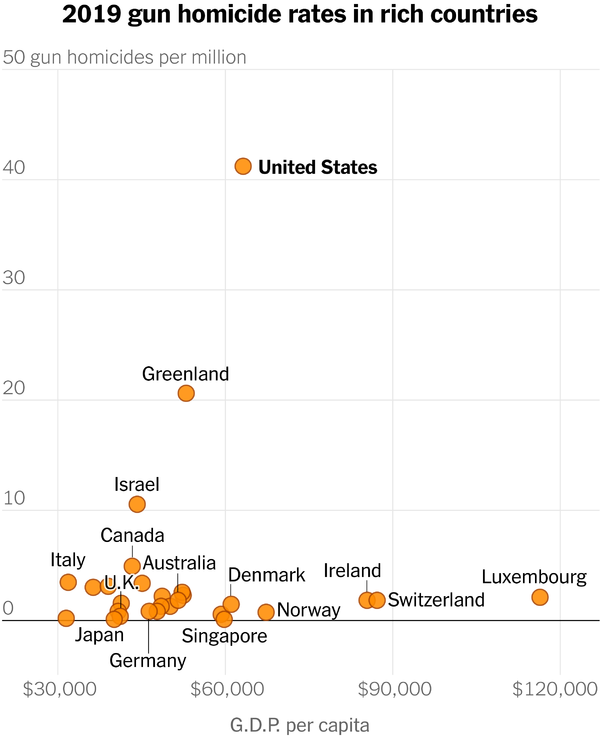
I was shocked — shouldn’t have been but was — when I got our of bed this morning and saw this New York Times graphic.
The homicide rate in America is more than double that of the second highest-ranking wealthy country…Greenland?
In his morning report, Dave Leonhardt of The Times wrote: “If American gun violence is no longer surprising, it still is shocking. On an average day in the U.S., more than 35 people are murdered with a gun. No other affluent country in the world has a gun homicide rate nearly as high.”
**
It is maddening that the vast majority of the public favors stricter gun-control laws, such as mandatory background checks and licensing, but intransigent, bought-and-paid-for Republican lawmakers at every level have succeeded in blocking the path to rational regulation.
It is maddening to see Gov. Greg Abbott, one of the biggest gun-rights advocates, out front in response to the Uvalde, TX, murders of 19 school children and two teachers.
Today, Abbott said his state does not need to adopt tougher gun laws because gun restriction is “not a real solution” to ending mass shootings. He regurgitated the now-rote, Republican line that the answer is improved school safety and better mental health care.
I guess that means every student gets a counselor, schools become fortresses and grudge-toting gun carriers fire away at brick walls and bullet-proof windows.
Abbott is one of many prominent Republicans who are certified stooges to the National Rifle Association. It’s so bad that Abbott and fellow Texas Republican Sen. Ted Cruz are (at this writing) still planning to attend the NRA’s annual convention this weekend in Houston, (along, naturally, with Donald Trump).
I don’t know how much money the NRA has contributed to Abbott’s campaigns, but The Washington Post reported today that 19 current or recent Republican senators, including Senate Minority Leader Mitch McConnell of Kentucky and Sens. Rob Portman of Ohio and Joni Ernst of Iowa, have each received at least $1 million in NRA campaign contributions over their careers, according to 2019 data from the Brady Campaign to Prevent Gun Violence.
That the Republicans are in league with an organization that appears to be rotten to the core — as well as committed to the notion that mass shootings are collateral, Second-Amendment damage — is appalling and saddening.
So, while parents, other relatives and friends continue trying to come to grips with the fact that 19 children and two teachers are gone forever, the backslapping, handshaking and searching for the latest in gun firepower will go on, full tilt, this weekend in Houston.
God help us.
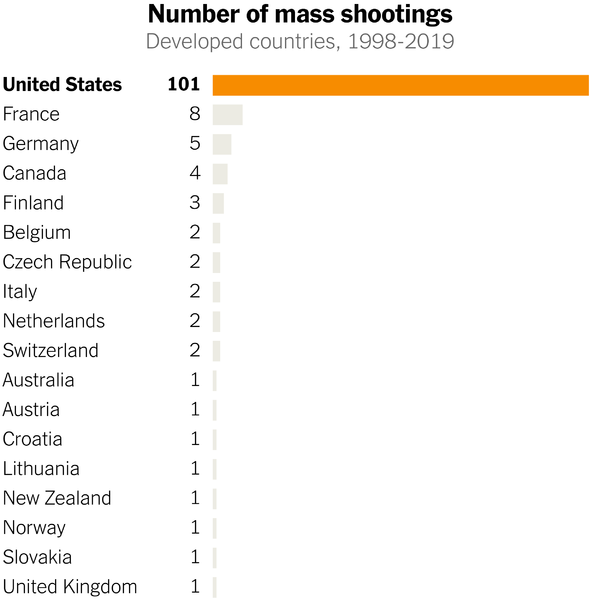
The mass shooter’s weapon of choice, the AR-15
**
Here’s another graphic from today’s (Thursday’s) New York Times morning report…
We returned to Kansas City this evening after a busy, four-day visit to my hometown of Louisville, KY.
In past years, we’ve gone to Louisville during Derby Week, but this year, with the ticket and lodging prices having skyrocketed, Patty suggested we travel two weeks later and go to Churchill Downs the day of the second leg of the Triple Crown, the Preakness Stakes. That way, we could save money, see friends and relatives and also make it out to Churchill Downs.
We stayed in an Airbnb just a few blocks from where I lived until I left Louisville for a newspaper job in northern Kentucky in 1968. (I didn’t stay there long, winding up in KC in September 1969.)
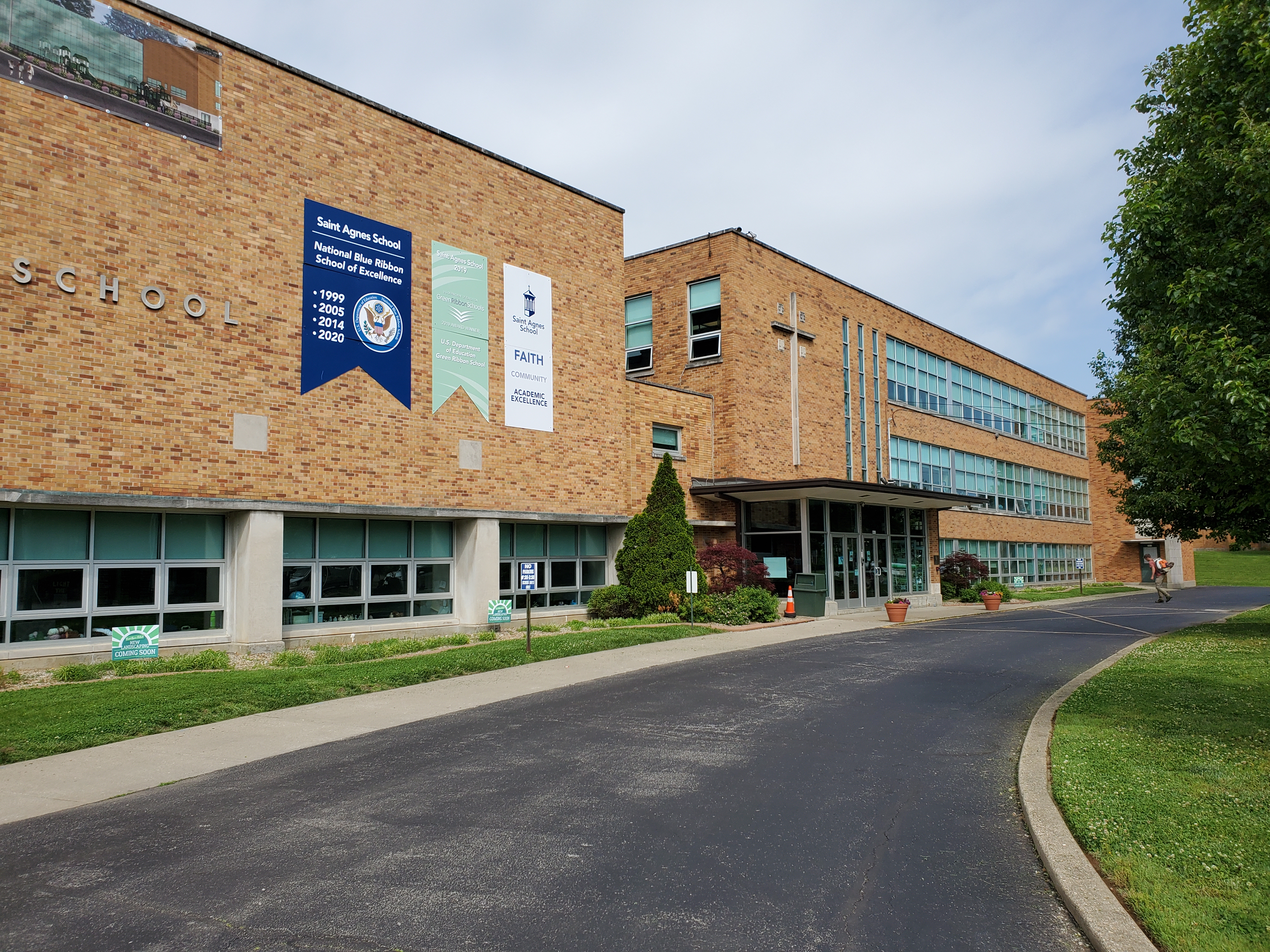
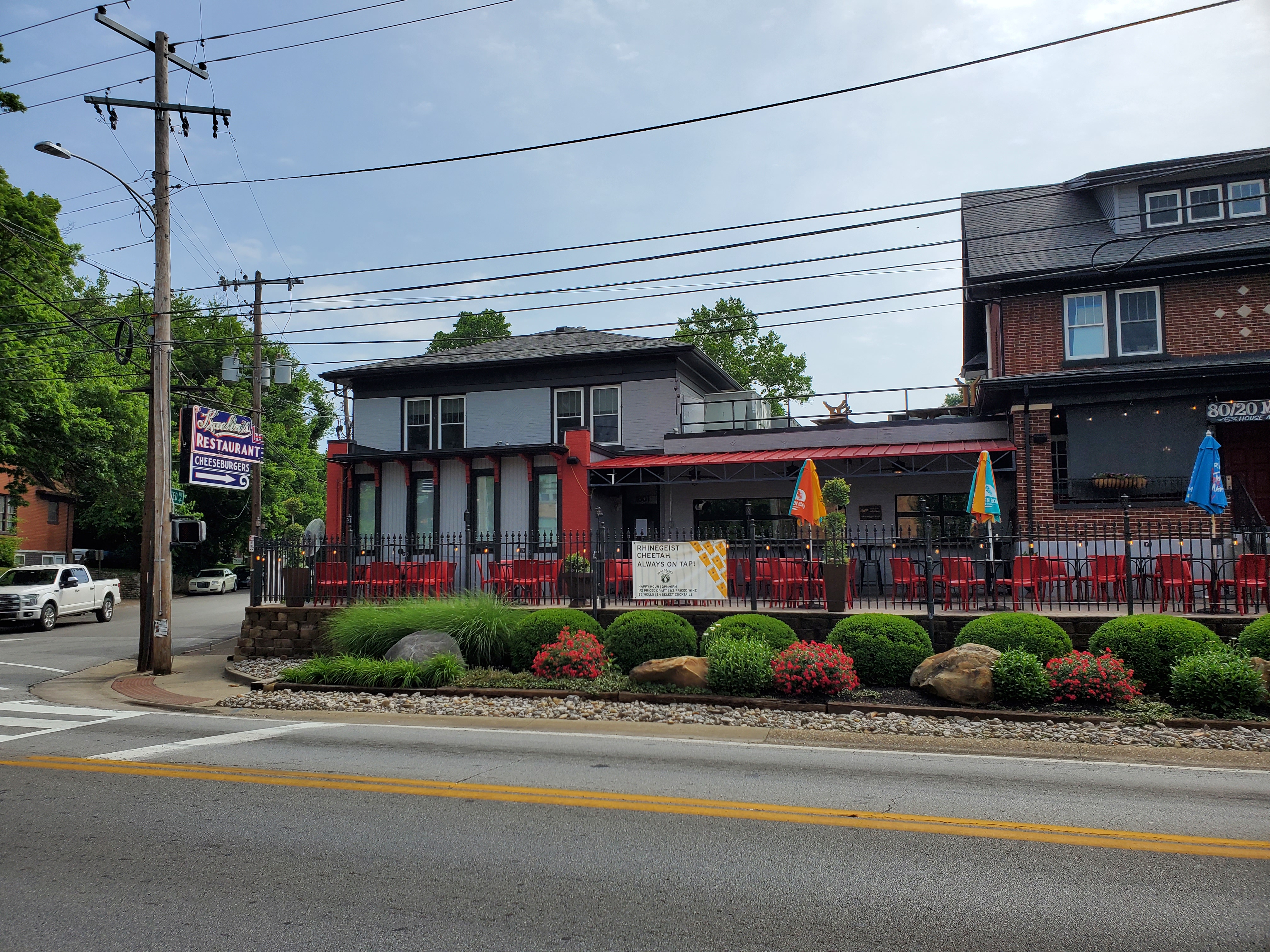
The morning after we arrived in Louisville, I took a walk around my old neighborhood.
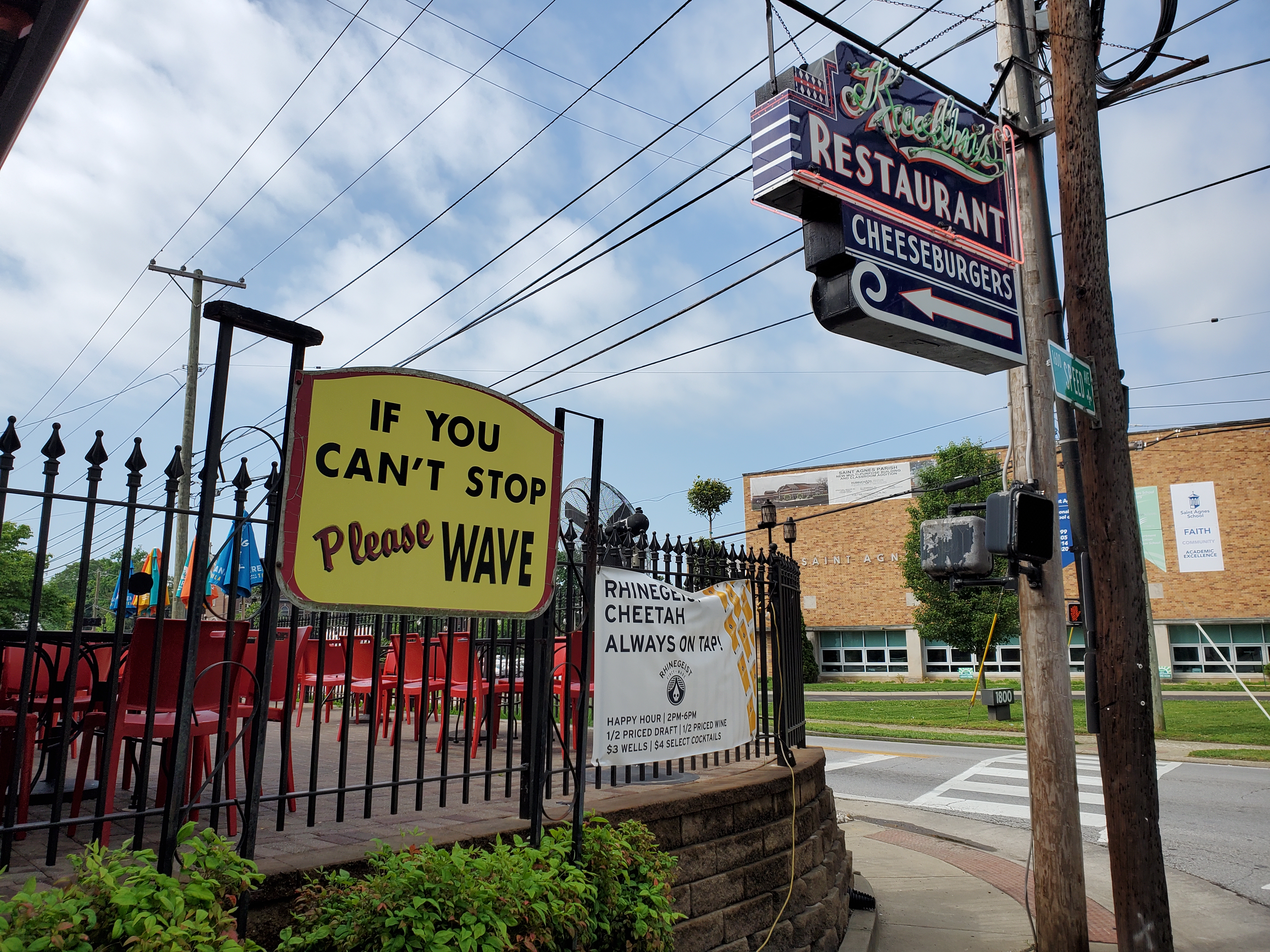
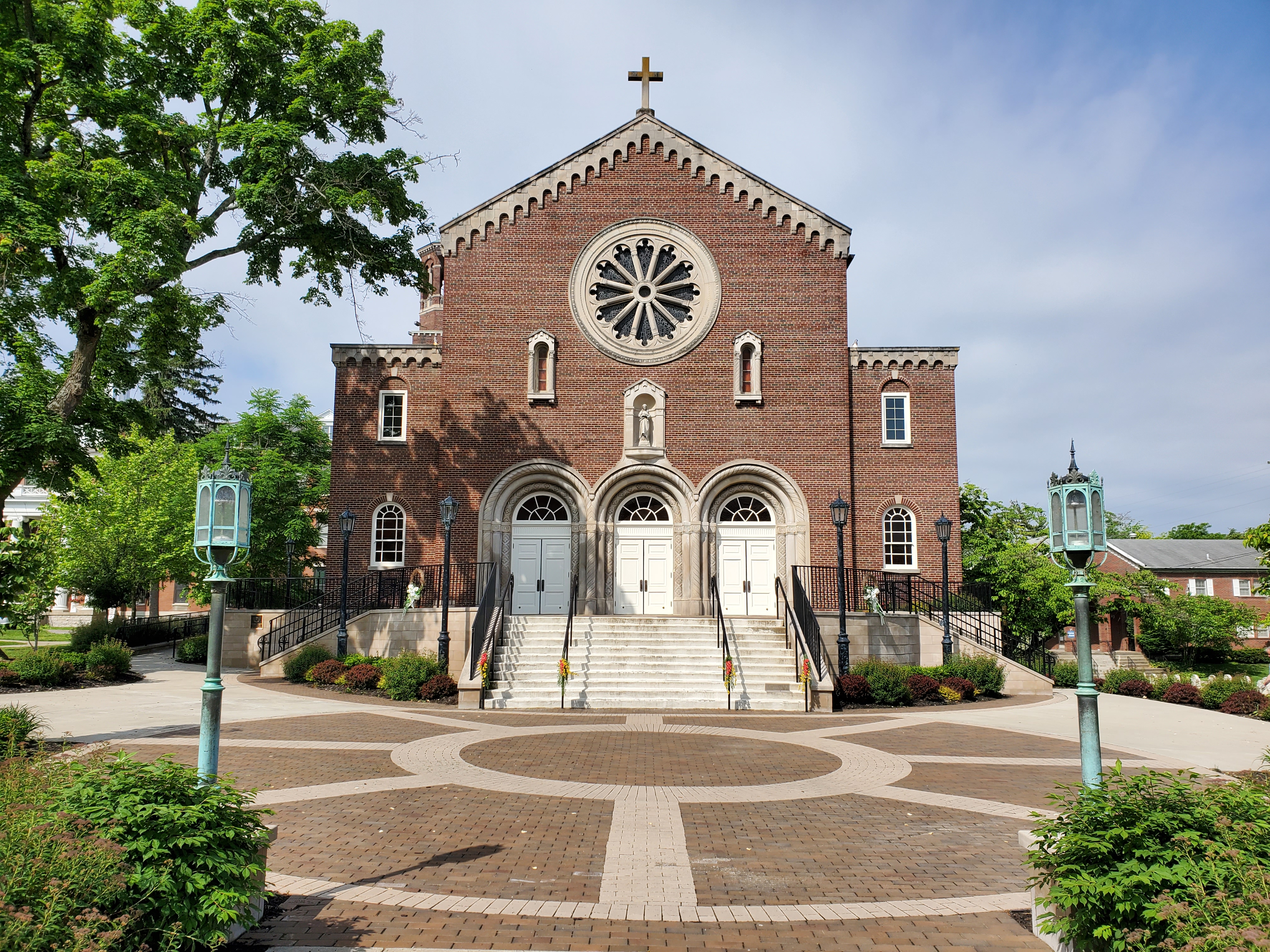
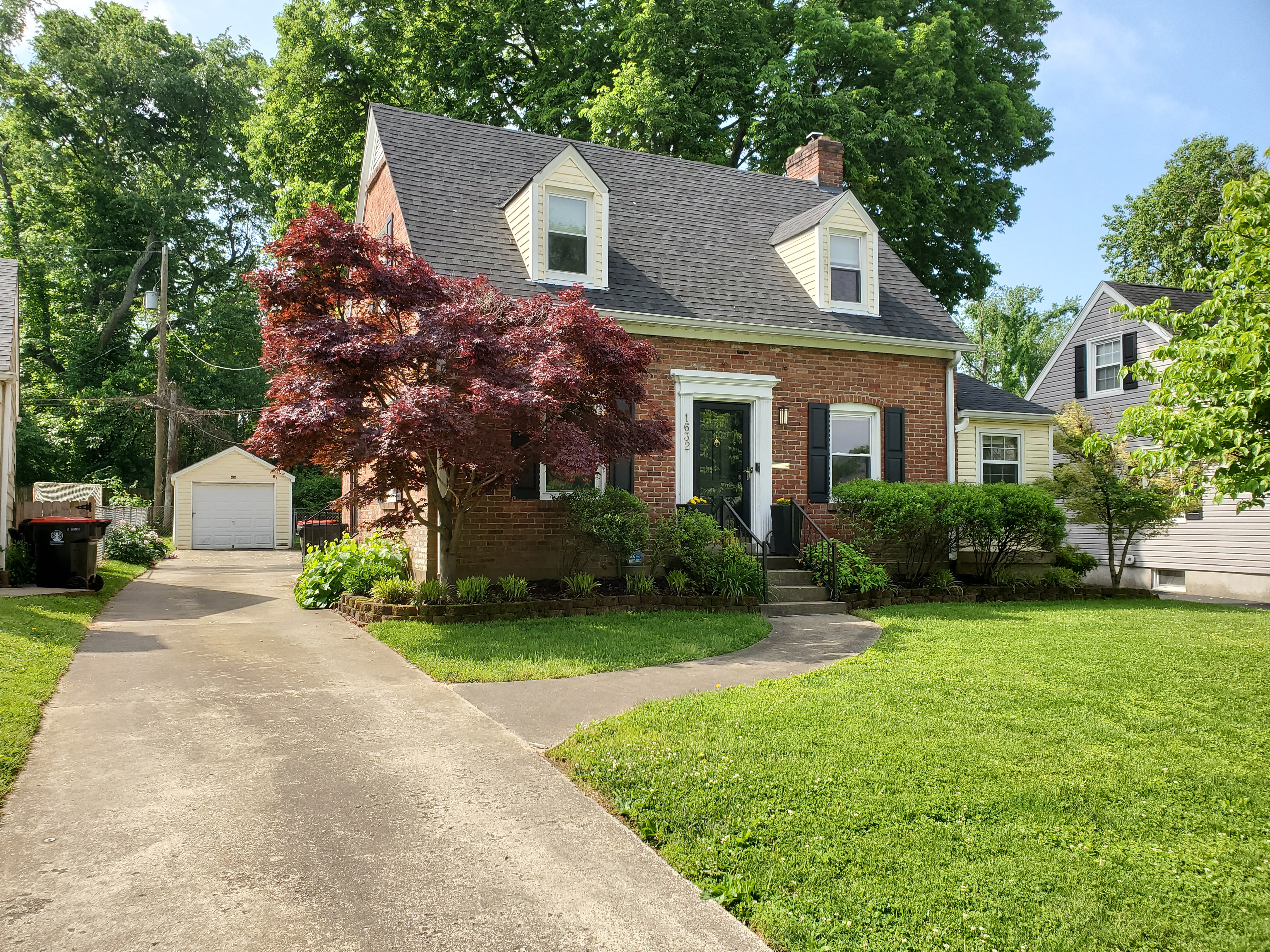
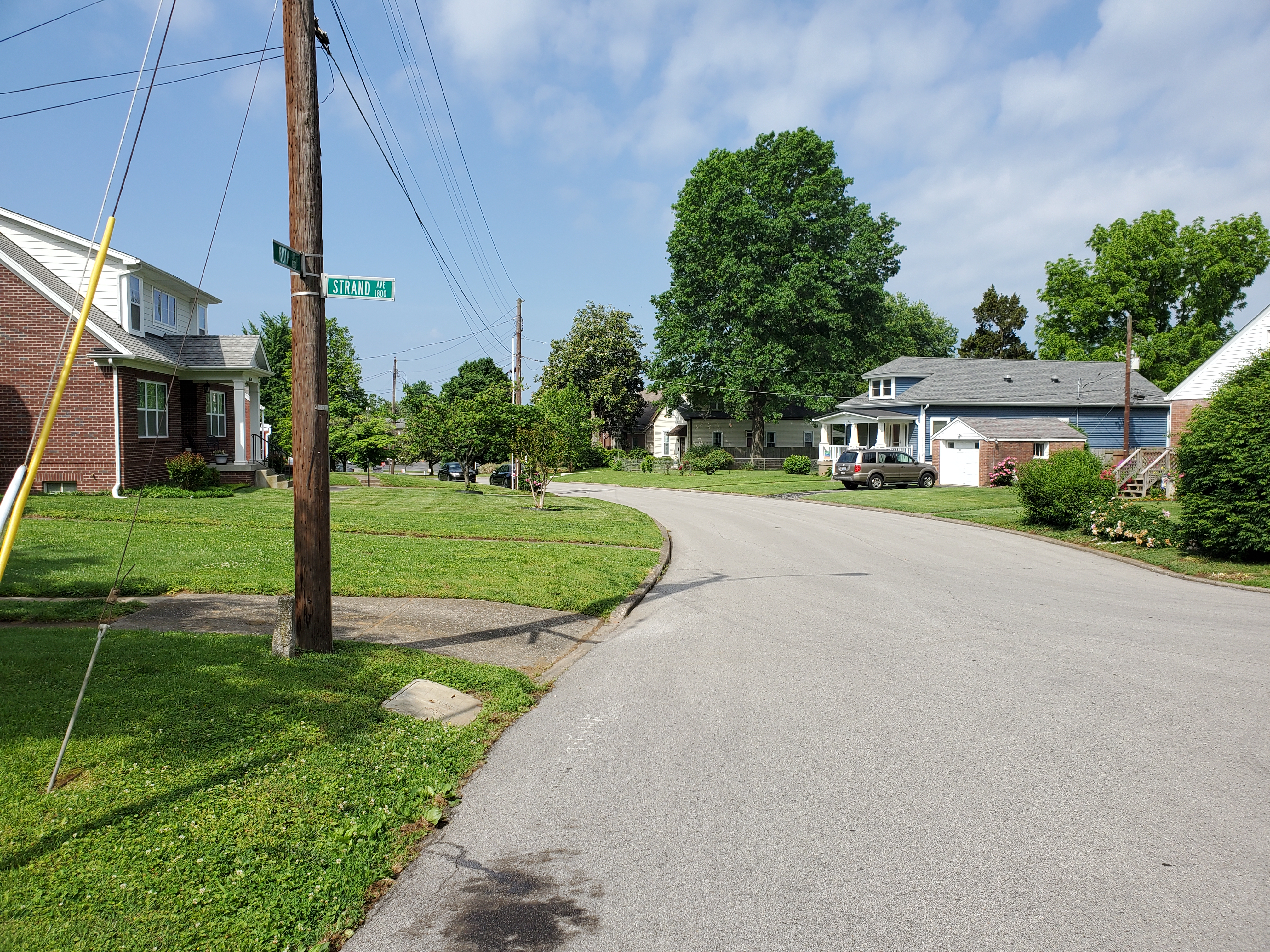
This is St. Agnes, Newburg Road and Speed Avenue, where I went to grade school.Across Newburg Road from the school is Kaelin’s Restaurant, which claims to be “the home of the cheeseburger” and which may have had the first carryout window of any restaurant in the country. (The carryout window was in the recessed area behind the red umbrella.) Kaelin’s was also the first Louisville restaurant that sold Col. Harlan Sanders’ Kentucky Fried Chicken.As far as a I know, this landmark sign has been there since the restaurant was founded, which was before we moved to the neighborhood. A couple of hundred yards from the school is St. Agnes Church, where I served many a 6:30 a.m. Mass and where I “confessed” to the parish priests to being besieged by “impure thoughts.” I can’t tell you how many “Our Fathers” and “Hail Marys” I said to try to atone for those terrible sins.About a block from the church was our modest, two-bedroom home at 1632 Ruth Avenue. A big Chinese elm once graced the front yard, and my father affixed a basketball goal to the garage. Also back then, the driveway consisted of two narrow concrete paths — wide enough to accommodate the car tires — not the wide slab that’s there now.This is looking down Ruth Avenue in the direction of Newburg Road and St. Agnes Church. When we moved to Ruth in about 1951, the section of the street you are looking at was a bed of rocks, not pavement. The pavement came a year or two after we arrived.
**
I also got in a round of golf…
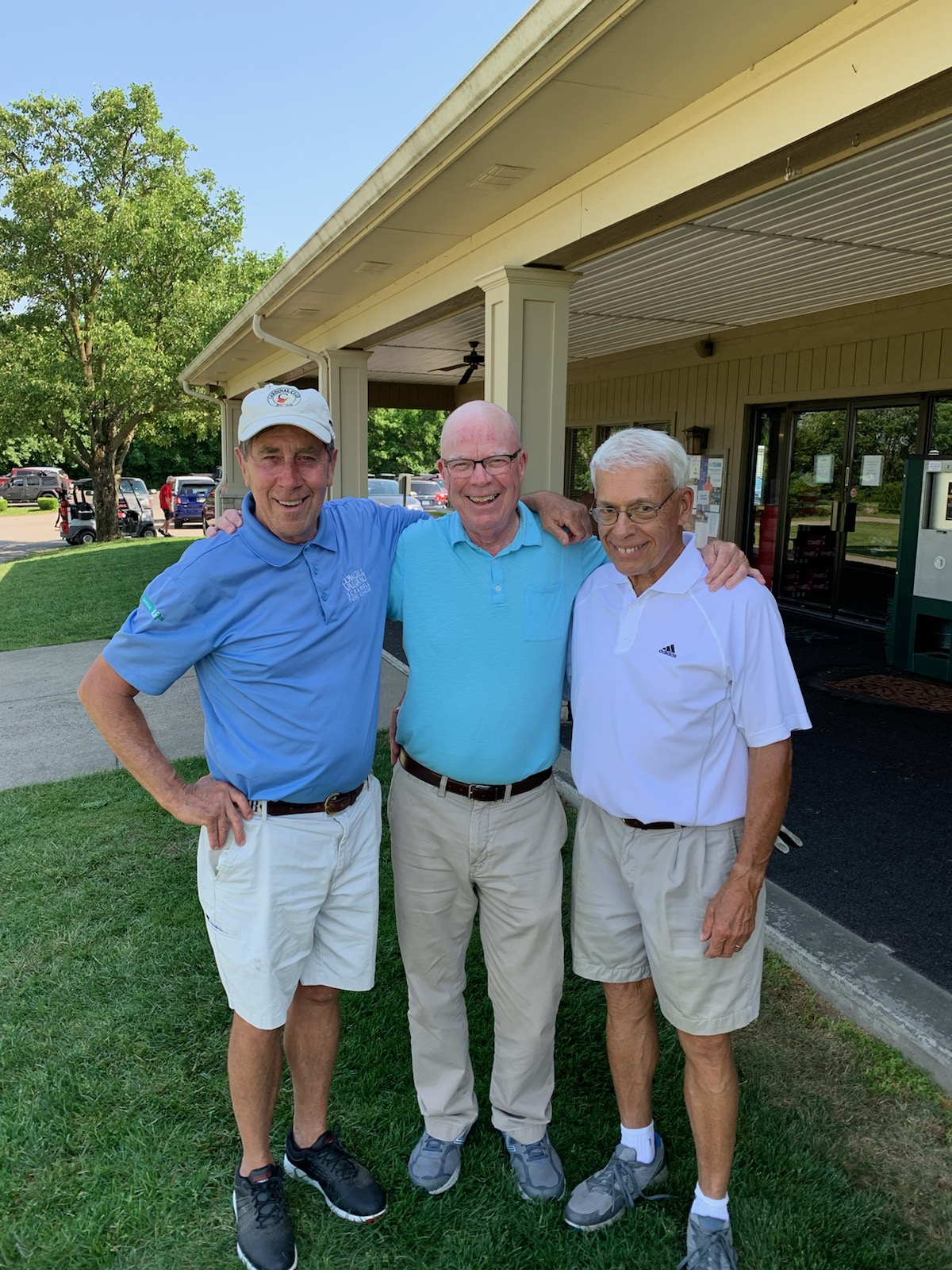
That’s my dear, longtime friend Bill Russell at left and another longtime friend, Bernie Bell, at right.We also visited cousins Sharron Hillbrecht (left) and Colleen Salazar. Sharron and Colleen are the oldest daughters of my father’s youngest brother.
**
On Saturday, we made it to the track…
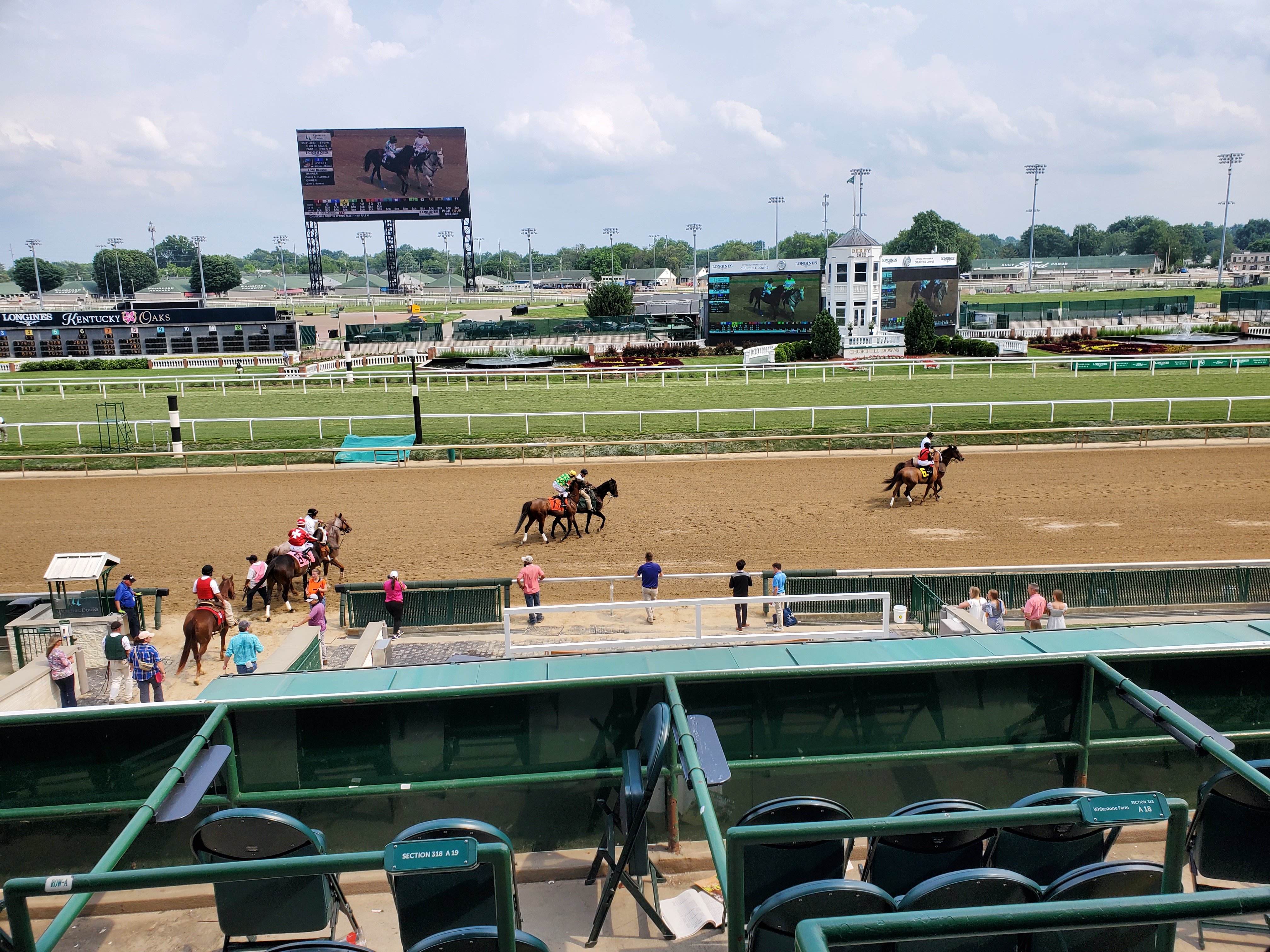
Here the horses are coming out onto the track for one of 10 races that day. In the background, middle right, is the Winner’s Circle, where Rich Strike had the Bed of Roses tossed over his mane on Derby Day, May 7.Before one of the races, my friend Bill, his wife Denise Carroll and Patty studied the program.
We stayed for about five races and decided to leave as storm clouds rolled in. Leaving when we did was a bad call: no sooner had we started for the car than the skies opened up, and pouring rain and howling wind laid waste to our small umbrellas. We went back to Bill and Denise’s downtown condo, borrowed outfits from them while our wet clothes took a spin in the drier, then settled down to bet the Preakness on the Twin Spires app.
If you’ll recall, my Derby pick was Zandon, on whom I bet $100 to win. He finished third, behind Rich Strike and Epicenter. On Preakness Day, though, it was a different story. Being a good Democrat, I felt sure that the No. 5 horse, Early Voting, was going to run well. In addition to fancying the name, I also like Early Voting’s trainer, Chad Brown, who trained Zandon and is regarded as the best trainer on the East Coast.
I stuck with Brown in the Preakness and was rewarded with a $187 profit, which made me a winner in the first two legs of the 2022 Triple Crown.
…It was a great trip to Louisville. Good to see the old neighborhood, spend time with friends and relatives and spend a few hours, once again, in the Churchill Downs grandstand under the Twin Spires.
With news coverage so splintered these days among online publications and old-fashioned newspapers, I’m here to help you sort out some of the main things the Missouri General Assembly did or didn’t do in the last few days of this year’s session, which ended this afternoon.
As I see it, here are some of the positives that came out of the session…
:: A big, fat state budget of $49 billion, up from $40.9 billion this year, due primarily to billions dollars in federal Covid relief funding. Two key items in the budget are $2.5 billion to pay for expanded eligibility to the Medicaid program and $925 million to increase payments to providers serving people with developmental disabilities, nursing home patients and people needing assistance to remain in their homes through the Medicaid program.
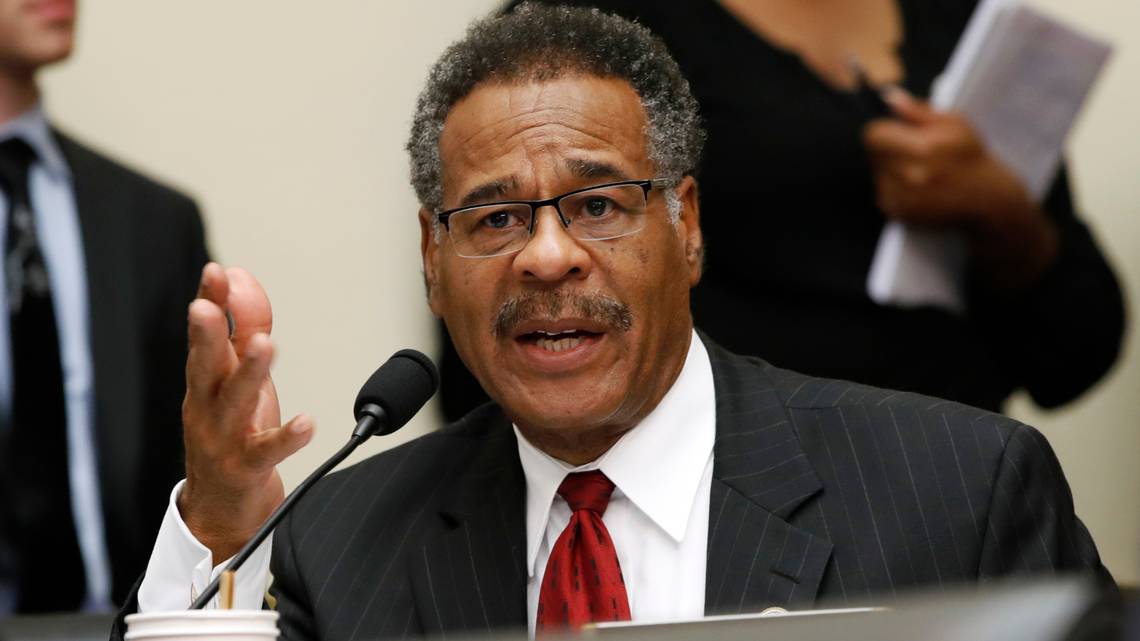
:: Retention of the “6-2” congressional map, which leaves intact U.S. Rep. Emanuel Cleaver’s 5th District. A group of ultra-conservative senators sought unsuccessfully to unravel the cohesive 5th District and stretch it eastward like a piece of bubblegum to dilute the Democratic vote and, ideally, turn it Republican, resulting in a “7-1” Republican-dominated map.
Emanuel Cleaver
:: The state, instead of the Kansas City and St. Louis public school districts, will pick up the cost of funding Missouri’s public charter schools at the same level as traditional public schools. Under an earlier version of the bill, approved by the House in March, millions of dollars in funds would have been stripped away from the Kansas City and St. Louis public school districts in order to make up for a formula disparity where charter schools are currently paid less per student. According to the fiscal note attached to the original House bill, KCPSD would have lost more than $8 million to public charter schools, and the St. Louis district would have been shorted about $18 million. Ultimately, the legislature decided the state should make up the difference – which, again, goes back to that big, fat budget.
:: Some of the best things to emerge from the session were things that didn’t get approved. For example, left on the cutting-room floor were bills that would have legalized sports wagering, diluted the open records law, and made it significantly harder to amend the state constitution through the initiative petition process…Legalized sports betting may help Kansas lure the Chiefs to Kansas, and as I wrote several days, ago, let ’em go. They’ve always had absentee owners and have never been as committed to Jackson County and Kansas City, MO, as the Royals.
**
There were, of course, some negatives, including big changes in voting practices.
:: Beginning Jan. 1, 2024, Missouri voters will be required to present a government-issued photo ID to cast a ballot. That is not the case currently, and Republicans have been trying to enact a photo ID requirement for 15 years.
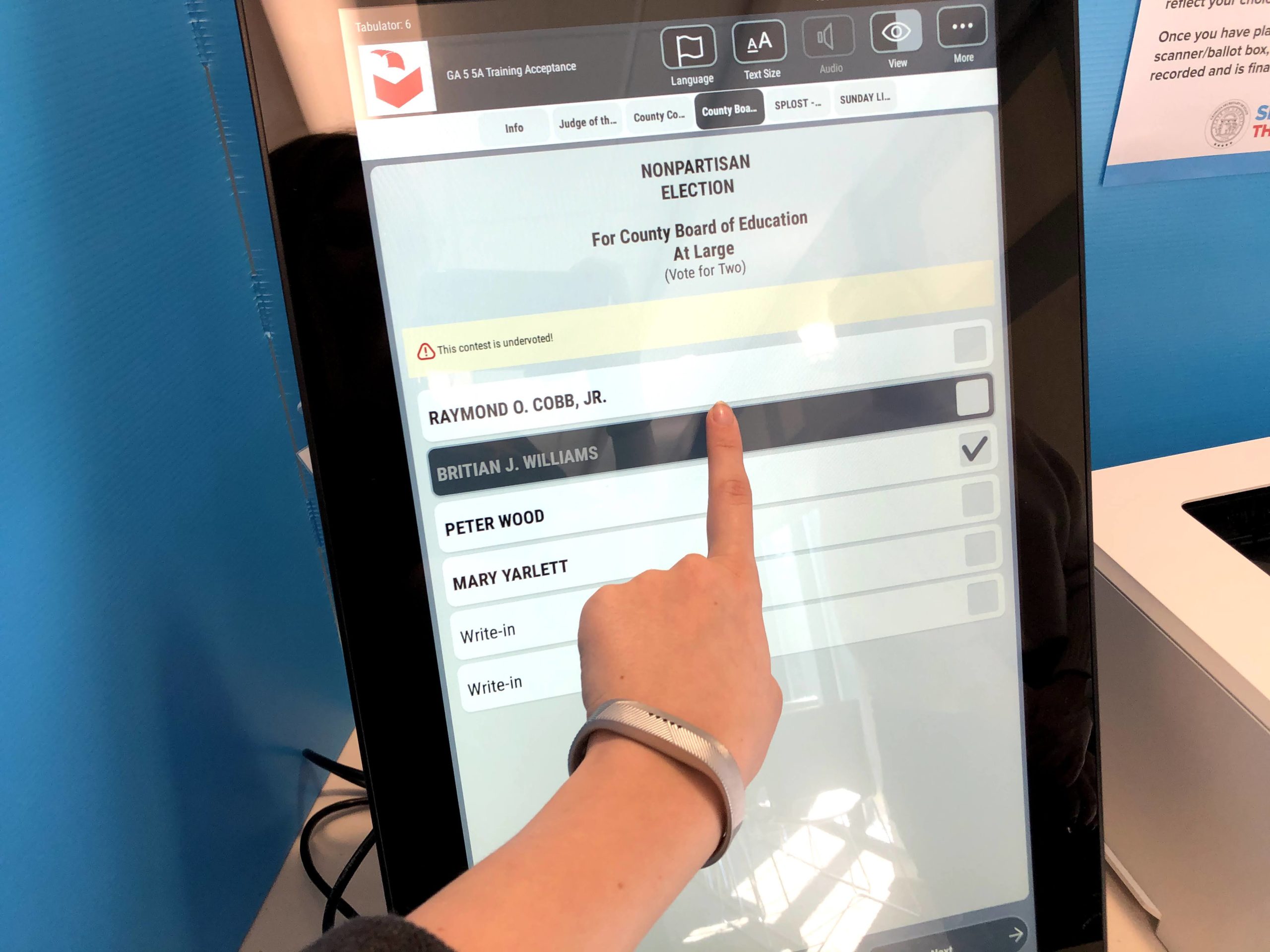
:: Local election authorities will no longer be able to use touchscreen voting machines. We’ll be leapfrogging back to the all-paper-ballot system, where we try to darken those little holes with little pencils that are down to the nub by Election Day afternoon…This is ludicrous. Touchscreen voting is easier, more reliable and probably less costly in the long run. Republicans want to do away with it because some fear the touchscreen machines are connected to the internet and the Chinese are getting in there and manipulating votes…In actuality, the Chinese are sleeping while we’re voting, and they don’t care who we vote for.
Enough of this!
:: The only good thing to come out of the voting bill is that it provides for a two-week, pre-Election-Day window when people can vote absentee without an excuse…Hallelujah! I can finally stop lying down to those workers down at Union Station.
:: Finally, the General Assembly approved two bills aimed at requiring the city to spend more money on law enforcement. One bill would would raise the minimum percentage of Kansas City’s general-fund revenue that must be spent on police from 20 percent to 25 percent. (We’re talking tens of millions of dollars that could otherwise go to street resurfacing, bridge repair, park amenities and other quality-of-life-and-city basics.) The other bill provides for a statewide vote to amend the constitution to allow the legislature to increase the percentage from 20 percent.
The KCPD-spending bills were intended, more than anything, as a poke in the eye to Mayor Quinton Lucas, who along with a Council super-majority, last year had the audacity to try to reallocate $42 million from the police budget to establish a Community Services and Prevention Fund. Unfortunately, the Council’s surprise move didn’t work out. The Board of Police Commissioners sued, and a Jackson County Circuit Court judge ruled the council had overstepped its authority to redirect police funding after it had approved the budget.
…I love Kansas City. It’s just that residing in Missouri is a prerequisite. C’est la vie.
Just like last year, I learned belatedly that a Kansas City journalist had won a Pulitzer prize.
Last year, after I had posted my Pulitzer story, my friend Dan Margolies at KCUR informed me that a colleague of his, Chris Haxel, had been one of four NPR correspondents who shared the prize for Audio Reporting. Haxel had contributed a podcast to the Guns & America national reporting project.
I worked that into the post an hour or so after publication.
This year, it took me nearly a full day to find out that a Kansas City reporter had won a Pulitzer this year.
I found out by reading The Beacon’s morning, emailed newsletter.
The local winner was a young woman named Madison Hopkins, who for the last seven months has worked as health care accountability reporter for The Beacon, which made its debut two years ago.
Madison, who, I believe, is in her late 20s, did not win for work she has done for The Beacon but for a series she worked on at her previous employer, the Better Government Association in Chicago.
Madison and 28-year-old Cecila Reyes of the Chicago Tribune collaborated on an examination of Chicago’s long history of failed building- and fire-safety code enforcement, which gave unscrupulous landlords the opportunity to commit serious violations that resulted in dozens of unnecessary deaths.
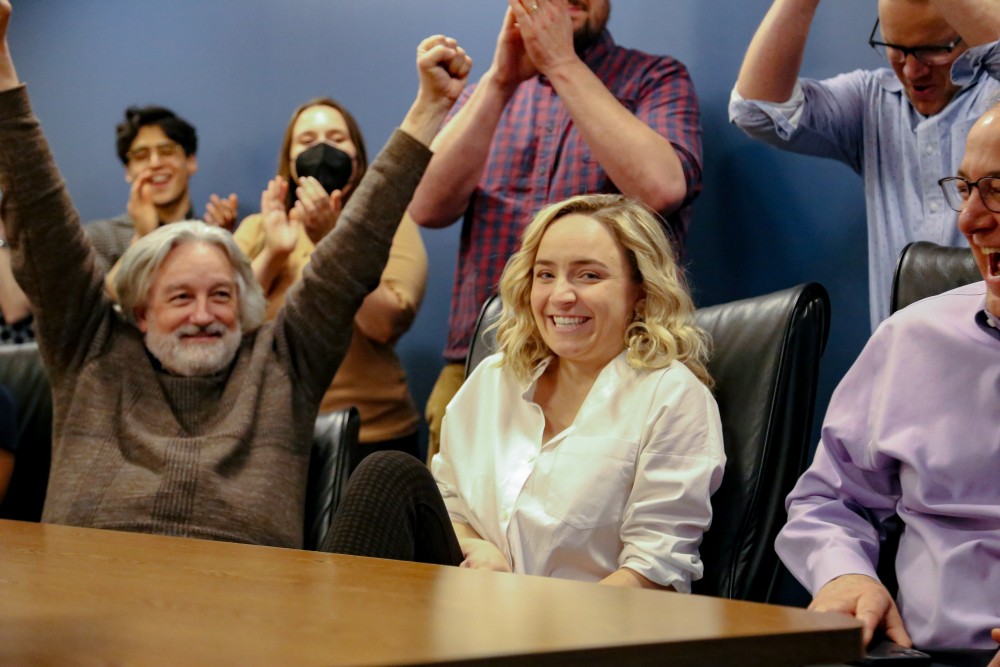
Madison Hopkins and her former colleagues at the Better Government Association celebrated Monday’s announcement of her (and their) Pulitzer Prize for local reporting.
This was not, of course, the first Pulitzer for the Trib, but it was for the 99-year-old BGA, a non-partisan, nonprofit news organization that works for transparency, efficiency and accountability in government in Chicago and across Illinois.
Hopkins’ and Reyes’ series, which ran in April 2021, followed more than a year of reporting and uncovered 61 deaths from fires in buildings that, the BGA said, “the city knew had fire safety issues, sometimes for years.”
Cecilia Reyes
The investigation highlighted the city’s failure to follow up on complaints about hazards and how the city put landlords’ interests ahead of tenants’ safety.
Most of the 61 people who died were Black.
This Pulitzer was for local reporting, a very prestigious category. It was in the local category that The Kansas City Star and Times won the 1982 Pulitzer for their overall coverage of the Hyatt Regency disaster.
**
Hopkins’ award says a lot not only about her but also about Kelsey Ryan, who founded The Beacon, a non-profit, online news outlet focused, according to its website, “on in-depth journalism in the public interest.”
Ryan was hired by The Star in 2017 and a year and a half later was summarily laid off. Her reaction? After getting a 7 a.m. phone call apprising her of the news, she “had a good cry” and immediately set about determining what she would do next.
Kelsey Ryan
It only took her a few hours…
“By 3 p.m., my work email was downloaded and my resume updated. And by 5 p.m., I realized I really didn’t want to ever work for another McClatchy paper. Or Gannett. Or GateHouse. Or (insert name of struggling newspaper company here). That in some ways, going to another newspaper was the easy route, to grab a lifeboat and hope it won’t sink itself in the next year or two. To bury my head in the sand, pretending more layoffs wouldn’t happen. Instead, I decided I would build a new ship.“
She christened and launched that ship less than two year later. It’s done well enough that she was able to expand last year to Wichita, where she worked for The Eagle before working at The Star. (The Eagle is also a McClatchy paper.)
When Kelsey hired Madison last fall, I don’t know if she had any idea Madison would be in the hunt for a Pulitzer several months later. But, in any event, the hiring is a testament to Kelsey’s managerial instincts and experience. Kelsey now has a Pulitzer-Prize-winning reporter on her staff, which should help raise The Beacon’s profile and readership.
…A final note: I find it ironic that where The Star’s Pulitzer-Prize winner, Melinda Henneberger, is looking at KC in the rear view mirror, on her way to The Sacramento Bee, Madison Hopkins is barely out of the car and still probably finding her way around town.
Let’s hope she stays a while and makes a big contribution to local journalism.
You can see some of her stories for The Beacon here.
After three straight years in the “finalist” role, Melinda Henneberger finally got over the top today and won a Pulitzer Prize for her resolute, journalistic campaign to hold former Kansas City, KS, detective Roger Golubski to account for his own resolute campaign to besmirch the badge.
Congratulations to The Star and Melinda!
Henneberger, who announced recently she was leaving The Star to write a regular column for McClatchy’s flagship paper The Sacramento Bee, was quoted on The Star’s website as saying she was overwhelmed.
I really don’t know what to say except that this is extremely humbling and, as I may have mentioned a few hundred times before, that it’s past time for the FBI to show up with some handcuffs. If this brings some measure of justice to Roger Golubski’s victims at long last, then that will be the best award.
The line about the FBI and handcuffs couldn’t be more appropriate. He is very credibly alleged to have raped and extorted sexual favors from Black women, sometimes pressuring them into fabricating evidence in cases he was handling.
Who knows how many people were wrongfully charged because Golubski let his sexual appetite and crookedness corrupt his commitment to public service?
Police chief after police chief in KCK averted their eyes at what had to be well known among officers — that Golubski was the worst type of cop.
One of his partners was Terry Zeigler, a former chief. In a court deposition, a woman said Golubski raped her in her home and told her Zeigler was waiting outside in a patrol car. The Star could never get Zeigler to comment.
Golubski retired from the KCK department in 2010 but then worked for the Edwardsville Police Department for six years before retiring completely in 2016.
Henneberger, in a 2019 Star photo.
**
The New York Times won four Pulitzers, including one for an investigation into deadly police traffic stops around the country.
The Washington Post won in the public service category for its examination of what led up to, and what transpired during and after, the Jan. 6 siege of the U.S. Capitol.
The feature writing award went to Jennifer Senior of The Atlantic for an account of one family’s reckoning with loss in the 20 years since 9/11.
On another police-related matter, Patty, Brooks and I were sitting in the kitchen last night when, about 9:15, we began hearing many sirens, seemingly close by. We live a block from Meyer Circle, so our presumption, when we hear nearby sirens, is always that there was a wreck at the circle.
Patty and Brooks decided to walk down toward the circle to see what was going on. I stayed behind.
When they returned, they reported that a major wreck had, indeed, taken place; that one car was overturned; and that our across-the-street neighbor had told them at least one person had died.
Sure enough, The Star reported today that “one person was killed after being partly ejected through the sunroof of an SUV in a rollover crash on Ward Parkway in Kansas City Sunday evening.”
The victim was as 42-year-old Cory Walter. None of the news outlets was reporting where Walter lived, but whitepages.com shows a Cory Walter, in his 40s, living in Grain Valley.
Walter was one of two occupants of a black Chevrolet Equinox that was westbound in the north leg of the circle and failed to yield to a stop sign in the circle. The Equinox pulled right in front of a southbound, gray Toyota Camry, and the impact overturned the Equinox.
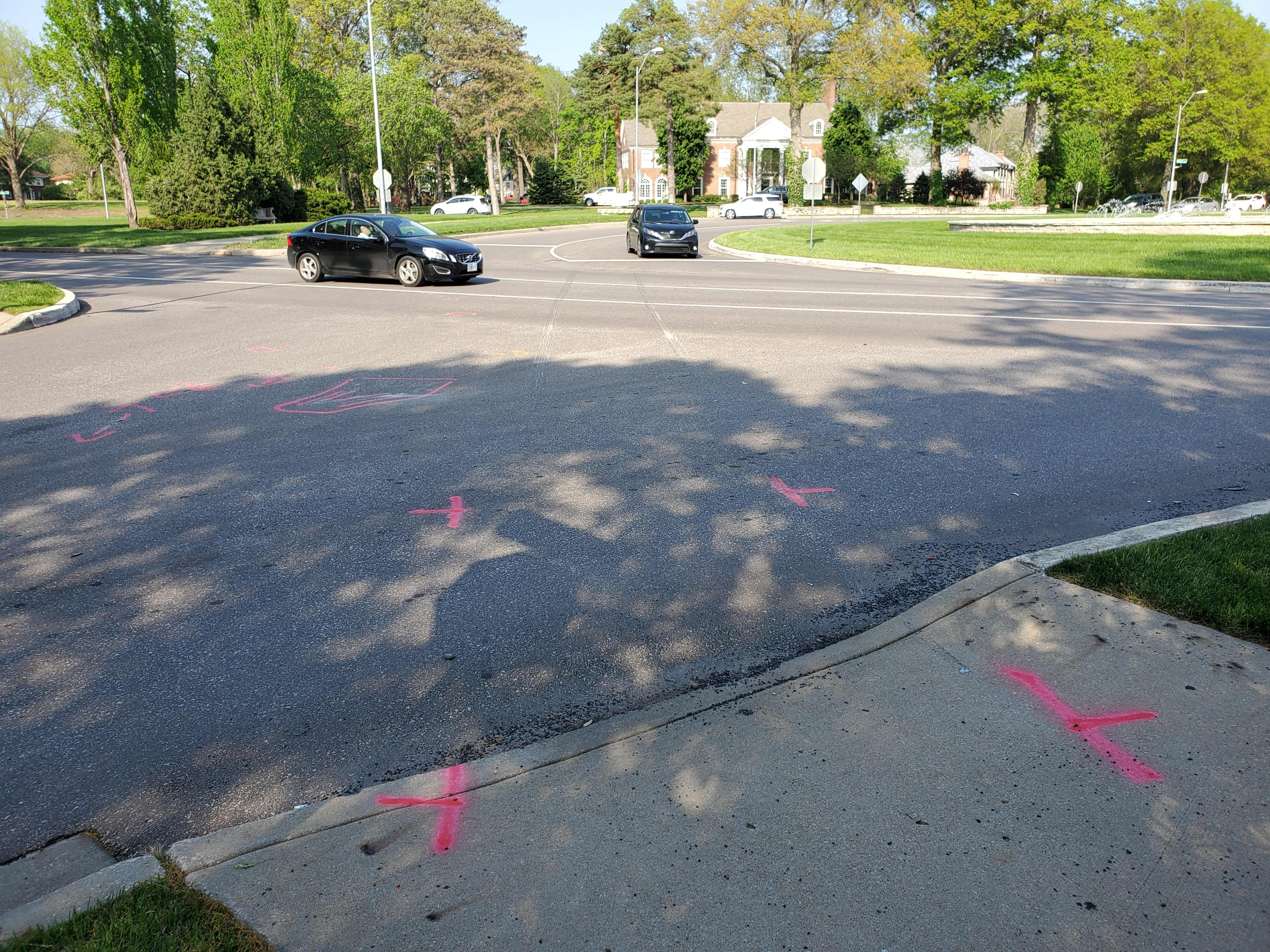
This is the crash site, looking east. The Equinox did not stop for the stop sing in the circle, and the southbound car (like the one coming from left to right) T-boned it.
There was a strange twist to the case: The second occupant of the Equinox (police had not determined who was driving) climbed out of the SUV and ran away.
Fortunately, neither of two people in the Camry was injured.
After reading and thinking about this, I sent an email to Mayor Quinton Lucas’ chief of staff, asking her to pass on to him a suggestion…which is, that he encourage the Police Department to launch an all-out campaign on speeding and reckless driving.
As I said in my email, with all the ridiculously scary driving we see every day, I can’t think of a better service to public safety. I believe a sustained barrage of citations would help rein in the frightening situation on our streets and highways.
And don’t tell me it wouldn’t make any difference. When traffic laws are being enforced, word gets around, and speeders notice when reckless compatriots are pulled over and blue lights flashing.
I lost $100 on the Derby, but I don’t care. It was the best and most exciting Derby in a decade or more.
Our 34-year-old daughter Brooks, a bid Derby fan, summed it up in a text she sent me and Patty minutes after the race: “Crazy!! Great Derby. So great to have something unexpected happen!!!”
Yes, this Derby — with 80-1 longshot Rich Strike, barreling through on the rail to prevail in the last few strides — was worth every one of those exclamation points.
Watching the race on TV, I thought the horse I had bet on, Zandon, one of the betting favorites, was going to win. He was engaged in a stretch battle with another betting favorite, Epicenter, and I was focused on those two. It was a bit discombobulating, then, to see Rich Strike, wearing saddle cloth No. 21, whoosh by both of them on the inside, where it’s usually difficult to gain ground.
Rich Strike, who had been purchased earlier in his racing career for a measly $30,000, paid $163.20 on a $2 bet.
It was the second biggest winning payoff in Derby history, behind only Donerail who paid $184.90 in 1913.
Joe Drape, a Kansas City native who has been turf writer for The New York Times for many years, had a compelling description of Rich Strike’s trip around the track.
(Jockey Sonny) Leon guided Rich Strike almost 90 degrees out of the gate, going from the 20th path to the inside. Then, they rode the rail like a couple of hobos.
Leon and his colt were unhurried as they followed 17 other horses chasing a wicked early pace into the far turn.
“Nobody knows my horse like I know my horse.” Leon said.
Leon started guiding his horse through the pack, zigzagging like someone late for work on a busy Manhattan sidewalk. Ahead of them, Epicenter and Zandon looked each other in the eye for what was going to be duel to the wire in the middle of the track.
“I had to wait until the stretch and that’s what I did,” Leon said, “and then the rail opened up.”
In the final strides, Drape wrote, “Leon and Rich Strike flashed past like a bottle rocket.”
**
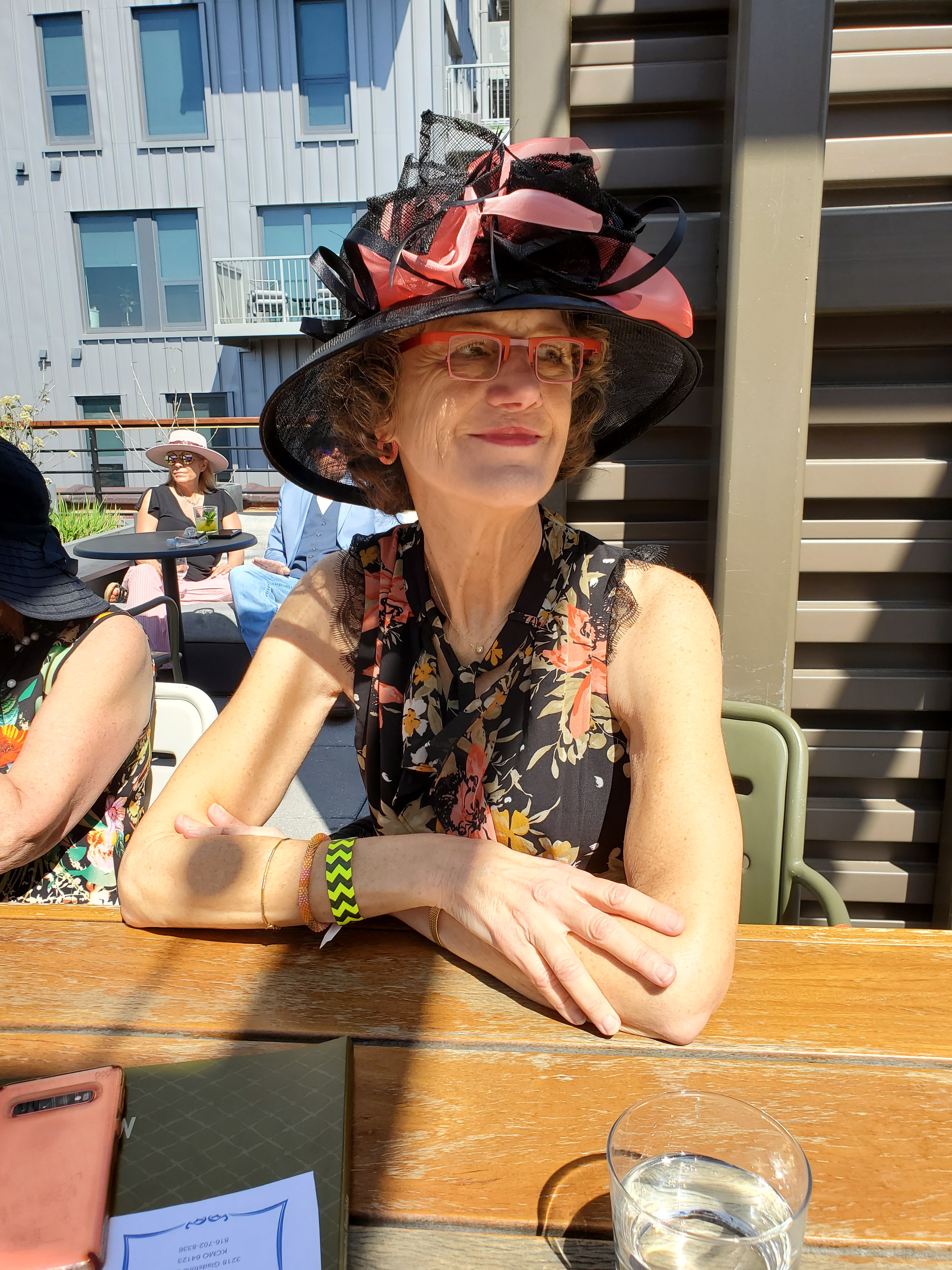
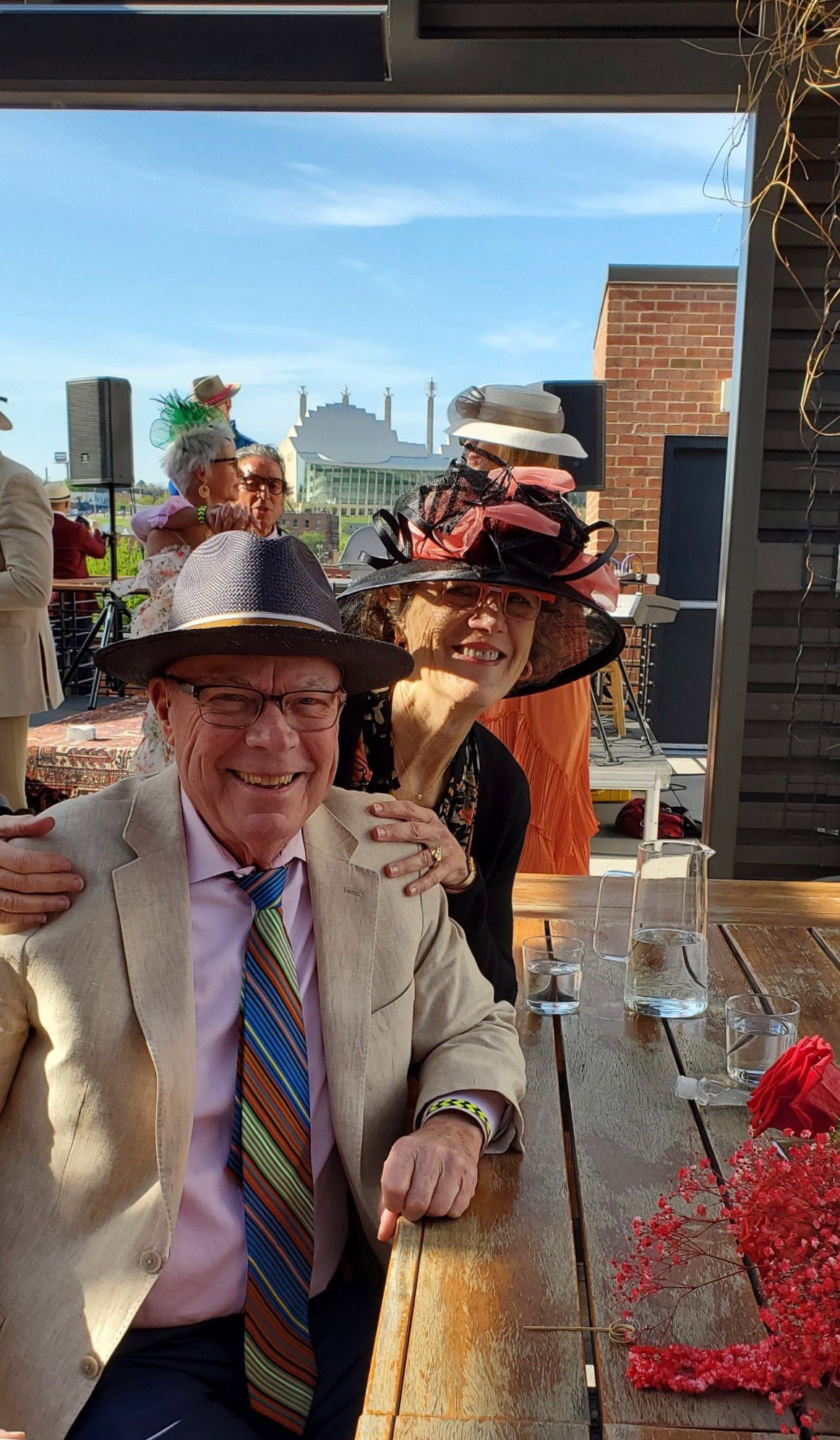
Patty and I watched at a Derby party on the rooftop of the Crossroads Hotel. We were with good friends, Leigh and Lorraine Elmore, with whom we go way back. In fact, the night I brazenly first approached Patty in the back room of the New Stanley Bar in Westport, she was sitting with Lorraine. Not just sitting, but smoking and drinking. (She gave up the smoking several years later.)
Now, here are several photos I took atop the Crossroads Hotel.
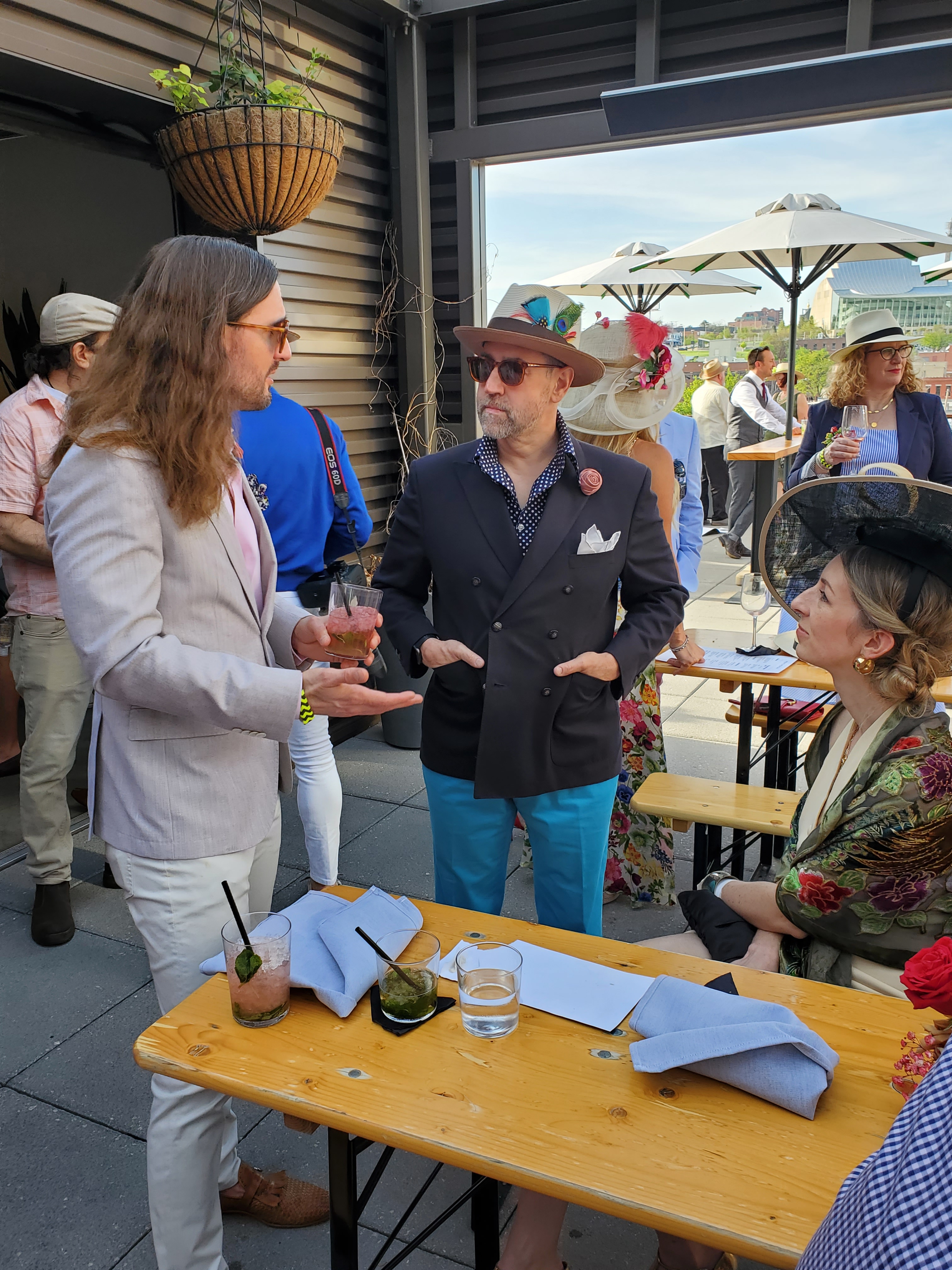
It was a little difficult to see the TVs because of the glare, but not bad enough that I didn’t see Rich Strike go by my horse, Zandon.A rooftop view looking north, toward Downtown.Patty, looking like a winner.Lorraine, wearing a hat she decorated with artificial flowers and butterfly.Patty and the blogger.Fashionable party goers.
It’s Derby Day, and even though I’m 500 miles away, I’m a bundle of pent-up energy…as usual.
For decades, I’ve awakened on Derby Day with eyes wide open and blood running a little faster.
Despite all the problems horse racing has had — sickening, terminal injuries and cheating trainers — and despite my beefing about how Churchill Downs has ruined the event for average people by raising prices to stratospheric levels, it’s still an amazing event.
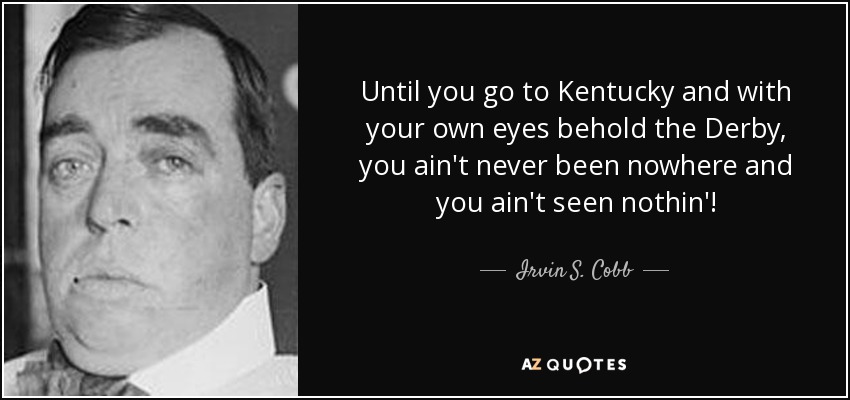
As Kentucky-born writer Irvin S. Cobb (1876 – 1944) wrote many years ago, “Until you go to Kentucky and with your own eyes behold the Derby, you ain’t never been nowhere and you ain’t seen nothin’!”
Mainly because of the prohibitive prices of Derby lodging and tickets, Patty and I didn’t go to Louisville for Derby Week. Instead, we’re going to a Derby party in the Crossroads District — a party that’s a benefit for the Kansas City Museum. (I intend to post some photos later.)
I’m glad we’re here, too. While it’s picture-perfect, Derby weather in Kansas City, in Louisville it’s 60 degrees and cloudy. I’ve been to Derbies in rain, snow and sun, and, needless to say, it’s much more fun on a perfect spring day.
We got our bets down through Louisville friends, who have the online-betting app. Missouri, as most of you know, does not have legalized sports betting, and its residents cannot sign up for any of the betting apps.
I’m betting $100 to win on Zandon, who is coming from the No. 10 post position, right in the middle of the 20-horse field. (I also placed a $20-to-win bet on Zandon for my longtime barber and good friend, Cecil.)
Patty bet $10 to win on Smile Happy, No. 5.
I expect Zandon to be either the favorite or the second favorite, along with Epicenter, who will be coming “out of the 3 hole,” as they say in racing.
(If you’re wondering where the name Zandon came from, his owner, Jeff Drown, named him after a hunting guide in Colorado.
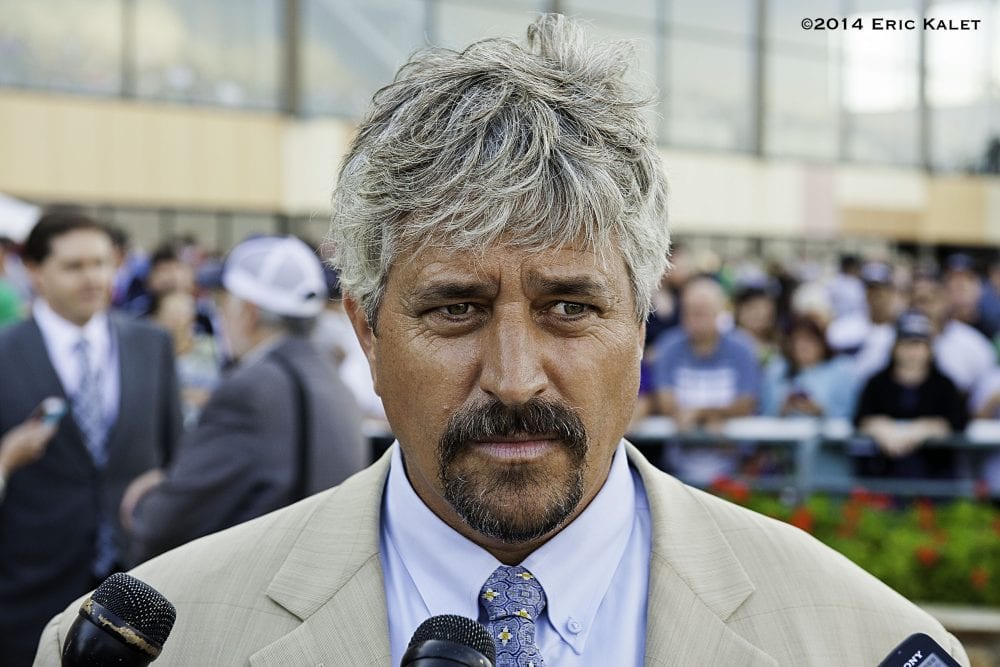
Interestingly, the trainers of both Zandon (Chad Brown) and Epicenter (SteveAsmussen) have never won a Derby, even though they are two of the top trainers in the country. Asmussen has had 13 starters in the Derby and Brown six.
Chad Brown
Indicative, in part, of why horse racing has fallen out of favor is the fact that both trainers have had their problems with allegations of dishonesty or unfairness.
In 2014, state and federal regulators investigated Asmussen over accusations by the group People for the Ethical Treatment of Animals (PETA) that some of his horses were subjected to various forms of cruelty, including having been administered drugs for non-therapeutic purposes and having a jockey use an electrical device to shock horses into running faster.
No charges came from the investigation.
Steve Asmussen
Brown, back in 2019, was ordered to pay $1.62 million in back wages, civil penalties and damages for underpaying 150 employees. Brown and his racing company admitted in federal court to violating federal labor and immigration laws by failing to pay required hourly and overtime pay to horse groomers and stable hands working at the Saratoga Race Course and Belmont Park in New York State.
Brown also has at least one violation of improper medication on his record.
Still, Brown seems to me to be more above board than Asmussen, and I think he’s got a great chance to get his first Derby victory today.
Four weeks ago, Zandon won a Derby prep race, the Blue Grass Stakes at Keeneland in Lexington, KY, after coming from last place.
With the customary 20 horses in the Derby field, it’s difficult for “closers” to get around or through the pack to get to the wire first. In early races at Churchill Downs today, however, at least two winners have come from well off the pace, which seems to bode well for Zandon.
About 6 p.m. today, Kansas City time, I’m looking for Zandon to be charging down the lane.
I really don’t want to write any more about Rick Smith. He was arguably the worst police chief we’ve had in the last 50 years. But I can’t help myself.
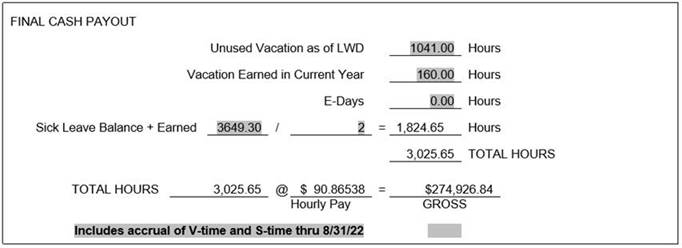
I said in an April 21 post that he would leave office with a handsome payout, and yesterday I found out just what it entailed. It was just short of $275,000.
Here are the details, sent by a Kansas City p.i.o. officer shortly after I requested it.
This package is not as outrageous as the one Smith’s predecessor, Darryl Forte, got — $500,000 — but it’s still way too much.
Of course, this isn’t Smith’s fault; he just took advantage of the liberal policies approved by the tone-deaf, Republican-dominated Board of Police Commissioners. And it shows, again, why we need — but won’t get anytime soon — local control over KCPD.
That Smith can do the damage he did to this once-admirable department and this community and still step aside with more than a quarter of million dollars is a damn shame.
The only way it could have been worse was if it wasn’t a matter of public record…And look out for what’s going on in Jefferson City because the Republican-dominated General Assembly is doing everything it can to dilute the Sunshine Law. In a year or two, those legislators and whoever the next Republican governor is could pretty well have that law gutted.
**
If you’ll recall, I took a swipe at Kansas PBS a couple of weeks ago for putting out a ridiculous, promotional plug for a “Week in Review” segment Nick Haines was doing on Smith.
The e-mailed promo said Smith “swings by the Kansas City PBS studios” and “tells all to Nick Haines.”
Anybody who’s watched Smith lead the department the last five years knows there’s never been a “tells all” moment for Smith. He never says anything in interviews. In fact, he gave very few, preferring to “speak” through his blog.
In keeping with form, he didn’t say anything in the interview with Haines, despite Haines’ best effort to get him to be specific. Let me give you a couple of examples from the interview, which aired Friday, April 29.
**
Haines: What do you look back on today as your biggest accomplishment?
Smith: Oh, man, there’s a lot, a lot of accomplishments.
Haines: Name one.
Smith: One I think the department’s in a pretty good spot. We’ve had our challenges but we’re doing some things that are great — social workers; technology; the foundation that supports us; the officers restructuring things to make officers be able to do the work that they need to be able to do; trying to take some impact off of our district officers so that they can do the job that they need to do; shift some duties around. I mean all of that, in the whole, makes an impact. The community ties and the neighborhood support we have out there for our officers when they go out and do the work…all of that. It’s one big situation rather than one little piece here and there, in my opinion.
Haines: Do you have any regrets?
Smith: I don’t think I have any regrets.
Haines: Is there anything you would have done differently?
Smith: Of course. There’s all kinds of things you do differently…And I don’t know that I have any one answer to that about, hey, I should have talked to this person or done that, but, you know, overall, were my actions, you know, honorable for the department? I think so. I think I always tried to do it with integrity. Do I wish some things would have panned out? I said May of 2020 would have been a lot different if we didn’t have Covid because this department would have been having meetings and things like that. And there was restrictions and even more challenges getting back to what we normally do.
**
And now, before we bid a final and not-so-fond farewell to Rick Smith, here’s my assessment of his term as chief…
When he took the oath of office, he undoubtedly promised to protect and serve the citizens of Kansas City and the city itself. But from Day One, the city and its residents were down the pecking order, well behind “the department.” (Look again at those two answers above.)
For Smith, the job was all about protecting the department — protecting it when it was in the right and protecting it when it was wrong.
And it was all about protecting each and every officer — every good officer and every bad officer, and there are plenty of both.
The city and many of its citizens suffered greatly under Rick Smith, and, as a result, the department that he loves so much went downhill.
He fell flat. Bam. Right on his face, right in the mud.
Now, let’s turn the page and hope for a better chief in a system that still sucks.
Derby Day is this coming Saturday, and I won’t be there. In fact, the way it looks, I won’t be attending any more Derbies.
Churchill Downs has priced the average person out of the event. Now, the Derby itself is still a fantastic sporting event and will be for as long as it continues to be held; it’s just that tickets have become prohibitively expensive.
I used to buy individual tickets outside the Downs and usually paid about $100 to $150 for reserved seats in the first-floor clubhouse. If I was going with other people, I’d sometimes buy two or more individual tickets, in different sections, and hope we could find some seats together in one of the areas where the tickets were located.
Once several years ago I bought five tickets for a total of $1,350. Only two of those tickets were a pair, but the people whose box the seats were in (there are six seats to a box) were kind enough to let our group use their box as our headquarters, of sorts. There’s a lot of moving around on Derby Day, so the boxes are often empty or in use by just one or two people for extended periods. It worked out well that day for me, Patty, Brooks, Charlie and a friend of Charlie’s.
The days of wheeling and dealing on tickets came to an end, for the most part, when the Downs, like many other sporting and event venues, went to electronic tickets a couple of years ago.
At the same time, the Downs made Ticketmaster its official ticketing resale agent. I say resale because all reserved seats are sold out well in advance, and the reserved seats that are available are those that people, or companies, have purchased but turn back in for resale.
So, I want to show you how the price of tickets as skyrocketed. Here’s the Churchill Downs chart of reserved seating sections.
All 100-level seats are on the first-floor, which is track level. Unlike at a basketball game, you don’t really want to be seated low at the racetrack because the only time you can get a good look at the horses is when they come by you. The 200-level seats aren’t much better. In fact, they are often worse, because you are wedged in between the first level and the third level, and the view is terrible. (I sat there once and hated it.)
The best vantage point, by far, is the third floor, which is elevated enough that you can follow the horses all the way around the track with the naked eye.
I’ve watched the race from the third floor about three times, and it’s great. But those tickets got too pricey for me years ago, and so the last few times I’ve gone, I’ve angled for first-floor seats. The advantage of the first floor is that there’s plenty of room to move around, and although you only see the horses come by you once, you can follow the races very clearly on a huge video board in the infield.
With that seating primer, here’s a sampling of prices.
As of this afternoon, 26 tickets were available in Section 112, in the first turn, for $750 each — and up — plus a service fee of $150 or more. So, for about $900, you could sit in 112 and see the Derby horses flash by you once.
In Section 117, which are low but on the finish line, 14 tickets were available, starting at $1,600, plus service charge.
Moving up to the third floor, four tickets were available in Section 320, which offers a spectacular view of the track, for $3,550 each, plus a hefty service charge.
Two tickets remained in Section 321 for $1,796 each, plus service charge.
A dozen tickets were available in Section 325 for $1,000 or more, plus service charge.
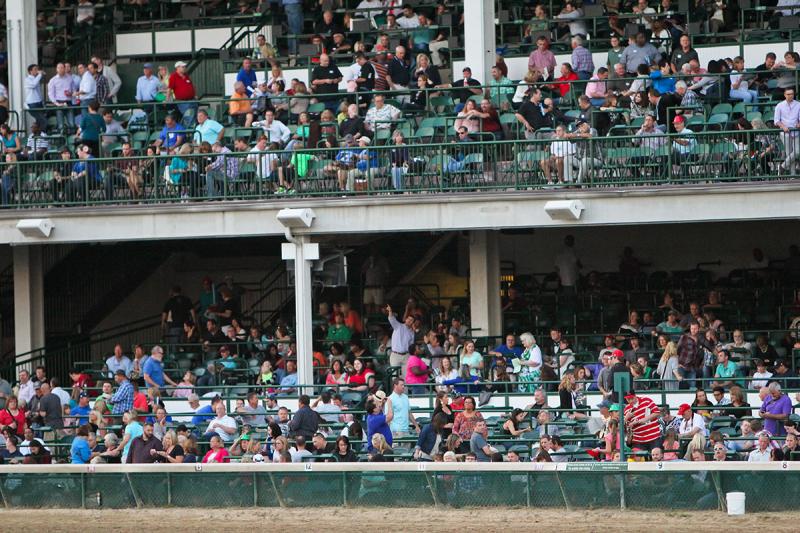
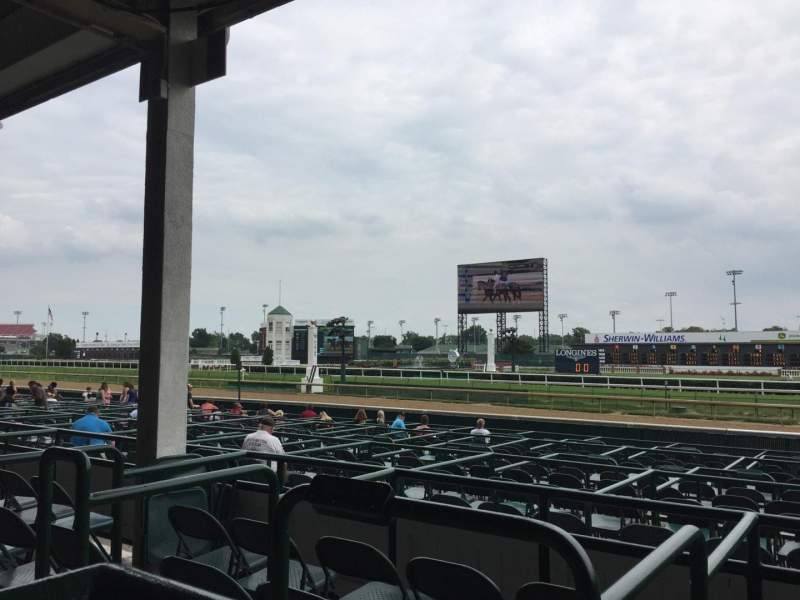
For perspective, here are a couple of photos. This photo shows the first floor and the third floor. (There is no second floor in this particular part of the stands.) You can imagine how much better the view is from the third floor than the first.
But if you want a better idea of what the view is like from the first floor, here’s a photo from Section 115. It doesn’t look too bad here, but imagine all those seats filled to capacity, and everyone standing on tiptoes or on those folding chairs, craning their necks for a view of the horses.
**
Jacking up ticket prices to an irrational level is just one way Churchill Downs has ruined the Derby for the average person. Another way is that for decades the Derby was the eighth race on the card, with post time about 4:30 Louisville time.
Over the years, because of nothing but greed, the Downs has increased the number of races on Derby Day to 14. (The more races there are, the more betting there is, with the track getting more money.) Post time for Race 1 is 10:30 a.m. Post time for the Derby — Race 12 — is 6:57 p.m., and post time for Race 14 is about 8:30.
By the Derby race, many people in the crowd are drunk, hungry and out of betting money. And even if you leave the track right after the Derby, it takes about an hour and a half to get out of the vicinity of the track and get home or to a restaurant. So, you’re talking about eating dinner at 9 or later. (The Downs now includes food and drink with the price of all reserved seats, but I wouldn’t expect the quality to be very good with the “all-inclusive” feature.)
In the process of protracting the day, the Downs has done a disservice to many Louisville restaurant owners because many people straggle out of the track and head home exhausted instead of going to a local restaurant.
**
Despite all the negatives, the Derby will continue to attract crowds of 125,000 to 150,000 because there are enough people with enough money who want to be there for “the most exciting two minutes in sports” and will spend the money and put up with the hassle at least once, just to say they’ve done it.
But for me, nah. I’ve been to well over 20 Derbies since starting to go regularly in 1971, and I get tired and irritated just thinking about fighting that crowd and the cost. We almost went last year. I was haggling for days online with a guy who was offering two third-floor seats for something like $800 each. I offered $600 or $650, but he wouldn’t come down, so we went to the condo of some friends and watched on TV, bet online and had a great time.
That showed me I no longer needed to be there in person. It’s been a great run, but I’m yielding the floor, and the turf, to younger people with more energy and more money.
**
Now that I’ve vented, here are the Derby horses, listed by post position, with trainers, jockeys and “morning line” odds, meaning what the Chruchill Downs handicapper projects the odds to be.
1. Mo Donegal, Todd Pletcher, Irad Ortiz Jr., 10-1
2. Happy Jack, Doug O’Neill, Rafael Bejarano, 30-1
3. Epicenter, Steve Asmussen, Joel Rosario, 7-2
4. Summer is Tomorrow, Bhupat Seemar, Mickael Barzalona, 30-1
From time to time, people have urged me to run for elective office — presumably because of my, uh, great wisdom and deep experience in covering local government.
I’ve never been tempted because, for one thing, I know I wouldn’t last long in elective office. If I’d been a member of the Missouri General Assembly back in the 1980s, I would have voted against the state lottery. And if I’d been a legislator in the early 1990s, I would have voted against legalizing casino gambling, which was euphemistically framed as “riverboat gaming.”
I would have voted against the lottery and casino gambling because they dig disproportionately deeper into the pockets of lower-income people than the wealthy and because casino gambling contributes to serious social problems. (According to the National Council on Problem Gambling, more than 103,000 Missourians have a gambling disorder.)
Outside Bally’s Casino last year
Which brings me to the debate that took place this week in the General Assembly over expanded slots-style gambling and the prospect of legalized sports wagering.
Rudi Keller reported on it Saturday in the Missouri Independent, and his third paragraph said everything you need to know about greed and slime…
“Wednesday began with the Senate galleries jammed with dozens of lobbyists representing casino operators, professional sports teams and video gaming companies.”
He might as well have said the galleries were jammed with lobbyists representing filthy-rich people aiming to suck blood from low-income people and further enrich themselves.
It’s neither the gamblers nor average Missourians whom the lobbyists and their employers are looking out for; it’s the wealthy.
Ironically, as it turned out, the greedy could not agree on how to divide the spoils. Nothing got passed Wednesday and might not before the legislative session ends on May 13.
Here’s how Keller described the fracture among those chasing the newest potential pot of easy money…
Casinos don’t like the provisions allowing the Missouri Lottery to place video gambling machines at fraternal clubs, veterans halls and truck stops. Video lottery advocates don’t want the casinos to get a new source of revenue if they aren’t included. And the companies that have placed thousands of unregulated machines…would prefer that nothing pass at all because it might make it tougher for them to do business.
Going unspoken in the debate was whether any of this was in the best interests of the people who patronize Elks clubs, American Legion halls, Love’s Travel Shops and the gas stations and bars where thousands of unregulated machines have been installed.
And now into that rancid stew sports wagering probably will be stirred.
Those who would benefit the most, and almost exclusively, are the casino operators and the owners of the state’s major professional sports teams. The casinos and the teams would get cuts of the betting action, as would the state, which would levy a 10 percent tax on the profits.
And who would lose? Why, the bettors.
My late father, an accounting professor, explained it to me a long time ago when I was single and spending a majority of my vacation days at various racetracks. He said that with the track taking out 10 percent or more of the pooled bets, the bettors would ultimately come out behind.
It’s no different with sports wagering; it’s the “house” that wins and the bettors who lose, if they keep playing long enough.
Another element in the gambling picture is the economic competition between Missouri and Kansas.
In Kansas, the Senate and House have approved legalized sports betting, and a bill is awaiting the signature of Gov. Laura Kelly, who is expected to sign it. In his story, Rudi Keller said that if Kansas got sports wagering and Missouri didn’t, “the odds of the Chiefs jumping the state line to a new stadium will grow shorter” because the vast majority of the state’s take would be funneled into a special fund to be used to lure major sports teams.
I say fine. Let Kansas have sports wagering and let the Chiefs move over to I-435 and I-70 into a $1 billion stadium built partly with sports-wagering proceeds. Jackson County residents have been bled long enough. From his home in Dallas and his suite on the “gold level,” Clark Hunt is perfectly happy to pit Kansas against Jackson County. And how do you think he’d vote on sports wagering?









 JimmyCsays: At the juncture of journalism and daily life in KC
You must be logged in to post a comment.