Feeds:
Posts
Comments

Another day, and we Kansas City area residents are fortunate enough to get another insightful Kansas City Star story on Schlitterbahn — this one on how the Caleb Schwab wrongful death lawsuit might play out in the legal system.

I should also quickly add that these investigative stories The Star is producing are just as maddening as they are insightful.

For example, The Star’s first investigative story showed how Schlitterbahn officials were essentially free to build the world’s tallest water slide, which they called Verruckt, with little or no regulatory oversight or restrictions.

They didn’t even bother to hire a professional water-slide builder. The family that owns the water attractions — one in KCK and four in Texas — decided, heck, they’d just do it themselves. We know our business…Why spend a bunch of money hirings some outsiders to tell us what we already know?

And so, as things often play out when arrogance and unregulated capitalism are the driving forces, disaster struck two weeks ago Sunday when 10-year-old Caleb was decapitated after the raft he was riding in apparently left the water channel, his body colliding with “safety” netting and perhaps metal rods supporting the netting.

Today’s story, written and reported by Scott Canon and Steve Vockrodt, appears under the headline “Legal landscape may mean we never know where Verruckt went wrong.”

Canon and Vockrodt report that while experts will probably be able to determine exactly what went wrong that day, we the public may never know.

“Taking yet-to-be-filed lawsuits all the way to trial would be costly,” the story says, “so the most likely outcome figures to be settlements. Such deals typically come with agreements to keep any findings secret.”

Here are a couple of other potentially maddening elements that Canon and Vockrodt explored.

First, in the Schwab family’s wrongful death lawsuit, Schlitterbahn might off by paying as little as $250,000, the maximum amount provided for in Kansas law. (Inexplicably, the reporters didn’t state what the comparable limit is in Missouri, and I was not able to find the answer on a Google search.)

Second, the Kansas City, Kansas, Police Department is investigating to determine if a crime occurred, but a department spokesman told The Star that if they find no crime was committed (the likely result), the department would release the first page of its incident report and maybe a press release, but nothing more.

…From experience, I can tell you that 20 years or so ago, The Star would have pulled out all the stops to get the full report, when it was completed. The paper would not have hesitated to file a lawsuit; it might not have been successful, but it would have pushed it to the hilt and spared no expense.

The Star’s penchant for filing lawsuits in the interests of the public’s right to know dropped off precipitously, however, after Capital Cities/ABC sold the paper to the Walt Disney Co. in 1996. Subsequent owners KnightRidder and the McClatchy Co., which bought the paper in 2006, were equally averse to spend money on lawsuits to uncover relevant, concealed facts.

In the Schwab case, there is sufficient public interest that we may see The Star file a lawsuit. I hope they do; the public deserves it.

…On the other hand, while public interest is high, I’m afraid public outrage is not…Otherwise, how to explain throngs of people returning to Schlitterbahn when it reopened three days after Caleb’s awful death? I can’t help but think that 20 or 30 years ago, before society started becoming desensitized to lying, cheating, corner cutting and outrage itself, very few people would have darkened the door of that facility ever again.

The fact is, as I’ve pointed out in some recent posts, the public doesn’t seem to get outraged about much any more. General Motors covers up an ignition-switch problem that killed 124 people and injured 275 and what happens? GM sales go up several percentage points…Donald Trump paints Arizona Sen. John McCain, a former military POW, as “a loser” because he got captured, and many people just shrug.

Maybe it’s just the newspaperman in me, but I wonder if society’s increasing imperviousness has something to do with the demise of newspapers as the public’s primary source of information and the proliferation of less reputable, less reliable sources of information.

On second thought, maybe it’s not just the newspaperman in me. Maybe I’m on to something. I think as a society we’re paying a big price for the veritable monopoly of corporate journalism and the rolling back of the daily paper as a trusted enterprise dedicated to rooting out the truth and defending the public interest.

To me, the overall attitude of people today seems to be reflected in a great country song by Pam Tillis called “Land of the Living.”

The refrain foes like this:

Just hurry back
To the land of the living
Things have changed
Since you’ve been gone
The world is turning
In the land of the living
Take a deep breath
Life goes on… Life goes on

Those of us who came of age around the time of the Watergate scandal got about the best lesson you can learn in life: Attempting to cover up something you’ve done wrong often thrusts you into a deeper stew than the deed itself.

The Watergate story should be taught starting in elementary school and carrying right into high school, and it should be taught at least every other year.

I doubt that U.S. Olympic swimmers Ryan Lochte, Jimmy Feigen, Jack Conger and Gunnar Bentz ever got the lesson, or they wouldn’t have made up the story — even in their drunken state — about getting pulled over in Rio and robbed at gunpoint by people posing as police.

Unfortunately for us Americans, this story reverberates well beyond these four guys. When it first came out, it seemed to confirm the reports that Rio was a wild and dangerous place and that your head better be moving on its swivel when you were out on the streets.

But as the story that Lochte and Feigen told police unraveled — turns out they fabricated it to cover up their destructive antics at a gas station — the backwash accelerated, and now many people around the world must be thinking, “Ugly Americans.”

A woman named Judy, from Canada, placed this comment on a story in today’s New York Times:

This, if it is true, is an unfortunate example of why some Americans are such bad ambassadors for their country abroad. They bring an attitude of arrogance and entitlement along with them. In this incident we have added to that the free pass that male athletes get in American culture. It is time that people who have so many privileges learn to respect others and act with a little humility in other countries and cultures.

Imagine how we in the States would react if Russian athletes were at the center of this caper. We’d be saying, “You can’t trust those Ruskies. Not only is the government systematically drugging the athletes, the athletes are liars.”

Instead, it’s Americans getting drubbed in the press. The headline in today’s Daily Mail, a British tabloid, screams “LYIN’ RYAN.” The paper quoted one Brazilian official as saying, “The only truth they told was they were drunk.”

Boy, that hurts. These guys have not only painted themselves as liars but they have embarrassed their country. One of the first thoughts that came to my mind was thank goodness Michael Phelps beat Lochte in their big showdown early in the Games.

lochte

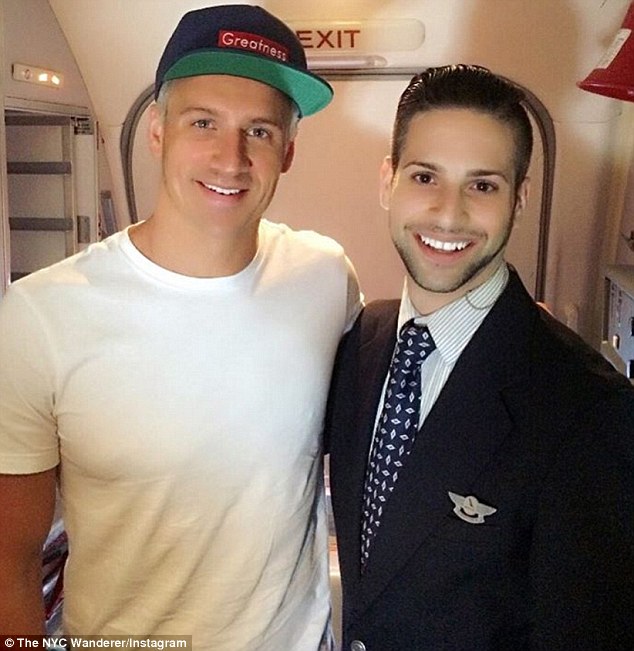
Ryan Lochte got out of Rio before Brazilian authorities could question him about his made-up story of being robbed by men posing as police. Safely back in the U.S., he posed with a flight attendant in Charlotte, NC, on Wednesday.

One of the most surprising elements of this story is the ages of the two guys who concocted the phony story. Lochte, the group leader, is 32. Feigen, the only other one to give a statement to police before yesterday, is 26. The other guys — Conger and Bentz, are 21 and 20 respectively. (The truth came out after Brazilian officials pulled Conger and Bentz off a plane last night and interviewed them.)

Had all four been 19 or 20, I could have understood better the rush to the lie. But 32 and 26? Lochte and Feigen — like Richard Nixon and his pals who tried to cover up the Watergate burglary — are just stupid.

It’s too bad that this sorry episode will end up overshadowing some of the great athletic feats that U.S. Olympians have recorded in Rio. Not all, but some. At any rate, the story is going to be remembered for a long time.

Another New York Times commenter, John Calderhead of Denver, succinctly explained exactly why it is going to endure:

“It’s not the crime, it’s the cover-up.”

Let’s start teaching Watergate early and keep teaching it often.

You remember the movie Caddyshack, in which the pesky gopher continually thwarted groundskeeper Carl Spackler (Bill Murray) and wreaked havoc on the country club course.

Well, a couple of months ago, it appeared that golf, as a sport returning to the Olympic Games after a 112-year absence, was going to be similarly torn asunder after one top professional after another backed out, claiming fear of the Zika virus.

The list of defectors included world’s No. 1 ranked Jason Day of Australia; U.S. major champions Jordan Spieth and Dustin Johnson; and former world’s No. 1 player Rory McIlroy of Northern Ireland.

One website I happened onto today, called The Wrap, said back in July, “You can officially add Olympic golf to the list of Rio disasters.”

Three weeks prior to the Olympics, the chief organizer of the Rio Games, Carlos Nuzman, put his finger on the real reason that some of golf’s biggest stars had bowed out. “They tried to blame Zika, but the media have shown that they are not coming because there’s no prize money,” Nuzman said.

Then, an amazing thing happened: Other top world players, including America’s Bubba Watson, Matt Kuchar, Patrick Reed and Rickie Fowler, moved to the fore and began saying how badly they wanted to play and how great an honor it would be to represent their countries on the world stage.

On Thursday, 60 players from 40 nations began playing the first of four rounds. Only three of those players would get any official recognition — the top three medal winners. No money was at stake; it was all for country, pride and prestige.

And what a finish!

This afternoon (Rio is two hours ahead of Kansas City), Sweden’s Henrik Stenson (No. 5 in the world) and Great Britain’s Justin Rose (No. 12) were tied at 15 under par as they stood on the tee at the par-five 18th hole. If one of them beat the other on that hole, he would be the gold medal winner; if they tied that hole, they would immediately begin a sudden-death playoff.

I love both those golfers — tremendous professionals and great sporting personalities — and would have been happy with either one. As it turned out, Rose made an incredible short-range pitch shot — his third on the hole — that came to rest two feet from the cup. The crowd roared. Minutes earlier, Stenson’s pitch, from farther away, landed about 20 to 25 feet from the cup.

justin

Justin Rose, winning Olympic gold

After Stenson three-putted — ramming his first putt several feet past — Rose claimed the victory by cooly tapping in his two-footer. As the putt dropped into the cup, Rose pumped his fist in the air and tugged at the British crest on his shirt, emphasizing the win was just as much for his country as for him. He later said:

“The reality is incredible. The reality hasn’t sunk in. The whole week, I’ve been so focused. I’ve been so into it. I’ve been up for it. I’ve been just so determined, I suppose, to represent Team GB as best as I could. And it was just the most magical week.”

And so, an event that had taken on dismal overtones just a couple of months go surged to the top Olympic tier, along with swimming, gymnastics and women’s beach volleyball.

And those guys who turned their backs on the Olympics — especially Spieth, Day, McIlroy and Johnson? I won’t be pulling for them nearly as much as I used to. I’ll be rooting for any of the 60 men who spent the week in Rio and played for the love of the game, love of country and to be part of golf’s historic return to the Olympics since the 1904 Summer Olympics in St. Louis.

And now this week, starting Wednesday, the world’s top women take to the course. I invite you to join me in watching at least part of it. I think it, too, is going to be a great show.

Let’s talk about that shining political light Donald Trump and The Press.

Have you ever seen anyone so adept at digging deeper hole for himself virtually every day?

Speaking Friday at a rally in Erie, PA, for example, he pointed at the media platform and said: “These people are the lowest form of life, I’m telling you. They are the lowest form of humanity.”

The crowd responded approvingly, giving Trump the satisfaction he was seeking, I suppose.

But what a dummy! To the best of my memory, no one has ever gotten elected to anything by bashing the press. It has never worked and probably won’t for a long time, despite the thinning of the “mainstream media” ranks and the proliferation of new media models.

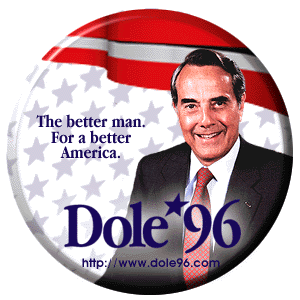
doleRemember Bob Dole? The year was 1996, and he was the Republican nominee, running against incumbent Bill Clinton. Dole railed against “the liberal media” and angrily denounced The New York Times for a pro-Clinton bias.

A story back then in The Weekly Standard, a conservative publication, said, “By all accounts, Dole’s audiences have loved this media-bashing.”

Fine and dandy. But what happened in November? Well, Dole lost the electoral vote 379 to 159 and the public vote by nine percentage points.

While surveys might show that much of the public says it doesn’t trust The Press, the vast majority of Americans intuitively understand that freedom of the press as it is practiced in our country is the best by far, and they rely on The Press to root out corruption and peel back the bullshit that so often shrouds the truth.

Trump’s latest demonstration of pique at The Press prompted The Times to do a story in today’s edition titled “Trump’s Other Campaign Foe: The ‘Lowest Form of Life’ News Media.”

At one point, the story quoted Kevin Madden, a former spokesman for Mitt Romney’s and George W. Bush’s presidential campaigns, on how futile it was for candidates to waste time tilting at the media windmill:

Whining about media coverage is just that: It’s whining. Any campaign that tells you it makes a difference with swing voters is just lying to themselves and lazy, because it’s easier than developing an actual strategy or message.

The Times’ reporters, Alexander Burns and Nick Corasaniti, added this bit of analysis: “If bashing the media proved an effective way of rallying the Republican base to his side during the primaries, Mr. Trump must now prove himself to a broader community of voters in the general election, who are far less preoccupied with the notion of press bias.”

From all accounts, Hillary Clinton has no love for The Press, either. She’s just smart enough not to talk about it. And shrewdly, an effective way she has chosen to deal with it is to hold precious few press conferences. That, of course, pisses off The Press no end…At the same time — just like Trump’s anti-journalistic drumbeat — it doesn’t bother the public a bit.

Also, in spite of The Press’ irritation at Clinton for refusing to hold press conferences, Trump’s hyperbolic press rants serve only to increase the media’s overall tilt toward Clinton.

…A wonderfully insightful and funny political cartoon appeared Friday on The Star’s Op-Ed page. It was by Glenn McCoy of the Belleville (IL) News Democrat. Under the headline “Hillary’s post-convention bump” were caricatures of Hillary, looking thick and dumpy, and an iconic reporter from yesteryear, wearing a nondescript tie and a hat with a “press” sign sticking out of the band…Looking slyly at each other, the two figures were exchanging a fist bump.

Onward and downward with that pit-bull, attack-the-press strategy, Mr. Trump!

Tony Botello, my fellow blogger and friend (not close, by any means, but certainly we’re friendly), is fond of referring to The Star and other newspapers as “the dead tree media.”

Gotta hand it to him, it is catchy, and easy for people to nod in agreement.

But, as even those who might nod in agreement might suspect, it’s far too dismissive of traditional, shoe-leather-thinning journalism.

Even after a decade or so of transition to digital venues and outlets, the vast majority of the best-researched, best-reported, most important and most relevant news stories are still generated by newspapers…Without a doubt. Case closed. Shut the door.

For example, who but The Star could throw a half dozen or so reporters — most with deep newspaper experience and the ability to stay cool amid chaos — at the Verruckt tragedy? No one. All other reporting outlets — TV, bloggers, whatever — are just nibbling around the edges. By contacting engineers, physicists and other experts, The Star was able to create in the readers’ minds an understanding of how things likely unfolded in that raft that hurtled down the water channel, left the channel at some point and brutally killed 10-year-old Caleb Schwab before the raft reached the calm waters of the receiving pool.

That’s a local example. Here’s a farther-reaching one. The New York Times leads the way on so many national and international stories — both straight news and investigative — that it leaves all other news organizations in the dust. That’s how good it is. Frequently, stories you hear featured on NPR (the only national news worth listening to on radio) were initiated by reporters and editors who read about them first in The Times.

**

parker

Kathleen Parker

The importance of the role that newspapers play — not necessarily with their the print editions but through the content they produce — was wonderfully expressed in today’s Star by Op-Ed columnist Kathleen Parker of the Washington Post Writers Group.

Listen to this, from the column:

The problem: People want news but they don’t want to pay for it. Consequently, newspapers are failing while consumers get their information from comedy shows, talk shows and websites that essentially lift material for their own purposes.

But somewhere, somebody is actually sitting through a boring meeting, poring over data or interviewing someone who isn’t nearly as important as he thinks he is to produce a story that will become news…(N)ews is a food chain, yet with rare exceptions, the most important members of the chain are at the bottom, turning off the lights in newsrooms where gladiators, scholars and characters once roamed.

As a reporter who earned his spurs in the 1970s and 1980s, I had to smile when I read the line about the newsroom being a place where “gladiators, scholars and characters once roamed.”

…I can’t help but digress here and give you an example of one “character” I encountered early on. Shortly after I started at The Star in 1969, reporters would routinely be sent out with photographers to go “cruising” for news. It was a ridiculous custom and never yielded anything, but it was what the editors did to keep us busy. Otherwise, between stories, we mostly sat around the newsroom, feet on our desks, reading the paper or magazines…Anyway, there was one particular photographer (still alive today, somehow) who was both an alcoholic and moral degenerate. While driving around with young reporters like me, he would routinely stop at the home of one of his girlfriends for a quickie. “Wait here,” he’d say, “I’ll be back in a few minutes.” Twenty or 30 minutes later he’d come back, refreshed — it would seem — and ready to resume “cruising.”)

But back to Kathleen Parker’s homage to newspapers. Here’s another dead-on paragraph:

“My point…is that only newspapers are the brick-and-mortar of the Fourth Estate’s edifice…What happens to the ‘news’ when there are no newspapers left? We seem doomed to find out, as people increasingly give up their newspaper subscriptions and seek information from free-content sources. And though newspapers have an online presence, it’s hard to get readers to pay for content. As (HBO’s John) Oliver says, now is a very good time to be a corrupt politician. Between buyouts, layoffs and news-hole reductions, there’s hardly anyone paying attention.”

**

I say, then, that Tony Botello and others digital dabblers who, for the most part, feed off other people’s research and reporting should reflect more deeply before they consign “the dead tree media” to history and irrelevance. Newspapers are the lifeblood of the news-generating machinery in our country and much of the rest of the educated world, and they will continue to fill that role for a long time to come.

We all need and greatly benefit from the content that newspapers provide, in whatever form, and I urge you readers to consider that good, valuable content does not come free: Those people turning out the lights in the newsrooms deserve to get paid well.

I would think Verruckt is kaput, and the KCK Schlitterbahn could be shot.

It will be interesting to see how many people show up when the water park reopens Wednesday, minus the 168-foot-tall Verruckt water slide, which will remain closed for at least the rest of the season.

It’s possible that media members will outnumber paying guests.

Wait…Did I say paying?

After Sunday’s unspeakable accident, with 10-year-old Caleb Schwab dying after apparently being thrown from the three-person raft he was riding in and then hitting protective netting full force — probably head first — it’ll be a wonder to me if anyone ever again pays to walk through the gates.

(For the record, general admission to the KCK park ranges from $42 to $50, with the lower rate available with online purchases.)

But then, I’m the same blogger who thought General Motors could be facing an operational crossroads after it came to light in 2014 that for a decade the carmaker had covered up a problem with ignition switches in Chevrolet Cobalts and Saturn Ions. At first, GM claimed the ignition-switch failures — and resulting deactivation of airbags — had killed 13 people. But attorney Kenneth Feinberg, who specializes in corporate payouts, later linked 124 deaths and 275 injuries to the debacle.

And yet, amid that terrible publicity and the exposure of a GM as a lying enterprise, the sale of its vehicles actually rose several percentage points in 2014.

The public is funny in an unpredictable sort of way…I mean, who would have thought that a major political party’s nominee for president would suggest, seriously, that gun-rights advocates might do something crazy if Hillary Clinton got elected and started appointing liberal Supreme Court justices? Yes, the public is really funny. 

verruckt

Verruckt

But tonight The Star has an investigative story that should hasten the demise of the Verruckt ride. KC Star reporters Laura Bauer, Steve Vockrodt and Eric Adler spoke with several people who experienced harrowing rides on Verruckt, either because their Velcro-style shoulder harnesses came undone during the ride or their raft lifted out of the water channel.

The reporters cited the case of Paul Oberhauser of Omaha who, on a trip to Schlitterbahn last month, had his shoulder strap come loose at the bottom of the first of Verruckt’s two big hills. Oberhauser’s wife Erin told The Star that for the rest of the ride her husband held on for dear life by his legs.

The Star’s story goes on to say:

The family figured the raft would be taken out of commission until workers could figure out the problem. But two hours later, Erin Oberhauser said from their cabana near the water slide, they saw it happen to another guy on the ride. “We heard a guy yelling, ‘My belt came undone!’ “

**

I have never liked heights, and I have never liked roller coasters, although I’ve been goaded into riding a few. I remember one in particular at Disneyland or Walt Disney World — an outer-space-type attraction that coursed through a darkened cavern. That was easier for me to tolerate because I couldn’t see the terror before my eyes.

Suffice it to say, I would not have been tempted to go on Verruckt. But our son Charlie, now approaching 27, probably would have been tugging at me to let him go on it, had it been around when he was a kid. Scary thought.

I learned today that the German word verruckt means “mad,” “crazy” or “insane.” To me, it will be downright crazy if Schlitterbahn doesn’t start tearing down the Verruckt ride tomorrow. It would be something positive for the handful of Schlitterbahn’s paying customers to witness.

A commenter on my last post — the one about the “unfiltered voices” video that The New York Times compiled from Donald Trump rallies during the past year — raised the question of balanced reporting, asserting that The Times’ video contained no balance whatsoever.

The commenter’s point is unarguable because Times reporters set out, video devices in hand, to record the most objectionable behavior and most contemptuous things that people shouted out at Trump rallies. For example, when Trump referenced President Obama at one rally, someone in the crowd shouted, “Fuck that nigger.” At another rally, a smiling, young Trump supporter held up for the camera a hand-printed T-shirt that said, “Trump that Bitch,” referring, of course, to Hillary Clinton.

That kind of stuff is shocking, and I, for one, am grateful to The Times for pulling back the curtain and giving us an inside look at those rallies.

No, there was no effort to “present both sides” in that video. The point — totally valid — was that some people in the Trump crowds have so far eclipsed reasonable and appropriate expression that, in some cases, two long-held tenets of journalism, fairness and balance, must be suspended. Otherwise, you would never get to the truth.

The public certainly has a right to know this type of vulgar and disgusting expression is taking place…out loud and in public. It’s not like it’s a group of seething rednecks and KKK members getting together around a campfire and cutting loose, with lookouts stationed around the perimeter to make sure no one was pointing an iPhone through the trees.

…Dovetailing with (but not stemming from) publication of the “unfiltered voices” video, NYT chief media reporter Jim Rutenberg today had an excellent commentary titled, “Trump is Testing the Norms of Objectivity in Journalism.”

Here’s how Rutenberg begins his piece:

If you’re a working journalist and you believe that Donald J. Trump is a demagogue playing to the nation’s worst racist and nationalistic tendencies, that he cozies up to anti-American dictators and that he would be dangerous with control of the United States nuclear codes, how the heck are you supposed to cover him?

Because if you believe all of those things, you have to throw out the textbook American journalism has been using for the better part of the past half-century, if not longer, and approach it in a way you’ve never approached anything in your career. If you view a Trump presidency as something that’s potentially dangerous, then your reporting is going to reflect that. You would move closer than you’ve ever been to being oppositional. That’s uncomfortable and uncharted territory for every mainstream, non-opinion journalist I’ve ever known, and by normal standards, untenable.

rutenberg

Jim Rutenberg

Covering Trump, Rutenberg said, upsets the balance of the “idealistic form of journalism” that working journalists have long been trained to aspire to.

“But let’s face it,” Rutenberg goes on to say. “Balance has been on vacation since Mr. Trump stepped onto his golden Trump Tower escalator last year to announce his candidacy. For the primaries and caucuses, the imbalance played to his advantage, captured by the killer statistic of the season: His nearly $2 billion in free media was more than six times as much as that of his closest Republican rival.”

Rutenberg says that now Trump is the Republican nominee for president, commentators — even some known to be friendly to him — have been analyzing him through a different lens, that is, how his temperament and grandiose policy statements would play out in the White House.

Rutenberg cited a report that former Republican Congressman Joe Scarborough made on his “Morning Joe” show on MSNBC. Scarborough told his audience about an alarming conversation he had with a “foreign policy expert” who had given Mr. Trump a national security briefing.

Three times, Scarborough said, the expert asked about the use of nuclear weapons, and one of the questions was: “If we have them, why can’t we use them?”

Yikes!

It’s worth noting that, in his column, Rutenberg also points an accusing finger at Hillary Clinton. He said that covering Trump as a potentially dangerous candidate “threatens to throw the advantage to his news conference-averse opponent…who should draw plenty more tough-minded coverage herself.”

“She proved that again last week,” Rutenberg said, “with her assertion on “Fox News Sunday” that James Comey, director of the Federal Bureau of Investigation, had declared her to be truthful in her answers about her decision to use a private email server for official State Department business — a grossly misleading interpretation of an F.B.I. report that pointed up various falsehoods in her public explanations.”

…I’ve said all along that Hillary Clinton’s evasion of the truth and cutting of corners have made my blood boil, and I will not cast my vote for her with great joy. But after all I’ve learned about Trump and the type of people who seem to support him, I will vote for Clinton enthusiastically.

**

Fifty years ago, in 1966, the writer Gay Talese revolutionized journalism with what still ranks today as one of the greatest magazine stories ever written — a very long profile of Frank Sinatra, titled “Frank Sinatra Has a Cold.”

A lead-in to an online version of the story says when Talese arrived in Los Angeles, Sinatra was “under the weather, out of sorts, and unwilling to be interviewed.” But Talese was undeterred; he stayed in L.A. and began talking to people in Sinatra’s circle and through them finally gained access to The Man himself. 

The lead-in goes on to say the resulting profile (which I hope many of you will take the time to read, if you haven’t seen it before) became one of the most celebrated magazine stories ever published, a pioneering example of what came to be called New Journalism—a work of rigorously faithful fact enlivened with the kind of vivid storytelling that had previously been reserved for fiction.”

Yes, journalism has changed in the past and continues to change and evolve. In this presidential election cycle, we can thank Donald Trump for triggering a new round of changes in covering the candidates who seek to lead the greatest and strongest nation in the world. We need to know, as best we can and with the veneer removed, what they are like and what they do to inspire support and dedication among their followers. As we’ve seen, it can be scary, and we deserve to know that before Nov. 8.

One of the more provocative questions facing our country, I’m convinced, is what’s going to happen with the rednecks after Hillary Clinton crushes Donald Trump in the fall?

Will some migrate to ISIS?

Will they form a far-right Tea Party of sorts and carry flags bearing the image of Gov. George Wallace?

Will they return to their man caves and sulk in beer and hatred?

Any number of things could happen, but, for now, this group has found its collective, frightening and powerful (to a point) voice, primarily at and through Trump rallies.

It is something to behold. I haven’t seen one myself, to be sure, but, like everyone else, I’ve seen the clips. And now The New York Times has assembled a chilling, 3 minute, 11 second video called “Unfiltered Voices From Donald Trump’s Crowds” that captures some of the most nauseating, revolting moments from a year’s worth of Trump appearances and rallies. The reporters and editors simply gathered inside and outside rallies, mingled with those in attendance and let the cameras and microphones record.

Being a reasonable and open-minded person, I’ve wanted to give Trump supporters the benefit of the doubt, at least at arm’s length, but I can’t do it any more. This video shows who’s at the core of the Trump movement — angry white men who feel the political system they, or maybe their parents, were comfortable with has passed them by. Many still have trouble accepting the fact that Americans elected a black president, and they are apoplectic at the prospect of Hillary Clinton being elected president.

Here’s a sample of what you hear and see in the NYT video:

Voices inside a Trump rally: “Build the wall! Build the wall! Fuck those dirty beaners!”

A young man wearing a Trump T-shirt leaving a rally and walking by some Trump protesters says: “Fuck political correctness. Fuck political correctness.” Then, as he moves along, accelerates his step and appears to grab his crotch as an exclamation point.

Inside a Trump rally, a man in a “Make America Great Again” cap sports a T-shirt that says in large white letters, “Fuck Islam.” He’s being escorted out of the rally, apparently because of the T-shirt. Once outside, he lingers so he can greet other attendees who emerge later. He grins as a young man with a ball cap and a gray muscle shirt walks past and says, “Thanks for not taking the shirt off.”

At another rally, we hear a man yell at a protester being escorted out, “Get out of here, you fag.”

trump-rally-fans

At another rally — one that has been widely viewed — a young black protester being led out is sucker punched by a white man in a cowboy hat, vest and long-sleeved red shirt. (The assailant looks like he came in straight from a cattle drive.)

At one rally, Trump proclaims, “Our president has divided this country so bad.” Then, the next words you hear — from an audience member near the NYT videographer — are “Fuck that nigger.”

You see and hear some terrible things being said about Hillary Clinton. At one rally, a voice clearly says, “Hang that bitch” after a reference to her.

Then, there’s a young man — looks like a teenager — holding up a homemade T-shirt, which says, “Trump that Bitch.”

…Another amazing thing about this video is that never, during the entire length of it, do we see a single Trump supporter admonishing any of the frothing-at-the-mouth, over-the-top lunatics. Maybe those standing nearby are afraid. There sure is a lot of angry machismo on display. But I think it’s more likely they simply agree with the sentiments being expressed and have no reason to object.

Coincidentally, New York Times columnist Charles Blow, who is black, has a piece today in which he manages to come up with the words that capture the frustration and anger at the root of his paper’s “unfiltered voices” video.

There is a portion of the population that feels threatened by unrelenting change — immigration, globalization, terrorism, multiculturalism — and those people want someone to, metaphorically at least, build a wall around their cultural heritage, which they conflate in equal measure with American heritage. In their minds, whether explicitly or implicitly, America is white, Christian, straight and male-dominated.

Blow goes on to allege that more restrained Trump supporters can be lumped in with those who scream vulgarities and engage in hateful displays.

“If you support Trump, you are on some level supporting his bigotry and racism,” Blow says.

“You don’t get to have a puppy and not pick up the poop.”

OK, Missouri residents, time to slough off the scales of last week’s Republican and Democratic national conventions and focus on the tomorrow’s primary election, where several important races will be decided.

The biggest race is on the Republican side, where four candidates have been waging an expensive fight for the nomination for governor.

…And wait. Before I go any further, I have to yell something I never had the power to do in 36-plus years as a reporter and editor at The Star:

Stop the presses!

Are they stopped? OK. Here’s the new banner story: Tomorrow will be the first time since I moved to Kansas City more than 45 years ago that I’m going to march into the polling place — yes march, really high-steppin’ it — and request a “red” ballot.

I’ve been thinking about this a lot, as you would expect, and I have three good reasons for entering what I’ve considered hostile territory for decades.

:: I have no use whatsoever for Chris Koster, the heavy favorite to become the Democratic nominee for governor. As attorney general he has been bought and paid for by special interests, including the NRA. If you want proof of his groveling at the feet of commercial special interests, check out the first few paragraphs of this startling New York times investigative story  from October 2014. I feel sure it will leave you disgusted.

catherine

Hanaway

:: I think Republican candidate Catherine Hanaway is well qualified to be governor. And if Hillary Clinton is going to become the first female president, why not vote Hanaway in as the Show-Me State’s first female governor? They can dance arm-in-arm to The Missouri Waltz the first time Hillary comes to visit Missouri after winning the presidency.

:: Koster will have little or no chance of winning the governor’s race in November, so I need to do what I can tomorrow to help my favorite Republican. (I have talked before about Republican usurpation of Missouri, and it bears repeating: In the last two decades, Missouri has gone from an up-for-grabs-state to solid Republican. The transition from fence-straddling to deep red was affirmed in 2012, when Barack Obama lost to Mitt Romney by 250,000 votes in Missouri, after losing to John McCain by less than 4,000 votes in 2008.

There are several things I like about Hanaway, 52, who lives in Ladue in St. Louis County.

  1. She’s a proven leader. After being elected to the Missouri House in 1998, she became the first woman Speaker of the House in 2003. In 2004, she was the Republican nominee for secretary of state and narrowly lost to Democrat Robin Carnahan. In 2005, President George W. Bush appointed her U.S. attorney for eastern Missouri. After Obama replaced Bush in 2009, Hanaway resigned (she would have been replaced had she not) and entered private law practice.
  2. She is the only candidate to publicly call for a law mandating the use of police body cameras — a gutsy position that probably puts her at odds with a majority of members of the Missouri General Assembly. “Cameras don’t lie,” Hanaway has been quoted as saying.
  3. She just might be willing to buck the NRA at some point…Consider this from a July 26 Kansas City Star story: “In 1999, Missouri voters rejected a ballot measure that would have legalized concealed carry of a firearm. Hanaway’s legislative district voted overwhelmingly against concealed carry, and in the years that followed she cast numerous votes against concealed carry. But when lawmakers were finally able to pass the provision, Hanaway supported it and helped override a gubernatorial veto to enact it.” In the story, Hanaway rationalized her earlier, anti-conceal-carry votes by saying that until 2003 Republicans did not control the Missouri House and Senate, which meant “my vote wasn’t going to make a difference, and so I voted against conceal carry to reflect the people of my district.”

…I have concerns about Hanaway, and the biggest is that her biggest campaign contributor is multi-billionaire Rex Sinquefield, a St. Louiis area resident who has waged a one-man battle, mostly unsuccessful so far, to eliminate earnings and income taxes. The Star has reported that since 2008, when Missouri lawmakers voted to repeal voter-imposed campaign contribution limits, Sinquefield has spent more than $45 million on donations to various candidates and committees in Missouri.

I am completely against Sinquefield’s push to shift more of the tax burden onto middle-income and poor people, but as I stand back and look at the governor’s race, I find more to like about Hanaway than any other candidate, by far.

Another factor that I take into consideration is that The Star last week endorsed Hanaway over her three G.O.P. competitors. (It will be interesting to see if the paper endorses her in November, if she wins tomorrow.) In its editorial, The Star noted that Hanaway’s campaign was being largely funded by “a low-tax fanatic” but went on to say that “based on her record, if anyone can stand up to retired St. Louis businessman Rex Sinquefield while still taking his phone calls, it is Hanaway.”

As usual, it’s a roll of the dice. The difference is this time I’m rolling in a completely unfamiliar alley.

The implosion of the Royals has been so swift and ghastly it qualifies as one of those disasters you’re reluctant to talk about or admit.

It’s like buying a Porsche one day, showing it off as you drive up and down your cul-de-sac — then totaling it that night and parking it in the garage out of embarrassment.

The last two years the Royals put together teams of extraordinary chemistry, grit and good fortune, and went to back to back World Series, winning in five games last year after our beloved Alex Gordon struck a shocking, mesmerizing, first-game homer that instantly crushed the New York Mets’ confidence.

Fittingly, our ice-blooded, virtually untouchable closer Wade Davis finished off the Mets in Game Five in New York.

That was last year. This year, although the Royals got off to a decent start, things never felt quite right.

Pitcher Yordano Ventura, never one to put the team before his own self-interest, went backwards (seemingly a difficult accomplishment, given his pouting and emotional meltdowns). Gordon got off slowly, then was out with an injury for many weeks and now seems completely lost at the plate.

Other once-reliable players, including Alcides Escobar, Kendrys Morales and Lorenzo Cain, also watched last year’s magic slide between their fingers. The only life vest we fans had to cling to was the ever-reliable Davis. And then, oddly, even he started to falter. It had to be a mirage, didn’t it? He, of all people, couldn’t possibly lose his edge…not with that withering demeanor and that downward-snapping pitch that hitters just couldn’t resist flailing at.

But, alas, even though the intimidating visage was the same, that pitch didn’t seem to snap as much and opposing hitters patiently waited on easier offerings.

…But the kick in the gut came tonight. It came in the form of a one-sentence Tweet by KC Star sportswriter Rustin Dodd about an hour before tonight’s game against the Texas Rangers. It said something like, “A source confirms that Royals closer Wade Davis is returning to Kansas City for an MRI.”

There it was, in black and white, in one small sentence. It might as well have said: “Toss all your hopes into one big duffel bag, Royals players, and throw it off any bridge you cross on your way back to the hotel tonight in Texas.”

And, of course, they lost tonight. Almost predictably, they lost in heart-breaking fashion, with a rookie reliever giving up a walk-off, second-deck blast to a Rangers hitter.

**

Just a day or two ago, rumors flew that the Royals were willing to deal Davis before Monday’s trade deadline in return for several young prospects that could help the team start afresh next year.

In light of Davis’ deteriorating performances, it didn’t really seem like the kind of deal another team would bite on. But what have we got if not hope? And like many other fans, I was hoping somehow we could get some young prospects in return for some of our under-performing players.

But now, no prospects. No hope. Nothing. About the only significant questions on the horizon are these: “Will Wade Davis have to undergo Tommy John surgery? And beyond that, will he ever again intimidate any Major League batter?

The rest of the summer, fellow Royals fans, is shaping up to be pretty, pretty gloomy in Kansas City.