Feeds:
Posts
Comments

We have a lot of fund-raising galas in this town, and a new one had its debut last night at the Sheraton-Crown Center (the former Hyatt Regency). It was called Radio Active: An Off-Air Affair.

Judging by the energy in the room and the size of the crowd — more than 500 — this looks like an event that will find a permanent place on the benefit calendar.

For one thing, KCUR lined up a well-known NPR personality, “Morning Edition” host David Greene, as guest speaker for the initial “Affair.”

For another, KCUR is on the move. The station has significantly increased its staff size in recent years and is steadily gaining listeners at the expense of some other traditional media models, including print journalism and AM radio.

Nico Leone, KCUR’s general manager, told the crowd 89.3 was one of the top 15 public radio markets in the country. That’s impressive.

And when Up to Date host Steve Kraske asked Greene why public radio’s stock seemed to be ascending everywhere, Greene said one reason is NPR’s conscious effort “to capture the energy of the younger generation.”

…Another factor that helped set a light-hearted, uninhibited tone to the occasion was the call for guests to wear “festive attire.” That flummoxed some people, but not me. As a Louisvillian and a Kentucky Derby regular, I know festive. I got a lot of compliments on my outfit, and I feel sure that had a vote been taken, I would have been named “most festive.”

That said, a lot of people were lookin’ good…Check it out…


P1060294

The backdrop

P1060288

Our table sponsors, Judy and Jamie Frazier

P1060290

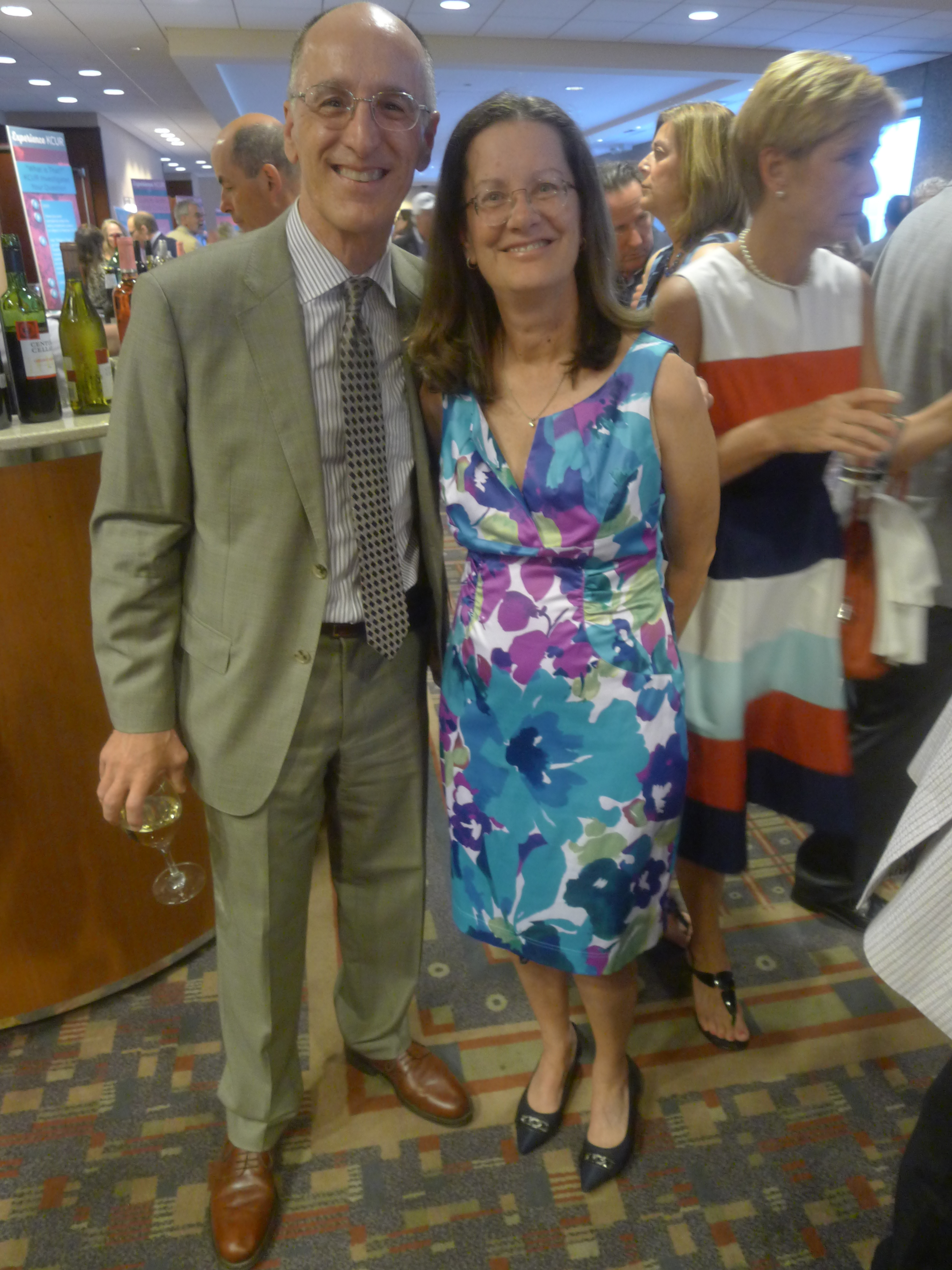
David and Julie Warm

P1060293

Gerald and Gloria Hiller

P1060285

Mr. and Mrs. JimmyC

P1060301

Nico Leone

P1060299

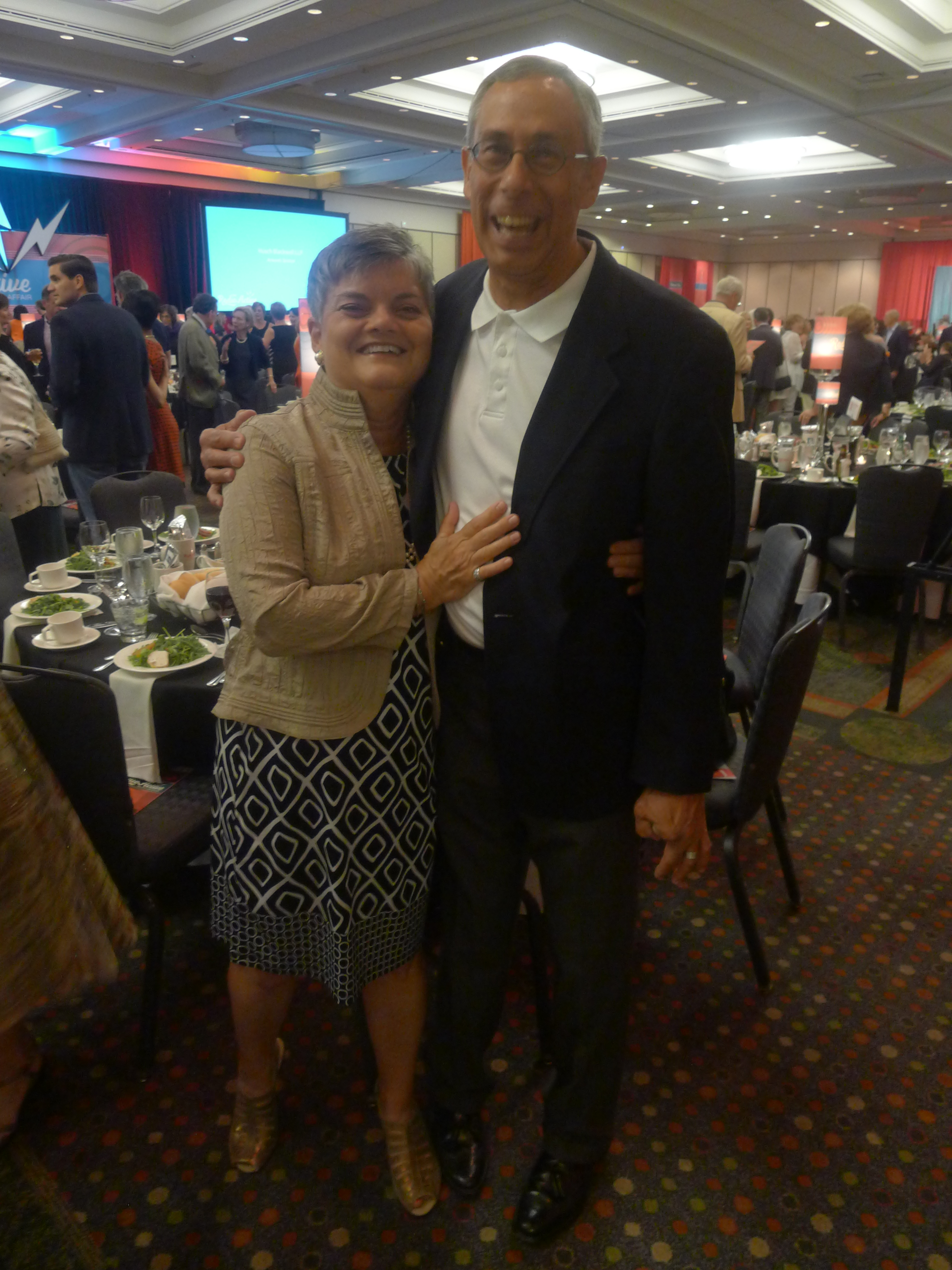
David Greene and Patty

P1060304

The dance floor and the BelAirs

P1060303

Ladies in black

P1060307

A lady named Jessica

P1060319

World famous investment banker Jack Holland and our friend Pat Russell, who is drawn to luminaries

**

Here’s a morning-after addition to the photo line-up. (See comment below by Kate, author of the 43rd Place blog.)

P1060315

Patty in festive skirt…


Creative Writing 401: The New York Times had an entertaining and inventive story on the front page today about the future of the period. That’s right, the period — the punctuation mark we use to signal a full pause at the end of sentences.

The story, written out of the London bureau by Times’ reporter Dan Bilefsky, said instant messaging, Twitter and other digital communication forms may be imperiling the period. (Never fear, though, alliteration is alive and well!)

Bilefsky writes:

“The conspicuous omission of the period in text message and in instant messaging on social media…is a product of the punctuation-free staccato sentences favored by millennials — and increasingly their elders…”

The best part of the story, the most wickedly creative part, is it was almost completely devoid of periods. Bilefsky pulled it off so shrewdly I didn’t even notice until I was more than halfway through the 17-column-inch story. As far as I could tell, Bilefsky used a period only twice in the story — both times when he wanted to imbue the preceding word with emphasis. For example, he said: “Can ardent fans of punctuation take heart in any part of the period’s decline? Perhaps.”

In that context, the period adds weight and profundity…well, at least as much profundity as the word “perhaps” is capable of eliciting.

Bilefsky’s “kicker” — his final sentence — was a killer: “Now all we need to know is, what’s next to go? The question mark”

Another outstanding NYT story — one that only The Times would conceive of and properly execute — was a profile of Lonnie Ali, Muhammad’s wife of 30 years.

Journalism 301: Maybe you’ve read KC Star sportswriter Pete Grathoff’s “For Pete’s Sake” column, usually a short, light-and-frothy online offering that makes a point and then segues into related Tweets and such. Yesterday’s piece, which went up in the afternoon, was much more provocative than usual because Grathoff contacted an event and security consulting firm with experience in estimating crowds. After looking at photos from the World Series parade route and the ensuing rally at Union Station, the consultant, Alexandar Kollaritsch, estimated the crowd that day at 255,000. That’s a far cry from the Kansas City Sports Commission’s estimate of 500,000 and Mayor Sly James’ estimate of 800,000.

Regardless of what you might think about the crowd estimates, this was an attention-getting story that tens of thousands of people must have clicked on yesterday. And to my delight, the editors recognized a “talker” when they saw one (they undoubtedly reacted to the number of hits, too), and they elevated the story to the front page of today’s print edition.

Now that was a bold stroke. The story was surely the best read in today’s paper.

Sportswriting 201: After failing to produce a column the night of the latest Yorlando Ventura meltdown, KC Star sports columnist Sam Mellinger shook off his somnolence today and had an insightful column on the Royals’ pathetic offense. Among other things, Mellinger said three of the Royals’ regular hitters — Kendrys Morales, Alcides Escobar and Cheslor Cuthbert — are hitting and getting on base at a rate that is well below the league average. In other words, they stink and are dragging the team down.

Journalism 101: Two of The Star’s most able and veteran reporters, Jefferson City correspondent Jason Hancock and City Hall reporter Lynn Horsley, had excellent stories in the last two days, but both made a basic journalistic misjudgment. In stories referencing votes by public bodies, they failed to report who voted and how they voted.

Hancock’s story, in today’s paper, included a reference to a Missouri Clean Water Commission vote in February to revoke the permit of an animal feeding lot in northern Missouri. The vote was important because it illustrated the importance of having a strong public representation on the commission at a time when the Missouri General Assembly has voted to decrease the number of public representatives and increase the number representing the agriculture and mining industries.

Hancock referenced the commission’s 4-2 vote to revoke the permit, but he didn’t say how many of the four voters were public representatives and how many were industry representatives…In an email today, he told me three of the four commissioners voting to revoke the permit were public representatives — which illustrated his point about the importance of a strong public representation. He also said he had made a mistake in not reporting details of the vote.

Horsley’s story, which appeared Thursday, was about a four-hour debate by two City Council committees on a proposed investment of up to $27 million in the 18th and Vine District. This is a big deal, and it’s controversial: Some council members see the proposal as a vital infusion into the district, which has never reached its anticipated potential, while others see it as pouring more money down the drain.

Eight council members participated in the joint committee vote, and they knotted at 4-4, which at least temporarily put the brakes on the ordinance. Horsley reported the 4-4 standoff high in the story, but she never named the members of the two committees or how each voted. So, Kansas City residents who read that story had no idea if their council representatives were involved or how they voted.

Like Hancock, Horsley gave me the voting breakdown in an email. Here it is…

Voting yes: Council members Lee Barnes, Scott Taylor, Scott Wagner and Quinton Lucas.

Voting no: Council members Kevin McManus, Heather Hall, Jolie Justus and Katheryn Shields.

This failure to report the breakdown on critical governmental-body votes has been going on a long time at The Star. The reporters invariably explain it by saying they didn’t have enough space, but I don’t buy that. These votes are usually some of the most important elements of government stories from the readers’ perspective, and the reporters should include the vote breakdowns and eliminate other material, if necessary.

…Class dismissed.

As you know, I don’t venture into sports commentary very often, leaving that in the usually very capable hands of KC Star columnists Vahe Gregorian and Sam Mellinger.

But here we are today, with the Royals clearly at a point where their top-tier, World-Series-status is in jeopardy, and Gregorian and Mellinger are missing in action.

Gregorian hasn’t written about the Royals during the current six-game losing streak, and Mellinger last weighed in on the Royals Saturday with a column about Dayton Moore’s 10 years as general manager.

I’m sorely disappointed that neither Gregorian nor Mellinger wrote a column for today’s paper in the wake of 25-year-old pitcher Yordano Ventura’s incredible meltdown last night in Baltimore.

When Ventura plunked Orioles’ third-baseman Manny Machado with a 99-mile-an-hour fastball in Baltimore last night, he not only cast grave doubts on his future as a big-league pitcher but also spun the team into disarray. No longer are the Royals concerned about poor hitting, leaky defense and inferior starting pitching. The more provocative question is what to do about this temperamental, immature pitcher who seems strangely distant from the rest of the team and who has completely lost his head twice in the last two seasons.

If you were watching last night, there was a very telling moment after the brief melee subsided. After Ventura got back to the dugout, he was seated on the bench all by himself. At first, no one was within several yards of him. His teammates were standing up, either on the dugout steps or on top of them, looking out toward the field or toward the Baltimore dugout. While rah-rah TV commentator Rex Hudler was jabbering on about Ventura “doing what he felt he had to do,” the more insightful Ryan Lefebvre was pointing out that Ventura’s teammates were shunning him on the bench.

When the camera went back to the dugout a minute or so later, we could see Royals’ trainer Nick Kenney approach Ventura and give him a pat on the back. One of the coaches did likewise. But no players. The scene had all the appearances of a team that wanted nothing to do with a maverick, air-head pitcher.

As all this was unfolding, I went to the kansascity.com website to see what The Star’s reporters, editors and columnists were Tweeting. Mellinger was weighing in very critically, and appropriately. I didn’t write down any of his comments, but at one point he said something like Ventura was acting like “a petulant kid.” He also said something like…”We thought Ventura was beyond things like this…What a joke.”

Reading those Tweets, I fully expected to see a column online late last night, or at least in today’s print edition, castigating Ventura and examining the Royals’ new twin dilemmas.

**

In my experience, Mellinger is very good about responding to emails, and I sent him one this morning telling him I was shocked he hadn’t written a column for today. He wrote back, saying: “I’m not in Baltimore, so couldn’t get the conversations I needed for a column last night. Working on one now.”

Like tens of thousands of other Royals’ fans, I’ll be waiting to see what Sam has to say…In the meantime, I’ll give you my prescription:

There’s no room on this classy, determined team for a player with an attitude problem. And that’s exactly what this is — a bad attitude. I think Ventura is more concerned about himself and his personal success as a pitcher than he is about the welfare of the team and whether it gets back to the World Series. 

In that regard, Ventura reminds me of former Royals’ pitcher Ervin Santana, who, like Ventura, had a lot of talent but also seemed strangely disconnected and indifferent. Since he signed with the Minnesota Twins before the 2015 season, he’s won eight games and lost 10, and the Twins have the second worst record in baseball. I think Ventura’s career is on the same trajectory as Santana’s.

Here’s my solution: Send him to Omaha for the rest of this season. Send him today. And let him stew and pitch in front of a few thousand minor-league fans — and unload him after the season. We won’t get much for him, now that he’s a certified head case, but we’ll a lot better off with his peculiar brand of poison out of the clubhouse. 

I gasped last night when I went to the ESPN website and saw the headline that Muhammad Ali was dead.

I gasped, even though Ali has been dying of Parkinson’s for at least 20 years and even though when he entered the hospital a few days ago, reports were clear that he was probably nearing the end.

I gasped because it’s hard for me to imagine a “World without Ali.” If anyone was ever bigger than life, it was Ali. Those of us who are from his era will never forget the outrageous boasts he delivered with innocent, child-like endearment. And we will not forget one of the greatest sporting lines of all time: “Float like a butterfly, sting like a bee.”

Another reason Ali’s death hit me hard is I have a long personal history with him. Oh, it’s all one sided. I only met him once — long after his mind had turned to mush and he was barely able to communicate. The crux of our “relationship” is that he and I were Louisvillians, growing up about the same time (he was four years older than I) in the same segregated southern city and taking baby steps that led to awareness of a world outside Louisville.

Ali was a special person, of course, but to Louisvillians — again, especially those growing up in his era — he was extra special. Many of us baby-boomer Louisvillians started watching Ali when he was a teenage amateur boxer.

A police officer named Joe Martin had a boxing club in Louisville. Martin recruited inner-city kids, with the idea of giving them a leg up, and taught them how to box. One day a kid named Cassius Clay wandered into Martin’s gym, and from the outset, with his speed and reflexes, Clay exhibited special skills.

Martin did such a good job with his gym that one of the local TV channels — either WAVE, the NBC affiliate, or WHAS, the CBS affiliate — began televising a weekly boxing show called “Tomorrow’s Champions.” At the time, no one in Louisville gave a thought to the significance of that name. It was just an entertaining boxing show.

“Tomorrow’s Champions” ran for either half an hour or an hour, and it featured three-round matches. Like many of my friends, I watched it religiously. It was always special when Clay fought — and he fought a lot and always won. I think the only guy who ever beat him locally was a boxer named Jimmy Ellis, who, like Ali, went on to win the world heavyweight championship at one point.

Back then, and still to a large degree, almost all black people lived in “the West End,” with downtown standing as a bulwark between east and west. I grew up in “the Highlands,” in east Louisville, and I seldom ventured more than a few blocks west of downtown. That’s the way it was with most of us from the East End.

Cassius, of course, lived in the West End, and none of us East End residents knew much about him outside of his “Tomorrow’s Champions” appearances. I learned much later that for a time, when he was a teenager, he worked part time at the downtown Catherine Spalding College library, where my stepmother was head librarian for many years. She said he was unfailingly courteous, friendly and a good worker.

After Clay won an Olympic gold medal in Rome in 1960, he turned pro. He quickly honed his skills not only as a boxer but also as an engaging braggart, which earned him the title “The Louisville Lip.” Undefeated, he worked his way up the ladder and in 1964 got a title shot against heavyweight champion Sonny Liston, an ex-con known for pulverizing opponents with a powerful right-hand punch. To the delight of the press, Clay dubbed Liston “the big, ugly bear.”

Before the Feb. 25, 1964, fight in Miami Beach, we in Louisville were tremendously excited, but, like many other people around the nation, we feared Liston might not only knock out Clay in the first or second round but might seriously injure or even kill him.

Those were the early days of closed-circuit TV, and along with several thousand other people I watched the bout at the Louisville Armory, which also was downtown and where, three months later, my all-boys Catholic high school would hold its graduation ceremony.

All of us were relieved when Clay survived the first round, and we became hopeful when it appeared his game plan — keeping his distance from the hulking Liston, dancing around on his toes and peppering Liston with lightning-fast left jabs — might lead to victory. Hanging on very twist and turn of the fight, we endured a torturous fifth round after a caustic substance — perhaps from Liston’s gloves — got in Clay’s eyes and forced him to run around the ring for the duration of Round 5, keeping his distance from Liston. Later, Clay said he only saw Liston as a shadow in the fifth round.
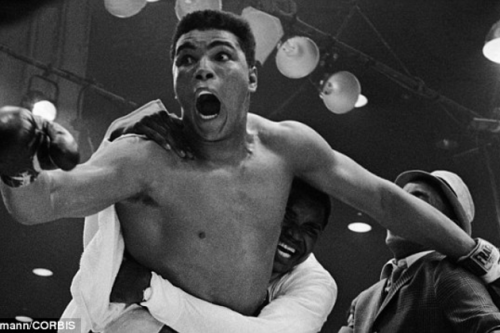
ali1

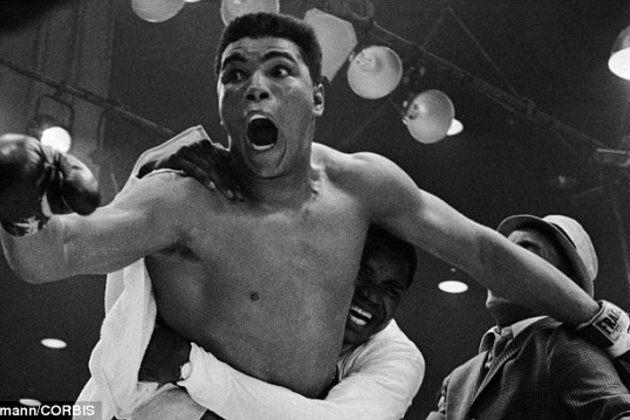
Cassius Clay, reacting to Sonny Liston’s failure to emerge for Round 7 in their heavyweight championship fight Feb. 25, 1964, in Miami Beach.

Clay regained command of the fight in Round 6, and, to the utter disbelief of us in the Armory, when the bell rang for the start of Round 7, Liston did not get off his stool. Just sat there, frustrated, disheartened and maybe suffering from a shoulder injury. The referee waved his arms, signaling that the fight was over, and just like that, Clay was the new heavyweight champion…We in the Armory erupted in delirious disbelief…It was, by far, the greatest thrill of my life up to that point, and it might still rank as the greatest thrill of my life.

…Fast forward to several years ago, when Ali appeared at the Muhammad Ali Center in downtown Louisville. I was in town at the time, and my good friend Bill Russell and I decided to go to the event. Ali was seated in a big chair, and each person in attendance had the opportunity to approach him, say a few words and have his or her photo taken with Ali. When I got my turn, I wasn’t the least bit interested in a photo; I just wanted to tell him I had been there, in Louisville, that night in 1964, watching on closed-circuit TV.

His mind addled by Parkinson’s, Ali stared straight ahead. As I prattled on, he never looked at me, just grunted once or twice. After 15 seconds or so, as I was still talking, a line attendant came up and shooed me on; the next person in line was waiting to pay his or her respects to what amounted to a statue of a man.

Leaving the center, I was glad to have been within a few feet of Ali but disappointed he apparently hadn’t understand a thing I had said or realized how much that night meant to me.

Ali was, as he unabashedly billed himself, “The Greatest of All Time.” But to us Louisvillians — and I still have a lot of Louisville in me — he was also “The Greatest Louisvillian of All Time.”

I tell you, when you leaf through the pages of The Star or check its website periodically, you have to steel yourself for the horrific stories you often read.

I’m talking about the stories of mayhem and violence — stories laid out in neat columns under unemotional headlines that don’t begin to reflect the upheaval and sorrow that the underlying events have wrought on Kansas City area families.

If you’re a feeling person, these are not stories you can read and dismiss and flip to the next page. They scorch the soul.

It’s absolutely tragic that we have so many such incidents — and stories — in our area. But Kansas City isn’t Mayberry. For all its fountains, the Country Club Plaza, Ward Parkway, Zona Rosa, Hawthorne Plaza etc., this is a big, gritty metro area where awful things happen every day.

Take a closer look at some of the perpetrators and victims whose stories have been starkly chronicled in black and white.

:: Twenty-four-year-old Caitlin Vogel of Stilwell died Tuesday night when a car driven by an incorrigible drunk driver, James Richard McAllister, ran a stop sign at 191st and Nall and broadsided Vogel’s vehicle. Twenty four years old. Just starting her adult life and her job as an autism instructional assistant in the Olathe School District. Think about the patience and dedication it takes to work with autistic kids day after day. to society’s benefit, Vogel did it…She should not have died, and McAllister is the worst sort of uncaring punk. He’s 27 and has at least two prior DUI convictions. He’s charged with involuntary manslaughter, which, unfortunately, is about the strongest crime that can arise from an unintentional vehicular death.

:: Far away from that scene but still in the Metro area, 58-year-old Michael R. Sear of KCK was killed early last Saturday when he was rear-ended on Interstate 29, not far from KCI, by 24-year-old Nicholas N. Sanders. Rear-ended! Can you imagine how fast Sanders had to be going to kill a someone with his vehicle while traveling in the same direction?

Get this…Sanders’ blood alcohol content was a stratospheric .313 — the highest I’ve ever heard of in a DUI case and nearly four times the legal limit of .08.

Sanders, who is charged with involuntary manslaughter, told investigators he had drunk three beers and three shots of whiskey earlier that evening at a Kansas City bar. My guess is he underestimated by about 10 of each.

kyle

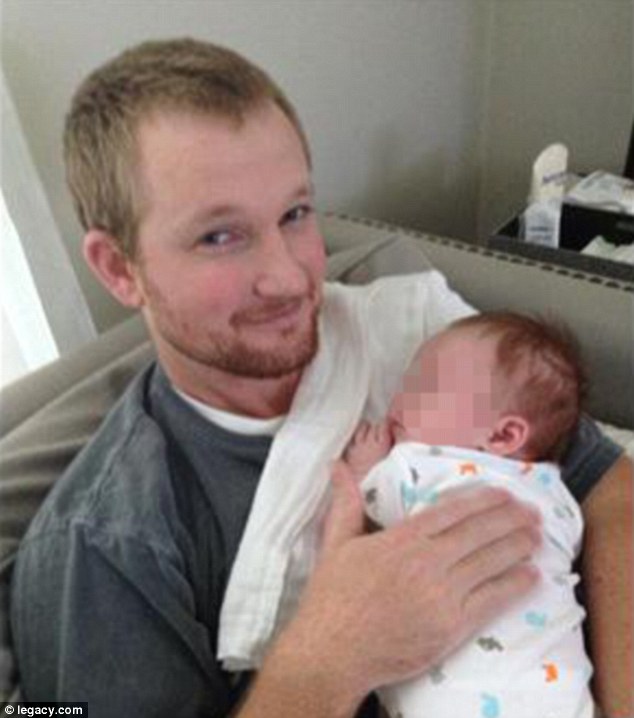
Kyle Van Winkle and infant son

:: In Jackson County Circuit Court Wednesday, 27-year-old Joshua T. Bradley pleaded guilty to involuntary manslaughter and was placed on five years probation for beating Kyle Van Winkle to death in the Arrowhead Stadium parking lot in 2013. Van Winkle, a credit union employee, was essentially drunk and harmless after having accidentally gotten in the wrong vehicle during a Chiefs’ game. Through a confluence of stupid events, including the young son of the “wrong-car” owner yelling that the interloper had stolen cookies (cookies!) from the car, Bradley came along and beat the crap out of Van Winkle, even continuing to punch him after Van Winkle was down and defenseless…At the time, Van Winkle and his wife had a seven-week-old son.

Bradley’s family must have money because they were able to hire one of the best defense attorneys in town, Patrick Peters, who lined up an expert witness — a physician — who would have testified that Van Winkle died of a stroke…The only saving part of this is that if Bradley screws up on probation, he will have to start serving a 7-year sentence that the judge suspended in favor of probation.

:: A 16-month-old boy will not have a chance to enjoy his childhood and grow up to be an adult, apparently because 31-year-old Nathaniel A. Littlefield of Kansas City beat the boy to death after the boy’s mother went to work and left her son in Littlefield’s care. The Star’s story says, “Littlefield admitted to repeatedly striking the child in the face and head, but he said he did so in an attempt to revive him.” I guess Littlefield wants us to thank him for his resuscitation effort. He’s charged with child abuse and two counts of endangering the welfare of a child.

:: And this just in…34-year-old Randy Michael Garrison of Orrick in Ray County was charged with two counts of second-degree murder for allegedly abandoning his two young sons to die in a 2013 fire. Three-year-old Roger Garrison and 1-year-old Ashton Garrison died in a trailer fire on Dec. 10, 2013 in Orrick. His own sons…The ultimate irony here? Weeks after the fire, friends and former Excelsior Springs classmates raised money and donated household items to Garrison.

Sadly, we live among a significant number of vicious and irresponsible people — people who will take a life and think very little of it.

What can we do about it? Very little, very little — mostly just hope we don’t find ourselves in the intersection with the drunk stop-sign runner or sitting in the wrong car eating somebody else’s cookies.

Gov. Sam Brownback and the state of Kansas today made the front page of The New York Times…Not surprisingly, it wasn’t a favorable story.

The headline was “Kansas’ Blame Game Over School Funding Crisis.” The story was about the fierce kickback Brownback and the Republican-dominated State Legislature are getting over the state’s budget crisis and how it is hurting elementary and secondary education.

Interestingly, three of the people who are quoted in the story as being critical of Brownback and the Legislature are Republicans. One, Dinah Sykes, who lives in Prairie Village, is so upset she is running for a State Senate seat, challenging the Republican incumbent in the August primary.

Sykes, whose photo appears on the front page, along with the story, is quoted as saying: “We’re getting a bad reputation: that our state doesn’t care about public education.”

LeEtta Felter, a Republican who is a school board member in Olathe, says in the story that “any responsible entity has a rainy-day fund except for the state of Kansas.” It had a rainy-day fund, but it got washed away because of the budget crisis owing to the Brownback-sponsored state-income-tax cuts of 2013.

Another Johnson County Republican, Cindy Neely, told The Times the sentiment she regularly hears from people is, “We need different representation in Topeka that will stand up to the governor.”

…When I was in The Star’s Johnson County bureau in 2004 and 2005, I remember a political reporter named Jim Sullinger — now retired — doing story after story about the pitched battle between conservative and moderate Republicans in the Legislature. The battle had gone on for years, so long that some editors at The Star — and probably readers, too — would roll their eyes at the latest incremental development in the battle. Well, the conservatives finally won out, and those stories stopped.

For the last several years, all of Kansas has been paying the price for the conservatives’ victory. Now, perhaps, moderates are about to mount a comeback. And while I’m not too keen on the prospect of a new, years’ long sequence of stories about a renewed conservative-moderate battle, it would be a healthy, positive development for the state.

And, come to think of it, we really wouldn’t be subjected to as many stories as we were before because The Star has its own budget crisis, and the number of reporters doesn’t approximate what it was back in the 1990s and early 2000s.

**

Congratulations to The Star on the hiring of veteran reporter Steve Vockrodt of The Pitch. (Congratulations to Vockrodt, too, of course!)

Vockrodt’s last day at The Pitch was yesterday; he starts at The Star Monday. Vockrodt has had a number of ground-breaking stories since starting at The Pitch in 2013. Before that he was with the Kansas City Business Journal for six years. He’s also a University of Kansas graduate.

vockrodt

Steve Vockrodt, new hire at The Star

This marks the first time in years, to the best of my recollection, The Star has hired an established, experienced journalist for the newsroom. Several years ago, The Star made a high-profile catch when it hired Vahe Gregorian away from the St. Louis Post-Dispatch. But Gregorian is a sports columnist, and sports is the only department where The Star has made an all-out effort to maintain the the quality and substance the paper enjoyed until the mid-2000s, when print advertising started falling off a cliff.

Star editors have toyed with the idea of hiring Vockrodt for a couple of years. I don’t know what finally prompted them to make the leap, but I’d like to think it was the appointment early this year of Tony Berg as publisher. At his introductory speech In January, Berg told reporters and other editorial employees he would fight for them and that he understood the work coming out of the newsroom is “what makes us so important in the community we work in.”

Vockrodt will be primarily a business reporter. Watch for his byline…

Three years ago, the Pew Research Center conducted a public opinion survey regarding how Americans viewed various professions in terms of how much they contributed to society.

As a group, journalists came in seventh out of 10 professions — ahead of only business executives and lawyers.

At the top, in order, were military personnel, teachers, medical doctors and scientists, followed by engineers, clergy members and artists.

Adding insult to injury, among all 10 groups, journalists had dropped the most in public esteem during the previous four years. The portion of the public saying that journalists contribute “a lot” to society was down from 38% in a 2009 survey to 28% in 2013. The drop was particularly pronounced among women, 17 percent of whom had a less favorable view of journalists than they did in 2009.

You might wonder why I went looking for statistics about the public’s view of journalists. Well, I was still scratching my head after having watched a recording of Donald Trump’s earlier news conference, in which he relentlessly flogged journalists for being “dishonest” and “not good people.”

The premise of the news conference was to reveal how much money Trump had raised for veterans groups. He did that (the amount was $5.6 million, according to Trump), but he spent almost as much time chewing on journalists as he did talking about his fund-raising for veterans. He seemed irritated because members of the media had questioned whether he had actually raised a significant amount of money, and they had been pressing him on where, specifically, the money was going to.

Here are a few samples of what he had to say about “the press.”

:: “The press should be ashamed of themselves…You make me look very bad. I have never received such bad publicity for doing such a good job.”

:: “You know my opinion of the media; it’s very low. I think the media is, frankly, made up of people that — in many cases, not all cases — are not good people.”

:: “I think the political press is among the most dishonest people I’ve ever met…I find the political press to be unbelievably dishonest.”

I’m in something of a state of disbelief myself. In all my years in and around journalism, I’ve never seen anyone in such a vaunted position as Trump go after the press so relentlessly and with such a broad brush…I mean, “not good people”??? It would be one thing if he said reports about him were “unfair” or “not objective.” But when he says journalists as a whole are “not good,” I get the distinct impression he thinks they’re evil. Or at least he wants his audience to think they’re evil.

Trump doesn’t hesitate to light into individual journalists, too. At today’s news conference, he called ABC’s Tom Llamas “a sleaze” and CNN’s Jim Acosta “a real beauty.”

maggie

Maggie Haberman

ashley

Ashley Parker

A few days ago, when New York Times reporters Maggie Haberman and Ashley Parker asked him for a comment on a story they were working on about his campaign team and its management, he sent them an email saying, “You two wouldn’t know how to write a good story about me if you tried — dream on.”

…So what is with these attacks? Trump, as we know, is crazy like a fox. My guess is he’s banking on the public’s low regard of journalists to help jack up his popularity. The theory being, I suppose, that if you put the hammer to a bunch of rats, a lot of people are going to cheer you on…Maybe he’s even aware that journalists have become less popular with women, among whom Trump is tremendously unpopular.

There’s another dimension of this story, though, and it goes like this: Never get in a fight with people who buy ink by the barrel.

Do you think Llamas and Acosta and Haberman and Parker — and their editors — might go looking for unflattering stories about Trump?

Of course, they are smart enough that they will not blatantly attempt to tar him. They will make sure they can justify any stories they write — or air — as timely and “newsworthy.” They will also make the requisite calls for comment and do what is necessary to insure their stories reflect their best efforts to be objective and fair. But, my gosh, Trump has declared war on journalists, and I don’t think he realizes how badly he’s outnumbered and outgunned.

After getting up this morning, with Memorial Day stretched out before me, my first inclination was to head for the golf course.

Pretty soon, though, feelings of pride (at being an American) and gratitude (for the millions of U.S. armed forces members who have died and been wounded for the sake of freedom) prompted me to put golf aside and head to the Liberty Memorial for Kansas City’s annual Memorial Day Ceremony.

I’m so glad I went. It was solemn, moving and gratifying.

Retired Gen. Richard Myers, former chairman of the U.S. Joint Chiefs of Staff, summed it up best when he opened his keynote address by saying:
“Isn’t it great to be an American?”

It’s a cliche, but on this day, it is particularly meaningful, and the several hundred of us in attendance nodded and affirmed.

Another speaker, U.S. Rep. Emanuel Cleaver, talked about how “messy” the nation is now, with the tremendous political strife and divisions we are experiencing. But as he spoke under a hot sun, he said that on this day said those fractures and fissures didn’t matter.

“On this day,” he said, “we come together as Americans and say ‘thank you’ to the men and women who served us well.”

Kansas City Mayor Sly James rightly called the ceremony “a reconnection with our values as a country.” Sometimes we take those values for granted, but James was reminding us that is a big mistake.

Alluding to Donald Trump’s “Make America Great Again” theme, James, who served in the Marines, said: “I never realized it wasn’t great. To me it’s great every day.”

Myers, an area resident who lives on the Kansas side, spoke about the qualities he believes have made America great: courage, sacrifice and optimism.

A prime example of our nation’s optimism, he said, came during a period when Americans were losing several battles in the Revolutionary War and the founding fathers gathered in Philadelphia to compose the Declaration of Independence.

“We were losing the war but declaring independence!” Myers said.

As an example of courage and sacrifice, he cited a visit he and his wife had years ago with a 20-year-old soldier at Walter Reed Army Medical Center. The young man was going into surgery the next day to have a leg amputated. Myers said he and his wife teared up as they talked to the troop about his plight. But the young man put an end to the commiserating, saying, “Oh, no. I was prepared to give my life for my nation; I only have to give my leg.”

In closing, Myers followed up his opening question (“Isn’t it great to be an American?”) with another rhetorical question:

“Aren’t we lucky to live in this country?”

Amen, General Myers, amen…

**

Now, here are some photos…

P1060262

The crowd,on the Liberty Memorial deck

P1060263

Placing a memorial wreath

P1060267

A mother and daughter take it in

P1060269

The American Legion Band, under the direction of Heather Picket

P1060273

Retired Air Force Gen. Richard Myers

P1060275

Taps

P1060279

U.S. Rep. Emanuel cleaver (right) and Jackson County Executive Frank White

P1060278

Our soaring Liberty Memorial

P1060266

The incomparable view of the south lawn, Union Station and the skyline

P1060280

Looking out at the Mall, toward the Federal Reserve Bank of Kansas City and the iconic KCTV tower

P1060281

We honor, and we remember…


After the last few days’ weather, I’m starting to identify with one of the great lines from a 1933 W.C. Fields movie The Fatal Glass of Beer. Living in a cabin in the Yukon, Fields’ character, Mr. Snavely, opens the front door several times and after getting a blast of snow in the face says, “It ain’t a fit night out for man or beast.”

It certainly ain’t fit for navigating the golf course today, but fortunately, there’s plenty of news to focus and reflect on. For example…

:: How about that Hillary? If it weren’t for the emails, she would be gliding toward victory in November. But isn’t there always an “if” with the Clintons?

When news of her flouting federal rules email practices surfaced about a year ago, I said I was washing my hands of her. But I came back around after seeing the Republicans would not be fielding a credible candidate.

I’ll surely end up voting for her in November, but here are the most recent, galling developments.

First, not only did she never request State Department permission to use a private email server, she refused to be interviewed by Inspector General Steve A. Linick or his staff. Stone-walled him. To me, that’s as damning as defendants who plead not guilty in criminal cases but refuse to take the witness stand.

Second, I was dismayed when she said, before the Kentucky primary, that as president she’d be putting husband Bill in charge of boosting the economy. Holy shit! Hasn’t everybody had enough of that guy? It’s distasteful enough to see news clips of him making speeches here and there and wagging that index finger when he’s not in a seat of power. But for God’s sake he’s the last person I want to be reading about in tandem with Hillary the next eight years.

I’ve said for years I would have much more respect for her if, after Bill’s White House weenie-wagging, she would have divorced Bill and charted her own course politically and personally.

And on the subject of her personal life, conservative columnist David Brooks had an insightful column the other day when he said the key to Hillary’s unpopularity is that people see her as strictly one-dimensional. While we know Barack Obama likes to play golf, watch basketball and vacation in Hawaii, we know very little about Hillary, other than that she dons her political face and lipstick every morning.

As Brooks said: “…(I)t’s hard to think of any non-career or pre-career aspect to her life. Except for a few grandma references, she presents herself as a resume and policy brief.”

With that observation, I think Brooks goes a long way toward explaining people’s reservations about her: Not only is she too slick for her own good but we know very little about here wants and needs, likes and dislikes, other than she wants power and needs public adulation.

:: The Kansas City Fire Department’s unvarnished assessment of the handling of the October fire that took the lives firefighters John Mesh and Larry Leggio struck me as having an indirect parallel to the 1988 explosion off Bruce Watkins Drive that took the lives of six Kansas City firefighters.

Although the new report focuses on mistakes by incident commanders — specifically, taking their time about getting Mesh and Leggio out of the alley off Independence Boulevard — the report also explores the department’s culture of aggressively fighting fires, even when lives are not at stake. The report says, in part, “cultural norms that work against the safety of firefighters are and can potentially be disastrous and should not be tolerated.”

On that fateful, unforgettable morning more than 25 years ago, it was over-aggressiveness that took the lives of firefighters James H. Kilventon Jr., Michael R. Oldham, Robert D. McKarnin, Gerald C. Halloran, Luther Eugene Hurd and Thomas Fry. 

The big difference in the 1988 explosion and the October fire on Independence Boulevard was that, in 1988, two fire companies headed by captains were following their own instincts. A battalion chief was on the way but not there when the captains made critical decisions. The companies chose to pour the water on at close range while a trailer full of explosives burned.

The two companies didn’t know for sure that the trailer contained explosives — back then exterior chemical markings were only mandatory while explosive containers were in transit — but dispatchers had warned that explosives were involved. A member of one of the two fire companies even asked the dispatcher to tell the other company to keep its distance. After extinguishing a nearby truck fire, however, that company joined the other company near the trailer.

I remember reading back then that flames coming from the trailer had a bluish hue, rather than the usual bright orange. Several of the firefighters on the scene had received hazmat training and should have recognized the fire as alarmingly unusual, but their adrenalin apparently overrode any reservations they might have had.

The most tragic part, of course, was that as Battalion Chief Marion Germann and his driver pulled up at the scene and saw the spectacle, Germann reached for his radio to tell the companies to pull back. He was seconds too late: Right then, the trailer exploded, gouging a crater at least 80 feet in diameter and 8 feet deep.

…You would think that incredibly painful lesson would have prompted the department to alter its approach to property fires. Maybe the new report will get the job done. As it points out, the firefighters on Independence Boulevard lost track of the fact that only property was at risk; it was just a building.

The most memorable line in the report should be posted on the wall of every fire station in Kansas City:

“When there is little to save, we should risk little.”

I barely left the house yesterday, but I still managed to procure a winning mutuel ticket on the Preakness Stakes at Pimlico Race Course in Baltimore.

If you read my Derby post two weeks ago, you know I was unhappy about Nyquist winning the Derby — not because I don’t like the horse but because his owner is in the payday loan business and his trainer has more than a dozen medication violations on his record.

One of the horses I liked in the Derby was Exaggerator, who finished second (although I didn’t bet him to place). In April, he had won the Santa Anita Derby, making a huge move on the home turn, on a sloppy track. He loves the slop.

When I saw earlier this week that the Baltimore forecast called for 100 percent chance of rain yesterday, I figured Exaggerator would have a great shot at turning the tables on Nyquist today. On Friday, then, I deposited $100 in son Charlie’s checking account and asked him to bet $100 to win for me today on Exaggerator.

Charlie, as some of you know, is a graduate student at UNLV. He just completed his class work for a master’s in environmental health physics, which basically involves measuring and controlling radiation levels in a variety of workplaces.

Early Saturday afternoon Charlie went to the Green Valley Ranch Casino’s sports book — where bettors wager on all kinds of sporting events — and placed the bet. He even took a photo (below) with his cellphone.

Picture0521161640_1

After the horses broke from the starting gate, Nyquist got caught up in a front-end speed duel on the sloppy track, while Exaggerator stayed back and saved ground along the inside. On the backstretch, Exaggerator, still on the rail, made up a lot of ground, and then, turning for home, jockey Kent Desormeaux swung Exaggerator to the outside. He easily passed two tiring front-runners, including Nyquist and sailed on to a three-length victory.

exaggerator-05212016

Kent Desormeaux (green cap) moves Exaggerator past Nyquist in the stretch at Pimlico Race Course in Saturday’s Preakness Stakes.

Exaggerator paid $7.20 on a $2 bet, so my total return was $360, with a $260 profit.

Not long after the race, Charlie sent me a text, saying, “I forgot to mention there’s a 10 percent bookie fee.”

The kid is a notorious deal maker, always finding a way to get a piece of the action. Naturally, I agreed to his terms because, as I told him, I wouldn’t have won anything if it hadn’t been for him.

So we both made out pretty well…But one last thing: Before you start thinking I must be a shrewd horse player, you should know I lost about $300 on Derby Day and that over the course of 40-plus years of playing the horses — most of it in my bachelor days — I’m probably down more than 10 grand. I’m not one of those gamblers who contends he wins nine out of 10 times. No, I lose most of the time. I can count on two hands the number of Derby, Preakness and Belmont winners I’ve had over the last 35 years. But I was reminded again yesterday how much fun it is to notch a big score on a Triple Crown race.