Feeds:
Posts
Comments

As much as possible, I try to ignore Kansas. It’s a dull disaster of a state, and Sam Brownback is unequivocally one of the worst administrators to ever inhabit in a governor’s mansion. (It’s a small miracle he was re-elected in 2014 — and he wouldn’t have if the Democratic nominee, Paul Davis of Lawrence, could have demonstrated he had a pulse.)

And yet I can’t entirely ignore the damn state. I live a block from State Line Road; I frequently shop at the Hy-Vee at 77th and State Line; we occasionally go to restaurants there; and, most important, a minor but valued part of my income hinges on secondary-education funding in Kansas.

After retiring from The Star in 2006, I enrolled in Avila’s teacher certification program, and since 2008 — when I got my certification — I’ve been a substitute teacher in the Shawnee Mission School District. I teach Language Arts, usually in high schools. It’s a great job, paying $135 a day. The assignments are handled by phone and computer, and I can make myself unavailable for any days or periods of time that I choose. The substitute coordinator doesn’t hold it against you if you make yourself unavailable for weeks at a time; she’s just glad to have you whenever you can jump in and fill a void.

As a result,  when I read about each round of cutbacks in government funding in Kansas — the latest was yesterday — I cringe because I envision secondary education taking a big hit and SMSD subsequently announcing it is either cutting the number of subs or slicing their pay.

So, I was relieved when I read in today’s Star that the latest round of budget cuts hits higher education but not secondary. Too bad for the universities but, frankly, I’m more concerned about my extra piece of bacon at the breakfast table.

…But I’m not completely selfish. In the bigger picture, the most maddening thing, once again, is a new round of cuts for Medicaid funding. Those on Medicaid — the poorest Kansans — aren’t thinking about an extra piece of bacon; they’re worried how they’re going to get treatment for such things as pneumonia, flu and accidental injuries and how they’re going to get needed surgical procedures.

By refusing to expand Medicaid (of course Missouri did the same thing), Kansas has already turned its back on more than $1 billion in federal funding, and after yesterday’s cuts, Medicaid funding will be reduced by another $50 million or so. How that will trickle down is that doctors and hospitals will receive less on the front end, and then they will either refuse or not be able to treat as many Medicaid patients.

As former Kansas governor (and former U.S. Health and Human Services secretary) Kathleen Sebelius told The Star, “I think the result is likely to be that more doctors will just refuse to take Medicaid patients. In the long run I think it is a very shortsighted way to save money.”
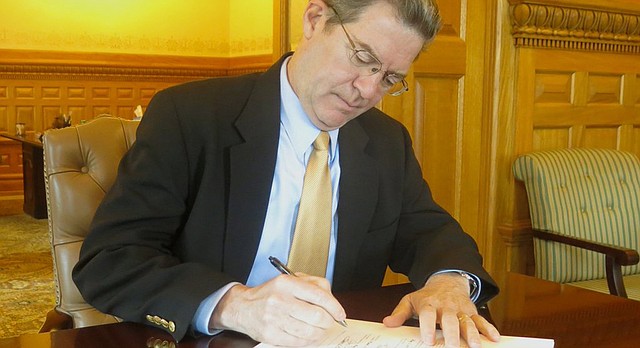
signing

Here’s Brownback yesterday, proudly signing the new budget bill involving $97 million in state spending cuts.

This fellow Brownback has got to be one of the cruelest, most callous people to ever run a government. He has simply decided, in effect, “to hell with the poor.” He figures they don’t vote (unfortunately he’s right), and they’re mostly out of sight and irrelevant. Brownback wants to lend a helping hand not to the poor but to those who run corporations, those who have proprietorships and LLC’s (like Kansas basketball coach Bill Self), and people who work as independent contractors. Yeah, the people who make a lot of money and can always use a little more and then might turn around and up their political contributions to the good Republicans who put a lot more bacon on their tables.

…One night back in the mid-2000s, when Sebelius was governor of Kansas and Matt Blunt (another stuffed-shirt Republican) was governor of Missouri, we saw Sebelius and her husband Gary at Knuckleheads Saloon in northeast Kansas City. There they were, out on the dance floor with us regular folks, laughing and drinking and dancing. Between songs, the band leader introduced Sebelius as “the good governor,” distinguishing her from Blunt. The line got a big laugh, and the crowd applauded her.

What are the chances, do you think, of seeing Brownback at Knuckleheads some night? And what do you think the crowd reaction would be if he did show up? I would hope the band leader would have the spunk to call him “the bad governor,” to distinguish him from Missouri Gov. Jay Nixon, who isn’t all that good, but at least isn’t the asshole Brownback is.


Back in the days of The Kansas City Star’s rapid and successful expansion into Johnson County — operating a big bureau on College Boulevard and publishing more than a dozen “neighborhood news” sections — the assistant managing editor for Johnson County used to say “the center of gravity” of Kansas City area journalism was shifting from downtown Kansas City to the southwestern suburbs.

That was in the early 2000s. And the editor, now-retired Michael “O.J.” Nelson couldn’t have been more wrong. By the late 2000s, the big bureau on College Boulevard was closed, along with all the other suburban bureaus; the far-flung neighborhood news operation had been disassembled; and scores of editorial employees had been bought out or laid off.

The plunge of print was — and continues to be — a humbling experience for The Star and most other major metropolitan dailies.

The center of gravity did, indeed, shift. But instead of revolving around the growth of the suburbs, it had to do with the shift away from print journalism and toward digital and other electronic formats.

…If ever there was an in-your-face-sign of how that shift is playing out locally, it occurred yesterday when KCUR-FM, the local public radio station, came out with a blockbuster story revealing that the highest-paid state employee in Kansas, KU basketball coach Bill Self, and perhaps the second-highest paid employee, KU football coach David Beatty, do not pay state income taxes on the bulk of their income because of the disastrous 2012 tax cuts in Kansas.

The reason is Self and Beatty receive the bulk of their incomes through limited liability corporations (LLC’s) they have created. LLC’s were among the many categories of “businesses” — along with partnerships, sole proprietorships and independent contractors, among others — that got a pass on state income taxes as a result of the 2012 tax-cut law.

The KCUR story says:

Before Gov. Sam Brownback signed the tax cuts, the top tax bracket was 6.45 percent. At that rate, Self would have owed up to $177,375 annually in Kansas income taxes. Even under the current reduced top rate of 4.6 percent, he’d have owed up to $126,500.

Under his contract with KU, Self receives a salary of $230,000 a year. But he gets at least another $2.75 million — channeled to the LLC — for “educational, public relations and promotional duties as assigned by the athletics director.”

The significance of the story is that, in the most dramatic way imaginable, it explodes the myth that the Brownback tax cuts were designed to create jobs. Like hundreds of thousands of others who benefited from the tax cuts, Bill Self and David Beatty do not create jobs; they just accumulate oodles of money in their various bank, trust and “wealth management” accounts.   

The story was a pure and breath-taking scoop for KCUR, which has quietly been assembling a powerhouse team of reporters and editors in recent years.

danny

Margolies

Adding to the  indignity for The Star, the lead reporter on the KCUR story is none other than former KC Star business reporter Dan Margolies, who left The Star in 2009 to take a media job on the East Coast but returned a year later after that job didn’t work out. Margolies joined KCUR two years ago as Heartland Health Monitor editor, but his reporting goes well beyond health care. The other reporter on the story is Sam Zeff, who covered health and education for KCPT-TV before joining KCUR in August 2014.

On Steve Kraske’s “Up to Date” radio show this morning, Zeff said he was watching a Royals game on TV when he was reviewing the nuances of the tax-cut law and suddenly realized Self’s LLC income was exempt from state income taxes. He and Margolies ran with it from there.

zeff

Zeff

Another former KC Star staffer now with KCUR is Donna Vestal, KCUR’s director of content strategy. In addition, Kevin Collison, The Star’s former development reporter, is freelancing for the station. And, of course, Kraske now divides his time between KCUR and The Star, as well as teaching at UMKC.

Shortly after Margolies accepted the job at KCUR in 2014, I wrote a post about him. When I asked how he felt about getting back into journalism in Kansas City, he replied, in part: “Here we have a news organization, KCUR, that not only is not shrinking but is expanding its news operation. That appealed to me.”

Two years later, it continues to expand — while The Star keeps shrinking. Ah, that center of gravity…yes, it is shifting.

Those who complain about The Star (and other papers) only printing “bad news” don’t have much to complain about today.

Consider these developments, for example:

— A U.S. District Court judge ruled that a jury can consider allegations that Missouri Highway Patrol Trooper Anthony Piercy violated the civil rights of Brandon Ellingson, when Piercy essentially catapulted the 20-year-old Ellingson out of his water patrol boat in 2014 and then failed to rescue him before he drowned in the Lake of the Ozarks…It’s gratifying that a judge — a federal judge, no less — said from the bench what has been painfully obvious all along.

— The American Royal Barbecue competition is moving to Kansas Speedway…Makes sense to me. Holding it at Arrowhead sure didn’t.

Pope Francis said he would establish a commission to study whether women can serve as deacons in the Catholic Church…According to all ancient available, Jesus never said women couldn’t be church leaders, so it’s about time the Catholic Church took steps to stop relegating women to the sidelines.

— Thanks to DNA testing, 38-year-old Jibri Liu-Kinte Burnett was sentenced to nearly 18 years in prison for raping and nearly killing a Kansas City, Kansas, woman in August 1999…In 2001, before the attacker’s identity was known, the Wyandotte County District Attorney’s office wisely filed criminal charges under the name “John Doe” so the statute of limitations would not expire before someone was identified.

— And, finally, Steve Kraske deduced from results of a new Quinnipiac poll that Donald Trump could beat Hillary Clinton in November…Wait a minute. That’s not such good news! (At least to most of us.)

Let’s take a closer look…Kraske deduced from a Quinnipiac University poll that a Trump-Clinton match would be close — and Trump could win — if he prevailed in three swing states with lots of electoral votes: Ohio, Florida and Pennsylvania. The Quinnipiac survey indicated that if the election were held now, the vote could be close in those three states.

Ah, but before we allow The Great Kraskini to rattle us too much, consider an alternate analysis by Chris Cillizza, who writes a political blog called “The Fix” for the Washington Post. Cillizza says:

“Start with the best-case scenario map for Trump and Republicans in which he holds every state Mitt Romney won in 2012 and adds Ohio, Florida and Pennsylvania to the GOP column. Trump wins 273 electoral votes — and the White House — under that map. But his margin for error is tiny — three electoral votes! — and this map assumes that he not only wins Florida and Ohio, both of which President Obama carried in 2008 and 2012, but also Pennsylvania, which no Republican presidential candidate has claimed since 1988.”

Under a second scenario Cillizza examined — where Trump wins the upper Midwest, including Pennsylvania and Ohio, but loses Florida due to the state’s large Hispanic population — Clinton ends up with 294 electoral votes to 244 for Trump.

The third scenario Cillizza posed gives Trump Ohio and Florida but has Clinton winning Pennsylvania. Trump loses that round, too, gathering 253 electoral votes to 285 for Clinton.

Cillizza concludes that “even if Trump is able to continue his competitiveness in these (three) states, it will take something close to a running of the table for him to get to 270.”

I don’t know about you, but I’m not worried. And The Great Kraskini should stop dropping his crystal ball on people’s toes.

The fatal shooting Monday of Kansas City, KS, police detective Brad Lancaster was an awful tragedy. But from The Kansas City Star’s thorough accounts, it is clear a few more people could have ended up dead.

We are very lucky that more funerals are not being planned and more tribute stories being written.

Consider the terror that five other people, including two children, endured:

brad lancaster

Lancaster

:: After shooting Lancaster near Kansas Speedway about 12:15 p.m., 28-year-old Curtis Ayers of Tonganoxie drove west on State Avenue in Lancaster’s vehicle. He must have been going mighty fast, but a KCK police officer was able to ram the detective’s car with his own patrol car. Unfortunately, Ayers was able to elude apprehension there and continued on to 118th and State, where he crashed the detective’s vehicle. He then carjacked a woman who was driving with two small children, forced the woman from the car and took off with the two children…Can you imagine how scared she was she might never see her children alive again? And the children — separated from their mother by a madman?

:: Ayers drove to the Falcon Lakes subdivision in Basehor, where he saw a house with an open garage and a car inside. (Police constantly warn against leaving garage doors open, and this is why.) Ayers walked into the house and put a gun in the face of the resident, who was sitting on a couch…How about that for unsettling your Monday afternoon? The homeowner turned over his car keys to Ayers, who took off in the resident’s car. The most fortunate part of this phase of the story is Ayers left the two kids behind and they were later reunited with their much-relieved mother.

:: Our unhinged criminal then headed east, where Kansas City police spotted him on Bruce R. Watkins Drive about 2:30 p.m…At that time, Lancaster was in a hospital emergency room, dying…At the Bannister Road exit, Ayers crashed the stolen car into a bridge pillar. He then approached a woman who was stopped in traffic, stood in front of her car and ordered her out. Before she could react, Ayers, armed with a shotgun, fired twice into the car, striking the woman with pellets in the shoulder, arm, neck and head. She, too, was lucky, driving away with non-life-threatening wounds. Another motorist was also counting his blessings. He told police Ayers fired into his vehicle, missing him…Imagine how long those minutes were for those two motorists? 

:: Finally, police were able to move in close enough to get a shot at Ayers. An officer struck him with a rifle shot, and he was taken into custody about 2:35 p.m.

:: There was no reprieve — no luck — for Brad Lancaster, who died about 3:30 p.m. and left behind a wife and two daughters, one 9, the other 10. Can you imagine the anguish they are going through — and will for years?

Contributions to a memorial fund for Lancaster’s family can be mailed to:

Kansas City, KS, Police Department
Attn. Chief’s Office
700 Minnesota Ave.
Kansas City, KS 66101

Sometimes I wonder why I keep going to the Kentucky Derby.

Thoroughbred horse racing has such a sordid backdrop — dotted with crooked trainers, owners of questionable repute and excessive, dangerous medication of horses — that it’s kind of amazing the sport is still drawing crowds at all.

But just as it is with brain-injury-riddled professional football, the power, beauty and grace of the athletes is difficult to resist.

And so on Saturday, there I was again, along with 167,000 other people, taking part in the thrill and spectacle of the Kentucky Derby at Churchill Downs.

But once again, for those looking past the mint juleps and colorful hats and outfits, the nasty underbelly of thoroughbred racing was on display.

The winning horse, as many of you know by now, was an undefeated colt named Nyquist. Nyquist was the 2-1 favorite (the fourth year in a row that the favorite has won), and he did it in impressive fashion, holding off a stirring but belated stretch run by the second favorite, Exaggerator. (For the record, I bet Suddenbreakingnews — he finished fifth — and left a few hundred dollars at the track.)

In the winner’s circle, it was all smiles and jubilation, with two of the leading participants being 47-year-old trainer Doug O’Neill and 60-year-old owner J. Paul Reddam.

The problem is both men have checkered histories, very checkered. O’Neill has accumulated nearly 20 equine medication violations — drugging his horses to either make them run faster or raise their pain threshold — and has served 45-day suspensions in both New York and California. He’s an engaging and attractive fellow, but he’s a proven cheater. Some people call him “Drug” O’Neill.

As for Reddam, I didn’t know much about him until I read a story in today’s Louisville Courier-Journal. It seems he owns a company called CashCall. Hmmm. The writer of the story, Jason Frakes, described CashCall as “a firm specializing in small loans at high interest rates.”

Being a Kansas Citian and having written about some local men who wandered down crooked alleys, I recognize the description of a payday lending scam when I see one.

I Googled CashCall and Reddam, and guess what? Yep, like some of our local schemers, Reddam apparently has been involved in the online payday loan business. In December 2013, the federal Consumer Financial Protection Bureau sued Reddam, CashCall and two other companies he owned, charging that the defendants illegally debited money from consumers’ checking accounts. The case is pending in U.S. District Court in California, where Reddam lives.

An amended complaint filed in March 2014 says, “Defendants initiated banking orders to extract funds from consumers’ bank accounts to pay obligations that under state law were void or that consumers had no obligation to pay in whole or part…Defendants thus took money from consumers, many of whom were struggling financially, that the consumers did not owe. These consumers suffered significant financial harm as a result.”

The suit says Reddam played a central role in developing and setting into motion “the nationwide scheme through which loans that his companies marketed, financed, purchased, serviced, and collected.” Reddam contends the loans did not have to comply with state licensing and usury laws because they were made in the name of a company owned by a member of an Indian reservation…That company, however, was a wholly owned subsidiary of CashCall.

So, take a look at this photo of a joyful winner’s circle yesterday. In my opinion, only one of the three people pictured front and center is a winner.


winner's circle

From left, trainer Doug O’Neill, owner J. Paul Reddam and jockey Mario Gutierrez

**

One of the elements of thoroughbred racing I have always loved is the concise, ear-catching way writers for the Daily Racing Form — thoroughbred racing’s most authoritative publication — chart the races. DRF analyzes how every race at major North American tracks are run, complete with descriptions of every horse’s performance.

Here is chart for the first three finishers in the Derby:

Nyquist came away in good order, was content to track the pace three deep, took closer order under confident handling leaving the three-eighths pole, overpowered Gun Runner soon into the lane, spurted clear while shifting towards the rail in midstretch, kept on under a downturned right-handed stick and held Exaggerator at bay.

Exaggerator drafted back off the early pace saving ground, picked up steam into the far turn, angled out and aggressively knifed his way between foes nearing the quarter pole, swung out before being straightened into the stretch, then closed strongly to narrow the gap.

Gun Runner showed speed from the gate, was allowed to settle off of the leader while saving ground, eased out advancing toward the half mile marker, overtook Danzing Candy departing the three-eighths pole, was confronted by Nyquist soon after, held a slim advantage into the lane, then gave way grudgingly through the final sixteenth.”

For comparison purposes, here’s the chart for Danzing Candy, who finished 15th:

Danzing Candy advanced wide and took command under the wire the first time, angled in when clearing, secured the rail to dictate terms, was collared three furlongs out, ceded command soon after and gave way readily.”

…Not just “gave way,” but “gave way readily.” What a wuss!

When Mark Mangelsdorf is released from the Kansas State Penitentiary this Saturday, the 34-year-old David Harmon murder case — beguiling and frustrating from start to finish — will officially be closed.

While Harmon was asleep, Mangelsdorf beat him to death with a crowbar in 1982 because he and Harmon’s wife, Melinda Harmon, had become close and had visions of a life together. David, of course, loomed as an impediment. But there was an equally big impediment. Being a good Nazarene and the daughter of the regional Nazarene superintendent, Melinda could not countenance divorce.

And so the couple turned to murder.

Olathe police might have solved the case in short order, except for one person, J. Wilmer Lambert, Melinda’s father. In his 2009 book, A Cold-Blooded Business, author Marek Fuchs described Lambert in a way that explained his later obstructionist role in perhaps the most heinous murder case Olathe has ever seen.

Lambert, Fuchs wrote, was “aggressive and worldly,” despite his spiritual calling.

“Lambert had an air of quiet superiority and a reputation for being demanding, tight-fisted, judgmental; he also took good care of relatives by finding them work in and around the church, as well as housing them, accumulating properties as he went along.”

Melinda’s story about the murder was two men came into their house, wanting David to give them the keys to the bank where he worked. One of the men knocked her unconscious, she said, and when she awoke, David was dead.

When police sought a detailed interview with Melinda, her father insisted on accompanying her and two officers, including Detective Roger LaRue, to headquarters.

Here’s how Fuchs describes what occurred next:

When the group got to police headquarters, stashed in a building with other city offices, they took the elevator to the fifth floor. When they stepped off the elevator, LaRue attempted to separate Melinda from her father.

LaRue told Lambert, “Melinda’s going to have to be questioned closely. And read her rights.”

“The hell she will,” said Lambert. “She’s coming home with me and right now, you bumbling pieces of shit,” he said, advancing at LaRue, pushing a forefinger into his chest, again and again and again.

Fuchs says a nervous assistant district attorney rushed out of a nearby office and arranged  compromise that allowed Lambert to be present for the interview.

Fuchs wrote that during the dust-up with Lambert, Melinda “observed the events around her passively, like a bystander at an accident.”

LaRue then informed Melinda she was a suspect, but Lambert, having gained the upper hand, grabbed his daughter by the shirt, walked her to the elevator, and they left the building.

That was the last time Olathe police talked with Melinda until December 2001, when two cold-case detectives approached Melinda at the Ohio home she shared with her husband, a dentist, and their two children.

Mangelsdorf also left the area, heading east, where he earned a master’s degree in business administration from Harvard. He married and moved to New York, where he worked for years as a marketing executive.

A measure of justice began to take shape in that 2001 police interview with Melinda, when her father was no longer her keeper. Giving in to her conscience, she changed her story and said she suspected Mangelsdorf was the killer.

Later, she and Mangelsdorf pleaded guilty to second-degree murder, and both were sentenced to 10 years. Melinda was released from prison last year, after serving nine years.

**

And J. Wilmer Lambert…what about him?

He died more than three years ago while living in Columbus, Ohio. His obituary says nothing about his time in Kansas.

The obituary says, in part…

“He went to meet his Lord on October 14, 2012, after serving Him all of his life. His focus on getting to Heaven had an impact on every life he touched. J.W. (as he was lovingly called) was a born leader. As a minister he was responsible for the building of new church buildings, increasing the membership of the churches, and spreading the vision of the Nazarene Church. Later he became the District Superintendent for the North Dakota, Upper New York and Central Ohio Districts. His energetic style and persistence raised hundreds of thousands of dollars for the churches on the various Districts. He was well thought of and respected by his peers. His care and guidance affected all those who served under him. He truly loved what he did as a minister and a District Superintendent and gave everything he had to further the Church and his belief in God. He had a deep heart for church missions and organized and participated in over 20 mission trips around the world. He also established a center to train ministers in Mexico. He made many life-long friends who appreciated the qualities that made him the man he was. They will not forget him and will miss him every day. J.W. loved life to the fullest. His many interests included hunting and fishing. Later in life he learned to paint and became a fine artist. His paintings hang in many homes of his family and friends…He is survived by two daughters, Janet Hyde (and Don Stalenger) and Melinda Raisch (and Mark Raisch); and two grandchildren, Landon Raisch and Layne Raisch. He loved his family with his whole heart and spent every moment he could with his grandchildren. He was their grandfather (“Paps”), mentor and coach and they will miss him greatly. His daughters are forever grateful for the love and support they received from their father.”

One daughter undoubtedly is particularly grateful for “the love and support” her father provided.

Now that the push for a new single-terminal airport seems to be gaining momentum, the big question is when to put the $1 billion revenue-bond proposal (or maybe $999 million, just to avoid the “b” word) on a ballot.

In my last post on the subject, I said I thought this year would be too soon. The airlines are agitating for an August election, and I think that’s definitely too soon. A KC Star editorial last week — undoubtedly written by Yael Abouhalkah — said an August vote could make it appear that the city is trying to ram the issue down voters’ throats.

Steve-Glorioso

Steve Glorioso

In need of keen insight on the matter, I turned to my longtime friend Steve Glorioso, who has been involved in local and national elections for nearly half a century. In an exchange of emails, Steve explained why the November general election offered the best option: “Younger voters could be the key to victory, and they vote in much greater numbers in November general elections, especially presidential ones. In August primaries, older voters are dominant.”

But…but, I replied, what about presidential elections attracting “a lot of uninformed voters, with their heads in the sand and who don’t want anything new”?

Steve pointed out the only Clay Chastain, light-rail plan that passed (but never came to fruition) was in a November general election. It wasn’t a presidential election, but it was the 2006, “off-year” general election.

“The under-35’s voted for it.” Steve said. “They just wanted light rail.”

…A letter in Saturday’s KC Star confirmed for me Steve was on the right track. Under the headline “Disgrace at KCI” was a letter from Don Hurlbert, a retiree who was city engineer during the construction of KCI in the late 1960s and early 1970s. I remember his name from when I covered City Hall from 1985-1995.

In his letter, Hurlbert, who has to be at least as old as I am — 70 –railed against a single terminal, saying the city could never replicate an airport as convenient as KCI.

“You can drive to a parking garage and walk under cover to your gate and depart or await arrivals with the most convenience. The facility was designed with that in mind. The idea that anyone could build one facility with the same convenience is asinine.”

Well, if we were going to follow Don’s reasoning, why would we have ever built the Truman Sports Complex?

We could have just held on to good ol’ Municipal Stadium and painted it from time to time. Remember? You could park right on the street and walk a block or so to the entrance and stroll right in. Now, of course, with the Royals and Chiefs so damned popular, you’ve gotta park way out in the farthest reaches of Lot F and walk a quarter- to a half-mile before waiting in a long line to put your cellphone and change in a plastic tub and then go through a metal detector.

Yeah, these modern times are hell, aren’t they? There are so many people everywhere. Big tie-ups on the highways. Waits to be seated in restaurants. And those checkout lines at Costco!

How will we muddle along?

Oh, I know, let’s let the young people lead the way; none of that stuff bothers them…I want them voting on the airport…In a way it’s too bad Bernie Sanders is sinking beneath the floor, arms waving wildly above his head. If he and the new airport proposal were on the ballot in November, the airport bonds would pass 2 to 1.

Today’s New York Times story about Ted Cruz selecting Carly Fiorina as his potential running mate has drawn nearly 1,800 comments.

Some are priceless…One commenter called Cruz’ gambit “the political equivalent of a student pulling a fire alarm to avoid an exam.”

Here is a sampling of other comments:

Ugly and Fat git, Boulder, CO

If Ted Cruz loses Indiana, he will pick his cabinet.

**

Jack, East Coast

To the Cruz team, this is a brilliant strategy to siphon off women voters.

**

kaw7, Manchester

Cruz should have borrowed Romney’s binders of women and looked a little harder.

**

T3D, San Francisco

So Captain Cruz now has his First Mate on the Good Ship Titanic.

**

sbmd, florida

Cruz picked Fiorina because she’s a woman with name recognition. He would have done as well if he had Lorena Bobbit!

**

J. Kevin Wright, Bloomington, IN

You’ve got to admit, Cruz and Fiorina kind of deserve one another.

**

SandyG, Albuquerque, NM

Like watching two cobras entwining.

**

mancuroc, rochester, NY

Well, there goes the HP vote.

**

John Michael Fields, Atlanta

Carly Fiorina…Cntrl Alt Delete

**

Let’s finish with this…My friend Dan Margolies, editor of KCUR’s Heartland Health Monitor, told me recently he had come up with the perfect adjective to describe Cruz: Oleaginous.

If you don’t know exactly what it means, and don’t want to go to “The Free Dictionary,” just think “oleo.”

Even though the drumbeat for a new, single-terminal KCI has been getting progressively louder, convincing Kansas City voters to approve a $1 billion bond issue for the badly needed project is going to be very difficult.

I am so afraid that once this gets on an election ballot (it shouldn’t be this year; too soon) a majority of voters are going to take the short view — that KCI is “just fine” and “it’s convenience that counts.” When instead they should be thinking about the need to accommodate a larger population down the road and future generations’ demand for and right to have a modern and comfortable airport with a bright and welcoming atmosphere.

I’m afraid the attitude of many voters will be akin to what we often see when it comes to bond and other tax proposals for school expansions and improvements — that is, many older people saying something to the effect of, “The schools are good enough as they are; besides, it isn’t going to affect me.”

We’ve got a responsibility to look ahead. Way ahead. Back when KCI opened in ’72 — three years after I arrived here from Louisville — this was a pretty sleepy metro area. What little downtown “action” that existed was focused around the Muehlebach Hotel, Municipal Auditorium, the adjacent Music Hall and the Lyric Opera. And the suburbs? Forget it…A bunch of what we now would call “historic downtown squares,” where you couldn’t find much more than a diner and a drugstore.

But look at our area now. I am continually amazed — often jolted — when I drive around the metro area and see throngs of people and extensive retail, residential and entertainment districts in every direction. I recall specifically being jolted one night last fall when I went downtown on impulse to see an early-season college basketball tournament. I never dreamed I’d have a problem getting in. I don’t even remember who was playing — I believe K-State was one of the teams — but what I came upon was incredibly long ticket lines outside Sprint Center and loud music and a cacophony of boisterous conversation emanating from some of the Power & Light District bars across Grand. I didn’t get into the arena until halftime of the first game…But you know how I felt? I wasn’t frustrated. I wasn’t put out. I was in awe that this scene was taking place in my city. More than anything, I was proud.  

You know what paved the way for Kansas City to become big time? Approval in 1967 of general obligation bonds to build the Jackson County (now Truman) Sports Complex. I wasn’t even when that proposal was presented to voters. It needed two-thirds voter approval and passed by a razor-thin margin. But I recall after then being assigned in 1971 to cover the Jackson County Courthouse how people and public officials were still busting with pride that voters had approved a tax-increase for a 100-million-dollar project. Almost unimaginable at the time. But Jackson County had somehow pulled it off, and Kansas City was on its way to being a fully credentialed big-league town.

That’s where we are today with the airport. It’s a billion-dollar project. It’s hard to imagine (even though it doesn’t involve a tax increase), and it makes some people’s heads swim. It makes some think: “Hell, no, I’m not voting for that. I’m going to be dead and gone by the time it opens. What we’ve got is good enough.”

No, it’s not good enough. Not good enough at all.

The headline on a KC Star editorial a few days ago called KCI a “functional dump,” and that’s exactly what it is. If you’ve been up there lately and waited in one of those dark, cramped, uncomfortable “bullpens” where you’re herded after going through security, you know what I’m talking about. It sucks. Its day is past.

…When KCI opened, I was absolutely mesmerized by those highly polished parquet floors. I thought it was the most stunning and distinctive airport floor covering I had ever seen. Then, a dozen years ago, I was horrified and anguished when the city removed the parquet and replaced it with blue terrazzo as part of a $285 million terminal improvement project. But you know what? It was time for the parquet to go. It had lost its luster — I grudgingly acknowledged that — and it was very difficult and costly to maintain. It just wasn’t practical. I moved on.

And now it’s time for the terrazzo to go. As well as the curving terminals, the lousy concession stands, the bullpens, the inner-ring glass walls, the haphazard security lines, the disparate baggage areas…all of it. Clear it out and let’s get on with building a new new airport. It’s time to move on.

Finally, when it comes to forward thinking, I try to never forget what former mayor and now U.S. Rep. Emanuel Cleaver used to say from the raised dais in the 26-floor City Council Chamber. When someone would dare to think small, he would frown, put his fist down and declare:

“This is not some podunk town along I-70; this is Kansas City!”

Come on, Kansas Citians, let’s rise to this challenge and do this not only for ourselves but our children and grandchildren and future generations.

We all know what a mess the McClatchy Co. has wedged itself into, with its ill-advised, 2006 purchase of the Knight Ridder newspaper chain, which included our beloved Kansas City Star.

Saddled with $1 billion in debt after that purchase — now down to a little more than $900 million — McClatchy has been trying to scrape and cut its way to financial stability since about 2008. (That’s when the layoffs started at The Star.)

As hard as it is to imagine that another newspaper chain could be more screwed up than McClatchy, there is one: Tribune Publishing.

Tribune’s flagship is the Chicago Tribune. Its fleet of papers also includes the Los Angeles Times, the Baltimore Sun, the Hartford Courant, the Orlando Sentinel, the Sun-Sentinel of Fort Lauderdale and the San Diego Union-Tribune. Big papers all, but this chain has been a basket case since April 2007, when a real estate tycoon named Sam Zell bought what was then the Tribune Co. for $8.2 billion. Having no idea what he was doing or how to run a newspaper business, he promptly ran it into the ground. Twenty months after the purchase, the company filed for bankruptcy, listing assets of $7.6 billion and an incredible debt of $13 billion.

Now, salvation — or at least stability — just might be at hand. On Monday, Gannett Co., the nation’s largest newspaper chain, announced that a couple of weeks ago it had submitted to Tribune an offer to buy the company for $815 million, including about $350 million in debt. The offer is for $12.25 per share, a more than 60 percent premium over Friday’s close of about $7.50. (The stock is trading at about $11.50 today.)

Gannett has more than 100 newspapers, including The Indianapolis Star, The Courier-Journal in Louisville, The Cincinnati Enquirer, The Tennessean in Nashville, The Des Moines Register and the Detroit Free Press.

The offer of $815 million, with a per-share profit of about $5, sounds pretty good to me. (It makes me wish I owned some Tribune stock, except that I’ve been narrowly focused on New York Times stock because NYT is the strongest newspaper company around and is making a winning transition from print to digital.) 

And yet, in spite of what looks like an appealing offer, Tribune Publishing hasn’t responded to Tribune’s bid. Having been met with silence, Gannett on Monday made its offer public, in effect taking the offer directly to shareholders.

The reason Tribune’s board of directors hasn’t responded to Gannett is that Tribune is going through another top management transition, where yet another non-newspaper tycoon is trying to establish himself, as a recent Chicago Tribune story put it, as “a 21st-century media baron” whose goal is to “save the journalism industry.”

michael ferro

Michael Ferro

Standing in the way, at least temporarily, of Gannett’s proposed purchase is 49-year-old Michael Ferro, a Chicagoan who made his money in the tech industry and early this year invested $44 million in Tribune, making him the largest single shareholder. Ferro already has one strike against him on the journalistic front, having failed in his bid to turn the Chicago Sun-Times, Chicago’s No. 2 paper, into a national media powerhouse. After making his big plunge in Tribune stock, he donated his roughly 40 percent stake in the Sun-Times to a charitable trust to avoid conflicts of interest with Tribune.

Ferro is currently Tribune’s “non-executive chairman,” and a story in today’s New York Times says that after a June 2 Tribune shareholders’ meeting, Ferro should control five of eight votes on the board of directors. The story goes on to say:

If Mr. Ferro….can get past June 2 without a deal, he will probably have the leeway to fully direct the process. He could choose to negotiate or perhaps he could stonewall. He could even try to take the company private himself. Who knows?

Putting an exclamation point on the clouded situation, The Times quoted a media analyst as saying, “Recent management upheaval creates numerous risks with respect to strategy and execution going forward.”

It seems to me the best thing that could happen in the coming weeks is a shareholder revolt that triggers a June 2 vote authorizing sale of the company to Gannett.

I never thought I’d be advocating a newspaper sale to Gannett, which turns its papers into the equivalent of sausage factories, but it probably would be the most favorable outcome for the papers, their employees and even Ferro, who stands to make a lot of money on a sale to Gannett.

But Ferro seems to have stars in his eyes, and if ego wins out over practicality and economics, Tribune Publishing might be in for another wild ride.

“I want to finish what I started,” Ferro told the Chicago Tribune in March.”Instead of playing golf and doing stuff, this is my project — journalism. We all want to do something great in life. Just because you made money, is that what your kids are going to remember you for? Journalism is important to save right now.”

I sure agree with that last statement, but I’d hate to see those Tribune papers end up in worse shape than they already are.