Feeds:
Posts
Comments

Maybe there’s been a breakthrough and people are beginning to see the light.

Or maybe the ballot box was stuffed.

Hard to say. But whatever the reason, the results of The Star’s “Monday poll” showed surprising support for building a new terminal at Kansas City International Airport.

From what I’ve heard and read, I would have thought people would oppose construction of a single terminal by a two-to-one margin. Instead, respondents to The Star’s online poll said by almost a two-to-one ratio that they would vote to build a new, single terminal.

Having long crusaded in this space for a new terminal — instead of renovating one or more of the three existing terminals — I found the poll results very encouraging.

That said, we don’t know how many of the more than 750 poll respondents are Kansas City, MO, residents, and it is Kansas Citians, of course, who would vote on whether to issue revenue bonds to finance the project.

In addition, it’s possible that people with vested interests in building a new terminal, including political consultants and associates of Mayor Sly James — who favors a single terminal — might have encouraged people to participate in the poll. I have no evidence that occurred…haven’t even heard it. I’m just throwing out the possibility because the results are so contrary to what I expected.

In case you haven’t seen the Monday poll before, The Star puts a question before readers, online and in print, every Monday, and people register their opinions online. The results are published online Tuesday and in print on Wednesday.

Here are the four statements and questions The Star asked readers to weigh in on:

— Despite the cost difference, the convenience of today’s KCI trumps any argument for a new single terminal.

— The current KCI portrays a negative image to much of the traveling public, which should lead to building a new terminal.

If the airlines want a new terminal, they need to provide a significant amount of their own money to help finance it.

Based on what I know now, I would vote to build a new terminal at KCI.

On statement one, 62 percent of respondents either disagreed or strongly disagreed with the statement that the existing terminals’ convenience “trumps” arguments for a new terminal.

On number two, 61 percent of respondents said the current KCI presents a negative image to travelers.

On number three, 75 percent of respondents said the airlines should provide significant funding for a new terminal.

And on number four, 66 percent of the respondents said they would vote to build a new single terminal, while 34 percent said they would not.

A public vote on constructing a new terminal could come late next year or in 2017. The aviation department recently presented results of research that indicate it would cost more to renovate the existing terminals than to build a new replacement. Another benefit of building a new terminal is the two currently operating (B and C) could continue operating as usual while the new one was being built nearby.

bullpen

The glass “bullpen walls” at KCI.

Here’s what I’ve said before, and what I continue to believe:

— KCI is a dump. Some people suggest the aviation department has let it go down because department officials want a new terminal. Maybe. But, in any event, KCI is completely outdated, plus dull, dark and lifeless.

— The terminals are maddeningly inconvenient once you have checked in at the main airline desk and are routed into “bullpen” waiting areas. There you are held hostage until your flight boards, and you’re limited, for the most part, to buying a cups of yogurt, bags of chips and soft drinks while you wait to be released.

— To be competitive with other cities our size that have built new terminals or have modernized those that already had a single point of entry, Kansas City needs a modern airport.

I want Kansas City to be first class in every way. We’ve taken care of downtown, thank God (imagine where we would be without Sprint Center and the P&L District), and now it’s time to get a new KCI.

A Kansas Citian named Brian Lea expressed it beautifully in an Oct. 31 letter to the editor. His last paragraph went like this:

“A new, single-terminal airport would be a much-welcomed change for us and the city and show visitors that we are a ‘real’ city and are proud of it.”

Come on, Kansas Citians, swallow hard and vote “yes,” when the time comes, for a modern airport we can be proud of.

One of the most interesting things about journalism to me, from an insider’s standpoint, is how high-level journalists sometimes needle newsmakers they don’t like by giving them derisive “handles.”

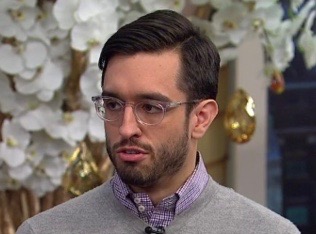
This has happened twice in the last eight days with editorial writer Yael Abouhalkah in writing about Clinton Adams Jr., a longtime public figure who, over many years, has rubbed a lot of people the wrong way.

For years, Adams was a critic of various Kansas City School District officials, including some school board members, and he lobbied and fought fiercely for changes he favored. Sometimes he was successful, sometimes not.

The Star’s editorial board has long been critical of Adams, and the board has usually put its criticism in perspective. In his last two, signed weekly columns, however, Abouhalkah has taken clear and unwarranted shots at Adams, seemingly just to pillory him because, well…because he holds the pen and has a guaranteed forum for disseminating his views.

yael

Abouhalkah

Last week and this week, Abouhalkah took gratuitous shots at Adams because Adams supports a referendum petition that is seeking to halt the proposed $5 million tax break for the proposed BNIM project in the Crossroads. It’s a contentious issue, and it appears that the leaders of the petition drive either have gotten the 3,400 signatures they need to put the issue on an election ballot or they’re going to get them. Just getting the signatures will delay the project long enough that the BNIM architecture firm is likely to bail out on the project because firm officials want to get on with getting new quarters.

The leaders of the petition drive are mainly a group of parents who don’t want to see the Kansas City School District lose the significant tax revenue the district would get absent the Tax Increment Financing deal the city has agreed to — and which The Star’s editorial board supports.

In his column last week (it appears in the Thursday morning paper and goes up on the website a day earlier), Abouhalkah had a line that read “one of the mayor’s longtime irritants, Clinton Adams, has signed the petition, ostensibly to help the school district’s revenue situation.”

The line related to absolutely nothing in the story, and Abouhalkah didn’t develop it. It was completely out of context and served no purpose other than to satisfy Abouhalkah’s desire to put the shiv to a person who obviously has gotten under his skin. Abouhalkah simply left the main road and went down a side street so he could paint Adams as “an irritant.”

The fact is, though, Adams is a lot more than an irritant to the mayor.

20140627_131536

Adams

For one thing, he heads the education committee of a seven-year old organization called the Urban Summit, whose mission is to “develop initiatives to foster community relations, enhance economic growth and improve the quality of life in the urban core.” The Urban Summit has come out against the proposed TIF project, and three of Urban Summit representatives, including Adams, testified against it recently before the City Council’s Plans and Zoning Committee.

In addition, Adams is legal counsel to the powerful black political organization Freedom, and he’s a key leader of the group. Freedom has a big constituency, primarily thousands of inner-city residents who feel the side of town they live in is much more in need of TIF-endorsed projects than the Crossroads, a booming district that is attracting market-rate projects without tax incentives.

Although Freedom has not taken a position on the TIF proposal, the vast majority Freedom’s constituents undoubtedly share Adams’ opposition to the tax break.

Adams should have complained immediately to Abouhalkah last week — and perhaps to editorial page editor Steve Paul — about Abouhalkah’s characterization of him. But he didn’t.

That’s a mistake many people make after a journalist has taken a cheap shot at them; they either don’t want to go to battle with “people who buy ink by the barrel” or they don’t want to let the writer know that he or she bothered them.

In this week’s column, Abouhalkah went after Adams yet again. The column includes this:

Activist Clinton Adams, a constant thorn in James’ side, has signed the petition aimed at getting a referendum on the ballot to put the tax break deal to a public vote in 2016. Adams has long been involved in roiling the waters when it comes to Kansas City Public Schools — and the district’s officials and some school parents have emerged as prime critics of the…project.

Of course, his opposition to the TIF has nothing to do with “roiling the waters” of the school district; he’s working to help the district from losing what could be hundreds of thousands of dollars in tax revenue…And, again, no reference to Adams’ testimony before the City Council committee or his association with a legitimate organization that works to advance the quality of life in the urban core.

**

This is simply an example of a powerful writer using his position and his virtual impunity to malign a newsmaker and a hard-working advocate of a better quality of life for East Side residents. Just because Adams has rubbed a lot of people the wrong way over the years, he in no way deserves to be labeled “an irritant” in the paper. And when referring to someone as an “activist,” the writer — any writer — should put it in context. Activist for what? In what arena?    

Don’t get me wrong here. I admire Abouhalkah and think he’s done a great job over the years of advocating for the best interests of all Kansas Citians. He holds the powerful to account, and he’s beholden to no one. If The Star is “a paper for the people,” Abouhalkah is “an editorialist for the people.” But in this instance, he let small-mindedness get the better of him. In fairness, he should write a clarification, which should include an apology to Adams…Let’s see if it comes to pass.

The Star deserves a lot of credit for its story today that explored why two Kansas City firefighters should not have died in the Oct. 12 Independence Avenue fire.

I’m sure the story — spread across the top of the front page — shocked many readers. It knocked me for a loop, that’s for sure.

It was shocking because what had heretofore seemed like an unequivocal tragedy suddenly turned into a story with profound questions about how the Kansas City Fire Department handled the fire.

hendricks

Hendricks

matt

Campbell

The story, written by veteran reporters Mike Hendricks and Matt Campbell, said that if Fire Department supervisors had followed established, nationally recognized protocol, the firefighters who died would not have been in a 30-foot-wide alley when a three-story brick wall collapsed on them.

Actually there were six firefighters in that alley, and none should have been there because it clearly constituted a “collapse zone,” that is, a confined area where they were likely to be trapped in the event of a collapse. And so it came to pass, and firefighters John Mesh and Larry Leggio died, and firefighter Dan Werner was seriously injured. (He’s on crutches and has not returned to work.)

Everyone who had been in the building was out, so no civilians were in danger at that point. The firefighters were in the alley because they were trying to beat down the fire so it wouldn’t jump across the alley and engulf a grocery store to the east. But being in the alley, their lives were at risk.

It’s not clear who told them to go into the alley; it doesn’t sound like they did that on their own. What we know is that the incident commander had declared a collapse zone, and the alley was clearly within the zone and should have been cleared. Moreover, supervisors knew firefighters were in the alley and didn’t order them out. Mesh’s and Leggio’s immediate supervisor, a captain, had left the alley to check with his supervisors to see what they wanted him and his crew to do next.

…What I liked about the way this story was written and presented is that Hendricks and Campbell approached it straightforwardly but with great sensitivity.

They didn’t shrink from the fact that a screw-up resulted in two firefighters dying. And they cited a federal safety agency’s assessment of the importance of clearing firefighters from collapse zones:

Obviously, no building is worth a firefighter’s life. Therefore, imminent risk to save a firefighter’s life is unacceptable.

On the other hand, they didn’t try to pin the blame on any supervisors in particular. Here’s as far as they went on that front: “The (fire) department did not respond to The Star’s request for the names of the commander and other supervisors on the scene.”

That’s all that needed to be said. The supervisors, from the captain to the incident commander, have to live with their actions and decisions. That’s an awful thing, and there’s nothing to be gained by hanging individuals out to dry. What emerged clearly from the story was that the Kansas City Fire Department, which claims to be among the best in the nation, needs to conduct a top-to-bottom examination of its response procedures to major fires.

The reporters tried to nudge Fire Chief Paul Berardi toward seeking an independent review of the department’s response to the fire, quoting a deputy fire chief in Fort Worth who said that would be the correct thing to do. Berardi didn’t want to hear of it, however, saying the national safety agency’s report will tell the full story.

A major problem with that, however, is the safety agency’s report could take up to a year to complete.

It seems almost certain that an independent review, focusing exclusively on this fire in this city, would yield a much faster report that would lead to quicker policy changes, which, obviously, are badly needed.

The reporters also pointed out that KCFD has no written protocol for dealing with collapse zones. The Star’s story ended with a quote from the Fort Worth deputy chief, who said if the department didn’t have such a protocol, “that’s an area you need to work on.”

Just as they did on the identity of the supervisors, Hendricks and Campbell didn’t wield a sledgehammer on the need for an independent review and updated protocols.

With two firefighters dead and a third still on crutches, this was a delicate story that required deft handling by the reporters and their editors. The Star gets an A+ on this one.

There’s a hero in this sordid, maddening Chicago case where a cop with a history of abusing citizens executed 17-year-old Laquan McDonald, who was jogging away from him, small knife in hand, and could easily have been brought down with a taser, or less.

The cop isn’t the only coward in this case, though. There are at least two others: Cook County State’s Attorney Anita Alvarez, who charged Officer Jason Van Dyke with first-degree murder only after a judge had ordered the video to be released, and Mayor Rahm Emanuel, who participated in the conspiracy because he was afraid the video’s release earlier might have cost him re-election.

Sadly, Emanuel, who was once President Obama’s right-hand man, showed that expediency and opportunism are more important to him than justice and the public welfare.

(A New York Times commenter, “Robert” from Minneapolis, said this about Emanuel: “Such a slimy mess. The mayor should go. The big Chicago Democratic machine did whatever it could to hide the truth. I wonder what is going through Obama’s head, as he reflects upon his sleazy former chief and the Chicago machine?”)

Several other cover-up artists are likely in the mix, including the person or persons responsible for making more than an hour of video from a nearby Burger King disappear without a trace.

…But, like I say, there’s a hero here. And not surprisingly it’s a journalist.

Freelance writer Brandon Smith pushed for months for release of the damning video and finally took the police department to court. If he hadn’t done that — and hadn’t won — who knows what would have happened with this case? It may well have been enveloped in that big cloud of bad-cop cases that just seem to drift away.

Now, Officer Van Dyke probably won’t be convicted of first-degree murder, even though McDonald wasn’t threatening him and he shot the young man 16 times. Laws give police a lot of discretion when it comes to determining if they feel they are in danger when they confront lawbreakers.

But in this case, the city has already admitted culpability, having settled with McDonald’s family for $5 million after their lawyers obtained a copy of the video (long before it was released publicly). And I think it’s very likely a judge or jury will convict Officer Van Dyke of voluntary manslaughter, at the very least, and that he will go to prison.

But back to Smith…He has a blog called muckrakery! and on the blog describes himself as a journalist who is based “wherever my suitcase sits.” His journalistic mission, his blog says, is to answer the question “what the hell is going on here, really?”

brandon smith

Brandon Smith

That’s precisely the question that spurred him to push the pedal to the metal on the Chicago case. On a recent Chicago TV talk show, he said he got interested in the case last April and contacted an activist named William Calloway, who said the video should be released. Smith and Calloway then filed a Freedom of Information Act (FOI) request for the video.

After getting stonewalled for four months, Smith contacted a lawyer, who filed suit in August. (I don’t know what the arrangement was with the lawyer — whether Smith paid out of his pocket, someone else paid or the lawyer took the case pro bono.)

On the talk show, Smith said several “big news organizations” had also filed FOI requests but had not pressed the issue. “I wondered why didn’t they ask their lawyers to sue for this,” he said.

Good question…And here’s the answer. As corporate journalism has tightened its grip on metropolitan dailies, and as newspapers have lost significant ground to the Internet, fewer newspapers have been willing to spend what it takes to hold public entities and officials to account. (I focus on newspapers because they have traditionally been the organizations, much more than TV stations, to sue for access to records or violations of open meetings laws. When I was with The Star, I saw firsthand how interest faded in spending money to hire lawyers when journalistic principles cried out for it.)

The New York Times is about the only paper — and, not coincidentally, one of a handful of remaining family owned dailies — that will spend big bucks to hold public officials accountable. But this was a Chicago case, so I’m not surprised The Times didn’t get involved. The Chicago Tribune should have been the organization to sue, but it didn’t. Again not coincidentally, the Tribune has lost more ground to corporate journalism than probably any other paper in the country.

So, it was up to a freelancer — a David with a slingshot — to challenge the city of Chicago. And he got ’em right between the eyes.

Now, flush with his recent success, Smith is pushing further. In a Dec. 1 article on the Daily Beast website, he said:

“But I’m not stopping there (with release of the video). With the help of attorneys, I’m continuing my Freedom of Information Act request of the city to release officer statements made to investigators, emails from city officials, and more. The public needs to know what as many as eight officers did immediately after the shooting, as well as how the department handled what should’ve been plainly seen as murder by one of its own officers that night.”

Bravo for Brandon Smith, a previously unheralded journalist, whose tenacity brought to the surface a story that could help stem police overreactions to challenging situations.


We’ve had some disagreements on this site about what constitutes a thug.

In the view of our most prolific commenter (that’s you, John) it seems to boil down to anyone resisting arrest or even a defiant, 16-year-old girl who was yanked from her desk and dragged out of a South Carolina classroom by a school security officer after refusing to leave the classroom.

I countered the comment about the recalcitrant student with my own definition of a thug:

“One who who beats people up, mugs ’em, kills ’em, robs ’em, engages in cowardly assaults and shows no mercy.”

Well, I think I’ve got an individual who we can all agree qualifies as a thug.

Robert Michael

I hate to judge a person on his (or her appearance), but I believe most of us, if we saw this guy walking toward us on the sidewalk, would slide over to the other side of the street and hope he didn’t follow suit.

The name of our facially decorated subject is Robert Michael. He’s 31 and has been charged in Jackson County with first-degree attempted robbery and armed criminal action after he allegedly grabbed the keys of a pastor’s truck and demanded money.

The Star’s Brian Burnes wrote about the incident in today’s Star.

According to court records that Burnes cited, Michael appeared at the door of the pastor’s Oak Grove church on Nov. 19, saying he had problems and wanted to talk. Naturally, the pastor — he’s a pastor, after all — admitted him.

Burnes’ story said Michael and the pastor talked for about 30 minutes — must have seemed like an eternity to the good pastor. Among other things, Michael said he had family problems and finally told the pastor he needed a ride to Independence.

The only clue Burnes gave that would indicate the pastor was unnerved is contained in this line: “The pastor decided the only way to get Michael to leave was to give him a ride.”

During the ride, Burnes went on to say, the pastor “grew nervous” after Michael told him he had served 10 years in a Texas prison.

Nervous? I’ll bet that pastor’s hands were trembling and his mind whirring as he considered various scenarios of how he might get away from Michael or what he would do if Michael tried to assault him.

…Now, back to Burnes’ account:

“The pastor said that after he stopped the truck outside a home near Independence Square, Michael tried twice to steal the keys from the ignition. On the second try, the pastor grabbed the keys and began to leave the truck. Michael demanded all the pastor’s money while holding what the pastor thought was a knife. The pastor left the truck, flagged the driver of a passing car and told her he was being robbed. The driver called 911 as Michael walked away from the truck. The pastor gave officers a description of Michael’s clothes and the tattoos covering his face. Officers soon arrested Michael.”

…You have to understand that when they are going by “court records,” reporters generally don’t have the ability to report the emotions involved in situations. Police reports and court records usually don’t reflect them; they just contain the bare facts.

The story would have been a whole lot better if Burnes had been able to contact the pastor to get his first-hand account of what happened. I don’t know if Burnes tried to reach the pastor; I suspect he didn’t, or he would have said something like, “The pastor could not be reached for comment.”

So, we’re left with a dry but nevertheless remarkable story about an incident in which an opportunistic criminal targeted a man he knew would probably invite him inside. We have to admire that pastor for doing what the Gospel would have him do. Because of his calling, the pastor really didn’t have the discretion to be as discerning as the rest of us would be if a guy looking like Robert Michael rang our doorbell.

The highlight of the story, of course, is the photo, which was scary enough as a black-and-white mug shot in the newspaper…Looking at this photo, it is reasonable for anyone to conclude that Robert Michael is most probably a thug.


I keep my voodoo doll hidden away and only bring it out, along with the poison pin (not pen, mind you), when a really bad actor crosses the most sacrosanct of boundaries.

I can put up with political incorrectness, lies and shameless displays of arrogance. But mocking a person with a physical disability is the ultimate boundary breach.

Now, who on our political scene these days might be most likely to stoop to such depths?

That’s right, the liar, charlatan and ultimate loser Donald Trump.

serge

Serge Kovaleski

At a rally last Tuesday, Trump appeared to ridicule the physical disability of a New York Times reporter named Serge Kovaleski, with whom Trump has a beef. (More about that in a minute.) Kovaleski has a chronic condition called arthrogryposis, which limits the movement of his arms and hands.

Flailing his arms as if imitating Kovaleski’s disability, Trump said, “You oughta see this guy” and then went on to mimic Koveleski backing away from a story he wrote after the 9/11 terror attacks, when Kovaleski was a reporter for The Washington Post.

Trump has denied he was mocking Kovaleski, but take a look at the video that accompanies this CNN Money story and see what you think.

The backdrop is Trump and Kovaleski have been skirmishing for almost a week over Trump’s recent assertion that he watched thousands of people in New Jersey cheering the collapse of the World Trade Centers. Numerous fact-checkers have debunked that claim, and Trump, fighting back, pointed to a story co-written by Kovaleski on Sept. 18, 2001. The story said authorities had detained “a number of people” in Jersey City who had allegedly been seen celebrating the attacks. But no proof has emerged that any such celebrations actually occurred, and Kovaleski, when asked about the controversy, said, “I certainly do not remember anyone saying that thousands or even hundreds of people were celebrating.”

Two days ago, Trump tweeted that he didn’t know Kovaleski and didn’t know what he looked like — even though Kovaleski had covered Trump when he was with the New York Daily News back in the 1980s and 1990s.

The capper to all this was Katrina Pierson, a Trump campaign spokesperson, asserting that Trump would never knowingly mock a person’s disability. For good measure, she added this laughable contortion of reality: “He has so much respect and care and compassion.”

…Yep, it’s time to dig out the voodoo doll and sharpen that poison pin. Don’t be surprised when Donald starts complaining in a few days about a disabling pain in his ass. We reporters have been making those happen for a long time.

Some hither and yon reflections while waiting for the rain to stop…

:: We used to go to the Plaza lighting ceremony almost every year but haven’t been the last three or four. Sometimes it’s been the weather, sometimes circumstances and sometimes just lack of motivation. One thing that has seriously crimped my motivation was the addition of fireworks. The Plaza Association or Highwoods, or whoever, for some reason decided some years back that one of the most distinctive, heart-warming events you can find anywhere in the country wasn’t strong enough to stand on its own. I guess some executive sat bolt upright in bed one night and said, “What the Plaza lighting ceremony needs is some rootin’-tootin’ fireworks to work up the crowd”!

However it came about, it was a supremely stupid notion. In times past, when the lights went on, it was an “Ah, yes,”  moment that also illuminated the collective spirits of tens of thousands of people standing side by side. It capped off a day of quiet celebration and thanks-giving. And then, in the glow of the lights, many people would mill about, strolling around the Plaza and enjoying the communal uplift, before drifting back to their cars and heading home.

Now, those personal, calming moments that come with the turning-on of the lights are quickly followed by the ka-bang! ka-boom! ka-whoosh! of commercial fireworks, the kind you can see so many places these days, including after every Friday night home game at Kauffman Stadium.

I don’t know about you, but I’m good for maybe one fireworks display a year. And it should not be on Thanksgiving night at the Country Club Plaza.

It came out recently that Highwoods is putting the Plaza up for sale. Let’s hope the new owners have enough sense to turn back the hands of time as far as the Plaza lighting ceremony is concerned.

:: On the subject of overkill, how about those college bowl games? Twenty-five years ago, in 1990, there were 19 bowl games. This year there will be 41 — so many that, for the first time ever, teams with losing records will be invited to participate. Until two years ago, teams had to have a record of at least 6-6 to be eligible. This year there won’t be enough 6-win teams to cover all the bowls, so several schools with losing records will be invited.

What’s at work here? Why, TV, of course. In a Kansas City Star story a few days ago, college sports reporter Blair Kerkhoff said bowl-game saturation isn’t going away:

ESPN wants live programming around the holidays, and even the lowest profile bowl games rate well. Plus the market supports the enterprise. Communities benefit from the tourism and it’s a big week for local charities.”

Of course, I understand the need for all these bowl games…The holidays just wouldn’t be complete without the Potato Bowl, Dec. 22, in Boise…Put the TV in the oven at 325 for two hours and it’s done.

:: This headline on The New York times home page got my attention last night — “Don’t Feel Bad About ‘Bad Sex’.”

I immediately thought, “There’s a story I need to read.” I mean, don’t we all — or most of us, anyway — live in fear of the possibility of bad sex? Just about as disappointing as the Royals’ Game 7 loss to the Giants last year, right?

When I got to the story, though, I quickly realized I’d been duped, along with a couple of million other NYT readers, I’m sure.

The story was by a novelist named Manil Suri, who was writing about the annual Bad Sex in Fiction Award, handed out by the Literary Review of London. The award is of interest to Suri because he was a “winner” last year.

…Sadly, then, I’m still waiting for the definitive (and comforting) article on not feeling bad about bad sex.

For the most part, I gave up watching pro football at the start of the 2014 season because of the high risk of long-term brain injury — a risk that the NFL spent millions of dollars trying to hush up for many years.

Studies have shown — and the NFL has acknowledged that nearly one out of three pro players ends up with neurological problems of some sort, the worst being CTE, or chronic traumatic encephalopathy, which literally reduces the size of the brain.

My personal withdrawal from pro football hasn’t been extremely difficult — I have substituted a lot of televised golf — and I have continued to watch a little college football.

But after reading an extremely troubling and sensitive story by sports columnist Sam Mellinger in the Sunday Star, I’m starting to wonder if I should swear off following football at every level.

The story was about a former high school and college player named Michael Keck, who grew up in Harrisonville and ended up dying of CTE complications at age 25…No, I didn’t get those numbers transposed; 25.

When he died in 2013, he left behind his wife Cassandra and their 2-year-old son Justin.

keck

Michael Keck

I think the word sad is applied too frequently and too loosely, but it certainly applies to this story…Michael took a lot of hits during his playing years, but the worst was at his last stop, Missouri State, when he took “a massive blow” to the head when the pads inside his helmet were losing air. Shortly after that hit, he quit playing football.

Within a couple of years, signs of trouble began popping up, like forgetting his keys or wallet. The problems escalated to uncontrollable anger — a symptom of CTE. Soon he became violent toward Cassandra — so violent that she developed an emergency self-defense plan. Mellinger explained:

“She moved the dresser in a way that she could shut the door and stiffen her legs against the furniture to keep him out. She didn’t always get there in time, so she learned to protect herself. Arms up.”

Incredibly, as her husband’s mind disintegrated and he turned on her out of frustration and convenience, Cassandra responded with love, compassion and understanding.

“I never took it personal,” she said. “I saw everything. I was with him every day. He showed me every part of his suffering. I saw it all.”

cassandra

Cassandra and Justin Keck

(As I read the story, my heart went out to Cassandra as much as Michael. Her commitment and courage make her worthy of a story in her own right. I hope that down the road Mellinger will consider a follow-up piece on Cassandra. I would like to know what unfolds for her.)

The unusual part of Michael’s case, obviously, is that CTE hit him so young. It usually begins exhibiting itself in former players when they are in their 50s, 60s or 70s. Because of the shockingly early onset, Mellinger wrote, Michael’s case is potentially ground-breaking for scientists and physicians studying the disease.

Mellinger quoted Ann McKee, a neuropathologist at Boston University who studied Michael’s brain.

“I have to say I was blown away. This case still stands out to me personally…It reinforces the notion that some people are very susceptible to this disease. They are exposed to this in amateur sports. They don’t have to be professional athletes bashing their heads in for a living. Michael, for whatever reason — and we need to figure it out — was very susceptible to this. This is just not acceptable.”

This is very frightening…And I’ll tell you something else that is frightening. This morning, I looked at the NFL injury report prior to this week’s games. The report lists the injured players on every team and their playing status.

I counted the number of players listed with concussions. Fifteen. That’s a big number. That’s 15 individuals who are significantly closer to developing CTE. Some might well be lucky and never develop it, but the odds are that at least one out of three of them will develop CTE…Concussions today, when they’re young and “healthy,” and chronic trauma when they’re older and the cheers and big money have stopped.

…In yesterday’s Chiefs-Chargers game — a bit of which I listened to on the radio on the way home from the golf course — one player for each team went out with a concussion. In addition, Chiefs’ wide receiver and punt returner Jeremy Maclin came out of the game for several plays after a helmet-to-helmet hit. I guess he passed the “concussion protocol” and then came back in the game — a move that left WHB radio personality Kevin Kietzman beside himself. On his show this afternoon, he said the hit was obviously so jarring that Maclin should have been kept out as a precaution, even if he passed the concussion test.

…And here’s the topper. St. Louis Rams quarterback Case Keenum got his head slammed violently to the turf in a game against the Baltimore Ravens. Despite being loopy, he was allowed to stay in the game.

Here’s how Bernie Miklasz, a sports-talk radio host and former columnist for the St. Louis Post-Dispatch, described the scene after Keenum went down.

“Clearly disoriented, Keenum squirmed on the ground. You could see him holding his head. Teammate Garrett Reynolds tried to pull Keenum up and get him to his feet, but Keenum wobbled and flopped down again. He was on all fours, then rolled over. Reynolds made a second try, and Keenum barely managed to raise himself up. His mind was in a different location.”

keenum_112215

Case Keenum, after the hit

Not only did Rams’ Coach Jeff Fisher and other team officials fail to do anything — Fisher said later he didn’t see Keenum (yeah, sure) — neither did the NFL injury “spotter” assigned to the game. The spotter has the authority to halt play if he has reason to believe a player may have suffered a concussion, and the player must come out of the game and be administered the concussion test.

Didn’t happen yesterday. Ready, set, hike…On with the game.

But after the game, guess what? Yeah, Keenum was diagnosed with a concussion.

The NFL is now investigating the circumstances, trying to determine why Keenum was not removed from the game.

What a joke. NFL football — and quite possibly football at lower levels — is killing people. Yes, the players are now aware of the risks and are choosing to play anyway, but, holy shit, isn’t this, yes, sad?

…Do you remember the old Waylon Jennings song “Mama, Don’t Let Your Babies Grow Up to Be Cowboys”? Well, I hope mothers everywhere are paying close attention to these concussions and to the incidence of CTE and vowing not to let their babies grow up to be football players.

If they are doing so increasingly, it would support speculation offered earlier this month by New York Times reporter Clyde Haberman. In a Nov. 8 story, Haberman suggested that somewhere down the road football could go the route of boxing, which once enraptured people nationwide but trickled into marginalization after a few fighters died or were mortally injured in the ring.

“Boxing’s contraction,” Haberman wrote, “is evidence that anything can happen.”

Before I tell you about a sports photography panel discussion at the Kansas City Public Library tonight, take a look at this photo…

Wade

You’ve seen it, of course: It was the lead photo on the 64-page World Series special section The star published on Sunday, Nov. 8.

The photographer was longtime Star photographer John Sleezer, who has been the paper’s primary Kansas City Royals’ photographer for years.

The picture captures the exultation of the moment just after Royals’ reliever Wade Davis struck out the last New York Met to seal the World Series championship for the Royals. The photo would be excellent without Eric Hosmer’s glove in the air, but that element gave it a mesmerizing effect, as if the moment of victory was hermetically sealed.

Sleezer was one of four sports photographers who participated in an excellent program at the Central Library, 10th and Main. The other participants were Dave Eulitt, also of The Star, and freelancers Jamie Squire and Denny Medley. Squire and Medley are based in Kansas City.

P1050560

Sports photographers (left to right) John Sleezer, Dave Eulitt, Jamie Squire and Denny Medley

More than 100 people attended the event, which was presented by Pictures of the Year International, a program administered by the MU School of Journalism, and the Kansas City Chapter of the American Society of Media Photographers.

The photographers talked about their craft, how they were “photo geeks” and how they strive to capture key moments in sports or, as Squire does, frame them in unique ways.

For example, Squire said it took him three days to set up a shot he took at a National Hockey League game. He encased a remote camera in metal and carefully positioned it on the ice, inside the back netting of one goal. The shot Squire ultimately went with showed the goalie on his knees and an opponent’s stick jutting inside the net, seemingly headed toward the viewer’s face.

The use of remote cameras was one of the most interesting parts of the discussion. Sleezer said that for the home World Series games he had three remote cameras set up to give different perspectives, such as views from behind home plate, center field and third base. Sleezer took up his customary position in the “photo well” near the first-base dugout. Then, when he “fired” with his hand-held camera, the shutter action triggered the remote cameras as well, capturing simultaneous frames from different angles.

…At one point in the discussion, Squire and Eulitt talked about their favorite photos. Squire selected one he took of Royals third-baseman Mike Moustakas about to catch a foul pop in last year’s American League Championship Series against the Baltimore Orioles. The photo shows the ball an instant before dropping into Moustakas’ glove as he is reaching over a railing, about to fall into a dugout suite.

P1050566

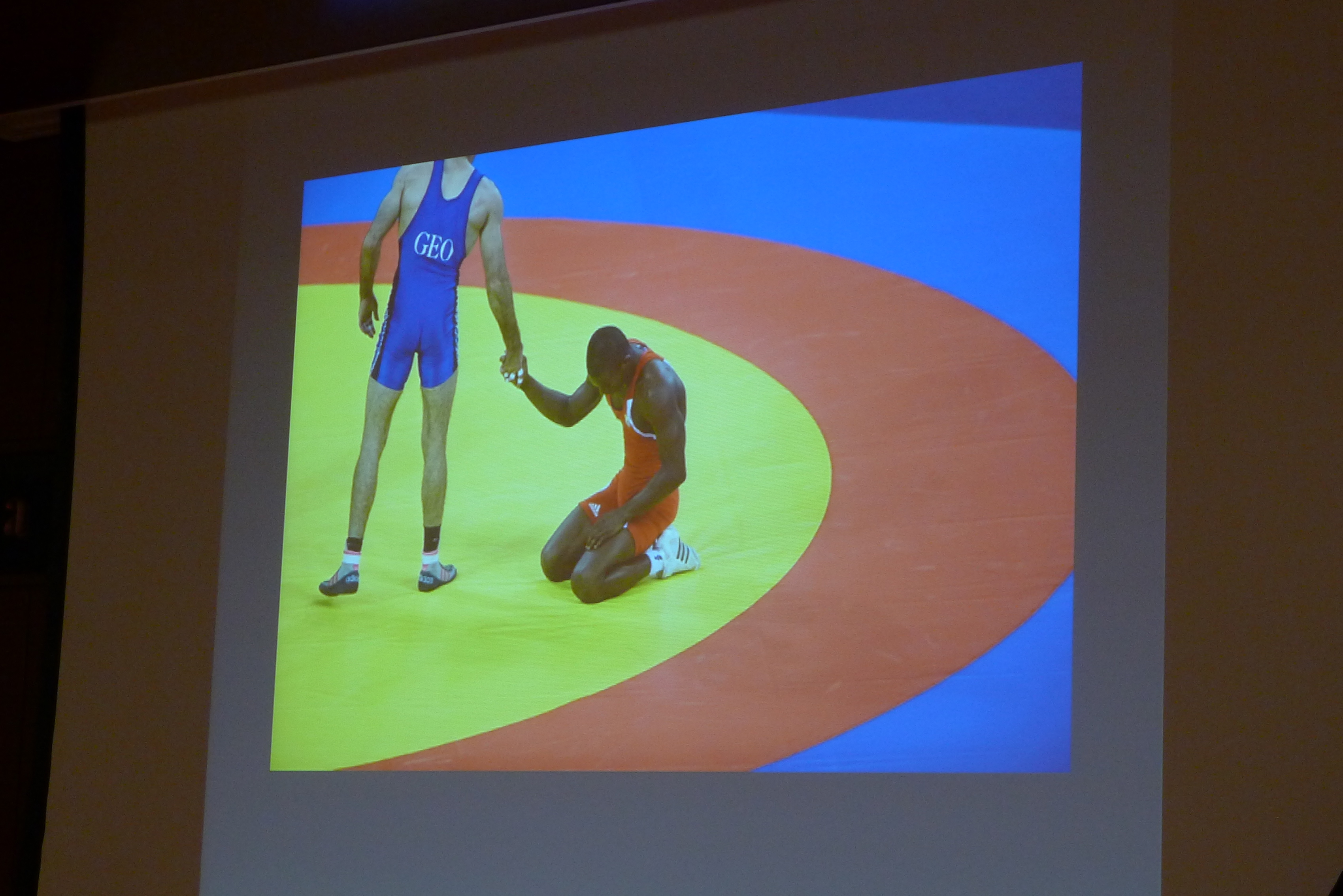
Eulitt picked a photo of a just-defeated wrestler at the 2008 Summer Olympic Games in Beijing. Eulitt said the photo’s great appeal to him was that it was “based in emotion.” The identity of the wrestler or what country he represented were essentially beside the point, Eulitt said; it was the crushing experience of defeat, as seen in the face and body attitude of the wrestler, that made it special.

In a brilliant touch — and Eulitt didn’t talk about this — he intentionally omitted the head of the victorious wrestler. The photo is exclusively about the vanquished.

P1050564

**

I want to finish on a digressive note: Under the energetic, inspired leadership of director Crosby Kemper III, who took over in 2004, the Kansas City Public Library has become one of the best in the nation. I can’t imagine how a library could be better.

Shooting Sports,” as tonight’s event was called, was another in a series of outstanding programs that we Kansas City area residents are privileged to have access to on a regular basis.

If you have not signed up for the library’s email list, I urge you to do so. You can subscribe on this page by clicking on the “get the latest library information” link at the bottom of the page, left side.

For the week of May 22, 1961, when I was a freshman in high school back in Louisville, KY, five killer rock ‘n roll 45-rpm records ruled the Billboard Hot 100.

The top five were, in order, “Mother-in-Law” by Ernie K-Doe; “Runaway” by Del Shannon; “Daddy’s Home” by Shep and the Limelights; “One Hundred Pounds of Clay” by Gene McDaniels; and “Travelin’ Man” by Ricky Nelson.

“Mother-in-Law” was a song I always liked, partly because it was easy to sing along to — especially those opening notes — and it was unique.

Although I would never have put “Mother-in-Law in my list of all-time favorites, last week I gained a new appreciation for it. What got me thinking about it — and singing it and listening to it on YouTube — was hearing that the writer of the song, Allen Toussaint, a New Orleans musician, died of a heart attack at age 77.

at

Allen Toussaint

I can’t say I’d paid much attention to Toussaint, although he was a New Orleans legend, but in his obit I read that he had written “Mother-in-Law” and another great oldie, “Working in the Coal Mine,” which peaked at No. 8 on the Billboard Hot 100 the week of July 23, 1966.

A story about Toussaint in today’s Kansas City Star got me thinking about “Mother-in-Law” even more. That’s because the writer of the story, Star music critic Timothy Finn, didn’t even mention “Mother-in-Law.” He touched on “Working in the Coal Mine,” but the bulk of his story was about Toussaint and his impact on the music industry.

That story sent me back to YouTube to listen to “Mother-in-Law” several more times, and I turned it up for Patty and Brooks to hear. When I went into the kitchen, Patty, a very good singer, was singing along and bobbing her head to the melody.

I wanted to know more about that song, so I dug into Google.

The Billboard Book of Number One Hits, by Fred Bronson, paid high tribute to the song, saying it “earned a place in rock history by spreading the gospel piano of the New Orleans sound, as championed by Toussaint.”

Of course, you can’t talk about “Mother-in-Law” without talking about Ernie K-Doe.

41DFBDNHXXLHe was born Ernest Kador Jr. and was raised in New Orleans by an aunt. Kador began singing in his church as a boy. He was first noticed by a talent scout when he was with a group called the Blue Diamonds. The scout signed him to one record label, but he bounced to another and then to a third, called Minit, where Toussaint worked.

The owner of the company was a man named Joe Banashak, who suggested that Ernie start going by the last name of K-Doe because “Kador” was too hard to pronounce.

Toussaint had already written “Mother-in-Law,” and K-Doe took a fancy to it because he was having marital problems and blamed them partly on his mother-in-law.

The song was an immediate hit. The Billboard Book of Number One Hits describes the crux of its appeal:

“The irresistible hook in the song is Benny Spellman’s deep bass voice intoning “mother-in-law” after K-Doe pauses at the appropriate places.”

The opening notes, of course, are what immediately come to mind and begin running through the head. Just the mention of the song makes me smile because, as The Billboard Book of Number One hits says, it is “the ultimate mother-in-law joke.”

K-Doe sings the song with a combination of angst and resignation:

She thinks her advice is a contribution
But if she will leave that will be a solution…

…As was the case with many “one-hit wonders,” K-Doe’s career reached its apex with his first big song. The Billboard Book of Number One hits says:

His final chart entry was ‘Popeye Joe’ in February 1962. He continued to record for Minit until it was sold to Liberty in 1965, and then signed with Duke Records. After three years, he returned to producer Toussaint, but without productive results. K-Doe died of liver failure at University Hospital in New Orleans on July 5, 2001. He was 65.

While K-Doe muddled along, Toussaint went on to become a legend. But Ernie K-Doe helped push him to legendary status, and I’m sure he appreciated that. Together, they gave us this incredible song, which is as fresh today as it was when it was released more than half a century ago and which people will continue to enjoy for years to come.

…The full lyrics:

The worst person I know, mother-in-law, mother-in-law
She worries me so, mother-in-law, mother-in-law
If she leaves us alone, we would have a happy home
Sent down from below
Mother-in-law, mother-in-law, mother-in-law, mother-in-law
Sin should be her name, mother-in-law, mother-in-law
To me, they’re about the same, mother-in-law, mother-in-law
Every time I open my mouth, she steps in, tries to put me out
How could she stoop so low?
Mother-in-law, mother-in-law, mother-in-law, mother-in-law
I come home with my pay, mother-in-law, mother-in-law
She asks me what I make, mother-in-law, mother-in-law
She thinks her advice is a contribution
But if she will leave that will be a solution
And don’t come back no more
Mother-in-law, mother-in-law…