Feeds:
Posts
Comments

After MU graduate student Jonathan Butler concluded his week-long hunger strike, my daughter Brooks posed an interesting question: What was his first meal when he resumed eating?

jonathanbutler-e1447363780152

Here’s a freeze frame from a video of MU grad student Jonathan Butler enjoying his first meal after concluding his week-long hunger strike…The people want to know: Just what did that meal consist of???

I combed The Star and the Internet and found, in a Los Angeles Times story, that his last meal before launching his strike was half a waffle. I came across video of Butler smiling and eating his first post-strike meal (above), but nowhere could I find exactly what the meal consisted of…Was it a banana? A steak? Spaghetti? I tell you, journalists these days just don’t have the curiosity they used to. Damn shame…I’ll be interested to see if any of our resourceful commenters can find the answer. I’d offer a free pizza from Minsky’s as a reward, but I’m afraid 100  people would come up with the answer.

:: There’s an interesting side story to the Gary Pinkel resignation that The Star didn’t write about in either of its stories today — although I suggested it in an email last night to Tod Palmer, who covers MU sports for The Star…In his resignation letter, Pinkel said he had non-Hodgkin lymphoma and wanted to spend his remaining years with his family and friends. He was diagnosed with cancer last spring. Many people might not know that he married a woman named Missy Martinette on June 27. (He and his first wife, Vicki, divorced several years ago after more than 35 years of marriage.) It would appear, then, that Pinkel’s second marriage took place right on the heels of the diagnosis…Not a huge deal, but if a big-name, local coach says he’s resigning to spend more time with his family, wouldn’t a journalist worth his or her salt think it was relevant to at least give a capsule of his family situation? Again, where’s the reportorial curiosity? Or is it just that my curiosity’s working overtime? Maybe, but don’t really think so.

102406fam

Pinkel and family in 2006: He and then-wife Vicki and their four children (first four from right in back row), their son-in-law (back left), and two grandchildren.

missy-pinkel-mizzou

…with new wife Missy Martinette, whom he married in Naples, FL, June 27

:: Finally, I trust some of you saw the story about 80-year-old mobster — or maybe former mobster — Vincent Asaro getting acquitted of participating in the 1978 Lufthansa robbery, which was believed to have been the largest cash robbery in U.S. history at the time. (The great mob movie “Goodfellas” was based on the crime.) Now, your average defendant, upon being acquitted of such a crime, might break into tears or collapse in his chair. Not Asaro. He pumped his right fist in the air three times, like he’d hit the winning homerun in a World Series game. Then, outside the courthouse in Brooklyn he raised his hands in the air and shouted, “Free!” Moments later, as he got into a white Mercedes, he took a jab at the prosecution, remarking to one of his lawyers, “Don’t let them see the body in the trunk.”

Now that’s being acquitted in style…

vincent

Vincent Asaro — happy with good reason.

Hugs. Tears. Breaking voices. Balloons sent skyward. And, of course, even after all these years…broken hearts.

Thirty-four years after 114 innocent souls died in the collapse of the Hyatt skywalks — during a late-afternoon tea dance — a stylized, polished-steel heart was dedicated to those who died and were injured in the July 17, 1981, disaster, the greatest in Kansas City history.

As was abundantly clear this morning, on a hillside across the street from what was the Hyatt Regency Kansas City hotel, the memorial is just as much for the living — those who lost relatives and friends and those of us who simply will never forget.

The memorial was nine years in the making. The ramrod — the chairman of the Skywalk Memorial Foundation — was Brent Wright, whose mother and stepfather died that fateful day. Along with others, Wright pushed relentlessly for the memorial and helped raise more than $500,000 to see it created and erected and to establish an endowment fund to maintain it.

The sculpture, called “Sending Love,” was designed by Kansas City artist Rita Blitt, who was among more than 200 people attending the dedication. The stylized heart, appearing poised to lift off into the sky, stands atop a matte black circular base that bears the engraved names of the 114 victims. (Note: In a story posted this afternoon, The Star’s Matt Campbell says the sculpture depicts a couple embraced in dance…Oh, well, the beauty of art is what you see in it and how it affects you, right?)

The memorial is at the north end of Hospital Hill on ground maintained by the Kansas City Parks and Recreation Department. A semi-circular stone and concrete bench offers visitors a place to sit, reflect and pay homage.

One of those who spoke most movingly at the dedication program was Frank Freeman, whose domestic partner Roger Grigsby died in the collapse. Freeman was seriously injured.

Voice cracking, Freeman said, in part:

“I’m overcome with joy and pride…This is a moment (when the skywalks collapsed) that wrenched loved ones from our arms but nor our hearts…The wounds remain. It is never gone.”

Of all the speakers, Freeman was the only one to allude to the cause of the disaster, mentioning the “careless, inexcusable design” of the skywalk support system.

…In a design change, engineers decided to use offsetting support rods instead of a single set to suspend the skywalks from the hotel ceiling. The change doubled the stress on the rods supporting the upper skywalk, on which people were standing and swaying to the band music…It was the first time most Kansas City area residents heard the term harmonic vibration.

The Hyatt name remained on the hotel until 2011, when it became a Sheraton property.

I have closely followed — and contributed to — the memorial effort, and this is a great day in Kansas City, commemorating the worst tragedy in our city’s history.

Here are some photos:

P1050503

The memorial site offers an excellent view of the skyline.

P1050519

P1050518

Part of the crowd.

P1050527

Rita Blitt, who designed the sculpture. Behind her, seated, are Mayor Sly James and former Mayor Richard Berkley, who was in office in 1981.

P1050538

A family member of a victim had to pause as she read the names of some who died.

P1050541

From left, Frank Freeman, Brent Wright (chairman of the memorial foundation) and Peggy Olson. Freeman lost his domestic partner; Wright his mother and stepfather; Olson her sister, who was 11 years old.

P1050542

A fitting send-up.


P1050543

Retired Kansas City Fire Chief Charley Fisher (right), who quickly went to the scene of the tragedy, hugged Brent Wright.

P1050552

The names of everyone who died are engraved on the base.

P1050501

Last dance, indeed…

P1050553

The building that lives in infamy.


Of all the madness that has been taking place at the University of Missouri-Columbia campus the last week or so, here’s what puzzled me most:

What the hell was an assistant professor of communications doing trying to block a couple of journalists from getting access to a group of student protesters? 

Although you haven’t seen them in The Star, widely disseminated photographs show Melissa Click, the professor, trying to stop a student photographer, Tim Tai, from photographing the protesters on Monday.

First of all, why would Click involve herself in a student protest? It appeared as if the students were doing OK for themselves, having brought down the president of the university system and the Columbia chancellor.

But there she was Monday (below), wearing an angry frown and calling for “muscle” to help remove another young man who was recording the confrontation between herself and Tai.

melissa click

This from a communications professor with a Ph.D., who apparently didn’t understand the First Amendment’s protection of freedom of speech and assembly on public ground.

Here’s part of the exchange between Click and cameraman Mark Schierbecker:

Schierbecker: I’m media. Can I talk to you?
Click: No, you need to get out! You need to get out!
Schierbecker: No I don’t.
Click: You need to get out.
Schierbecker: I actually don’t.

tai

Student photographer Tim Tai

Tai, who is only 20, and Schierbecker handled themselves respectfully and professionally, asserting their right to stand their ground and resisting any urge to angrily engage Click. Even at my age and with my background, I’m not sure I could have been that restrained.

Tai said later:”I wish she had handled the situation differently, but as a journalist it really just became part of the scene I was presented with and I never took her or anyone else’s actions personally.”

…Click’s background and areas of professional focus are, shall we say, a bit out of the mainstream. Perhaps that helps explain how she wandered off the beaten path Monday.

Her bio, on the university’s website, cites her research interests as “popular culture texts and audiences” and says her work “is guided by audience studies, theories of gender and sexuality, and media literacy.”

The website goes on to say that her current research projects include “the impact of social media in fans’ relationship with Lady Gaga, masculinity and male fans, messages about class and food in reality television programming, and messages about work in children’s television programs.”

Her doctoral dissertation was about the “commodification of femininity, affluence and whiteness in the Martha Stewart phenomenon.”

Her bio prompted Maureen Sullivan, a contributing writer at Forbes, to write an article titled “Why do Parents Hate Paying College Tuition? Meet Missouri Professor Melissa Click,” in which Sullivan said Click “crystallizes the view that tuition dollars are spent on nonsense, and sometimes worse.”

Click has been affiliated with MU since 2003, and she became an assistant professor in 2008.

MU officials have given no indication of how Click’s antics might affect her employment status, but her department issued a statement rebuking her actions.

The University of Missouri Department of Communication supports the First Amendment as a fundamental right and guiding principle underlying all that we do as an academic community. We applaud student journalists who were working in a very trying atmosphere to report a significant story. Intimidation is never an acceptable form of communication.

To her credit, Click issued an unequivocal apology, which Tai accepted.

…I do not know if Click has tenure, and, in any event, I would be surprised if she was fired. But I would think her chances of becoming a full professor have been greatly reduced.

All in all, she would have been a lot better off spending Monday doing more research on Lady Gaga instead of trying to emulate a Kansas City Chiefs lineman.

The last two presidents of the University of Missouri system have lasted a total of less than seven years.

Each had previously worked in upper management in the insular world of big business. Neither had experience in academia.

forsee

Gary Forsee

Gary Forsee, former C.E.O. at Sprint — the man who engineered the disastrous merger of Sprint and Nextel — served from February 2008 to January 2011. Although his relatively brief tenure at MU was not marred by any significant scandals, he certainly didn’t leave much of a legacy.


Tim Wolfe, who resigned as president Monday morning, succeeded Forsee in February 2012. (An interim president served slightly less than a year.) Wolfe had previously worked in upper management for IBM and the software firm Novell.

If ever there was a time for a change of approach in the hiring of the top person at MU, it is now.

It’s imperative, in my view, that the MU board of curators hire someone with administrative experience at a higher educational institution…someone who understands the warp and the weft of campus life and who enjoys mingling with students and talking with them about their college experiences.

Forsee and Wolfe were out of their depths and lacked the ability to communicate effectively with people at every level of the four campuses they oversaw.

In my experience the best leaders are those who are a good fit for their positions and effective communicators.

As most of you know, I was a reporter and editor at The Star for 36-plus years. The best editor I ever had, Mike Waller, who went on to become publisher at the Hartford Courant and The Sun in Baltimore, endeared himself to the rank and file partly by roaming around the newsroom, chatting with reporters, assignment editors, photographers and copy editors. More than once, he stooped down and read the top part of stories I was writing and offered comments or suggestions.

Since retiring from The Star in 2008, I’ve been a substitute teacher at middle schools and high schools in the Shawnee Mission School District. I have seen first hand that the best principals are those who are outside greeting the students in the morning and seeing them off in the afternoon.

In general, I think it’s fair to say, leaders who secrete themselves in their offices tend to lose the confidence of those who rely on them for inspiration and leadership.

I don’t know for sure that Tim Wolfe secreted himself in his office, but I know of two telling incidents where lack of communication got him big trouble.

wolfe

Tim Wolfe

The first incident occurred in 2012, according to Wikipedia, when Wolfe announced that the University of Missouri Press — the university’s main publishing arm — would shut down and be replaced by a new publishing operation. This from Wikipedia:


Wolfe said he did not know how much the new model would cost and that he had not spoken to any employees at the press before making his decision. In October 2012, it was announced that the University of Missouri Press would not close after all. Wolfe said that he always intended to increase the cost-effectiveness of the press and that it was never the plan to close the press. He said that he should have spoken to more press employees, authors, and other publishers earlier in the decision-making process.

And then there was the incident on Oct. 10, during MU’s homecoming parade, when several black students shouted chants, demanding to have marginalized voices heard.

If Wolfe had an ounce of common sense — and if he was the sort of leader who could communicate effectively — he would have gotten out of his car and talked to the students. “What’s up?” would have been a good way to start a conversation.

Instead he remained ensconced in his steel cocoon. Was he afraid the students were going to beat him up? Was he in a hurry to meet the homecoming king and queen? Whatever the case, he waited for Columbia police to shoo the students from the parade route and continued on his way.

By no means was that the only chance Wolfe and Columbia campus chancellor R. Bowen Loftin (who also is on the way out) failed to respond to complaints and protests from black students — and other minority students — who had been subjected to a succession of slights and offenses. Other incidents included a truck-load of dim wits shouting racial slurs at an African-American student who is president of the MU Students Association and one or more students using human feces to draw a swastika in the bathroom of a student residence hall.

There’s no guarantee, of course, that an MU president with a background in academic administration will be successful. But it’s certainly time for the board of curators to stop trolling the ranks of former and current business executives and set about finding someone with a track record of effective communication and leadership at either MU or another higher-education institution.

For the last couple of days, the MU situation has been one of the biggest stories in the nation. (The story was on the front page of The New York Times website Monday night and had drawn more than 1,345 comments.)

…The next MU president’s biggest job will be fostering an environment of accommodation, open-mindedness and goodwill toward all. It’s a hell of an opportunity for someone with really good “people skills.” Let’s hope the board of curators understands that.

Patty and I got back to KC last night after a week on the road — a monumental week here in KC, which we kept up with on TV and kansascity.com.

A lot of times when you leave town, you don’t miss much. Then, every 30 years or so, there are weeks like this one, where…

:: The Royals win the World Series

:: A downtown parade attracts 800,000 people. (Estimate courtesy of Mayor Sly James, who apparently has a master’s in Hyperbolic Numerical Studies.)

:: Alex Gordon opts for free agency.

:: The first streetcar arrives.

:: Southwest High School is slated for closing.

:: The state of Kansas continues to loses hundreds of millions in revenue and, by the day, becomes less livable.

…I guess you’re wondering just what could have taken us out of town during a week like this. Well, it was mostly business — Patty’s business. She has a company that designs and manufactures clergy vestments, primarily for women, and she was displaying and selling her products in my hometown of Louisville, KY, and Sewanee, TN. I was along mostly to help load and unload; set up and tear down; and drive.

Here are some of the highlights — just in case you’re wondering how a couple of absentee Royals’ fans spent their days while Kansas City was going crazy.

** We arrived in Louisville last Saturday night and immediately went to a bar-restaurant called the Mellow Mushroom to watch Game 4, which we had been listening to on the radio. The game was in the sixth inning, and although this was the World Series, not one TV in the bar was tuned in to the game. Every TV was on the Kentucky-Tennessee football game — which I could sort of understand, except that Tennessee was winning by more than 20 points…Kindly, the manager granted our request to turn one TV to the baseball game. By the time the game ended, we were about the last people in the bar and were yelling our fool heads off.

** For Game 5, Sunday, we went to a bar called Molly Malone’s. Again, not one TV was tuned in to the World Series. Every TV was on the Sunday night football game between the Denver Broncos and the Green Bay Packers…Now I was convinced that my hometown was no longer the town where I had grown up — the town where lots of people, including me, avidly followed the Cincinnati Reds, who play about 100 miles up I-71. Once again, though, a bartender accommodated us and switched a TV to the only game that really mattered. Seated at the bar, we screamed and shouted as Eric Hosmer “stole home” with the tying run and the Royals went on to blow the ham-handed Mets out of the series…Patty celebrated with a couple of shots of whiskey; I had two N/A beers.

** On Tuesday, we heard from our daughter Brooks, who had braved the crowd of about a million people (hey, Sly could have been a couple hundred thousand off, right?) and had her photo taken with none other than Most Valuable Broadcaster Rex Hudler.

IMG_00231

Brooks and Rex

** Tuesday night we left Louisville, where Patty had been selling at Louisville Presbyterian Theological Seminary, and headed to Sewanee, TN, an hour and a half southeast of Nashville. Patty’s objective was the School of Theology at Sewanee:The University of the South. The university, founded in 1858, sits atop the Cumberland Plateau, which is basically the southern part of the Appalachian Mountains. While Patty worked, I played golf Wednesday and Thursday. I lost about half a dozen balls the first day and came close to hitting one off the Cumberland Plateau. Fortunately it stopped in some heavy grass behind the green. (At least I think that’s where it ended up; I never found it.)

** Thursday night we headed west and stopped in Nashville. Boy, was I excited! The last time I was in Nashville, about a year and a half ago, I had a great time hanging out on Honky Tonk Row, the strip of bars on Broadway between Fourth and Fifth streets. Back then, I latched on to a couple of musicians — a lead guitarist and a bass player — who moved around from one bar to another and one band to another. Those two guys could play just about any song anyone requested. Their forte was classic country by artists like George Strait, Alabama and Brooks and Dunn…This time, I was hoping to find those guys again and, if not, at least hear some similar music.

Nashville is a high-energy tourist town, and several thousand people clogged that one-block stretch Thursday night. I arrived on the scene at 10 p.m. (Patty had gone back to the hotel after dinner) — just as the early-session bands were wrapping up and the late-session groups were about to take over. During the changeover, I meandered from bar to bar, checking out the groups that were setting up and hoping at least one group would offer classic country music. After the bands struck up the music, however, it was pretty clear that rock and country-rock were the only genres being offered. By about 11:15, I was on my way back to the hotel.

Picture1107150855_1

Thursday night on Honky Tonk Row in Nashville

I was disappointed, but I’ve been around long enough and seen enough to know “you can’t always get what you want” and even though you might not like it, things change.

…The disappointment was short-lived, however, because yesterday morning we headed home. Back to Kansas City…Kansas City, home of the World Champion Kansas City Royals.

Even experiencing it vicariously, it was a hell of a week.

Okay, get the children out of the room because I’m now going to deliver what my daughter Brooks has dubbed my “stodgy old-man rant.”

Of course, she’s wrong about the first two parts — that I’m stodgy and old — but I will accept the rant part.

I just can’t hold back any longer. As far as I’m concerned, the Smartphone and the iPhone — which are less phone than constant communication devices — are, to some degree, ruining social interaction as we have known in since the advent of civilized society.

My benchmark for this judgment is my parents. They were two of the smartest and most gracious and refined people I have ever known. My father had a CPA and master’s degree and was a college professor most of his career. My mother had a master’s in English Literature and also taught at the college level. My father was a brilliant conversationalist and story teller, and my mother always got in her share of conversation and made each person around her feel like they had her undivided attention — which they did.

So, I can tell you unequivocally that the presence of a dinging, beeping, buzzing or ringing electronic device in social company would have absolutely horrified both of them. I’m pretty sure that if they were alive today and had people over who had their phones out — referring to them every few seconds or minutes for “important” updates from the outside world — those people would never have been invited back.

God bless them. I tell you, it makes me proud to be able to say that about them and know exactly what their reaction would have been.

On his deathbed — he died eight years ago — my father didn’t say, “JimmyC, promise me you’ll never pull out your cell phone when in the company of others,” but I did scare the crap out of him more than once when I was highway driving, talking on the phone and holding the steering wheel with one hand.

I don’t do that any more. I seldom talk on the phone while driving, and when I do, I use the Sync system — when it works.

Much worse than talking while driving, to me, is being with people in their (or your) home or at a restaurant and one or more of them have their phones out, either on the table or in their hands — fielding texts, emails and sometimes calls.

To me, that is virtually the same as looking over the shoulder of someone you’re talking to at a party and checking out the crowd.

As daughter Brooks so aptly put it (and by the way, even though she knows a rant when she sees one, she totally agrees with me), with the “phone-out” culture, “it’s become socially acceptable to be rude.”

Amen, Brooks, amen.

…The difficult part about this is that I have some very good friends who do exactly what I have described. My best friend, who lives in our hometown of Louisville, has become a slave to his phone. He’s a busy realtor, which is one reason for his dependency, but still, even in the evenings, he frequently lets himself be sucked into the “I-must-be-missing-something-more-important-elsewhere” syndrome and yields to the temptation to absorb himself in the phone.

Also, Patty does it to some extent. My wife! What’s a guy to do? Am I going to dump my best friend and my wife? Of course not. I’m stuck with these people…Scratch that; it’s off the record…What I mean is I’m going to be true to the friends I’ve already got and just grit my teeth and suffer the indignity. But as for any fledgling, prospective friends who find their phones more interesting than me — well, they’re not going to be good-chum candidates. They will find themselves on permanent hold.

Now, I guess you’re wondering how “Mr. Manners” of the local blogosphere handles the phone dilemma.

Well, I (that’s who I was referring to, in case you were confused) have a flip phone, and all I do is text occasionally and make and receive calls.

I keep the phone on vibrate 95 percent of the time. (That can cause problems, of course, because recently I lost the phone in the house for 24 hours and couldn’t find it partly because it didn’t ring when I called it with Patty’s phone.)

If I feel the phone vibrate when I’m actively engaged with others, I don’t pull it out and check to see whose calling or texting. I wait until there’s a break and I go to the restroom or another room away from the gathering and check there. If it’s important, I will make a quick call or send a text. As we all know, however, 95 percent of the time, it’s shit that can wait — usually a long time.

I’m not suggesting that we turn back the hands of time and go back to flip phones. What I am suggesting is that the dipsticks out there who can’t muster the willpower to resist the seductive siren of their cellphones wise up and develop some good cellphone manners.

Brooks said it’s become socially acceptable to be rude. No, I won’t accept that. It’s never acceptable to be rude. If you’re guilty, knock it off.

…I’m done spewing.

When Rex Hudler first came to Kansas City as TV color commentator for the Royals in 2012, I couldn’t stand him.

Over the top. Mangled the King’s English. Came across like a jackhammer.

As time went by, however — and I think I speak for many others — I came to like him.

And now I love him.

His enthusiasm is infectious and irresistible. His belief in last year’s Royals and this year’s Royals is impenetrable. Instead of grating, his garbled grammar has become part of his appeal. Plus, of course, being a former major league infielder, he knows the game and consistently makes the game more enjoyable for the listeners by pointing out nuances most of us would otherwise miss.

With Fox Sports taking control of the series on the TV front, Rex and his announcing partner Ryan Lefebvre have been cut out of in-game duties.

Fortunately, however, he and his post-game partner Joel Goldberg are still holding forth on the FSKC Boulevard Royals Live show from Lot A outside Kauffman Stadium.

…Mercifully, compared to Tuesday’s 14-inning marathon, last night’s game went the conventional nine innings and took slightly less than three hours. So, it was no trouble staying up to watch the post game show…And, I’ll tell you, it was one for the ages.

Rex was at his intense, superlative-laced best. Wearing a winter, waist-length coat and gripping (as always) a baseball in his left hand, he gushed like a waterfall, praising the Royals’ brilliance in the game they had just won 7-1 and needling the New York Mets for the torment they had just experienced and the torment that Rex saw on the horizon.

joel and rex

Joel Goldberg (left) and Rex Hudler

…Relatively early in the broadcast, Rex talks about the way the Royals manhandled Mets’ starting pitcher Jacob deGrom — he of the wild, curly hair that springs from under his cap like an electrified bird’s nest. He says…

“I love tonight, the way they were squaring de Grom up…They were all up the middle, Joel, and I loved it. You’re hitting the ball when you know you’re going right back up the middle…That’s where the money is. Believe it!”

At that point, the viewers are seeing a replay of a Royals runner crossing home plate, with de Grom backing up the catcher. Transitioning to retrospective commentary, Rex shouts at de Grom…

“Go ahead and back up home…and, by the way, get a haircut!”

A few minutes later, when Joel is talking about Royals’ winning pitcher Johnny Cueto — he of the peroxide-tinted dreadlocks — Joel points out that Rex has not called for Johnny to get a haircut. Rex splutters…

“Oh, no. No, no, no! He’s got to keep those locks on; it really looks good.”

Another reference to personal grooming touches off a second Rex run of the mouth.

When a photo flashes on the screen of former Royals center fielder Willie Wilson, Joel points out that in the photo Willie has a mustache. Rex says…

“You know what? That looks really good on him. I couldn’t get away with it, but he can. Willie Wilson’s a b-a-a-a-a-a-d man!”

Rex then leapfrogs to a key point about the Royals, saying…

“But I’m gonna tell you what. It don’t matter…Hair or no hair, these guys are talented; they’ve got experience now, Joel. And look, when you put those two together…”

In mid-sentence, Rex pauses and starts looking around, back and forth, toward the clutch of cheering fans gathered behind the stage where Rex and Joel are seated.

Then Rex finishes his thought —

“…hopefully a World Series title. It’s going to be a beautiful thing!”

Ever the perfect straight man, Joel says, “What are you looking at?” And Rex, almost elevating from his chair, turns directly toward the fans and says…

“I can’t help it! I’m looking around for the people. Come on, people, let’s go!”

A few quick, vigorous pumps of the right fist polish off the exhortation.

Joel then calmly turns to the camera and says: “There’s our segue, whether it works or not, into the next topic.”

Which is the pitching match-up for Game 3, Friday in New York, between Yordano Ventura and Noah Syndergaard.

Laying the groundwork for another oratorical flourish from his partner, Joel notes that each pitcher has an interesting nickname: Ventura is known as “Ace” and Syndergaard as “Thor” — after the hammer-wielding god in Norse mythology.

“So, it will be Ace versus Thor,” Joel states in a foreboding tone.

Rex drops his jaw and his eyes pop open in a feigned look of fear, but he quickly recovers and says…

“The Royals continue to hit like they’re hitting that hard fastball that Thor throws, they could…show Thorthe door!

Just before sign-off, Rex contributes a final, steely-eyed assessment…

“Believe it. It’s going to be happening right there in the Big Apple! It’s gonna be fun! He’s (Thor) a good pitcher, but so are the other two we’ve faced!”

…Good night, Rex. Thanks for being you. See you Friday from the Big Apple.

The disturbing incident at Spring Valley High School in Columbia, SC, where a school resource officer — a deputy sheriff — wrenched an uncooperative student from her desk Monday and dragged her out of the classroom struck a chord with me.

In nine years as a substitute teacher since retiring from The Star in 2006, I have experience dealing with students who are difficult to “redirect,” as we say in the teaching business. For those unfamiliar with the term in the school setting, redirecting is simply calling a student’s attention to inappropriate behavior or conduct and getting him or her back on board the lesson or activity at hand.

But let’s back up to the Spring Valley incident. Video showed Sheriff’s Deputy Ben Fields dealing with a 16-year-old girl who had refused to stand and leave her math class, after her teacher reportedly caught her using her phone.

After an administrator and Deputy Fields arrived, both asked the girl to leave several times and requested that she cooperate. She remained quietly in her desk as they continued to ask her to leave and then, apparently with no warning, Deputy Fields grabbed the girl, flipped her desk over and dragged her to the front of the classroom, where he cuffed her hands behind her. One student said he saw the deputy put his knee on her as he tried to arrest her.

One of the oddities of the video is that only two other students can be seen clearly, and both appear absorbed in their work at the outset of the incident and then appear only slightly distracted from their work as the officer extracts the girl from her desk and drags her away. After the deputy has the girl on the floor in the front of the classroom, he says, “Gimme your hands; gimme your hands.”

Before you read any farther, I urge you to view the video, which is linked in this NYT story.

By any measure, the video is shocking, and it’s clear that Deputy Fields badly overreacted.

So much so that Sheriff Leon Lott, his supervisor, has washed his hands of him — suspending him and saying he will never return to school duty anywhere. Deputy Fields could also be in deep legal trouble. The Columbia office of the FBI and the U.S. Attorney’s Office for the District of South Carolina have opened a civil rights investigation into the incident.

FBI Special Agent in Charge David Thomas said in a statement Tuesday, “The FBI will collect all available facts and evidence in order to determine whether a federal law was violated.”

At the very least, the girl’s family will almost certainly file a civil suit against Deputy Fields, and my guess is the family will win a significant monetary judgment.

Some of more than 1,000 people who already have commented on today’s New York Times story on the Spring Valley incident have defended the officer’s response. One person said that once the girl refused to leave the classroom, she was, in effect, trespassing and that Deputy Fields was justified in resorting to violence to uproot her.

That’s utter balderdash, of course. We’re talking about a public school, a public school the student had been going to every day.

Certainly, though, something had to be done. Administrators couldn’t just shrug their shoulders and say, “Never mind” and let the girl continue using her phone in violation of school rules — or let her stay in the classroom indefinitely after she refused to leave.

For sure, in my experience, similar situations can be very, very challenging.

A couple of times, I have had to call a school office and summon administrators to collect a student who refused to be redirected and then refused to leave the room. Fortunately, in those instances, the students got up and left when administrators arrived.

My worst handling of an incident occurred in my early substitute days. It was at William Chrisman High School in Independence. I let a girl in an English class get under my skin because she was fiddling with a case of some sort and she was very slow in responding to my directive to put the case away.

(I should note here that the girl wasn’t really disrupting the other students, she was just being inattentive. I learned from that incident, and similar ones, that the best thing to do when a student is “off task” but not bothering anyone else is simply ignore them. It’s just not worth the time and emotional energy to make a big deal out of it.)

Where I made my biggest mistake was after approaching the girl’s desk, I placed my index finger on her knee and said, “Put the case away!” With that, she jumped up, started screaming, “He touched me! He touched me!” and ran out of the classroom and down the hall to the office.

Immediately I realized I had screwed up royally. I didn’t hear anything for a few days, but then a school administrator summoned me to the school for an interview. Her immediate intent was to determine if I had been guilty of sexual harassment. Fortunately, she quickly determined that was not the case, that it was just a terribly misguided attempt at redirection.

The official told me to never touch a student below the shoulders and to never touch a student at all in a “redirecting” situation. The official also banned me — for my own good and that of the student — from substituting at Chrisman in the future.

It was a tremendous lesson for me in dealing with difficult classroom situations. As you might imagine, I’ve never touched a student in a redirecting situation since then and never will.

…Now, back to the Spring Valley case. Like I said, something had to be done because the girl was not only disobeying school rules but flouting authority.

Had I been the administrator, the first thing I would have done was to take charge of the situation and not defer to the officer. The officer should be secondary to the administrator, unless a fight is in progress or a student is attacking a teacher or administrator.

After telling the officer to give me the opportunity to handle it, I would have carefully considered the options. As in my situation with the girl at Chrisman, there was no compelling reason to rush to a showdown.

To me, the main options would have been:

:: Turning the German-Shepherd sheriff’s deputy loose on the girl.

:: Allowing the girl to stay where she was and immediately call a parent and have the parent talk to the student on the phone or ask the parent to come to the school. (I realize that might not have been possible on short notice, but it still should have been considered before resorting to mayhem.)

:: Waiting until the bell rang for the end of the period. At that point, the girl probably would have gotten up as other students entered the room and took their seats for the next class. Staying put would have put her in a very awkward position.

:: Asking the other students to leave the room and stand in the hallway or take them to an empty classroom. That would have isolated the recalcitrant student and probably prompted her to end her sit-in.

The point is the administrator had a number of viable options and the girl had very few. She had leverage at the moment, but her standoff would soon come to a natural end as the school routine unfolded.

Where the administrator and Deputy Fields erred badly — as I did at Chrisman — was immediately submitting to a power struggle with the girl: Who’s gonna win? You gonna win? Oh, no. We’re gonna win. Just watch and see!

Now the deputy has cost himself his job, and the administrator has demonstrated he or she was incapable of calmly and professionally defusing what was, initially, just a knotty situation.

Once your team is in the World Series, it’s never too early to start thinking about a World Series victory parade.

And, from Kansas City’s 1985 experience, the only time the Royals won the World Series, I hope the people who are put in charge of the parade will do some serious brainstorming.

I was one of several reporters who covered the 1985 victory parade, which went up Grand Avenue from the River Market (then theRiver Quay) and ended at the Liberty Memorial, where various officials and players spoke to the huge throng that packed the Liberty Memorial Mall.

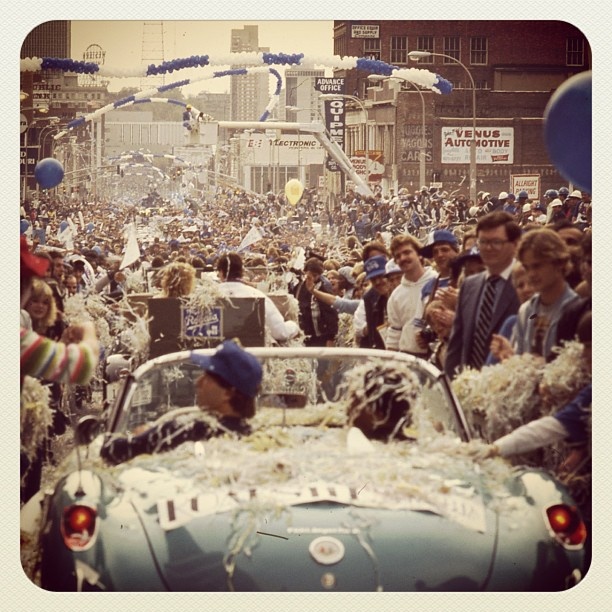
I guess it’s too strong to say the parade itself was a disaster, but it was pretty close. In summary, classic cars, overheated catalytic converters and shredded newspaper combined to form a combustible concoction that forced several parade participants, including then-Manager Dick Howser and his wife Nancy to bail from their cars and proceed either on foot or in other vehicles.

ticker tape

The parade proceeded south on Grand.

…When you think of a downtown victory parade, the first thing that comes to mind is confetti, right? Well, there was no confetti at this parade; it was all shredded paper — shredded paper that quickly balled up. And, unfortunately, that paper became both a weapon and a fire accelerant.

The first thing I noticed as I stood near The Star building at 18th and Grand was that some people were taking chunks of balled-up paper and hurling them at the occupants of the cars. Instead of light, fluttery confetti wafting down on the players and their cars, our World Series heroes were being pelted with meteor-like objects with tails. Plus, there were no barriers lining the streets; as best I recall, people pressed right up to the line of cars. The street was a mass of humanity, cars and globs of heavy paper.

That part alone was unsettling to me. But then it got much worse. As the paper piled up on the street, the slow-moving cars began passing over the paper, and in the case of about five cars, the heat from the catalytic converters (emissions-controlling devices) ignited the paper.

I mostly saw smoke, but I’m pretty sure some cars were in flames. As you might expect, the occupants of those cars simply bailed.

I distinctly remember seeing the car in which the Howsers had been riding. The back seat was empty, except for one ladies high-heeled shoe. I didn’t see Nancy after that, and I don’t know what she did, but I imagine she took the other shoe off and proceeded barefoot.

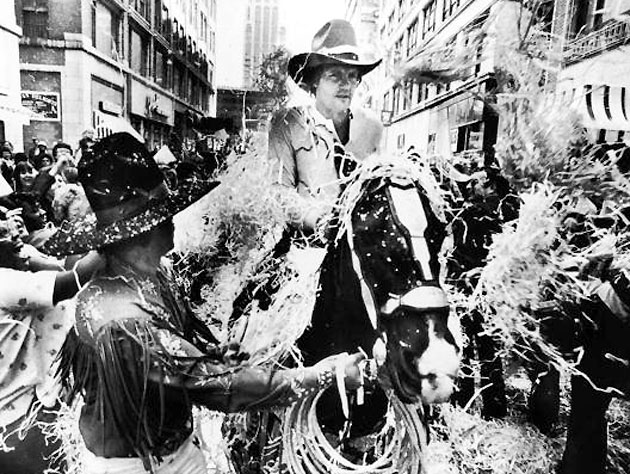
I have read that the car in which Royals’ third baseman George Brett was riding was one of those that caught fire, and there’s a photo of Brett riding a horse and wearing a cowboy hat. Whether the horse ride was planned or spontaneous, I’m sure George was glad he was able to get up and away from the worst of the newspaper onslaught.

bretthorse

“Cowboy” George Brett

Some of the drivers abandoned the cars, which resulted in the parade being re-routed around Crown Center. Thousands of people lining Grand in that vicinity didn’t see the parade as they had planned. I don’t know exactly how the parade was re-routed, but it must have jogged west on one of the numbered streets and then gone up the Main Street hill.

I just remember being glad to finally arrive at the Liberty Memorial, knowing that the players, their families and team officials were out of harm’s way. I was never so glad to see a parade end.

So, if any potential parade planners are reading this, please, do whatever you have to do to get real, sliced and diced confetti. If necessary, import it from New York. Spare no cost.

So where were we on the subject of The Star’s price schedule for the print edition?

Oh, that’s right, it’s all over the place.

As you might recall from an informal survey I conducted last week, retail prices ranged from about $16 a month — for a 26-week introductory offer — to about $35 a month, among people I contacted.

In addition, two retired Star employees — architecture critic Donald Hoffmann and society editor Laura Hockaday — said they were getting retiree discounts that put them at $14.83 per month, or roughly half of what most retail customers appear to be paying.

S0mewhere along the line I let the retiree discount slip between the cracks and have been paying a whopping $34.51 per month, having it charged to my MasterCard. (By contrast, I pay $36.66 for a 7-day-a-week subscription to The New York Times, although I get a 50-percent-off, teacher’s rate.)

Several people complained, either in private emails or in the comments section, about the poor state of The Star’s circulation customer service. The complaints ran in polar directions — either how hard it was to get through to circulation or how people were getting dunned by solicitation calls.

Against that murky backdrop, I plunged into action, determined to break through any walls of resistance and get the retiree discount.

Here’s how my crusade unfolded:

Call #1: Circulation, care of “my account.” After a hold time of slightly more than 15 minutes, a helpful-sounding fellow named Vin picked up. In the Phillipines. Confirmed my current rate but, after consulting someone else, said he couldn’t change the rate, that I’d have to call “account billing” in Kansas City. Well, that was a good start: I was on the precipice of getting through to a person at The Star, in Kansas City.

Call #2: The number Vin gave me. But, a recorded message from Phyllis said that number was no longer working and directed me to one of two other numbers, one of which was Phyllis’ new number.

Calls #3 and #4: Got recorded messages from Phyllis, as well as from the person at the other number, assuring me I’d get a return call.

Calls #5 and #6 (24 hours later): Left messages on the same voice mails.

…Within two hours of placing those calls, I was on my way to The Star, the venerable building at 18th and Grand that was the center of gravity for my 36-plus years at The Star.

I didn’t expect to get very far into the building, and I didn’t. Made it as far as the foyer, where a mild-looking, elderly security guard slid the glass open and said, “Hi, may I help you!” — or at least some version of that.

The guard dialed up Phyllis and left a message on her voice mail. He dialed another number and left a message. He dialed a third number and got through. Pretty soon, he extended the phone through the window, saying “Here’s Phyllis.”

Gotta tell you, I almost jumped for joy.

Phyllis was very receptive, listening as I laid out my case and my bona fides as a fully accredited, sheet-cake and pizza-party retiree (class of 2006).

Then she said The Star had recently installed a new computer system and that she herself was not able to go into the system and change my rate. But…but, she knew who could! A woman named Bev who works in Phyllis’ vicinity!

(Editor’s note: In my Oct. 12 post, I quoted a longtime Star carrier who said, “The new system hasn’t worked from Day One.”)

Phyllis said she would talk to Bev and call me back right away. After I gave her my number, the sliding of the glass window officially ended my first visit to The Star in years.

Fortunately, Phyllis was under the impression that I was waiting at the guard station, and she called me back in less than 10 minutes.

The news was not entirely negative and not entirely positive…Bev also couldn’t get into the “new system” and make the fix. Phyllis assured me, however, that she, Phyllis, would make it happen. She would go “across the street” — presumably the green-glassed printing plant across McGee Street — and talk to the technical people in charge of the computer system.

“I’m going to get it done, and I’ll call you to let you know when the new rate is entered,” she said.

Before saying goodbye, I profusely thanked Phyllis for “taking an interest in my case.” I don’t mind saying I gushed because, at that point, the price that I would pay for my paper lay completely, utterly and unequivocally in this fine woman’s hands.

…That was Tuesday. Today came and went without a call from Phyllis — who, I’m sure, is beautiful and has never sinned. Nevertheless, I was not sitting and stewing. Far from it. I laid the groundwork for a bold flanking attack. I called a buddy who is now in ad sales but previously worked in circulation for many years.

Rob said, “I know right where her office is” and assured me he would intercede for me whenever I bugled “Charge!”

So now it’s Wednesday night. Can hardly wait for tomorrow. As Ernest Hemingway once said (by the way, he once worked briefly at The Star briefly):

“I like getting up in the morning not knowing what’s going to happen but knowing something’s going to happen.”

Something good, I trust, something good.