Feeds:
Posts
Comments

We’ve been home since Saturday night, and, while it was nice to be in the Florida sun, it’s great to be back in Missouri.

Great to be back in Kansas City, too, even though the hometown paper keeps sagging, sagging, sagging.

One predictable facet of The Star, however, is Chief Star Meteorologist Robert Cronkleton’s almost continuous updates on the weather. This morning he was reporting “numerous accidents.” This afternoon he was warning of “a prolonged (snow) event, stretching over 24 to perhaps even 30 hours.”

…I was joking when I called Cronkleton the paper’s chief meteorologist. Actually, he’s one of only two or maybe three general assignment reporters they have. His byline appears on a majority of all breaking-news stories.

Checking his bylines in the “search” box for Tuesday, Wednesday and today, I found five weather stories, three crime stories and one story about the Big 12 basketball tournament. Nine stories in three days is a pretty good churn. I wonder if he also had time to get down to Grand Boulevard and shoot some hoops in the makeshift buckets set up on the street…weather permitting, of course.

Cronkleton, who’s been at the paper about 30 years, is a good hand. He’s not in the upper echelon of reporters, and he’s not an outstanding writer, but he’s reliable, accurate and persevering.

Cronkleton

I know him pretty well. We worked together for several years when I ran the KCK bureau, from 1995 to 2004. He’s managed to hold on to his job through many rounds of layoffs (the first of which occurred in 2008), partly because he’s been willing to work the very-early-morning shift. When most everyone else is in bed, he’s checking the overnight police, fire and weather activity and pecking away on his computer — at home, of course, because The Star no longer has a physical office, as far as I know, anyway.

At this point, I’m sure “Cronk,” as he’s known by many, is just trying to keep his powder dry until he can retire. So today, hats off to a new-era, old-time reporter…Keep churning out the bylines, buddy!

**

Here’s something else on my mind…Do you remember, not that long ago, when there was an abundance of office-supply stores in central KCMO? During the period that Office Depot and Office Max were competing (before Office Depot bought the competitor out) an Office Max was built at the site of the former Club Royal (which just about everybody mistakenly pronounced Royale, as if it had an “e” on the end). Another office supply store was on Grand at about 20th Street. Then the Office Depot on Main and another one near 103rd and State Line Road opened. You didn’t have to go far to get your papers, pencils, erasers and computer supplies.

But then the “great closing” began. I think the store at 20th and Main was the first to go, followed by the “Club Royal” Office Max. A few years ago, the Office Depot in south KC closed, and the building was converted to a Tesla dealership.

The Office Depot in Midtown has been a pretty sorry place — they don’t even carry traditional 3-tab file folders — but at least it stayed open. Today, though, I got a big surprise when I dropped by and found it shut. The glass doors were locked, and accordion-style, metal gates were pulled together behind the glass. There was no sign on the door indicating it was out of business, but closed it was, and my guess it wasn’t because of the “snowstorm.”

If it’s closed, the nearest office supply stores for central city residents are in Merriam, Overland Park and Independence.

If it’s closed, that would be rotten. On the bright side, though, wouldn’t it be something if I beat The Star’s ubiquitous retail reporter Joyce Smith to the story?

Why, I bet “Cronk” would be proud of his former boss.

Florida…continued

We are in week three in southwest Florida, and — sorry to tell you friends back home — the weather is perfect. On a typical day, the temperature starts out in the 60s, zooms up to the mid- to upper 70s and then cools down in late afternoon.

I’ve found that the best time to play golf is about 4 p.m., when the crowds have departed, the rates are better ($53, morning, $43, afternoon), and the sun is starting to descend in the southern sky.

We’ve done a lot of exploring and still have more to do. Brooks was here for a few days last week, and Charlie and his girlfriend Sabrina are arriving tonight, for a few days.

One place I want to get to is Ybor City, a historic neighborhood near downtown Tampa. It was founded in the 1880s by Vicente Martinez-Ybor and other cigar manufacturers and populated by thousands of immigrants, mainly from Cuba, Spain and Italy. The best cigars outside of Cuba are rolled in Ybor City, and excellent Cuban food, like paella and Cubano sandwiches, is plentiful.

For this post, though, I’ll stick to where we have been…I hope you enjoy the photos.

The Sunshine Skyway Bridge, a magnificent structure, connects the Clearwater-St. Petersburg area with the Bradenton-Sarasota area. From end to end, it is slightly more than four miles long. It opened in 1987.
Yesterday, we went to Fort Desoto Park, at the tip of the Pinellas Peninsula, and to the nearby town of Pass-a-Grille. Above is Fort Desoto Beach. The fort was built to protect Tampa Bay residents during the Spanish-American War.
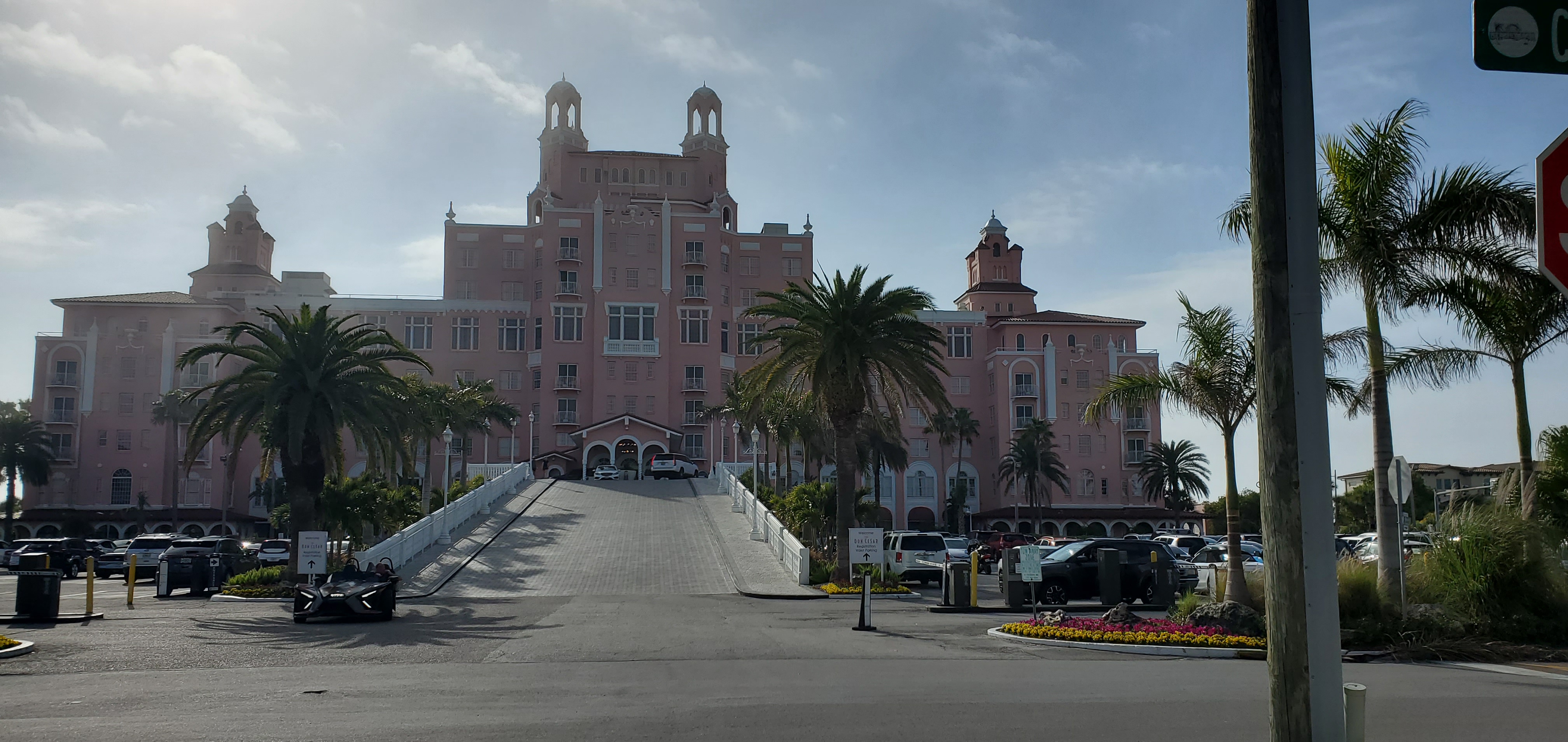
The centerpiece of Pass-a-Grille, along St. Pete Beach, is the Don CeSar hotel, which opened in 1928 and “gained renown as the Gulf playground for America’s pampered rich,” according to Wikipedia. This is as close as we got. Parking is nearly impossible unless you’re a hotel guest or want to pay a short-term visitor’s fee of about $27.
Here are Patty and Brooks at the Manatee Viewing Center near Tampa. (I couldn’t get a good photo of a manatee, so I focused on the beauty right in front of me.)
On the way to the Manatee Viewing Center, we stopped in downtown Tampa for lunch. Being on the board of the City of Fountains Foundation, I’m very interested in fountains, and this elegant one was outside the Tampa Bay History Center.
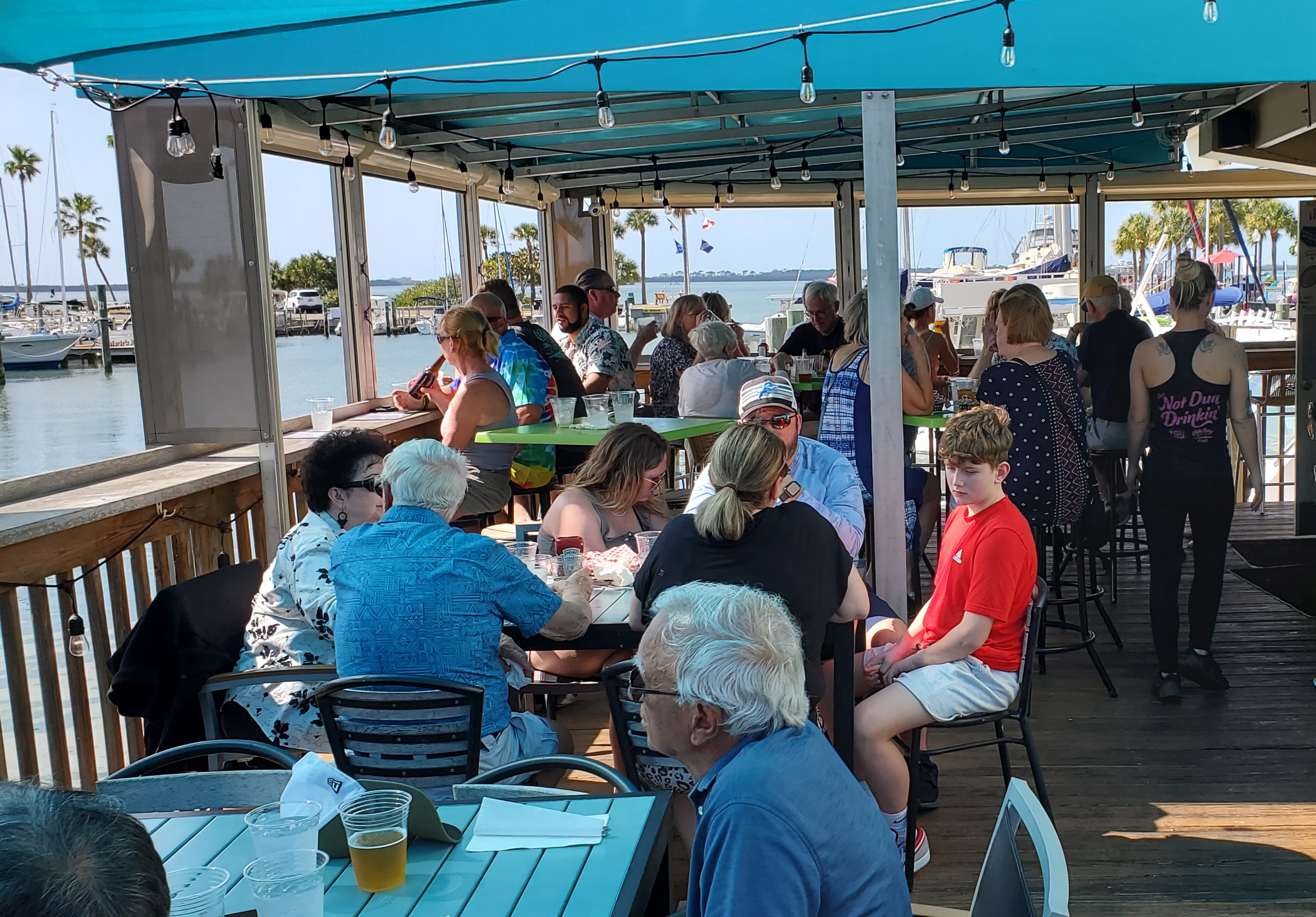
We are staying in Dunedin, a city just north of Clearwater. We had lunch today at Olde Bay Cafe, adjacent to the Dunedin Marina.
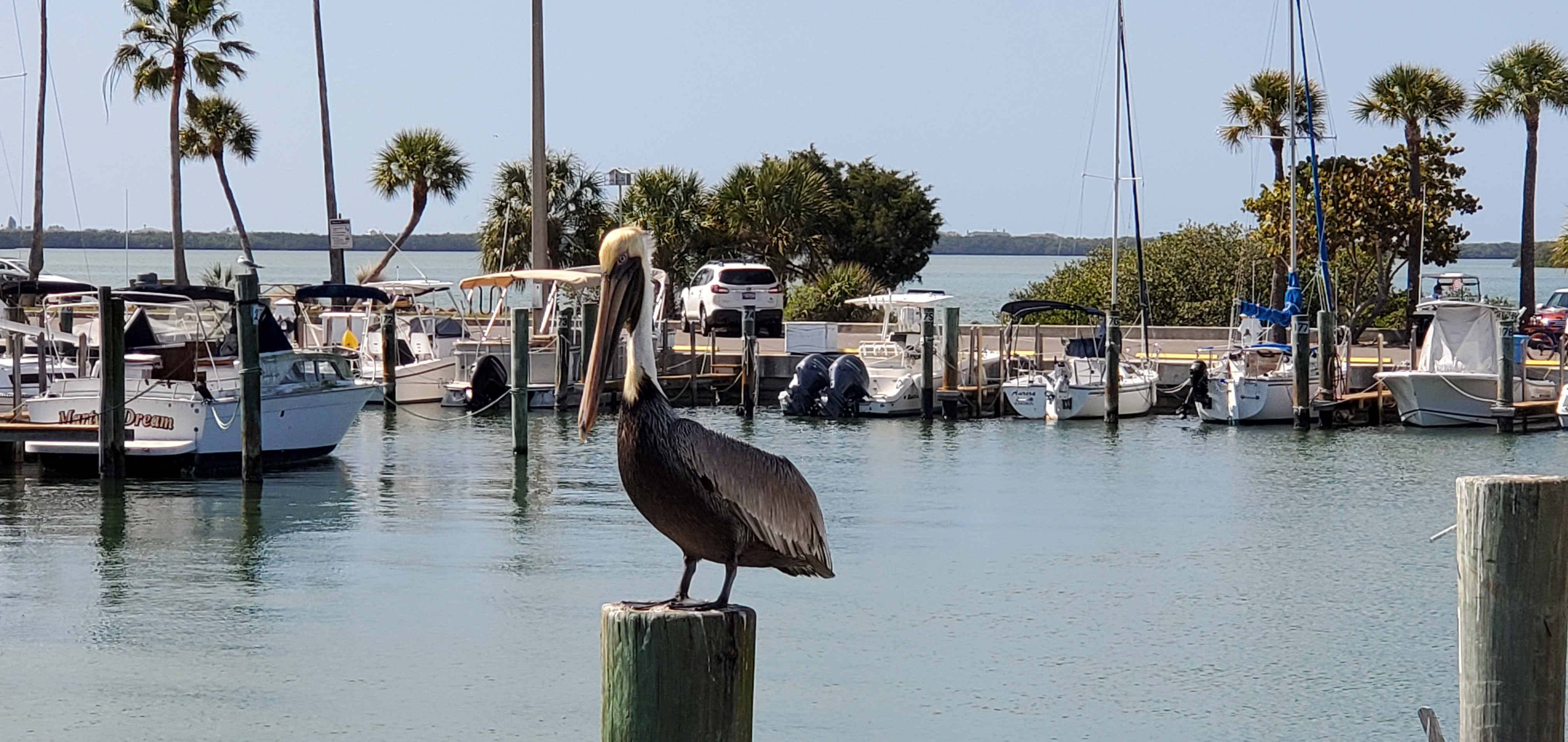
This pelican was just a few yards away, eyeing the diners very closely.
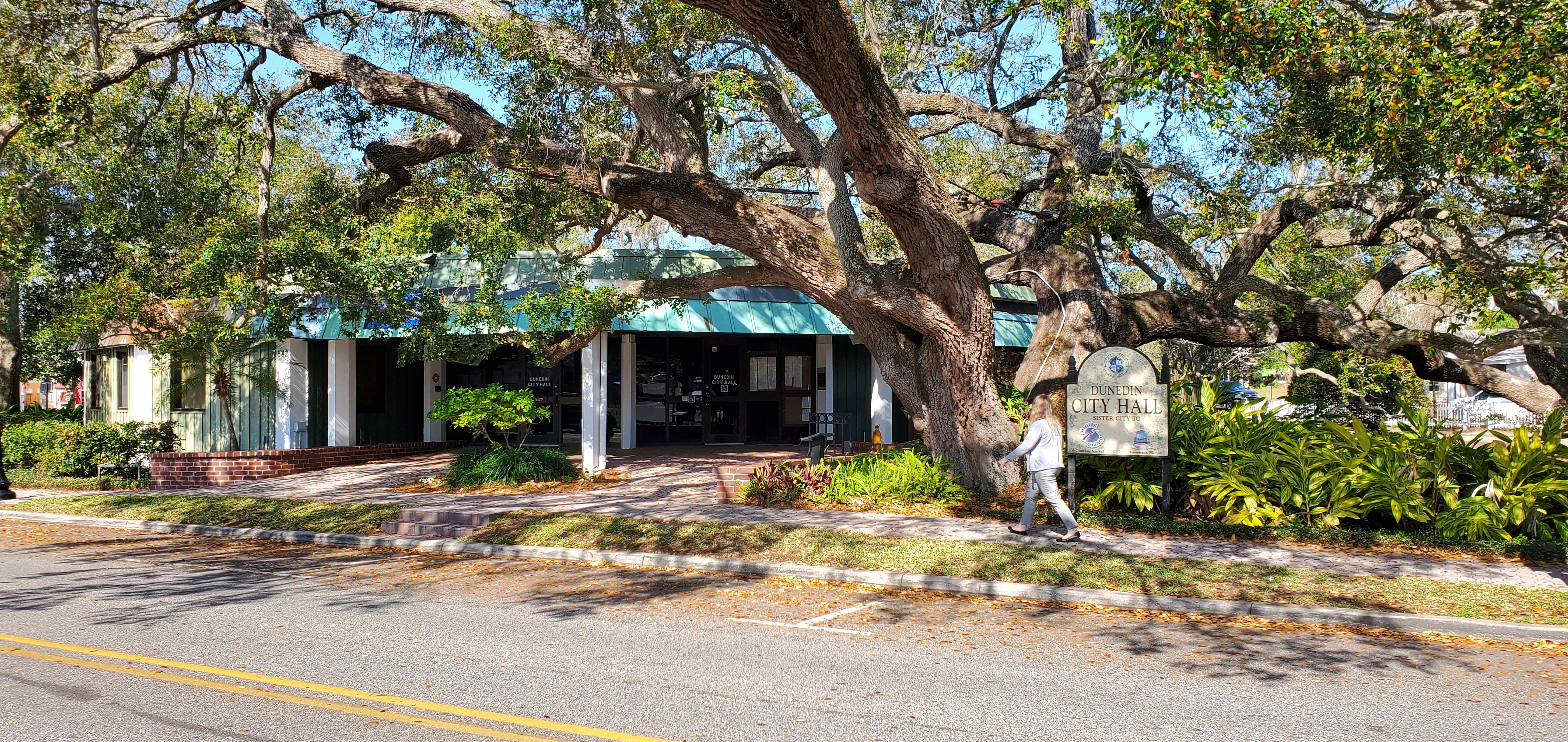
Dunedin is growing very fast, thanks in no small measure to tourism. The city’s existing City Hall doesn’t indicate how much it is prospering…
But its new, three-story City Hall, expected to be completed later this year, definitely does.

Tracking world, national and back-home developments is different when you’re on vacation.

Wherever I am, I follow the news, but it’s with a more removed outlook when I’m out of town. We’ve been in Florida almost two weeks now, and there’s been a lot to keep track of. But my news-priority list is not the same.

For example, I’m every bit as concerned as I was two weeks ago about the Ukrainian crisis. I go to The New York Times and Washington Post websites several times a day, and that’s usually the lead story — appropriately.

Another timeless and place-less story is the $73 million settlement in the Sandy Hook school shooting settlement, a case in which the relatives of children and adults who were killed in that awful incident took on and defeated the now-bankrupt Remington Arms Co.

The relatives and their attorneys charted a novel approach, arguing that Remington’s advertising encouraged illegal use of the Bushmaster weapon the 20-year-old killer used. One ad equated owning a Bushmaster with manhood: “Consider your man card reissued.” Another included the words: “Forces of opposition, bow down. You are single-handedly outnumbered.”

…Remington’s epitaph should be, “Hoiist on its own petard.”

**

From afar, I got a kick out of reading a story about Missouri: On Wednesday, U.S. Attorney General Merrick Garland sued the Show Me state over its gun law that discourages local officials from enforcing federal firearms measures.

The state’s “Second Amendment Preservation Act” allows citizens to sue any local police agency for $50,000 for every incident in which they can prove that their right to bear firearms was violated, provided they were not flouting state law.

The way the General Assembly and Gov. Mike Parson have been going, it’s not surprising that Missouri would try to stiff arm federal law, but to much of the nation it must look ridiculous. As Brian M. Boynton, head of the Justice Department’s Civil Division said, “A state cannot simply declare federal laws invalid.”

And what was the reaction from fearless Missouri Attorney General Eric Schmitt? “Make no mistake, the law is on our side in this case, and I intend to beat the Biden administration in court.”

Fighting the feds…A Missouri politician can hardly go wrong going in that direction.

**

Then there was the snow storm back home. For news about that, I turned to The Star — with the expected result that I’d be disappointed.

And, of course, I was. The Star’s main report informed readers how much snow had fallen in just about every part of the metro area, with one glaring exception — Downtown and central Kansas City.

I learned that Weatherby Lake, Shawnee and Kansas City, KS, got nine or more inches; that Lenexa got 8.8 inches; that Overland Park and Parkville got 8.5 inches; that Lansing and Platte Woods got 8 inches; that Platte City and Independence got 7 inches; that Spring Hill got 6.5 inches; and that Lake Tapawingo, Lone Jack and Stillwell got 6 inches.

Somebody needs to remind The Star’s editors that the area’s center of gravity (C.O.G., as one former editor used to call it) is still Kansas City proper.

That said, can somebody tell me how much it snowed in Brookside?

I’d appreciate it…

On a happier note…

As I said at the outset of Monday’s post, we are in southwest Florida, where we’ve come for a few weeks the last three years. We spent the first week with Louisville friends who rent a house in Naples for three weeks each February.

On Sunday, we moved up to Clearwater/Dunedin, where we’re staying in an Airbnb and where two Kansas City friends have a home.

We like Naples, but we love the Tampa Bay area, which offers a tremendous variety of sightseeing and entertainment options, including golf, Tampa Bay Downs racetrack, The Dali Museum, the Pinellas Trail, great beaches and the Gulf of Mexico.

Check out some of what we’ve experienced so far…

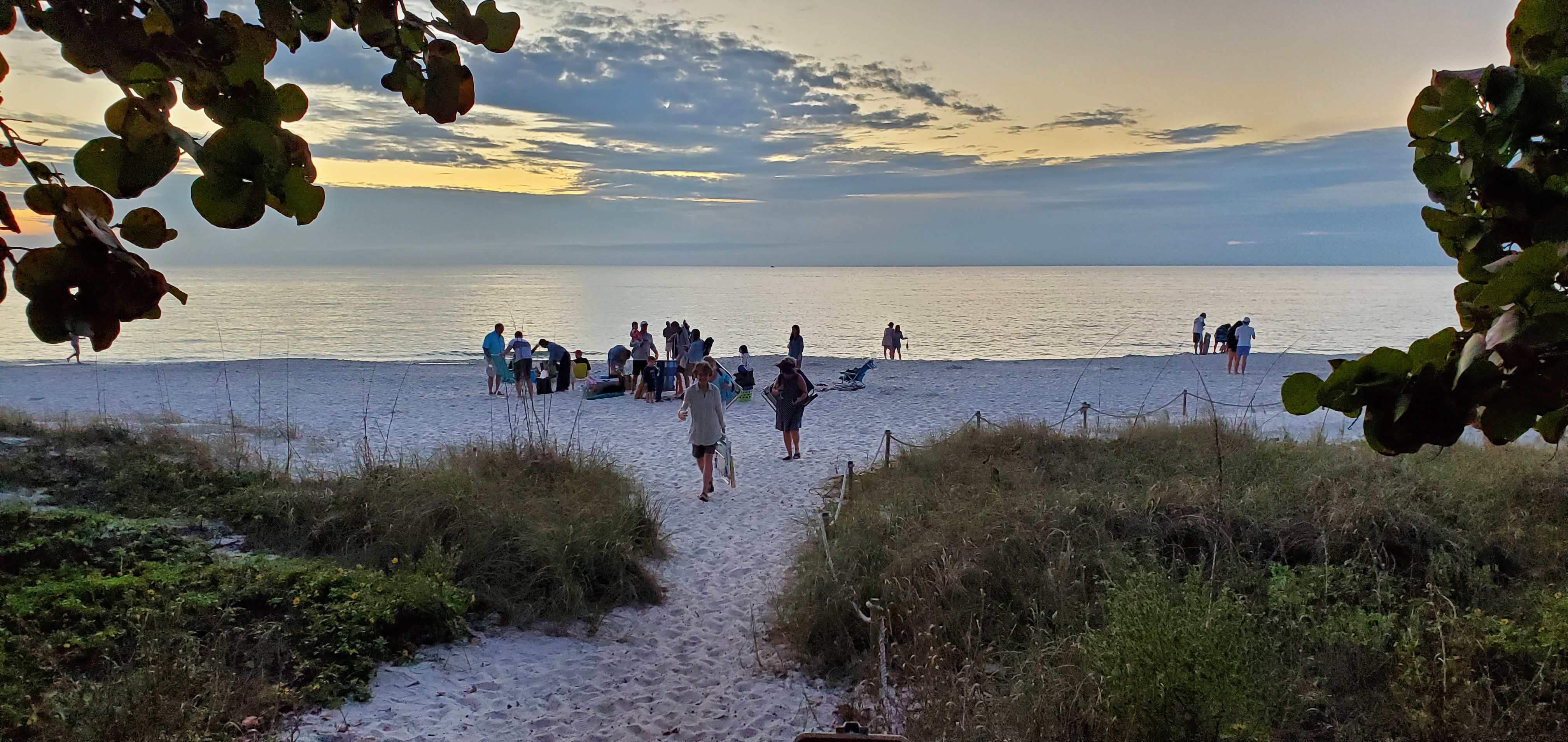
The house where we stayed in Naples was a couple of blocks from the beach, which attracts a crowd on sunny days and almost every evening for sunset. The two days we went down at sunset, however, about all we saw were clouds.
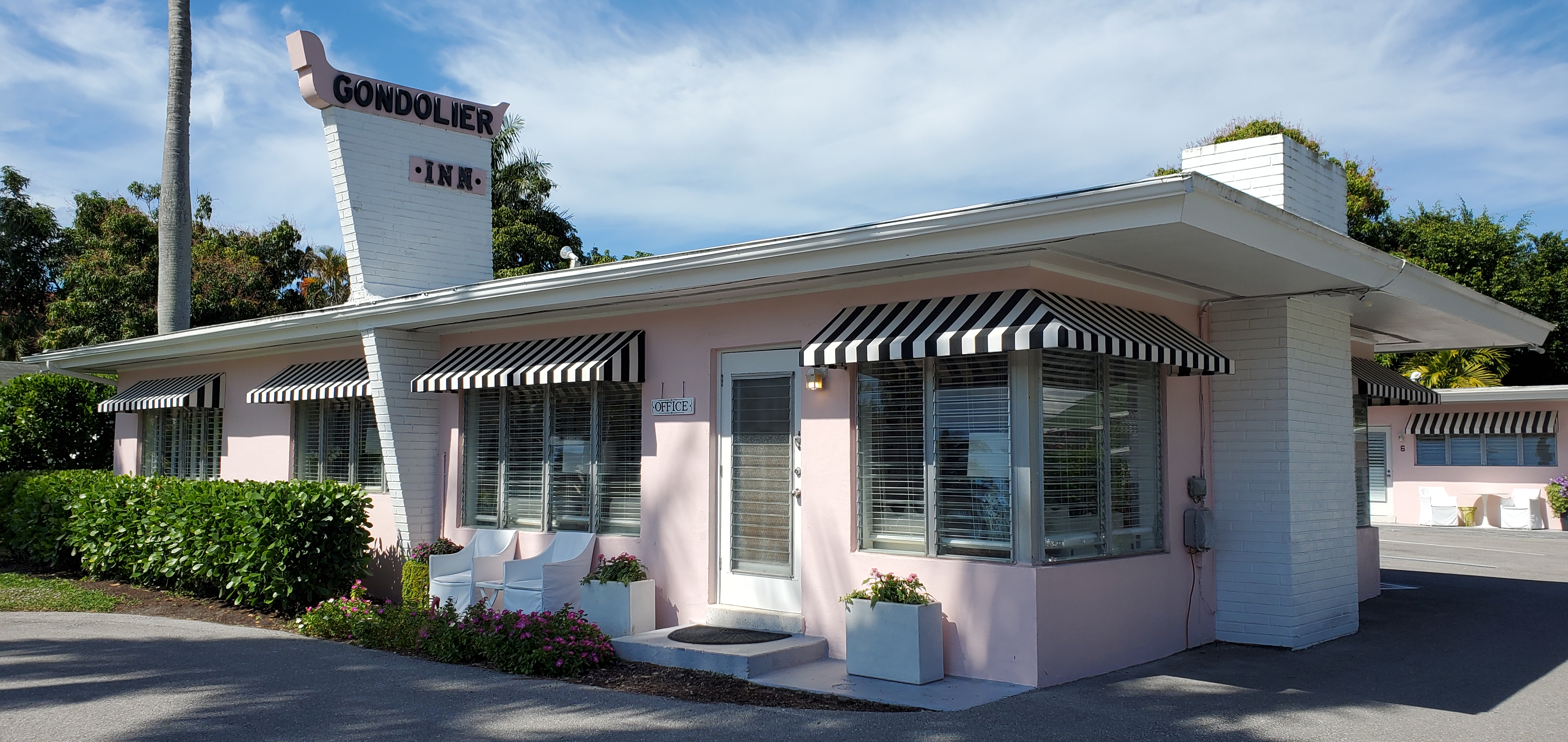
In Naples, old and new coexist, with new (and bigger) clearly having the upper hand. The Gondolier Inn on 8th Avenue South is a slice of the old. Old and new are both expensive, however: A room at the Gondolier runs about $400 a night, before taxes.
Eating out is expensive, too, even at the food
trucks, where this wagyu beef hotdog cost $17.
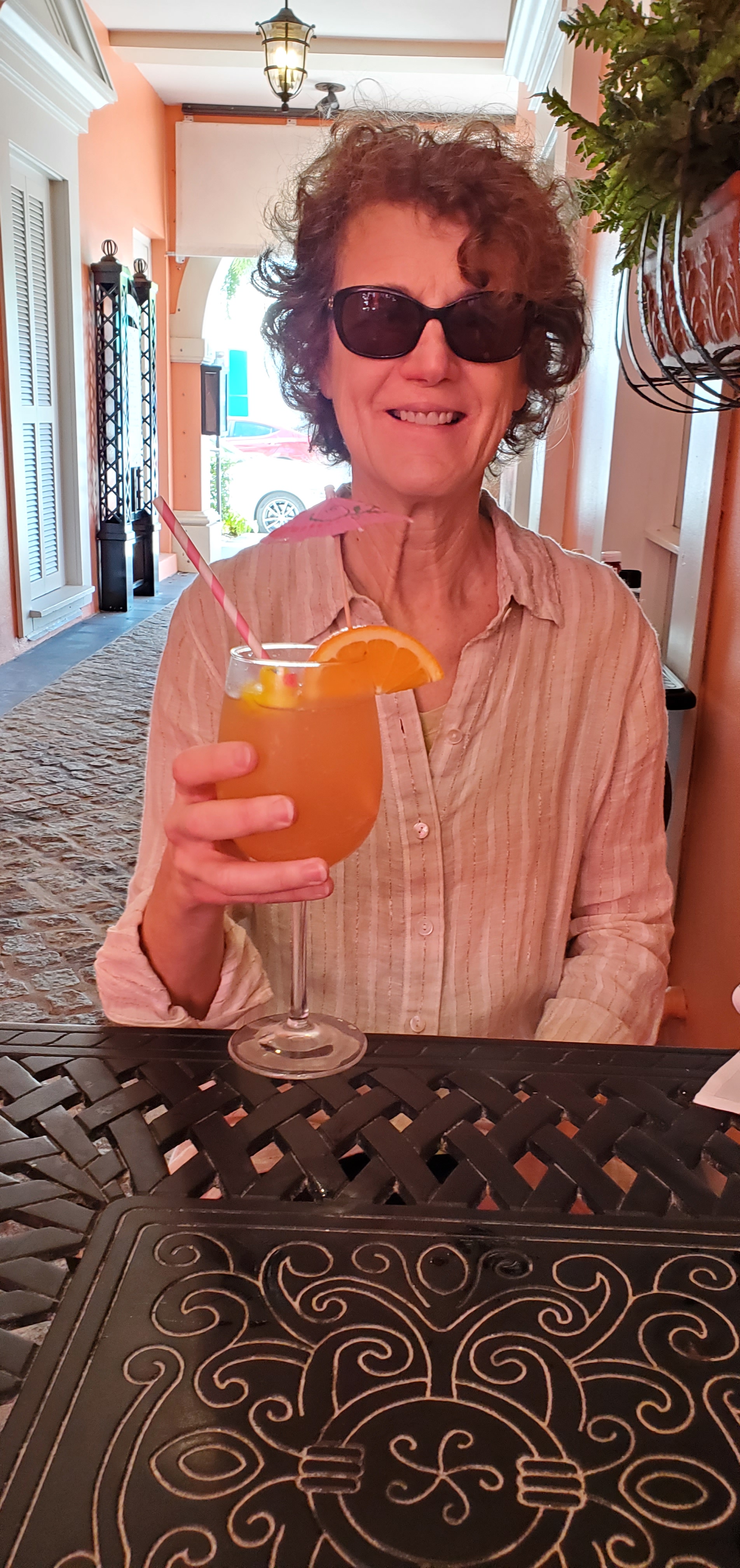
Patty was in good form on Day One.
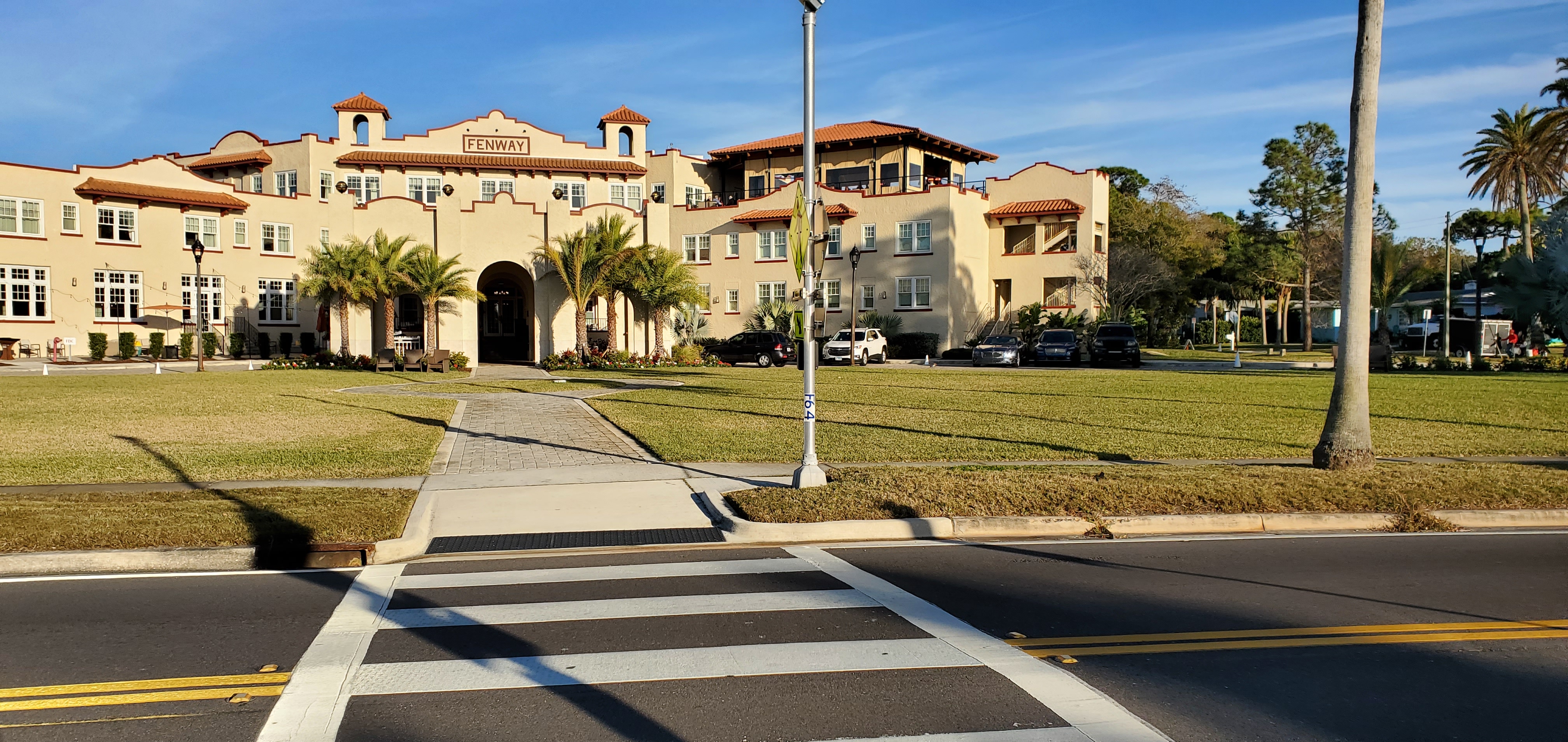
We got to Dunedin Sunday night. No, we’re not staying at the Fenway hotel, across the street from the Gulf. Rooms start at about $400, and that’s a last-minute deal.
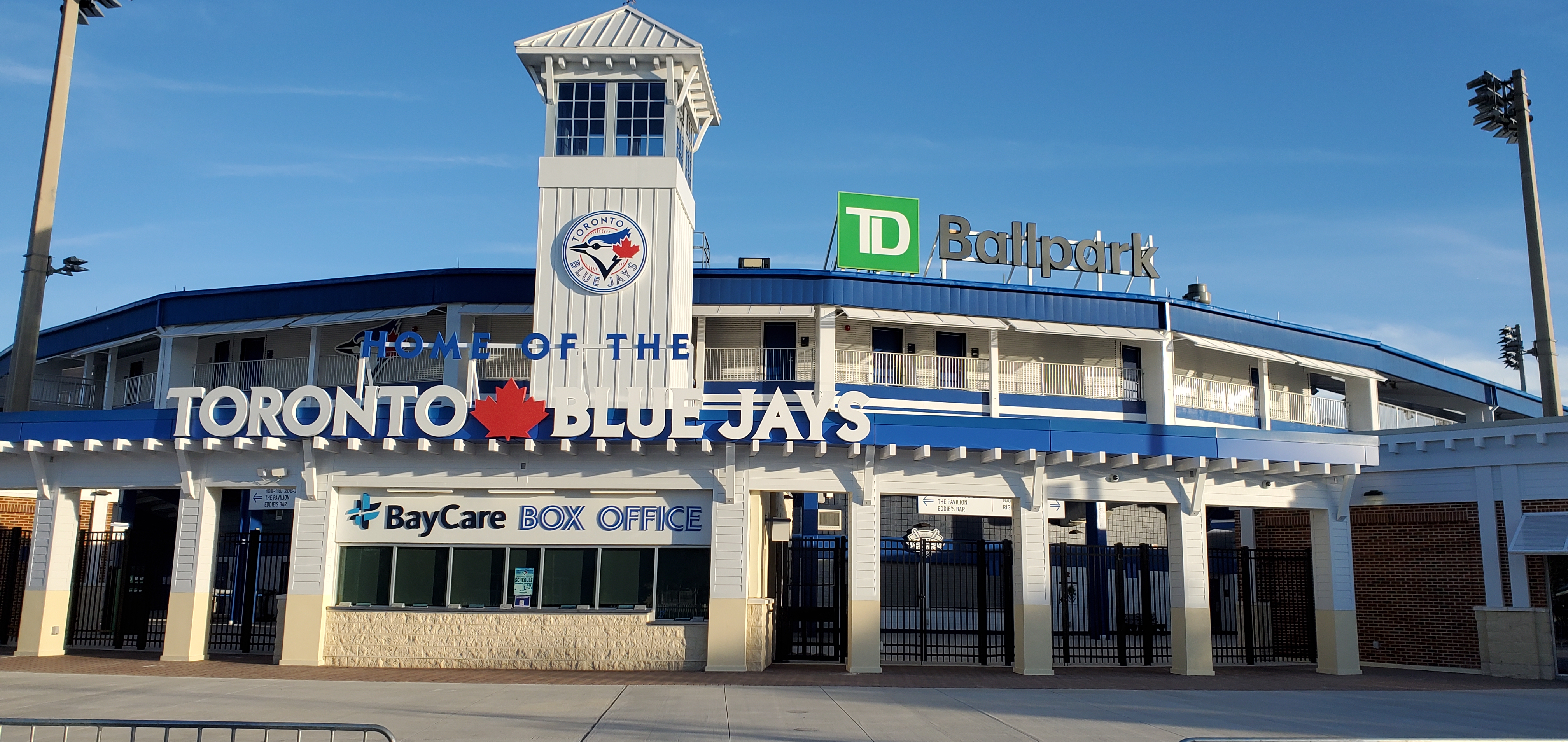
With the MLB lockout — and baseball on hold for now — the Dunedin, spring training home of the Toronto Blue Jays is looking pretty forlorn.
Today we went to Myakka River State Park, an area of great natural beauty just east of Sarasota. It was developed between 1934 and 1941 by the Civilian Conservation Corps, with help from the National Park Service and the Florida Park Service.
One of the park’s greatest attractions is its canopy of trees. I took this shot from a tower, about 50 feet above ground. (I didn’t have the leg power or courage to go to the top of the tower, about 25 feet farther up.)
Here’s a view of the canopy from ground level.
Bird watching is a major sport in the park.
The Myakka sand is unique and fascinating. During the summer rainy season, the ground is constantly wet. In the fall, it dries out in clumps in park areas with trees. On the walking paths, it is a fine, non-grainy sand.
In 1989, the Florida legislature designated Myakka fine sand as the official state soil. It occurs in more than 1.5 million acres of Florida “flatwoods.”

We’re in Florida, having a good time, but I got terrible jolt yesterday morning: Ernie Torriero, a good friend and former colleague at The Star, is dying of Covid in a Washington, D.C., area hospital.

Although vaccinated and boosted, he got a case of Covid after Christmas that infiltrated his lungs. Despite being on a ventilator, the doctors have determined he will not survive. Soon he will be taken off the ventilator.

Saturday, Ernie’s wife Antje Torriero explained the situation to Ernie’s 91-year-old mother, who, coincidentally, lives near where we are in southwest Florida, and his brother and sister.Ernie was at The Star (actually The Kansas City Times, the morning paper) for only four years, from 1981 to 1985, but he made a distinctive mark. He had come from the Miami Herald, and like many of us in the newsroom, he had a compulsive personality and was a hard charger. But he also had a big heart, was extremely gregarious and made friends easily.

It was pretty clear that Ernie would not be at The Star very long: He had exceptional talent and ambition, and he wanted to move up the journalistic ladder. Early on, I’m happy, to say, he cultivated my friendship. We would frequently go to lunch together and we hung out after working hours.

Before we became good friends, however, we had a mild dust-up over a reporting matter. The Rolling Stones were coming out of retirement not long after Ernie arrived, and the tour included a performance at Kemper Arena. The city editor at the time, a guy named Bob Samsot, went crazy on the coverage. He dispatched at least six reporters to the arena and the immediate area, and he had a couple of people, including me, in the office doing rewrite.

At one point, Ernie called in, was rung through to me and began giving me quotes from people he had spoken to at the concert. Very quickly, it struck me that some of the quotes were exaggerated. They just didn’t sound like words and sentences that most people would say off the cuff.

I stopped him in mid-sentence and said, “Hey, buddy, we don’t put up with cowboy quote artists here in Kansas City…Give me what they’re saying word for word.”

Ernie Torriero

At the time, Ernie had a bad stutter, and he began stuttering. But he also went back and got some authentic-sounding quotes.

Far from holding the scolding against me, Ernie admired the fact that I had insisted on accuracy and adherence to high journalistic standards.

After that, we began spending a lot of time together. One of the times we went to lunch was particularly memorable. One night in early August of 1983, I had met an engaging and good-looking young woman at the New Stanely Bar in Westport. I didn’t ask for her phone number, but she told me she worked at Cy Rudnick’s Fabrics in Crown Center.

A day or two later, Ernie asked if I wanted to go to lunch, and I said, “Yeah, how about going to Crown Center? I met a girl at the New Stanley the other night who works down there, and I’d like to see if she’s there.”

Ernie, of course, was game. When we got to the fabric store, I looked around eagerly, over and around bolts of fabric and counters where clerks were precisely cutting fabric with large scissors. Across the room, I spotted the girl I had met at the bar. She spotted me and broke into a big smile…That “girl” was Patty Corteville, to whom, on Feb. 23, I will have been married for 37 years…Ernie was in the wedding.

A year later, in August 1984, came another seminal occasion involving Ernie. My best friend in Kansas City, a guy named Dick Arnett, who had been married to a Star editor, committed suicide. I got the news on a Friday night, immediately upon arriving with Patty at the home of friends in St. Louis. I was shattered. I barely slept that night, and we headed back to Kansas City early Saturday. When we I pulled up to my house on Grand Avenue at 51st Street, Ernie was there, waiting in the front yard. I collapsed into his arms, and the grieving was officially underway.

**

About the same time I met Patty, Ernie had one of the most outstanding feature stories that has ever run in The Star. As I said, he had a stutter. It was a really bad, achingly bad, stutter. But he also had an indomitable personality, and he wanted to get rid of it.

The editor at the time, Mike Waller, offered to pay for speech therapy for him. After weeks of therapy — at KU Med Center, as I recall — all that remained was an occasional, mild stutter. Waller also had a secondary motive in extending a helping hand to Ernie: he wanted him to write about his experience with stuttering and the treatment. Waller, a genius of an editor, knew it would be a compelling story.

So, Ernie proceeded to write a two- or three-part series. The headline on Day One was, “I Just Want to be Normal.”

It was a blockbuster. I think just about everyone who subscribed to the paper read it. Inside the newsroom, Ernie was roundly congratulated. Often, one story can take a reporter or editor to a new level, and that’s the way it was for Ernie with “I Just Want to be Normal.”

In 1984 or 1985, when Ernie went looking for a bigger job, editors at The Washington Post almost hired him based on that story. It wasn’t quite enough to push him over the top, though, and he took a job at the San Jose Mercury-News. From there he went to The Sun-Sentinel in Ft. Lauderdale, where he was a foreign and national correspondent from 1994 to 2000.

His upward trajectory continued when he got hired by The Chicago Tribune in 2000. He was a senior reporter there for eight years, during which time I had the privilege of accompanying him to the newsroom in the fabled Tribune Tower, which, sadly, is no longer home to the Tribune.

Like many papers, the Tribune was in sharp decline in the late 2000s, and Ernie quit. For a little more than a year, he worked as an editor for a fledgling online publication. I talked to him fairly often during that time, and it was very difficult. By then he was married to Antje, who was not working, and they had young, twin sons. Ernie had no benefits, was working his ass off and not making very much money.

As I said, though, he had an indomitable spirit, and in 2010 he landed a destination job with Voice of America in D.C. He has held several important posts at V.O.A., including his current job, in which he supervised creation and production of digital content distributed to Africa.

…I had not spoken with Ernie for several months, and I’m sick that I didn’t call. I had determined to call him in early March, when both of us celebrate our birthdays. Unfortunately, Ernie Torriero, one great journalist and a loyal, loving friend, will not make it to his 68th birthday.

Today’s post focuses on some great lines from journalists, a Democratic state senator and two members of the public.

**

Jennifer Rubin, a columnist for The Washington Post is right on the money with her latest column, titled “I’ll skip the Olympics. You should, too.”

She says China, one of the most repressive nations in the world, should never have been awarded the Olympics, but now that they have them, people should register their objection by not watching. Rubin says…

“While NBC has already shelled out money for the rights to air the events and corporate sponsors and advertisers have spent millions to promote their products during them, perhaps a significant drop in TV ratings would send a message to all of them: If the IOC (International Olympic Committee) awards the Games to monstrous regimes, viewers might flee, rendering them less valuable. We can choose not to encourage such moral travesties.”

Rubin

Naturally, NBC is trying to sugarcoat the situation. Molly Solomon, head of the network’s Olympics production, was quoted as lamely acknowledging that “there’s some difficult issues regarding the host nation.”

Difficult issues?

To which Rubin responded, “What better PR could a totalitarian regime hope for from a U.S. media outlet?”

**

Many of you probably haven’t been following the latest escapades of our Missouri General Assembly, which never ceases to amaze with its steady march back to the Dark Ages.

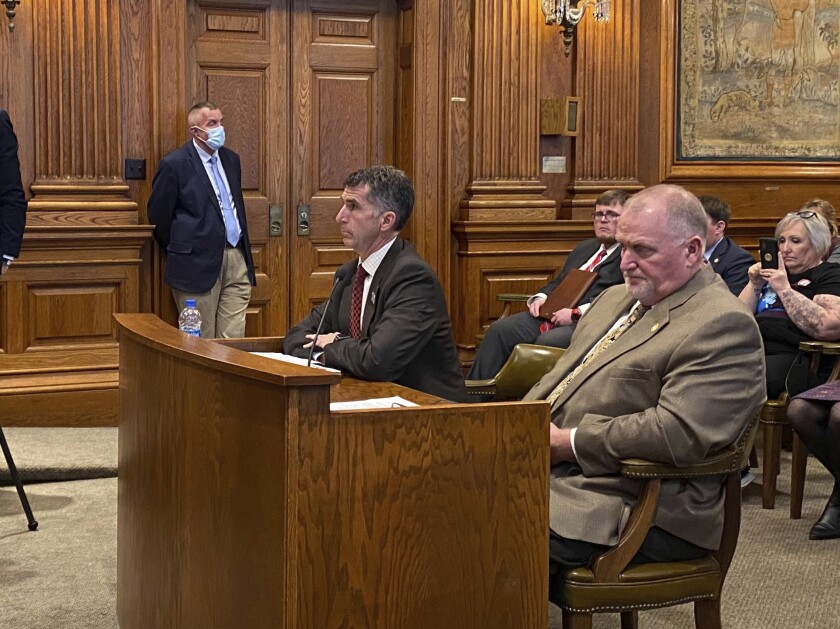
This week, a state Senate committee rejected Gov. Mike Parson’s nominee for director of the Department of Health and Senior Services, Donald Kauerauf, mainly because Kauerauf had been quoted in St. Louis Magazine as saying, “The goal of public health vaccination programs is to achieve 100 percent coverage.”

Donald Kauerauf, left, at Monday’s confirmation hearing. Beside him was Senate President Pro Tem Dave Shatz of St. Louis County.

As you know, I’m no fan of Parson, but in this case it appeared he had chosen a very qualified candidate to succeed Randall Williams, a goofball whom Parson ousted last spring. (Among other things, Williams once advised Parson to veto funding for a program aimed at connecting severely ill patients with hospitals that could treat them most effectively.)

Kauerauf was assistant director of the Illinois Department of Public Health from 2016 to 2018 and has three decades of experience in public health. Parson named Kauerauf director of the department in July, but the appointment required approval by the Missouri Senate, which proved more than problematic.

About 150 people rallied in the Missouri Capitol rotunda before Monday’s confirmation hearing to express their opposition to his confirmation. Some of those in the crowd promoted the idea of “medical freedom” and others inaccurately asserted that Kauerauf supported vaccine mandates, which he does not. (Later in the day, after the hearing, one person in the crowd called Kauerauf a Nazi.)

Naturally, the Senate heard the call of the wild and refused to advance the nomination to a vote. On Tuesday, Kauerauf resigned.

All of which prompted Senate Minority Leader John Rizzo of Independence to say: “The guy answered the questions right. But at that point the die had been cast…The guy could have given the cure for cancer and it wouldn’t have mattered.”

**

The Chiefs’ inexplicable collapse in Sunday’s game against the Bengals continues to echo. In Wednesday’s Star, a couple of letter writers were able to look on the light side.

Liberty resident Paul Stephen Smith had this after-the-fact headline suggestion for Monday morning’s paper: “Grim weeper.”

Dan Gruss of Shawnee had the best line, though…

All we needed was the refs to find us four more points.”

It was about six years ago, as some of you might recall, that I swore off pro football, mainly because of the high incidence of concussions and the disproportionate rate of chronic traumatic encephalopathy (C.T.E.) among former pro football players.

In 2017, I vowed to also give up college football, meaning I stopped going to KU games to see the school’s outstanding marching band. (I would almost drive over there just to hear the band’s soul-settling rendition of “Home on the Range,” which it plays after every home game.)

In about 2018, though, when “Mahomes Magic” struck Kansas City in a big way, I began drifting back, plowing over my principles. By the time of the Super-Bowl-winning season, 2019-2020, I had abandoned all pretense of boycotting football. I cheered as loud as anybody and jumped as high out of my chair as anyone when Mahomes threw his 44-yard (57 in the air) “Wasp” pass to Tyreek Hill against the San Francisco 49ers.

I watched with anguish last year when we lost the heart-breaker to Tampa Bay and Tom Brady, and I was a nervous wreck on Sunday, alternately sitting on the edge of the couch and walking back and forth between kitchen and living room in an effort to fend off the nerves during the Bills game.

The last 13 seconds of regulation left me spellbound and disbelieving, and when overtime began, I was so addled and undone that I got in the car and delivered dinner prepared by Patty to our daughter Brooks in Waldo. I was in Brooks’ driveway, listening on the radio, when Mahomes threw the game-winner to Travis Kelce.

Only then did I start to breathe normally.

That’s a long way of getting to the gist of this post: How I could so easily abandon my commitment to principle and return to watching football regularly while little or nothing has changed on the concussion-C.T.E. front?

I kind of understood how I could do it, but I didn’t quite have the words for it. Then, in yesterday’s New York Times, a writer for the paper’s Opinion section spelled it out for me.

The writer, Jay Caspian Kang, had a story under the headline, “We Used to Care that Football Players Got Concussions.”

Kang

He started like this…

Of all the disappearing stories in the American consciousness, none has receded from the public eye quite like football concussions. It’s hard to remember now, but less than a decade ago, President Barack Obama said that if he had a son, he would have to think ‘long and hard’ before letting him play football.

He noted that many stories were published about parents pulling their children from youth and high school football and how “obituaries were written for the future of the sport.” He cited a study that found C.T.E. in 110 of 111 deceased N.F.L. players.

But, obviously, that burst of concern was short lived. What has evolved, Kang said, is a “concussion ritual” that occurs routinely:

A player is knocked out, the TV announcers say, “Well, you hate to see this”; the player gets carted away or staggers off to the designated blue medical tent; the sideline reporter tells the audience that the player will not be returning to action. All this is done in somber tones with the implicit understanding that the player will probably be back in a week or two.

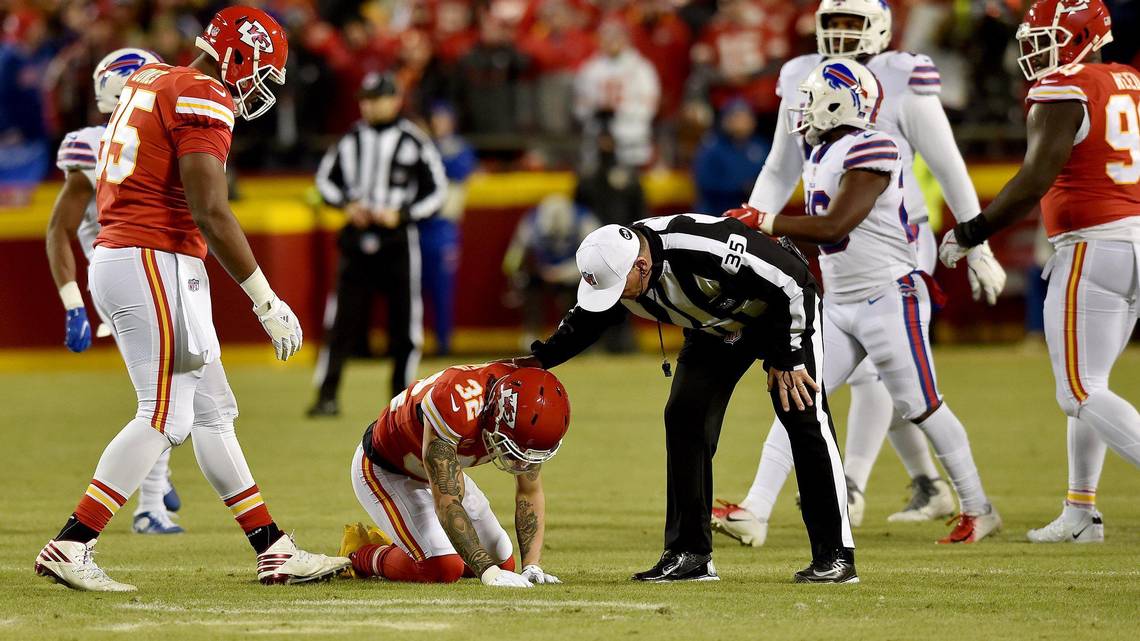
That’s essentially what happened early in Sunday’s game after a Chiefs’ player inadvertently struck teammate Tyrann Mathieu in the head with his leg and knocked the star defensive back out of the game and into “concussion protocol.”

Kansas City Star photo

Like everyone else in Kansas City, I’m sure, I did not turn off the TV in disgust. Like everyone else, my next thought was, “Who’s going to replace him?” (For the record it was Daniel Sorensen.)

Back to Kang’s story…Moving toward his main point, Kang said the passage of time and fans’ resignation to the inevitability of head injuries in football had led us to where we are today in our acceptance of football’s health hazards.

Kang’s “kicker” paragraph summed it up perfectly…

The way we watch football today feels like a capitulation that’s interesting because of how common this kind of giving in has become in modern life. We, the concerned public, may flare up our indignation for a short period when faced with an obvious problem — from school shootings to Covid policy — but there’s no real sense that we can do anything about these issues that make us mad. This doesn’t mean we are unaware or even particularly apathetic — again, nine out of 10 sports fans believe concussions are a problem in football; it’s more that we have no faith that we can change our institutions and, with ample evidence and sound reason, have dropped the belief that we even should have any input into how they choose to do business. What usually remains are the empty displays of concern we see every Sunday: the collective wincing when the inevitable happens, the hope that the harmed will be OK and then the quick move to a different subject.

Capitulation. Feeling hopeless about our ability to bring about meaningful change.

As Kang suggested, that’s where we are politically, for the most part:

What can we do about the “red” states that are intent on making it more difficult for big-city residents, particularly members of minority groups, to vote easily?

What can we do about the Missouri General Assembly’s drive to make it virtually impossible for a statewide initiative petition to succeed, by raising the threshold for approval from a simple majority vote to a two-thirds majority?

And that’s where we are in football — resigned to the fact that the N.F.L. owners and the commissioner aren’t going to make a serious attempt to reduce head injuries and we can’t do anything about it.

So, we keep watching. It’s entertaining, it’s exciting and, hell, it’s possibly our Kansas City Chiefs going to the Super Bowl for the third straight year!

It’s also likely that one or more of the Chiefs who are giving us those spine-tingling performances will end up half out of their minds later in life and come to a bitter end, like many other former players have.

But that’s 20 or so years from now. Not today. Today it’s still shock and awe about our guy having moved the ball 44 yards downfield in 10 seconds to set up the game-tying field goal.

That’s just the way it is and the way it’s going to be for a long time.

For the first time in my life, I no longer have a newspaper coming to my front door or into my yard.

Several years ago we canceled home delivery of The Star, but we continued with a daily subscription to The New York Times. With The Star apparently no longer able or willing to hire enough carriers to guarantee consistent delivery, however, we decided last week to cancel.

So now, like most of the rest of the world, our news consumption is online and on TV and radio.

I’m not going to wring my hands over the situation, but with the passing of print, I wanted to tell you about some of the great newspaper terminology that is being consigned, little by little, to history.

Here are some of the terms we in the newspaper business became familiar with and embraced as our own coded, professional language.

Banner — A headline in large letters running across the entire width of the front page.

Beat — A reporter’s particular assignment, such as City Hall, County Courthouse, cops and courts.

Bold Face — Heavy or dark type.

Box — Border around a story. (When I was working at the Kentucky Post in Covington, KY, back in 1968-69, the granddaughter of a woman from whom I rented a room once registered her impression of one of my stories by telling her grandmother, “He had a box!”)

Broadsheet — A large-sized newspaper, as opposed to a Tabloid, which is more magazine size.

Budget — The lineup of news stories scheduled for the next day’s newspaper.

City Desk — The area of the newsroom responsible for covering local news. (Many papers, including The Star, no longer have newsrooms; they operate out of rented office space or, in The Star’s case — for now — a post office box.)

Clips — Articles that have been cut out of the newspaper. (The Star used to have a “library” that featured a comprehensive clip file, by both subject and reporters’ bylines. The clips were meticulously folded and stored in yellow envelopes, which were stored vertically in large, metal file cabinets.)

The Star library envelope containing my first “clips” as a Star (Kansas City Times) reporter.

Compose — To set type or design pages, as in “the composing room.”

Copy — All material for publication, whether written stories or pictures. (Until about the early 1970s, “copy boys” and “copy girls” would run pages of copy from reporters’ typewriters to editors on the City Desk as deadline approached.)

Copy Editor — A person who corrects or edits copy written by a reporter and writes the headlines. (The Star and its morning counterpart, The Kansas City Times, had phenomenal copy desks, which caught scores of would-be errors every week.)

Cutline — The information below a picture or graphic — the caption.

Dummy — A diagram or layout of a newspaper page, showing the placement of stories, headlines, pictures and ads.

Extra — A special edition of the newspaper, printed between regular editions, containing news too important to hold for the next regular edition.

Flag — The newspaper’s name, printed at the top of the front page.

Folio — The number of a newspaper page.

Four-color — When a color photo was needed, a slide was separated into the basic colors of red, yellow, blue and black.

Fourth Estate — A traditional name for the press, referring to a fourth social class, the others being the clergy, nobility and commoners.

Gutter — The margin between facing pages where the fold lies.

Hot Type — Old-style type made from molten lead.

Inverted Pyramid — A method of writing by placing parts of the story in descending order of importance.

Jump — To continue a story from one page to another. (A Double Truck is a story that jumps from the front page and took up two full, facing pages inside.)

Justify — To space out a line of type so that each line fits flush to the margin.

Kill — To strike out copy, remove type not to be printed or “kill” a story altogether. (Another way of saying a story was killed was to say it was Spiked, that is, the copy was impaled on an actual spike on an editor’s desk.)

Lede — Generally, the first sentence of a story. (One reporter would sometimes compliment another by saying, “Great lede.”)

Linotype — An old-style machine used to produce hot type, one line at a time.

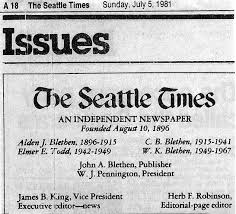
Masthead — A box printed in every issue that states the title, owner and top managers on both the news and administrative sides of a paper.

Masthead

Newsprint — The bare, machine-finished paper on which newspapers are printed. Newsprint comes in huge rolls.

Pagination — The computerized process by which a newspaper is laid out.

Plate — An aluminum sheet that the negative is transferred to so that it can be run on the press. (People who got written up in the paper sometimes would request that the paper provide them with the page plate, for posterity.)

Press Run — Total number of copies printed.

Proof — A page on which newly set copy is reproduced to review for possible errors.

Rewrite — To write a story again to improve it; to rearrange a story that appeared somewhere else; or to write a story from facts phoned in by a reporter. (As in, “Give me rewrite!”)

Scoop — A story obtained before other newspapers or media outlets report it. (Many a reporter, including me, has been dubbed “Scoop” by some non-newspaper types. Another moniker I picked up from one or two people was “Poison Pen.”)

Stringer — A part-time reporter or correspondent. (In my first few years at The Star, I sometimes took “dictation” from a stringer we had in West Plains, MO, at the southernmost part of the state.)

Syndicated Features — Material such as comics, advice columns, etc., supplied nationally to newspapers by news syndicates.

Typo — Short for “typographical error.”

Wire Services — Agencies like the Associated Press or The New York Times News Service that gather and distribute news to subscribing papers for a fee.

**

Most of those terms are passe, having been replaced by terms like bandwidth, memory, hard drive, hardware, browser and bytes. It’s all good — and I have embraced technology to the best of my ability — but for this former ink-stained wretch, the new terminology has no allure.

-30-

Last week’s start of the 2022 Iowa legislative session saw some hand wringing and gnashing of teeth by some members of the media because of a change in media policy by the Republican-controlled Senate.

No longer would members of the media be allowed to watch, record and take notes from a “press bench” on the Senate floor. By order of the Senate leadership, the media was consigned to the public galleries in the Senate balcony.

You might think I’d be outraged by this, but, no, it’s just part of a trend going back at least 25 years to inject space between legislators at various levels of government and the dreaded “press.”

Caleb Hunter, a spokesman for Iowa Senate Republicans, had a valid point when he explained his party’s reasoning…

“The principal dilemma faced by the Senate is the evolving nature and definition of media. As non-traditional media outlets proliferate, it creates an increasingly difficult scenario for the Senate, as a governmental entity, to define the criteria of a media outlet.”

I’m a blogger…So, does that make me a member of the media? I tend to think not, but who can say with any assurance? Suppose, in past years, a blogger would have demanded to be allowed onto the hallowed “press bench” (and maybe that happened). Would he or she have a right to be admitted? Tough call.

There are a lot of other non-traditional “media” types now who fancy themselves as “press,” complicating elected officials’ role of trying to determine who and what is media and the privileges they should be accorded.

I’m not going to spend any time thumb-sucking on this issue…For purposes of today’s post, I just want to tell you how it used to be, back when it was quite clear who and what qualified as media and when many public officials and members of the press were, if not joined at the hip, pretty darn close.

When I started covering the Jackson County Courthouse for The Star in 1971, reporters had free run of the place. I was at the courthouse six, seven or eight hours every day; I knew people in every department: I knew all the elected officials and could walk into just about every office and usually be greeted with a smile from a secretary and allowed to go back to the inner sanctums.

I would stroll into the County Prosecutor’s Office on the seventh floor mezzanine, past the front desk, and make a loop among the desks of the various assistant prosecutors, stopping to talk to whoever was there about what cases they had and how they were coming along. I remember one longtime assistant prosecutor who used to ask for positive coverage in a nasally voice, saying, “Hey, scoop, give me some B & W?” B & W was black and white…the only colors newspapers offered back then.

I would also spend a good deal of time talking to the secretaries in every department, and that paid off in the form of numerous dates.

When I would go in to see County Executive George Lehr, whose office was on the second floor (where Frank White’s is now), he would usually shoo away whoever he was talking to and say, “Let me talk to Fitz now.”

Of course, this wasn’t because Lehr thought I had a swell personality. It was because he wanted “good press” and knew he had a good chance to get it if he gave me ready access. Lehr, who died of a brain tumor in 1988, had me wrapped around the tip of his finger. Stupidly, naively (I never had any formal journalism schooling or training other than on the job), I let him compromise me in ways that would have made journalistic ethicists gasp even back then, when things were a lot looser than they are now.

For example, those were the days when the Chiefs were coming off their 1970 Super Bowl win and tickets were hard to come by. Lehr had two tickets on about the 20 yard line in the lower level. Several times he offered me those seats at face value. And I took him up on them. Even though I was paying for them, this was out of bounds because I wouldn’t have been able to get tickets like those on my own.

**

When I went to City Hall in 1985, the City Council offices on the 24th floor were wide open to me. I would greet the front desk person and walk on into the labyrinth of individual council offices. Almost all the council members kept their doors open, and I’d just appear at the door and ask if I could come in. The answer was almost always, “Sure.”

One time when I was in the council offices, outside and a few steps away from the office of Councilman Bobby Hernandez, I heard him make a phone call in which he asked a retailer for a favor. What I overheard was him say went something like this: “Hi, this is Councilman Bobby Hernandez. When I was in your place a few months ago, you were kind enough to give me a 20 percent discount, and I was wondering if you’d extend me that courtesy again.”

After a few seconds, he said, “Well, thanks, I really appreciate it; I’ll be around in a few days.”

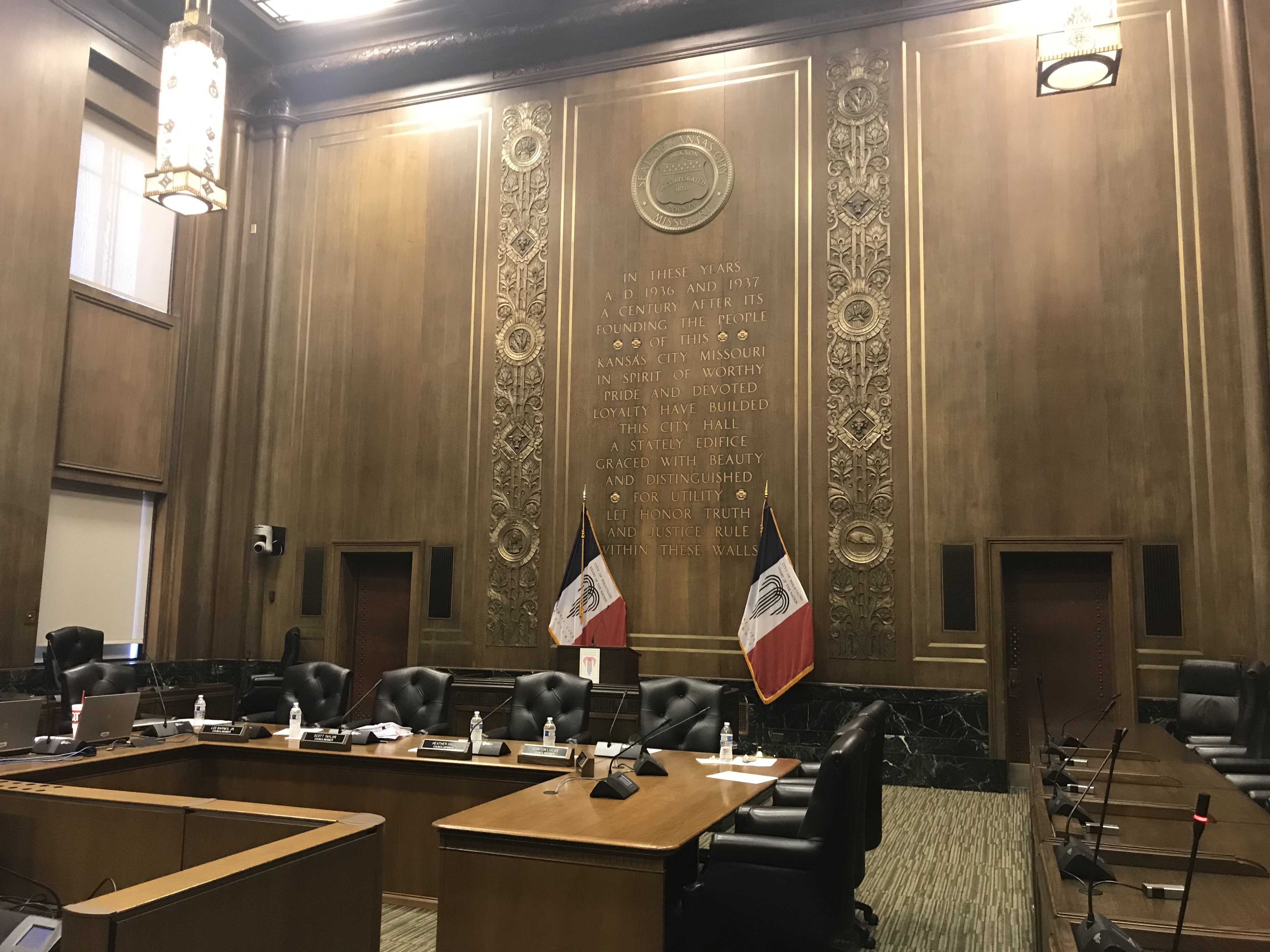
At council meetings, held in the council chambers on the 26th floor, there were one or two press tables that were a few feet from the mayor’s podium. We had full access to the 12 council members, even during meetings. We could get up from the table, kneel beside a council member’s desk and question him or her about the proceedings.

The City Council Chambers on the 26th floor of City Hall

We also had access to an anteroom behind the council chamber where council members would sometimes hang out before meetings or where they would go to take a break, duck a vote or make a phone call.

The only official at City Hall who was difficult to get in to see was Mayor Richard Berkley, who was mayor from 1979 to 1991. His door was always closed and access to him was strictly controlled by an aide named Kristi Smith Wyatt. Reporters would ask Kristi to arrange an interview, and she usually came through, but it almost always involved a wait of half an hour or more.

I remember the reporter who preceded me at City Hall, John Dvorak, saying, “If I had a nickel for every minute Dick Berkley has kept me waiting, I’d be a rich man.”

The first sign of real change in media access at City Hall came soon after former Councilman (now U.S. Rep.) Emanuel Cleaver became mayor. In short order, he moved the press room from the 29th floor, where the mayor’s office was (and still is), to the 26th floor, which is kind of a wasteland, except for the city council chambers.

The 29th floor was the nerve center. We in the press room could sometimes tell something big was going on by who was coming and going. I remember one time, during the days Missouri was on the verge of getting casino gambling, when a riverboat operator from St. Louis was in the building and meeting with the mayor. I wanted an interview. This guy didn’t want to be interviewed. But I waited by the guard’s desk until I saw him emerge, along with some aides, and he headed straight down a set of stairs. The guard let me through, and I hustled down the stairs after them and got a stairwell interview.

At some point before I left City Hall in 1995, reporters’ easy access to the council offices on the 24th floor was shut off. After that, reporters had to tell the front desk person which council member they wished to see, and the front desk person would ring the council person’s aide, who would then check with the council person — if that council person was in.

Over the years, elected officials at almost every level have made it more difficult to get access to them. I can’t say that I blame them. So, nobody should be surprised that the Iowa Senate has banished the press to the public galleries. You can still see and hear what’s going on from the galleries (assuming your hearing is good). It’s just not nearly as much fun as being up close and personal.

We’ve seen a tremendous amount of change the last 25 years, both within the media and how media members (however they’re defined) interact with government and public officials.

I mean, who would have predicted in 1995, that in 2022 The Kansas City Star would be operating out of a post office box?

For The Kansas City Star, it’s been a hiccuping start to 2022.

On Monday, Tuesday and Wednesday, Jan. 3, 4 and 5, I didn’t get my New York Times, which, like the Wall Street Journal and some other papers, is delivered by contractors who deliver The Star.

The first day, I thought it was just an aberration, but the second day I realized it was probably a significantly broader problem because my neighbors weren’t getting their papers either.

So I called my carrier, and he told me that his contract and those of about 25 other carriers had expired at the end of the year. (He delivered a couple of days beyond the 31st.) My carrier said he didn’t like the new contract he was offered and decided to call it quits, after more than 20 years of delivering The Star.

Then, I called my former carrier — a guy I got to know pretty well over the years — and he opened the conversation by saying, “You’re not getting your paper, are you?”

He said the distributor he had worked for (the carriers now work for distributors, not McClatchy or The Star) had offered him a contract to resume his old routes, including the one we live on. But the contract he was offered was essentially for the same amount of money he’d been earning in 2018.

“No thanks” — understandably — was his answer.

I heard nothing from The Star about delivery problems until this morning, when I got an email under the heading “important delivery update.”

It said in part: “Due to carrier shortages, there is a possibility that upcoming editions of The Kansas City Star will be delayed in some areas. While we continue to recruit carriers, the area manager is delivering multiple routes each morning and is working hard to ensure all routes are completed as quickly as possible.”

Then, whoever wrote that email, tried to divert our attention to the bright side, reminding us that, on our digital versions of The Star, we were getting “more than 60 pages of bonus content each day; subscriber-exclusive features on politics, sports and entertainment; (and) a customizable reader experience.”

Well now…that sure must have eased the frustration of the elderly readers who don’t read the paper online and count on having the print edition with their morning coffee.

But then, as I read on, I came across something very interesting. At the very bottom of the email, in small print, The Star’s address was listed as “4741 Central Street, Ste. 541, Kansas City, MO 64112.”

Hmmm, I mused, so The Star has rented space on the Plaza??

When last I wrote about The Star, it did not have a physical location, having sold both the former headquarters at 1729 Grand and the printing plant at 1601 McGee. Under a lease agreement with the new owner, some employees remained at the printing plant until late last year.

I had heard that The Star would be leasing space somewhere in the Crown Center area, so I was a bit surprised to see the 4741 Central address.

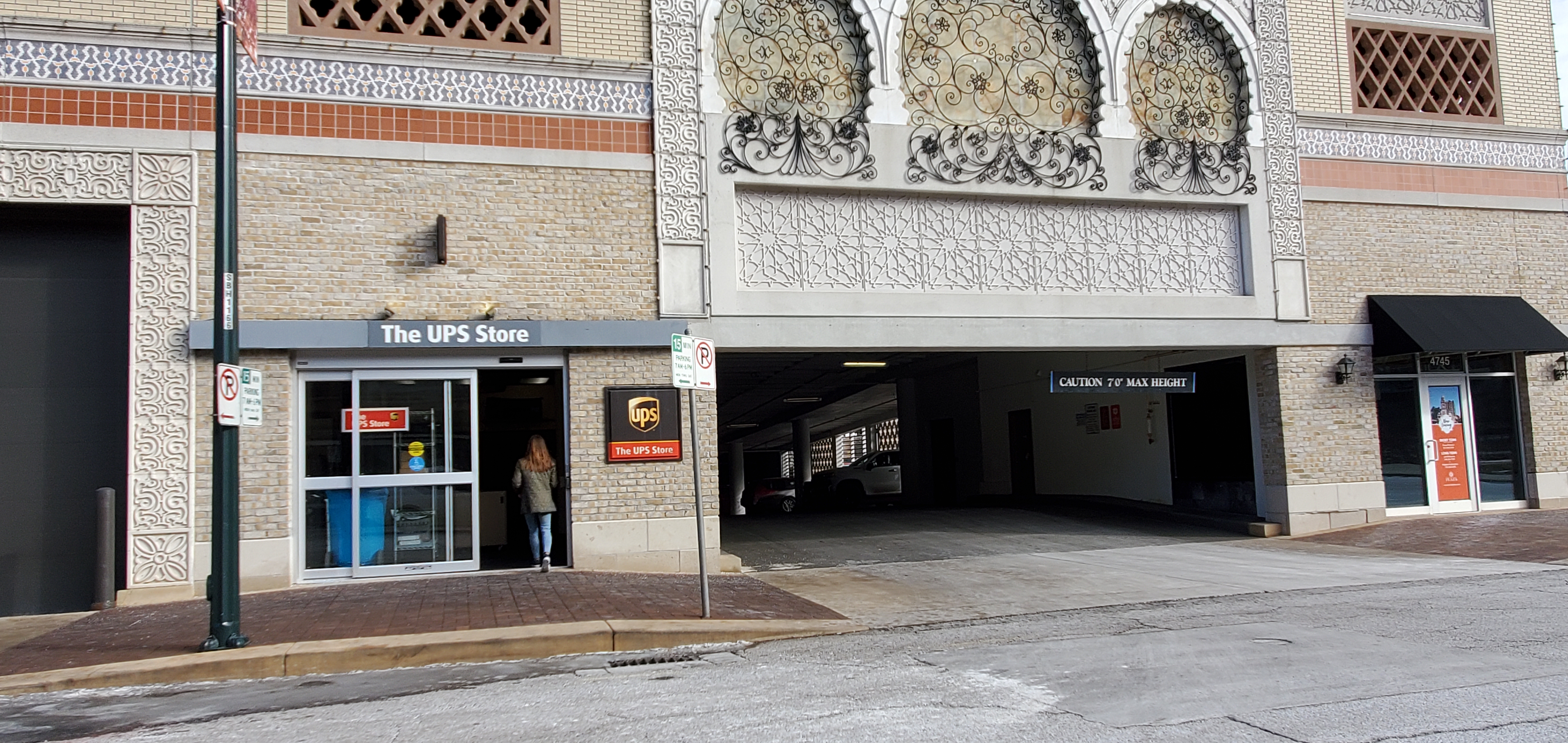
I quickly Google-mapped it, and what popped up was an image of a UPS store. That confused me, and when I showed it to Patty, she said, “That’s the old Halls store.”

Now, I knew damn well the old Halls building didn’t have five stories, so I wondered where the heck Suite 541 could be in that building.

So, this afternoon I drove down there and confirmed with my own eyes that it’s a three-story building, with a few retail businesses, including UPS and an Apple store, on the first floor, and parking on the top two floors.

Still mightily puzzled, I went into the UPS storefront. Two employees were behind the counter, and I said, “Say, do you know where Suite 541 might be?”

One of the employees directed my attention to a bank of rental mail boxes across from the counter.

“There’s Suite 541,” he said, pointing at this…

And sure enough, surrounded by “suites” 537, 538 and 542 was The Kansas City Star’s new address and– let’s hope temporary — home.

My immediate thought was that Suite 541 was a hell of a descent from the ornate building on Grand Boulevard and the stunning print plant with its angled face pointing toward the heart of downtown and T-Mobile Arena.

Before leaving the area, I took a couple of other photos, which help put The Star’s new address in perspective.

Suite 541 is in the first column of large boxes at lower right.
Like 1729 Grand, The Star’s new location has an ornate facade; it’s just not as impressive.