The Star recently lost an exceptional amount of journalistic talent with the retirements, via buyout, of reporter/editor Darryl Levings, assistant metro editor Elaine Adams and sports reporter Randy Covitz.
But the most painful loss to me, as a reader, was that of investigative and courts reporter – and periodic columnist — Mark Morris.
Morris, a friend for many years, was one of those reporters who, when you saw his byline, you knew you were in for a good read. There aren’t a lot of reporters about whom that can be said, and with Mark, KC Star readers were privileged to be on receiving end of bushels full of thoroughly reported, felicitously written stories.
But at 61 years of age and with 31 years of service behind him, Morris said goodbye to The Star last week. You might have read his last column, which appeared in Monday’s paper under the headline “Hear ye, Hear ye, court is now adjourned.” (In case you didn’t, here it is.) In the column Mark reflected on his 17 years of courts coverage. One of his seminal pieces of advice was to defendants in criminal cases: “Never represent yourself in court…You’ll be convicted.”

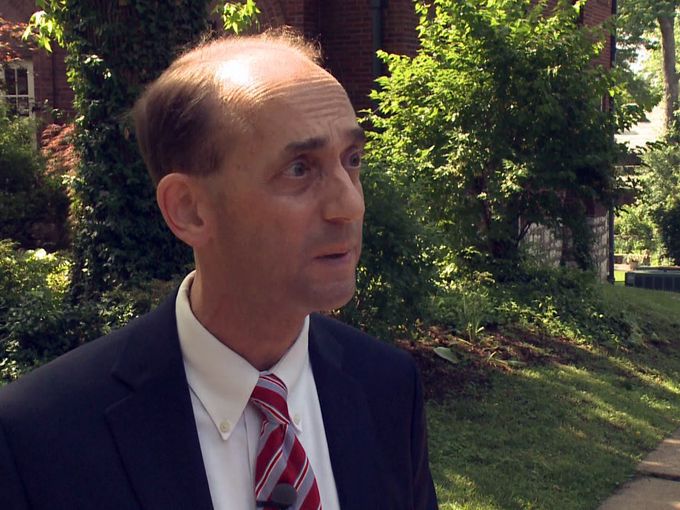
Mark and the family Black Lab, Booner, outside the home in Liberty
Mark is rightly proud of his career at The Star, and while talking about it at his Liberty home on Thursday, he emphasized that he had left the paper voluntarily and with a sense of satisfaction.
“I had a great run at The Star,” he said. “The people (managers, in particular) have been good to me…I left at a good time.”
My association with Mark
I intend to recount some of the highlights of Mark’s career here — including his brief ascension to “bestselling author” and examples of his resourcefulness and powers of observation — but first I want to tell you how he and I came to be friends.
I had already been at The Star for 15 years when Mark arrived at the paper in 1984 (I arrived in 1969, to spare you the math) as assistant night city editor. Prior to that, he had worked at smaller papers in Fulton and Centralia, Missouri.
He advanced to night city editor, but then, after a decade as an editor, made the somewhat unusual switch of becoming a reporter. (The customary path of upward progression in journalism is reporter first, then editor.)
In 1994, then, he joined me at City Hall, which I had been covering since 1985. We had a good time at City Hall, working out of the 26th-floor press room, yards away from the City Council Chamber. We also became friends and turned out a lot of good stories. At one point in the mid-90s, federal and state authorities were investigating four council members – Michael Hernandez, Chuck Weber, Jeanne Robinson and Carol Coe — and three ended up being convicted of felonies – all except Coe.
In 1995, I became an assistant metro editor and took charge of the Wyandotte County bureau, where I spent the next nine years. Mark stayed at City Hall until 1998, when he was named federal courts reporter, the post he held for the last 17 years of his career.
…Here I want to inject a note that is important to both Mark and me. Since I began blogging in 2010, Mark has never provided me with any inside information about developments at The Star. In fact, because people at The Star knew that we were friends, he was careful to maintain arm’s-length distance. So, any “scoops” you have read in this blog about The Star did not come from Mark, directly or indirectly.
Some career highlights
Mark gathered about 20 first-place honors and awards during his years at The Star. Those include:
:: The 2010 Robert F. Kennedy Journalism Award for “A New Slavery,” a five-part series he and two other reporters, Laura Bauer and Mike McGraw, did on human trafficking.
:: The 2010 Investigative Reporting award from the Associated Press Sports Editors for 2011 for “Trouble in Jayhawk Nation,” a series of stories on a ticket-skimming scandal by employees in the University of Kansas ticket office. (Other staff members shared the award.)
:: The 2012 Best News Story award from the Kansas Press Association for “Bishop, KC diocese indicted.” Reporters Judy Thomas and Glenn Rice shared the award.
In 2001 and 2002, Mark and a Michigan reporter, Paul Janczewski, collaborated on a book titled “Fatal Error,” about a Michigan housewife who convinced her lover, a former Cass County deputy sheriff, to murder her husband. For one week – the first week of March 2003 — the book was on The New York Times Extended Bestseller List, ranking 30th in the “paperback nonfiction” category.
Talking excitedly while moving around his kitchen yesterday, Mark said: “Do you know what that does (having reached “bestseller” status) to my obituary? That’s awesome!”
A bonus – in more ways than one – was the Lifetime cable channel’s decision to exercise an option to make a movie out of the book. It aired in 2006 under the title “Fatal Desire.”
Although “Fatal Error” is Mark’s only book so far, it probably won’t be his last. He has “two or three ideas” for writing projects and plans to move forward in due time.
Before any work-related retirement projects get underway, however, Mark has a couple of other important engagements. In the days ahead, he and his wife Carolyn will spend a week together in France, where Carolyn is headed on a business trip for Nestle Purina PetCare Co., with which she is a manager.
After that, both will pour much of their free time into helping prepare for the scheduled July wedding of their 28-year-old daughter Sarah. Sarah, an optometrist, lives and works in California. Their other child, 25-year-old Will, is a medical student in Arizona.
Journalistic resourcefulness (Example No. 1)
— The Lonnie Moore case
On Tuesday, March 29, 2011, an Independence police officer shot and killed a 41-year-old drifter named Lonnie Moore after Moore began shooting at the officer on a patch of Interstate 70 overlooking the Bass Pro Shop.
As best Mark can recall, he was on vacation when Moore was killed. The reporters who were working the story didn’t get Moore’s identification for two days and were unable, despite their best efforts, to find out much about him.
The only visual evidence reporters had to go on was a photo that a camera at a local bank had captured of Moore when he was robbing the bank. (That’s why police were after him.) When Mark returned to work the following Monday, an editor dropped the Moore story in Mark’s lap. The assignment: “Find out who this guy is and give us a profile.”
Before jumping into electronic records, Mark began to study the photograph. He noticed that Moore was wearing a baseball cap with the letter “T” superimposed on the letter “C” and immediately recognized it as a Minnesota Twins cap.
With that, Mark began combing through online Minnesota law enforcement records and, bingo, up popped the name of Lonnie Moore, above a lengthy criminal record. A few weeks later, under Mark’s byline, The Star published a fascinating front-page profile on Moore.
Journalistic resourcefulness (Example No. 2)
— Kansas City Council members convicted of bribery
I mentioned earlier that, at one time in the mid-90s, four former Kansas City Council members were being investigated for possible public corruption.
Mark knew that council members Michael Hernandez and Chuck Weber were the targets of one investigation, and he was trying to find out exactly what the investigation revolved around. He homed in on a proposed residential development being pushed by the Frank Morgan group.
For several weeks a council committee was holding hearings and taking testimony on the development proposal, which needed City Council approval. As part of the deal, officials in the City Development Department were requiring the developer to pay $521,400 to for construction of part of an access road, Line Creek Parkway, in the Northland.
The City Clerk’s office routinely publishes reports from City Council and council committee meetings, and it also tapes those meetings. Mark spent hours and hours poring over the written reports and the audio tapes, looking for any suspicious developments.
Finally, one day while going over the paperwork at home, it struck Mark that between one hearing and the next, the requirement for the developer’s participation in Line Creek Parkway had vanished without explanation. Like Hercule Poirot’s “little gray cells” churning into action, the disappearance of a few words produced an epiphany for Mark. And from there the story took off.
It turned out that Hernandez had agreed to drop the road-construction requirement in return for a $20,000 bribe. On another development project, he was taking a bribe of $50,000. In both instances, the idea was for the money to go to one or more nebulous Hispanic development groups and then be funneled back to Hernandez.
Weber’s role was more limited: At one committee meeting, at Hernandez’ request, Weber left the council chamber and reminded Walker LaBrunerie, a member of the Morgan development group, that the $70,000 in “contributions” had not yet been made.
Ultimately, Weber and Hernandez were convicted of felonies and left the council in disgrace. Hernandez was sentenced to 15 months, and Weber to five months, with a recommendation for home confinement.
LaBrunerie and another member of the development group, Mark Morgan, also were charged and convicted. LaBrunerie was sentenced to a year and a day, and Morgan, a son of the late banker and developer Frank Morgan, got an 18-month sentence.
Moral? Crime doesn’t pay, but the stories can be priceless…Sorry to see you leave The Star, Mark, but many of your friends and followers will be looking for you under the arc lights in the months and years to come.
















 JimmyCsays: At the juncture of journalism and daily life in KC
You must be logged in to post a comment.