Rolling Stone magazine is now dealing with the worst sort of journalistic backwash that a news organization can possibly experience.
Just this afternoon it has had to essentially retract what it portrayed as a shocking, inside story on an alleged 2012 sexual assault in a fraternity house on the University of Virginia campus. The story, titled “A Rape on Campus,” was written by Sabrina Rubin Erdely, a contributing editor.
In her Nov. 12 article, Erdely foolishly relied on the first-person account of a woman named “Jackie,” who claims seven men raped her one night at a party at the Phi Kappa Psi fraternity house.
 Her editors decided to publish the story, despite two prominent sticking points: Jackie would only allow her nickname to be used, and Erdely made no attempt to interview any of the alleged attackers.
The story roiled the university, which put a halt to all Greek system activities for the remainder of the semester. For its part, the fraternity voluntarily surrendered its Fraternal Organization Agreement with the university, thereby suspending all chapter activities.
…You can see where this is going, can’t you?
Sure enough, Jackie’s credibility has been cast into serious doubt, to the point that Rolling Stone — after initially defending her credibility — today acknowledged that there appeared to be “discrepancies” between Jackie’s account and facts that have been uncovered since the article appeared.
Will Dana, Rolling Stone’s managing editor, said in a statement that in the face of the new information, “we have come to the conclusion that our trust in her was misplaced.”
Now isn’t that a fine kettle of fish? And doesn’t it do wonders for the already-long-embattled image of “the press?”
Journalistic history has several prominent cases that show the pitfalls of placing full trust in single, unnamed sources, and yet the Rolling Stone plunged ahead. And now it’s paying the price.
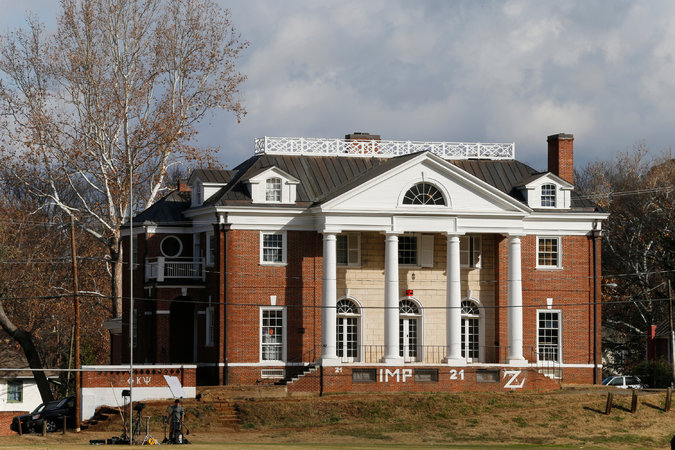
Phi Kappa Psi house
Today, the U-Va. fraternity chapter where Jackie said the attack occurred in September 2012 denied that such an assault took place in its house and also asserted that it did not host a “a date function or social event” during the weekend of Sept. 28, 2012, the night of the alleged assault.
In addition, the name of one alleged attacker that Jackie provided to close friends for the first time this week turned out to be similar to the name of a student who belongs to a different fraternity. Contacted by the Washington Post, the man said that while he was familiar with Jackie’s name, he had never met her or taken her on a date.
The fraternity issued a statement today, saying: “Our initial doubts as to the accuracy of the article have only been strengthened as alumni and undergraduate members have delved deeper.” The fraternity is working with police to try to determine what, if anything, happened.
**
One of the most troubling aspects of Erdely’s story is that her editors went along with her decision not to attempt to contact or interview any of the alleged assailants, whom she didn’t name in the story. Earlier this week, The New York Times published a story examining the problematic nature of the Rolling Stone article. Regarding Erdely’s failure to talk to the alleged assailants, The Times said, in a classic understatement: “News organizations, seeking to be fair, usually seek comment from those suspected of criminal conduct.”
The Times story also said that Jonah Goldberg, a Los Angeles Times columnist, had compared the case to rape accusations in 2006 against three Duke University lacrosse players who were subsequently cleared. Goldberg speculated that the Virginia story might be a hoax.
In an interview for The Times’ story earlier this week, Erdely said she stood by her reporting and added, “I am convinced that it could not have been done any other way, or any better.”
The magazine’s statement today said:
“We were trying to be sensitive to the unfair shame and humiliation many women feel after a sexual assault and now regret the decision to not contact the alleged assaulters to get their account. We are taking this seriously and apologize to anyone who was affected by the story.”
This afternoon, a New York Times reporter got an interview with Dana, the managing editor.
“I don’t know what happened that night,” Dana told The Times. “I don’t know who is telling the truth and who is not.”
And that, he added, is a position that an editor should never be in after a story is published.

 JimmyCsays: At the juncture of journalism and daily life in KC
You must be logged in to post a comment.