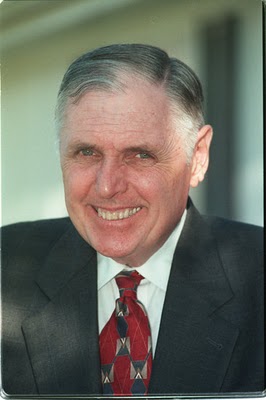
I was very saddened to read in Sunday’s paper about the death of former Kansas City Councilman Bob Lewellen.
I’m proud to say he was a friend to me personally, and, from a professional standpoint, he was a reporter’s delight. He was always thinking, figuring out how to advance the causes that were important to him, and he was a font of information and shared it liberally.
Between Lewellen and former Councilman Frank Palermo, who served contemporaneously with Lewellen, the information spilled out like the swollen Mississippi River.
I used to call Lewellen “an equal opportunity tipster” because, when he wanted to get a story out about one thing or another, he might first pitch it to a favored reporter, but if that reporter didn’t run with it, he’d tip off the next reporter on his list.
I covered City Hall for The Kansas City Times and, later, The Star, from 1985 to 1995 and had a lot of opportunities to write about Lewellen, who was on the council from 1983 to 1991.
 The most memorable story I have about Lewellen came about as a result of a brouhaha over a secret, illegal meeting that took place in the late 1980s, I believe, while Lewellen was chairman of the Finance Committee.
Here’s what happened:
One of the main jobs of the Finance Committee was to recommend a proposed city budget, which the full council took up in late April every year. At about $750 million dollars (more than $1 billion now), the budget was almost always delicate and controversial. Every council member fought for a piece of the pie for his or her district, and reaching a consensus required a fine balancing act.
That particular year, the budget process was particularly fractious and difficult. Unbeknownst to the council at large, one Finance Committee member, Mary Bryant, asked Lewellen and the two other committee members — Joanne Collins and Katheryn Shields — if the committee could meet in secret at Fedora’s, an upscale Plaza restaurant.
The idea was to hash out their differences and cut up the pie outside the public eye so the committee members could wheel and deal freely.
Now, anytime that a quorum of an elected public body, or a committee of an elected body, gets together in public, it’s considered an open meeting under the Missouri Sunshine Law, requiring at least 24 hours public notice. So, this gathering was clearly illegal, and the committee members knew it.
The meeting went off as planned, with one exception: Bryant, who initiated the meeting, didn’t attend. I never found out why; he just didn’t go.
At the next regular meeting of the council, Councilman Dan Cofran, who had learned about the meeting, stood up and, in front of everyone, exposed the dastardly deed. As I recall, one of the committee members either confirmed the meeting, or none of them denied it.
I was furious. When the meeting ended, I corralled Cofran and got as much information from him as I could. I don’t remember if I was able to talk to any of the Finance Committee members, who scrambled out of the chamber as fast as they could, but I got enough to know that Cofran was on the money.
As I left my parking lot on the north side of City Hall and proceeded south on Oak, toward The Star building, Lewellen happened to be pulling out of the City Hall garage. We looked at each other. He grinned. I gave him the finger.
I wrote a story for the next day’s paper, exposing the chicanery, but that didn’t satisfy me…not at all.
I tossed and turned that night, and the next morning, still fuming, I went straight to the third-floor office of then-publisher Jim Hale. “Jim,” I said, “as you probably know by now, the City Council Finance Committee held a secret meeting at Fedora’s last week, and I think we should sue them.”
These were the days when The Star was a cash cow, and we didn’t hesitate to sue someone over a violation of the Sunshine Law.
“I think you’re right!” Hale said, without hesitating. And with that he summoned Scott Whiteside, our in-house lawyer, had me brief him on the situation and gave him the green light to set in motion a civil complaint.
Then, Whiteside and I traipsed down to the second-floor newsroom for a meeting with managing editor Monroe Dodd and other top editors. That’s when I started feeling a little awkward. After all, in going straight to Hale, I had completely jumped the chain of command, bypassing my assignment editor, the managing editor and the editor.
But I had set the wave in motion, and nothing was going to stop it. I remember that Dodd glanced at me curiously a couple of times during the meeting. Afterward, he took me aside and said, “Fitz, I wish you’d let me in on the fun sometimes!”
That reaction greatly relieved me because I could see that while he was a little miffed at being circumvented, he recognized that I had acted strictly in the interest of the newspaper and the public.
The case went to trial in Jackson County Circuit, with Lewellen, Shields and Collins as the defendants. Bryant, because he had been a no-show, slipped the noose.
I remember Lewellen’s attorney cross-examining me at length on a variety of issues that didn’t relate to the issue of the Sunshine Law having been broken.
When Lewellen was asked how the meeting came about, he said, succinctly,“The girls (Shields and Collins) wanted to get together and talk things over, and I agreed.”
The judge — whose name I can’t recall — found all three guilty. He fined Shields and Collins $100 each, and he fined Lewellen $300, hitting him harder than the others because of his leadership post. Although the fine was small, it was a clearcut win for the paper and the public and, naturally, we reported the result.
Collins and Lewellen accepted the ruling and paid their fines. Shields, with her husband, Phil Cardarella, serving as her attorney, appealed to the Missouri Court of Appeals-Kansas City District but lost.
Within days, I was back in Lewellen’s office, and we laughed and joked about the case, particularly about Bryant getting a pass. I asked Lewellen if he remembered me giving him the finger, and he said it had slipped his mind.
For both of us, the secret meeting was water under the bridge. City Hall was brimming with stories, and we needed each other too much to let a little thing like an open-meetings lawsuit lead to relation-changing resentment.
Read Full Post »

 JimmyCsays: At the juncture of journalism and daily life in KC
You must be logged in to post a comment.