Feeds:
Posts
Comments

Archive for the ‘Uncategorized’ Category

Almost every day, someone asks me: “Who’s behind this sales-tax proposal and what do they want?”

Many people seem to think that the Civic Council is involved in some sort of conspiracy designed to further enrich its individual members.

I tell people I do not believe that is the case.

In my opinion, the Civic Council’s motivation revolves around an under-the-radar aspect of this campaign:

For more than a decade, the Civic Council (consisting of the CEO’s of the biggest companies and the managing partners of the biggest law firms) has quietly nurtured the idea of making Kansas City a national center for “translational medical research.”

Furthermore, and more specifically, the Civic Council wants to make sure that the organization calling the shots is an institution of its own creation — the Kansas City Area Life Sciences Institute.

The Civic Council dreamed up the idea of the life sciences institute about 15 years ago, and the institute was formally established in the early 2000s. (You can read more about the institute’s history on its website, http://www.kclifesciences.org.)

The institute’s original business plan, finalized in 2000, called for KCALSI to “build a critical mass in life sciences research in Kansas City.” In its plan, the institute set a goal of coordinating the expenditure of $500 million a year on medical research in the Kansas City area.

The institute now has 10 “stakeholder” institutions (not including the Stowers Institute for Medical Research, which dropped out somewhere along the way). The stakeholders (including Children’s Mercy Hospital, St. Luke’s and UMKC, which would receive tens of millions of dollars a year in sales-tax proceeds) spend more than $550 million a year on medical research, according to the KCALSI website.

Despite having reached the $500-million-a-year threshold, however, the fact is that the life sciences institute has not grown and prospered as the Civic Council had envisioned.

It has not approached anything close to the “critical mass” it talked about in 2000.

With just three employees and depending exclusively on its “stakeholder” institutions to keep it relevant, KCALSI has failed to establish itself as a key player in the medical-research industry.

In my opinion, that’s what this tax proposal is all about:

The Civic Council is seeking to prop up and inflate the life sciences institute, making it the viable, prosperous hub around which most of the major medical-research institutions in the Kansas City area would revolve.

To me, it’s simply a matter of the Civic Council being determined to reach a long-sought goal — but at taxpayers’ expense, not the private sector’s.

Once again, it is clear that wealthy, influential individuals and big corporations would rather gamble with public money than their own.

The half-cent-sales-tax proposal on the Nov. 5 ballot in Jackson County is risky and extravagant, and it deserves to be voted down.

**

See this post and much more at stopabadcure.org

**

The first of three Town Hall meetings sponsored by Question 1 opponents, including Committee to Stop a Bad Cure, will be held at 6 p.m. tonight at the Mid-Continent Library in Independence. The address is 317 W. U.S. 24. Everyone is welcome. Hors d’oeuvres will be provided.


Read Full Post »

This is the day many of you guys have been waiting for — Yard Sign day.

Marcus Leach and I picked up an order of 500 this afternoon from Gill Studio in Lenexa.

Marcus is with Citizens for Responsible Research, a campaign committee financed almost exclusively by Brad Bradshaw, a lawyer and physician from Springfield. My Committee to Stop a Bad Cure works loosely with his committee. Marcus is working on behalf of Bradshaw’s committee.

Anyway, I like the signs a lot, particularly the words “$800 MILLION TAX,” which is the total amount (at a minimum) that the proposed half-cent sales tax for “translational medical research” would raise.

I planted the first sign in my yard yesterday afternoon.

I have 200 signs; Marcus kept 100 for his committee’s distribution; and 200 are going to the League of Women Voters.

Any of you who would like one or more, contact me by email — jim.fitzpatrick06@gmail.com.

Let’s plant these yard signs and stake out our turf….NO ON JACKSON COUNTY QUESTION 1.

photo

**

Meanwhile, the money keeps a rollin’ into the coffers of Citizens for Research, Treatments and Cures, the Civic Council-sponsored committee that is going all out financially to try to push Question 1 over the top on Nov. 5

St. Luke’s Health System made two $10,000 contributions within the past week, bringing its total contribution level to $40,000. In addition, St. Luke’s Foundation has given $10,000.

Is it any wonder that St. Luke’s is able to dump $50,000 or more into the election? The private, nonprofit hospital would love to get its hands on $8 million a year of taxpayer funds for 20 years. Not that it needs it, of course, because the hospital probably is generating tens of millions of dollars more than it spends each year, as it is. 

Other large contributions in recent days: Mariner Holdings, an investment advisory firm in Leawood, $25,000, and Kansas City Southern Railway, $10,000.

The CEO’s of Kansas City Southern and Mariner Holdings undoubtedly are members of the Civic Council, an organization of the area’s top business and law-firm leaders. The Civic Council does not reveal its list of members.

As an organization, the Civic Council has donated $600,000 to the cause, and, yet, oddly, the organization never sends one of its members or leaders out into the community to speak in support of Question 1. It always sends minions, usually lawyers from the Polsinelli firm, which is in line to do a significant amount of legal work for the proposed Translational Medicine Institute of Jackson County.   

The cures committee has raised $1.5 million or more.

Read Full Post »

Following Kansas City Mayor Sly James’ refusal to endorse the proposed, half-cent sales tax yesterday, the Catholic Diocese of Kansas City-St. Joseph also came out flatly against the tax.

An afternoon post on the diocesan website said that developing “next generation medicine leading to cures for the people of the world is an ambitious and worthy goal, which should not be paid for by a regressive tax on the citizens of one county in a single state.”

The post went on to say that taking $800 million from Jackson County taxpayers (over the 20-year, initial life of the proposed tax) “without improving local services, will be additional spur for young families to move out of Jackson County.”

The statement also addressed the diocese’s concerns about ethics in medical research. The post said:

“There is nothing in the text of Question 1 to prevent embryo-destructive research. Although many scientists believe in the long-term potential for clinical applications from embryonic stem cell research, it destroys nascent human life and is thus immoral…”

That point is likely to reverberate with many conservative Catholics. There are plenty in that category.

**

Regarding Mayor James’ statement, I learned just last night from an irrefutable source that before the Civic Council of Greater Kansas City — the prime mover behind the tax proposal — brought its case to the County Legislature, the civic leaders first spoke with Mayor James. He told them he couldn’t support it.

No wonder…with other pressing issues on the city’s plate, including renovation of KCI, separating the combined storm water and wastewater sewer system, and building the $100 million streetcar system downtown.

Rebuffed by James, the Civic Council took its extravagant and risky plan to the county, selling it well enough to convince the County Legislature to put it on the ballot. Now, the Civic Council is trying to take us county residents for a ride.

Fortunately, a veritable mountain of organized opposition is developing, and the Civic Council’s $1.5 million to $2 million campaign could very well end up falling flat.

**

This is all pretty serious business, you know, but here, for your enjoyment are three pertinent cartoons that a friend of mine put came up with. All three are included in posts — “August Ambush,” “Current Sales Tax Rates” and “Translational Means I Don’t Get It” — on stopabadcure.org.

Bad Cure05

Fleece10

Fleece99


Read Full Post »

Important breaking news, everyone: Mayor Sly James and several other Jackson County mayors have refused to endorse the sales-tax proposal.

Yael Abouhalkah of The Star reported the news in an online story this morning.

You might think that a non-endorsement is not important, but it is very much so.

Listen to the official comment from the mayor’s office:

“Mayor James is supportive of the broad concept of translational medicine but at this time is not taking a position on this particular ballot question.”

It’s easy to read between the lines, isn’t it?This particular ballot question SUCKS!

Slyj

James

A person close to James told me a few weeks ago that James opposed the measure, partly because, if it passed, voters would be less likely to approve any other, higher-priority proposal that City Hall might bring to a vote in the next few years.

In addition, friction has developed between the city and the Civic Council of Greater Kansas City, which is spending and pushing all out for the new medical-research tax.

Last year, the Civic Council refused to endorse a proposed half-cent sales tax for park and zoo improvements — a measure that James went way out on the limb for.

The civic big shots said they wanted to see a full financial plan from City Hall before they endorsed anything.  (I think, like many other people, including me, the civic leaders want the City Council to deal with the sticky issue of pension reform before any more tax increases are proposed.)

Voters approved the sales-tax, giving James a big victory.

Today, it was payback time for the Civic Council.

It’s not a good idea to be on the Civic Council’s shit list, but it’s even worse to be on the mayor’s shit list.

**

I apologize for the double posting; I had formatting problems with the first post.

**

Be sure to keep reading the stopabadcure.org website for more scintillating information about the boondoggle tax.

Read Full Post »

Boy, are the political consultants and the local TV stations making out in this campaign!

According to a finance disclosure report filed with the Missouri Ethics Commission on Tuesday, the Committee for Research, Treatments and Cures had paid three local consultants or groups nearly $100,000 as of Sept. 30.

In addition, the committee, which is pushing a proposed half-cent sales tax for “translational medical research,” had spent a whopping $353,000 for TV ads.

Tuesday was the due date for the first full, campaign disclosure reports for committees working for and against Jackson County Question 1.

The research and cures committee reported having raised slightly more than $1 million as of Sept. 30, the ending date for the Oct. 15 report.

But we know that they have raised at least $1.4 million because contributions of $5,000 or more must be reported within 48 hours of being received.

The vast majority of the proponents’ campaign funds are coming from people and businesses associated with the Civic Council of Greater Kansas City, which consists of the leaders of the area’s largest businesses and law firms.

With the help of its veteran consultants (political gunslingers for hire) the civic elite are trying to slip this bloated and risky plan past the public in a Nov. 5 special election. The tax would extract $40 million to $50 million a year from taxpayers, or about $1 billion over the initial 20 years’ duration.

The election qualifies for “special” status because it is the only issue on the ballot everywhere except in Blue Springs, where a half-cent sales tax for parks is also on the ballot.

The cost to  Jackson County taxpayers to simply conduct the election is $1 million. (Thanks a lot to the Cowardly County Legislature for rolling over for the civic big shots and putting this on the ballot without any serious public discussion.)

The names and amounts for the major contributors (see “Big Bucks” post on the Committee to Stop a Bad Cure’s website) did not change significantly in today’s report.

This did mark the first time, however, when the public was able to see how the tax advocates are spending that boatload.

The local consulting companies that had received significant sums as of Sept. 30 were:

Axiom Strategies (Jeff Roe), $47,000

O’Neill Marketing and Events Management (Pat O’Neill), $22,700

Glorioso Resources (Steve Glorioso), $17,000.

Cambridge Consultants of Prairie Village (Pat Gray), $10,230.

In addition, the campaign committee paid Groundswell Public Strategies, Des Moines, $18,000. Roy Temple, chairman of the Missouri Democratic Party, is a Groundswell partner. He lives in Lee’s Summit.

jeff rowe

Roe

oneill

O’Neill

stevieg

Glorioso

Most gifts to the cures group during the first period were above $1,000.

The smallest contribution, by far, was $5, from a woman named Mindy Mazur of Ashland, Mo. She might be one of the few grassroots supporters of the tax proposal.

And, finally, one other contribution note…Roe’s Axiom Strategies, which, as I said, received $47,000 from the committee, made a contribution to the committee:

One…hundred…dollars.

**

:: The Committee to Stop a Bad Cure, which I registered on Aug. 27, reported raising $4,307 and spending $4,010 during the first period. I contributed $4,000 of the $4,300. Our biggest expense was $3,000 for four billboards.

**

:: Another opposing committee, Citizens for Responsible Research, led by Brad Bradshaw of Springfield, reported raising $113,506 and spending $97,425. Bradshaw contributed $57,000 to his committee; he loaned it $50,000; and he contributed another $6,306 in the form of “in-kind services.”

He had only one outside contributor, a Springfield lawyer named Eric Belk, who contributed $200.

Of the $97,000 that went out, Citizens for Responsible Research paid The Borich Group of Kansas City $60,000 for a variety of work.

The company is headed by a young man named Shawn Borich, who is an MU graduate. Two other Borich Group employees are working on the campaign.

Bradshaw, a physician and lawyer, favors a statewide tax for medical research,

**

To see various committee reports, go to the Missouri Ethics Commission website. Then…

– Under “Resources For,” click on “Candidates/Committees
– Click on “Ballot Measures by Election
– Select the 11/05/2013 election date from the drop-down box
– Click “Search

At that point, you can select the committee whose report you would like to review.
Click the “Reports” tab at the top of the page, and you’re on your way.

The Citizens for Responsible Research’s report is difficult to find, but you can get to it by entering the committee name on the “candidates and committees” link.

Read Full Post »

Tonight, for the fourth time in the last two weeks or three weeks, I listened to proponents of the half-cent, medical-research sales tax make their sales pitch at a public meeting.

And for the fourth time, I watched the opponents present their case.

(Tonight’s meeting was of the South Kansas city Alliance in a fire station/meeting hall complex at 97th and Marion Park Drive.)

After watching and participating in those four meetings, I can tell you that a clear trend has developed.

Here’s how it goes:

The proponents — the speakers vary from one place to another — do a workmanlike job of laying out their cards.

The problem is they have a weak hand and that their selling points — “Jackson County could be a destination for health care”…”We could make ground-breaking advances”…”This is an investment that will generate a return” — are general and unconvincing.

On the other hand, we, the opponents, always make a much stronger case, with arguments such as:  “Forty million dollars a year could put to much better use than on a local medical-research program;” “Sales taxes are already too high, and they hit poor people the hardest;” and “The proposed tax looks like a money grab.”

But I have noticed another element that is Just as important as having a superior case:  Most of us opponents speak with passion. And that’s because, where the civic elite are propping up and dispatching their minions around the county, the opponents are fighting tooth and nail for what is in the best interests of their neighborhoods and their county.

As I said at last week’s Citizens Association meeting, we are in a street fight with very wealthy people. And we dearly want to kick their asses, partly because the civic elite were so cavalier about bringing this extravagant and foolish proposal forward and getting the County Legislature to slip it onto the Nov. 5 ballot.

Fleece10The civic leaders’ ambush — launched just three weeks before the Aug. 27 deadline for putting a measure on the ballot — was very calculated.

Their strategy from the outset has been very simple:

Rush the proposal onto the ballot without anything approaching a full, public airing; run a heavily financed, six-week campaign; and try to fool enough people — through TV ads and splashy brochures — to skim to victory in a special, one-issue election with a light voter turnout. 

The problem is that this arrogant, condescending strategy has started to make a lot of people really angry, and I think the turnout could end up being significantly larger than the 10 percent (of registered voters) that some election officials are predicting.

Tonight in Southtown, for example, a man named Lou Austin spoke in a raised voice as he recounted his own medical problems but asserted that a local sales tax should not go toward a bloated medical-research program. The city and his own south Kansas City area had many other, higher needs, he said.

He also drew nods and utterances of agreement when he spoke angrily about the proponents’ ability to raise hundreds of thousands of dollars with a few snaps of the fingers.

(I’m not sure one person among 50 or six on hand tonight was in favor of the tax proposal — besides, of course, the proponents’ presenters.)

Yes, this is a David and Goliath situation.

But our slingshot-launched pellets are opening big holes in Goliath’s flimsy armor, and they’re starting to take their toll.

…Wouldn’t it be great to see arrogance and entitlement brought crashing to the ground?

**

For much more about the proposed half-cent sales tax for “translational medical research,” go to stopabadcure.org

Read Full Post »

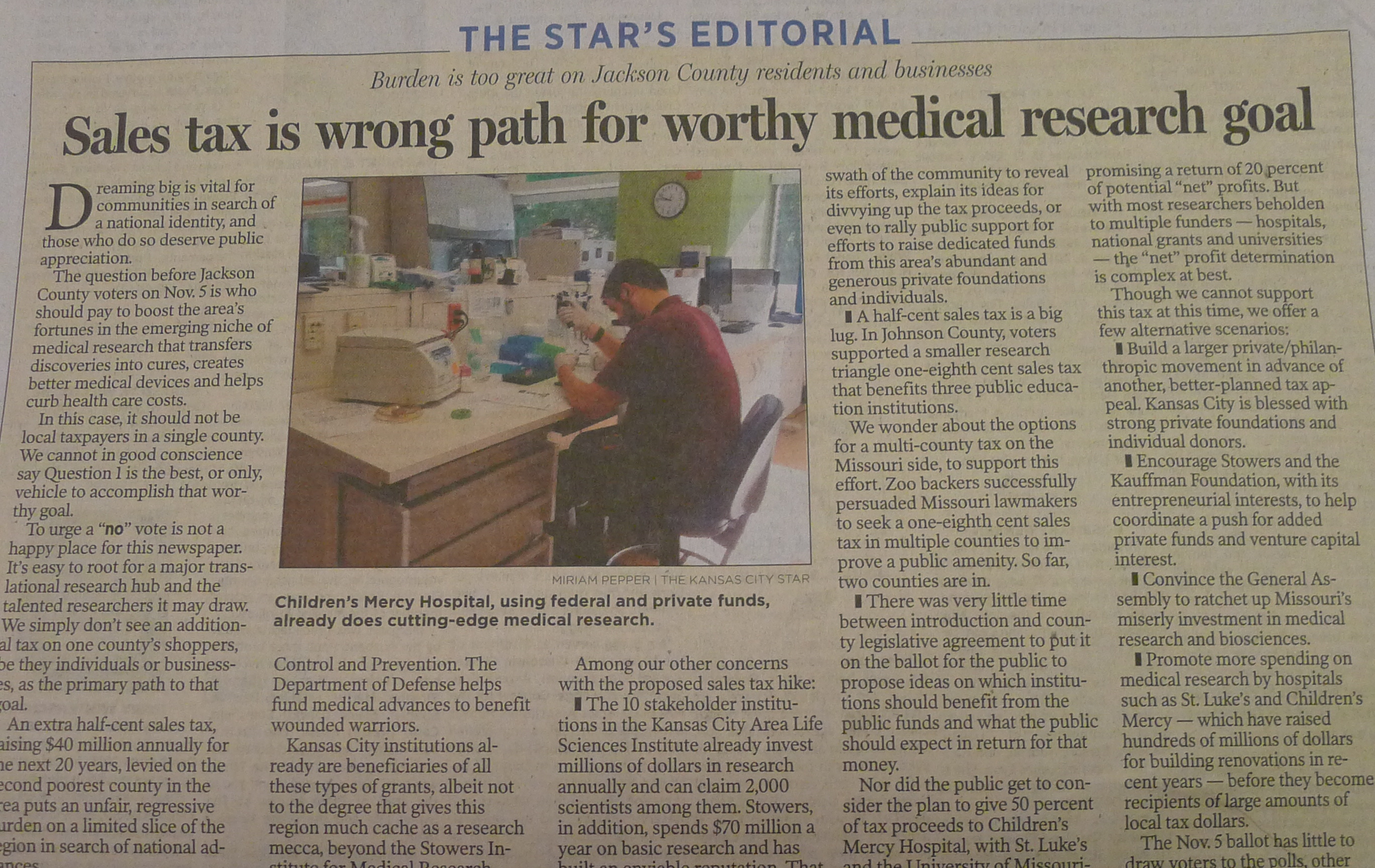
P1030082

It’s a beautiful thing, isn’t it? This editorial splashed all across the top of the Sunday KC Star editorial page?

How could we opponents of Jackson County Question 1 ask for more? Can’t. Won’t. We’re very happy.

I called Clinton Adams of Freedom Inc. at 10 o’clock last night, after reading the editorial online. He was at his girlfriend’s house.

“Clinton,” I shouted into the phone, “Great news…”

He was equally excited.

Despite the precipitous decline of daily newspaper fortunes around the country, the big-city dailies remain the most credible molders of public opinion within their coverage areas.

Many, many people tend to follow the lead of their local paper, mainly because most people don’t pay a lot of attention to political and governmental developments, day in and day out. Instead, they rely on their newspaper to sort it out and point them in the direction of the best public interests.

Ohhhh, I can already hear the scoffing and howling at that idealistic assertion:

“Hardly anybody reads anything printed any more.”

“The paper is so damned one-sided (liberal, for sure) I don’t pay any attention to it.”

“It’s a bunch of elitists down there, sending out ultra-low-frequency waves and trying to control our minds.”

I’ve heard it all. (Maybe not that last one, but it’s coming.)

But I worked at The Star for 36 years, and I know that the newspaper’s editorial voice has always spoken in the best interests of the city and the region.

In fact, there’s only been one instance that I’m aware of when a publisher overruled an editorial-board majority. I think it was when Bill Waris was running for re-election as Jackson County executive in 1987. Then-Publisher Jim Hale wanted to endorse him, for one reason or another, while the editorial board was decidedly against it.

With gritted teeth, somebody had to write the endorsement editorial, not believing a word of what he or she wrote.

**

Besides the newspaper’s credibility, there’s at least on other reason that Sunday’s editorial was so important.

People who read the paper tend to vote…especially in special elections. The proposed half-cent sales tax for “translational medical research” is the only thing on the county ballot, everywhere except Blue Springs, which also has a half-cent-sales-tax proposal for city parks. (How do you think Blue Springs residents are going to feel about the medical-research tax?)

More than anything else — more than TV and radio ads, billboards, mailers, public hearings — that Sunday editorial will influence votes on Nov 5.

In the past week or so, I’ve written about what a terrible job The Star is doing of reporting developments on the sales-tax campaign. It didn’t report, in print, the decisions of Freedom Inc. and the Citizens Association to recommend that voters reject the tax. It mentioned the developments online, but you had to be Inspector Clousseau to find those mentions.

But on the editorial page, Yael Abouhalkah is watching…watching out for the public interest, as he has for about 25 years or so, “covering” City Hall and Jackson County, to a lesser extent.

A lot of people don’t like Yael’s commentaries; they regard him as a guy with a funny name who’s trying to dictate public policy.

You know what? He’s more right and more credible than the politicians…

He doesn’t take campaign contributions or money under the table; he doesn’t go out drinking with the pols;  and when he writes the lead editorial on a Sunday paper that goes to more than 300,000 households, people pay attention.

Papers across the nation have editorial page writers like Yael — although probably not nearly as good, in most cases — evaluating elected officials, tax proposals and government trends, and trying to point the best way forward for their cities.

In the short term, right here in Jackson County, the best way forward is to turn back the civic elite’s goofball proposal that county residents pay for their extravagant pet project. You know it’s a phony-baloney deal — The Kansas City Star says so.

**

For much more on the sales tax, check out stopabadcure.org

Read Full Post »

The Kansas City Star today delivered a sledgehammer blow to the prospects for Jackson County’s proposed half-cent sales tax for “translational medical research.”

In an editorial that will appear in Sunday’s printed edition, The Star said that “local taxpayers in a single county” should not have to bear the cost of “the emerging niche” of translational medical research.

In the medical sense, “translational” means reducing the time frame, as much as possible, between discoveries and getting products and pharmaceuticals into the marketplace.

The editorial, probably written by chief political editorial writer Yael Abouhalkah, eloquently explores the many flaws in the proposal, which was the brainchild of Kansas City’s civic elite.

The Civic Council of Greater Kansas City, consisting of area business leaders, already has poured at least $600,000 into a TV-heavy campaign designed to win voter approval of the measure on Nov. 5.

The editorial said, in part:

“An extra half-cent sales tax, raising $40 million annually for the next 20 years, levied on the second poorest county in the area (after Wyandotte) puts an unfair, regressive burden on a limited slice of the region in search of national advances.”

The editorial noted that 10 Kansas City health-care institutions “already invest million of dollars in research annually and can claim 2,000 scientists among them.”

A separate institution, the Stowers Institute for Medical Research, “spends $70 million a year on basic research and has built an enviable reputation,” the newspaper said.

The editorial also made the following points:

— The Civic Council leaders “failed to reach out early to a broad swath of the community to reveal its effort” or rally public support for a drive to raise money privately, including from corporations.

— The three-week period between introduction and county legislative agreement to put the issue on the Nov. 5 ballot did not allow for public input.

Turning to “alternative scenarios,” The Star made these suggestions:

“Build a larger private/philanthropic movement in advance of another, better-planned tax appeal.”

“Encourage Stowers and the Kauffman Foundation, with its entrepreneurial interests, to help coordinate a push for added private funds and venture capital interest.”

“Promote more spending on medical research by hospitals such as St. Luke’s and Children’s Mercy — which have raised hundreds of millions of dollars for building renovations in recent years — before they become recipients of large amounts of local tax dollars.”

The Star’s editorial board consists of Publisher Mi-Ai Parrish; Editorial Page Editor Miriam Pepper; Abouhalkah; and columnists Barbara Shelly and Lewis Diuguid.

Foreshadowing today’s editorial, Abouhalkah for weeks has been writing columns critical of the measure.

Shelly attempted to balance the scales on Friday, Oct. 4, when she wrote an Op-Ed column saying that the sales-tax measure “deserves at least to be judged on its merits and not on distractions.” The distractions she referred to included opposition contentions that the proposal was “a greedy cop-out,” in Shelly’s words.

In staking out its position, The Star joined several civic and political organizations in denouncing the measure.

Organizations opposing the tax are the east-side political club Freedom Inc.; the nonpartisan, city-oriented Citizens Association; and the local branches of the League of Women Voters and the NAACP.

Two registered campaign committees are working against the measure: Citizens for Responsible Research and the committee that I registered a day after the County Legislature approved the vote — Committee to Stop a Bad Cure.

**

You can read this same story on the stopabadcure.org.

Read Full Post »

Greetings from the campaign trail!

I believe momentum is building on our side, and it’s a sweet thing to see and feel.

Wherever I go, people tell me they think the proposed half-cent sales tax for “translational medical research” is not a county government priority or responsibility and that taxpayers should not have to pick up the tab for the proponents’ extravagant, $1 billion program.

One of the things that galls me about this tax is that it did not originate with county government. Our civic leaders hurled it at the Jackson County Legislature, and it crashed down on the courthouse steps like a meteor, hissing and smoking.

Almost invariably, proposed tax proposals start within governments. For example, let’s say that city officials are facing a backlog of road, bridge and curb repairs. The bureaucrats might take their case to the City Council and ask the council to put a quarter-cent sales tax on the ballot (or some other tax or fee) to finance the project.

Another example: The Parks Department needs more money for the zoo and for other park district improvements, and it asks the City Council to put a half-cent sales tax on the ballot.

By the way, that’s exactly what happened last year, and voters approved the new tax. Moreover, it passed with no help from the Civic Council of Greater Kansas City (the group that is behind the medical-research tax), which refused to endorse it.

The point is, the civic bigwigs foisted the latest tax proposal on the County Legislature in August, just three weeks before the deadline for putting a measure on the Nov. 5 ballot.

Pressured by wealthy people, the Cowardly Legislature voted to put the measure on the ballot, even though nobody seemed to like it except County Executive Mike Sanders.

Sanders is sucking up to the Civic Council in hopes that its members will shower him with large contributions when he runs for statewide office.

The whole thing stinks.

**

…Anyway, I wanted to tell you how the endorsement battle is shaping up and show you a couple of photos.

As you know, we — the opponents — have had a very successful two weeks, with Freedom Inc. recommending a “no” vote last week and the Citizens Association putting its “bullshit” stamp on the measure this week.

Earlier, the local branches of the League of Women Voters and the NAACP came out against the measure, which will be Question 1 on the Nov. 5 ballot. (It will be the only question on the ballot in all but one municipality.)

On the other side, here are the groups and organizations that have endorsed the proposal:

The Committee for County Progress, Firefighters Local 42, the Greater Kansas City Chamber of Commerce, the Mattie Rhodes Center and the Latino Civic Engagement Collaborative.

Of those, the firefighter union is the most significant because the firefighters and their families go to the polls and vote. In their spare time, the firefighters should be teaching civics classes in our local high schools.

I have no idea why the firefighters have endorsed the issue, other than that, like Sanders, I’m sure they want to be in good stead with civic leadership when it comes time to battle with the city over salaries and departmental manpower.

Certainly they aren’t for it because they’ve got hearts of gold and want to see cancer, diabetes and multiple sclerosis stamped out right here in Jackson County.

**

Now on to those photos.

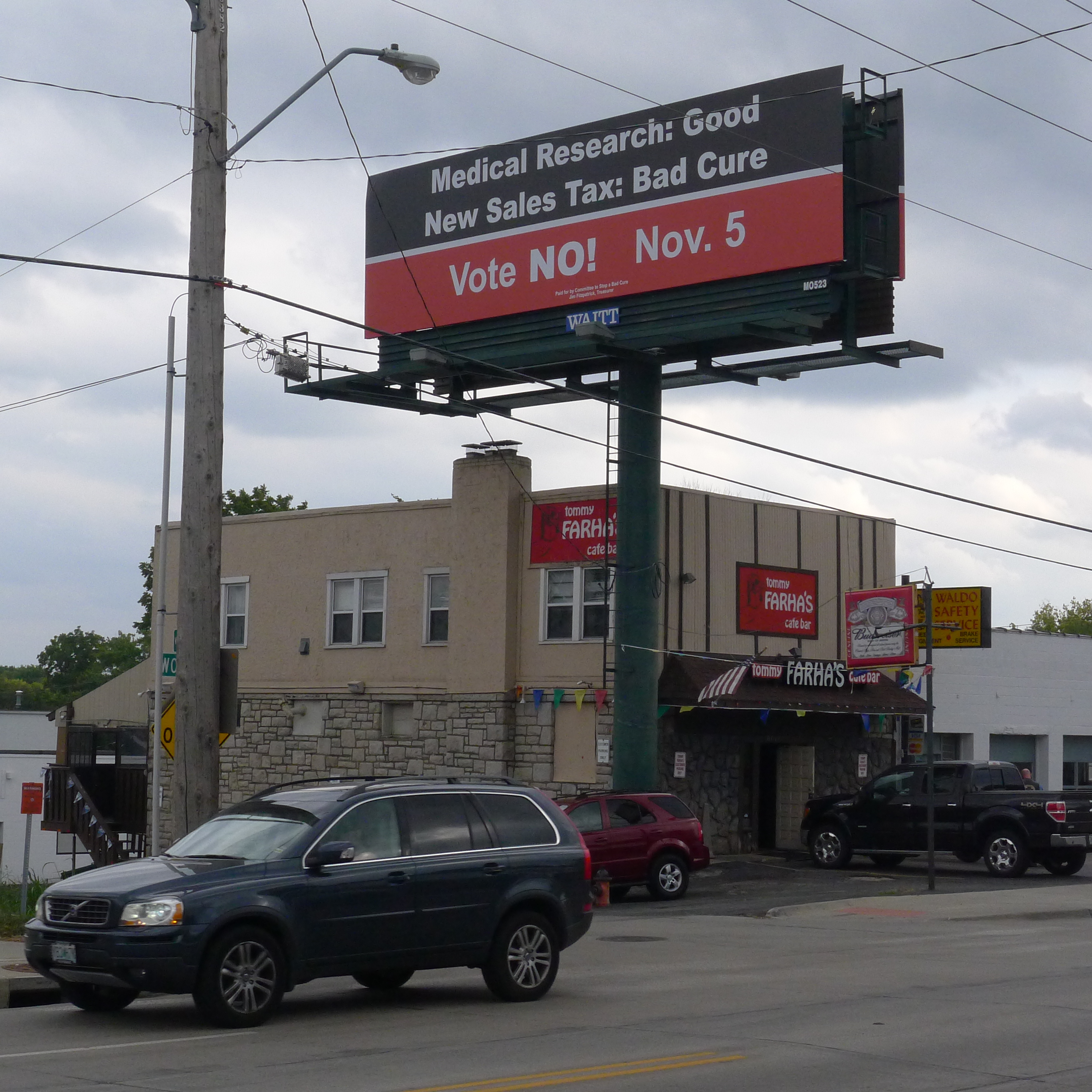
Here’s a photo of one of four billboards the Committee to Stop a Bad Cure has up around town. This one — and the board directly behind it — is at 80th Terrace and Wornall, on the east side of the street.

P1030079

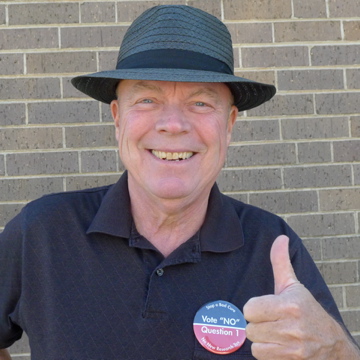
And here’s a new photo of me, which I have put on the committee’s stopabadcure.org website.

P1030064

Be sure to check out that website periodically. New posts go up every other day or so. A new one — delving into what “translational research” is all about — went up today.

Pax vobiscum (Peace be with you.) But let’s continue fighting like hell!

Read Full Post »

The Committee for Research, Treatments and Cures must be getting used to rejection by now.

Tonight, the Citizens Association, a non-partisan, Kansas City political organization followed the lead of several other political and civic organizations and recommended that citizens vote against the proposed half-cent sales tax for “translational medical research.”

The Citizens Association is the fourth major organization to come out against the tax, which will be on the ballot throughout Jackson County on Nov. 5.

The others have been the local branch of the League of Women Voters, the local branch of the NAACP, and Freedom Inc., the powerful, east-side Democratic organization.

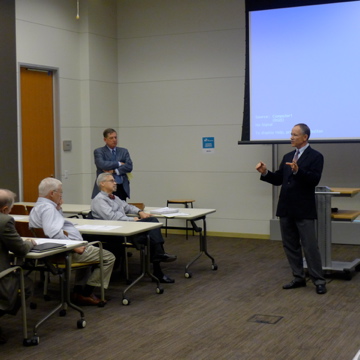
P1030057

Dr. Wayne O. Carter spoke Tuesday night in favor of a half-cent sales tax for “translational medical research.” Standing to the side was Pete Levi, who also spoke on behalf of proponents.

The Citizens Association has been in existence since 1934 and has long stood for progressive and honest government. The association was largely responsible for breaking the Pendergast organization’s stranglehold on city government.

The association usually limits its range to city activities, but it made an exception in this case. Association Chairman Dan Cofran came out against the tax proposal on this blog on Sept. 5.

Members of the board of directors said the board voted overwhelmingly to oppose the tax, which would extract $40 million to $50 million a year from the pockets of Jackson County residents.

A news release from the Citizens Association said:

While well intended and thoughtful, local sales taxes are regressive, are getting too high in our community, and in any event should be used carefully to provide services that only government can provide, for example, basic local government services.

In addition, the community would benefit from having more time to consider this relatively complicated proposal.

Proponents of  the tax — primarily the biggest business and law-firm leaders — dropped the tax proposal on the Jackson County Legislature three weeks before the deadline for the legislature to put a measure on the Nov. 5 ballot. After being heavily lobbied by the monied set, the legislature voted 7-2 to put Question 1 on the ballot.

…Before making its decision Tuesday night, the Citizens’ board heard from representatives of both sides of the issue.

Representing the Committee for Research, Treatments and Cures were former Chamber of Commerce President Pete Levi and Dr. Wayne O. Carter, president of the Kansas City Area Life Sciences Institute, which is a driving force behind the proposed Translational Medicine Institute of Jackson County.

Representing the opponents were Linda Vogel Smith of the League of Women Voters, Marcus Leach of Citizens for Responsible Research and yours truly, treasurer of the Committee to Stop a Bad Cure.

The board members had many questions for the proponents but none for the opponents.

Although the Committee for Research, Treatments and Cures is losing the endorsement battle badly, it has, as noted above, at least $1.5 million to spend on its campaign. Most of that has been contributed by the Civic Council of Greater Kansas City (from organizational coffers), construction and engineering firms, lawyers and wealthy individuals.

The proponents’ campaign will rely primarily on TV advertising and full-color, four-page mailers to frequent voters. They also have hired the area’s best local political consultants, including Jeff Roe, Steve Glorioso, Pat Gray and Pat O’Neill.

We, the opponents, will rely on appearances before neighborhood organizations, limited TV ads, newspaper ads, billboards, yard signs and flyers.

**

Of note to some of you, The Kansas City Star held fast with its apparent new policy of not reporting major endorsements immediately after they happen. Reporter Mike Hendricks attended the meeting, but he did not write a news story for the kansascity.com website.

Last week, the paper didn’t bother to send a reporter to monitor the Freedom Inc. board meeting and, on Friday, it relegated the Freedom Inc. development to a throwaway paragraph in an otherwise unrelated political column. If you could find it, Yael Abouhalkah also wrote a column for the website’s “Opinion” section. Neither piece made a printed edition of the paper, as far as I could tell.

It’s too bad that Star readers, most of whom VOTE, are not getting these significant news developments in a timely manner and on readily observable website pages.

The paper is missing a chance to connect with its core readers, baby boomers and elderly people, many of whom have subscribed for years and rely on the paper to keep stay informed.

Oh, well…let’s hope those readers hear the political news by word of mouth.

**

You can see the same story on the Committee to Stop a Bad Cure website…http://stopabadcure.org

Read Full Post »

« Newer Posts - Older Posts »