Feeds:
Posts
Comments

Final word

Sorry, I can’t resist one last, short post on “The Election that Sent a Message.”

As you know, I tracked and reprinted on the stopabadcure.org website the best of the letters to the editor opposing Question 1, which voters crushed on Tuesday.

A wrap-up letter, written by Susan Herold of Kansas City, appeared in today’s paper. Here’s an excerpt:

Too many taxpayers throughout the country — not just Jackson County — are barely getting by…Additional sales taxes…only make purchasing basic necessities more expensive for the people who can least afford to pay for them…At a time when taxpayers are being squeezed to support the activities of corporations…I find it appalling that anyone with any sense of social justice would even suggest a sales tax as the proper support for private enterprise.

It’s a good letter, which leads me to two points.

1) The members of the Civic Council of Greater Kansas City — or any other non-governmental entity — need to leave the politics to governments. Tax proposals and other elective measures ordinarily should spring from within government rather than be thrust upon government by an outside entity, as the Civic Council did in this instance. Sometimes, of course, initiative petitions and referendums are in order, but those are exceptions.

2) Our local governments need to be much more careful and discerning regarding what types of measures they decide to bring to the voters. We voters sent a clear message Tuesday that the days of rubber stamping tax proposals are over. We will carefully analyze any new tax proposals that come forward, especially from the Jackson County Legislature, which foolishly decided on Aug. 26 to put Question 1 on the ballot.

(For the record the legislators who voted “yes” that day were Fred Arbanas, Scott Burnett, Dan Tarwater, James Tindall, Theresa Garza-Ruiz, Dennis Waits and Crystal Williams. Voting “no” were Bob Spence and Greg Grounds.)

We don’t want to see any more stinking, awful proposals, like Question 1.  In the future, legislative bodies should put any prospective ballot measure to this three-question test: Does it make sense? Will it benefit the vast majority of residents? Is it worth the cost?

You’re officially on notice, Kansas City and Jackson County.

At least one institution and one individual threw away thousands of dollars in the waning days of the Question 1 campaign.

I have previously reported significant contributions to the Citizens for Research, Treatments and Cures campaign committee through Oct. 31., a week ago today.

But, lo and behold, one chump and one institution gave a total of $20,000 after that.

Now, the world-renowned political consultants working for outlandish fees certainly knew by that time that Question 1 would be going down to an ignominious defeat. So, didn’t they tell this guy and this institution to hold on to their money? That the cause was hopeless?

Guess not.

Maybe it was because, by that point, ace consultant Steve Glorioso had become preoccupied with his impending hip-replacement surgery, which took place Wednesday morning.

Maybe ace consultant Pat Gray had gotten pissed off by then and jumped ship, as he’s been known to do.

Maybe ace consultant Pat O’Neill, who reportedly signed onto the campaign reluctantly, had moved on to planning next year’s St. Patrick’s Day Parade.

Or maybe super-ace consultant Jeff Roe had decided he was working for a bunch of losers and simply allowed them to keep pouring money in to the end.

(The end result, of course, was an 84 percent to 16 percent drubbing of Q. 1.)

At any rate, Paul DeBruce, founder and CEO of DeBruce Grain, contributed $15,000 on Nov. 1.

Then, on Monday — Election Eve — Kansas City University of Medicine and Biosciences tossed $5,000 onto the cash pile just before voters put a wand lighter to it.

Four days earlier, Thursday, Oct. 31, KCUMB had contributed $4,450.

You would think that considering all the KCUMB money the late Karen Pletz made off with when she was CEO, the medical school would be looking to replenish its coffers.

As I said in my Nov. 1 post, the heavy hitters contributed about $1.8 million to the cures committee. On Tuesday night, as the results rolled in, I kept thinking that it was kind of entertaining sometimes to watch super rich people spend their money foolishly.

**

Now, as we put this election campaign in our collective rearview mirror, I want to tell you the Top Five reasons why we had to defeat the proposed half-cent sales tax for translational medical research.

Because if voters had approved it…

5) Jim Stowers would have wanted taxpayers to reimburse him the $2 billion he spent establishing the Stowers Institute for Medical Research.

4) The “rock star” researchers who would have been hired would have built swimming pools in their south Johnson County backyards.

3) Jackson County would have used part of the money to build a golf course for research retirees.

2) The next time, instead of three weeks notice, the Civic Council would have given the County Legislature three hours’ notice of a proposal it wanted on a ballot.

And the No. 1 reason that we had to beat Question 1 is because if it had passed…

1) The Civic Council’s next proposal would have been a sales tax for therapeutic mineral baths.

P1030118

If Jackson County voters defeat Question 1 on Tuesday’s ballot, a group of people who can claim a good deal of credit is one that is splintered and diverse.

It is not a registered committee, not a political organization and not a behind-the-scenes cabal of agitators.

It’s the people who have taken the time to express their views by writing letters to the editor of The Kansas City Star.

I haven’t kept track of all the letters, unfortunately, but I have run most of them on my stopabadcure.org website. (See “Latest Letters to the Editor” post.)

I know who wrote the first letter to the editor, however, and precisely when.

letterIt was Don Biggs, a former Kansas state senator who now lives in Downtown Kansas City.

The date was Aug. 20, less than two weeks after the public learned about this god-awful sales-tax proposal and six days before the Cowardly County Legislature voted 7-2 to put Question 1 on the November ballot.

I had been following the run-up to the county legislative vote, and Biggs’ letter struck at the heart of the matter.

His letter started like this:

I am disappointed in still another effort to raise the sales tax in Kansas City. Anti-tax is not my mode as I have voted for previous proposals, but enough is enough.

Medical research is wonderful, and Children’s Mercy and other medical facilities are worthy, as are the business leaders backing the proposal. They just need to get the revenue from sources other than a sales tax, which is the most regressive of all taxes with its greatest burden on those least able to pay.

Biggs was the first to lay out the case that we opponents of Question 1 have been repeating and reiterating in the ensuing 10 weeks.

Immediately, I began trying to get in touch with Biggs and quickly succeeded. He responded to one of two letters I sent to two addresses I found for him on whitepages.com.

At that time, I was thinking about registering a campaign committee to work against the measure, and subsequently Biggs became either the first of second member of my Committee to Stop a Bad Cure. He also was the second person to contribute to my committee ($200). (I was the first.)

Since Biggs’ letter, The Star has run about two dozen letters, I would estimate, opposing the proposed half-cent sales tax for “translational medical research.” Two appeared in the Star today. (See “Vote no on sales tax” and “Legislature wrong” in the link.)

Only a handful of letters urging a “yes” vote have been published.

The dearth of supportive letters tells me two things: 1) The proposed sales-tax does not have many strong supporters and 2) even with all its money (about $2 million), the Citizens for Research, Treatments and Cures committee has not been able to get people to either write letters of their own or sign letters that committee consultants have ghost written.

On the other hand, the constant drumbeat of letters from genuinely angry opponents has a significant influence on the electorate, in my opinion.

When readers see a steady stream of letters on a given issue — especially on one side of the issue — it registers with them and prods many to find out more about it. It also tends to tilt them in the direction that the vast majority of letter writers are pointing.

With that, I offer a tip of my entire hat collection to, among others…

Amy Brown, Leawood
Dick Franklin, Independence

And from Kansas City…

Don Biggs
Mary Lindsay
Kathy Arthur
Ginzy Schaefer
Susan Birt
Catherine Morris
Dan Cofran
Paul Cox
Linda Vogel Smith
Patrick Dobson
Mark Shaft
Patty McCarty

Thank you, one and all letter writers, for organizing your thoughts and putting your stamp of disapproval on an extremely repugnant tax proposal.

As of yesterday, the people who are trying to buy this election have contributed more than $1.8 million to the Committee for Research, Treatments and Cures.

That means the committee pushing Jackson County Question 1 probably will end up spending more than $2 million trying to ram this ridiculous half-cent-sales-tax increase down the throats of average citizens.

Here’s a list of the latest four- and five-figure contributions:

UMKC Foundation, $96,000
Sprint, $25,000
Barnett Helzberg Jr. Revocable Trust, $25,000
James B. Nutter Co., $17,000
Walter Porter, Olathe, $10,000
Global Prairie, Kansas City, $5,000
Kansas City University of Medicine and Biosciences, $4,450

And here is a list of major contributions that I previously reported, as of Oct. 25:

Civic Council of Greater Kansas City, $700,000
Children’s Mercy Hospital, $100,000
Donald Hall Jr., $100,000
Hallmark Global Services, $100,000
JE Dunn Construction, $100,000
John G. Sherman, chairman and c.e.o of Inergy L.P., $100,000
Robert Kipp, former Crown Center Development president, $50,000
Burns and McDonnell, engineering company, $50,000
St. Luke’s Health System, $40,000
St. Luke’s Foundation, $30,000
KCP&L, $25,000
Mariner Holdings, $25,000
Tom McDonnell, retired DST c.e.o., $25,000
Irvine O. Hockaday Jr., former Hallmark Cards c.e.o., $20,000
Randall O’Donnell, Children’s Mercy CEO, $15,000
William Gautreaux, a top Inergy LP officer (see John Sherman), $10,000
Wagstaff & Cartmell law firm, $10,000
Kansas City Southern Railway, $10,000
Husch Blackwell law firm, $10,000
Dr. L. Patrick James of the KC Area Life Sciences Institute, $10,000
Polsinelli law firm, $10,000
Lockton Companies, $10,000
Tension Envelopes, $10,000
Health Alliance of Mid-America, $10,000
Blue Cross and Blue Shield of Kansas City, $7,500
Kansas City Chiefs, $7,500
Stinson Morrison Hecker law firm, $7,500

**

Today, four days before the election, here are my predictions:

1. Fourteen percent, or 56,672, of the county’s 404,000 registered voters will cast ballots.

2. The total number of “no” votes will be 30,033 (53.1 percent).

3. The total number of “yes” votes will be 26,639 (46.9 percent).

4. The Committee for Research, Treatments and Cures will have spent almost $75 per vote.

**

See stopabadcure.org for much more campaign news and analysis.

After reading the editorial and Op-Ed pages of today’s Kansas City Star, I am more convinced than ever that we opponents of Jackson County Question 1 are poised for a big victory on Tuesday.

Three letters to the editor bashed the proposal; editorial board member Yael Abouhalkah threw another uppercut in his weekly Op-Ed column; and even the leading editorial, deftly couched in the Halloween theme (“Be very, very scared”), called Question 1 a “spooky scenario.”

I can’t recall ever having seen such an imbalance in the number of letters to the editor on a tax issue. I think The Star has run two or three letters in favor of the half-cent, medical-research, sales-tax proposal, but I’ll bet two dozen opposing letters run.

What’s even more surprising about the imbalance is that when one campaign committee, such as Citizens for Research, Treatments and Cures, has an overwhelming amount of money, its consultants usually can ghost write letters and find people to sign them and send them in.

That does not appear to be the case here. All I can conclude from what I don’t see is that very few people are willing to attach their names to a letter urging passage of the tax.

Here’s a sample of what today’s writers said.

Charles Wilson of Lee’s Summit said:

“This is not a public works project worthy of taxpayer funding. This is a private, for-profit venture by groups to fund their research at taxpayer expense…Taxpayers, watch your pockets.”

Chris Haberman-Wilson of Overland Park (can’t vote, of course) urged people to read an article titled “How science goes wrong” in the Oct. 19  edition of “The Economist.”

And Mary Lindsay or Kansas City said she was “disgusted” by a mailer that lauded the benefits of “translational medicine” but bore no disclaimer — as required by law — regarding who had paid for the piece.

For his part, Yael said a significant amount of translational research (aimed at shortening the time between advances and use by consumers) already is taking place in the Kansas City area, particularly at the KU Medical Center’s “Frontiers” program. Two years ago, the medical center received a $20 million National Institutes of Health grant for clinical and translational research.

All these developments — the editorializing and the angry voices of area residents  — are looming like a giant hammerhead over Citizens for Research, Treatments and Cures.

The committee’s major backers and funders — individuals and firms connected with the Civic Council of Greater Kansas City — are dealing themselves a serious blow. Ordinarily, we residents tend to hold our civic leaders up for admiration for their contributions to the city and county, but those leaders have now dug a deep hole for themselves.

The last time the Civic Council — a secretive organization (no public membership list, no website) consisting of the CEOs of the areas biggest companies and the managing partners of the largest law firms — got so deeply involved in a political issue was 1991. That year, the Civic Council hand picked its mayoral candidate, Brice Harris, a Metropolitan Community Colleges administrator.

Harris and the Civic Council were in over their heads, and Harris didn’t even make it out of the primary election. In the general election, then-Councilman Emanuel Cleaver easily defeated Councilman Bob Lewellen, a unique and blunt-speaking guy who died a couple of years ago.

My suggestion to Civic Council leaders is that they get back to their real business — guiding their businesses and law firms — and don’t resurface on the political landscape for at least another 22 years.

Then, we (our the next generation of political activists) can whack them on the head again.

**

Note: The proponents will be holding their “watch party” at Union Station. The place to be Tuesday night, however, will be the opponents’ “victory party” at The Drop, 409 E. 31st St. (just west of Gillham). Appetizers will be served, with guests purchasing their own beverages.

All readers are invited!

Ever since hearing last Friday that the Business Journal made a ground-breaking decision to withdraw its earlier endorsement of the proposed half-cent sales tax for “translational medical research,” I have been wanting to get my hands on a copy of the full editorial.

But I’ve been REEEAL busy lately, and it’s not particularly easy to come by the Business Journal, if you don’t subscribe online or to the printed edition.

They’ve gone to a full pay wall on the Web, so you can see only about the first 100 words of any given article before being asked to subscribe in order to read further.

Also, I don’t think the Business Journal has box sales any longer, because I couldn’t find a box anywhere between the Plaza and Waldo.

But today I got a copy ($3.95!) at Barnes & Noble. The full editorial is interesting and well written. I hope you’ll take a few minutes to read it. Here goes…

P1030108

Sometimes you want something so badly, you suspend your normal thought processes.

That essentially is why we editorialized in favor of the Jackson County Translational Research sales tax in mid-August. Although we had questions at the time about the exact setup of the proposal, they were eclipsed by enthusiasm for the overall goal of building on the area’s existing life sciences efforts, especially through three impressive local institutions.

But a closer examination of the issue brings us to new ground as an editorial board. Although we are as supportive as ever of the tax proposal’s goal, we no longer support the half-cent Jackson County sales tax as the means for bringing it about.

Although supporters of the tax point to the Johnson County Education Research Tax as a good example of a county stepping up to support a less traditional public goal, taking the comparison further highlights flaws in the Jackson County proposal.

Johnson County’s one-eighth-cent levy is smaller, not only reducing the burden on taxpayers, but posing less competition for other county budgeting priorities. This is an important consideration for Jackson County if it is to continue pursuing a commuter-rail system and addressing basic infrastructure and protection needs.

The Johnson County tax is overseen by a board appointed by public bodies and populated by elected officials. This provides a level of accountability and partnership that is lacking with the Jackson County proposal, where the main recipients of the proceeds would control a majority of board seats and the county government has one representative.

It is clear that the Jackson County measure was meant to minimize county involvement as much as possible. An outline presented to the Kansas City Business Journal editorial board included no county representative on the board — the same board that would hire a scientific director and appoint both community and scientific advisory boards.

Promises that Jackson County will receive a 20-percent cut of revenue resulting from the proposed Institute for Translational Medicine are fuzzy, at best. How much revenue will the institute stand to receive after taking into account the interests of scientists and institutions instrumental in the basic scientific work that the translation institute seeks to commercialize? How will partners Children’s Mercy Hospitals and Clinics, St. Luke’s Health System and the University of Missouri-Kansas City be compensated for their collaboration? What about interests of any outside investors?

The answer is that no one can say. Backers say negotiations are underway and would continue beyond Election Day.

Finally, previous reporting by the Business Journal has pointed out that the area’s big need — if it is to optimize the economic benefit of the life sciences — is not another translational research lab, but investors. Only private investors can put up the hundreds of millions — if not billions — of dollars needed to bring a new drug to market. These investors can dictate where startups locate their operations and the jobs that go with them.

Backers of the proposed Jackson County tax say that they have no other choice after failing to win passage of a state incentive program and admit that a big reason for moving quickly is to get the measure considered during an offseason, low-turnout election. Although they deserve credit for being upfront about what’s in the best interest of their goal, that’s different from the best interests of Jackson County residents.

Even voters in favor of the establishment of a Jackson County Institute for Translational Medicine owe it to themselves to give more than  a cursory review to the 20-year investment proposal. After engaging in this process as an editorial board, we believe the present tax proposal suffers from a lack of detail, insufficient public discussion and too little accountability to taxpayers.

Now, that is an outstanding editorial, isn’t it?

I love the emphasis on the lack of public accountability; the proponents’ rush to get the measure on the ballot; and the logic of leaving extremely risky and costly research to private investors.

In addition, urging voters to “give more than a cursory review to the 20-year investment proposal” is right on the money.

Shamefully, that is exactly what the Civic Council of Greater Kansas City — the wealthy, elite group of business leaders behind this unholy proposal — DO NOT want voters to do.

No, no! Don’t examine this too closely because if you do, you just might see the gaping holes.

The proponents just want voters to watch their heart-tugging TV ads and go out and vote on emotions only.

Well, Civic Council; the voters are onto you. They’re pissed, and they’re going to blow you away on Tuesday.

**

You can see this post and much more about Jackson County Question 1 on the stopabadcure.org website.

On a day when the Kansas City Business Journal retracted its earlier endorsement of the proposed half-cent sales tax for medical research, the Civic Council of Greater Kansas City pitched another $100,0000 onto the huge pile of money being spent to try to pass the measure.

The Civic Council — whose members are primarily the CEOs of the area’s largest businesses and the managing partners of the most prestigious law firms — has now invested $700,000 in the campaign.

And still, not once, to the best of my knowledge, has a member of the Civic Council shown up to speak in favor of it. It’s always people representing the Civic Council. Even Jackson County Executive Mike Sanders, who championed the idea of putting the proposal on the ballot, has abandoned the effort, at least publicly.

Another contribution that was reported to the Missouri Ethics Commission today was $20,000 from the St. Luke’s Foundation. That brings the total St. Luke’s investment to a whopping $70,000 — $40,000 from St. Luke’s Health System and $30,000 from the foundation.

St. Luke’s Health System, of course, is one of three institutions that would share $36 million a year in new sales tax proceeds, if voters were to approve Jackson County Question 1 on Nov. 5. The other chief beneficiaries would be Children’s Mercy Hospital and Clinics and UMKC.

Other new entries into the contribution sweepstakes for the proponents are:

Tension Envelopes and the Health Alliance of MidAmerica, $10,000 each, and Blue Cross and Blue Shield of Kansas City and the Kansas City Chiefs, $7,500 each.

The view from this web perch, however, is that the nearly $2 million that the proponents probably will end up spending is headed down the tubes.

The latest setback for the Citizens for Research, Treatments and Cures campaign committee was the Business Journal’s capitulation. The weekly endorsed the proposal in mid-August, about two weeks before the county legislature even voted to put the measure on the ballot.

Last week, when Business Journal Editor Brian Kaberline was interviewing me about the campaign, I turned the conversation to his paper’s endorsement, saying: “What the heck were you guys thinking about, endorsing the proposal before the legislature had even put it on the ballot?”

He paused for a second and said something like, “I wish we would have waited on that a bit.”

In Friday’s edition, the paper said that its editorial board had had concerns about the proposal initially but that “enthusiasm for the overall goal of building on the area’s existing life sciences efforts” eclipsed those concerns.

“But a closer examination of the issue brings us to new ground as an editorial board,” the editorial went on to say.

Well, thank God. And let’s give the editorial board credit for admitting it was wrong.

…Here is a list of the cures committee’s major contributors as of today, Friday, Oct. 25.

  • The Civic Council of Greater Kansas City, $600,00;
  • Children’s Mercy Hospital, $100,000;
  • Donald Hall Jr., $100,000;
  • Hallmark Global Services, $100,000;
  • J.E. Dunn Construction, $100,000;
  • John G. Sherman, chairman and c.e.o of Inergy L.P., $100,000;
  • Robert Kipp, former Crown Center Development president, $50,000;
  • Burns and McDonnell, engineering company, $50,000;
  • St. Luke’s Health System, $40,000;
  • KCP&L, $25,000;
  • Mariner Holdings, $25,000.
  • Tom McDonnell, retired DST c.e.o., $25,000;
  • Irvine O. Hockaday Jr., former Hallmark Cards c.e.o., $20,000;
  • Randall O’Donnell, Children’s Mercy CEO, $15,000
  • William Gautreaux, a top Inergy LP officer (see John Sherman), $10,000;
  • Wagstaff & Cartmell law firm, $10,000;
  • St. Luke’s Foundation, $30,000;
  • Kansas City Southern Railway, $10,000
  • Husch Blackwell law firm, $10,000;
  • Dr. L. Patrick James, of the KC Area Life Sciences Institute, $10,000;
  • The Polsinelli law firm, $10,000;
  • Lockton Companies, $10,000;
  • Stinson Morrison Hecker law firm, $7,500;
  • Tension Envelopes, $10,000;
  • Health Alliance of Mid-America, $10,000
  • Blue Cross and Blue Shield of Kansas City, $7,500
  • Kansas City Chiefs, $7,500

That’s a total of $1.71 million.  The next deadline for a full disclosure report with the Missouri Ethics Commission is 5 p.m. Monday.

**

You can see this story and much more about the proposed half-cent sales tax at stopabadcure.org.

Funny how the Civic Council of Greater Kansas City works.

As you know, the organization of business and legal bigwigs dropped the proposed “translational research tax” on the County Legislature just weeks before the deadline for putting a measure on the Nov 5 ballot.

Said they had been working for months on details of the proposed $1 billion tax program and couldn’t present it to the Legislature until it was ready.

Well, you know what? They were telling the truth.

But they weren’t “working” on it in any conventional process. No, they were working on it through the campaign contribution process.

Last night I checked the last three years’ worth  of County Executive Mike Sanders‘ campaign disclosure reports.

You won’t believe what I found, and we’ll bring that to you right after this commercial br…

Oh, wait, this isn’t TV, I can tell you right now!

During the last three years, individuals, companies and consultants who are involved in the translational sales-tax campaign have contributed nearly $65,000 to Sanders’ campaign committee.

The committee currently has about $260,000 on hand, and it is no secret that Sanders aspires to statewide office.

Now, you can’t get to one of the big offices in the State Capitol without a lot of financial help, and the folks who want Jackson County residents to approve this tax increase have paid handsome homage to Sanders.

In turn, Sanders gladly accommodated the civic titans when they came to him sometime this year (who knows when?) and asked him to support their plan for a new 20-year sales tax to pay for this extravagant and risky research program.

Also a gleam in the eyes of civic leaders was a proposed new Hospital Hill building that would house a Translational Medicine Institute of Jackson County.

…Just rolls off the tongue, doesn’t it? Makes me picture room after room of translators working with people of various nationalities, trying desperately to get to the bottom of those people’s medical complaints.

Anyway, Sanders obliged the bigwigs and pressed the County Legislature to put the sales-tax proposal on the November ballot.

The cowardly legislature then did its part, voting 7-2 on Aug. 26 — the day before the deadline — to put Jackson County Question 1 on the ballot.

**

Now, reports are circulating that infighting has been occurring within the proponents’ campaign committee, the Committee for Research, Treatments and Cures.

That wouldn’t surprise me at all. Five or six different consulting groups are drawing down fantastic fees to try to pull the wool over the public’s eyes, and — except for my Irish buddy Pat O’Neill — some bloated egos are bouncing around at campaign HQ.
colsanders

The Colonel

In short, Col. Sanders has cooked up a particularly greasy batch of fried chicken, and almost all the key people on the proponents’ side — including the civic leaders who have tossed hundreds of thousands of dollars into the campaign kitty — are trying to figure out how to get out of the frying pan.

Well, the hot oil is of the Civic Council’s making. Its members, along with Col. Sanders, ambushed the County Legislature, and now they’re trying to take Jackson County taxpayers for a ride. But thanks to a stout organized opposition that has emerged in recent weeks, the public has caught on, and many residents are infuriated.

What Civic Council members had hoped would be an intense but smooth, nine- or 10-week campaign has become a big street fight. The civic set didn’t bargain on that, and they don’t like it. Sure, they’ve got their gladiators, the horde of consultants, but the gladiators are just hired hands; they’re getting paid regardless of the outcome.

As I’ve said before, though, we — the opponents — have passion and extremely strong arguments on our side, and we are relishing the street fight. Not only that, we think we know who’s going to win.

Now, here’s that list of individuals and companies that have given Sanders money during the last three years and are now involved in the Question 1 campaign in some way. (I could be off a few hundred or even a few thousand dollars because I just finished the review an hour or so ago — before I started writing this — and I’m dead tired.)

Burns & McDonnell engineering company — $20,000
Polsinelli law firm — $12,500
KCP&L — $11,500
Husch Blackwell law firm — $6,000
JE Dunn Construction — $4,500
Steve Dunn (Dunn Construction) — $750
Terrence Dunn (Dunn Construction) — $750
Tom McDonnell, retired from DST — $2,500
Pat O’Neill, consultant — $2,250
Pete Levi, Polsinelli — $1,350
Robert Kipp, retired from Hallmark — $1,000
Steve Glorioso, consultant — $600
Jewel Scott, Civic Council exec. director — $500
Lockton Companies — $500

With the proponents of Jackson County Question 1 having lost what little momentum they had early on, I’ve been watching closely to see if the eye-popping contributions to the Citizens for Research, Treatments and Cures campaign committee would fall off.

You know, at some point, even the very rich people and well-to-do companies have to wonder if they’re throwing good money after bad.

But, no, it appears that the big bucks are continuing to flow fairly steadily.

The largest, recent contribution to the cures committee came from Children’s Mercy Hospital, which tossed an additional $100,000 into the kitty last Friday, after a September contribution of $100,000.

Children’s Mercy, of course, is poised to be one of three major beneficiaries, should Jackson County voters approve a new half-cent sales tax for “translational medical research” on Nov. 5. (The other chief beneficiaries would be St. Luke’s Health System and UMKC.)

randall

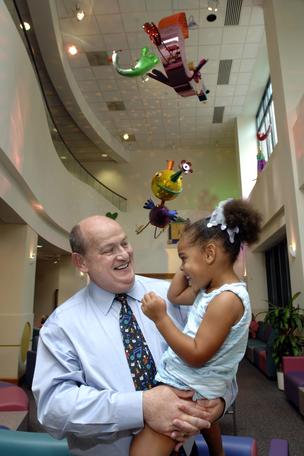
O’Donnell with CMH patient

Children’s CEO Randall O’Donnell has contributed $15,000 personally…And he can afford it. His salary is about $1 million a year, and in 2009 he received a $6 million bonus. (“Honey, we’ve hit the jackpot!)

Another recent, significant contribution came from the Burns & McDonnell engineering company,, which added $25,000 to an earlier gift of $50,000.

The cures committee is now well over $1.5 million in contributions.

The leading, single contributor remains the Civic Council of Greater Kansas City, the organization of top area business leaders that is spearheading the push for a new half-cent, countywide sales tax for “translational medical research.”

Interestingly, even though these hefty individuals and wealthy corporations (uh, I mean, wealthy individuals and hefty corporations) have put in hundreds of thousands of dollars, the Civic Council leaders themselves never appear at neighborhood meetings to explain why they want the taxpayers to fund their extravagant pet project.

Instead, they send out their minions, often lawyers and others who are expecting to get business deals or advisory board appointments, if the measure passes.

The civic leaders don’t like a street fight, which this campaign has become. They’d rather sit back in their homes — several of which are in Mission Hills and Leawood — and throw more money onto the pyre.

And, yes, that money will be going up in flames; this monster is headed for a hard fall.

As of today, here’s the latest list of five- and six-figure contributors to the cures committee:

  • Civic Council of Greater Kansas City, $600,00;
  • Children’s Mercy Hospital, $200,000;
  • Donald Hall Jr., $100,000;
  • Hallmark Global Services, $100,000;
  • J.E. Dunn Construction, $100,000;
  • John G. Sherman, chairman and c.e.o of Inergy L.P., $100,000;
  • Burns and McDonnell, engineering company, $75,000
  • Robert Kipp, former Crown Center Development president, $50,000;
  • St. Luke’s Health System, $40,000;
  • KCP&L, $25,000;
  • Mariner Holdings, $25,000.
  • Tom McDonnell, retired DST c.e.o., $25,000;
  • Irvine O. Hockaday Jr., former Hallmark Cards c.e.o., $20,000;
  • Randall O’Donnell, Children’s Mercy CEO, $15,000
  • William Gautreaux, a top Inergy LP officer, $10,000;
  • Wagstaff & Cartmell law firm, $10,000;
  • St. Luke’s Foundation, $10,000;
  • Kansas City Southern Railway, $10,000
  • Husch Blackwell law firm, $10,000;
  • Dr. L. Patrick James, of the KC Area Life Sciences Institute, $10,000;
  • The Polsinelli law firm, $10,000;
  • Lockton Companies, $10,000

Long ago, a wise editor told me, “Never make the reader do the math.”

Those contributions total $1,555,000.

**

See this post and much more at stopabadcure.org