Feeds:
Posts
Comments

With the passage of several days and the surfacing of more information, the human error that led to the fatal explosion at JJ’s restaurant last week has become clear:

For more than an hour, as gas poured out of a broken line before the explosion, NO ONE WAS IN CHARGE.

I hate to say emergency responders were standing around with their hands in their pockets, but it’s pretty clear that nobody was doing much, for a long time, to protect citizens in the bar and in the immediate area. Evacuation didn’t start until a few minutes before the explosion, and apparently no one shut off the nearest gas valve.

(I would love to find out that was not the case, but in the absence of an assertion that gas was cut off, we’re left to assume it wasn’t.)

We all know by now that the Fire Department unwisely deferred to workers with Missouri Gas Energy.

Whoever the ranking fire fighter at the scene was…he failed to take charge.

Same for any of at least three MGE workers who arrived at the scene, separately, before the explosion. The fact that they arrived separately may well have contributed to a “who’s-in-charge-here” attitude.

The MGE workers told fire fighters that they had the situation under control. That’s a lot different, of course, than someone actually being in control.

The other main people on the scene — besides customers who smelled gas but didn’t go anywhere, partly because they weren’t told to — were the workers who pierced the gas line while digging in preparation to lay fiber optic cable.

None of them was in charge, of course. They work for a company that does work for Time Warner. They were trained in digging and running lines, probably not in organizing an evacuation and maybe not even in shutting off gas valves.

It was a most regrettable case, then, of a public agency and a private company being on the scene but neither knowing for sure which was in charge or what steps should be taken to protect the public.

In the absence of a clear process on what to do, the only hope that JJ’s patrons and workers had was that someone would step forward to fill the void. Unfortunately, no one picked up the hero’s mantle, and one person died and 15 were injured.

The Star’s Dave Helling reported yesterday that Kansas City’s generic emergency response plan calls for public safety officials — that is, police or fire fighters — to decide “if threats such as gas leaks warrant evacuations.”

That means the fire department should have taken the reins…Ah, but it’s not that simple.

The document goes on to say that “incident commanders” are in charge of “routine evacuations” —  which, clearly, this should have been.

Strictly speaking, however, there was no “incident commander,” partly because, for some crazy reason, the fire department routinely takes a back seat to the gas company in the case of leaks.

Helling also wrote about another document that should help the city deal with similar situations in the future. It’s called the National Incident Management System. It’s produced by the federal government, and the fire department follows its guidelines.

The telling line in the document, as far as the JJ’s explosion is concerned, says that at the scene of a dangerous situation or a disaster, the command function “must be clearly established from the beginning of incident operations.”

Makes all the sense in the world…So, let’s make sure that happens in the future.

Our very self-assured mayor — who sank from from mayor mode to lawyer mode that fateful day (and the next) — should step forward, soon, and hand down common-sense guidelines to govern dangerous situations where multiple agencies are involved.

kcfdlogoI’ll even give him the first two paragraphs of the new policy:

“When an incident arises where public health and safety is at risk — and where more than one agency or entity is involved — the Kansas City Fire Department or the Kansas City Police Department — whichever is appropriate — will be in charge of the incident and will take immediate steps to protect the public.

“The highest-ranking officer at the scene will assume command, and he or she will organize and direct the response of whatever agencies are involved in the incident.”

Never again should we Kansas Citians see our well-paid, well-trained fire fighters (or police officers) standing down to some gas energy guys running around in jeans, T-shirts and hard hats.

And those guys…let’s make sure they know where the shutoff valves are and how to switch them to the off position.
The Kansas City Star assigned a team of four outstanding reporters to the JJ’s explosion story Wednesday, and they established facts that pointed fingers of blame at two companies, a city agency and one big-city mayor.

Let’s be clear: These are maddening, infuriating fingers of blame.

Waitress Megan Cramer should not be dead; more than a dozen other people should not have been injured; JJ’s should still be intact.

Clearly, this was a disaster and tragedy that occurred because no one, NO ONE, made COMMON-SENSE decisions in the presence of a strong smell of gas…a smell that permeated the immediate area for MORE THAN AN HOUR before Tuesday’s explosion.

OK, so which individuals and entities shoulder the blame and why?

Investigative reporters Judy Thomas and Mike McGraw, energy reporter Steve Everly and City Hall reporter Lynn Horsley laid out the prosecution’s case in their story, and the four defendants seem to have little defense.

Let’s consider the defendants in the order that they screwed up…

1) Heartland Midwest LLC.  Shall we just call them The Mad Diggers?

Using a trenchless, horizontal boring machine, the Time Warner subcontractor managed to bore into a two-inch gas line that serviced JJ’s.

The Star’s story said that before digging, Heartland officials called Missouri One-Call, a nonprofit organization set up by utilities to help excavators and utilities dig in compliance with safety laws. The story doesn’t say what, if anything, Missouri One-Call did in response to the Heartland call, so that part of the story remains up in the air. Missouri One-Call could end up sharing blame.

2) Missouri Gas Energy. It will be a long, long time before this company regains any credibility.

How could MGE workers not recognize this was an extremely dangerous situation?

Perhaps more important, WHY DIDN’T THEY SHUT OFF THE GAS LINE TO THE RESTAURANT???

Not to mention…WHY DIDN’T THEY ORDER THE AREA EVACUATED???

With damning impact, The Star interviewed the president of the North American Gas Workers Association, a safety advocacy group based in Massachusetts.

The official, Mark McDonald, told The Star, “It should have taken three minutes (to shut off gas to the area), and the building wouldn’t have exploded.” He said a shutoff valve to the restaurant could have been closed soon after utility workers arrived, which was nearly an hour before the explosion.

3) The Kansas City Fire Department. Asleep at the wheel.

A truck arrived on the scene at 5:04 p.m., about 10 minutes after Heartland reported the leak.

Fire Chief Paul Berardi said that firefighters conferred with MGE workers and that the workers assured the fire crew that they had the situation under control.

“We left the situation in their hands,” Berardi said, “We have to leave that up to the experts at the scene.”

What? WHAT? Like the fire department doesn’t know anything about the hazards of natural gas?

And when, by the way, does the fire department defer to anyone? When there’s distinct danger in the air, the fire department has a responsibility to act.

On Tuesday, KCFD was the public’s strongest representative at the scene. The crew captain or battalion chief — whoever was in charge when that first truck arrived — could have, should have, said, “This doesn’t smell good to me…Let’s check this out a little further.”

4. Mayor Sly James. Like the fire department, he abdicated his duty to the public on Wednesday.

In a morning news conference, James deflected questions about who might be to blame, saying that simply that an investigation was underway.

“Now I understand everybody wants to know what happened, wants to blame somebody,” James said. “Everybody wants to know these details, but let me just assure you that’s not going to happen today.”

james

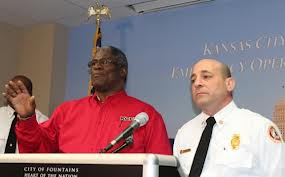
Mayor Slay James and Fire Chief Paul Berardi

That statement was OK, as far as it went. But the situation begged for much, much more.

What he should have added, emphatically, is something like this: “I assure you we are going to get to the bottom of this. This tragedy has raised plenty of questions, and I am going to make sure that every question is answered. We will let the chips fall where they may.”

Remember when the skywalks at the Hyatt collapsed, killing 113 people?

The day after it occurred (maybe the second day), Mayor Richard Berkley stood up to Don Hall, Hallmark and other deep-pocketed, vested interests and called for a federal investigation. Then-Sen. Thomas F. Eagleton got involved and a full-scale investigation got underway almost immediately.

Berkley didn’t say, “Let me assure you that (the search for answers) is not going to happen today.”

***

James’s attitude is going to have to change, and quickly. The public will demand it. What James didn’t seem to take into account yesterday was the anger that was, and is, coming to a boil.

The Star reporters showed us exactly what that looks like when they quoted the executive director of a foundation that has offices immediately north of JJ’s.

“I’m really, really angry,” said Gayla Brockman. “I honestly don’t get it.”

She smelled the gas slightly more than an hour before the explosion, and it was so strong that it nauseated her.

People with Heartland Midwest, MGE and the fire department smelled gas, too…Why didn’t any of them act quickly, in the interests of public safety? 

And why wasn’t Mayor James demanding answers the day after a tragedy that will not soon be forgotten?

I want to know. And my fellow Kansas Citians want to know.

And there must be accountability.

Like the locker room of the World Series champions or the Super Bowl winners, the second-floor mezzanine of The Kansas City Star probably was the scene last night of champagne corks flying and reporters and editors spraying each other with the traditional celebratory beverage.

If it wasn’t, it should have been: The Sports Department learned yesterday that it was one of three papers to win sports journalism’s biggest award for its work in 2012.

The Associated Press Sports Editors voted The Star as a winner of its “Grand Slam” competition. That is, The Star was named one of the top 10, large-circulation newspapers in each of four main categories: daily sports section, Sunday section, special sections and website content and presentation.

It is a tremendous triumph for the paper, especially considering that the only other two papers to gain Grand Slam status last year were the Washington Post and The New York Times. The air is mighty thin at the top, and that’s where The Star’s Sports Department has stood for the last 15-plus years.

In a sports-section story today, sports editor Jeff Rosen said, “We’re not in this business to win awards, but it’s a tremendous honor to score The Star’s first Grand Slam.”

The quality of the sports section is something that, I’m sure, a lot of readers take for granted. The sports section’s rise to the top has been gradual, for the most part, and it’s worth taking a look at the modern history of the sports section and how it climbed into the top ranks nationally.

In most cases, the stature of a paper’s sports section coincides with the caliber of its columnists. For the most part, that is the case with The Star.

When I was hired as a general assignment reporter at The Star in 1969, Joe McGuff was sports editor and sports columnist, and his name was uttered with reverence. He was a clear-headed thinker and straightforward writer whose honesty and dedication to Kansas City and its betterment were unquestioned.

joe

Joe McGuff

His greatest hour came in 1968-69 when he played a huge role in convincing the executives at Major League Baseball to locate an expansion team in Kansas City. That, of course, came on the heels of the late Charles O. Finley owner of the Kansas City Athletics, moving the team to Oakland.

Not since then, and probably not before, has a sports writer or columnist stepped so far beyond the customary trappings of his job. As far as Kansas City was concerned, McGuff might as well have been “St. Joe” after that.

Another great Star sports columnist in the 1960s and 70s was Dick Mackey. Another not afraid to leave the comfort zone of sports, Mackey set sports aside the day after Martin Luther King’s assassination (April 4, 1968) and wrote about King and the nation’s shock.

Metaphorically, Mackey later drove himself into the ground: In a state of exhaustion and with an ulcerated stomach, he collapsed in the back of a cab in Memphis and died. That was in the late 70s.

jon

Jon Rand

In the 1980s and 1990s, the featured columnist was Jon Rand, another straight shooter, who came to The Star from the Miami Herald. He wasn’t a flashy writer, but readers could rely on him to give them informed opinions. The most memorable line that I recall of Rand’s was a year or so before The Chiefs hired Carl Peterson as general manager and Marty Schottenheimer as coach. The front office was led by Lamar Hunt’s old buddy, Jack Steadman, who was never popular with the fans.

“This fish stinks from the head down,” Rand wrote one day, capturing the sentiment of the entire city.

Gib Twyman was another outstanding columnist. A born-again christian, he was genuinely empathetic with people who were experiencing difficulties, and he frequently digressed from the sports scene. He wrote several extremely touching columns, I recall, about the Thompson family after a Thompson daughter, Amy Thompson, was shot in the neck and paralyzed in a botched robbery on Halloween night 1986. Some friends organized the first Amy Thompson Run in 1988, and over the years it has raised more than $1.5 million to help people with brain injuries.

On Christmas night, 1989, Amy died of complications from her injuries.

Twyman, unfortunately, had a big problem making deadlines, and that resulted in him getting fired for plagiarism in 1994. He later redeemed himself as a reporter and columnist at a paper in Salt Lake City, before dying of a heart attack in 2001.

In the long run, though, it was not a columnist but an editor who took the sports section to new and spectacular heights.

In 1996, then editor Art Brisbane and managing editor Mark Zieman brought in a guy named Dinn Mann, who, at 31 years old, already had some notches on his journalistic belt. He came to The Star from the Atlanta Journal-Constitution, where he was associate sports editor. Before that he had been sports editor at the Houston Post before it folded in 1995.

Mann also had a high-propane personality and some estimable blood lines: His grandfather was Judge Roy Hofheinz, a former Houston mayor, who built the Astrodome.

dinn

Dinn Mann (right) with Louisville, KY, sports commission director Karl Schmitt

Mann only stayed at The Star for five years, but he brought the sports section into the 21st Century before the 21st Century arrived. It was he who introduced the snappy, funny headlines on the lead sports story of the day. It was he who pushed for award-winning special sections, and he who introduced many features that are still cornerstones of today’s sports section, such as the Five-Game Planner and expanded “On the Air” listings of sports on TV.

In addition, Mann hired columnist Joe Posnanski, who became the counterbalance for Jason Whitlock, whom Mann’s predecessor, Dale Bye, had hired in about 1994. It was at The Star that Whitlock and Posnanski found their voices and established their launching pads to bigger jobs. At The Star, Whitlock wielded the hammer, while Posnanski supplied the poetry.

Mann himself went on to an extremely big job in 2001 — founding editor-in-chief of MLB.com, baseball’s official website. Mann is still with MLB.com, which has grown to more than 100 employees.

When Mann left, his top assistant, Mike Fannin, became editor and kept the momentum going. After Fannin was named editor of The Star in 2008, the sports section went through a bumpy period. Fannin’s top assistant in the department, Holly Lawton, took the reins, but she left two years later, after allegations surfaced that she and Fannin had had an affair. About the same time, Whitlock left the paper after a blow-up with Fannin and perhaps Lawton.

jeff

Jeff Rosen

The ship got righted late in 2010, however, after The Star hired Rosen as sports editor. For six years, Rosen had been deputy sports editor at the Houston Chronicle.

For the last couple of years, the public face of the sports section has been columnist Sam Mellinger, who combines Whitlock’s hammer with Posnanski’s poetry.

Already, Mellinger has established himself as a “destination columnist,” that is, someone who draws readers to the paper just for what he brings to the paper.

Headed by the team of Rosen and Mellinger, and buttressed by fine reporters like Blair Kerkhoff, Adam Teicher and Bob Dutton, The Star’s sports section should be solid for the near future.

Don’t be surprised if you hear about more “Grand Slams” down at 18th and Grand.

On a whim, I went over to Lawrence last night to attend the Kansas-Kansas State basketball game.

I’m much more likely to be found at KU women’s games, but with the Kansas men having lost three in a row, I thought a close, interesting game might be in the offing.

I arrived a few minutes after 8, the scheduled tip-off time and stationed myself in front of Allen Fieldhouse to see what was available. Within two minutes, I was able to get a $100 face-value ticket for $50. In addition, I got a chance to be a Good Samaritan: A KU student who had not exercised his option to buy athletic tickets as part of his tuition, was trying anxiously to buy a ticket from the guy who sold me one.

The young man told the seller that he had only $22 with him. The seller wanted $30. Turning to me, the seller said, “Can you help him out?” I peeled a ten from my quickly thinning layer of bills and handed it to the student, who promptly bought the ticket.

“Thank you,” he said, beaming, as we walked to the front door. “You don’t know how much this means to me.”

Seeing the joy on his face was reward enough for me. “Have a great time,” I said, as we parted ways.

***

Naturally, I didn’t sit in my assigned seat, which an usher told me was on the third level.

Instead, I went to a corner of the court, behind the K-State bench, and took an empty bleacher seat in about the 10th row. I noticed that another seat was empty behind me. At that point, the teams were just being introduced, about 15 minutes later than scheduled. (The delay probably had something to do with TV; Brent Musburger and an ESPN crew were there to broadcast.)

Just before tip-off, two guys came along, and one motioned to me that I was in their seats. The seat behind me was still open, and I deposited myself there.

I said that the guy motioned to me…That’s because it was so loud in the fieldhouse, even during the introduction of the KU players, that I couldn’t hear a word he said to me.

At that point, I knew it was time for me to break out the earplugs. I learned after attending a men’s game last year that, for me, earplugs are a necessity. I was glad I had brought them, too. I think that without them last night I probably would have lost about one percent of what hearing I have left.

KU took control of the game from the outset, and Bruce Weber, the K-State coach, crossed his arms tightly in front of his chest and adopted an expression of frustration, which he maintained most of the game.

As KU went up by 10, then 15 and then 20, KU Coach Bill Self countered Weber’s frustration with a rigid-jawed, fiery-eyed look of intensity. It was evident that he wanted his guys to not let off the gas for a minute.

***

Off to my right was an end-zone section full of arm-waving, leather-lunged KU students. Many of them spent a lot of time looking at the video board, hoping for an opportunity to get on camera. A student not too far from me waved a sign that said “Pope Jeff Withey V.” I’m sure that got on TV.

Another person who caught my eye was Sheahon Zenger, KU’s athletic director. Two years ago, Zenger succeeded Lew Perkins, who I consider one of the worst big-time collegiate athletic directors of all time. It was under his watch that a bunch of Okies who ran the KU ticket operation made off with at least $2 million in a ticket scalping scandal. Several of the Okies are now in prison, and Lew got himself a big, fat buyout on the way out the door…So what else is new, eh?

Anyway, Zenger, who came to KU from Illinois State University, is a clean-cut, earnest-looking guy who always sits at the end of a floor-level table that appears to be reserved for Athletic Department employees.

At one or two of the women’s games I’ve attended this season, I noticed that Zenger spent most of his time texting. Once in a while he’d look up for a few seconds, without changing expression, and then direct his eyes back at his phone.

I wondered if it would be the same last night. Well, your faithful reporter can tell you that he spent part of the time texting, but much less than he did at the women’s games.

Just from looking at the guy, I don’t care for him. He strikes me as a cold fish. Maybe he will be successful — his biggest hire so far has been Charlie Weis as head football coach — but it’s hard for me to see how he’s personally going to win anyone over…And, hey, Sheahon, how about getting off that fuckin’ phone and paying attention to what’s going on before your eyes????

***

When the game was over, Holly Rowe of ESPN first interviewed Bill Self and then Ben McLemore, the freshman star, who scored 30 points. After a while, Brent Musburger packed up and made his way out of the gym, smiling and exchanging a few words with people as he went along.

I hung around because I was waiting for my favorite part of KU home games. After each one, the KU Pep Band (or Marching Band during football season) waits ’til things have settled down and then eases into a rendition of “Home on the Range,” the official state song.

Last night, I positioned myself several rows below and facing the band, led by Sharon Toulouse, assistant director of KU bands. Several people standing close to the band put their arms around each other’s waists, as is the tradition, and swayed slowly back and forth as the horn section led the way into and through that beautiful, soul-soothing song.

I’m not a KU graduate, not even a Kansas resident, and am only a casual fan. But when the KU band plays “Home on the Range,” I feel myself being pulled gently, steadily westward for a few minutes, out onto the open range land, where the sky is high and mostly clear blue…and where our country separated itself from all other nations.

All too often the print edition of The Kansas City Star makes me wonder what’s going through the minds of the editors.

The latest puzzlement was on Sunday, when the editors relegated a timely, can’t-put-it-down story about the AR-15 semi-automatic rifle and its shirttail cousins to the bottom left corner of the front page.

darryl

Darryl Levings

Below a one-column headline, only slightly more than three inches of text appeared on the front page before the story “jumped” inside. On Page 12, the reader was greeted by, or I should say treated to, an additional 82 inches of text. The writer was Darryl Levings, a highly respected senior editor and writer.

The AR-15, or variations thereof, have been used in several of the nation’s mass shootings in recent years, including the Aurora, CO, killings last July. In addition, the weapon is one of the chief objects of Sen. Dianne Feinstein’s gun-control bill, which she recently introduced before the Senate.

I emphasize that the story could not be more timely and it was incredibly informative, especially for the thousands of Star readers, including me, who probably know very little about guns, other than .22-caliber pistols and 12-gauge shotguns. The story was chock-full of details, such as that the weapon had its “breakthrough” after Air Force Gen. Curtis LeMay saw its promise more than 50 years ago.

Why then, was this story not the “centerpiece” of the Sunday paper?

The centerpiece, for those not attuned to newspaper lingo, is the story that, each day, gets the biggest play on the front page. The centerpiece is always at least three columns wide and is accompanied by at least one large photograph, illustration or, infrequently, a graphic.

The editors chose instead to feature a story about charitable organizations — like The Salvation Army and Uplift — that provide meals for people who live on the streets, in the parks, under bridges and elsewhere without four walls around them.

The gist of the story was that while the agencies are rendering an important service, they probably are contributing indirectly to the trashing of neighborhoods and theft and vandalism.

This was, by no means, an unimportant story. To me, however, it paled beside the weapons story, which is probably the biggest story in the country right now.

I’ve been racking my brain, trying to figure out why the editors made the choice they did.

I’ve developed a theory…Hang with me now.

I think that one thing that boosted the “Help or Hindrance” story about the homeless was that it had four good photos with it — three of them taken on the night-time streets and featuring heavily bundled people receiving or eating recently dispensed meals.

On the other hand, the AR-15 story was accompanied by an excellent 4 1/2-column photo showing an intense gun-store manager firing a rifle that was emitting a sunburst-like muzzle flash. But that photo, which I think would have made for an outstanding centerpiece, appeared on Page 12, not on Page 1.

The more I thought about that photo the more I tended to think that the muzzle flash held the key to the story’s back-seat placement.

From my 36-plus years at the paper, I know how the editors think and the idea comparing that they go through while deciding what is appropriate and what is inappropriate for front-page display.

It’s my opinion — based solely on experience and instinct — that the editors decided that many readers would see the AR-15 photo, with that splash of orangish-yellow erupting from the rifle tip, as menacing and sensationalistic.

Certainly, the photo would have drawn some reaction from people on both sides of the gun-control issue:

Some of those in favor would have said the photo glamorized the AR-15 and its power, and some of those against would have contended that The Star was trying to demonize the weapon.

So, the editors went milquetoast, in my opinion, and opted for the innocuous, no-risk photos of the homeless and the Salvation Army trucks.

Too bad, eh? The editors had, right in their hands, an edgy, compelling story that was well illustrated and would have been read by thousands and thousands of more readers than it was. It’s a story that would have made a splash and would have been talked about at the water coolers on Monday.

Let’s strip away all subtleties, then:

This was a pitiful, gutless decision that showed, once again, why The Star is losing subscribers.

I and many other former Kansas City Star employees got a surprise on Tuesday when we reached the end of The Star’s excellent news story about Adele Hall’s death and found that first reporter credited with providing information was former society editor Laura Rollins Hockaday.

The surprise was not that Laura was involved. She would have been a natural for involvement in the obit, except for the fact she retired 13 years ago, after 38 years with the paper.

I jumped to the conclusion, as some other people did, that Laura had heard the news, pulled her boots on and made a beeline for the newsroom. Had that been the case, the appropriate headline for the back story would be Former society editor to the rescue!

That’s not how it unfolded, however. Today I got the story behind the story from Hockaday and Darryl Levings, who edited and assembled the A-1 story.

Hockaday said Star reporter Lisa Guttierez called her about 4:30 Monday afternoon, telling her that Hallmark had just released the news of Adele Hall’s death on Sunday in Hawaii, where she and her husband Don Hall own a home.

I can assure you that getting a call at 4:30 p.m. on a story of that magnitude is challenging and often frustrating for reporters and editors because, first, they know they’re going to be working late and, second, they know they’re going to have trouble reaching sources after business hours.

laurah

Laura Rollins Hockaday

Hockaday said Gutierrez asked her for the names and numbers of people the reporters could try to contact. Hockaday said she provided contact information for several people, including Mary Shaw “Shawsie” Branton, a close friend of Adele, and Irvine O. Hockaday Jr., another longtime Hall family friend and the only non-Hall family member to ever serve as Hallmark CEO.

Oh, and did I mention that Laura and Irvine are first cousins?

He’s a tough man to reach…for the average person, anyway.  I know that from experience, although I once had his personal number at Hallmark and got through to him on it one time.

Getting ahold of Irvine is not difficult for Laura, however. “I gave them every phone number I had for him,” she said.

As a result, Irvine Hockaday was quoted at length. Branton also was quoted.

In addition, Laura told Gutierrez it was imperative that The Star get ahold of someone in administration at Children’s Mercy Hospital, which was the top beneficiary of Adele’s charitable and fund-raising endeavors. Thus, high in the story, The Star quoted CMH board chairman Jack Ovel as saying of Adele:

“She was quick to give others credit. She was always telling other people, ‘You are the wind beneath my wings.”

As for the rest of her contributions to the story, Laura said that the reporters used some material from an interview she had done with Adele many years ago.

In short, Laura asserted that her contributions were minimal..no big deal.

“I don’t deserve any credit at all…I was very honored to be called,” she said. Jokingly, she added, “I’m surprised they remembered that I had worked there.”

Now, here’s the other side of the back story, from Levings, the KC Star editor who assembled the 40-inch story.

Levings said The Star had in its files what is called an “advance obit” on Adele. Laura had prepared and filed it many years ago, and it sat around waiting for the inevitable day.

In an e-mail, Levings said:

“Laura’s prepared, two-page obit, sitting in our files since before she retired a decade ago, was the blueprint and safety net for our efforts. Lisa Gutierrez and Lee Kavanaugh (another reporter on the story) had it when we started. Lisa, I believe, called Laura for potential sources. Hallmark sent their three-page version, which we used to fill in some material.

“The reporters did an excellent job zeroing in on excellent sources quickly, to the point that I had more than I could use.”

So, why did Levings decide to put Hockaday’s name before the names of the three full-time reporters who were included in the credit box?

“I wanted to honor her earlier work,” Levings said.

That placement was a great and much-deserved tribute to Laura, who is a friend of mine and a loyal reader of this blog.

My take on this is that there is no substitute for institutional knowledge on stories involving notable people and major developments with links to the past. Calling Laura was a brilliant, if logical, thing to do. She had what The Star needed — longstanding civic, social and personal connections to Adele.

Bravo, then, Laura; you deserve a lot of credit.

And bravo, Kansas City Star; you gave a great lady a thorough and well-written news obituary.

I missed President Obama’s inaugural address yesterday, but I caught the last part of the event and was excited and uplifted.

Indulge me in a few reflections and observations, if you will:

:: One of my foremost impressions of the inauguration was that it probably will be a long, long time before the nation sees a couple as handsome and appealing (appealing from the standpoint of vigor and well being) as Barack and Michelle Obama.

The day’s events were a photographer’s dream.

And how about Michelle? Wow, that woman knows how to dress! A fashion critic was quoted by CNN as saying her style is “ladylike with a twist.” The twist is that she always adds her own distinctive touch to her outfits.

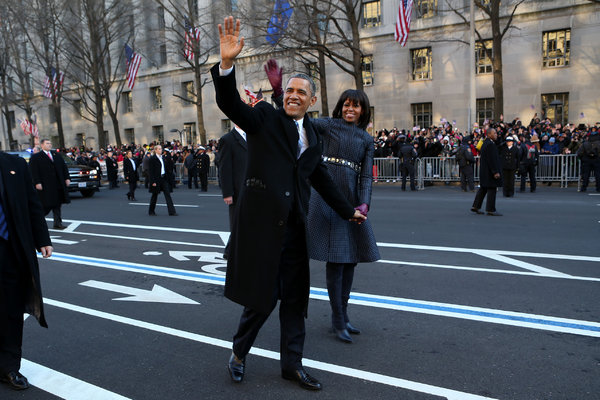
My favorite photo, which appeared on the front page of Tuesday’s New York Times, was this one by Times photographer Doug Mills

Barack

It perfectly captured the joy and celebration of the day.

…I know. You Republican readers are probably curling your upper lips and muttering uncharitable things about now. But how could anyone say that the first couple and their daughters Malia and Sasha did not emanate vigor and electricity?

:: Unfortunately, the inauguration wasn’t authentic from start to finish. I was shocked and appalled to learn Tuesday that a performing artist committed felony fraud.

I can almost always tell when a performer is lip-syncing, but I’ll be damned if Beyonce (accent aigu over the final “e”) didn’t slip one by me. And by almost all other viewers, I’m willing to bet.

At the end of her stirring rendition of the National Anthem, I was on my feet singing with her, just not quite as beautifully.

And then I learned today that she did, indeed, lip-sync.

What a chicken shit!

Kudos, however, to Kelly Clarkson, “American Idol” star, for her outstanding rendition — SUNG LIVE — of “My Country ‘Tis of Thee.”  Her performance prompted Sen. Chuck Schumer, master of ceremonies, to say, “WOW!”

(Also, who can forget Aretha Franklin’s rendition of the same song four years ago at Obama’s first inauguration? And, yes, she sang it LIVE.)

As for Beyonce (accent aigu over the final “e”), I never heard her sing and never paid any attention to her before yesterday, and she’s now won a spot in my personal trash bin of overhyped musical artists.

:: I’ve got to give credit to our hometown Kansas City Star, too, for the way it played the inauguration. A photo of a smiling and ramrod straight President Obama taking the oath of office, with Michelle holding two historic Bibles in her gloved hands, swept across the front page, down to the fold.

Good call at 18th and Grand. Surely, a lot of Democrats who don’t subscribe bought copies when they saw it in the newspaper stands.

:: A couple of weeks ago, a commenter to my blog predicted that Obama would go down as “the most hated President ever.”

I replied, “More hated than Nixon???”

And now, as the nation embarks on four more years under Barack Obama, I’m going to predict that he will be long remembered for, among other things, his achievements, his even temperament, his judicious choice of words, his humanness and, finally, for bringing us the finest first lady we could possibly ask for.

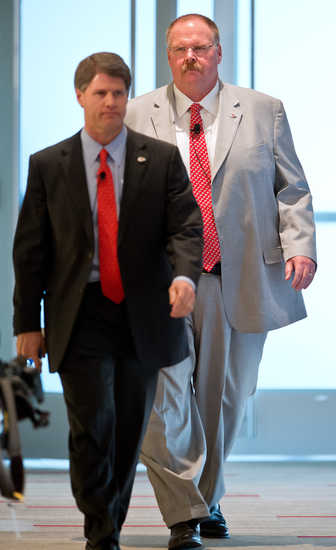
I’m startin’ to get pissed off…It’s that Andy Reid thing. Not his coaching; it’s his sartorial inadequacy.

If you didn’t see The Kansas City Star photo that I ran with yesterday’s blog, check it out. And on the sidelines, he looks worse. When I would catch glimpses of him when Eagles games were on TV, he didn’t cut a very appealing figure with that walrus mustache, ball cap and zip-up jacket.

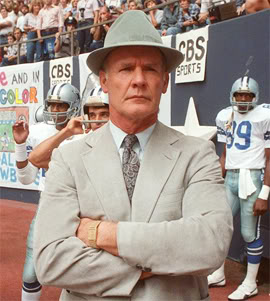
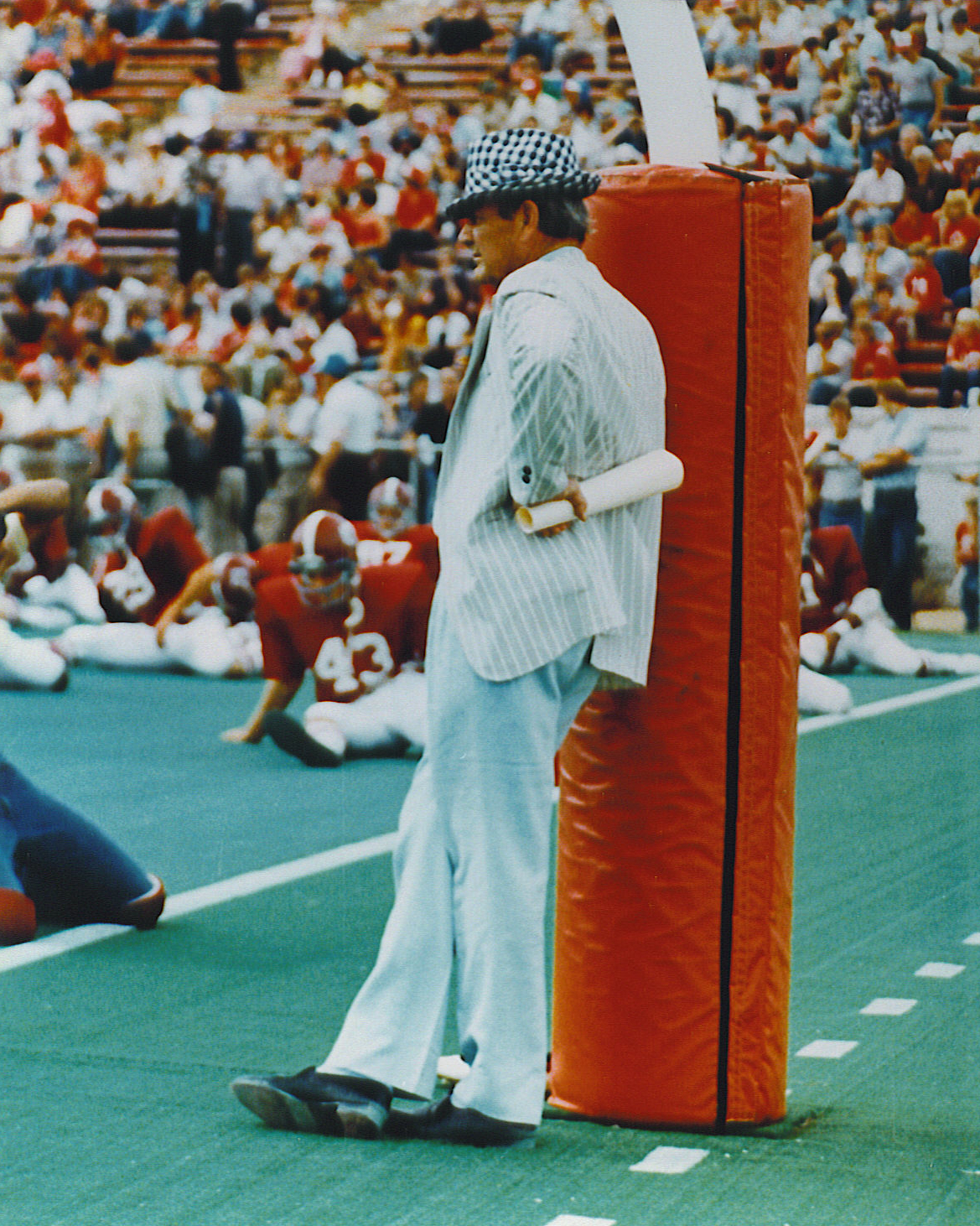
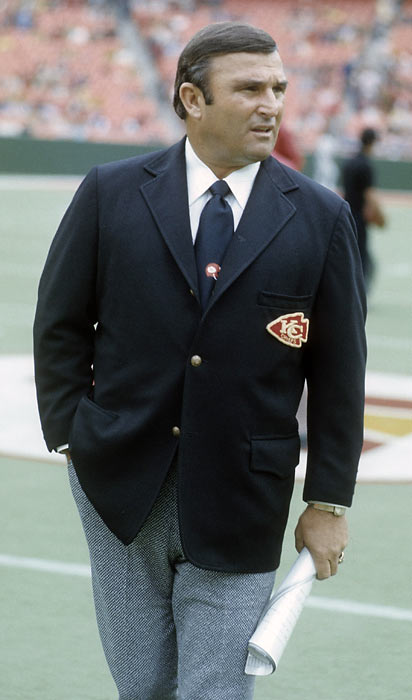
This deplorable situation got me thinking about some football coaches who really dressed well, even impeccably.

Here are the first three that came to mind, plus a throw-in…

TomLandry

Former Cowboys coach Tom Landry…A winning smile is not necessary when you’re this dapper.

paul-bear-bryant

The late, great Paul “Bear” Bryant in his trademark houndstooth hat

hank-stram-chiefs

Who needs a smile with hair like that??? I noticed when looking at these photos that Bear Bryant always had a rolled-up program in his hand. Ah-ha! So that’s where The Mentor got his inspiration.

And for the road…

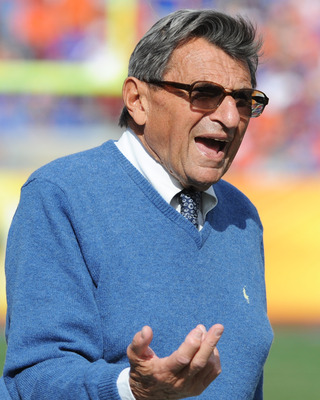
paterno

If only he had been as attentive to his moral compass as he was to his sweater collection…

The last few weeks have been great for newspapers — from the news standpoint, anyway.

From Hillary Clinton’s concussion to the tax deal in Washington to the Chiefs’ lightning-bolt hire of a new coach, it’s been a windfall for us news hounds.

Today, if you’ll indulge me, I’d like to comment on a few of the stories that have caught my attention.

1) Like most Chiefs’ fans, I’m glad that Andy Reid will be coaching the team for the next few years, at least. He seems like a very down-to-earth, honest guy, and he’s got a lot of wins on his resume. But, holy smoke, did you get a load of the guy’s wardrobe? He needs a new tailor…real bad. Just because a guy is fat doesn’t mean he has to look like he’s a fabric salesman’s dream come true…

areid

Kansas City Star photo

2) Once again, the Jesuits have demonstrated that they are the best at educating our youngsters and doing everything possible to mold their students into responsible citizens.

Rockhurst High School’s new drug-testing program, to begin next summer, is bound to intercept and redirect many students who are using recreational drugs, like marijuana. Wisely and correctly, Rockhurst officials are pitching the initiative as a “health and wellness” program. The first time a student gets caught, he will be brought in for counseling; the second time, he could be disciplined and will be put on notice; and the third time…well, he’s out.

Not only does the program look excellent, but the way Rockhurst officials, including Principal Greg Harkness and President Terrence Baum, rolled it out was a thing of beauty. After two years of study and groundwork, Rockhurst officials informed faculty, students, parents and the news media in a matter of a few hours one morning last week. Then, Harkness answered questions from the media all afternoon, and several students were made available to discuss the program on the record and in front of cameras.

Congratulations to Rockhurst on skillfully planning and publicizing this unprecedented program — unprecedented in Kansas City, anyway.

3) On the national front, President Obama has chosen an outstanding person, in my opinion, to head the Defense Department. You’ve got to love it, don’t you, when a guy like Chuck Hagel, who has been in the battlefield, says he views war as the very last resort? The last thing you want in that job is some trigger-happy muscle flexer who wants to crack skulls all over the world.

I predict that the Senate will approve him. Yes, he made a big mistake in 1998 when he described a U.S. ambassador nominee as “openly, aggressively gay.” I’m sure, however, that his views on that subject have changed significantly — just like those of a lot of formerly homophobic folks. As liberal as I am, I have to admit that coming around to a “live-and-let-live” philosophy regarding homosexuality was difficult for me.

4) bloombergIn an open letter in today’s New York Times to Mayor Michael Bloomberg, columnist Joe Nocera praised Bloomberg for wielding the shrillest and most effective voice on gun control. Nocera called on Bloomberg to go to bat for gun control with his energy and his money (net worth $20 billion, says Nocera) after his third and last mayoral term ends in December.

“There is, quite simply, no one else in America who has a better chance of moving the country toward a saner gun policy than you,” Nocera wrote, addressing the mayor. “It is an effort worthy of your talents, and your money.”

5) Let’s end on a head-scratching note…In a story out yesterday, some scientists have concluded that the cause of fingers wrinkling after being in water for some time is a function of evolution. Laboratory tests have confirmed a theory that wrinkly fingers let us get a better grip on wet or submerged objects, acting like a treads on a car tire.

Now, if you’ll excuse me, I have to go bathe my hands and make a run to the Plaza to get as many coins as I can from the Mermaid Fountain.

Last week, I recounted some of my favorite stories about a former KC Star Publisher Jim Hale, who died in 2003. (Here’s the link, in case you missed it.)

The post drew a lot of readers and a lot of comments. When I wrote that piece, however, I knew of at least one person in Kansas City who was a lot closer to Hale than I. And that is Mike T. White, development attorney with White Goss Bowers March Schulte & Weisenfels. Shortly after Hale arrived in Kansas City in 1977, he hired White to represent The Star in most business matters. White held the job for many years, and he developed a close personal, as well as business, relationship with Hale.

At the time I posted the blog, I sent Mike an e-mail, asking him to comment on the Hale post. He said he would, and yesterday, Christmas Day, he pulled together some of his recollections and sent them on to me as a “comment” at the end of my Hale story.

Well, it didn’t take a genius to see that Mike’s recollections deserved much higher billing than the comments section of a week-old post, so I’m taking the liberty of publishing them as a “guest blog” for your reading pleasure.

With that, Heeeeere’s Mike!

***

I met Hale in 1977, when Capital Cities Inc. brought him here from The Fort Worth Star Telegram (from which Wesley Turner, another former Star publisher, recently retired as publisher). He brought Gerald Garcia with him to serve as executive editor. Garcia’s main role was to trim excess people from the payroll to make the papers lean and mean. (Editor’s note: In one bloody day alone, Garcia herded 20 or more long-time Star editorial employees into a room and fired them. They didn’t need sympathy, though, because most left The Star as millionaires, having scored big when Cap Cities paid $2 for every $1 of Star stock they owned.)

mikeyI started representing The Star in 1979. One of my first assignments was to defend a regulatory action by the EPA against The Star because it was discovered that we (the paper) had polychlorinated biphenyls (a banned carcinogen) in some of the electrical transformers in the building.  While this was going on, I was surprised to open the paper one morning to read a story about it in which an enterprising reporter simply went around the building interviewing anyone who knew anything about it. I complained to Hale, saying “Good Lord, when you are in litigation, it’s not a good idea to have your employees talking to the other side.” He told me there was not a damned he could do about it. “If I tried to tell a reporter what to write, they’ll all quit,” he said. “You’ll just have to live with it the best you can.”

We settled the case.

When the society editor, Elsye Allison was fired, she sued for age discrimination. We tried the case to a jury in federal court. Elsye’s lawyer tried to intimate that Hale was having an affair with a young, attractive anchorwoman at one of the local television stations. She was married to another young, attractive anchorman who looked like a movie star.

I had Hale sit on the front row while she testified. That killed their theory. All I had to say about that in closing was “Really?” Afterward, Hale told me that he thought that was the first jury trial The Star had won in the last 40 years. I guess their losing streak started with the WDAF antitrust case in the 1950s. Hale always felt bad about firing Elsie, and she literally, but unintentionally, haunted him: After that trial, he said he ran into her everywhere he went and that he would see her driving down the street in her beat up, old Thunderbird.

I remember the episode that you recounted about O.J. Nelson getting fired. Actually, O.J. tells this story better than anyone, and with a great deal of self-deprecation. There was another person (I can’t remember who) involved, and both were sitting in Hale’s office when Hale said to Executive Editor Mike Waller, “And these two assholes should be fired!”

I think O.J. just kept coming to work until Hale started to speak to him again, as if nothing had happened.

I think the guy that asked you to leave the Chamber of Commerce Board meeting was Dino Agnos. Hale hated going to those meetings anyway and absolutely detested attending the dinners because everyone read their speeches. He thought if they were going to write the speeches out word for word ahead of time, they should just send them to him and he could read them in his spare time. The final straw was when they sent him a list of Chamber of Commerce members who were delinquent on their dues. He said, “They want me to call some guy that owns a body shop and tell him to pay his dues. Not gonna happen.”

He would much rather sit around and drink Usher’s Green Stripe Scotch with Charlie Price (the late Charles H. Price II, who was a former U.S. ambassador to England) and the late John Latshaw (a Kansas City investment banker and businessman who died in 2010). That went on until Hale got a little put out with Latshaw after Latshaw called to tell him that he had just bought the prize steer at the American Royal and that Hale owed him half.

Hale thought very highly of Arthur Brisbane. In 2000, when discussions began about the new production plant, Art asked me to handle the legal side. It was very clear that the paper could have saved $10 million to $15 million by building the plant in Lenexa, and Tony Ridder (Knight Ridder c.e.o.), couldn’t understand why, from a business perspective, that wasn’t a no-brainer. Art stuck doggedly to his guns, reasoning that the paper had editorialized against urban sprawl and excessive economic incentives and that it would’ve been hypocritical in the extreme to just look at the bottom line. Furthermore, the incentive package that we finally negotiated was just enough to pay for the excessive costs for building the plant where it is today — which was very difficult. I told Art I could have negotiated a better deal, but he turned it down.

I agree with you that Hale was a character and a reporter’s publisher. That comes as no surprise given that he had about every job in the newspaper business as he rose through the ranks. He was also very successful. But let’s not forget that he took over the papers at a very opportune time, when profits could be increased by adopting modern technology; eliminating The Times (the morning edition of The Star); and raising the price. Brisbane, on the other hand, had the misfortune of being at the helm when the Internet really began to take off.

Hale did two things that, while simple, exemplified his style: He had the first paper off the press delivered to his door every morning, and he signed every non-payroll check.

More later, when I get time.