Feeds:
Posts
Comments

Ever since the newspaper industry and TV began chasing the Internet Express, trying to catch up with the fast-changing way in which news was being gathered and reported, the news media’s credibility has sunk ever lower.

I don’t really know how it could have been avoided because if the old-line media organizations had not jumped on board — however awkwardly — they would have been left farther behind than they are. Still, this loss of credibility is just appalling to me and many other past and present members of the media.

What I’m talking about is the old media lowering the accuracy and editing bar that it had painstakingly established over generations. The first big belly dive into the mud occurred the night of the 2000 presidential election, when the major networks, including CNN and Fox, called Florida for Al Gore prematurely and later stamped George Bush as the winner of the presidential election — 19 days before the Florida vote count was certified and Bush declared the winner by 500 some votes.

As I recall, we at The Star were one of many news organizations that had Bush winning on our Web site. I believe that in the morning paper, we went with too close to call.

All in all, the media’s performance that night made the classic, 1948 Chicago Tribune headline, “Dewey Defeats Truman,” start to seem not so embarrassing in retrospect.

There have been many other erroneous, main-line-media Web site reports since the 2000 presidential election, but this week brought another new low: The Associated Press, The Boston Globe, CNN and Fox News all reported early Wednesday afternoon that an arrest had been made in the Boston bombings case, when, in fact, no arrest had been made.

A story by Bill Carter in yesterday’s New York Times said that CNN and Fox “spent about an hour discussing the news of an arrest with various correspondents and experts before backing off when they received further information.”

It was the same two networks that breathlessly reported — again erroneously — last June that the Supreme Court had overturned President Obama’s health-care-overhaul law.

I guess officials at some of these networks have come to the conclusion that if you don’t know for sure, run it anyway because it will seem to advance the story.

The last thing the network executives want, it seems, is anchors and reporters saying, “We’re waiting for new information.” The new credo at some networks and newspapers is There Can Be No Wait; It Must Be Now!

CNN’s John King was the first to set his network’s pants on fire when, at 12:45 p.m. Kansas City time, he reported that police had a bombing suspect in custody.
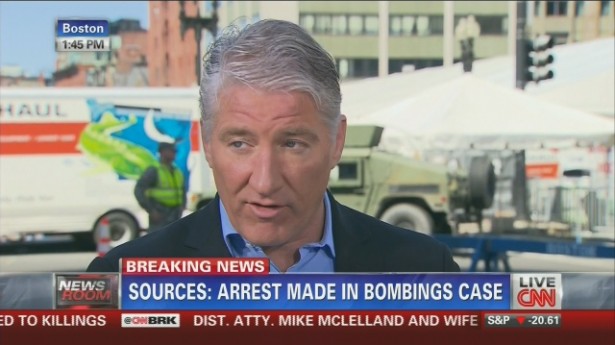
king

In his NYT story, Carter said that about 1:45 p.m., “one of CNN’s law enforcement experts…appeared on the air and reported and reported that he had three sources who assured him no arrest had been made.”

And how did CNN explain its screw-up? It issued this statement:

“CNN had three credible sources on both local and federal levels. Based on this information we reported our findings.”

Their “findings” were nothing more than “phantom findings,” and CNN should have apologized.

The Associated Press also didn’t see fit to extend its regrets about its messy reporting. Carter wrote: “Paul Colford, a spokesman for The Associated Press, said later in the afternoon that the news service did not ‘pull back’ from its original reporting, but only ‘added other reporting.’ ”

Well, now, that’s a fine kettle of fish, isn’t it? “Added other reporting…”

As the reactions of CNN and the AP indicate, the worst part of this “it-could-be-right-or-it-could-be-wrong” approach to Internet-era reporting is that there’s no need to apologize, no need to be embarrassed, just keep rolling out whatever some ding-dong whispers to the stressed-out, over-caffeinated reporters in the field.

Culminating his story, Carter quoted Judy Muller, a former network news correspondent who teaches journalism at the University of Southern California. She said:

“The rush to be first has so thoroughly swallowed up the principal of being right and first that it seems a little egg on the face is now deemed worth the risk.”

Quite often, people ask me if I miss working as a journalist. I always say that I don’t miss it at all and that I am happy to be out.

I respect the vast majority of journalists, especially my former Star colleagues, but I’ve got to say that when we started chasing the Internet back in the late 1990s, our “quality control” system — based on verified reporting, careful copy editing and several sets of eyes on every story in line for publication — quickly went to hell.

I could not come to grips with throwing under-reported, poorly edited stories up on the Web just to try to keep up with the local TV stations.

As a result of the free-wheeling reporting that has supplanted careful, verified reporting, the reputation of American journalism has, sorrowfully, slipped into a huge sinkhole, and I don’t know how it’s going to get out. It looks like it could go the route of that guy in Florida who was swallowed up by the earth and never resurfaced.

***

All that is not to say that some newspapers and networks have not done great things in opening new doors afforded by the Internet. For example, perhaps you saw that The New York Times won four Pulitzer prizes this week, for stories published in 2012, including John Branch’s spectacular feature “Snow Fall: The Avalanche at Tunnel Creek.” I wrote admiringly about that story in December, a few days after it was published. I quoted Rebecca Greenfield of The Atlantic Wire Web, who said that the project “makes multimedia feel natural and useful, not just tacked on.”

The Times, with pockets deep enough to hire experts in every dimension of news gathering and presentation, has done the best job of melding newsprint journalism and electronic journalism. It also has resisted the urge, for the most part, to go with unverified reports in the race to be first on big stories. But, alas, even The Times got sucked in on the Bush “victory” on election night 2000.
Yael Abouhalkah had a very interesting column in yesterday’s Star, in which he touched on some of the biggest challenges facing Kansas City Mayor Sly James at the halfway point of his first term.

First off, Abouhalkah said James is in great position to get re-elected in 2015 because “no current City Council member comes close to matching the wattage of James’ personality or his ability to influence policies and programs at City Hall.”

In the past (with the notable exception of James in 2011), the strongest candidates for mayor generally have come from the council’s ranks, and none of this council’s other members seems to be establishing a high profile for himself or herself.

Some of the major challenges that Abouhalkah listed were:

— Construction of a new, single terminal at KCI

— Proposed local control of the KCPD

— City Hall pension reform

In brief, here’s what Yael had to say about each of those issues…and my observations (not as brief).

Single terminal

Yael: “If it (the single-terminal concept) remains as unpopular  as it seems with a large contingent of Kansas Citians, James could face a possible defeat on a major issue.”

Me: Organized opposition to a single-terminal is growing, with the formation of a Save KCI! (savekci.com) group, and letters to the editor continue to tilt heavily to the status quo. Yesterday, the City Council voted 9-3 to move ahead with further planning for construction of a new, single terminal. The mayor voted with the majority, but it appears that he has begun equivocating on his previous strong stance in favor of a single terminal.

In a report on the meeting, KSHB-TV, Channel 41, said that James “admitted he is not completely sold on the current proposal, but said since Kansas City is not obligated to anything at this point, the process needs to continue.”

I don’t think James’ position on this issue will be a major factor in whether he gets re-elected. If he is going to establish himself as a strong leader on difficult issues, however, and if he wants to be remembered as a bold and farsighted mayor, he needs to stay out front for a single terminal and resist the impulse to assuage those who are steadfastly parochial and nostalgic about KCI.

If you’ve traveled to just a few other major airports in the U.S., you know that KCI sucks by comparison in just about every aspect except the distance between parking and gate. Now, that is an important consideration, but the facts…that KCI is way too expensive from a security standpoint and that it’s a HOLLOW, DARK, BORING, ANTIQUATED PIECE OF SHIT... far outstrip the convenience factor.

The correct call on KCI is as clear as it was on Sprint Center and the Power & Light District. If Mayor Kay Barnes hadn’t led courageously and pushed hard for those two massive attractions, Downtown would be a fuckin’ wasteland, and we would be well below Omaha (not to mention St. Louis, Denver and Louisville) in the category of downtown venues that attract tourists and area residents.

It seems abundantly clear that if we don’t get a modern airport within the next several years, usage of KCI will continue to drop dramatically and the airlines will shift many flights to other cities.

Don’t let us down on this, Sly. This isn’t a re-election issue; it’s a legacy issue. Do you want to be remembered as a big, energetic guy with a big personality — another H. Roe Bartle — or as a mayor who catapulted us into the ranks of big cities with great airports? 

Local control of KCPD

Yael: “The mayor appears ready to embrace local control of the Police Department…But if the panel (a commission he has appointed) balks at local control — or the (Missouri) legislature gives James the cold shoulder next year — the mayor could lose out on a key issue of how taxpayers finance public safety.”

Me: Again, I don’t think this is a big deal either way as far as the mayor’s chances of getting re-elected. (Can we just acknowledge that he’s going to serve six more years?)

But, just as with the single terminal at KCI, local control is an issue whose time has come. In fact, it came about 15 years ago, but the police bureaucracy has such a stranglehold on operations and on the Board of Police Commissioners that it’s been difficult for the advocates of progress to get any traction. James has wedged a foot in the door with the appointment of the panel to review the idea, but my guess is that the police hierarchy (along with just about every brain-washed, puffed-up police board member who has served during the last 30 years) will stamp their feet and holler so long and loud that the change agents will back off for another decade.

Sly James just might end up leading the local-control retreat, too…If he does, it will be another missed opportunity to be remembered as a gutsy, decisive mayor whose first interest was the taxpayers, not police commanders or the fat-cat commissioners appointed by Missouri governors.

Pension reform

Yael: “He (James) is still working to reform the unsustainable pensions for firefighters, police officers and other city employees — almost 18 months after a citizens commission delivered a how-to report on the issue in late 2011. The cost to taxpayers for retirement benefits has reached $60 million annually, up from $54 million two years ago.”

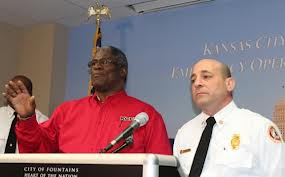
Me: Ho, ho, ho, ho, ho! Ha, ha, ha, ha, ha! Turn on the laugh tracks…Pension reform involving the firefighters? After James rode high and tall in a fire truck at the St. Patrick’s Day Parade a week before the 2011 election? And after he donned a bright red KCFD jacket after the JJ’s tragedy and said, famously, “Fire (department) doesn’t do gas.” ????

james

Mayor Sly James and Fire Chief Paul Berardi after the JJ’s explosion

The chances of meaningful pension reform involving the fire department during the next six years are slim and none.

The next mayor, though? The unfortunate, winning candidate who succeeds James?

Well, the pension situation will be at crisis point by then; the new mayor and City Council will have to do some incredible belt-tightening and make some mighty unpopular moves; and they’ll all serve one term and be thrown out of office.

Thanks in advance, Sly.

***

Editor’s note: You’ll recall that I wrote about the steps taken by the North Kansas City Mayor and City Council to put in motion a possible sale of North Kansas City Hospital. Well, last night KCPT ran a nine-minute piece, reported by special correspondent Sam Zeff. It featured, among other things, an interview with me, as well as video of Patty’s clothing manufacturing business on Swift Avenue. Here’s the link. If you watch it, I think you’ll find it interesting.

Three things in particular have cropped up in the news in recent days that call out for closer inspection under the JimmyC microscope:

Charlie Wheeler’s financial dilemma

The amazing parallel between the Rutgers and Kansas City-St. Joseph Catholic Diocese scandals

The Star’s telling story about why MGE didn’t shut off the gas valve to JJ’s

***

I’m proud to call Charlie Wheeler a good friend. I admired him and wrote a few stories about him during his years as mayor, from 1971-1979. Since retiring in 2005, I have worked as a volunteer in two of his last three political campaigns: county executive in 2006 and state treasurer in 2008. In the 2011 mayoral race, while working as a volunteer for Mike Burke, I helped arrange for Wheeler, who was also in the race, to throw his support to Burke shortly before the primary election. Burke, in one of the slickest political moves I’ve ever seen, also managed to reel in former mayors Dick Berkley and Kay Barnes. It wasn’t enough, of course, as Sly James, with his big personality and big head start, went on to beat Burke handily.

I learned several years ago that Charlie didn’t pay close attention to his finances, preferring instead to roam about town as an ambassador at large and dispenser of witty and insightful political observations.

P1000331

Photo by JimmyCsays

As far as I can tell, while Charlie helped quite a few people get rich (or richer) while he was mayor, such as the late Frank Morgan and lawyer I.I. (Double I) Ozar, he never made a dime off politics, other than his salary. He’s similar, in that respect, to the late, great House Speaker Sam Rayburn, who was one of the two or three most powerful men in politics for years but died with about $25,000 to his name.

So, last week, out comes the story on page A4 of The Star, saying that Wheeler is facing the loss of his home on 53rd Street, just west of Loose Park. He has fallen way behind on his house payments, particularly taxes and homeowner’s insurance, and the house is scheduled to be sold on the courthouse steps this week.

He and his wife, Marjorie, who is an invalid, are supposedly moving into a duplex on Pennsylvania, which, I understand, might be owned by a friend.

My arm’s length observation on the situation is that regardless of how beloved a person is or how clean his reputation is, he’s still gotta write the checks for what he owes. My less-than-arm’s-length observation is that I sure hope this turns out OK for Charlie and Marjorie and that we don’t see a photo in The Star of their personal property stacked up on the curb of West 53rd Street.

Charlie, if you’re reading this, listen to me: One story is enough.

***

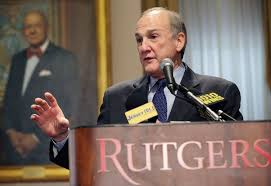
I trust that most of you are aware of the situation at Rutgers University, where the athletic director, Tim Pernetti, failed last year to fire basketball coach Mike Rice after he was made aware of videos that showed Rice physically and verbally abusing players during practices. The Rutgers president, Robert Barchi, subsequently went along with Pernetti’s decision to fine Rice $75,000 and suspend him for three games. The key thing here is that Barchi did not view the videos, or at least says he didn’t.

barchi

Robert Barchi

The shit hit the fan last week, however, after ESPN got ahold of the videos. The clips prompted an immediate outcry, and late last week Pernetti resigned and Barchi was clinging to his job. He was apparently spared because he had not actually seen the videos. (It should be noted that some faculty members are continuing to call for his head.)

I was in Philadelphia over the weekend — Rutgers is close by in New Jersey — and I read everything I could get my hands on about the scandal. In Sunday’s Philadelphia Inquirer, a sports columnist named Bob Ford explained in a single sentence how Barchi managed to slip the noose:

“One does not become a university president without cultivating a close relationship with deniability.”

I had already been thinking how closely the Barchi-Pernetti situation mirrored the scandal surrounding Bishop Robert Finn last year.  After it surfaced that the Rev. Shawn Ratigan had surreptitiously taken pornographic photos of elementary school girls at the parish where he was pastor in Kansas City, North, Finn attempted to shift the blame to Vicar General Robert Murphy, saying that he himself never saw the photos and that he relied on Murphy’s assessment that the photos were not pornographic.

In other words, Finn gave himself deniability.

That didn’t fly with a Jackson County Circuit Court judge, of course, who found Finn guilty of a misdemeanor charge of failing to report child abuse. Now, Finn, who is on probation for two years, stands as the most senior Catholic official convicted in the church’s long-running child sex-abuse scandal.

Nevertheless, Finn has refused to resign, even after ruining the reputation of the Kansas City-St. Joseph diocese. Like Barchi, he’d rather carry on tattooed with shame than bow out gracefully and allow his organization to start afresh with new leadership.

***

The Star’s “Mr. Energy,” reporter Steve Everly, confirmed for readers on Sunday why MGE did not shut off the gas valve to JJ’s restaurant before the Feb. 19 explosion that killed server Megan Cramer and injured several others. The reason? It would have been costly and time consuming to restore service to customers in the area.

Restoring service involves utility employees going around from house to house, business to business, relighting pilot lights.

Everly wrote:

“Instead of shutting the valves when the smell of gas was in the air before the February blast that leveled JJ’s restaurant, Missouri Gas Energy waited for a backhoe to arrive from Raymore — more than 20 miles away — in a failed attempt to vent the leak.”

God help us…We’re on our own, aren’t we?

MGE employees tell a fire department crew that they have the situation “under control” — meaning they’re sitting on their hands waiting for a backhoe — and the firefighters get on the truck and drive off. All the while, several sitting ducks, mostly JJ’s employees, go about their business having no idea what’s in store for them.

As many of you probably suspect (or know), I don’t have a smartphone, a laptop or an iPad. Many times when I’m away, as a result, I don’t have regular access to the Internet and don’t get my full quotient of news.

So, what I sometimes do is have someone save all our home-delivered copies of The Star and The New York Times. Then, when I get back, I go through them at my leisure.

And so it went with last week’s trip to the Bay Area: A big stack of orange (The Star) and blue (NYT) bags were perched on the kitchen counter when we returned Sunday night, and I’ve spent parts of the last few days leafing through the papers. I focused on The Star because the national and international news are more readily available on the road.

As I read, I made note of several stories that caught my attention for one reason or another.

Here, then, are few JimmyC-tagged stories from editions of last week’s KC  Star:

Monday, March 18: “As red-light citations drop, speeders may be next target.”

The gist of this story, written by City Hall reporter Lynn Horsley was that the red-light-camera system installed at various intersections over the last several years has been so successful at reducing red-light running and T-bone crashes that city officials are thinking about deploying cameras aimed at catching people speeding.

The irony of this story is that in January 2012, The Star let itself get swept up in an effort by the Police Department to undercut the red-light-camera program. The Star ran — as an A-1, centerpiece — a story in which police officials essentially contended that the program was a failure because it had triggered an increase in rear-end crashes because of people supposedly jamming on the brakes to avoid running lights.

The story was way off base, and The Star was forced to clarify it in a follow-up a day or two after the first story…And what, you ask, could have motivated the Police Department to try to jettison the program? Simple, it takes department employees a lot of time to process the images and send out the thousands of citations the system generates. In other words, it’s a big inconvenience.

Now, the whole truth and nothing but has come out: The system has worked and people driving the streets of Kansas City are a lot safer than they were before the program began.

Tuesday, March 19: “Brookside Berbiglia”

This subhead appeared above a story that is more about the evolving tenor of the Brookside shops than it is about changes at the Berbiglia store a block west of 63rd and Main.

Here’s the scoop, as brought to us by The Star’s Joyce Smith: Joe Zwillenberg, owner of the Westport Flea Market Bar & Grill, has purchased the Berbiglia building. After renovation, Berbiglia will move to the south part of the building, and a Jimmy John’s will open on the north side of the building.

Do you remember about 10 years ago when Brookside residents raised a hue and cry when reports surfaced that a Starbucks might open on Brookside Boulevard just north of 63rd Street? The locals managed to beat back the threat, and a Roasterie coffee store moved in instead.

But then, a year or two ago, a Panera was erected on the corner of 63rd and Brookside Plaza, tripping the wire for the invasion of the franchises.

So now we get a nice, black and red Jimmy John’s, which produces the worst sandwiches in the nation, in my opinion. If you take away the shredded lettuce, all you have is a thin layer of salami (or whatever), a thin slice of cheese and a slice of mealy tomato — all wedged into a disemboweled sandwich roll.

Friday, March 22: “Two Jump Off Bond Bridge”

A man in his 50s and his 29-year-old daughter committed suicide by jumping off the Bond Bridge over the Missouri River. They were holding hands. In her other arm, the daughter cradled the family’s Chihuahua.

A Chihuahua, not the Chihuahua

A Chihuahua, not the Chihuahua

Now I understand how depression can push people into such a state that they want to take their own lives. But why in the world would someone want to take the family dog with them? Was the dog suffering from terminal cancer? I doubt it. I wish that dog could have swum to shore and lived out his life with a new, more appreciative owner.

Friday, March 22: “Man gave tainted gum to women, police say.”

Uhhh, tainted…How shall I say this in a primarily family friendly blog? OK, the guy jerked off and spread his cum over pieces of chewing gum and then distributed them — on a platter — to female co-workers at a Northland grocery.

Now there’s a novel way of exerting control over women, eh?

Oh, yeah, and, like me, he’s a blogger. He goes by the handle “BlueMidnighter.” Blue, as in dirty, filthy, nasty.

No further comment.

Saturday, March 23: “Suit filed in JJ’s explosion”

A Jackson County Circuit Court lawsuit filed on behalf of six JJ’s employees named five defendants:

Missouri Gas Energy, whose workers assured Kansas City fire fighters an hour before the explosion that they had the gas leak “under control”

Heartland Midwest, the contractor that was digging in the area and punctured the gas line

Time Warner Cable, which had contracted Heartland Midwest to install fiber optic cable to the new Plaza Vista project across the street from JJ’s

— Missouri One Call, a utility-sponsored service that anyone planning to dig in the vicinity of gas lines must call before proceeding

— USIC Locating Services, a company that does the marking for most of the utilities in the Kansas City area.

Obviously, the plaintiffs are casting a broad net, as City Councilman Jim Glover told me would happen a few weeks ago.

The surprise, at least to me, is that neither the city nor the Fire Department was named. What that tells me is that the plaintiffs’ attorney, Grant L. Davis, concluded that the Fire Department was not legally culpable, even though a fire fighting crew left the scene after MGE workers assured the crew that everything was A-OK.

I’ll bet city officials emitted a communal sigh of relief after they heard the news of the filing.

I don’t think that means, however, that the city is completely off the hook: I imagine that any of the named defendants could attempt to bring the city into the lawsuit as a defendant.

It promises to be an interesting legal case to follow, so stay awake, readers!

It’s been a while since I’ve done one of my famous travelogues, but last week Patty and I had a very fine trip to the Bay Area, and it offered some good photo opps.

The reason for our trip was business. As some of you know, Patty owns and operates a company called WomenSpirit, which designs and manufactures robes, blouses, stoles and other items for women ministers. (There’s also a men’s line, called AbidingSpirit. For more on WomenSpirit and AbidingSpirit, visit the website, http://www.womenspirit.com,)

There are three Protestant seminaries in Berkeley, and Patty and I spent one day at each seminary, displaying and selling robes and other garments to seminarians and seminary staff members.

It was not only a good trip from the business standpoint, but also from the sightseeing and touring standpoints. Combined, San Francisco, Berkeley and Oakland have about everything a person could ask for in terms of quality of life. Individually, they are fascinating and distinctive cities.

If you’ve been to Berkeley, you know everything revolves around “Cal,” that is, the University of California, Berkley, with an undergraduate and graduate enrollment of more than 35,000.

The school, which sits halfway up a big hill a couple of miles from the waterfront, generates a nearly round-the-clock flow of foot and bike traffic, which makes for a lively environment.

We also spent an afternoon in San Francisco, but having explored San Francisco in depth several years ago, I wanted to get a good look at Oakland this time.

In some ways, Oakland is similar to Kansas City. For example:

:: Oakland has about 390,000 residents; Kansas City about 460,000

:: Oakland’s downtown is making a comeback, just as Kansas City’s is

:: Both cities have high crime rates

:: Kansas City lays fleeting claim to Ernest Hemingway; Oakland prides itself on being the one-time home of Jack London (“The Call of the Wild” and “White Fang,” among other works)

In some ways, the two cities are very different:

:: Oakland has the San Francisco Bay; Kansas City, the Missouri River

:: Kansas City has the renovated Truman Sports Complex; Oakland, the stark, unattractive Oakland Coliseum

:: Oakland covers 78 square miles; Kansas City, 314

:: Oakland has an average of 260 sunny days a year; Kansas City, 120

With that lengthy lead-in, then, here are some images from the Bay Area.

P1020427

San Francisco Bay, with the Bay Bridge in the background

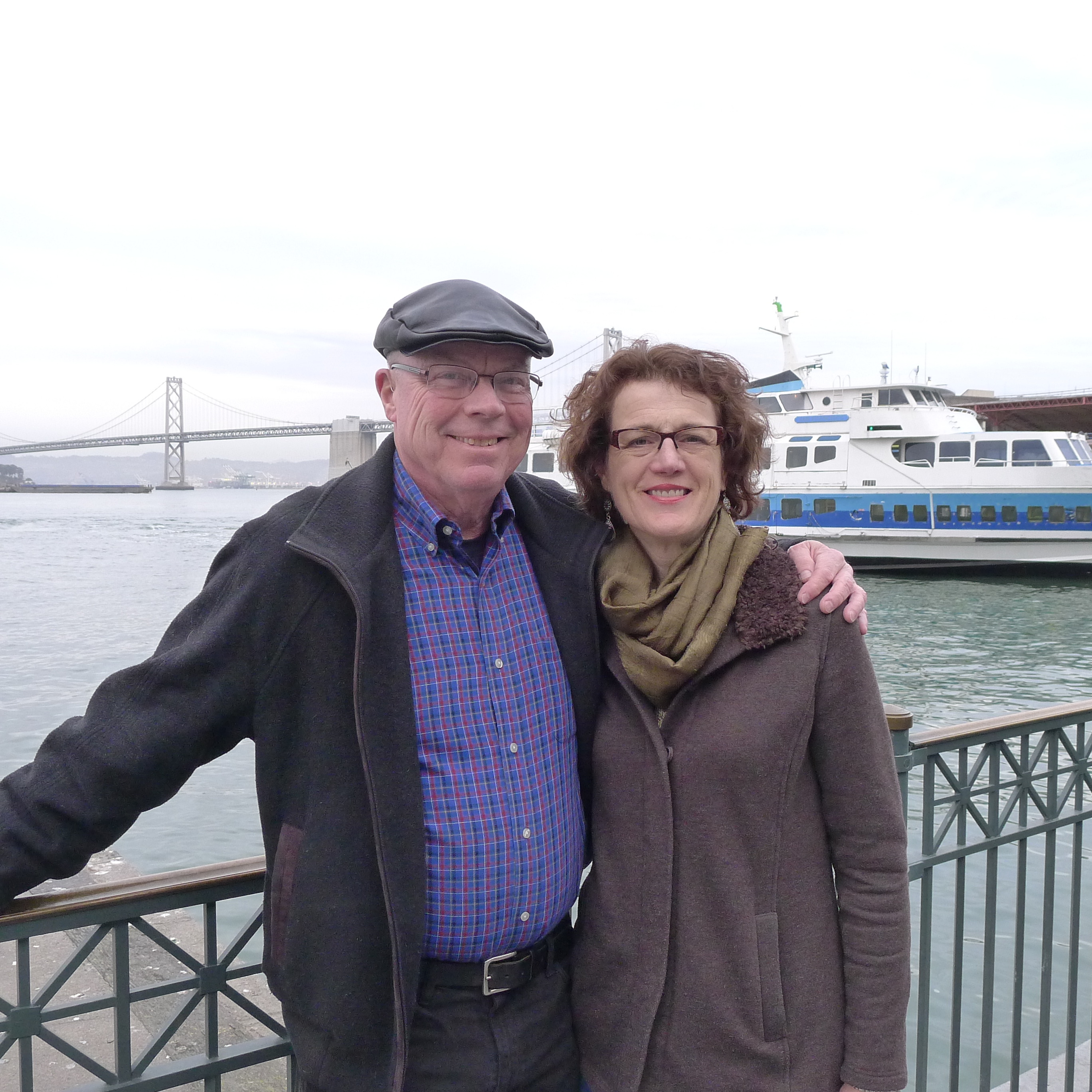
Happy travelers from Kansas City

Happy travelers from Kansas City

A popular restaurant inside the San Francisco Ferry Building

A popular restaurant inside the San Francisco Ferry Building

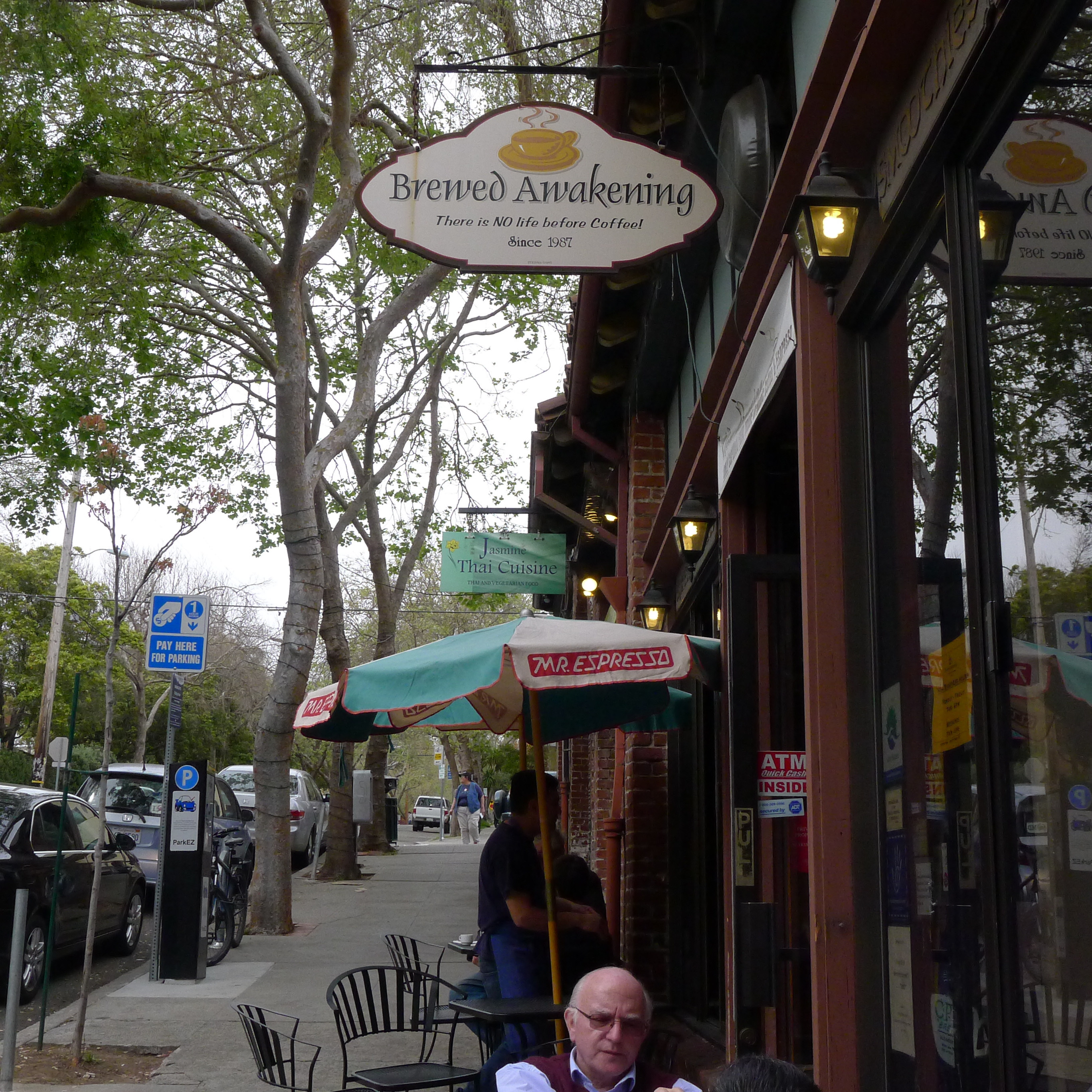
The Brewed Awakening, a Berkeley coffee shop where we started each day

The Brewed Awakening, a Berkeley coffee shop where we started each day

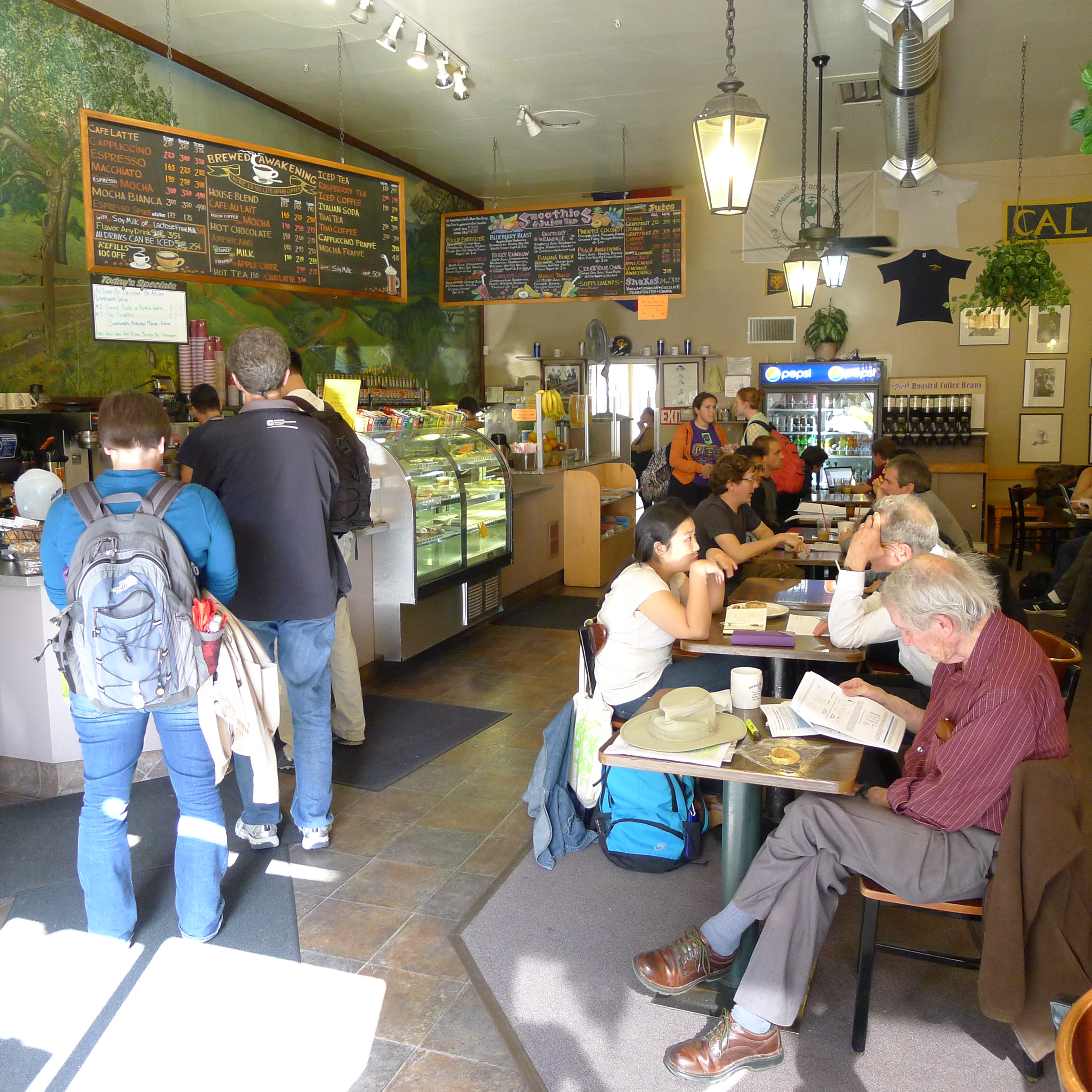
...we and a lot of other people

…we and a lot of other people

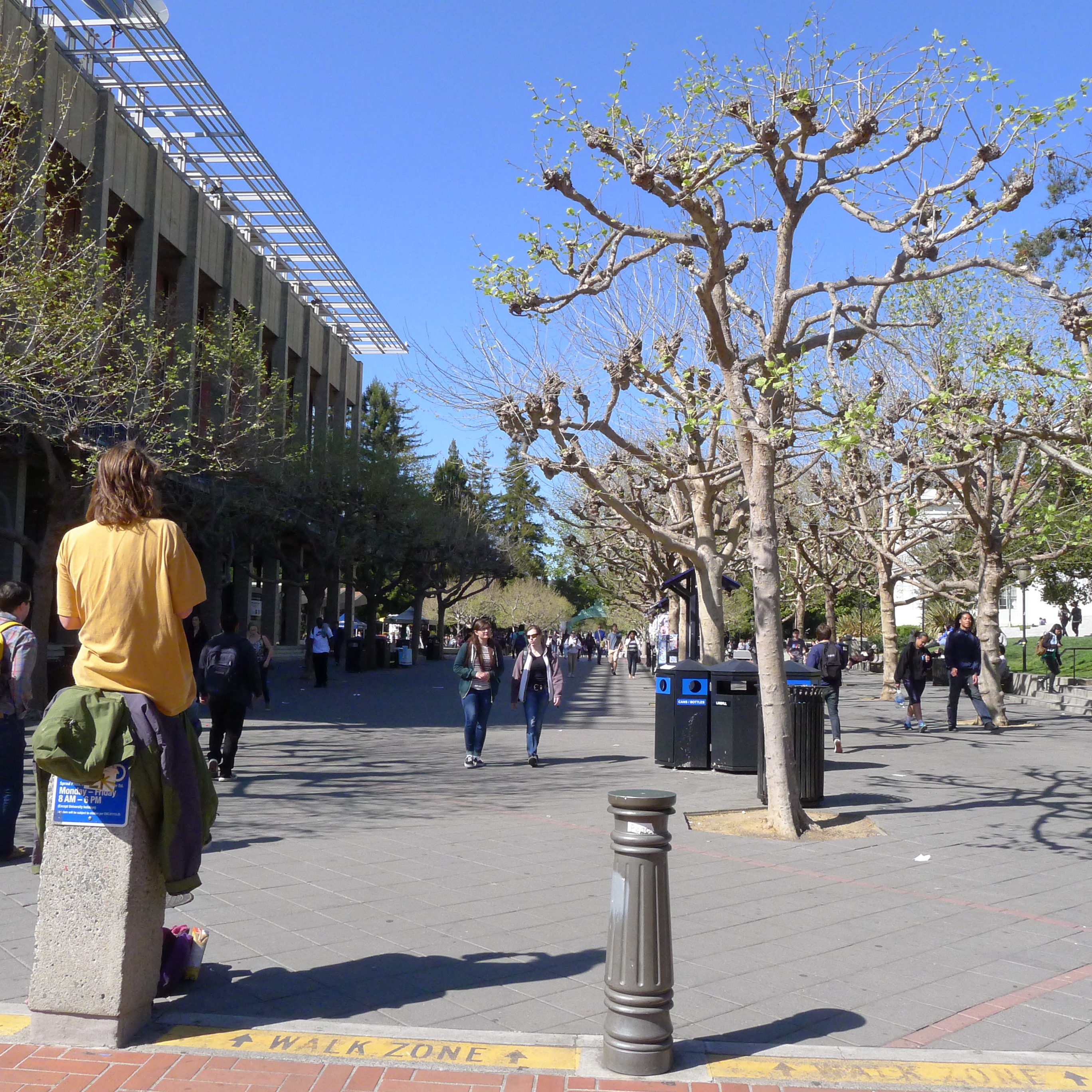
Sproul Plaza on the Cal campus

Sproul Plaza on the Cal campus

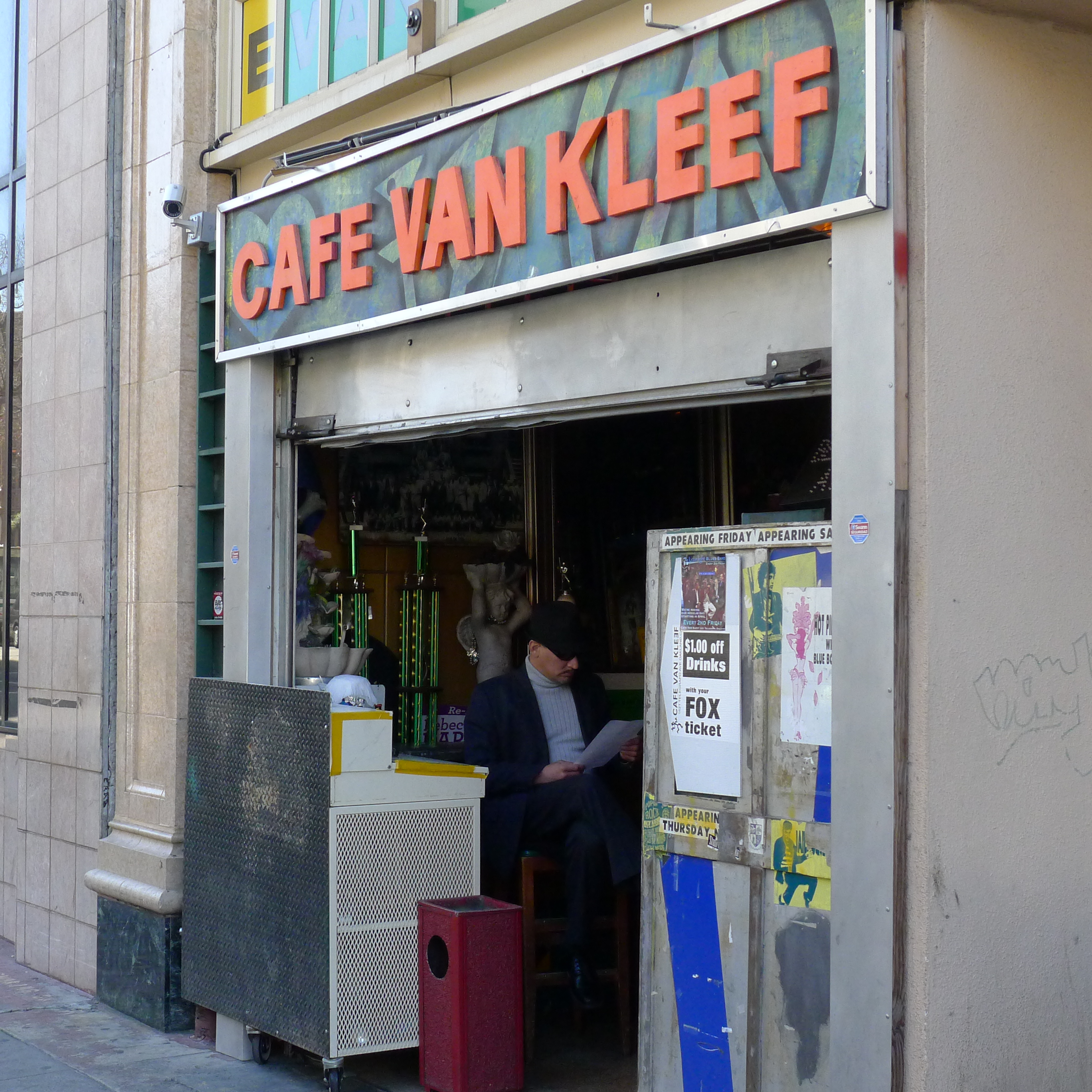
Cal isn't exactly a conservative campus

Cal isn’t exactly a conservative campus

Alice Waters' famous Chez Panisse restaurant, closed until about June because of a recent fire

Alice Waters’ famous restaurant, Chez Panisse, in Berkeley (It is closed until about June 1 because of a recent fire. We had reservations, which were canceled after the fire.)

P1020514

An entrance to Jack London Square, Oakland waterfront

Jack London: He went to high school in Oakland and spent time there before heading to Alaska for the 1897 Gold Rush

Jack London: He went to high school in Oakland and spent time there before heading to the Yukon Territory in 1897 for the Gold Rush

P1020499

Oakland City Center

City Hall

City Hall

Waiting for business

Taking a break in downtown Oakland

Waiting for business

Not quite as active as the Brewed Awakening

The Art-Deco style Paramount Theatre, completed in 1931

The Art-Deco style Paramount Theatre in Oakland. (It opened in 1931.)

P1020496

Like Kansas City’s Folly Theatre, the Paramount was renovated after decades of neglect. Once again it is a major performing-arts venue.

P1020517

The Cathedral Building, the centerpiece of Latham Square

At last, nearly a month after the JJ’s explosion, the Kansas City Fire Department has acknowledged the obvious: That it is responsible for dealing with natural gas leaks.

Initially, after the Feb. 19 explosion that killed waitress Megan Kramer and injured 15 other people, Mayor Sly James infamously said in defense of the Fire Department: “(The) Fire Department doesn’t do gas.”

No more.

The Star’s Matt Campbell reported today that KCFD would change the way it responds to gas leaks.

Campbell wrote: “Fire Chief Paul Berardi said that from now on, the initial dispatch on any call about a possible natural gas leak will include a battalion chief and a fire truck equipped…to monitor gas levels in the air.

“In addition firefighters will remain on the scene and continue to consult with gas utility experts to determine whether to evacuate an area or building. They will remain there until the risk has been resolved.”

That’s the way it should have been all along. In 2010, Fire Engineering, a firefighting trade journal, had this to say on its website about natural gas leaks:

“Responding to gas leak emergencies often carries the stigma of a routine service-level call. The contrary is true, however, in that each of these incidents can easily escalate into a major emergency that could involve fire, explosion, collapse, evacuation, and any number of serious outcomes. Each of these responses must be treated as true emergencies and be handled with appropriate levels of risk management.”

Why, then, would a KCFD crew to arrive at the scene of a major gas leak, heed the advice of gas workers saying “we’ve got it under control,” and then get back on the truck and drive away?

That’s exactly what happened an hour before the JJ’s explosion. The crew left 13 minutes after they arrived and about 45 minutes before the explosion. .

It is unclear to me whether a battalion chief was at the scene, but from all I’ve heard and read it appears that the captain in charge of the truck made the call.

As one former KC firefighter told me, for whoever made the call, “It could be a career-altering move.”

Another big mistake the crew made was advising JJ’s staff to keep all ignition sources off. The crew told JJ’s employees to turn off all ignition sources but didn’t make sure it got done and didn’t help. Thus, the staff overlooked a couple of pilot lights — which I can see easily happening: Pilot lights are out of sight and somewhat out of mind, at least for the average person.

The pilot lights actually triggered the explosion, but it was what took place earlier — MGE saying it had the situation under control, the pumper truck driving away, and evacuation delayed until 10 to 15 minutes before the explosion — that truly caused the disaster.

By the way, in announcing the policy changes, Berardi said his comments would be his final statement on the matter.

This chief, who succeeded Smokey Dyer last year, has already had more than his 15 minutes of fame. He probably hasn’t had a solid bowel movement in weeks. He has not handled this debacle well, and the city and MGE — and perhaps others — are going to pay mightily for their mistakes.

A lawyer friend of mine said the litigation scenario would go like this: The plaintiffs will sue everybody — the contractor doing the digging, the fire department, MGE and maybe Time Warner Cable, which hired the contractor. Then, the defendants will file “cross claims,” each trying to cast the brunt of the blame on the other defendants.

Depositions and case filings will point toward how the blame should be apportioned. Then, the settling will begin.

Millions of dollars will change hands. In the end, though, Kansas City still will have lost a fine citizen, and area residents will forever think of the JJ’s site as the scene of a senseless tragedy.

It’s a beautiful, warm day in Kansas City, and, except for a slight crick in the neck, JimmyC feels good — mighty glad to be alive and writing.

And yet…Jimmy is puzzled and troubled by a number of things.

For example, he wants to know:

:: Why is the Kansas City Fire Department trying to shovel part of the blame for the JJ’s explosion onto…JJ’s?

According to a police and fire department report released yesterday, the area of origin the fire was listed as “cooking area, kitchen.”

Pardon me, but shouldn’t that have read: “Punctured gas line, alley”?

A story in The Star today goes on to say that “firefighters arriving on the scene before the explosion said they instructed JJ’s workers to extinguish flames on the candles, stove and water heater.”

The day after the explosion, the restaurant manager told fire investigator Thomas Kievlan that employees put the candles out and turned the stove off but did not turn off the stove or water-heater pilot lights.

Just gotta ask here: WHY THE HELL DIDN’T THE FIRE DEPARTMENT GO IN AND MAKE SURE ALL THE IGNITION SOURCES WERE TURNED OFF?

I get the impression that some fire fighter stuck his head in the restaurant door and said, “Hey, you’d better blow out the candles and turn the stove off” or maybe, “You’d better make sure all ignition sources are off.” Even if it was the latter, it’s easy to understand how workers would overlook pilot lights.

Fire fighters, if they had done their jobs properly, wouldn’t have overlooked them, though.

:: How will the city ever get control of the Police Department while an outgoing police board  commissioner is co-chairman of a committee charged with studying the issue of local control? 

A story posted today on The Star’s website quotes Mayor Sly James as saying: “We have assembled fair-minded, equally wise Kansas Citians to weigh this complex issue.”

The co-chairmen are former Mayor Kay Barnes (good) and former Police Board President Pat McInerney (bad). I’ve never heard a single police commissioner who has had anything good to say about local control. And why should they like the idea? They’re the people who have, nominally, controlled the department. (Actually, the police department bureaucracy is in charge.)

:: What prompted H&R Block to notify clients through Facebook about errors it made that will delay tax returns for possibly hundreds of thousands of people?

One client, Dustin Munson, told The Star: “I have been patiently waiting for my education credit refund, which I need to pay tuition bills. I was aghast to learn of the delay ON THE INTERNET and not from communication issued from your company…”

The question of WHY left Block’s director of communication, Gene King, pleading “no comment,” according to The Star.

Facebook? Well, all I can say is H&R Block is really up to date on its social media.

:: How will Kansas City Southern’s decision to not allow commuter trains to use its tracks affect County Executive Mike Sanders’ political ambitions?

Earlier, KC Southern had agreed to allow commuter trains to run on its tracks from Blue Springs to near Third and Grand in the River Market. But The Star reported today that KC Southern officials have changed their minds and are now insisting that Union Station be the final destination. That’s a problem, though, because Union Pacific has not agreed to have commuter trains running on its tracks leading to Union Station.

I smell politics…The Civic Council? Sly James? State reps or senators? Sanders would like to run for statewide office, but this development could pluck a big prospective accomplishment from his resume. Somebody, or somebodies, are out to get him.

:: Can anything good come from a party centered on a dance style “that involves shaking one’s rear,” as The Star put it?

Such a party was held Saturday night at the Tropical Palms Banquet Hall, 87th and Hillcrest. The Star reported that five people between 15 and 20 years old were wounded by shooting that broke out about 11:45 p.m…Of course, nobody saw anything.

The promoters didn’t have a dance-hall permit, and police said they had learned of only one unlicensed guard at the event, which was billed as “Everything/March Madness Twerk Fest.”

The Urban Dictionary lists “twerk” as a verb and gives the following definition: “to work one’s body, as in dancing, especially the rear end.”

Please, readers, for your welfare, stay away from twerk fests.

:: Why must Ding Dongs and Twinkies come back?

I like sweets as much as the next person, but I like them in the form of real food, like apple pie and chocolate cake.

***

Please feel free to hazard a response to any or all of these provocative questions.


A big, developing story that many area residents might not be paying much attention to is the future of North Kansas City Hospital.

I’ve been following the developments closely, partly because the long-running story of Northtown, as it’s called, has been mesmerizing. It goes like this:

Small, humble city on the edge of Downtown Kansas City stumbles into wealth after casino gambling comes to town, and proceeds to plow through its treasure trove and find itself in worse shape than before it got rich.

The story’s arc is like that of a modest family that wins the lottery, starts buying fancy cars and lavish homes and then finds itself in dire straits. The family members are left looking over their shoulders, saying:

“How in the hell did we let that happen?”

Long story short, North Kansas City has burned through millions of dollars in casino revenue, and city officials now want to sell the hospital, which the city owns but is under the control of an independent board of trustees.

The hospital’s value? An estimated $500 million.

Thus, a battle royal is underway: On one hand, the City Council is doing everything it can to gain the right to sell the hospital, while, on the other hand, most citizens and hospital officials are striving to build a legal moat around the facility, which was built in 1958.

***

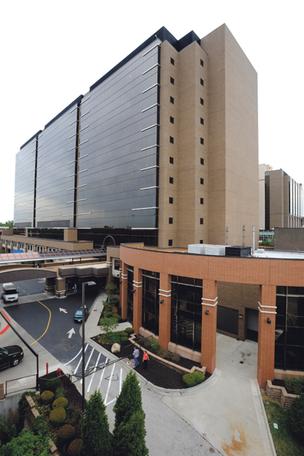
NKCHosptitalI have a slightly more than passing interest in this battle.

First, my wife Patty and I own a building in the 1300 block of Swift Avenue, where Patty operates a clothing manufacturing business. We’ve owned the building for more than 10 years, and North Kansas City has proved to be a great place to do business…It is quiet, safe, and city services have been excellent.

Second, my primary care physician is with North Kansas City Internal Medicine, which has its offices adjacent to the hospital. Fortunately, I’ve never been hospitalized there, but it’s entirely likely that I will be some day.

If and when I am admitted to NKC Hospital, I don’t want it to be owned by a mega corporation like Hospital Corporation of America (HCA).

If I have to be in a hospital for an extended stay, I want it to be one where the emphasis is on patient care, not cookie-cutter systems designed to generate as much money as possible from operations.

That’s not to say NKC Hospital isn’t financially successful; it is big, and it generates lots of revenue.

But now…back to the riches-to-rags story of North Kansas City.

After Missouri voters approved legalized gambling in 1992, Harrah’s planted its “boat in a moat” at Chouteau Trafficway and Missouri 210 (eastward extension of Armour Road). At its peak, North Kansas City was taking in $11.5 million a year from the casino, including $1 for every person who entered the casino to gamble.

Eight months ago, The Star’s Steve Everly and Allison Prang charted beautifully Northtown’s rise and fall.

For a while, everything was great: The city was flush and city services were impeccable. (I remember several years ago, when the city put new sidewalks in on Swift, when the existing sidewalks still looked pretty good.) But after Gene Bruns was elected mayor in 1997, the city went on an extended spending spree.

Among other things, the city built a gigantic community center — perhaps the biggest in the metro area — on Armour Road, not far from City Hall; it spent $10 million for properties near Armour Road and I-35 for a mixed-use development; and it built its own fiber optic network at a cost of $13.5 million.

Here’s how those investments have fared, as reported by Everly and Prang:

— During the 2011-2012 fiscal year, the community center had revenue of $1.1 million and operating expenses of $2.6 million.

— The mixed-use development has not come to fruition.

— The fiber optic network lost more than $1 million during 2011 and 2012.

The city partied on for most of Bruns’ 12 years in office, which came to an end in 2009.

Everly and Prang were not able to reach Bruns (I wonder why), but, according Elizabeth Short, who preceded Bruns, he made his intentions clear early on.

“He told me, ‘You got the money, and I get to spend it,’ ” she recalled.

***

It’s too bad the citizens of North Kansas City didn’t catch on to Bruns earlier and nip him and his councils in the bud.

But the damage has been done, and now North Kansas City residents and their elected representatives in Jefferson City are trying to prevent the worst possible development.

Recently, state Sen. Ryan Silvey introduced a bill that would allow the hospital’s board of trustees to vote to become an independent, nonprofit corporation.  In addition, if five percent of the city’s registered voters signed a petition calling for the hospital, to go to nonprofit status, the question would be put to North Kansas City voters.

State Rep. Jay Swearingen told The Star last month that he planned to introduce a similar bill in the House.

Let’s hope that city officials and lobbyists for corporations eyeing the last big independent hospital in our area are not able to convince — or buy — the favor of a General Assembly majority.

This is a story that deserves to be watched very closely, whether you live in Kansas City or North Kansas City…Grain Valley or Pleasant Valley.

Kansas City Mayor Sly James has been praised and criticized for his handling of the explosion at JJ’s.

There is no doubt that he was assertive, but was he more concerned with appearing to be in charge than making sure he was on the side of public health and welfare?

The problem with Sly’s initial response — we’re not going to play the blame game (paraphrasing), and the fire department “doesn’t do gas” — is that he didn’t think his comments all the way through.

Instead of a measured response — we will get to the bottom of this with all deliberate speed  (paraphrasing again) — he opted for an assertive, knee-jerk reaction that made him appear to be defending the fire department and beating back the press. (Oh, the press! Those turds in the punch bowl…always asking niggling questions and trying to make us public officials look like we’re picking our noses.)

…It didn’t help that Sly was wearing a fire-engine red, KCFD shirt at the news conference. Instead of trying on shirts before the news conference, he should have been sitting in a corner, or in his car, thinking about what he was going to say and asking the Holy Spirit for guidance.

But what’s done is done, and what was said has been consigned to Google.

So, what now?

A City Councilman I spoke with this week (he didn’t want to go on the record before the results of the fire department’s investigation has been released) noted that it’s easy for a public official to make a mistake and say something wrong in the midst of a crisis. The key, he said, is for public officials not to be afraid to reverse course once they analyze a crisis in hindsight and realize they erred.

If, after the fire department investigation is made public, James comes back and says that mistakes were made…and if he lays out a plan aimed at decreasing the chances of something like this happening again, then, yes, all is forgiven. The mayor will have reassured us that our safety is his top priority.

But if he sticks to “we don’t do gas,” he’s burying his head in the trench, and he will have used up a good measure of the trough of good will that every public official starts out with.

So far, Sly has taken only a baby step toward making amends with the public. In an interview with The Star’s Dave Helling last Friday, James said:

“If it turns out that something should be tweaked or done differently, that will certainly be something we will take a look at. But I’m not looking for somebody to blame… I’m not coming in with a preordained conclusion that somebody screwed up.”

Clearly, city procedures in the handling of gas leaks need to be more than “tweaked,” and blame must be assessed, no matter how uncomfortable it makes the mayor.

Unfortunately, Sly’s comments so far have put him in the position where he has to lead from behind in order to get back to the front.

The next time he talks about JJ’s, I want to see him playing mayor not fire fighter.

The two posts in which I have held the city’s and the gas company’s feet to the fire for the way they handled (or didn’t) the JJ’s disaster last week have generated many comments and lots of interest.

A key person who just weighed in today, with two lengthy comments on the first post, was Mark McDonald, president of the North American Gas Workers Association.

Some of you will recall it was McDonald who told The Star:

“It should have taken three minutes (to shut off gas to the area), and the building wouldn’t have exploded.”

With those few words, McDonald voiced the frustration that thousands of Kansas Citians were feeling about Missouri Gas Energy’s response to the situation, as well as the failure of the gas company and the Kansas City Fire Department to evacuate people from the area before the blast.

People reported that a strong smell of gas permeated the area for an hour before the explosion, which killed one person, waitress Megan Cramer, and injured 15.

markmcd

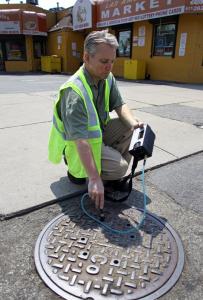
Mark McDonald, checking for gas leaks in Boston

In today’s comments (which you can see in their entirety at the bottom of my Feb. 21 post), McDonald responded to another commenter’s call for him to elaborate on his original statement. He also responded to a commenter who accused me of playing “the blame game.”

Below, I have culled what I consider the most interesting and pertinent quotes from his two comments.

:: Regarding the commenter’s call for elaboration on shutting off gas valves…

I agree with your points about my statement being somewhat confusing to the lay person/public…I explained in length (to the reporter) and extensively about what should be available to shut down a gas leak of this magnitude…The reporters-editors decide what to write, and to what extent they decide makes enough sense to the average reader. Space in the newspaper is (at) a premium.

I will elaborate here…The gas could have been turned off at what’s known as a “critical valve” or primary valve. These are required to be in place and inspected annually under state and federal regulations to ensure they are accessible…to prevent such a disaster at JJ’s.

My understanding is the crew decided to dig a vent hole to help the gas vent into the air, instead of shutting down the critical valve. After the explosion, it appears the company had to dig out one valve at one end of the street and dig down to the main and crimp off the other end.

I hope that helps a bit. I also must point out that my comments are based on industry standards and requirements/regulations and what information I can confirm from the incident itself. I am not on-site or involved in the direct investigation, but I believe my comments were accurate in this case.

Keep in mind, when something like this happens, the media is full of questions without many answers. When asked, I try to educate the reporter on the technical basics of natural gas and what I believe are the possibilities, based on dozens of other gas explosions around the nation.

My overall goal is to ensure that information that is as accurate as possible gets out to the public — sooner than a year or so from now…when the PSC  (Missouri Public Service Commission) releases its final report of its findings.

Questions need to be asked and answered soon after the explosion. The public and the loved ones of those lost and injured deserve at least that.

***

:: Regarding another commenter’s assertion about “the blame game” and the location of shut-off valves…

If you read the state and federal regulations, it does state the location of such valves shall be positioned for a shutdown in case of an emergency, and it also states the “pressure” is one of the things to be considered when spacing these valves.

If it (the shut-off valve) is blocks away from the leak…it sounds like the company may not have placed the valve correctly in terms of safely shutting down a high pressure system.

The other factor here is (that) “main” valves used (to) be located at the end of each street (or every few blocks on longer streets)…and maintained. In my opinion, since de-regulation the gas companies have reduced their staffing by over 20 percent, while gas customers have grown by more than 20 percent.

The companies looking to cut back on costs could not maintain the main valves, nor were they directly required to by regulation. So, they were often paved over and not installed in newer installations.

Placing hundreds or even thousands of customers on one “critical/primary” valve is quite dangerous…The PSC (Public Service Commission) does take an extra step on the federal regulation requiring critical valves (to) be spaced so that a shutdown can be re-lit within eight hours.

Based on this incident and some comments here, it (the PSC) needs to go much further, especially on high-pressure gas, since it sounds like the company can’t control their own gas when it leaks.

***

Many thanks to Mark McDonald for elaborating on his understanding of the situation at JJ’s.

Everything he has said, as well as a strong feeling in my gut, has convinced me that the JJ’s explosion could have been avoided and that, at the very least, the area should have been evacuated.

If JJ’s would had exploded without any injuries or loss of life, most of us would have said, “That was a big fire.” Few people, except maybe Jimmy and David Frantze, would have questioned so strongly what responders were doing during the hour before that horrible explosion.