Feeds:
Posts
Comments

I returned yesterday from the city where the fashion runway and parade of humanity never end.

It was the first time I’ve been to New York City in probably 20 years or more, but I don’t remember for sure. All I know after going back is that I should have gone sooner and intend to go more often.

Patty and I spent three days in the Manhattan — staying at a hotel on the Lower West Side — and then three days on Long Island with friends who’ve lived there many years.

While I came back yesterday, Patty stayed on. She and our friend Cheryl D’Antonio will be getting on a train Thursday for a three-day Amtrak ride to Salt Lake City…It’s a bucket list thing of sorts in honor of, and with, another friend who has a serious health problem.

In Manhattan, we saw two musicals — a stirring revival of Oklahoma! and a fast-paced show called Come From Away, about one aspect of the 9/11 tragedies. (Tip on buying theater tickets: Don’t buy online in advance; you pay about a 33 percent processing and handling fee per ticket. We went to the box offices the day of and the day before performances and got good tickets at face value.)

I’ve got a lot of photos to show you…so many that I’m splitting them up over two days.

Let’s get cracking with Part One!
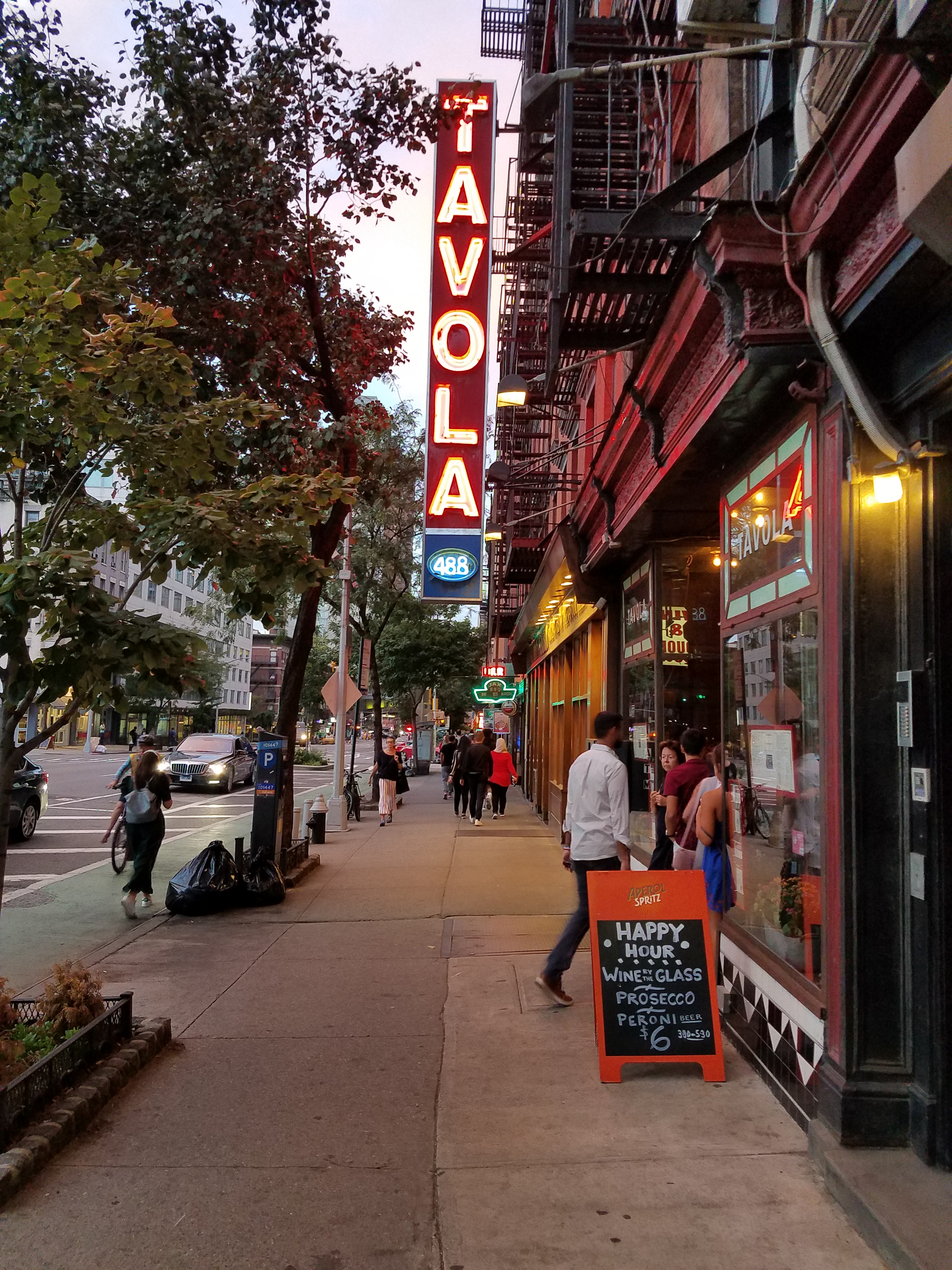
After arriving last Tuesday, Aug. 27, we walked over to 9th Avenue and found this great Italian restaurant. It was noisy, but the food and lively atmosphere overrode that drawback.
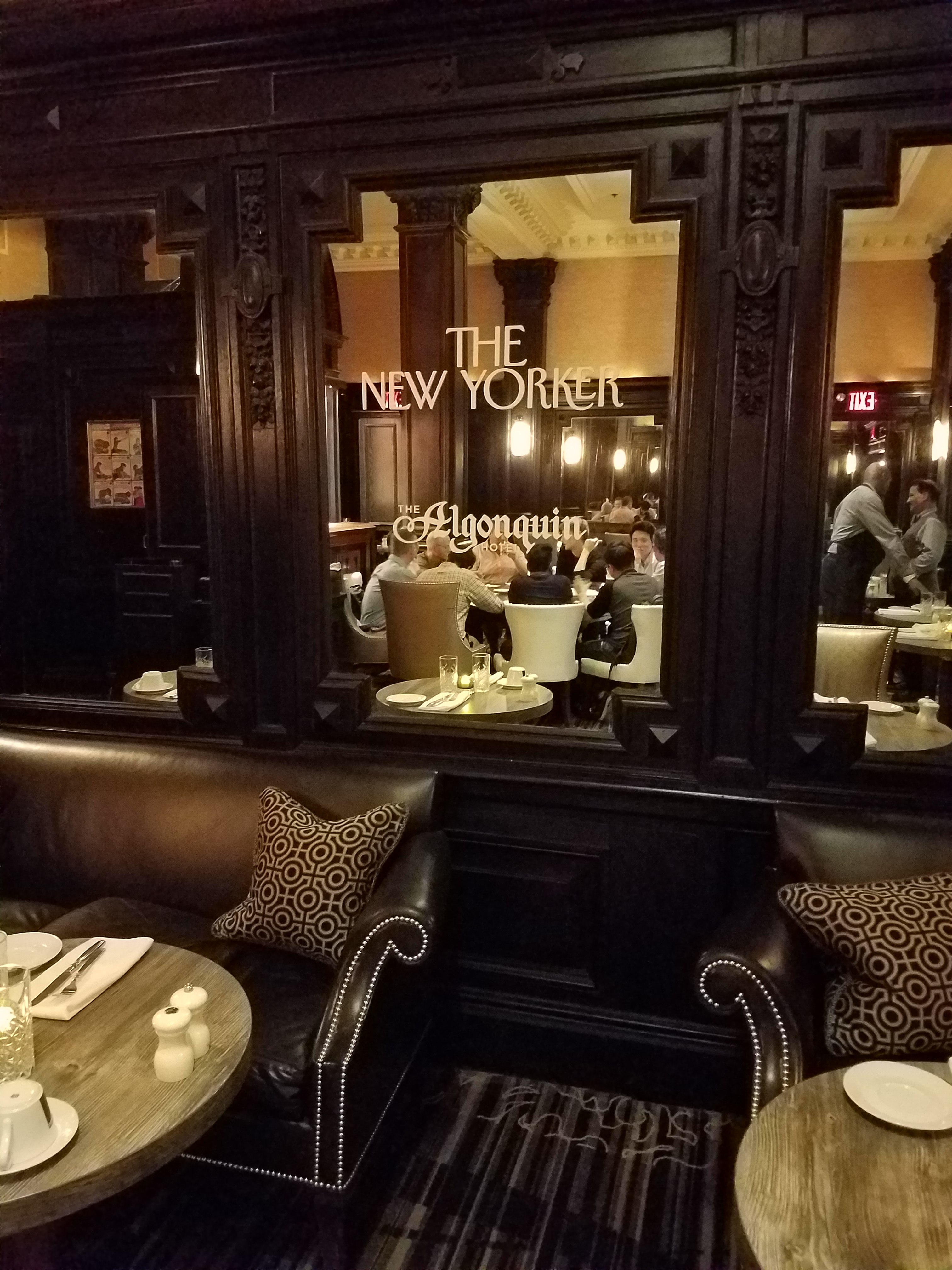
Although it was pretty late when we finished dinner, we went over to The Algonquin Hotel and had a drink in its famous lobby. Famous for what? Well, it was the hangout in the 1920s for a group of actors, critics and writers who called themselves “The Vicious Circle.”
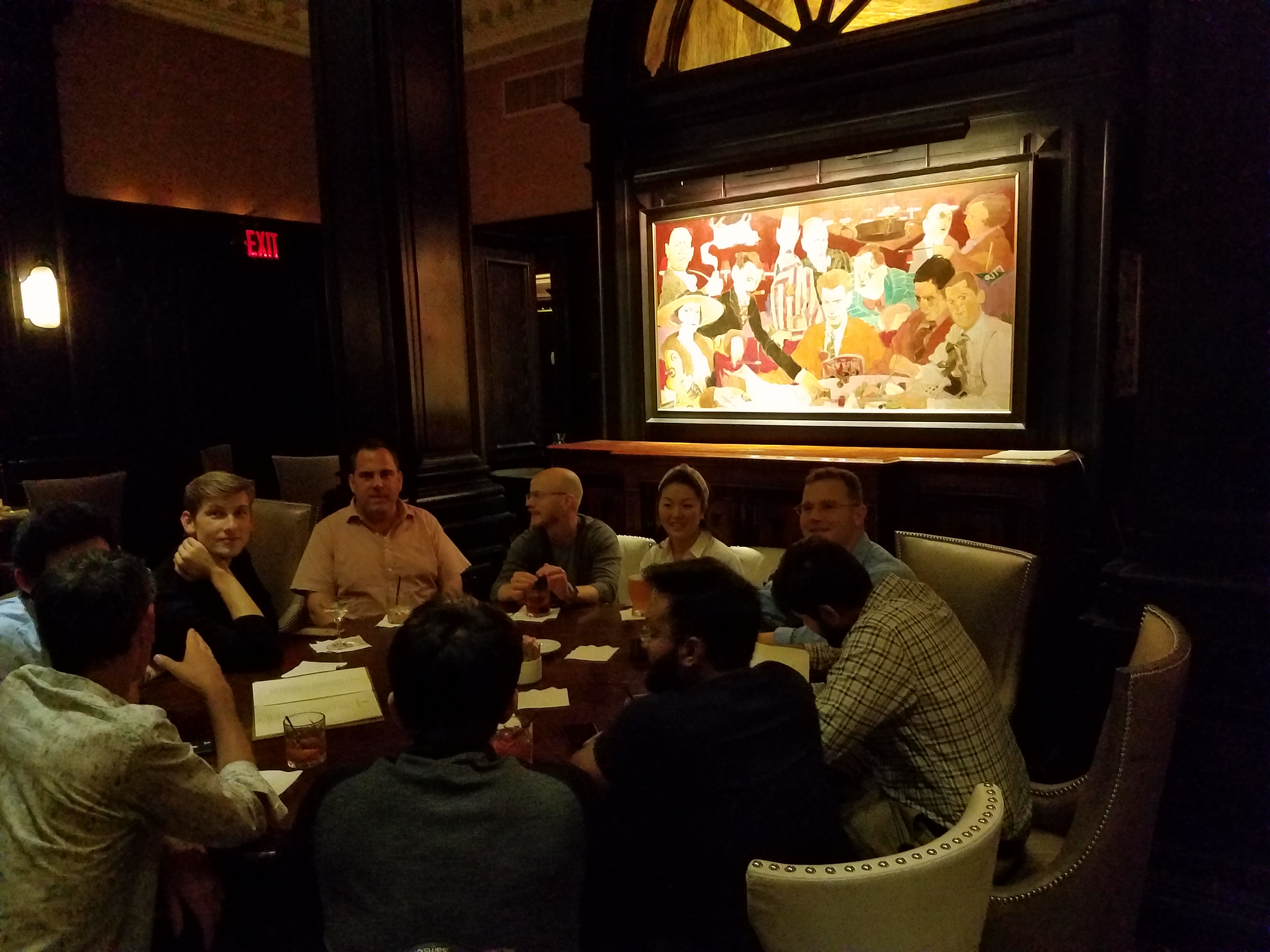
They had lunch daily at a round table — either this one or one like it. The titular head of the group was Harold Ross, founder of The New Yorker magazine. In the painting hanging above the table, Ross is at the center. He died in 1951 at age 59.

Another landmark is The Dakota coop apartment building on the Upper West Side, across from Central Park. It has been home to many famous people, including John Lennon, who was murdered in the archway in 1980. Other residents have included Judy Garland, Lauren Bacall and Boris Karloff.

The greatest landmark in the world…the Empire State Building, 34th Street and Fifth Avenue.

Times Square, with its digital ticker tape…One of the big stories this night was the pending sale of the Kansas City Royals by David Glass.

Part of the Theater District. The Schoenfeld, on West 45th Street, was where we saw Come From Away.

Radio City Music Hall, on 6th Avenue

Patty, who is quick,, quick, quick, spotted this place not far from the Schoenfeld.

This Mid-Century-Modern era building near Washington Square Park closely resembles our former TWA building (except for the coloring) at 18th and Baltimore.

C

Here’s another striking-looking building — architect Zaha Hadid’s condo building on West 28th Street, along the High Line elevated park and south of a mega-development called Hudson Yards. According to Crain’s, sales of units have been slow, perhaps because Hudson Yards is still under construction.

This is what I mean when I say “still under construction.” It’s a veritable spaghetti junction of cranes. (Our hotel was adjacent to the development.)

If you like these photos, come back tomorrow and I’ll have more for you…
 

The Star was forced to write an embarrassing correction Monday after publishing an online story that said a federal judge had issued a preliminary injunction blocking parts of Missouri’s new abortion law.

The incorrect story was pulled from the website before I saw it; it was a major gaffe.

The corrected story, by reporter Crystal Thomas, began like this…

“CORRECTION: An earlier version of this story incorrectly said that the judge had issued a preliminary injunction. The judge is still considering whether to do so.

“A federal judge said Monday he will consider whether to temporarily block parts of Missouri’s new abortion law, including a ban on abortions after 8 weeks of pregnancy, from going into effect.”

…Unfortunately, the erroneous version reflected on reporter Thomas, who has been with The Star four months. But it wasn’t Thomas’ fault. To its credit, The Star inserted a “Behind our Reporting” box explaining how the earlier version came about…

“When we anticipate that an important story will break, we often prepare material in advance. This allows us to move as quickly as possible to get a story to our readers once events unfold. In this case, however, an assignment editor inadvertently published advance material before the court hearing had concluded. The advance material was prepared based on how this same judicial circuit had ruled invalidating similar laws in Arkansas and North Dakota.”

I like the fact that The Star was preparing a story in advance. It’s too bad the editor hit the send button, but one of the benefits of online is that mistakes can be caught and fixed quickly…Nevertheless, I’m sure the editor with the itchy finger feels terrible.

One more thing: This correction shows the utter foolishness of The Star’s long-time policy of “not repeating the error” in corrections in the print edition. Can you imagine the semantic contortions the editors would have gone through to try to correct this error without stating the mistake? So, maybe the editors will come to their senses and start telling print-edition readers what they screwed up so that the corrections themselves don’t spawn confusion.

(Unlike some papers, The Star doesn’t make note of most corrections that have been made in online stories. Obviously, it couldn’t do that in this case.)

**

While we’re talking Star business, here’s news about some high-profile former reporters and editors:

:: Medical reporter Andy Marso, who, during his three years at The Star stamped himself as one of its top reporters, left the paper last Friday to take a job with Leawood-based American Academy of Family Physicians. Marso said on Twitter that he would be an editor for an AAFP journal called FPM (Family Practice Management).

Andy Marso

Marso said: “Family physicians are the foundation of medicine and our best hope for creating a system that keeps people well, rather than just treating them after they get sick. I’m excited to do my small part to move us in that direction. Also will likely do more meningitis vaccine advocacy.”

The Star will really miss Marso, but he’s making a move that is in his best long-term interests, in my opinion. The shakeout and consolidation that’s ahead for the newspaper industry is going to generate a load of anxiety for thousands of employees around the country. I wouldn’t want to be part of it.

:: Former Star business editor Chris Lester, who had been in AT&T’s marketing department the last several years, has become managing editor at KCPT. I don’t know exactly what that job entails or how many people he oversees, but it’s good to have Lester back in the news business.

Caitlin Hendel

:: Former assistant state desk editor (Missouri and Kansas) Caitlin Hendel has moved to KCUR, which has been on a major expansion run for several years now. Until several months ago, Hendel was CEO and publisher at Kansas City-based National Catholic Reporter. Hendel started work earlier this month as KCUR’s director of institutional giving and communications.

Donna Vestal

:: Also at KCUR, Donna Vestal, a former assistant business editor at The Star, is switching from director of content strategy to a job pertaining to KCUR’s collaborations with other public radio stations. The content-strategy position will be eliminated, and a new position — director of journalism — will be created. KCUR is now advertising that job. The person who gets it will oversee the station’s content team, including everyone who produces and works on the station’s news and talk shows.

It’s great to see at least one KC news outlet growing and going strong.

I’m glad I was a reporter in the days when you could pick up the phone and call CEOs, police chiefs, elected officials and other people you needed to get information from and often make direct contact on the first try.

For example, I remember once wanting to reach Paul Henson, then-CEO of United Telecommunications, before it became Sprint. I dialed the main switchboard and asked for Henson. The operator rang his office, he picked up and said in a near-growl, “Henson.”

Paul Henson

I was so startled at the way he answered it took me a couple of seconds to recover and state what I wanted. I don’t remember what the story was about, but I’ll never forget the sound of that voice.

Another time, I somehow got the private office number of Irvine O. Hockaday Jr., then Hallmark CEO. I held onto the number until one day I really needed a comment from him. I dialed it, he picked up, and that time it was the CEO, not the reporter, who was startled.

These days, that kind of thing wouldn’t happen. If you wanted a comment from an Irvine Hockaday or a Paul Henson, you would have to go through the Sprint or Hallmark p.r. machine and tell them exactly what you wanted and what you were working on. Nine times out of 10 you’d get some dull, scripted comment back from the p.r. office in an email. About the only chance you’d ever have of getting through to a Hockaday or Henson would be if another civic big shot died and you called seeking a comment about their dear, departed multi-millionaire.

But for any story that appeared to reflect badly on the company — or attempted to hold the CEO to account — forget it; no way you’d get through.

It’s gotten so bad that, as far as I can tell, any question a reporter has for the Kansas City Police Department must be submitted to the media relations office by email. I mean any question — like “What’s the status of such and such case?” or “I need a mug shot of the guy arrested for the carjacking on Gillham.”

The chief, Rick Smith, speaks primarily through his blog. I don’t know that I’ve ever read a quote from him that came from an interview or a phone call with a reporter.

But I’m not singling out KCPD. The hiding behind p.r. departments and insipid, emailed statements is pervasive. Why, it’s so bad that the bob and weave game (a deft boxer’s best friend) has now filtered down to college newspapers.

Jack Holland, a friend and follower of the blog, sent me a link to a recent story in The Atlantic about student journalists finding themselves stymied and made to jump through numerous hoops.

The story ran under the headline, “Bureaucrats Put the Squeeze on College Newspapers.”

Consider this paragraph from the story…

The decline of college newspapers has taken place against the backdrop of a decades-old power shift in the American university. As the Johns Hopkins University professor Benjamin Ginsberg chronicles in his 2011 book, The Fall of the Faculty, administrative bureaucracies at American universities have grown much faster than the professoriate, a trend that Ginsberg decries. “University administrators are no different than any other corporate executives or heads of government agencies,” Ginsberg said in an interview. “They’re engaged in constant spin designed to hide any shortcomings that they or their institution might have.”

Frank LoMonte, director of a free-speech institute at the University of Florida, told The Atlantic: “The concentration of resources into university p.r. offices has made the job exponentially harder for campus journalists. The p.r. people see their job as rationing access to news makers on campus, so it is harder and harder to get interviews with newsmakers.”

…I often hear people complaining that, more and more, newspapers often are doing much more editorializing in their news columns than they used to. “I just want to read the facts and make up my own mind,” people sometimes tell me.

Well, one reason the national newspapers, in particular, have gone to more analysis and editorializing in the news columns is the p.r. bulwark has become so big and so powerful that it’s very difficult to get legitimate, honest “testimony” from both sides of a given issue.

So much information is shaded, manipulated and offered up like chopped salad that the only way reporters can let readers know what’s really going on is just state it outright. In nearly every case, it’s the reporters — not the sources — who are the true, honest, information brokers.

The Tivoli Cinemas — or a reasonable facsimile thereof — might be getting a revival.

Harrington

Officials with the Nelson-Atkins Museum are in discussions with Jerry Harrington, Tivoli owner, on a collaborative project to present “art-house” movies at the museum.

Kathleen Leighton, manager of media relations and visual productions at the Nelson Gallery, said museum director and CEO Julien Zugazagoitia “has been in talks with Jerry.” She added that as of now, “There is nothing to announce.”

If terms and a deal are reached, movies like those that Harrington brought to the Tivoli before it closed in April would be shown in the 500-seat Atkins Auditorium event space.

Admission would be charged, but because the auditorium is considered gallery space — some Thomas Hart Benton paintings adorn at least one wall — food and drink might not be allowed.

The Nelson’s website describes the space as blending “up-to-date audio-visual capabilities with a gracious setting” and adds, “The acoustics are well-suited for film, voice and music.”

…In the spring I attended a One Day University event at the Atkins Auditorium and found the space to be reasonably appealing. On the positive side, the sound and sight lines are good. On the negative side, the slope of the room is rather steep, and some uneven surfaces near the top make footing a bit challenging in those areas.

Overall, however, a return of a Jerry-Harrington movie-house operation at the Nelson would be a wonderful thing for Kansas City and the gallery, as well as Harrington. Let’s hope it works out. I don’t see any reason why it shouldn’t.

**

Former Kansas city Star reporter Kelsey Ryan, who is developing an online news operation called The Beacon, sent out a unique “Happy Layoff-versery” notice today.

Ryan

Ryan’s email marked the one-year anniversary of The Star laying her off — a fate that has befallen scores of editorial and other Star employees since 2008, two years after the McClatchy chain bought the paper as part of its acquisition of the Knight Ridder chain.

Although the Newton, KS, native was shocked and very upset when she got that 7 a.m. phone call, she said she almost immediately began looking forward. She wrote…

“By 3 p.m., my work email was downloaded and my resume updated. And by 5 p.m., I realized I really didn’t want to ever work for another McClatchy paper. Or Gannett. Or GateHouse. Or (insert name of struggling newspaper company here). That in some ways, going to another newspaper was the easy route, to grab a lifeboat and hope it won’t sink itself in the next year or two. To bury my head in the sand, pretending more layoffs wouldn’t happen. Instead, I decided I would build a new ship.”

She has meticulously and painstakingly been developing her new venture, which is not yet up and running. She has some funding and office space (the Westport Plexpod) and hopes to announce a board of directors soon.

Her plan with The Beacon is to shine a light on “wrongdoings and abuse by government, businesses and other institutions in the region through in-depth, solutions-driven journalism.”

Just like her old job with The Star, her new undertaking is “still a grind,” but with a big difference…”It’s my grind.”

…I wish Kelsey the best and, like many other former Star journalists, am eager to see The Beacon up and running.

On The Rachel Maddow Show last night, an investigative reporter for the Miami Herald delivered the most succinct and skillful condemnation of social media I have seen or heard.

Maddow’s guest was Julie K. Brown, who co-reported and co-wrote a three part series — Perversion of Justice — that helped break the Jeffrey Epstein case wide open late last year.

For their series, Brown and fellow reporter Emily Michot won a Polk Award — one of journalism’s highest awards. Surprisingly, the series was not even a finalist for the Pulitzer Prize. (Just as former Department of Labor Secretary Alexander Acosta minimized Epstein’s abominable crimes, the Pulitzer board underestimated the Herald’s series.)

Julie K. BrownBrown’s felicitous skewering of social media came during an interview with Maddow, who had been asking Brown about the Epstein case and where it might go from here.

At the end of the interview, Maddow asked Brown for her reaction to President Donald Trump “promoting this conspiracy theory about Epstein’s death on Twitter.” (Within hours of Epstein’s death, Trump retweeted a post by Terrence Williams, a comedian and Trump supporter, saying that Epstein “had information on Bill Clinton & now he’s dead.”)

Here’s how Brown answered Maddow’s question…

“I don’t like to talk about conspiracy theories because I don’t like to perpetuate them, and I think it’s just sad that people are getting their news primarily from Twitter and Facebook and not by reading a newspaper or reading a digital website like The New York Times or the Miami Herald.

“I think people need to pay more attention to reading books and reading real news rather than getting their news off Twitter, quite frankly.”

Maddow replied:

“You are a living example for why everybody within shouting distance of the Miami Herald ought to subscribe to that paper.”

**

I tell you, it warmed my heart to hear that exchange, and it should warm the hearts of everyone who is disturbed and concerned about the millions of people who have forsaken reliable, tried-and-true news sources and jumped into bed with information sources that are 99 percent gossip and rubbish.

…In fairness, I should note that the Herald is a leading paper in the McClatchy chain, which I often bash. As troubled as McClatchy is, any of its 29 daily papers is 100 times more reliable than the vast bulk of the stuff being passed off as news on Twitter and Facebook.

I presume most of you are aware of the recent announcement that GateHouse Media and Gannett are seeking to merge, with the lesser-known GateHouse being the majority owner and the new entity operating under the highly identifiable Gannett name.

If shareholders approve the deal, the new Gannett would have more than 260 daily papers in the U.S. along with more than 300 weeklies.

By comparison, McClatchy, owner of The Kansas City Star since 2006, owns 29 daily papers.

Analysts, as well as leaders of GateHouse and Gannett, say the main motivation for the merger is for the combined companies to save hundreds of millions of dollars a year by reducing overlapping costs and buying time to implement the long-sought plan of a “digital transformation.”

(GateHouse C.E.O. Mike Reed said he expected the bulk of the savings to come from reducing business-side headcount and buying out duplicative vendor contracts, but with all the editorial-side layoffs that have taken place the last 15 years, it would not be surprising to see many more reporters, editors, photographers and graphic artists getting axed.)

All the big chains, including McClatchy, have been banking on “digital transformation,” but it is really working for only three papers — The New York Times, The Washington Post and the Wall Street Journal. It’s no coincidence that those papers are dedicated primarily to national (and, in the case of The Times, international) news and business. I know of only one major metropolitan paper, The Boston Globe, that has had any significant success in the realm of “digital only” sales.

Chain executives’ dreams of “going digital” are now going on 20 years old, and yet all the chains have been losing more and more money. As leading newspaper industry analyst Ken Doctor said in a story on the Newsonomics website, “In a deal that is all about cash flow, the merger partners face the fact that, on an operating basis, too much cash is flowing… backward.”

It’s been my contention that while chasing the elusive, and perhaps apparitional, dream of digital transformation, some chains — with McClatchy being the ignominious industry leader on this front– have let their print products go to seed.

The Star is a prime example. The print edition is treated almost as an afterthought, even though it probably continues to generate a majority of revenue. With a few exceptions, the reporting is now more superficial than ever; weekday papers are embarrassingly thin and unstructured; and virtually no effort is being made to augment stories with photos and graphics. (A Star photographer who got laid off last year wrote on this website recently that the paper is down to four photographers, from a peak of more than 20.)

**

I believe turning its back on print has been a big mistake by McClatchy. The hoped-for digital transformation at the local level is looking more and more like a pipe dream, not just here but in almost every metro area. There are simply too many other ways for people to get whatever information — not necessarily news — they are interested in.

Is McClatchy too far down the “digital transformation” road to turn back now? Maybe. But I wish McClatchy or some other chain would re-dedicate itself to putting out quality print products. I believe McClatchy, or whatever chain it might be, would find that tens of thousands of people in a given community — maybe hundreds of thousands, even — would pay premium rates for high-quality print products.

Of course, that also means McClatchy (or whatever chain it might be) would have to commit itself to reconnecting with the communities it serves. That’s the biggest tragedy of corporate journalism — the loss of the proprietary feeling that people used to have about their local papers.

As Bernie Lunzer, president of the national union that represents journalists, told The Washington Post, “Creating real ties to the community — that’s the only way these things (local papers) are going to work.”

So, let me put the question I wrote above a different way:

Is McClatchy too far down the “digital transformation” road to double back and recommit itself to publishing quality print products?

The answer is “no.” But it won’t happen for two reasons. First, McClatchy leadership is rigidly flailing at the digital transformation that is not happening, and, second, McClatchy executives are not the least bit interested in reconnecting with the communities they serve. (And “serve” is putting it loosely.)

**

So, looking into the crystal ball, I see McClatchy being acquired by another chain headed down the road of false hopes and idle dreams, with its print products dribbling to a halt and its websites focusing on crime, weather and sports (more Kansas City Chiefs news!) leading the way.

Oh, my, what a mess.

In recent years, I’ve written about two god-awful car crashes that took lives — crashes that were a direct result of motorists driving not just irresponsibly but with I-don’t-give-a-shit-what-happens abandon.

In one case, a guy driving a Cadillac Escalade plowed into the back of a car near the Adams Dairy Parkway exit on I-70 and killed the two children of a couple who were headed home to Warrenton, MO, after a vacation. The father of the two children was left paralyzed from the waist down.

In the other case, a guy in a pickup was driving 90 miles an hour down the 23rd Street ramp in eastern Kansas City and caused a chain-reaction crash that killed a 3-year-old girl, a 16-year-old girl and left the father of the 16-year-old with a serious brain injury.

In both cases, the worms in their big, heavy steel cocoons walked away uninjured. The guy driving the Escalade is now doing 25 years in prison, and the other guy died of cancer before he could be tried or plead guilty.

Now we’ve got an equally egregious case — the then-Kansas City police officer who was going 76 miles an hour one second before plowing into the rear of a much smaller vehicle in his Ford E350 police van on northbound I-435 near the Truman Sports Complex.

Terrell E. Watkins

Terrell E. Watkins, 34, was headed to an off-duty assignment at Arrowhead Stadium last October 21. (He resigned from the police force last month.) Late for his game-day assignment, he was weaving in and out of traffic, using his cellphone and not the least bit concerned about public safety — which was his sworn duty to protect as an officer.

Possibly without hitting the brakes, Watkins hurtled into the rear of a Mitsubishi Lancer being driven by 17-year-old Chandan Rajanna, a senior at Shawnee Mission South. Chandan was killed, and his father and sister were seriously injured. As in the 23rd Street ramp wreck, a couple of other vehicles were involved, but no one in those vehicles was seriously injured.

And, once again, predictably, the worm in his big, steel cocoon was not seriously injured.

Earlier this week, the Jackson County Prosecutor’s Office charged Watkins with first-degree involuntary manslaughter, two counts of second-degree assault and a misdemeanor count of careless and imprudent driving. If convicted, he could be sentenced to several years in prison.

…After the crash, I wondered if Watkins would get preferential treatment because of his status as a lawman.

Yesterday, we learned that, unfortunately, he did.

Longtime police reporter Glenn Rice reported on The Star’s website that Watkins got preferential treatment in three ways. First, he wasn’t arrested; he was, instead, served with charging documents. Second, because he wasn’t arrested, he didn’t have his mugshot taken. And third (and most maddeningly to me) Prosecutor Jean Peters Baker decided not to put his home address on charging documents but instead let her staff use the address of the police station where he once worked — 5301 E. 27th Street.

What a sham! Not only did Baker allow her staff to plug in a bogus address, the address they used is for a station that closed three years and eight months ago after East Patrol moved to a new building at 27th and Prospect.

When Rice asked Mike Mansur, Baker’s spokesman, if Watkins had been treated differently because he had been a police officer, Mansur said, “We have given him no special consideration.”

Utter balderdash.

Wisely, Rice put the same question to a well-known, local defense attorney, John Picerno, who said: “They gave him a break on that one. It is obvious they did that because he’s a police officer.”

The whole thing — Watkins driving with complete disregard for his fellow human beings and then getting special treatment for having been a cop (a horrible cop, as it turns out) makes me want to break some boards over one of my replaced knees.

I can understand if a driver screws up, gets distracted for a moment or two and plows into somebody. That’s a tragedy. But these guys — the Escalade driver, the pickup driver and Watkins — who feel invulnerable in their big hogs and just don’t give a shit about anybody else — they are dangerous criminals.

I would like to see Watkins go to jail for a long time, like eight to 10 years. That’s what he deserves. Unfortunately, he’ll be out in a few years at the most. He might even get probation…And we may never know exactly where he lives.

:: Was Dennis Carpenter out of his depth as Lee’s Summit School District superintendent? Or are a majority of school district parents wearing blinders and simply dead set against district employees being trained to do a better job of helping to even the academic scales?

And while we’re on that subject…Why hasn’t The Star’s longtime education reporter Mara Rose Williams written a news analysis about Carpenter’s departure? It’s not enough to recount months of roiling over the issue of “equity training” (as Williams did Wednesday). And it’s not enough to quote opposing “tweets” various people posted (as Williams did Thursday)…What this situation calls for is enlightenment from one of the the leading education reporters in town. So far, we haven’t gotten it.

:: Why would an ICE agent break out the car window of illegal immigrant Florencio Millan while his two children were sitting in the car? He was not a felon or someone posing a threat to anyone; he was just guilty of re-entering the United States illegally. Aren’t ICE agents on salaries? If so, what’s the problem with waiting a while, until Millan realized he had no option?

:: Why would a member of the Manhattan (Kansas) City Commission — Usha Reddi — think that revealing her father had raped her boost her chances of winning a U.S. Senate seat?

:: Why would a 31-year-old Independence man — Larry R. McQueen — not be wearing a seat belt while driving on I-44 near Springfield, MO? He died after his Dodge Ram pickup went off the road, struck a rock and overturned.

:: Why would a man be recklessly driving a Dodge Challenger on Emanuel Cleaver II Boulevard at 11:30 in the morning while carrying five passengers, including four children in the back seat and a woman up front, with no one in the car wearing a seat belt or in a child booster seat? After the driver ran off the roadway and struck a tree in the median, the woman died; the man was seriously injured, and the children were being treated for broken bones and other injuries.

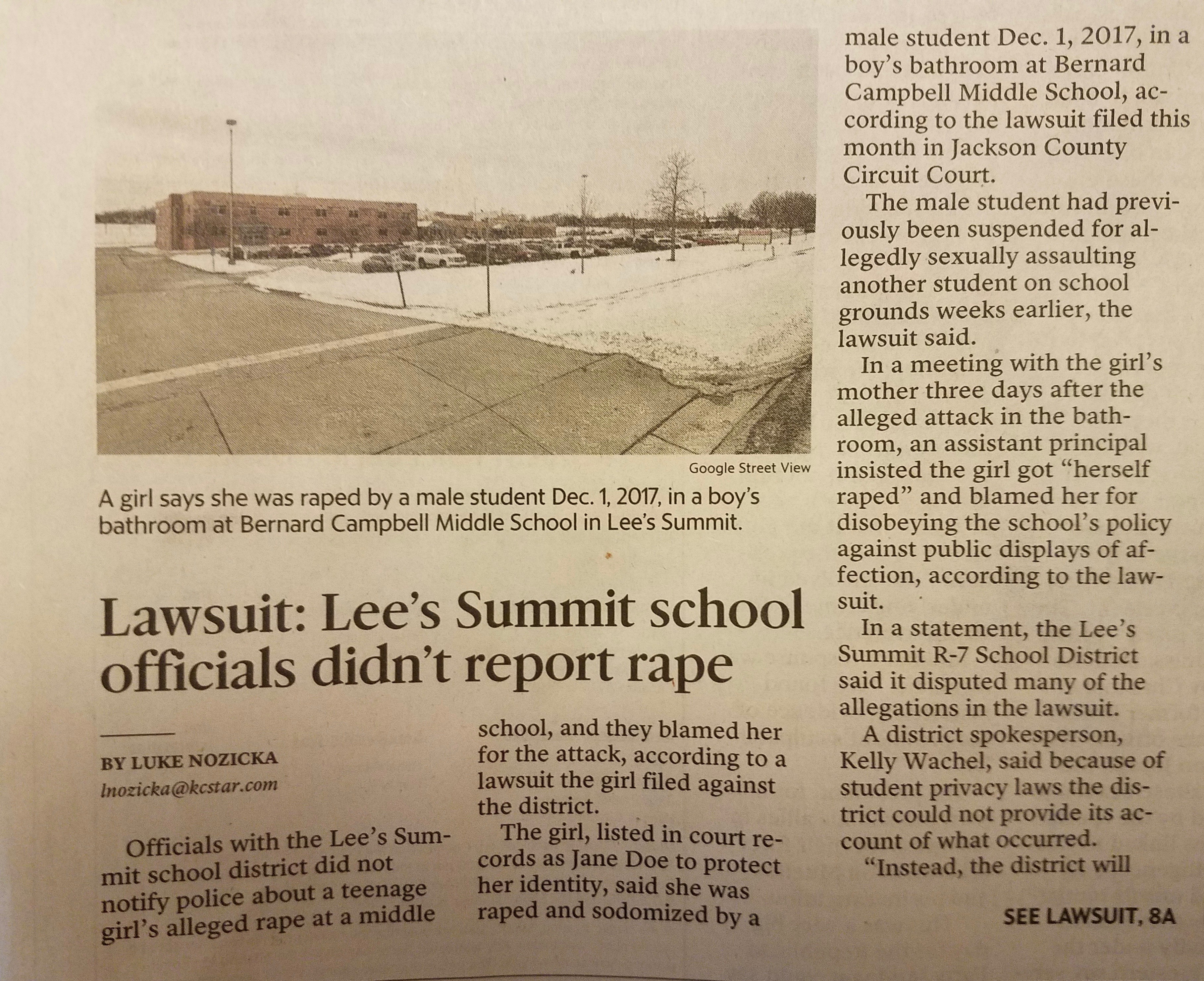
:: Why would The Star run a ridiculous “Google Street View” photo of a Lee’s Summit middle school on the front page? Don’t they have enough photographers to send one on a 90-minute round trip to a Kansas City suburb to snap a decent photo?

These things I would like to know. If I had some answers that made sense, I’d never have to go to my pencil bag and reporter’s notebook again.

Media experts have been predicting for a year or more that consolidation was on the way for the nation’s five or six leading newspaper companies, including McClatchy, which owns The Kansas City Star.

The first big move appears close to being announced, according to Ken Doctor, media analyst with the NiemanLab, a subset of the Nieman Foundation for Journalism at Harvard University.

Ken Doctor of NiemanLab

Doctor wrote last week he expects an announcement by the end of summer heralding a merger between Gannett, the nation’s largest newspaper chain, and GateHouse, the second-largest chain. (GateHouse owns more papers than Gannett, but Gannett is larger in terms of market capitalization, cash flow and revenue.)

The big surprise in this deal, if it happens, is that GateHouse, which has a much lower profile than Gannett, would be the buyer.

Just six years ago, GateHouse found itself with such a large debt that it filed Chapter 11 bankruptcy. Since emerging from bankruptcy, it has been on an acquisition tear. It got a big boost two years ago after SoftBank, the Japanese company that has a large stake in Sprint, acquired the company that manages GateHouse. GateHouse now owns more than 150 daily papers and more than 300 weeklies.

Gannett ended up on the weak side of the proposition partly because it was the object of a hostile takeover attempt last year by another chain, Alden Global Capital. Even though Gannett was able to beat back the bid, “Alden had pushed Gannett into play,” as Doctor put it.

…Although a Gannett-GateHouse merger would not directly affect Kansas City or The Star, it would significantly alter the newspaper-industry playing field.

McClatchy, as is well known, has been struggling under a big debt — now about $745 million — since it acquired the Knight Ridder chain in 2006. Nevertheless, it remains a major player: If Gannett and GateHouse merged, McClatchy would be the second-largest chain in terms of print circulation (although dwarfed by G-G).

McClatchy suffered a setback last year when it made an unsuccessful bid to buy Tribune Publishing, which owns, among other papers, the Chicago Tribune, the Baltimore Sun, the Orlando Sentinel and the Hartford Courant.

Currently, McClatchy and Tribune remain unmoored, and a Gannett-GateHouse merger probably would leave them and a few other chains looking to team up.

All the chains are struggling financially, and the idea behind any mergers is for the participants to buy time until they might succeed at making a profitable transition from print to digital.

Doctor described it this way…

“Gannett and GateHouse, like all their industry brethren, look at ever-bleaker numbers every quarter; the biggest motivation here is really survival, which in business terms means the ability to maintain some degree of profitability somewhere into the early 2020s.”

So far, McClatchy has been lagging on the print-to-digital transformation, but in the first quarter of 2019 it had its biggest-ever percentage jump in digital subscriptions, with nearly 60 percent more digital-only subscribers than in the first quarter of 2018.

That is one sign of hope for McClatchy. Another is the turnaround GateHouse made after emerging from bankruptcy in 2016. Could it also catch a big wind through a bankruptcy?

In any event, it’s very hard to see McClatchy surviving without either teaming up with another chain or going into bankruptcy and reorganizing. And with its huge debt, it seems unlikely McClatchy would end up as the big dog in any merger.

In the meantime, the clock is ticking, and the monetary losses keep mounting.

Should Kansas City, KS, police have charged into Edwards Corner Market & Deli after the July 10 shooting?

That is a huge and difficult question. Members of the families of Lachell Day and Dennis Edwards obviously believe police should have gone in and tried to save the two after they had been shot by 39-year-old Jermelle Andre-Lamont Byers, who had been dating Day about four months.

We can all understand the families’ frustration, especially in light of recent revelations, which I’ll get to in a minute.

Dennis Edwards

I certainly don’t have a ready answer to the question, but I do know this: This is another example of KCKPD demonstrating that it is a second-rate law-enforcement organization. There are enough red flags surrounding this tragedy to make reasonable people skeptical of the police department’s competency.

Consider four curious aspects of this case:

:: Police originally put out a release saying they had found Day and Edwards dead inside the store. But police came back the next day, Thursday the 11th, saying Day was still alive.

Which leads me to say…WTF? It didn’t take 24 hours (or about that) to determine that Day was still alive. That should have been corrected within hours. Moreover, I’ve never heard of a police department announcing a victim is dead and later announcing he or she is actually alive. That’s appalling.

:: Police said the victims died of gunshot wounds but apparently did not tell the Edwards family — not to mention the public — that he had also been stabbed several times. A niece of Edwards, Christina Bennett-Smith, told The Star the family didn’t learn that Edwards had been stabbed until they saw his body at the funeral home.

Why would police have held back the fact Edwards was stabbed? The unavoidable answer is it would have would given credence to the family’s belief — and public speculation — that Edwards was alive during at least part of the two-hour period police negotiated with Byers, trying to get him to surrender. Relatives of Day and Edwards believe the two victims “bled out” during that period.

:: At one point, early on, one or more officers apparently went inside the store and confronted Byers. An officer fired once, striking Byers but not seriously wounding him. When Byers pointed a gun at them, they withdrew, according to The Star.

I don’t understand that at all. We’ve heard of numerous cases where police have shot and killed people who either have pointed guns at officers or whom officers believed, right or wrong, presented an immediate threat. Without question, Byers presented a threat, so why didn’t the officers who initially went inside open up with their guns and blow him away? 

:: Outgoing Chief Terry Zeigler, whose integrity has been in question because of a sweetheart house-rental deal The Star exposed, has not addressed the situation, other than to issue a tweet the day of the incident, calling it a “horrific event.”

As head of the department, Zeigler should be front and center in an incident of this gravity and with so many loose ends. The fact that he’s hiding in his office tells me he either doesn’t have the confidence or courage to tackle the toughest aspects of the chief’s job — or he knows his officers botched the job.

**

KCKPD spokesman Jonathan Westbrook told The Star officers carrying shields made at least two attempts to get inside the store. He said: “This guy, our suspect, was standing over the victim, who had sustained a mortal wound. We’re not going to put our officers in harm’s way for what we see is a deceased individual.”

Lachell Day

It’s not clear which victim Westbrook was talking about. But at least one of them, Day, was alive.

It just seems odd, doesn’t it — cops so willing and quick to kill people presenting perceived threats but these cops retreating in the case of a guy they knew had seriously wounded or killed at least one person?

As The Star’s editorial board and I have said, the next chief should come from outside the KCKPD. The place needs a major shake-up and attitude reset. It would be at least a good start if the department could get its facts straight and be upfront with the public and victims’ families.