Feeds:
Posts
Comments

One after another, minutes apart, Jackson County jail inmates paraded into the courtroom of Judge Richard Standridge today so the judge could determine the status of their cases, mostly whether they had lawyers.

Some of the inmates were white, some black. But they all had three things in common: They were young, they wore orange jumpsuits bearing the words “DETENTION CENTER,” and they had waist chains that their transporters could attach to other chains to secure them in transit.

And then the parade took a decidedly different twist. Judge Standridge called the name David Jungerman. From just inside an adjacent room where the inmates were awaiting their turns, a court official called out, “Jungerman!”

With that, out came an 80-year-old man, shoulders slightly hunched, with two or three days’ stubble of white facial hair and slightly disheveled hair that was long on the top and short on the sides.
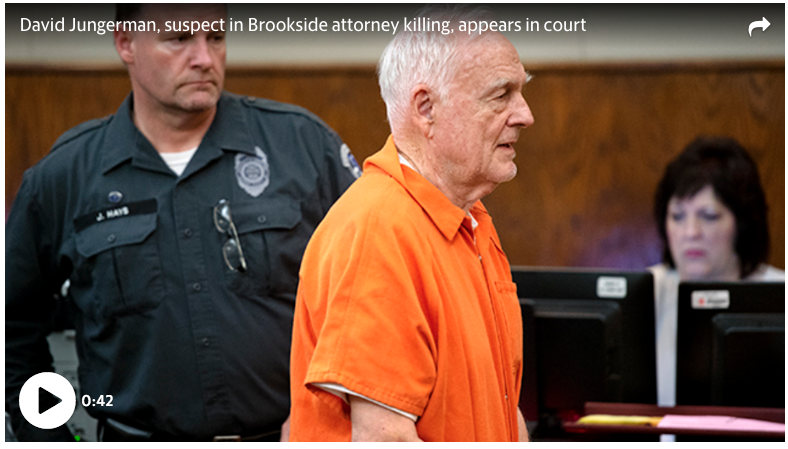
KC Star photo by Keith Myers

It wasn’t the natty David Jungerman — in khakis, white dress shirt and neatly cut and combed hair — I saw four months ago in a Nevada, MO, courtroom, when he appeared for a hearing in a different case.

Things have changed a lot for David Jungerman…and his appearance shows it. Back then, he was just charged with one felony, a relatively minor one at that — attempted burglary — and a misdemeanor harassment charge.

Now, he’s charged with five additional felonies in two new cases, and one of those charges is the most serious a human being can face: first-degree murder.

This seemingly harmless, fast-fading old man (seemingly being the most important word there) is alleged to have shot Kansas City lawyer Thomas Pickert outside the Pickert home in Brookside the morning of Oct. 24, 2017.

Today marked his first court appearance since being charged with Pickert’s murder.

When he entered the courtroom, several lawyers — one or two for Pickert and three representing the Jackson County Prosecutor’s Office — got up and moved close to the judge’s bench. The appearance didn’t last long, maybe three minutes. Jungerman had previously entered a not-guilty plea, and today’s appearance was only to determine the next step.

A defense attorney requested a preliminary hearing. The purpose of a preliminary hearing is for the prosecution to present enough evidence to convince a judge to “bind the case over” for trial. It is the route that some criminal cases take before going to trial or plea.

Judge Standridge

Before Judge Standridge scheduled a date for the preliminary hearing, one of the prosecutor’s mentioned the possibility of taking the case to a grand jury. If the prosecution seated a grand jury, it could present evidence to the jury in closed session, and the jury would decide whether to “indict” Jungerman. If the jury returned an indictment — which would be a matter of open record — a preliminary hearing would not take place; the case would be scheduled for trial in Circuit Court.

Judge Harrell

Judge Standridge scheduled a preliminary hearing for 10 a.m. June 11 and assigned the case to Judge Kevin D. Harrell, who has been a Circuit Court judge six years.

The proceedings over, Jungerman turned and began walking back toward the room he had come from. Just before reaching the door, he made eye contact with a women — perhaps a lawyer — who was seated at the end of the bench in front of the low wall that separates court officials from the audience.

Jungerman’s eyes brightened, he smiled and said in a whisper, “Hi, how are you?”

And with that, he disappeared into the room, where the chain around his waist would be secured to another chain and he would be walked the short distance back to the Jackson County Detention Center, where he’s been held without bond since March 8.


When McClatchy Co., The Star’s owner, announced in January it was going to a new “regional” system of editorial leadership and newspaper management, I knew it signaled one thing: Contraction and more layoffs company wide.

The first big hit under the new system came two weeks ago, when a 37-year-old regional editor announced more than 20 layoffs at the Sacramento Bee, McClatchy’s flagship paper.

Lauren Gustus, who had just been elevated to regional-editor status in January, issued a statement that said in part, “Our future requires us to adapt and innovate, and we will continue to change as we forge a path forward.”

As we’ve seen the 10 to 15 years with most remaining newspaper chains, forging a path forward can be translated only one way: “How do we cope with the disintegration of our business model?”

Yesterday, another shoe dropped, this time here in Kansas City, with the announcement that The Star was laying off — or parting ways with — at least 10 employees.

Finn

Chrostowski

Long

Among those who are packing their pencil or photo bags, according to KCUR’s Laura Spencer, are pop music writer Tim Finn; photographers Allison Long and David Pulliam; reporter David Frese; and editors Tod Palmer, Greg Branson and Michelle Smith.

Another editor, Keith Chrostowski, a four-decade veteran of the paper, is retiring.

In a non-explanation of the layoffs, KC Star editor Mike Fannin and managing editor Greg Farmer said in an internal memo that editors in the new midwest region (which Fannin heads) had determined in meetings that “we can do more to realize the future faster.”

Well, uh, the future certainly is coming at us pretty dang fast, but I’m not sure that stating it as a fact is going to help these editors cope with the mess they’ve got on their hands.

The whole idea the last several years has been for newspaper chains to transition subscribers from print to digital. That’s a good strategy, but it does not appear to be working for some companies, including McClatchy.

Consider three key points from a recent Poynter Institute analysis of McClatchy’s first-quarter, 2018 earnings report:

:: “Total revenues for the first quarter this year were down 10.1 percent compared to the same period in 2017.

:: “Digital-only subscriptions increased to 112,000, up 32.8 percent from a year ago. But spread across 30 properties, that is a modest number — a promising start but not enough to have much impact financially.  By contrast, the Boston Globe has roughly 100,000 paid digital subscribers and the Minneapolis Star Tribune 50,000.

:: “Digital subscription revenue did not grow nearly as much as the raw number. Digital-only audience revenues grew 16 percent year-to-year. And since McClatchy assigns a share of print-digital subs (subscriptions) to digital, total digital audience revenues were up just 2.6 percent.”

The digital-only figure of 112,000 is less than modest; it borders on disastrous. That’s an average of 4,000 digital-only subscriptions at each of the company’s 30 papers. (A trade organization called the Alliance for Audited Media publishes circulation figures for all U.S. newspapers, but I cannot tell from The Star’s data how many stand-alone digital subscriptions it has.)

So, where is this headed?

I don’t know, but it looks to me like McClatchy is something of an empty sandwich board at this point. If it drops or curtails print editions to cut expenses significantly, it also sacrifices the main part of its subscription and advertising revenue. If it continues to push away gradually from print, while raising print subscription prices, it risks falling flat on the all-digital front.

**

As I said, I don’t have the answer. But at the very least, I would like to see McClatchy officials start publicly acknowledging the company’s dire situation and stop issuing platitudinous memos, like the one Fannin and Farmin put out yesterday.

That memo concluded with this…

“Progress is never easy, but we see a lot of compelling evidence of the impact we are having every day on the communities we serve. And we have a responsibility to those readers and to the businesses we all love to keep moving forward.”

Weatherford

A friend of mine, a laid-off, former Star copy editor named Les Weatherford, deftly punctured that hot-air balloon on the Kansas City Star Bylines Facebook page.

Weatherford wrote:

“And we have a responsibility to those readers and to the businesses we all love to keep moving forward…This is a recording…This is a recording…This is a recording…”


It’s unusual to see The Star’s editorial board tiptoe around a big issue. The board usually states its positions resolutely and decisively.

But the issue of the proposed T-Mobile/Sprint merger seems to have smothered The Star’s normally edgy voice. At least that’s the indication from today’s lead editorial, titled, “Is a T-Mobile merger the last best hope for Sprint to survive?”

I could tell from that headline that the editorial would be an exercise in equivocation, and it was.

The reason for the equivocation is local jobs. At its peak, in about 2004, the Sprint World Headquarters Campus at 119th and Nall had almost 15,000 employees. The number is now down to about 6,000, and it’s about as likely to go back up as it would be for The Star to go on an editorial hiring spree.

Here are a couple of key paragraphs from the editorial:

“Sprint’s name will likely disappear if the agreement is approved by regulators. That’s worrisome in a region that sorely lacks a nationally-recognized corporate presence.

“Yet we can’t oppose the merger out-of-hand. The real truth is this: Any chance for Sprint’s long-term presence in our area, even in a diminished, unnamed capacity, likely requires a merger with a stronger company such as T-Mobile.”

That makes sense, but later in the editorial, the writer put on his or her rose-colored glasses, saying:

“Already there’s a furious argument about the impact of a merger on competition: Some believe prices will go higher with just three national carriers, while others argue that a strengthened T-Mobile could force costs down across the industry. We’re not ready to endorse either conclusion.”

OK, class, those of you who think cellphone fees would go down, please raise your hands. Do I see someone in the back of the room there raising his hand? Oh, sorry….Of course, you can go to the bathroom.

Rather than wring its hands about those 6,000 jobs — which are at risk in any event — I’d rather see the editorial board take the blinders off and consider what is best for consumers everywhere.

On that count, The New York Times was unequivocal in two articles — its lead editorial and an Op-Ed commentary.

Citing both companies’ pledges that prices would go down, hiring would go up and profits would increase, The Times editorial said: “All that’s missing from this list of promises is permanently blue skies.”

Love it…

The editorial takes a clear-eyed view of the prospect of prices rising, saying “…becoming much larger could change the financial calculus at T-Mobile, encouraging it to raise prices to lift profits and pay off Sprint’s debt” — which stands at a jaw-dropping $32 billion. (Makes McClatchy’s $700-million-plus debt pale by comparison.)

Tim Wu, a law professor who specializes in antitrust and telecommunications, struck an even harsher note. Here are a couple of key paragraphs from his Op-Ed piece:

“T-Mobile, the self-proclaimed “uncarrier,” has done an admirable job of attacking termination fees, abusive contracts and other mistreatment — often outperforming regulators as an agent of consumer protection. Sprint, meanwhile, has come to excel in its role as a price-cutting maverick. Allow me to advertise for Sprint: Did you know that it offers a service for $60 with an unlimited data plan?

“In short, competition has actually worked the way economists say it is supposed to, forcing firms to improve quality or face elimination. But it takes competitors to compete, which is where blocking mergers comes in. That’s a point well demonstrated by the case of the airline industry, where the government let the mergers happen. Over the last decade, Delta was allowed to buy Northwest, United to buy Continental, and American to buy US Airways, leaving behind just three majors. What happened next demonstrates the “curse of triopoly” in all its terrible glory.”

…I hope that future Star editorials will swing around to elevate the “curse of the triopoly” ahead of those 6,000 tenuous, local jobs.

Even if those jobs disappear and bulldozers have to clear away all those plain-jane buildings at 119th and Nall, the Kansas City area will continue to prosper. And that end result would be preferable to millions and millions of cellphone consumers getting gouged even worse than they are now.

Mark Davis, one of The Star’s two all-purpose business writers (the other being Steve Vockrodt), must be sick today. Sick at heart.

He obviously devoted  many hours to a story on Page 10-A titled “Feds target sweepstakes schemes that are KC-based.”

Stories about phony sweepstakes and other scams have an inherent appeal to many readers because there’s always the “there-but-for-the-grace-of-God-go-I-falling-for-it” dimension. So, I imagine tens of thousands of people tried to read this story in the printed edition.

It is a long story — 66 inches spanning five columns — and it was nicely laid out, with sub-heads breaking up the columns and a photo montage assembled by graphic artist Neil Nakahodo.

The problem is every column break — and I mean every column break — was botched. When you read from column one to column two, there is a contextual disconnect. From column one to column two, the text does not connect, and it’s the same with each subsequent column break. No connection.

And then, topping the disaster like a moldy cherry, the last paragraph trailed off into outer space — an incomplete sentence hanging out in the typographical breeze.

In all my years in journalism, I’ve never seen anything like it. Many times, especially in the pre-computer days, we would see columns transposed, such as what was supposed to be column two lying a couple of columns over. At least with that, the readers could put the text together, mentally, like an easy jigsaw puzzle, and make sense of the story. I’ve also seen stories disappear, like this one does, into thin air at the very end.

But never have I seen every column break screwed up, plus the “kicker” disappearing into the ether.

Mark Davis

I’ve got an email in to Davis, an outstanding reporter, to try to find out what happened. My suspicion is that a line or two — or maybe more — was inadvertently lopped off the bottom of each column, with the next column picking up with the continuation of the excised copy.

Here are the column breaks…

:: Column one to column two: “Many of the mailings that consumers receive bear official-sounding but fictitious names — National Awards Commission, North American Awards Center (break)…such as Larry Hourd.”

:: Column two to column three: “Next-Gen claims in one court filing that it has paid 77 winners (break)…winner.”

:: Column three to column four: “In addition to the direct-mail businesses, Brandes and Gra- (break)…Both men are involved in B&G Auto Sales.”

:: Column four to column five: “In 1993, the FDIC had banned him from the Kansas City area bank (break)…When Anderson and Blunt sold…)

And here’s the last line of the story…

“That’s what we call a recidivist,” said Rich, now vice president of advocacy at Consumer…”

**

Let me complete the thought…That’s bad newspaper production.

Let me show you how The Star’s owner, McClatchy Co., conducts business in these days of newsroom salary contraction and staff reductions.

Over the last decade or so, since the Internet began killing newspapers, McClatchy has fixed on a cost- and newsroom-cutting formula. It generally revolves around hiring relatively young and inexperienced editors; putting them in big jobs that pay significantly less than what comparable editors were making a generation ago; then ordering them to preside over layoffs.

A perfect example of the strategy played out in northern California this week.

A year ago, 36-year-old Lauren Gustus was executive editor at the Fort Collins Coloradoan — owned by Gannett, another ball-busting chain — with an average Monday-Saturday circulation of about 16,800.

In other words, it’s a piddly paper.

Lauren Gustus

Always on the lookout for young, fresh meat, McClatchy snatched up Gustus last June and made her vice president and executive editor of the Fort Worth Star-Telegram. And just like that it was…Welcome to the big time, baby!

With average weekday circulation of 75,000, the Star-Telegram is one of McClatchy’s largest papers.

Meanwhile, financial problems were brewing at McClatchy’s flagship paper, the Sacramento Bee — also known as the SacBee — and McClatchy executives needed somebody to come in and take out some bodies.

Who better than young Gustus? In February, then, Gustus, with all of eight months’ experience at a major metropolitan paper, was summoned to McClatchy headquarters in Sacramento and put in charge of all five of McClatchy’s California papers.

In addition to the SacBee, the jewels in her crown included the Fresno Bee, the Modesto Bee, The Merced Sun-Star and The Tribune in San Luis Obisbo.

The combined, average weekday circulation of those papers — including digital subscriptions — is about 226,000.

So, in less than a year’s time, Gustus had gone from overseeing a less-than-20,000-circ paper to five papers with more than a quarter of a million daily subscribers.

Hey, Lauren, welcome to the big, big, BIG time!

But no sooner had the hangover from the welcome party subsided than Gustus found a big, fresh turd on her plate…And so this week, under marching orders from HQ, Gustus announced the SacBee had laid off 23 employees — 15 editorial staff members (I read 14 elsewhere) and eight production people.

The casualties included business writer Mark Glover, a 34-year veteran of the paper, and Stephen Magagnini, a 32-year veteran who covered ethnic affairs, race relations and immigration.

In a letter announcing the layoffs, Gustus “told her colleagues the layoffs were part of a company restructuring seeking to foster greater collaboration between editorial staffers at different company papers.”

…What? Lay off people to “foster greater collaboration”? 

Insane.

The letter went on to say several new people would be hired “with specific expertise to fill critical roles.”

Translation: Just as at The Star and other McClatchy papers, young reporters champing at the bit to break into the business would be hired to replace senior, high-paid employees with irreplaceable institutional knowledge.

**

I wonder how Ms. Gustus feels this weekend…Dirty, used? Or that she had shown McClatchy executives she was up to the lofty status they had bestowed on her?

Maybe she feels a little of both.

Either way…welcome, Lauren, to the nasty business of journalism at failing, publicly owned newspaper chains.

As I read The Star, I can’t help but keep a mental scorecard, noting both where it does well and where it falls short.

Here are some of my pluses and minuses from recent days (and in one case weeks).

+ The Star gets a gold star for today’s lead story about Jackson County suspending implementation of a policy change that would have greatly limited the hours that people who were arrested would be able to bond out. Instead of 24-hours a day, every day, the new policy, which seems to have been rolled out of somebody’s back pocket (look what I’ve got!), people would have been able to bond out only from 8 a.m. to 5 p.m. Monday through Friday, meaning many people arrested on minor charges would have to stay in jail overnight or over a weekend before having even a chance to bond out…If The Star hadn’t picked up on this, the policy would have quietly gone into effect next Tuesday. But reporter Mike Hendricks, who has broken several big county stories the last year or so, saw it on the county website and asked County Executive Frank White about it. White then his the brakes. And the brakes should definitely stay on; that is a ridiculous change, even though two St. Louis jail have similar bond-out restrictions.

= (That’s a minus sign.) Tuesday’s sports section contained three stories about today’s NFL college draft. One story, by Blair Kerkhoff, led the section; the other two, inside the section, were by Chiefs’ beat writer Terez PaylorNone of the three stories said when the draft was being held. Now, most NFL fans knew when it was taking place, but I didn’t, and I’m sure thousands of other readers didn’t, either.

Bill Turque

+ City Hall reporter Bill Turque gets a kudo (here) and a kick (next bullet). On Monday, he had an excellent enterprise story (one he had to dig for instead of coming from breaking news) about troubles with the ATA’s on-demand, ride-sharing system for disabled persons. Seems it’s much more popular than expected, resulting in sometimes long delays for riders.

= Last week, Turque wrote a story about a south Kansas City pastor endorsing Kansas City businessman Phil Glynn in the 2019 mayor’s race. This was surely one of the strangest stories I’ve seen in the paper in a long time. That’s because more than a decade ago, The Star stopped writing about endorsements in local political races. They have virtually ignored endorsements from major groups like the Citizens Association, the Committee for County Progress and Freedom Inc., not to mention endorsements by individuals. Turque, of course, is relatively new to The Star (although this is his second stint), so maybe he’s been given the latitude to cover the mayor’s race however he wants. The problem is this story sets a precedent. The field of mayoral candidates is going to be large, and with that endorsement story, every candidate will be able to go to Turque and demand equal coverage for their endorsements. If he writes about every endorsement, I’m fine with it because I love politics and want to know about the endorsements. But I doubt that was Turque’s intent, and I have no idea how he’s going to get out of this mess, other than to disappoint people.

+ You don’t see The Star covering very many evening and night meetings. That’s become a thing of the past. But hats off to Max Londberg for covering the MLK Advisory Group’s first public meeting Tuesday at the Linwood YMCA. It started at 6 p.m. and must have run at least 90 minutes, meaning Londberg didn’t get back to the office and start writing before about 8 p.m. The Star recognized this was an important meeting and a delicate subject — how to appropriately honor Martin Luther King Jr. in Kansas City.

Melinda Henneberger

= I’m not a big fan of editorial page writer and columnist Melinda Henneberger (who is married to Turque). She hits the long ball occasionally, but I generally find her writing stilted and opaque…I read with interest, though a recent piece in which she drew parallels between Gov. Greitens and President Trump. I was going along nicely until I hit the “kicker,” the last sentence. It reads like this: “Just as Trump himself would never willingly leave office, he won’t push Greitens to do that. But because the president really is sui generis, Greitens is a lot less likely to have a choice.”

I took three, maybe four years of Latin in high school (can’t remember exactly), but I don’t think I ever came across that term, and it stopped me short when I read it in Melinda’s column. At coffee yesterday with a friend — a learned lawyer with tons of political experience — if he knew what it meant, and he said, essentially, unique or one of a kind.

I think if I went out on the street, though, and asked the first 10 people I came across what it meant, I’d be lucky to find one.

The JimmyCsays rules of journalism (and probably The New York Times style book) says reporters should not use foreign-language phrases unless 1) it is abundantly clear what they mean (i.e., carpe diem) or 2) you say in parentheses what they mean.

…There’s a King’s English term for what Melinda did: SHOWING OFF.

By a longshot, Jackson County has seized the “worst-local-government” mantle in the Kansas City region, on both sides of the state line.

In recent months, we’ve seen an extraordinary list of scandals and astounding developments. Consider:

:: The pitiful condition of the Jackson County Detention Center, highlighted by shocking video of an inmate beating a guard for eight minutes and critically injuring him.

:: Former County Executive Mike Sanders pleading guilty to misusing tens of thousands of dollars for his personal gain, including trips to Las Vegas and California wine country.

:: Sheriff Mike Sharp resigning in the wake of an affair with a civilian employee who had sued the department and whom Sharp had apparently attempted to co-opt with financial assistance.

:: County Executive Frank White’s inability to make his house payments and pay his taxes, even with income of at least $250,000 a year from the county and Major League Baseball’s pension fund.

Justifiably, an implosion like that raises the question of term limits. As The Kansas City Star said in an editorial yesterday, “(T)he attitude of entitlement that comes along with unlimited terms is clearly a part of the mud at the courthouse.”

Although White is in his first full term as county executive, Sanders and Sharp were both in their third terms when their wrongdoings began surfacing.

I completely agree with The Star that term limits are necessary and that, without them, that sense of entitlement inevitably sets in. Four of the nine county legislators have served more than two terms. They are Dennis Waits (8th term), Dan Tarwater (6th term), Scott Burnett (5th term) and Greg Grounds (3rd term). All four have overstayed their welcome.

Burnett

Grounds

Waits

Tarwater


And who could forget Fred Arbanas, who got his name identity as a tight end for the Kansas City Chiefs and went on to a nice, 42-year retirement job on the Legislature before stepping down in 2014?

**

As I said, I agree with The Star’s call for term limits at the courthouse. At the same time, the specifics of The Star’s demand are unrealistic.

The editorial urges county residents to call their legislators and demand that term limits be effective with the first election following voter approval of such a measure. In other words, if a legislator is finishing his third term this year, the way The Star envisions it, he or she could not seek re-election at the next election cycle.

Naturally, legislators see it differently: They want to be grandfathered in and be able to run for two more terms before bowing out. Under the proposal being discussed at the courthouse, the county executive would also be limited to two four-year terms — again, however, with the ability to run two additional times. The sheriff and county prosecutor would be limited to three terms — three new terms for current officeholders.

What The Star is asking the Legislature to approve is unrealistic because legislators are never — never — going to approve a ballot measure that involves voting themselves out of office.

The only way to get term limits effective immediately is through the initiative-petition process. However, that is a big hurdle, too, because the County Charter makes it markedly more difficult to get a measure on the ballot than the City Charter does.

In KCMO, promoters of initiative petitions need only gather signatures of registered voters amounting to five percent of the number of people who voted in the last mayoral election. Currently, that’s a paltry 1,700 signatures. (Why do you think goofball activist Clay Chastain has been able to sell his snake oil here even though he moved to Virginia about a decade ago?)

The Jackson County Charter also requires five percent of the number of voters in the last county executive race, but the raw number is much higher — about 13,700 — partly because elections are held in November of even-numbered years, not spring of odd-numbered years, when city elections are held.

The county’s significantly higher signature threshold makes a successful term-limit initiative petition unlikely.

**

The Star’s editorial strays a bit off course, also, when it cites Kansas City’s 28-year-old precedent for term limits. It says…

“In 1990, Kansas City voters approved term limits for the city council without a grandfather clause. A clear majority of the council’s 13 members were immediately blocked from seeking office in 1991.”

What the editorial fails to reveal is the City Charter amendment came about via the petition route. After advocates gathered the (relatively low) number of required signatures, voters approved Question 1 about 55 percent to 45 percent.

The City Council would never have approved an election on a proposition that would have put themselves out of office.

In fact, the two longest-serving and most self-serving council members, Charles Hazley and Bobby Hernandez, filed suit in U.S. District Court after the election, alleging that the new provision restricted the choices of voters in predominantly minority districts. Hazley, who died several years ago, was black, and Hernandez, who is still alive, is Hispanic…Not only did they lose their case, but after the term limits took effect, minority and female representation on the council increased.

**

The Star’s editorial urges Kansas Citians to “pick up the phone in the next few weeks” and urge their county legislators to make a term-limit proposal effective immediately.

I don’t care if there are a million calls to the county; it isn’t going to happen. If The Star wants immediate term limits, it ought to start hiring people to collect signatures outside Price Chopper and Brookside Market. Voters would readily approve, but elected officials slurping at the trough will not.

What do I have this ongoing, fingernails-on-chalkboard sensation that Eric Greitens is going to be governor until the second week of January 2021?

Well, being one who has always wanted to be on both sides of the notebook — asking the questions and providing the answers — let me offer a few possible reasons.

:: Not going to resign

The man has no shame; that is very clear. In addition, the way things are now, politicians at the statewide level and above can greatly limit direct contact with members of the media and the public, enabling them to avoid subjecting themselves to probing questions.

:: The hand-cranking pace of the wheels of justice

Greitens faces two felony charges, invasion of privacy and felony computer tampering, and it will take months or years to resolve either. Even though he’s scheduled to go to trial next month on the invasion of privacy charge — he’s pushing for a quick trial because he thinks he has a good chance to prevail — he would undoubtedly appeal if found guilty. He would appeal as far as he possibly could, and that could easily gobble up a couple of years.

:: Conviction in doubt

Kim Gardner

Although the woman he sexually abused says Greitens took a photo of her partly naked after strapping her to exercise equipment, St. Louis Circuit Attorney Kim Gardner does not have the photo, and Greitens will deny it. With the case turning on the photo, it looks like he said/she said, assuring that “beyond a reasonable doubt” will be a difficult level to reach. Also, I think Gardner made a huge mistake hiring private investigators to conduct the investigation instead of having the St. Louis Police Department investigate. (The alleged crime occurred at Greitens’ Central West End home in St. Louis.) It is much easier for a prosecutor to get private investigators to do his or her bidding (after all, the prosecutor is authorizing payment for services) than it is to hand-direct a standing, professional police department on a high-profile suspect. The judge in the case has already scolded Gardner for allowing the investigators to delay turning over evidence to the defense, thus arming the defense with grounds for an appeal even before testimony has begun…The computer-tampering case, where Greitens allegedly used a nonprofit donor list to solicit campaign contributions, could be more straightforward, but where Greitens wants a quick trial on the privacy case, he will probably seek to delay the tampering case as long as possible. And, again, he would appeal a conviction as far as he could.

:: Impeachment uncertain

Our governor in action

Although there’s a lot of chatter about impeachment among both Republican and Democratic lawmakers in Jeff City, some sobering poll numbers came out over the weekend. A survey of likely voters taken last Wednesday and Thursday indicated that 57 percent of Republicans approve of the job Greitens is doing…(How in the world 57 percent of likely Republican voters could possibly offer such an assessment shows that 1) either the Missouri Scout news service poll is off base or 2) Missouri has far more ignorant Republicans than I imagined.) Among Democratic respondents, only 12 percent said they approved. (That’s more like it.) Overall, 37 percent of respondents approved of his performance and 51 percent disapproved…Those numbers could significantly slow any movement toward impeachment because, like Republican members of Congress who loathe President Donald Trump but are afraid to take him on because of his popularity with rank-and-file Republicans, Republican state reps and senators might not want to cross Greitens’ still-significant constituency…So, look for the impeachment train to slow down or get derailed. (It’s a screwball system anyway, with the Senate supposedly selecting seven “eminent jurists” to render a final verdict, if the House votes to impeach. Can you imagine how much games playing and back-room politicking would take place in the selection of seven “eminent jurists”?)

**

Let me assure you, though, we won’t have to deal with Greitens beyond his current four-year term. He won’t be dumb enough or hard-headed enough to campaign for re-election. Like the Seal he is, he just wants to avoid drowning in the fecal-filled pond he created for himself.

The Star’s big story this week about Sheriff Mike Sharp’s demise said intimations of his terrible judgment and obsession with sex cropped up in the 2016 election campaign, before he was elected to his third term as sheriff.

Ah, but The Star didn’t go far enough back in its morgue…There were strong indications of his unprofessionalism as far back as 2008, before he was elected to his first term.

As soon as I saw the Star’s story, I was sure I remembered indications of problems long before 2016. It just took me a while to run it down, and today I found it.

Back July 31, 2008, the week before the primary election, Kevin Murphy, my former running mate when we both covered City Hall back in the early 2000s, wrote a story about Sharp acknowledging “that he was once part of an email exchange among city and county law officers that included images of nude women.”

Sharp

Before he ran for sheriff, Sharp had been a reserve officer with the Kansas city Police Department. Murphy said that in 2003, Sharp had been part of a group of about 35 KC police officers and Jackson County Sheriff’s deputies who shared sexually explicit emails.

Murphy wrote:

“One email, which had an attached video showing a woman in a sex act, went to Sharp and about 12 Kansas City officers and 25 Jackson County deputies, sergeants and other officers. Although not illegal, the sexually explicit emails are prohibited by city and county personnel rules.”

Murphy, who left the paper several years ago, had obtained several of the emails from someone who had received them. He quoted Sharp as saying he regretted his actions.

“In retrospect, it was probably not the best thing to do,” he said. “It was an email list with some buddies of mine. If I had it to do all over again, I would never have done it.”

…Note his comment “not the best thing to do.” Obviously, he didn’t think it was extremely bad, just something he probably should not have done.

That attitude in itself shows his only regret was getting caught and was certainly nothing to disqualify him from becoming sheriff.

Yet, both agencies — the PD and the Sheriff’s Office — had years earlier explicitly and clearly prohibited employees from viewing or transmitting sexually explicit images through email or on the internet.

Perhaps even more amazing than Sharp’s casual downplaying of the law enforcement group’s email follies was the reaction of his top competitor in the 2008 primary.

Murphy paraphrased John Bullard of Buckner as saying that while sex-related emails should not be exchanged among law officers, email exchanges dating back five years should not be an issue in the campaign.

Another Democratic candidate had it right, though. Murphy quoted Mike Mauer, a Blue Springs resident, as saying: “It’s outrageous. I’d think women in the community would be quite upset about this. And if you are talking about the top law enforcement officer in Jackson County, it says something about his integrity.”

Unfortunately, the race was virtually a foregone conclusion even before the filing deadline. Sharp had wrapped up the support of the county’s leading Democratic organizations and donors. The juggernaut behind him included the Committee for County Progress and mega-donor James B. Nutter Sr., who died last year.

None of Sharp’s three challengers for the Democratic nomination stood a chance. When the votes were counted, Sharp took 55 percent of the votes to 25 percent for Bullard, with Mauer and Tom Krahenbuhl of Lee’s Summit trickling it at less than 10 percent each.

With that election, Sharp was on his way to being elected in the general election and then being re-elected twice. He was on the taxpayers’ dime nine years in all, and who knows what kind of antics were going on in the Sheriff’s Office during that time.

**

In retrospect, it’s too bad that in that 2008 campaign none of his opponents questioned his commitment to law enforcement. Although he had extensive experience in law enforcement — having been a full-time officer with KCPD and a reserve officer for many years — most recently he had been owner of Wholesale Carpet Warehouse in Lee’s Summit.

To me, that would have been one indication that his best days in law enforcement were behind him.

Of course, the best indication that he was no longer cut out for law enforcement was his role in the email follies.

It’s unusual for a non-investigative news story to help solve a murder, but that could well be the case with a story The Star published early in the wake of the Thomas Pickert murder case.

Most of you will remember the front-page story — from Friday, Nov. 10 — which featured a four-column photo of David Jungerman above a big headline that said, “Van owner never suspect in slaying of lawyer, police say.”

Like a lot of people, I was amazed at that headline and story because it flew in the face of logic: Jungerman not only had to be a suspect in Pickert’s murder, he was, in all probability, the only suspect. He was the only person who had motive, opportunity and a known propensity for settling disputes with gunfire.

I thought — and still do — that The Star’s editors were naive in letting the reporters emphasize the police assertion that Jungerman was not a suspect. Moreover, the headline was incorrect. Police had never used the word “never” in relation to Jungerman’s status as a suspect. They were extremely careful in their language…The official position, which The Star quoted, was: “We do not consider him a suspect at this time. Nor did we consider him a suspect at that time.”

That is a clear hedge in both cases — “at this time” and “at that time.”

It was also outright untrue. As I wrote back in November, two sources — both defense attorneys — told me Jungerman was the one and only suspect. They also speculated that police were putting out the “not a suspect” line to lull Jungerman into a false sense of security while they continued digging up evidence and trying to develop a chargeable case.

In fact, that’s exactly what was going on, and the strategy worked.

The investigators knew — as most of us watching the case and learning about Jungerman suspected — Jungerman is only capable of thinking in short bursts, and not very far ahead. In fact, he usually acts before he thinks, which is why he was charged with a gun-related felony in southwest Missouri long before Pickert was murdered and why he was charged with additional gun-related felonies in Jackson County before police solved the Pickert murder.

The exception to his act-first, think-later approach was the Pickert murder. He did have a plan there, although it was a poor one. After all, he drove his own van to the scene in broad daylight; was seen well enough by one witness that the witness was able to provide a good description of him; and afterward, while he apparently got rid of the gun, he failed to get rid of a live bullet that matched the caliber of the relatively uncommon weapon he had used — a .17-caliber rifle.

Now, back to my premise…The Star’s story, with Jungerman’s picture plastered atop the front page, almost surely eased his apprehensions about being caught. Told by the reporters that police did not consider him a suspect, he replied, “That’s nice, though I think it’s a day late and a dollar short.”

He also regaled the reporters with stories of his gun-related adventures, including two 2012 incidents, about a month apart, in which he shot a total of four people.

After the interview, he went on bragging and running his mouth for another five months, during which time detectives were painstakingly developing evidence and waiting for him to slip up.

That was almost inevitable, and it happened, and now he’s behind bars, with plenty of time to reflect on his greatly shortened horizon and the many occasions he should have thought more and acted less.