Feeds:
Posts
Comments

The Star’s Ian Cummings embarked on a long-shot reporting mission Wednesday and succeeded in a big way.

He got a face-to-face interview with the 37-year-old woman who has been charged with second-degree murder in the March 6 shooting death of Clinton police officer Ryan Morton.

Ian Cummings

It appears, from a front-page story in today’s print edition, that Cummings simply showed up at the Henry County Jail during visiting hours and asked to see Tammy Dee Widger, the woman who rented the home where Morton was shot.

Cummings didn’t reveal any ancillary details about the interview, such as how long it lasted or exactly where it took place, but he came away with a good story.

Among other things, Widger told Cummings she was “right there” when Morton and four other officers were exchanging gunshots with James Earl Waters, a career criminal and friend of Widger, whom Widger thought had gone out the back door before officers went inside.

“In the blink of an eye, my life changed,” Widger told Cummings. “I didn’t want this.”

If you’ve been following this case, you know the murder of Morton — and the death of Waters, who either shot himself or was shot by police  — occurred under bizarre circumstances.

For reasons yet to be determined, police went to Widger’s house even though the 911 call for service came from a home in Windsor, MO, 20 miles away from Widger’s home.

Police had been at Widger’s home earlier in the day, but it is inexplicable why they went back there that night. County emergency communications officials have said a “database error” was responsible and that they are investigating.

Whatever comes of the investigation, one thing is certain: This was law enforcement at its worst. It looks for all the world like a Keystone Kops movie, except with tragic results.

It also leaves the police department open to suspicion that it was harassing Waters and Widger mainly because Waters had been a longtime thorn in law enforcement’s side.

This week, the Henry County prosecutor’s office raised the stakes on the questionable-judgment front by filing second-degree murder charges against Widger, whose main action that fateful night appears to have been agreeing to allow officers into her home.

It’s been long established that people who are not actually involved in murders but are accomplices can be charged with felony murder if a killing occurs during the commission of another crime. Examples include a getaway driver being charged in a robbery-murder when the driver was not present at the murder scene. Or a robber being charged with felony murder after a firefight in which one of his own accomplices dies.

The Henry County prosecutor’s office alleges Widger was guilty of felony murder because Morton was shot and killed “as a result of the perpetration of the class C felony of delivery of a controlled substance.”

To me, that is a big reach, and I doubt that the prosecutor’s office is going to be able to make the murder charge stick.

…Not just Cummings, but Widger, too, gambled on this interview.

She gambled that by talking to Cummings she could help herself more than hurt herself. Her assertion that she thought Waters had gone out the back door is very plausible. If the case goes to trial, she will probably say she initially resisted officers’ requests to go inside but acquiesced after they persisted.

The prosecution’s problem — a big one — will be to establish that Widger knew, or should have known — an armed man who was a convicted criminal was inside.

Had Widger been “lawyered up” by Wednesday, she surely would not have spoken to Cummings. She has asked for a public defender, and the public defender’s office is determining if she qualifies. Lacking an attorney, she made a quick decision that could either hurt or help her down the road, depending on what evidence authorities have to back up the murder charge.

For now, though, it appears both reporter and defendant came out winners: Cummings got a Page One story, and Widger got to tell her story without having a nettlesome prosecutor there to cross examine her.

Oh, Rex, it’s hard to grasp that you are gone,
It must have been a shock to get that call,
The one before you reached the head Ding-Dong;
And then that awful Tweet that said it all;
You looked harrumphed reading your goodbye speech,
Slapping pages below a big grimace;
Just months ago you stepped into the breach,
To see it spin into nasty business;
Too bad you chose to lead without consult,
But that’s what Mr. Exxons tend to do;
At least you now can duck further insult
And will escape that frothy White House stew;
In retrospect, you were a high-paid pawn,
Used up, beat down beneath the great moron.

Good news, readers: It appears David Jungerman will remain behind bars until either of two felony cases pending against him goes to trial.

In my rush to put together Friday’s post on the new felony charges filed that day against Jungerman in Jackson County, I failed to check the latest entries on Case.net, the Missouri judiciary’s case information website.

When I went to Case.net on Saturday, I had a pleasant surprise…Judge David R. Munton, who is overseeing a southwest Missouri case in which Jungerman is charged with attempted burglary, had entered this note on Friday:

“Defendant’s bond is revoked. Defendant to be held without bond until further order of the court. Revocation pending hearing is based on allegation of new multiple felony charges in Jackson County.”

Before the new charges were filed — two counts of unlawful use of a weapon and one count of armed criminal action — Jungerman had been free on $15,000 cash bond in the southwest Missouri case.

Now he is behind bars, I believe in the Jackson County Detention Center, on $1 million bond in the new case.

Although he is a multi-millionaire, all the money in the world might not be able to spring him from custody at this point, before one of those cases goes to trial. He will get a hearing on the bond revocation, as Judge Munton indicated in his entry, but I believe the judge will stand firm on the revocation, possibly on grounds Jungerman poses a threat to others and is a flight risk.

My concern Friday was Jungerman might be capable of making the new bond because of his wealth. He has said in court that his net worth is about $8 million, but indications are it could be a lot more than that.

He owns several thousand acres of farm land in southwest Missouri, and for a long time he was executor of the Jungerman Family Trust. He passed the executorship to his daughter — essentially meaning he no longer had direct access to the assets — after civil lawsuits were filed against him in connection with two 2012 shooting incidents.

The biggest threat to his wealth is a $5.75 million civil judgment that a victim of one of the 2012 shootings won at trial last summer in Jackson County. That case may well have led to the fatal shooting of the plaintiff’s attorney, Thomas Pickert, who was gunned down in his front yard a day after Jungerman was notified court officials would be seizing enough of his property to satisfy the $5.75 million award.

Police and prosecutors have not been able to uncover enough evidence to charge Jungerman with Pickert’s murder. Although two witnesses described seeing an elderly white man with gray hair in or near a white van parked in front of Pickert’s house, neither, apparently, can positively identify the shooter, and neither got the license plate of the white van. Jungerman has a white van, which police searched but later returned to him.

**

This new development — Jungerman being held without bond — is a big relief to those of us who have been frustrated by the lack of a solution to Pickert’s murder. Finally, it would seem, this maniac who likes to settle disagreements with gunfire is off the streets.

At age 80, he is not likely to adjust well to life behind bars.

For one thing, he will be surrounded, for the most part, by young toughs also charged with felonies and awaiting trial. In addition, his health could go downhill quickly in confinement. He’s had both knees replaced, and during the civil trial last summer, he claimed to have suffered brain damage in a 2013 fall when his head struck concrete.

“That’s why things don’t flow out like they should,” he said during the trial, in which he foolishly represented himself.

I think confinement is also likely to knock the cockiness out of him. His brashness has been chronicled in public documents at least twice.

In the new case, where he shot at or near a man he believed had stolen iron pipes from his business, Jungerman told police he fired a warning shot but did not aim at the man. He later told a Kansas City police officer, “Missing him would have hurt my pride.”

The other time his cockiness was on display was in a deposition before the civil trial. Pickert noted, in questioning, that Jungerman had fired five times at the victim — his client — and hit him with three bullets. (The man later had to have a leg amputated.)

Jungerman offered: “That’s pretty good from the hip isn’t it? That’s lucky shooting, isn’t it?”

…At long last, it appears David Jungerman’s luck has run out.

David Jungerman, the man police and prosecutors have been trying to build a murder case against the last four and a half months, was arrested Thursday and charged with three felonies and a misdemeanor after shooting at, or near, a man he believed had stolen pipes from a business Jungerman owns in northeast Kansas City.

Today, Jungerman, whom police interviewed in the October killing of Kansas City lawyer Thomas Pickert, is in the Jackson County Detention Center on $1 million bond.

He is facing two counts of unlawful use of a weapon (firing at or near someone, and exhibiting the weapon “in an angry or threatening manner”) and one count of armed criminal action (committing a felony with the aid of a deadly weapon).

He also faces a misdemeanor assault charge.

If convicted of the felonies, Jungerman could be sentenced to up to a total of 22 years in prison, if maximum, consecutive sentences were imposed.

Jungerman, in booking photo from KCPD

It is extremely unusual for the prosecutor’s office to request a million-dollar bond in an unlawful-use-of weapon case. However, a source told me that in requesting that bond, the prosecutor’s office presented information to the judge that was not related to the case at hand…In other words, prosecutors told the judge they suspect Jungerman of killing Pickert.

In this week’s case, Jungerman fired a shot in the vicinity of a man he believed had stolen 780 pounds of iron pipe from his — Jungerman’s — high-chair-manufacturing business at St. John and Belmont. Jungerman followed the man and a female companion to a recycling business at 12th and Jackson, about two miles southwest of St. John and Belmont.


This screen shot shows the locations of Jungerman’s business (upper right) and the recycling center where Jungerman confronted a couple he believed had stolen pipes from his business.

In an unusual twist, Jungerman was on the phone with police, reporting the alleged theft of the pipes, while confronting the man and woman at the recycling center.

The 911 recording, which is part of the charging documents filed in the case, includes the following exchange between Jungerman and the man…

Jungerman: “Now, buddy, hold it right where you’re at, motherfucker.”

A gunshot is heard.

Man: “Motherfucker, what’s your problem?”

Jungerman: “You stole my fucking pipe.”

Man: “I didn’t. Get that thing away from me. I didn’t steal shit from you, buddy..Get away from me with that fucking thing…What are you going to do, shoot me?”

Jungerman: “You’re fucking A I’m going to shoot you.”

Man: “For what?”

Jungerman: “Right between…For stealing my pipe.”

This is at least the third occasion in the last several years in which Jungerman has either shot people or shot at someone. In addition, Thursday’s incident was reminiscent of a case Jungerman was involved in many years ago, when he caught four youths trespassing on lake property he owns in Raytown. While holding the youths at gunpoint, he called police. After police arrived, they arrested him, not the youths. Jungerman was later convicted of a misdemeanor weapons offense.

**

The Pickert murder is the most serious case, by far, of any in which Jungerman has been implicated.

Pickert, 39, was gunned down, probably by someone shooting a rifle from a white van, while standing in his front yard near 66th Terrace and Brookside Road. He was talking on his cell phone after having walked his two young sons to a nearby school.

In addition to his history of trying to settle disagreements with firearms, he also had a strong motive to kill Pickert.

Pickert represented one of two men Jungerman had shot on his property in 2012, and last summer a Jackson County jury returned a verdict of $5.75 million in favor of the plaintiff, Jeffery Harris, who had to have a leg amputated as a result of the shooting.

The day before Jungerman shot Harris, court officials presented Jungerman with papers informing him property of his valued at$5.75 million would be seized to satisfy the award.

Before Pickert was shot, someone had seen an elderly, gray-haired white man standing behind a white van parked on 66th Terrace, near Pickert’s home.

In addition, Pickert’s wife, Dr. Emily Riegel, told police that after hearing two shots and seeing her husband lying on the ground, she saw an elderly, gray-haired white man driving off in a white van, heading west on 66th Terrace toward Brookside Road and Wornall Road.

Police interviewed Jungerman — who turned 80 last week — for several hours until he halted the interview and asked for a lawyer. Police got a search warrant late the night of the slaying for a white Chevy van Jungerman owns. They searched it but apparently found little or no incriminating evidence.

Meanwhile, Jungerman was — and still is — facing an attempted burglary charge in southwest Missouri, where he owns several thousand acres of farm land. Unable to make the murder case, the Jackson County Prosecutor’s Office has conferred with Vernon County Prosecutor Brandi McInroy in hopes of gaining a conviction on the burglary case and getting Jungerman behind bars.

The attempted burglary case — also a felony — is scheduled to go to trial April 3 or 4 in Lamar, MO. A pretrial conference is scheduled for next Thursday in Nevada, MO.

It is unclear how or if the new Jackson County charges will affect proceedings in the burglary case.

**

After a Jan. 9 hearing related to the burglary case, I spoke with Jungerman outside the Vernon County Courthouse. Among other things, he told me: “I believe in the castle doctrine: You come in my house, I’m going to blow your ass away.”


One of the greatest things about reporting is with almost every new story, you learn something new.

Today, it was dentistry.

Now, before you click the “back”button and head to another website, let me explain…You’ll find this fascinating. I guarantee it.

A story in The Star’s sports section caught my eye this morning because of the headline: “Texas gives its all, including a tooth, into Big 12 tourney win.”

The story, by college sports reporter Blair Kerkhoff, said that at one point in Texas’ 68-64 win over Iowa State in the Big 12 tournament Wednesday night, an Iowa State player accidentally elbowed Texas guard Kerwin Roach II and…”A tooth fell to the floor.”

Kerkhoff then wrote:

“At halftime, according to the Longhorns, Roach’s tooth was reattached by Chiefs’ dentist Dr. Bill Busch. Roach played the second half with a mouthpiece.”

…I was very puzzled, as you probably can imagine, at how a dentist would be able to reattach a tooth that, presumably, was knocked out from the roots.

Ah, but therein lies the root of the problem, if you will: The story was short on detail.

Kerwin Roach II, after a tooth was knocked out Wednesday night

In an email this morning, Kerkhoff told me that at the time he wrote the story for the print edition he didn’t know how much of the tooth had been knocked out, so he just went with “tooth fell to the floor.”

Personally, I think Kerkhoff should have avoided the tooth business if he couldn’t give a clear explanation. He did better in the updated, online version, when he clarified that “part of Roach’s tooth fell to the floor.”

He added this quote from Roach: “It just split in half. They basically glued it back together. I still can feel the glue on my teeth.”

Even with that, my curiosity wasn’t satisfied. Just how, I wondered, could a tooth be reattached at halftime and be so secure that the player could go out and play the second half?

In search of an explanation, I called my former dentist, Dr. Carla King, a personal friend, who retired two or three years ago.

After I gave her the overview, she allowed as to how she, too, was perplexed. Three times, while propounding various theories, she said the words, “I don’t know.” After suggesting that I call Dr. Busch, she closed the conversation by qualifying her circumspection by saying, “Anything’s possible.”

Following doctor’s orders, I put in a call to Dr. Busch, and he called me back a few hours later. Here’s what he told me:

Roach’s front right tooth was fractured close to the gum line on the front side, with more of the tooth remaining on the back side. The Texas trainer, well prepared for such an emergency, immediately put the broken part of the tooth in a container with a solution that halted, or at least slowed, decay.

At halftime, Dr. Busch got out his dental travel kit, which included an extremely strong bonding agent and, indeed, glued the tooth back on. He advised Roach it was fine to continue playing with a mouth guard, and that’s what Roach did.

When I spoke with Dr. Busch this afternoon, he had just finished doing some touch-up work on Roach in his North Kansas City office.

He said the training staff’s foresight in bringing the solution, coupled with the fact that he was able to bond the tooth right away, may well preclude the need for any further work — provided the nerve was not damaged. Time will tell the story there.

…Before ringing off, I asked how he happened to be on hand. He said Big 12 officials had asked the University of Kansas Health System, a sponsor of the tournament, to arrange or a dentist to be at the tournament, and KU had contacted him.

The moral of this story, as the Boy Scouts know so well, is “Be Prepared.” In this case, credit for foresight goes to the Big 12, the Texas trainer and Dr. Busch. The beneficiary, of course, is Kerwin Roach II, who tonight can smile, just as he did yesterday, without exposing an ugly gap in his mouth.

Put him in, coach; he’s ready to play.

A criminal case I have written about for months is over.

Fifty-one-year-old Terry A. Gray, who was charged with two counts of causing death while driving under the influence of marijuana and two counts of DWI resulting in serious physical injury, died earlier this week.

I got a tip about this startling development this afternoon, and Mike Mansur, spokesman for the Jackson County Prosecutor’s Office, confirmed it.

Mansur said he had been informed of Gray’s death by Dan Portnoy, the assistant prosecutor who had been handling the case.

Gray had made his first court appearance Feb. 6 and was scheduled to return to court today. He was free on a face-amount bond of $75,000, which he had made by paying a bond service $7,500.

One of his attorneys, John P. O’Connor, said Gray was taken ill recently and died — to the best of his understanding — Monday.

O’Connor and Mansur said they had no other details.

Terry Gray, when he appeared in court Feb. 6

O’Connor said the last time he or his son, P.J. O’Connor, who was also representing Gray, were in contact with Gray was late last week, when they exchanged texts with him.

John O’Connor said he knew little about Gray other than that he was a veteran of the Armed Services.

**

On the afternoon of Sept. 23, 2017, Gray was driving to his home in Independence in his black, 2015 Dodge Ram pickup.

Witnesses said he was driving fast and recklessly, weaving in and out of traffic, on northbound I-435 before he shot off onto the 23rd Street ramp.

Crash investigators later determined Gray was going 90 miles an hour down the ramp when he slammed into an SUV, which, in turn, hit two other vehicles and sent them flying.

When the metal settled, 3-year-old Ryan Hampel of Independence and 16-year-old Samantha Raudales of Shawnee were dead. Two other people were seriously injured, including Samantha’s father, Edwin Raudales-Flores, who suffered a brain injury.

Cellphone video taken by a bystander showed Gray walking aimlessly around his truck after the crash, picking up detached pieces and finally kicking a piece.

Not once did he approach any of the other vehicles involved in the crash to check on the occupants.

…Sometimes cases don’t end conventionally or neatly. This is such a one. But it is over.

Patty and I got back to Kansas City today after several days in Berkeley, CA, and Las Vegas.

Patty goes to Berkeley just about every year on WomenSpirit business, displaying and selling clergy garments to students and faculty at seminaries. Sometimes I go along and help with loading, unloading, hanging and packing of robes, blouses, stoles, dresses and other clerical garments. (She won’t let me sell; I’m a bit too enthusiastic.)

With at least eight seminaries, the Bay Area is a good market for WomenSpirit, and, of course, it’s a beautiful area to visit. Unfortunately, we didn’t have time to get over to San Francisco, which partly accounts for the paucity of photos from the Bay Area.

Las Vegas was a bonus. Our 28-year-old son Charlie has lived there the last few years, working toward a master’s degree in environmental health physics, and until this weekend, Patty and I had not been out to visit him.

I  hadn’t been to Las Vegas in about 40 years. I was single and alone back then and had a terrible time. It’s not a place to go by yourself. This trip, though, was memorable in a good way, especially with Charlie serving as guide, driver and entertainment coordinator.

If you’ve been there, you know the throng of humanity in the casinos, bars, restaurants and on the streets and in the hotels is astounding. Even more astounding, I’m sure, is the amount of money the Las Vegas entertainment and hospitality industry generates each day. Everywhere you go — downtown, The Strip, the suburbs — hordes of people are assembled, and cash, credit cards and chips are continuously changing hands.

It was  no surprise to me to find that between 2006 and 2016 Nevada’s population grew by 16.5% — nearly twice the 8.3% national growth rate.

…With all those people and all the drinking that takes place, the fun sometimes gets out of hand. On Friday night, I was nearly the victim of a boisterous young man’s disregard for his fellow fun seekers. I was in a restroom stall at one of the Fremont Street casinos when I heard a loud, unintelligible exclamation from the stall beside me. Next thing I know, a beer bottle clanged to the floor in my stall, the drunken young man having lofted it over the divider.

Fortunately, the bottle didn’t break when it hit the floor. I don’t know how close it came to hitting me, but it could at least have left a bump.

I made a mental note of the young man — little guy wearing jeans and a black ball cap — as I left the restroom but didn’t say a word. Mini crisis averted…I just hope no one was injured because of his recklessness that night.

Now, here are the photos…

From the grounds of the Pacific School of Religion, a seminary in Berkeley, we had an alluring view of the Golden Gate Bridge.

The stone entryway to the seminary offices.

Other than the view of the mountains to the west of Las Vegas, the transition from Berkeley was abrupt. McCarron International Airport (below) is modern and efficient, but it’s the slot machines that grab arriving visitors’ attention.


Paris like you’ve never seen it.

In Las Vegas, it’s just a hop, skip and jump from Paris to Hollywood.

The Fountains of Bellagio are one of the top visitor attractions on The Strip…

…and we were there, despite it being cold and windy Saturday night.

“The Chandelier” is a three-level lounge at the Cosmopolitan casino, also on The Strip.

And here’s what pays for all the glitter.

One thing we know for sure about law enforcement’s response to the Parkland, FL, school shooting is this:

The school resource officer and other members of the Broward County Sheriff’s Office did not respond to the unfolding danger the way emergency responders reacted to the Sept. 11, 2001, terrorist attacks on the World Trade Center.

After 9/11, many of us probably assumed that emergency responders everywhere stood at the ready to enter dangerous, life-threatening situations and do whatever they could to save ordinary citizens’ lives.

Until I started thinking about it for this post, I had forgotten just how many emergency workers sacrificed their lives that day.

Of the 2,977 dead, 412 were emergency workers in New York City. The toll included 343 FDNY employees; 37 police officers of the Port Authority of New York and New Jersey Police Department; 23 NYPD officers eight EMT’s and paramedics; and one patrolman from the New York Fire Patrol.

Compare that with what is unfolding about the response of Broward County Sheriff’s Department deputies…

Deputy Sheriff Scot Peterson, 54, the Marjory Stoneman Douglas High School resource officer since 2009, apparently stood outside the school talking on his radio while 19-year-old Nikolas Cruz blasted away with his AR-15, killing 17 students and faculty members. (The best account of this was provided by Washington Post reporter Tom Jackman, who was The Star’s Downtown federal courthouse reporter until leaving for The Post in 1998.)

— Today, The Post is reporting that the Broward County Sheriff’s Office is investigating allegations that multiple deputies failed to enter the school during the shooting.

To its credit, the Sheriff’s Department quickly suspended Peterson, a 30-year veteran of the force, and he quickly resigned. Sheriff Scott Israel was unflinching in his criticism, saying Peterson should have gone in and “addressed the killer, killed the killer.”

So, what’s the problem here? How do you account for the difference between the responses of fire fighters and other emergency responders in New York on 9/11 and law enforcement officers’ response in a Florida suburb on Valentine’s Day?

I’m slightly reluctant to generalize, but, what the hell, that’s what I do. So…

Overall, I am much more confident in the ability, training and effectiveness of big-city police and emergency departments than I am in sheriff’s departments and rural and small-town police departments.

I have felt that way since the early 1970s, when I was assigned to the Jackson County Courthouse “beat” as a young reporter for The Star. There I saw the Jackson County Sheriff’s Office in “action” every day. The sheriff’s office was responsible for the jail on the top four floors of the courthouse, prisoner movement and courtroom security. (There wasn’t much of a need for general courthouse security at the time.)

What I saw — generally — was a bunch of guys who moved with little sense of urgency or purpose. There was a lot of pipe and cigarette smoking, chatting and hanging around in anterooms and in an office that served as home base in the courthouse.

(Deputies who were not assigned to the courthouse were charged with patrolling unincorporated parts of the county and providing law enforcement services in some of the smaller cities that didn’t have police departments, and that remains the Sheriff’s Department’s primary responsibility.)

The relative indolence of the sheriff’s deputies contrasted sharply with the demeanor most Kansas City police detectives and uniformed officers projected when they came to the courthouse for various reasons, including testifying at trials. They seemed much more focused, engaged and professional.

There’s an obvious reason for that. While sheriff’s deputies and police officers undergo basically the same training, police officers in urban areas regularly encounter more challenging and intense situations. They maintain a heightened sense of alert because the job demands it.

I have always had a high level of confidence in the Kansas City Police Department. The department has had its fair share of black eyes over the years — the appalling laxity in the Crimes Against Children unit, for example, and the maddening failure to solve last year’s murders of Thomas Pickert and Zach Pearce. Overall, however, it’s an excellent department, and as a nearly 50-year resident of KCMO, I feel very good about our police services.

**

Now, take a look at this map, showing where Parkland, FL, is…

Parkland, with a population of about 30,000, is an affluent suburb of Fort Lauderdale, but it’s 25 miles from Fort Lauderdale. Around Parkland are a bunch of small cities with small police departments…Some probably don’t have police departments and contract with the Broward County Sheriff’s Department for law enforcement services.

Just as some people in our area want to move to areas like Lansing and Leavenworth on the Kansas side or Liberty and Smithville on the Missouri side — often so they can send their children to “good” and “safe” public schools — I can understand why many Broward County residents would want to send their children to school in an affluent suburb like Parkland.

On Valentine’s Day, however, we saw vividly one of the down sides of living in an affluent, seemingly safe, suburb:

Sheriff’s Deputies who apparently didn’t have the skills or experience — or maybe the stomach — for going up against a real, live, active shooter.

I’m not saying every KCSD resource officer or every KCPD officer would have rushed in to challenge Nikolas Cruz had the Feb. 14 massacre occurred in a Kansas City school, but I sure don’t think we’d be seeing as much second-guessing of law enforcement’s response as we’re seeing in south Florida.

In the last couple of days there have been developments in one high-profile case that has drawn extensive media coverage and two others that the mainstream media has largely overlooked.

Let’s start with the biggie:

“Proper Use of Force”

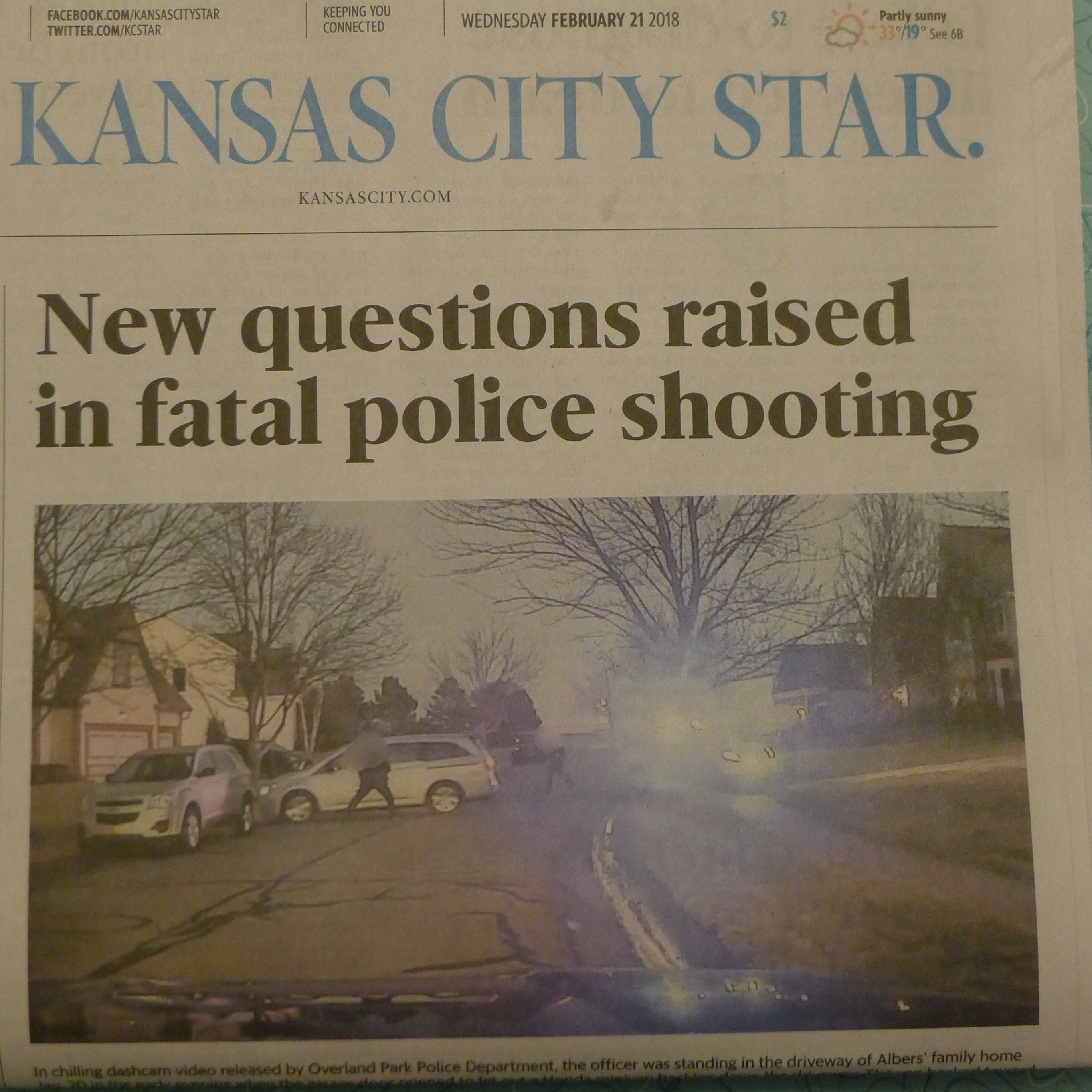
The foregone conclusion came to pass Tuesday when Johnson County District Attorney Steve Howe announced he had decided an Overland Park police officer had exercised “a proper use of force” when he shot and killed 17-year-old John Albers in the Albers’ driveway on Jan. 20.

This is one of the most upsetting use-of-deadly-force cases that our area has seen in a long time. The dash-cam video is hard to watch and raises serious questions about the way the officer who shot Albers handled the incident.

I don’t know if this has been reported, but I have heard the officer was a rookie…The video certainly tends to indicate the officer was inexperienced and used poor judgment.

With Albers sitting in his vehicle inside his garage — and the garage door down — we see that the officer has taken up a position in the middle of the driveway, several yards behind the garage door. He’s not off to one side or in the yard; he’s precisely in the path of where a car would go if it emerged from the garage.

And so, when the door opens, the van Albers was driving heads in reverse toward the officer, and the officer jumps off to one side and starts shooting into the van.

If the officer had positioned himself off to the side — which I think is what 99 out of 100 people would do — there would have been no need to shoot Albers.

Now, my heart does go out to the officer (as well as to the Albers family, of course) because he has to carry the memory of that day, and his own second-guessing, for the rest of his life. In the video, when you hear him saying in a cracking, almost wailing voice, “I thought he was going to run me over,” you can tell this man knows his life has just changed forever.

Wisely, he has resigned from the force, instead of going through months of internal reviews and rehashing the incident and probably being fired.

This is just awful all the way around…But for the life of me, I cannot figure out why he decided to position himself where he did. I would bet anything that police academies do not instruct cadets to position themselves in the middle of driveways if they suspect someone is about to drive out of a garage — the very thing, it appears, police were anticipating.

Manslaughter

In a case I wrote about last year, a 42-year-old Kansas City, KS, man was found guilty of voluntary manslaughter for killing a 34-year-old woman while the two of them sat in a pick-up truck outside the house they were sharing in the Armourdale area.

Enemencio Lansdown pleaded no contest Monday in Wyandotte County District Court and was sentenced to 20 years and seven months in prison.

Casey Eaton (left) and her mother Cherri West

The most interesting element of this case is that the victim, Casey Eaton, was the daughter of Cherri West, who lost another daughter, Pamela Butler, in a horrific child-abduction/murder case in October 1999.

At the time, I was editor in The Star’s Wyandotte County bureau and edited the first two days’ of stories about the case. But the case shook me to the core, partly because Pamela was 10 and my daughter Brooks was 11 at the time. On Day Three of the story, I took the day off — the only time I can recall a story getting the best of me. Another editor handled that day’s developments, highlighted by police fishing the killer, Keith D. Nelson, out of the Kansas River near the 12th Street bridge. (He’s been on death row in a federal penitentiary for more than 15 years now.)

I always admired the way Cherri — a blue-collar, working lady –handled the media crush. Unlike someone who is rich, she had nowhere to hide and answered all questions put to her. She answered them with a composure and dignity that was partly responsible for people contributing more than $100,000, I believe, to a fund that enabled Cherri to get out of Armourdale. The last time I spoke with her, at a memorial gathering for Casey last April, she was living in Mound City, KS.

I should have gotten her phone number then but didn’t. I would love to talk with her…Can you imagine losing two children to murder?

Burglary

Finally, for the case that the mainstream Kansas City media is scared to death of — 79-year-old David Jungerman.

Jungerman, of Raytown, was questioned but not charged in the Oct. 25, front-yard killing of lawyer Thomas Pickert three months after a Jackson County jury awarded $5.75 million judgment to a man Jungerman had shot a few years ago. Pickert represented the man at the civil trial.

If you’re a regular reader, you know that the Jackson County Prosecutor’s Office and the Vernon County Prosecutor’s Office have engaged in discussions on an attempted burglary charge against Jungerman in southwest Missouri, where Jungerman owns several thousand acres of farm land. The prosecutors hope to get a conviction on the attempted burglary charge and get Jungerman into prison while Kansas City police continue their investigation into the murder case.

On Tuesday, a hearing was held in Greenfield, MO, on a defense motion to dismiss the burglary charge. I wrote last week that I would let you know how Judge David Munton ruled on the motion.

On Wednesday, he dismissed the motion, saying, “Some of the issues in the motion, appear to be fact questions that would be decided by a jury.”

A pretrial hearing is scheduled for March 15 in Lamar, MO, and trial is scheduled for April 3, also in Lamar.

In a story that very few Kansas City Star readers probably saw, the paper’s owner, McClatchy Co., announced two significant changes at the corporate level last month.

One of those changes recognized Colleen McCain Nelson’s terrific work in slightly more than a year as KC Star editorial page editor: She is now charged with raising the level of McClatchy’s opinion work nationwide…at all 30 of its daily papers. (Fortunately for Star readers, she will handle the added duties out of Kansas City.)

That’s quite an honor, and well deserved. More about that in a minute.

The other change does not immediately affect The Star but could have a significant impact down the road: McClatchy is phasing in a new “regional editor” system under which one person will be ultimately responsible for editorial content at several papers.

I don’t know how the regional system will play out over time, but it would not surprise me to see KC Star editor Mike Fannin either lose his job, at one end of the spectrum, or get assigned to oversee several other papers in addition to The Star.

As a starting point, McClatchy announced that a regional editor working out of Sacramento, where McClatchy is based, will oversee the chain’s five California papers and one in Idaho. An editor working out of Raleigh, NC, will be in charge of editorial content at McClatchy’s seven papers in North Carolina and South Carolina.

Naturally, McClatchy didn’t label the new system as a cost-saving measure, but virtually everything the chain does revolves around saving money.

My bet is they will eventually name five or six regional editors and pay them salaries comparable to what editors at individual papers are now being paid. Then they will elevate lower-ranking (and lower paid) people to the top editorial posts at the individual properties, saving a significant amount of money in the process.

As I’ve said time and time again, almost every McClatchy move is dictated by trying to slash its way out of the huge hole it dug for itself when it paid an exorbitant $4.5 billion for the Knight Ridder chain in 2006.

**

Maddeningly, The Star bungled the way it reported Nelson’s promotion and the change to a regional editing system.

The Star didn’t see fit to run the story in the print edition, just online. And even there it wasn’t featured prominently. (If it had been, I would have seen it; I’m on that site about 10 times a day.)

Instead of leading with the news about Nelson — which would have been of keen interest to thousands of readers — the story curiously focused on the regional editing system. The story ran a total of 11 paragraphs, and Nelson’s promotion wasn’t mentioned until paragraph 10, which read as follows…

“McClatchy also announced that Kansas City Star’s editorial editor Colleen McCain Nelson will take on a broader role as McClatchy Opinion Editor.”

Journalists have a great term for stories that totally miss the mark — “burying the lead,” meaning the most important news is not at the top of the story, where it should be, but buried way down low.

That’s what happened here, and it’s kind of astounding. Whoever edited the McClatchy story in Kansas City should have immediately recognized it needed to be rewritten to highlight Nelson’s promotion and play down the regional-editor changes. The editor should have assigned a reporter to interview Nelson, get quotes from her and flesh out the scope of her new duties. But nope, the editor just hit the send button and ran the story just as it came across the news wire, with The Star’s very deserving editorial page editor being relegated to the second-to-last graph.

**

For her part, Nelson handled the dismissive treatment with aplomb and humility.

“I don’t think I’m particularly newsworthy,” she said in an email to me yesterday. “…But I am really excited about working with other editorial boards. It’s a great gig.”

It is a great gig, and The Star should have played it like it was. And more important, we readers need to appreciate Nelson every day we have her. It wouldn’t surprise me if we wake up one day and read that she’s taken a big editorial-page job at The Washington Post or The New York Times.