Feeds:
Posts
Comments

One thing that infuriates voters is a proposed tax that appears to be applied unfairly, with average-income people paying their share and wealthy people getting a break.

A story in today’s Kansas City Star raises that specter in regard to the owners of condominiums at the Walnuts, 5049 Wornall, one of the most prestigious addresses in the city.

It seems that if voters within the proposed, expanded streetcar district approve establishment of the district, condo owners at the Walnuts would be getting a pass, while nearby owners of much-lower-priced residences would see their property tax bills go up.

The vast majority of condos in the Walnuts, built in 1929, go for $1 million and up, while most houses in the area probably sell in the range of $150,000 to $300,000.

But somehow, as The Star’s Lynn Horsley reported today, when the property-tax district lines were drawn, the Walnuts was conveniently omitted.

Let me walk you through the geography here…

The expanded streetcar line would end at 51st and Brookside. The Walnuts sits just off 51st Street between Wyandotte, a lightly traveled street, and Wornall, obviously a major thoroughfare.

Going from east to west, the property-tax district would go up the 51st Street hill and across Main but then would screech to a halt at little old Wyandotte, a block shy of Wornall.

By any kind of logic, Wornall would seem to be the natural breaking point, not only because Wornall is such a major corridor but also because, west of Wornall on 51st, you run into Loose Park and Pembroke Hill School.

…So, what could have prompted the planners to exclude a rich lode like the Walnuts, where condo residents could easily afford whatever property-tax hike is involved. (And, by the way, if I hear of a Walnuts condo owner whining, “But I’m on a fixed income,” I’m going to personally root them out and egg their unit, if I can sneak past the damn doorman.)

But back to the question of “how did this happen?”

Horsley said some people had suggested that the Walnuts complex was left out of the assessment zone because influential people, such as former mayor Kay Barnes, live there.

Well, now, that’s interesting…It’s also worth noting that Barnes got remarried a couple of years ago to Tom Van Dyke, an attorney with the highly regarded Bryan Cave firm.

Kay’s a gracious lady and was a great mayor, and Tom seems to be a nice guy. I like them both and see them at Country Club Christian Church, where they are members and I’m a regular attendee. (I also make an annual monetary pledge, for the record.)

David Johnson, one of the two men who drew the lines for the property-tax district, told Horsley the boundaries had “absolutely nothing to do with where Kay Barnes lives.”

“I didn’t even know where she lived,” he said. “I thought she still lived in Briarcliff.”

Well, maybe it wasn’t just Barnes’ address that made a difference with Johnson and attorney Doug Stone, the other man involved in drawing the lines. The Walnuts has more than 100 units, with a lot of very rich and influential residents. I can see where a few well-placed calls from those people or on their behalf could have prompted Johnson and Stone to place the pencil on Wyandotte instead of Wornall.

The Walnuts

Johnson told Horsley his and Stone’s main objective was to include properties within walking distance of the streetcar line. Horsley apparently didn’t press Johnson on this, but is he suggesting the people living in the Walnuts aren’t within walking distance of 51st and Brookside?

Hell, from Brookside to Wyandotte it’s five blocks! To Wornall, it’s six!

…Unfortunately, Horsley’s story might have appeared too late to make a significant difference. Mail-in ballots that were sent to people living within the expanded streetcar district — which is larger than the special property-tax district — are due Aug. 1. The ballots went out a month ago, and many of the 5,700 people eligible to vote may well have sent them back by now.

Even if voters approve the expanded district, more elections would be required to actually impose the higher property taxes, as well as a higher sales tax within the district. Horsely told me today it’s possible the property-tax lines could be adjusted before everything is finalized, but I gathered that was unlikely.

Too bad. I’d hate to see Kay and Tom and all those other rich folks at the Walnuts get away without paying the higher property tax that would help support the expansion.
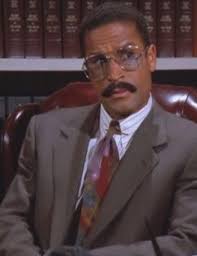
As Jackie Chiles, the hilarious attorney on “Seinfeld” would say: “It’s outrageous, egregious, preposterous.”

You said, it Jackie…
One thing that easily discourages newspaper readers, and understandably so, is stories that leave them saying, “Huh?”

Such a story — an update on the Tour de France — appeared in the print edition of Monday’s KC Star sports section.

The complete, online version contained all the key information readers needed to know, but the print version was a meat-cleaver job.

I haven’t been following the tour closely, but I did know that defending champion Chris Froome of Britain had been leading. So, when I saw the headline on Monday’s Associated Press story — “Tour bike problem nearly derails Froome” — I was interested.

Here’s how the story began:

If Chris Froome rides into Paris next Sunday with the Tour de France’s famed yellow jersey still on his shoulders, it will be impossible to argue that he didn’t earn the win.

In another day of drama Sunday in a 104th Tour full of twists, Froome broke a back-wheel spoke at the worst possible time on Stage 15 — just as his top rivals were picking up speed in front of him going into yet another punishing climb.

With that set-up, the average reader would have at least two questions:

— Did Froome retain the yellow jersey, as overall tour leader, after the wheel mishap?

— If so, what is his overall lead? If not, how far behind is he?

The story went on for seven more paragraphs, but, in its poorly edited version, it failed to answer either of those questions. Instead, the reader was whiplashed one way and another, leaving the overall race status unaddressed.

For example, there was a Froome quote with a weird introduction…

“Panic stations,” he said. “I really thought that that could be the yellow jersey changing shoulders again.”

“Panic stations?” What the…? Why quote that? It doesn’t track.

That was immediately followed by a curious use of imagery…

“Like a hound chasing prey, Froome hared off after Romain Bardet…”

I suppose the writer was using the verb “hare” in the sense of the tortoise and the hare. But, then, why bring in the hound?

There was one more brain twister…

“Earlier at the Tour, Froome’s rivals had waited for the race leader to catch them back up when he suffered another mechanical problem, that one with his gears.”

“…catch them back up”?  

One factor in the odd phraseology is that the writers — John Leicester and Samuel Petrequin — are Englishmen. (I had to look that up to verify it.) I have never seen an American writer use the word “hare” as a verb. And maybe that “catch-them-back-up” thing is peculiarly British.

Nevertheless, whoever was editing that story down at 18th and Grand in KCMO, USA, should have edited the story so it made sense.

For the record, Froome fought back from the mishap and managed to hold onto the yellow jersey. Going into the final days of racing, Froome had an 18-second lead over Fabio Aru of Italy.

…Just like the Royals send players down to AAA Omaha sometimes, KC Star management should send the editor of the offensive Monday morning story to the minor leagues of journalism for more training. He or she needs to “catch them back up.”

**

On the Kansas City Star Bylines Facebook page, former KC Star employee Krys Reese referenced a very questionable classified ad that appeared in Monday’s paper.

It was listed as a “business oppty.” Beneath a photo of a man in a cowboy hat, the ad began like this: “American Big Money, Earn big Money Part-Time From Home Mailing our Full-Color Sales Postcards.”

It went on to say that for an investment of a mere $193 — for post cards and stamps — people could be up and running in business. Didn’t say exactly what the business was or how the investors were going to make money…In other words, it’s a scam. And somebody ought to call the cops — on The Star, for starters.

As Krys Reese said on Facebook, “McClatchy must be desperate for every cent.”

**

Many of you will remember the Missouri Transportation Department’s “Arrive Alive” campaign, which encouraged the use of defensive driving techniques to reduce wrecks.

Well, it’s time for Kansas City area residents to go beyond defensive driving and just get off area interstates as much as possible, until this current spate of highway construction projects is finished.

I’m sure many of you know by now that we had another giant, fiery, rear-end-precipitated crash yesterday — this one occurring on eastbound I-435 at U.S. 69 (Metcalf) in Overland Park. And, yes, this five-vehicle smash-up involved a tractor-trailer, as did the one that killed five people last week on I-70 near Tonganoxie.

The Star reports that in the latest crash two people were taken to hospitals, one with critical burns. The Star said it was not clear which vehicle began the chain-reaction crash.

I said the other day I’ve adjusted my driving habits to stay off area interstates as much as possible, and I urge all local residents to do the same, at least for now. There’s no place in our area you can’t get to by taking city streets and secondary highways. For now, we area residents should wave the white flag, turn the highways over to the truckers and cross-country travelers and “arrive alive” at our destinations. Believe me, we all have the time…


My fellow Americans, I have suggestion for you this summer of 2017: Avoid Interstate 70 westbound between downtown and the toll station a few miles past Kansas 7.

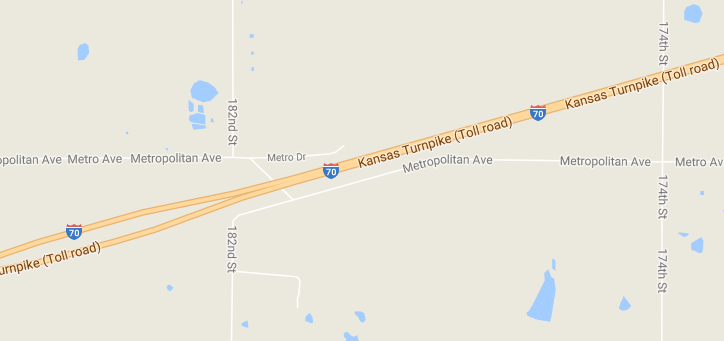
As you know, an almost unimaginable crash on I-70 at 174th Street (see map) took the lives of five people Tuesday. It was entirely preventable: An 18-wheeler being driven by a Texas man who was going too fast and not paying attention slammed into two vehicles, killing their occupants. His rig bulldozed on, pushing a third vehicle under another 18-wheeler, killing the occupant of the submerged vehicle.

The three vehicles that were on the receiving end of 56-year-old Kenny Ford’s “special delivery” were all at rest, stopped in traffic for construction just east of the toll station. (On the map, the toll station is where the eastbound and westbound lanes separate, just past 182nd Street.)

Ford has not yet been charged with any violations. It may be difficult to determine his speed because, from the way it sounds, there wasn’t much braking. A Kansas Highway Patrol lieutenant told The Star Ford “wasn’t paying attention ahead of him.” That makes me think he was doing one of three things — texting, playing dial-a-tune or dozing. Exactly what he was doing will probably come out at some point.

Being a curious sort, I felt compelled to drive out there Friday and see the crash site and surrounding area for myself.

What I found, both westbound and eastbound, scared the crap out of me.

…Driving westbound from Kansas City, before reaching K-7, I began noticing a slowdown in the eastbound lanes. Traffic was backing up, single file, amid dust and periodic bursts of orange cones. As I proceeded west, I saw that the eastbound tie-up extended at least two or three miles, and I decided that after I had finished my westbound reconnaissance, I would get off at the first possible exit and catch eastbound State Avenue to avoid the tie-up.

I was traveling about 65 in a 70 mph zone, and as I proceeded, several cars whizzed past me going 80 or more.

The numbered streets (174th, 182nd, for example) are not marked along the interstate, so I didn’t know exactly where 174th crossed. I was on the lookout, however, for “a slight rise,” a term that The Star had used in describing the location of the wreck.

In the general area where I thought the wreck took place, I came upon a gradual upswing and then, suddenly, I was there, traversing the spot where the crash had taken place. It was an ugly black patch, long and wide, and the wheels of my Ford Fusion rumbled as I crossed it. It was like driving over the world’s biggest scab.

About half a mile or so farther west, I came upon the construction zone — minimal on Friday, anyway — that had brought traffic to a dead halt three days earlier. That was just shy of the toll station. Wanting to make sure I had correctly identified the site of the wreck, I asked the toll clerk where it had occurred. “You missed it,” she said, pointing back to where I had just been.

By then, traffic was flowing normally in the eastbound lanes, across the highway. I took the Tonganoxie-Eudora exit and got back on I-70, now heading back toward town.

After clearing the toll booth again, I went along smoothly for maybe a half mile and then saw, not far ahead, indications of a significant wreck. Three vehicles were involved, and it could not have occurred more than four or five minutes before. Both eastbound lanes of I-70 were blocked because of debris in the roadway. Two cars, one badly damaged, were off in the ditch, and another was parked in the emergency lane. Two or three people were sitting on the hillside, above the ditch, and they were being comforted by several people who were standing. Fortunately, it didn’t look like anyone was seriously injured, and no sirens were sounding.

Once I cleared that wreck, I drove maybe half a mile before catching up to the eastbound slowdown I had seen on the trip out. Then it dawned on me: The wreck I had just passed had undoubtedly been triggered by one vehicle failing to stop in time for slowed or stopped traffic. Shades of Kenny Ford and his 18-wheeler three days earlier. 

Crawling along, I got off a few minutes later at K-7 and went north to State Avenue. No problem there. The speed limit was 50, and traffic flowed freely in each direction. It was enjoyable, too. The sights I took in included Kansas Speedway, Children’s Mercy Park, CommunityAmerica Park and Cerner west. Seeing the massive racetrack facility reminded me how the KCK chamber of commerce’s “Our Hearts Are Racing” video had convinced Nascar officials, more than 15 years ago, to build in KCK — and how that led to the ensuing, incredible development at the northwest quadrant of I-435 and I-70 quadrant.

At I-435, I took a chance on being past the eastbound I-70 tie-up and got back on the turnpike. I had guessed right; the slowdown was now behind me.

At that point, I started watching the posted speed limit signs. At I-435 it was 70. At 78th Street, 70; at I-635, same. Not ’til I got to 18th Street Expressway, just six miles from downtown Kansas City, did it drop to 65.

…My fellow Americans, people drive too fuckin’ fast. And they don’t — sometimes can’t — slow down fast enough. The speed limits are way too high around our major metropolitan areas. In my opinion, it should be 60 within 25 miles of every big city’s downtown. That would be a good first step that would save a lot of lives.

Can’t we slow down… just a little…to save lives?

A lower speed limit west of K-7 might have saved the lives of the five souls Kenny Ford obliterated last Tuesday:

  • Teresa J. Butler, 61, of Urbana, Illinois
  • Karen L. Kennedy, 63, of New Palestine, Indiana
  • Ricardo Mireles, 38, of Topeka, Kansas
  • Sheldon Cohen, 83, of Topeka, Kansas
  • Virginia Cohen, 79, of Topeka, Kansas

Kenny, of course, wasn’t seriously hurt; he was ridin’ high and wide when hurtling toward that construction zone.

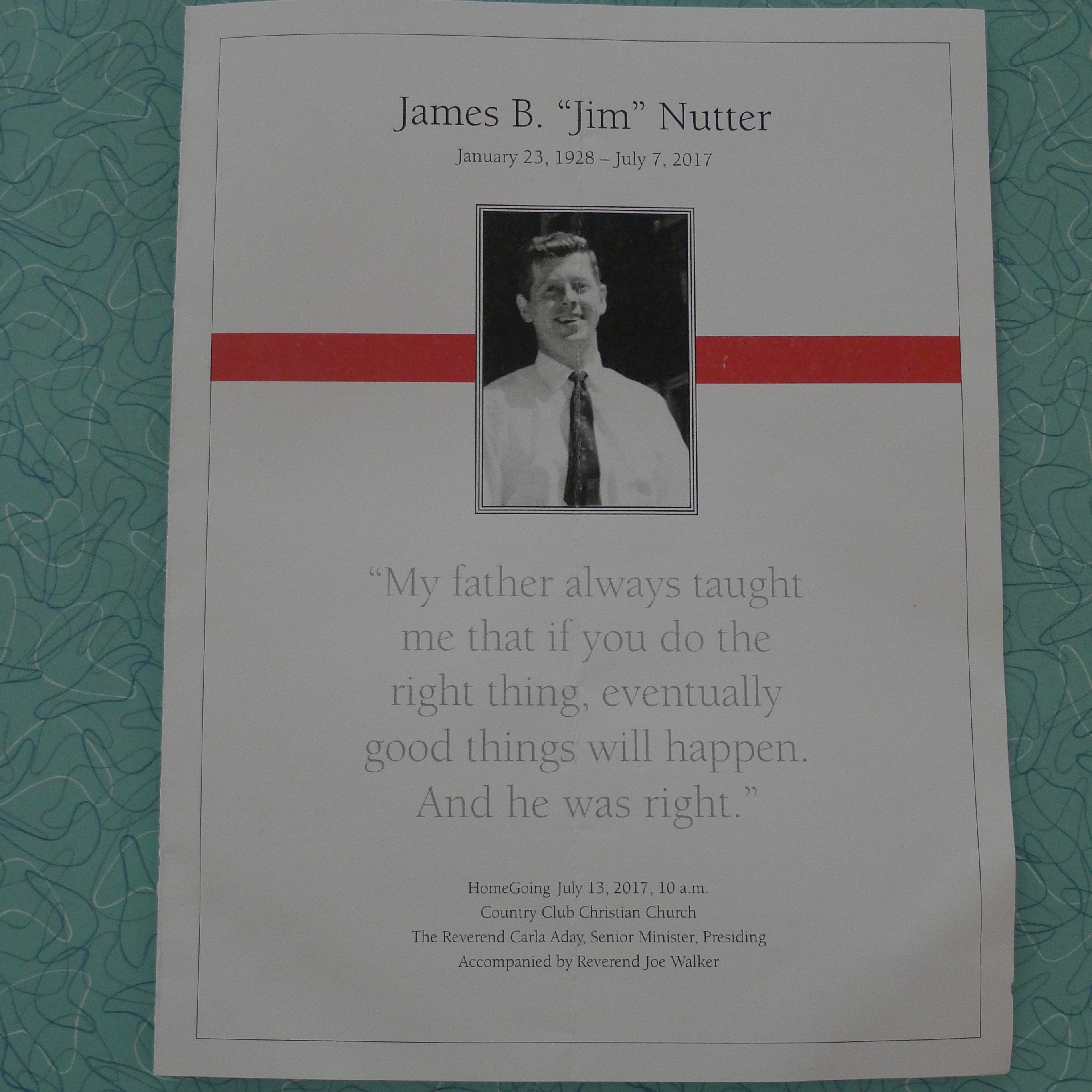
Jim Nutter, a great Kansas Citian and an even better human being, had his “HomeGoing” today at Country Club Christian Church, 61st Terrace and Ward Parkway.

I walked over to the funeral with a good friend, Kaler Bole, who, like me, was an admirer or Nutter’s big heart, which expressed itself partly in his unconditional and uninhibited generosity.

Nearly everyone who knew Nutter has his or her own story about a cause he gave to or a person he helped.

(Mine is about a contribution he made early this year to the public-private drive to renovate Meyer Circle Fountain. When I first called, asking for a contribution, Nutter noted that he had already pledged $300,000 toward renovation of the fountain at the eastern end of Meyer Boulevard. “I’ve done more than my fair share,” he said, but added that, nevertheless, he would give $1,000 for Meyer Circle. When I called him back a few weeks later to arrange pick-up, he said, “Make it $5,000.”)

Today, two family members and two close friends got to tell their Jim Nutter stories to several hundred people gathered in the Country Club Christian Church sanctuary, where Jim and his wife Annabel were longtime members.

The speakers were: grandson Russ Moore; longtime friend Dr. Harry Jonas; U.S. Rep. Emanuel Cleaver; and Jim Nutter Jr., who has been president for several years of the mortgage banking firm his father founded, James B. Nutter & Co.

Here are some eulogy highlights:

Russ Moore

Russ is only 24 or 25 but talks and carries himself like he’s much older. He is the son of Jim and Annabel’s only daughter, Nancy Moore, who died of breast cancer in 2004, when Russ was 11 years old. After the death of his mother, who was divorced, Russ went to live with his grandparents, and Nutter profoundly influenced Russ.

Russ spoke of seeing Nutter’s compassion first-hand and of his grandfather’s belief that the “reverberation of compassion” was not only good for business but “good for the heart.”

“He was a giant and a champion of the common people,” Russ said. “He was my personal champion…My grandfather was the father I never had.”

Harry Jonas

Back in the early 1970s, when I was a young reporter covering the Jackson County Courthouse, Jonas was one of the initial members of the Jackson County Legislature, after the county went to home-rule government, instead of being politically beholden to the state.

Jonas, whose friendship with Nutter goes back to those days, noted that Nutter was a strong Democrat and contributed primarily to Democratic candidates. He added, however, “He never hesitated to support good Republicans, like our three-term mayor, Dick Berkley.”

(Berkley, now in his mid-80s and very weak, was at the funeral.)

Jonas said that Nutter, despite battling a variety of health problems the last decade or so, “never lost his enthusiasm and his commitment to a life of doing good.”

“Jim,” Jonas said in closing, “we love you, and you will always be Mr. Kansas City.”

Emanuel Cleaver

Cleaver started his eulogy with an anecdote about inadvertently having left his backyard gate open recently and then watching the family’s 125-pound dog running out of the yard — “with what I interpreted as a smile on his face.”

“What has that got to do with Jim Nutter?” Cleaver said. “Let me explain.”

He went on to say that Nutter had gamboled through life without strictures or restraints, liberally helping others and following his own weathervane. “Thank God somebody left the gate open for Jim Nutter,” Cleaver said.

Jim Nutter Jr. 

Jim Sr. was legendary for his long conversations, either on the telephone or in person, and it was hard to cut him off partly because he was so animated and enthusiastic in his story telling. After mounting the steps to the church pulpit and pulling papers from his inside coat pocket, Jim Jr. deftly alluded to that, saying, “Have you got time for one more story?”

He went on to talk about his father’s “uncanny sense of business, numbers and people.” And he recalled how his father urged him to “try to understand people by taking a walk in their shoes.”

In a beautiful touch, Jim Jr. recounted the highlights of his father’s last day on earth, last Friday.

For lunch he had a sandwich that had been brought to his home from the Capital Grille on the Plaza. After that, he watched some TV and read that day’s Kansas City Star. Then, he laid down for a nap.

And that was that.

As you “up-to-date” Kansas Citians are well aware, we lost two business and civic titans in recent days — mortgage banker, philanthropist and political kingmaker Jim Nutter Sr. and Cerner co-founder Neal Patterson.

Maybe you saw their obituaries in The Star. Nutter’s ran yesterday and Patterson’s yesterday and today. (It won’t run again tomorrow.)

One interesting element of the obituaries is that, because of the closeness of the first letters of their last names, their obits ran side by side, straddling two pages. Had both obits been on the same page, they would have taken up nearly the entire page.

What many of you might not know is how significant a source of revenue the obits are for the print editions of The Star and other major daily papers. The Star began charging for obituaries many years ago, before significant reader migration to the Internet and the over-the-cliff plunge in classified advertising. What The Star — and probably many other papers — expected to be bonus income from obituaries in the end turned out to be a lifesaver.

The Nutter and Patterson obituaries made The Star a pretty penny, indeed. More about that in a minute, but first here are The Star’s obit rates:

:: First eight lines, free

:: Nine to 11 lines, $114

:: 12 to 15 lines, $170

:: Every additional five lines, $39

:: Half-column photo, $100; full-column photo, $125

By my calculations, each full page of obituaries generates about $6,000 in revenue. Wednesday and Sunday are the biggest days for obituaries, and today’s obits took up about two and a half pages — meaning The Star made about $15,000 on today’s obits.

Now, to Nutter and Patterson…

The Nutter obituary ran 479 lines, at a cost to the family of $3,800. The one-column photo pushed the cost to $3,900.

Patterson’s obituary, at 300 lines, cost the family $2,500 Day One, about $1,450 Day Two (with a second-day discount) and about $200 in photo fees.

One of my early editors told me to never make the reader do the math, so the grand total for both obits, with pictures, was about $8,000.

Those guys are certainly worth the ink, and I’m sure their families aren’t complaining about the price. Both guys made fortunes.

On days like this — housebound by heat, just hangin’ around — I often entertain myself by going to YouTube and listening to oldies. And being a hopeless romantic (and kid at heart), I tend to home in on some of those great droopy-drawers songs from the early ’60s.

Sometimes I start with one song in mind and then meander to others, finally settling on one.

Such was the way I landed on a great oldie by The Lettermen, “The Way You Look Tonight.”

Come along, trace my footsteps…

Several days ago, something triggered in my head the old song “I’ve Got Your Number.” I couldn’t quite remember who did it — or, more correctly, whose version was going through my head. A YouTube search revealed it to be Peggy Lee, who recorded it in 1964.

Fantastic song…Listen…I love the opening three lines…

I’ve got your number
I know you inside out
You ain’t no Eagle Scout

I listened to it several times, then a YouTube list of songs from the same era diverted my attention to Frank Sinatra’s version of “The Way You Look Tonight.”

If you’re a Baby Boomer, like me, that song could well have special appeal for you: It has a rich history of making many a Boomer swoon for a boy or girl…or ache for lack of one.

…I’ve said before that high school was the loneliest period of my life: I was a good Catholic boy, going to an all-boys prep school in Louisville, feeling the rush of desire for contact with girls but not having much idea where to find them or what to do on the rare occasion I did.

So, it mostly came down to longing and imagining. Lots of it. Sinatra’s version, upbeat, hints at it. But it’s The Lettermen’s version — syrupy, yes, but irresistible, at least for me — that grabs the heart and squeezes ’til it almost cries.

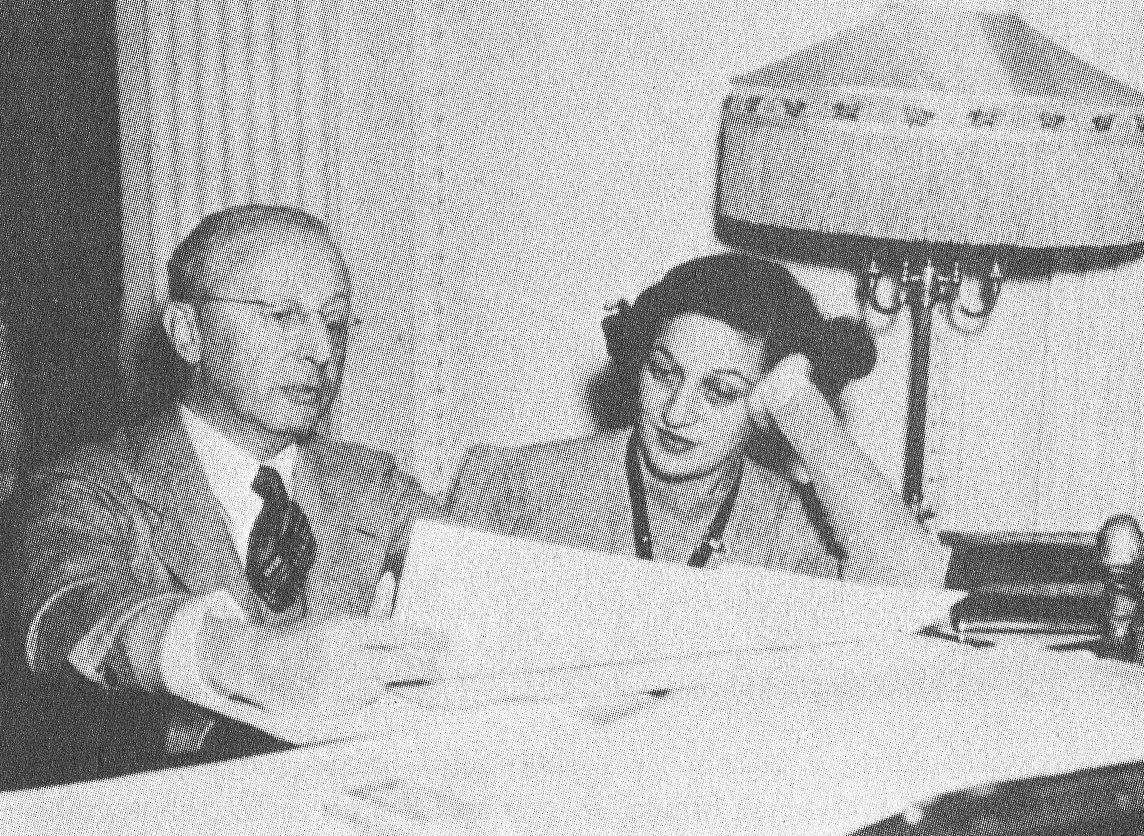
The song is imbued with a special magic partly because it was written by the great Jerome Kern (1885-1945), with lyrics by Dorothy Fields (1905-1974). Kern wrote it for the 1936 movie “Swing Time,” starring Ginger Rogers and Fred Astaire.

Jerome Kern and Dorothy Fields, working in Kern’s Beverly-Wilshire suite

In the movie, Astaire’s character, “Lucky” Garnett, sings the song to Rogers’ character, Penny Carroll, through a closed door, while Penny is washing her hair in the bathroom. You might wonder how that setting could be romantic, but check it out…

As good as Astaire’s original was, it was The Lettermen’s version that struck at the hearts of us Baby Boomers and our feelings of longing, inadequacy and uncertainty — or, perhaps, connection, or missed opportunity.

The Lettermen

The Lettermen recorded it in 1961. It was their first big hit. I was either a freshman or sophomore in high school. The record climbed to No. 13 on the Billboard Hot 100 singles in the U.S. and to No. 36 in the United Kingdom. How it didn’t get to No. 1 in the U.S., I don’t know, probably because The Lettermen were unknown before then.

…I’m not alone in the powerful emotions the song triggers. The proof is in the scores of comments written on the YouTube pages that feature The Lettermen’s version.

Here’s a sample…

Topaz Dupree (one year ago): My husband and I were married September 30, 1961. We stopped at a diner that evening for a snack, and he played this song over and over on the jukebox. It’s a very special memory.

Tandy Warwick (four years ago): I have great memories of this song (from) 12-31-70. I was dancing with my first love that night and to this song, and even though we’re not together any more, this one song plays in my head each New Year’s Eve.

Reg Dunlop (two years ago): Dancing cheek to cheek.

J. Puglisi (two years ago): Finally a slow song. I’m gonna ask her to dance.

Michael Hickey (one year ago, writing in response to Puglisi): I did, she was my first love and I think of her often to this day.

Frank Oakes (one year ago): This recording, I am sure, brought along my 3rd child. Dancing with my wife…Oh, my.

Chuck Ranker (two years ago): Married in 1965 and lost her July 2012. Will never recover but it’s OK.

Terilynn Wells (one year ago): Washing your hair, setting it on horrible brush curlers; sitting under a dryer with a hood, painting your nails with Revlon’s “Hot Pink”; then teasing the crap out of it, spraying it, putting on a Bobbie Brooks outfit…It all went to pieces — JFK’s trip to Dallas in in Nov. ’63, then Vietnam.”

Tim Drumm (five months ago): Brother, did these guys ever — truly — capture the phenomenal story line, the motion of love, in this classic.

Ah, yes, the motion of love. Listen. Feel it… 

Keep that breathless charm.
Won’t you please arrange it
Cause I love you…just the way you look tonight.

I’ve written my share of criticism of shoot-first-ask-questions-later cops, but today I was glad to see that a Kansas City International Airport Police officer was cleared of a harassment allegation.

The Star’s Matt Campbell had a thorough, well-balanced report on the incident and the ensuing complaint, and from that account it appeared to me the officer encountered a chronic loudmouth who did his best to bait the officer into losing his temper.

Apparently, it didn’t happen, and that officer, Sandy Thompson, can now look back on that day and be very satisfied with how he handled a difficult situation.

The complainant, Michael McGill Jr., contended Thompson ordered him against the outside wall of the terminal and threatened him by fingering his gun three times after Thompson had pulled over the car McGill’s mother was driving. She was dropping him off. The car, which must have been registered in Missouri, didn’t have a front plate.

Employing a line that many a quick-to-the-trigger police officer has employed in the courtroom to good effect, McGill said, “I was in grave fear for my life.”

His problem, though, is airport audio and video don’t show him in any fear at all. What they show is a guy exhibiting diarrhea of the mouth. He was jabbering away from the start, and in an audio recording, Officer Thompson is heard saying McGill has been “extremely rude from the get-go.”

Even his mother was trying to shush him. The video shows McGill jabbering away on his phone, while Officer Thompson is attempting to talk to him. His mother is heard on the audio telling her son to “shut up and let the man talk,” and video shows her moving to put her hand over McGill’s mouth.

Michael McGill Jr. (right), his mother and KCI Police Officer Sandy Thompson on April 29

Thompson denied ordering McGill against the wall and said he never grabbed at his gun. The video shows the officer reflexively and momentarily touching the bottom of the holster at one point, apparently to adjust his belt.

After McGill filed his complaint, the Airport Police asked the Missouri Highway Patrol to investigate the case, and after doing so, Highway Patrol Superintendent Sandra K. Karsten concluded Officer Thompson was guilty of “no readily discernible criminal act.”

In a way, it’s too bad this had to go all the way to the highway patrol superintendent, but if that’s what it takes to clear an officer wrongly accused in a delicate situation, well then we in the public should be grateful the incident got scrutiny from a lofty level of law enforcement.

And congratulations to Officer Sandy Thompson. If he ever stops me at the airport, I’m going to congratulate him…and then keep my mouth shut.

**

Another KC Star story gave me a shuddering sense of deja vu. In a crash that was eerily similar to the I-70 crash last year that took the life of a Warrenton couple’s children, a retired Johnson County fire fighter named Paul W. Scott was killed in KCK on Thursday when his SUV was struck from behind after Scott’s vehicle had stopped for traffic congestion.

Paul W. Scott, years ago when he was a Johnson County fire fighter

Scott, 68, of Tonganoxie, was stopped on westbound Parallel Parkway in his tan SUV. Another westbound driver, apparently paying little or no attention, rear-ended him in a white SUV. The impact plowed Scott’s vehicle into another vehicle at the intersection of Kansas 7.

I would bet just about anything we will learn the other driver, whom The Star had not yet identified, was either texting or playing dial-a-tune on his phone.

That is exactly what happened last Labor Day evening when a 61-year-old Odessa man plowed his SUV into the rear of David and Jennifer Beaird’s car while they were stuck in traffic on eastbound I-70 near the Adams Dairy Parkway exit. The Beairds’ two children, Gavin, 13, and Chloe, 7, who were in the back seat, were killed. David, who was driving, was paralyzed from the waist down. Jennifer escaped serious injury.

In April, James L. Green pleaded guilty to two counts of second-degree murder and was sentenced to 25 years in prison.

As regular readers of this blog know, I have written about the Beaird case extensively, after going to Warrenton early this year to interview them.

On Friday, I spoke with David on the phone and told him about the K-7 crash. He was not surprised.

…David and Jennifer continue to recover from the trauma that was visited upon them by Green. They intend to move to either upstate New York, where Jennifer has family, or Myrtle Beach, which would seemingly present a more hospitable lifestyle for David, who is confined to a wheelchair.

For months, they have had their house on the market with no success. David told me Friday, however, that their real estate agent had put together a group of friends from her church and the group is going to build a deck on the back of the home. The lack of a deck or patio has discouraged prospective buyers, David believes.

I hope they are able to sell the house soon and get the fresh start they want in another part of the country.

Closer to home, my thoughts and sympathy go out to Paul Scott’s family…And my greater concern is that with the ever-increasing use of cells phones anywhere and everywhere, more and more of us are becoming sitting ducks in traffic stops and potential road kill under ordinary driving circumstances. My advice: Go slow and keep checking the rearview mirror.

There’s no doubt that The Kansas City Star, being a link in the debt-laden McClatchy newspaper chain, is operating under significant financial constraints.

But one area in which a relatively small investment could pay big dividends is online reader comments.

Unfortunately, The Star took steps several years ago that had the effect of discouraging reader comments, and it has never made a serious effort since then to build a workable system. That apparent lack of interest and initiative has had two big, negative impacts.

First, it has made online subscriptions — where the paper’s future seems to lie — less appealing. At this stage, if online subscriptions are not growing by leaps and bounds, The Star is in deeper trouble than it appears. (For the record, I don’t know how The Star is doing in regard to online subscriptions, but I haven’t talked to a lot of people who have signed on.)

Second, The Star’s abdication on reader comments makes the paper less relevant than it would otherwise be. As the community’s single strongest information source, The Star could establish itself — with the hiring of two or three people — as the authoritative moderator of responsible discussion on important community issues. That would not only raise the paper’s much-diminished community profile, it would also attract a lot more online subscriptions.

…It’s not fair to compare The Star or, for that matter, any other American daily with The New York Times, but it’s nevertheless interesting to point out the amazing success The Times has had with its online reader-comment system.

Bassey Etim

The Times began enabling comments 10 years ago. The Times now receives about 12,000 comments per day. Every one of those comments is read and either approved or rejected by a 13-member “community desk” headed by Bassey Etim, who has been with The Times since 2008.

It is not uncommon for a big story to get more than 1,000 comments. Today, for example, the lead story in the online edition — a news analysis speculating about how many casualties there might be in the event of a limited war on the Korean peninsula — has attracted more than 1,000 comments.

(At random, I looked at seven KC Star online stories this afternoon and saw a total of six comments. A majority of the comments — four — were on a Kansas City Royals story.)

By virtue of its comments system, The Times has become the de facto clearinghouse on national discourse. Sometimes I will read scores of comments on a single story and spend much more time on the comments than on the story that generated the comments.

In a 2013 story in The New Yorker magazine, a writer named Maria Konnikova reflected on the psychology of online comments, saying they contribute to the reading experience and prompt many readers to want to engage each other on the topic at hand. She added:

In a phenomenon known as shared reality, our experience of something is affected by whether or not we will share it socially. Take away comments entirely, and you take away some of that shared reality, which is why we often want to share or comment in the first place. We want to believe that others will read and react to our ideas.

**

Now, I have no evidence whatsoever that The Times’ well-oiled comments system has contributed to its amazing success with sale of digital subscriptions — it is up to 1.9 million news subscriptions, after starting at zero in 2011 — but I have to think it has.

It just makes sense to me that many people, when they read other people’s comments, want to chime in, and I think the combination of getting a good news product (which The Star is) and then being able to weigh in on various issues is a powerful marketing combination.

I understand why The Star changed its approach to comments several years ago, banning anonymous comments and requiring that commenters be registered on Facebook. The trolls, particularly those with a racial ax to grind, were overrunning the comments and making them unreadable. (As an example of a horrible comments system, where anonymous comments are not only accepted but encouraged, check out Tony Botello’s local blog.)

All things considered, I think The Star is missing a golden opportunity. Over the last year, under still relatively new publisher Tony Berg, The Star has hired several young reporters and has done a complete and successful makeover of its editorial page. It wouldn’t take much of an investment — maybe $100,000 to $150,000 a year — to establish its own “community desk.” A few good hands could keep the trolls squarely under the bridges and trigger invigorating dialogue on any number of issues.

Consider, for example, how interesting and intellectually stimulating it would be to get a wide variety of local views on the prospect of a single terminal at KCI — or the resolution of Brandon Ellingson case, or Kelsey Ryan’s Sunday story about Kansas City being a “murder capital.”

I tell you, it could enliven and uplift the entire community. And it could sell a lot of online subscriptions.

I hope some of you have noticed that The Star’s editorial page has been as hot as the Royals lately.

Editorial page editor Colleen McCain Nelson and her band of writers have consistently been churning out substantive, well-written and interesting editorials.

From a low point just before last year’s general election, when the editorial-board cupboard was completely bare and many readers were wringing their hands in despair, the editorial page has roared back to life and has, to some degree, revitalized The Kansas City Star Media Company.

Readers and voters look to their local paper for analysis and guidance on major issues, and The Star is delivering in a big way these days. Consider the editorial board’s handling of three issues in particular:

A New KCI

As the city has bumped along, trying to unravel myriad knots presented by a first-ever, $1 billion, private-build proposal, The Star has dispensed sound advice at every turn. First, it urged the city to get more than the lone Burns & McDonnell proposal. Then, after the city opened the doors to more proposals, The Star advocated for giving companies more time to respond. The council did so. The Star also urged keeping open the possibility of the city issuing revenue bonds and retaining control of the project. City officials opted to keep that door open.

On Sunday came the strongest shot of all: The lead editorial unequivocally urged Kansas Citians to “embrace a new airport terminal.” The editorial laid out four main reasons for scrapping the three-terminal set-up that has lost its relevance and physical appeal. Likening KCI to a “warehouse,” the editorial batted away the widely held “convenience” argument, saying:

“At certain departure times, ticket and security lines stretch 100 to 150 people deep…Security stations are crowded and sometimes understaffed.

“Worse, passengers who clear security are penned inside glass-enclosed waiting areas, sitting in uncomfortable chairs and confined to cramped spaces that lack amenities found in other terminals.”

The editorial concluded by saying, “A new terminal will create jobs and opportunity and will move Kansas City into the 21st-century when it comes to travel and commerce.”

Finally, The Star promised an ongoing “series of editorials” explaining why it’s time to move forward on a new airport.

Damn…I love it!

The Brandon Ellingson Case

As you regular readers know, the Ellingson case has been particularly frustrating. The 20-year-old Des Moines area man drowned at the hands of a Missouri Highway Patrol officer who had arrested and handcuffed Brandon for boating under the influence. After months of shell games by prosecutors and the Highway Patrol, the trooper, Anthony Piercy, was charged with involuntary manslaughter. Last week, Brandon’s family, realizing a felony conviction was a virtual impossibility — like us, they’ve seen bad cop after bad cop acquitted in the killings of unarmed civilians — agreed to a deal that allowed Piercy to plead to a misdemeanor boating violation.

In an editorial on Saturday, The Star said the case “reveals the perils” of government taking action in the interest of trying to save money. The editorial said…

“In 2011, to great fanfare, Missouri merged the Water Patrol with the Highway Patrol in an effort, supporters said, to cut costs…The merger led to fewer troopers on the water, with less training for Highway Patrol officers assigned to water duty.

“And the decision almost certainly contributed to Ellingson’s death. At a coroner’s inquest, Piercy conceded his training was inadequate for the duties of the Water Patrol. He was cleared for “solo boat time” after two days of training. Two days. We’re told that things are better now. We hope that’s the case.

“Brandon Ellingson died needlessly. The best way to remember him is to make sure this never happens again.”

This case is coming to a totally unsatisfactory conclusion, but the editorial put it in the proper context by pointing toward what we all hope will be a future in which better-qualified people patrol state waters…And allow me to add a wish of my own: smarter, more caring officers working the water.

Claire McCaskill’s Tweet

Showing it’s no Democratic toady, The Star on Sunday sharply rapped McCaskill’s knuckles for a tweet she posted a while back in which she denied ever speaking to or meeting with Russian Ambassador Sergey Kislyak.

The claim was exposed as false: In fact, she attended a reception at Kislyak’s residence and donated to a foundation of which he is a board member.

The editorial said that “in her rush to raise doubts about Trump administration officials, the senator got it wrong. And there’s no excuse for that.”

**

The way the Star’s editorial board is chopping wood these days makes you realize how low it had fallen when, toward the end of last year, it was down to Yael Abouhalkah writing all the editorials and the vastly overpaid Lewis Diuguid in charge of letters to the editor.

From this corner, the Colleen Nelson era gets the “new and improved” stamp of approval. Much improved.

During the time Patty and I were driving back from St. Louis last Sunday, a 29-year-old St. Louis area man, Casey Saunders, was killed in a bike race after he crashed into a metal barrier at the corner of 18th and Oak streets here in Kansas City.

I don’t know about you, but when I hear about particularly heartbreaking tragedies, I often think about where I was and what I might have been doing at the time of the tragedy.

I guess it’s because of the shocking contrast between the moments surrounding a fellow human being’s encounter with violent death and the contemporaneous, uneventful moments (at least so far) for me.

When Casey Saunders hit that barrier about 1:30 p.m. during the Tour of Kansas City race, we were westbound on either I-64 or I-70. I don’t recall exactly what time we left St. Louis — where we had attended a wedding Saturday night — but I started out driving and Patty soon took over because I drive too slowly to suit her.

I don’t remember if she had taken over by 1:30, but, whatever the case, it was a blessedly uneventful trip.

I also don’t remember if we heard about the Kansas City tragedy that night or the next morning. In any event, like most people who read or heard about the incident, we wondered exactly what had happened.

For several days, no details emerged. Today, however, The Star’s Joe Robertson pinned it down in a front-page story. The main problem was that the barriers separating bystanders from the racers were not bound together. The racers were westbound on 18th, turning north onto Oak, when Casey got tangled up with another racer on the turn and was carried wide. He hit one of the barriers hard, knocking it backward. Then, Robertson said, “he flew over his handlebars at the suddenly exposed hard edge of the next barrier, slamming it with his forehead.”

Before the race resumed, workers tied the barriers together with zip ties.

Robertson’s reporting makes it clear this was an avoidable tragedy. While proper race course set-up would not have prevented the crash, in all likelihood it would have prevented Casey’s death.

As is often the case, the tragedy can be traced to a failed link in the chain of events leading up to the fatal incident.

The race was sanctioned by USA Cycling, which establishes regulations and assigns officials. When USA Cycling sets up barriers for championship races, it secures the barriers. In this case, however, Tour of Kansas City was responsible for setting up the course, and tour officials apparently delegated barrier set-up to a vendor, who, for whatever reason, didn’t tie the barriers together. Robertson did not attempt to address whether or not the vendor was instructed to secure the barriers.

On that point, Scott Ogilvie, a close friend of Casey, said in a Facebook message to me today that he had not made inquiries on that point. “If anyone is exploring that, it’s probably USA Cycling because they permit and insure the events,” he wrote.

**

Michael “Casey” Saunders lived in the St. Louis suburb of Kirkwood. Cycling was a big part of his life. He worked full time at Big Shark Bicycle Co., which has two locations in St. Louis City and one in Chesterfield, in St. Louis County.

Survivors include his parents, a grandfather and three sisters. His obituary also referenced his “loving soul mate,” Maria Elena Esswein, who had traveled to Kansas City with Casey for the race.

A memorial service was held Thursday at a funeral home on Manchester Road in Kirkwood.

Apparently, he had been a Boy Scout. The obituary said…

Casey lived his life according to the Scout Law: trustworthy, loyal, helpful, friendly, courteous, kind, obedient, cheerful, thrifty, brave, clean and reverent.

This photo of Casey and Maria appears on the Facebook page of his friend Scott Ogilvie.

Ogilvie said of Maria: “She’s a very strong rider too and they did some great rides together. One of their first encounters was when he stopped to help her fix a flat during a mountain bike race.”

That’s a great “how-they-met” story. It’s a damn shame they didn’t get to spend a lot more time together.