I was rooting around in the attic this morning, looking for some electrical adapters for an upcoming trip, when I came across some yellowed Kansas City Star editions I had filed away long ago.
The first thing that struck me was how narrow the paper has become — from 13 1/2 inches in 1993 to 11 inches now. It brought back memories of the pain we editorial employees experienced when the paper started to shrink — and kept on shrinking.
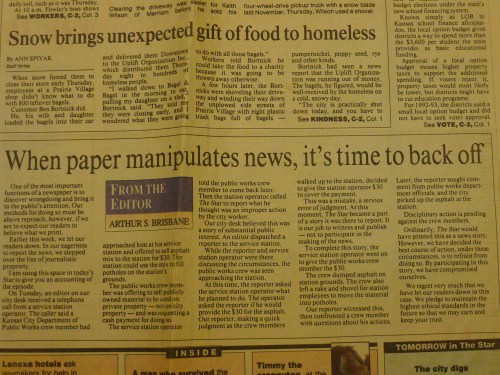
The second thing I noticed was a commentary written on Feb. 26, 1993, by then-Editor Art Brisbane.
It was a column about my most ignominious and embarrassing experience as a reporter — an incident that ended up being referred to in the newsroom as “Asphaltgate.” And, unfortunately, I was the one who opened the gate and let the shit come cascading down on myself.
It was so bad that my screw-up led directly to the appointment of a newsroom committee that was charged with writing a new KC Star ethics policy.
Fortunately, I survived Asphaltgate and went on, as I’ve recounted several times before, to tack my way to a conventional retirement with the most treasured send-off in journalism — the pizza and sheet-cake party.
But let me tell you about Asphaltgate, which very few people out there have been around long enough to remember.
I was covering City Hall at the time, and Tuesday, Feb. 23, 1993, was my eighth wedding anniversary. My editor got a call that morning from a guy who owned a gas station at about 59th and Swope Parkway. The station operator said a Kansas City Public Works Department crew had come around earlier offering to sell cold-mix asphalt for $30 so station employees could fix several potholes on the station grounds. Clearly out of line, the public works crew was using publicly paid for asphalt mix to do pick up side money, all while on the city clock, of course.
The station owner told them to come back later and then called The Star. The editor sent me and a photographer out to the station to see if the crew returned and, if they did, to document and report it.
When I went out there, I planted myself just behind the office area. The photographer, Jim McTaggart, positioned himself a half block or so away with his camera and a long lens. Pretty soon, the city crew pulled slowly into the station. At that critical juncture, the station owner turned to me and said something like, “Do you have $30,” or, “Will you pay the $35?”
I as caught totally off guard. I hadn’t given a thought to the money for the transaction. But I had cashed a check that morning because Patty and I were going to dinner that night to celebrate our anniversary. So I reached for my wallet and gave the station owner $35. Immediately, it didn’t feel right, but I was caught up in the moment and, well, the money was now walking out to the crew.
The crew dropped a large pile of asphalt and left a rake and shovel for station employees to use to move the material around later.
At that point, I left the station, jumped in the photographer’s car, and we followed the crew to a public works maintenance site off Blue Parkway. There I confronted the crew leader, who had little to say. What could he say? He’d been caught red handed.
Turned out, though, I was in almost as much trouble as the crew was. Immediately after confronting the crew leader, I went to a pay phone, called my editor, told him what had unfolded and said, “I want you to know, I paid the $30 for the asphalt.”
The editor said, “Ooohh,” his voice trailing off, which confirmed my gut feeling that I had made a big mistake.
By the time I got back to the office, the in-house wheels were spinning. But instead of the editors being interested in a story about a city crew cheating the taxpayers, they were completely focused on me having paid for a story. I hadn’t really thought about it in that context — buying a story — but there was no denying that’s what it amounted to.

Art Brisbane, as pictured in a 1995 column
The first decision the editors made was not to run the story. It was getting late by then, and I went home. As I recall, had a pretty nervous anniversary night. First thing the next day, Metro Editor Randy Smith escorted me to a meeting with Brisbane and Managing Editor Mark Zieman. The meeting was in the spacious, wood-paneled conference room, which featured a long, cherry table with a polished glass top. I remember that neither Brisbane nor Zieman offered any greeting. They were quietly conversing when I came in, and Brisbane turned toward me and started talking straightaway about the incident.
I had no idea what was going to happen, but I figured I wasn’t going to get fired. I had had a couple of close calls earlier in my career and had always avoided the ax, partly because I also had a history of turning out big stories that tended to offset my face-down spills in the mud.
This time, I was also lucky because the ethics policy was outdated and did not address the issue of “buying stories.” Had the policy specifically prohibited that, I think I would have been gone.
I didn’t get suspended, either. However, Brisbane told me he intended to write a column apologizing to the readers for the paper’s — for my — ethical failure. Sparing me the ultimate indignity, he said he wouldn’t name me; in print, I would be the anonymous reporter who dropped the turd in the punch bowl.
Brisbane didn’t say this, but I am sure he had consulted with Publisher Robert Woodworth and that it had been a joint decision to handle the matter with a public apology.
The column appeared two days later. Perhaps the most ignominious part was that I had to help write the column because, of course, I was more familiar with the circumstances than anyone.
The column appeared under the headline, “When paper manipulates the news, it’s time to back off.”
Besides recounting the facts of the incident, Brisbane made had two key points:
:: “In our eagerness to report the news, we stepped over the line of journalistic propriety.”
:: “By participating in this story, we have compromised ourselves. We regret very much that we have let our readers down in this case. We pledge to maintain the highest ethical standards in the future so that we may earn and keep your trust.”
**
After the column was published, several reporters sympathetic to me said they thought Brisbane had used the column as a back-door way of reporting a story he had decided would not be published.
Personally, I thought the matter should have been handled internally, but, on the other hand, city officials were aware of what had taken place and could have pointed quietly to The Star having conveniently overlooked an error in judgment by one of its reporters.
A couple of other factors were at play, too. For one thing, both Brisbane and Woodworth had ascended to their respective posts the previous year, 1992, and were undoubtedly eager to establish their bona fides. Woodworth had succeeded legendary publisher James H. Hale, and Brisbane had succeeded another KC Star legend, Joe McGuff.
Perhaps an even bigger factor, though, was that journalism had very recently been caught with its pants down. Just two weeks earlier, NBC had publicly apologized for a “Dateline NBC” program in which the network had staged a fiery test crash of a General Motors pickup truck. The network made it look like the crash was spontaneous, but it was rigged. Not only did NBC apologize but it also agreed to settle a defamation suit filed by GM. It was one of the biggest scandals in modern-day journalism.
Fresh on the heels of that blockbuster journalistic embarrassment, along came JimmyC reaching in his pocket and forking over $30 for cold-mix asphalt.
For many months after that, I was extremely pissed off at Brisbane and once spoke very critically about the paper at an intimate meeting among him, my editor and one or two other City Hall reporters. To Brisbane’s credit, he held his tongue. He could have unloaded on me then and there, or he could have bided his time and had me demoted. He didn’t do that, either. In fact, two years later I got promoted to assignment editor and took charge of the Wyandotte-Leavenworth bureau.
After the meeting, I asked fellow City Hall reporter Kevin Murphy for his impression of my performance. He replied, “Oh, I just figured you were still hot about asphalt.”
Yes, I was. Yes, I was. But I got over it. It only took a couple of years.
Oh…and those public works crew members? They were fired. Also, a week or so later, I turned in a phony mileage expense voucher for the $30 I had handed over. I even told my editor exactly what I was doing. He hesitated, then quickly scrawled his signature on the expense voucher and turned away with a grimace.





 JimmyCsays: At the juncture of journalism and daily life in KC
You must be logged in to post a comment.