Feeds:
Posts
Comments

We could be headed toward a “Snapchat presidency.”

That’s the view of New York Times columnist David Brooks, who, in a piece on Tuesday, propounded a possible scenario in which the relationship between President-elect Donald Trump and Russian President Vladimir Putin degenerates into a “schoolyard fight,” pushing the world toward the brink of a nuclear war.

That’s the kind of thing that kind happen, Brooks said, when a president detaches himself from “the system of governance he’ll soon oversee” and, instead, fires off Tweets that at least appear to represent policy statements.

“His statements should probably be treated less like policy declarations and more like Snapchat,” Brooks wrote. “They exist to win attention at the moment, but then they disappear.”

In that sense, Brooks went on, “Trump is not a national leader; he is a national show.”

It’s a given that Trump has a lot of personality. He can be very charming and entertaining. But think about it…Is that what we’re looking for in a president? What we’re looking for is a person with an even temperament who thoughtfully considers issues that affect all Americans, while getting advice and suggestions from trusted, knowledgeable people around him. And through that process he arrives at decisions that reflect the serious consideration those decisions deserve.

**

As I read that column Tuesday morning, it immediately brought to mind Episode Eight of “The Crown,” an outstanding Netflix series about Queen Elizabeth II’s long tenure on the throne and how she grew into the monarchy from the time she acceded to the throne when she was a young woman of 25.

I had just watched Episode Eight Monday night, and one of its plot lines offers parallels to the troubling signs Trump has been exhibiting.

…In 1954, Queen Elizabeth and her husband, Prince Phillip, were preparing to embark on a trip of many weeks to visit British colonies in an effort to shore up the standing of the British Empire. A sticky problem attending their departure, however, was how the headstrong Princess Margaret, the queen’s younger sister, would handle the royal duties while filling in for Elizabeth.

princess-margaret-at-west-malling-kent-1957-1024x976-430x410

Princess Margaret, in 1957

trump

President-elect Donald Trump


Their mother, Queen Mother Elizabeth, who was also going to be away from London, had pushed for more exposure for Princess Margaret in order to “give her a chance to shine.”

In a conversation between the sisters, Margaret vows to inject “character” into the monarchy while her sister is away. Elizabeth warns her against displaying “too much character, an excess of character.” This exchange ensues:

Elizabeth: “Just remember who you’re standing in for when I’m gone.”

Margaret: “My character-less sister.”

Elizabeth: “Your queen…not a showgirl.”

Margaret proceeds to do as Elizabeth and others around her had feared, going “off script,” tossing out inappropriate one-liners and offending important people with her loose tongue.

Her performances leave Prime Minister Winston Churchill irate, and he confronts Margaret and dresses her down.

“When you appear in public, performing official duties,” he says, “you are not you…No one wants you to be you; they want you to be it…The crown. That’s what they’ve come to see — not you. The minute you become yourself, you shatter the illusion; break the spell.”

He finishes by pointing out that Henry VIII — Elizabeth’s uncle several generations removed — tried to impose his individuality on the monarchy — “and he almost destroyed it in the process.”

**

It’s becoming very clear that, so far, Donald Trump is more interested in putting on a show than he is in learning the nuances of governance and preparing to accede to the presidency of the world’s most powerful nation.

Consider another passage from David Brooks:

Trump…is a creature of the parts of TV and media where display is an end in itself. He is not really interested in power; his entire life has been about winning attention and status to build the Trump image for low-class prestige. The posture is the product.”

…At a time like this, I sure wish a Winston Churchill was nearby to dress him down and try to set him straight…It’s likely, of course, that not even a Churchill-scale figure could rein in Trump. With each passing day, the run-up to the inauguration is looking more like a Broadway production than a serious attempt to prepare for the heavy responsibility that lies ahead.

As we all know, the most important thing on Broadway is the show must go on.

Last week, I was talking to the two men — East Side residents named Jimmie and Charles — who cut my grass and mulch my leaves, and I asked them if they had big New Year’s Eve plans.

Almost before I’d finished the question, Charles began shaking his head and said: “July 4 and New Year’s Eve, I’m in bed before the gunfire starts.”

I laughed, but, of course, there’s a lot of truth to what he said.

From celebratory shooting to shooting with malice, New Year’s Eve is a day we usually get a lot of gunfire in the Kansas City area.

The last day of 2016 and the first hours of 2017 were no exception: Three triple shootings occurred between Saturday and Sunday in Kansas City. Fortunately — and I say that loosely — only one of the nine people injured in those shootings died.

But that one death pushed the 2016 homicide count to 126 for last year — the city’s highest homicide count since 2008.

The headline on The Star’s year-end crime story was: “2016: The killing began quickly and never let up.”

That’s a hell of a commentary, isn’t it? To lift a phrase from the Jackie Chiles character on “Seinfeld,” “It’s outrageous, egregious, preposterous.” But in this case, it ain’t funny.

And here’s something that makes me squirm: Of those three triple shootings, only one occurred in what most of us would consider the “inner city.” That was in the 5800 block of Blue Parkway, near Sni-A-Bar Road.

One of the others occurred in the 1700 block of Missouri Avenue, near the Della Lamb Community Center in northeast Kansas City. And the third shooting, in which a man in his 20s died, took place on Ninth Street, between Broadway and Washington, near The Peanut’s downtown location.

I don’t know about you, but I am frequently in the vicinity of Blue Parkway and Sni-A-Bar; it’s my go-to route to Kauffman Stadium. And the Milwaukee Delicatessan, Ninth and Baltimore, is my second favorite pizza place (after Minsky’s).

As much as I’d like to wave off those incidents as not being in my frame of reference, I can’t do that. In fact, there are many places we all go that have been the scenes of shootings and that probably will be in the months and years to come.

The rate of shootings and homicides has to be a major concern for all of us. As Damon Daniel, executive director of the AdHoc Group Against Crime, told The Star: “Today’s shooters are very young and never stop to think about the collateral damage they cause to families and the community at large.”

A shooting might start with the mildest of personal slights; or with revenge in mind and no reflection on the likely consequences; or by accident, with a novice criminal wielding a handgun during his first armed robbery.

And what’s the common thread here? Duh, it’s the guns. They’re everywhere.

I got this from the Washington Post: The United States has the highest gun ownership rate in the world — 89 guns for every 100 people — and the highest per capita rate of firearm-related murders of all developed countries — 67.5 percent.

Think about that: Eighty-nine guns for every 100 people. And I don’t know if that includes the unaccounted-for guns on the streets, the guns that are being used in many of the shootings in the Kansas City area.

homicide-rate

We can be grateful, I guess, that we’re not as bad off as Chicago, which recorded 762 homicides in 2016. That’s the most murders Chicago has had in 20 years and more than New York and Los Angeles combined last year.

A story in today’s Kansas City Star about Chicago said this: “The bulk of the deaths and shooting incidents…occurred in only five neighborhoods on the city’s South and West sides, all poor and predominantly black areas where gangs are most active.”

What a scourge…and not just for Chicago. It’s a pox upon all of us, but particularly on generations of elected officials for allowing this situation to descend to the current, perhaps irredeemable level.

And it’s a rotten shame for the most advanced, most ingenious nation in the world to have to own this problem. All of us, as the saying goes, “have to wear it.”

Obviously, I don’t have the answer…I’m with my lawn guy Charles: It’s a good idea to be in bed before the shooting starts.

You know how I love a mystery.

And, if you’ve been reading this blog, you know there are more mysteries these days because the local news media is not doing the aggressive, follow-up kind of journalism it was doing several years ago.

The newspaper where I spent my career, The Kansas City Star, is more guilty than the local TV stations, which have long been spotty and inconsistent in their coverage. Before The Star began gong downhill, roughly in the 2000-2005 time frame, it covered virtually everything worth covering and followed up faithfully on breaking stories that left unanswered questions.

A big, breaking story that left unanswered questions was the fatal shooting Oct. 25 of Nicki Alexopoulos, a retired Fort Osage High School teacher, who lived in the 5700 block of Central Street.

A murder in the Brookside area is naturally going to get a lot of attention, and this case got plenty. The Star and all four local TV stations, I believe, jumped on it, as they should have.

I learned about it from a friend, who sent me an email as soon as he heard about it that night. It shook me up, mainly because Patty and I know a family who lives on Central. But I couldn’t remember if our acquaintances lived in the 5700 block or the 5800 block, so I got in my car and drove to the block, which is less than two miles from where we live.

When I arrived, police had the entire block sealed off. I asked a police officer to point out the house, and he did. It didn’t look like the house where our acquaintances live, and I then drove into the 5800 block and identified the house where our acquaintances live. Relieved, I went back home.

nicki

Nicki Alexopoulos

News reports that night, the next morning and a few days thereafter focused on the fact that Alexopoulos’ son had gone to her home because she had become aware he was embezzling money from her. He shot his mother several times inside the house, then he went outside and shot a woman who had been visiting his mother — seriously injuring her — and finally went back in the house and killed himself.

In all, he fired about a dozen shots in that normally quiet neighborhood.

The follow-up stories on TV and in The Star focused on Alexopoulos’ teaching career and the positive impact she had on many of her students.

That was all well and good, but what I wanted to know — and fully expected to emerge within a few days — was 1) the son’s identity and 2) the friend’s identity.

But no news outlet, not one, as far as I can tell from extensive research, ever followed up with that information. News outlets reported that police were withholding the son’s identify, and The Star and TV stations apparently never pressed the issue.

And there the story died.

I remember running a Google and whitepages.com search a few days after the killing and not being able to home in on the son’s identity. And I, too, let it go.

But then, on Dec. 16, a feature story on Alexopoulos turned up in The Star. Reporter Katy Bergen, a newcomer, wrote about Nicki Alexopoulos’ writings about raising her two children — a daughter and the son who ended up killing her — in a household with an abusive husband and father. That was in Boonville, Missouri, where Alexopoulos previously lived and taught.

In that story, Bergen identified the friend who had been shot in the front yard — a woman named Alice Snodgrass — but she did not identify the son.

A few days after that story was published, I sent an email to KC Star managing editor Greg Farmer, asking why the paper had never identified the son.

In the email, I noted that there was no need to protect the son’s “good name,” and I said that if he was mentally unstable, that too was a moot issue.

My final line was, “I don’t think I’ve ever seen the paper not identify the killer or alleged killer in a high-profile homicide.”

I didn’t hear back from Farmer.

**

The question of the son’s identity continued to gnaw at me, and today, after seeing an obituary about another person named Alexopoulos, I launched an extensive Google and whitepages.com search.

Finally, I was able to identify the son. His name was Patrick Nichols Fricke Alexopoulos. He was 38 years old.

A death and funeral notice — but not a full obituary — is on the website of Thacher Funeral Home in Boonville. With a few more clicks, I found a two-paragraph obit in the Missourian, a daily paper published by the University of Missouri-Columbia.

Here’s that obit:

Patrick N. Fricke Alexopoulos, 38, of Kansas City and formerly of Boonville, MO, passed away Tuesday, Oct. 25. Visitation will be 2 to 3 p.m. on Sunday, Nov. 6, at Trinity Lutheran Church, 20209 Ellis Davis Road, Boonville, with a celebration of life for the family at 3 p.m.

Patrick was preceded in death by his grandparents, William Norbert and Marie Fricke, and his mother, Nikki (stet) Alexopoulos. Survivors include father Norman Fricke, of Boonville, and sister Kristen Fricke-Oehlert, of Kansas City. Patrick was born in Boone County and was raised in rural Cooper County. He later attended Saint Peter and Paul Catholic School and graduated from Boonville High School. Patrick also attended the School of Business at Central Missouri, and he received his bachelor’s degree. Patrick will be missed by all who knew him.

nik

Patrick Fricke Alexopoulos

The Thacher Funeral Home notice also included a weird photo of Alexopoulos. Viewed from a distance, Alexopoulos is standing in front of a house, hands folded in front of him. He’s wearing dark slacks, a dress shirt, a narrow tie and a yellow ball cap.

There’s still a lot of mystery about this case: What was this guy like? What kind of jobs did he hold? Did growing up with an abusive father contribute in the end to the killing of his mother?

Answers to those questions would be nice to have, although they don’t constitute essential journalism. But the man’s identity — the killer’s identity — is essential journalism.

On this story, The Star and all four local TV stations get an F, as in pi-ti-Ful.

The Star’s editorial page is about to get a jump start under new editorial page editor Colleen McCain Nelson.

A source whose tipster track record is unparalleled told me last week that longtime political reporter Dave Helling is packing his pencil bag and heading to the south wall (if, indeed, that’s where the editorial page still holds forth), and Steve Kraske is exchanging his part-time post as political analyst to part-time editorial writing. (He will continue as host of KCUR’s “Up to Date” show and as a part-time journalism teacher at UMKC.)

As I said a couple of weeks ago, The Star’s editorial page has lost a ton of credibility in the last couple of months, since opinion-page anchor Yael Abouhalkah was laid off by first-year publisher Tony Berg, leaving a near-total vacuum going into the November general election.

Since Abouhalkah’s departure, The Star’s editorial page has consisted of a disproportionate number of letters to the editor, disproportionately large political cartoons and weak-kneed “As I See It” columns that were magically transported from their would-be natural habitat — the Op-Ed page.

That should soon change. The addition of Helling and Kraske should restore a measure of credibility to the editorial page.

kraske

Steve Kraske of KCUR’s “Up to Date”

Helling and Kraske could be the two highest profile political writers The Star has ever had. Not only have both men cultivated deserved reputations as clear-thinking, steady journalists, but both have also made their mark in electronic media, which gave them a tremendous advantage over earlier standout political reporters like Rich Hood and the late Henry Clay Gold, who labored in the print vineyard their entire journalistic careers.

Kraske has hosted “Up to Date” since 2002. He has been with The Star more than 20 years and is probably in his mid-50s. In the 1980s, he worked for four years at the Dubuque (Iowa) Telegraph Herald.

helling

Dave Helling, as a TV reporter in 2002

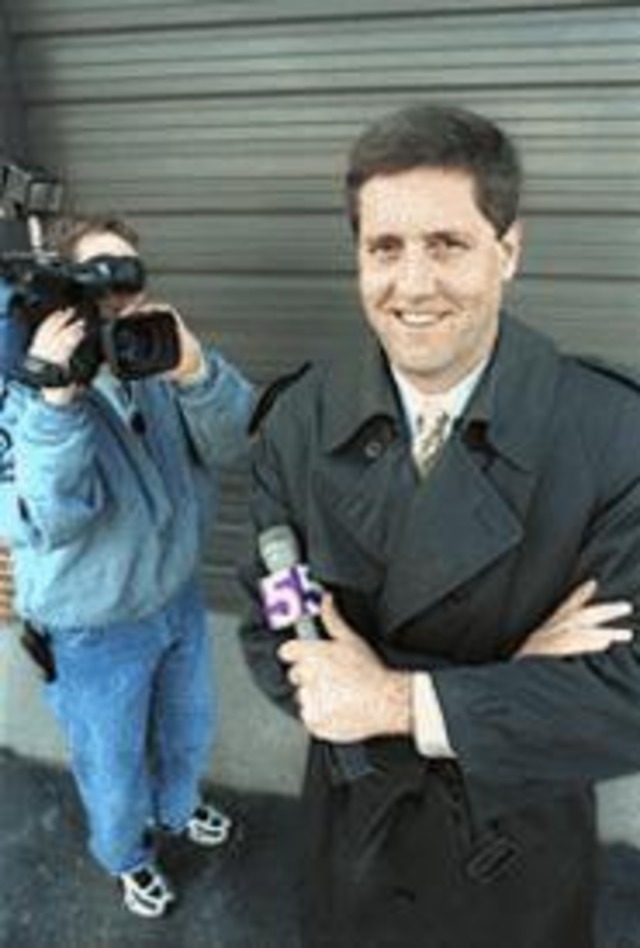
Helling, who is about 60, came to The Star about 13 years ago after a noteworthy career as a TV political reporter. He left KCTV5 after it took a sharp turn toward tabloid journalism in the early 2000s under a news director named Regent Ducas. The station embraced a theme of urgency and sensationalism, with the hook “Live. Late breaking. Investigative.”

Channel 5’s loss was The Star’s gain, as Helling immediately became a trusted political reporter. He and Kraske have collaborated on a readable and entertaining political column called “The Buzz” for several years.

**

Even as the editorial page was falling apart last fall, I speculated that Berg, who became president and publisher last January, had a plan for creating the new, less liberal page that he envisioned.

These two personnel moves could have been part of his plan…Either that, or he woke up bolt upright one night with an epiphany.

I am told — and I hope this is accurate for the sake of Star readers — McCain Nelson will be given the luxury of hiring a couple of other editorial writers. If so, I would guess they would be younger and significantly lower paid than Helling and Kraske.

But that’s OK. It will be a sign of significant progress just to see some more names on the masthead, under the heading “Editorial Board.” It was looking quite lame for a while, when “Tony Berg” held that distinction by himself.

It being close to year’s end, I could do one of those “Highlights/Memorable Moments/Top Stories of 2017” blog posts.

But I’ve got another idea. How about a “State of the City” report?

Huh? Huh? HUH? Yes, I knew you’d like that!

What got me thinking along those lines was an exchange of emails yesterday with a former KC Star reporter, Repps Hudson, who left here many years ago and spent most of his career in St. Louis. His last position was business reporter and columnist for the St. Louis Post-Dispatch. He’s been retired from the P-D nearly 10 years, about as long as I’ve been retired from The Star.

In our email exchange, my friend raised the comparison between St. Louis and Kansas City, and his seminal line was this:

“It (Kansas City) has improved sooo much. St. Louis is divided and stuck, but KC is rollin’ along.”

That was really good to hear, especially coming from a person who has lived in both cities and has a good frame of reference…Now, I’m not happy in any way to hear his assessment that St. Louis is divided (racially, he suggested) and “stuck.” I like St. Louis a lot, but I have gotten the impression in my trips over there that it’s not making the kind of strides Kansas City has made.

In one of my messages, I likened Kansas City’s progress the last 10 years to creation of a three-legged stool — the perfect stool, of course, because a three-legged stool doesn’t rock.

Former Mayor Kay Barnes (1999-2007) gets much of the credit for constructing this stool because she was responsible for two of the three legs.

Kansas City’s resurgence — and I mean the resurgence of  the whole city because a city can’t be strong without a solid core — started with construction of the Sprint Center. Before Sprint Center, we had tired old Municipal Auditorium, which, although a beautiful example of the Art Deco style, dated to the Pendergast era.

Sprint Center opened in 2007. Before it opened, work began on improving downtown streets, sidewalks and other infrastructure. I remember walking around downtown with the late Bill Grigsby, probably in 1980s, with him bitterly pointing out crumbling sidewalks outside the Hotel Muehlebach, which, before it was refurbished and subsumed by Marriott in the late 1990s, was the last vestige of an earlier, prosperous downtown era.

Since the day it opened, the Sprint Center has been one of the most successful arenas in the nation, event without a National Hockey League or National Basketball Association team. It sizzles as is, with concerts, college basketball games and other events.

kcpl

Power & Light District

Another leg was added with opening of the $850 million Power & Light District, which had its genesis many years earlier as a gleam in the eye of movie-theater magnate Stan Durwood, who, interestingly, dated Kay Barnes for several years. Durwood died before he could bring his dream to fruition, but his former girlfriend got the job done. Who knows? Maybe she blew a kiss skyward the day P&L opened in 2008.

The district has had — and probably still has — its share of critics. It opened when the Great Recession was taking hold and overall has not generated the revenue that was forecast, leaving the city to supplement its operation by several million dollars a year. But that won’t be the case forever. The district seems to be going great, and it’s undeniable that, combined with Sprint Center, it turned around our downtown.

I remember going to a basketball tournament at Sprint Center in the fall of 2015 and finding, when I arrived at the center, a huge walk-up crowd, with people waiting in several long lines to buy tickets. Across the street music was blaring from a couple of P&L bars, which were jammed with people. For me, it was a blood rush the likes of which I had never experienced in Kansas City. My city had changed, I realized; it had changed a lot, and for the better.

The third and final stool leg was added in 2011 with the opening of the incredible Kauffman Center for the Performing Arts. For that, Julia Irene Kauffman, daughter of the late Ewing and Muriel Kauffman, deserves almost full credit. She arranged funding for the bulk of the $350-million project from the Muriel McBrien Kauffman Foundation. With its two sophisticated performance halls — one primarily for opera and one for symphony — it has to be up there with the best performing arts centers in the nation.

facade

The angled, glass facade of the Kauffman Center for the Performing Arts

If you can stand in the multi-story lobby of that building and look out — through Moshe Safdie’s angled glass facade — at the lights of the Liberty Memorial, the Western Auto building and other Kansas City landmarks…if you can do that and not feel uplifted, your sensory gas tank is running on empty.

Since work on the first leg of the stool began, scores of new restaurants have opened downtown; construction of apartments and condominiums has boomed; the streetcar has proved a resounding success; and the Crossroads and River Market areas have contributed to the core’s revival.

We can and should be very proud of what has taken place in Kansas City during the last decade. We don’t have to worry about Omaha passing us by, and it doesn’t matter that Greater St. Louis has more residents than Greater Kansas City. What we’ve got here in Kansas City is really, really good.

As we look back, then, we can do so with satisfaction…At the same time, as we march into 2017, it’s time to look ahead again. If all goes as planned, the first leg of a new stool will be a new 800-room convention hotel at 16th and Baltimore, across from Bartle Hall. The hotel development team, led by former City Councilman Mike Burke, announced this week that it had an agreement with an undisclosed lender for a $110 million construction loan, which was the last major obstacle to getting underway.

The second leg of the new stool could be extension of the streetcar line from Union Station to 51st and Brookside — which would require approval of a sales-tax increase by voters living near the proposed expansion.

And the third leg would be…

You got it: A new, single terminal KCI.

It will happen, it WILL happen…With each additional year of aging, the nearly 50-year-old KCI is going to lose its hold on those who love it for its convenience. The warts — including that gloomy interior and those awful bullpen waiting areas — are only going to get uglier.

The wood for the new stool is on the bench, then. All we’ve got to do is start shaping, sanding, sawing and assembling. Let’s get going.

Who could forget the story of Roadrunner, the little dog whose owner abused him so badly back in 2014 that he had to have both eyeballs removed?

anderson-kimberly

Anderson

In case you missed it, the former owner’s criminal case was resolved this week: Kimberly Anderson, 38, of Kansas City, pleaded guilty Thursday to felony and misdemeanor animal abuse and abandonment charges in Jackson County Circuit Court.

The Star’s Glenn Rice reported the elements of her punishment:

— She agreed to enter the court’s mental health division and have no contact with or own any animals in the future.

— She was ordered to pay $200 restitution to the KC Pet Project, which treated and cared for Roadrunner after he was abused.

— She got a four-month jail sentence, but the sentence was suspended and she will have to serve no time if she successfully completes three years of probation.

If she fails to adhere to any of the above conditions, she could be sentenced to four years in prison.

As much as I’d like to see Anderson spend time in jail, I think this is a reasonable resolution. She’s got a felony conviction on her record (I don’t know if it goes away if she successfully completes probation), which probably will affect her employment options for a long time. Plus, the prospect of incarceration is hanging over her, if she slips up.

Jackson County Prosecutor Jean Peters Baker deserves a lot of credit for seeing that the punishment fit the crime in this case. Originally, authorities cited Anderson for municipal violations, which would have carried a maximum penalty of $1,000 fine and up to six months in jail. As a practical matter, however, the vast majority of Municipal Court defendants do not get jail time; it’s usually a fine and probation. Peters Baker filed felony, state charges.

I’m not going to recount what Anderson did to this dog, a Tibetan spaniel, but he also suffered a broken pelvis, which a Pet Project veterinarian repaired by installing a plate.

roadrunner

Roadrunner

After this incident occurred, in November 2014, I was so upset I went to the city’s animal shelter on Raytown Road to inquire about the possibility of adopting Roadrunner. Not surprisingly, the dog was already spoken for: A Pet Project employee was in the process of adopting him.

Roadrunner reportedly made an excellent recovery and, surprising to me, apparently suffered no psychological ill effects from his ordeal. I assume that like most dogs, Roadrunner offers his owner unconditional love and wants in return only to be cared for, petted and appreciated.

Let’s hope that during the past two years, Kimberly Anderson’s heart has lost its hard edge and that her mental health has improved and will continue to do so during her probationary period.

**

In a review of a new book about table manners, Dwight Garner of The New York Times took issue with the author’s conclusion that it was OK to have one’s cellphone on the table at a restaurant, provided the screen is facing down.

Garner’s response to that ridiculous notion:

“I am experiencing outrage fatigue. The best cellphone maneuver I’ve heard about — it is supposedly seen at some restaurants in Silicon Valley — is as follows: Before ordering, everyone places his or her cellphone in a pile at the center of the table. The first person to retrieve a phone must pick up the tab.”

**

When I went to the Chiefs-Raiders game a week ago Thursday, the decibel level hit 142, even with the crowd gloved and bundled in 20-degree temperatures.

Tomorrow, I doubt the number will get close to 142. The temperature at game time tomorrow — noon — is supposed to be 5 degrees. About the time the game ends, 4 p.m., it’s supposed to be all of 13 degrees.

I look for a crowd tomorrow of no more than 50,000, instead of the usual 70,000 or so. If you want to go to a game cheap and don’t mind freezing your butt off, you can go out there and probably buy good seats at the curb for $5 or less. Some people will be giving them away, maybe even club-level seats.

I thought about going out and trying to buy a club-level seat on the cheap but ultimately decided against it. I’m afraid I’d be chilled to the bone before I got to the club.

It appears that The Star’s new editorial page editor is now on the job.

Since Monday, the name of Colleen McCain Nelson has appeared on The Star’s masthead (the box at the bottom of the editorial page), beneath the name of publisher Tony Berg. In addition, I understand she was at a company-wide meeting the other day.

So, maybe the long weeks of seeing an editorial page filled with letters to the editor, political cartoons and occasional “As I See It” columns (which, by all rights, should be on the Op-Ed page) are nearing an end.

There’s a lot more to this, however, than the fact that the new editorial page editor has unpacked her bags and is occupying a desk at 18th and Grand.

Since her hiring was announced in late August, The Star’s editorial page has lost massive credibility. So much that I doubt it will ever get back to where it was, in terms of the paper’s ability to help set the local agenda on by editorializing on regional development and issues, endorsing political candidates and recommending approval or disapproval of ballot measures.

Let’s review just how much dysfunction has set in since early this year.

:: In early March, the editorial page was relatively healthy, with four editorial writers — page editor Steve Paul, Barb Shell, Yael Abouhalkah and Lewis Diuguid. In mid-March, Paul and Shelly accepted buyouts, leaving Abouhalkah and Diuguid to produce the editorial page, handle the letters to the editor, review guest columns and manage the Op-Ed page.

:: In late September, six weeks before the November general election, Berg summoned Abouhalkah, who had 32 years of experience on the editorial page, to his office and laid him off. (He’s now a blogger.) A week or so later, Diuguid announced he was leaving. After they left, there was only one name under the words “editorial board” on the masthead: Tony Berg’s…And he doesn’t write editorials.

:: For the election run-up, Berg recruited former editorial page editor Rich Hood — who had been fired in 2001 — to write several political endorsement editorials. With Berg’s blessing, Hood wrote editorials endorsing several Republican candidates whom Abouhbalkah almost surely would have spurned. They included U.S. Sen. Roy Blunt over up-and-coming, home-grown politician Jason Kander; Josh Hawley for Missouri attorney general over home-grown Teresa Hensley; and U.S. Rep. Kevin Yoder over newcomer Jay Sidie. (I have to say, Hood picked winners there; all three — Blunt, Hawley and Yoder — prevailed.)

:: After the election, with no one writing editorials, Berg decided to fill the page with letters to the editor and political cartoons, some produced by Star cartoonist Lee Judge, others from syndicated services.

:: A few weeks ago, with that situation either becoming too embarrassing or the supply of letters running low, Berg began fleshing out the editorial page with syndicated opinion columns and “As I See It” submissions. Such columns should, under no circumstances, be on the editorial page (that is, the left-facing page), which is sacrosanct ground reserved for the newspaper to express its positions.

It is at this nadir that Colleen McCain Nelson enters the building this week. Problem is, thousands, maybe tens of thousands, of editorial page followers have probably left the building, too, figuratively speaking.

I have talked to people who have said they are canceling their subscriptions because of The Star’s Nov. 8 endorsement line-up and because of the veritable void of an editorial page. Also, maybe worse, I hear no one talking about the editorial page. There’s nothing, really, to talk about.

Compounding the problem is the sharp turn in philosophy that Berg ordered up, taking the editorial page from liberal to center right in a matter of days. That’s his prerogative, but readers do not like to be whiplashed. He had to know that’s the risk he was taking when he laid off Abouhalkah, and he’s paying a heavy price.

The challenge facing Berg and McCain Nelson now involves more than just hiring some new editorial writers and churning out local copy for the page. They’ve got to try to lure back some of the readers they’ve lost and attract a new group of readers.

But like I said, I don’t think the editorial page will come back to where it used to be, at least where it was a few years ago. The paper as a whole has been headed downhill for 10 years. About the time the McClatchy Co. bought The Star in 2006, newspaper advertising began falling off a cliff: Nationwide, ad revenue is now less than half what it was in 2006. That precipitated a downward spiral involving layoffs, thinner papers, distribution problems and reader disenchantment.

It takes a trusted newspaper a long time to lose readers’ goodwill, but The Star has been doing it for the last decade. I’d sure like to see Berg and Colleen McCain Nelson restore a good and substantial editorial page, but, given the overall direction, I’m not optimistic.

So, take a good look at the new editorial page editor…It’ll be interesting to see how long she hangs around.

colleen-head-shot


Two days ago, it was all praise in this corner for The Kansas City’s Star’s three-part, investigative series on fire departments’ failure nationwide to develop consistent training standards and to apply lessons learned from disasters that took firefighters’ lives.

Today, though, I’m bringing down the cudgel. We will examine — yes, you will be right there with me — how and why The Star has whiffed on a huge story that, in my opinion, is nearly as important as the firefighter story. Moreover, it’s a story of more immediate interest in our region because it is about shortcomings in Missouri state government.

The story behind the missed story has something of a cloak-and-dagger element. It revolves around a former prize-winning KC Star investigative reporter, Karen Dillon, whom The Star fired in 2013. At The Star, Dillon won several big awards, including the prestigious George Polk Award in 1998 for a series about the finances within the NCAA and lack of gender equity. She would be the first to admit, however, that she was also a thorn in management’s side at The Star with her outspokenness.

Dillon, 64, is now a freelance investigative reporter, and she recently produced a blockbuster story for The Pitch. It’s a story The Star undoubtedly would love to have had, but for reasons we will explore, is now virtually ignoring.

Let’s take this in two phases — First, Dillon’s expose and then how other news operations, including The Star, have handled it.

Dillon’s story

dillon_karen_mug

Karen Dillon

Late last month, The Pitch, a weekly paper that has been gaining stature in recent years with deeper reporting and investigative take-outs, ran a story Dillon researched and wrote about widespread sexual harassment by employees in the Missouri Department of Corrections. The story went far beyond the exposure of sexual harassment, however. It also broke open a secretive system the state has been utilizing to settle cases in which DOC employees filed lawsuits.

The payments have come from the state’s Legal Expense Fund — a slush fund, of sorts, that provides a nice cover for the state by throwing something of a veil over the settled cases. As part of settlements, the state requires many plaintiffs to sign a release and waiver agreement that allows the state to assert it did no wrong and also prohibits the victims and their attorneys from revealing details of the agreements.

The result of this secretive scheme, Dillon wrote, is that state departments that have deep-seated problems — like the Department of Corrections — can avoid making needed corrective changes and, worse, can retain as employees those guilty of sexual harassment or other unacceptable behavior.

As Dillon wrote: “The result is beneficial to almost everyone involved — except the taxpayers of the state, who are footing the often-substantial bills.”

The most shocking and disturbing part, as Dillon reported, is that payments from the Legal Expense Fund to settle Corrections Department cases have skyrocketed in recent years. Consider this: From fiscal years 2002 through 2006, the DOC paid out $340,612 in settlements and judgments, but between 2012 and 2016 that figure rose to nearly $7.6 million!

That in itself is enough to make a person scream holy shit! — and recognize there are big, big problems at the Department of Corrections.

Dillon’s story emphatically and graphically established the depth of the problems. For example, some male DOC employees had called female co-workers “nigger,” “token nigger” and “sexual chocolate.” One woman was called a “Tijuana crack whore.” Other women have been commonly referred to as “bitches,” “whores” and “cunts.”

It gets worse. Male employees, Dillon wrote, “have rubbed their groins against female guards, slapped women’s buttocks and commented on their breasts; and have commented about their wives’ and girlfriends’ sexual prowess or lack thereof in front of other employees, including women.”

Dillon’s story is exhaustive: It consists of 4,028 words in the main story and another 4,185 she devotes to 13 specific harassment cases. It is also compelling; it’s the kind of story that, once into it, you can’t put it down.

You can read the entire story here.

Treatment by other news-gathering operations

Responding to Dillon’s report, the state’s other major metropolitan daily, the St. Louis Post-Dispatch, ordered up a story of its own and put three reporters on it. On Dec. 8, a little more than two weeks after Dillon’s story ran in The Pitch, the P-D ran a story under the headline “Investigation of Missouri Corrections Department sought as harassment claims soar.”

Generously and appropriately, the Post-Dispatch story credited Dillon and The Pitch with the scoop.

The Post-Dispatch also ran an editorial about the situation. The editorial started like this:

It is unacceptable for the Missouri Department of Corrections to continue withholding information about reported payments of about $7.6 million to employees who say they were harassed and targeted for retaliation when they spoke out. The department’s leadership must answer for not fixing the problem, attempting to sweep it under the rug, and failing to provide a full accounting to Missouri taxpayers — the people who are actually footing the bill for the payments.

Two days ago, on Sunday, the News Tribune in Jefferson City ran a story saying Missouri State Auditor Nicole Galloway had announced late last week that her office would audit the Legal Expense Fund. The News Tribune also credited The Pitch and quoted from that story extensively.

…Where those two papers recognized the importance of the corrections department story and saw fit to air it more broadly, KC Star editors down at 18th and Grand greeted the story with hand wringing.

To be sure, I wasn’t there to witness it, but I can assure you from how The Star has handled the story that hand wringing was what took place.

Dillon’s story had run in The Pitch on Nov. 22. During the ensuing two weeks, The Star was absolutely silent on the story. No story, no “brief,” no throwaway mention.

Then, last Friday, after The Star’s brain trust had come to the realization that this was too big a story to ignore, Jefferson City correspondent Jason Hancock and part-time political writer Steve Kraske did a back-door job on the Department of Corrections story.

What they did was include it as an addendum to a separate story, one about an age and gender discrimination case that another state employee had filed. That employee had settled her case for $2 million, which was coming, of course, from the Legal Expense Fund. At the bottom of their story, Hancock and Kraske listed six additional employment cases that had been settled, including two from the Department of Corrections.

In their closing paragraphs, Hancock and Kraske briefly segued to the problems in the DOC and touched on the state auditor’s upcoming investigation.

**

So, what we have here, basically, is The Star turning its back on the story.

Why?

Well, unfortunately, the answer is fairly clear. In all likelihood, it’s small-mindedness — and, by extension, punctured pride. Pride punctured at the hands of an outstanding reporter whom The Star let go.

Listen to how Mike Rice, a former reporter whom The Star laid off in 2008, analyzed The Star’s blown coverage in an email to me last week:

rice-1

Mike Rice

“The story that Karen Dillon reported for The Pitch was journalism at its best. It exposed significant wrongdoing…The Star’s editor and metro editor should be embarrassed that they did not uncover this…It is clear to me The Star’s management does not want to admit that they were scooped by a reporter they not only laid off but disliked because of her outspoken stance on the paper’s staffing cuts and the impact it has had on the quality of their product.

“I think they are hoping to see the story go by the wayside, but that is not going to happen.”

**

As I’ve said many times, The Star is still unquestionably the big dog on the block as far as reporting power goes in Kansas City. It has the power to dispense information and the power to withhold it, which is sometimes appropriate. But when it withholds, or buries, important stories that would be of keen public interest, it does a tremendous disservice to its diminishing number of readers and subscribers.

This is a shameful commentary on The Star, and I’m embarrassed for my former employer.

On Saturday, The Star finished running a blockbuster series of three reports on the state of fire suppression in the United States.

The upshot of the series was that scores of firefighters around the country have died needlessly for three main reasons:

:: Fire departments do not have standardized, national training standards and are not subject to federal regulations established by the U.S. Occupational Safety and Health Administration (OHSA) or another federal agency.

:: Partly because of the lack of centralized regulation, individual fire departments continue making the same mistakes over and over, often failing to institute procedural changes in the wake of precedent-setting tragedies.

:: A culture of aggressive fire suppression — rushing pell-mell into burning buildings, for example — over safety.

One of the most striking elements of the story was in Part 3, when a former Phoenix fire chief, Alan Brunacini, was quoted as saying, “We only have one eulogy (at firefighter funerals) and it’s a very heroic eulogy.”

His point was many of those “heroic” deaths shouldn’t have happened and wouldn’t have happened if fire departments had been putting a higher priority on safety nationwide.

leggio_mesh

Leggio (left) and Mesh

Here in Kansas City, we have seen more than our share of “heroic firefighter funerals,” the last ones being in October 2015, after firefighters Larry Leggio, 43, and John Mesh, 39, died when an exterior wall collapsed on them in an alley as they were fighting an Independence Boulevard arson fire.

It came to light later that they should not have been in that alley at that time. A “collapse zone,” which included the alley, had been declared, but for one reason or another — confusion, communication problems or supervisory failure — the order to clear did not get through to Leggio and Mesh.

The two reporters who broke that story — exposing the fact that Leggio and Mesh should not have been in the alley — are the ones who investigated and wrote this current series. The Independence Boulevard fire provided a natural springboard for the investigative series.

hendricks

Hendricks

matt

Campbell

The lead reporter was Mike Hendricks, a 30-year veteran of The Star, who has transformed himself from a columnist to top-notch investigative reporter. The co-author was Matt Campell, one of the most solid and versatile reporters in The Star’s greatly reduced reporting ranks and also a 30-year-plus employee.

Besides Hendricks and Campbell, others who deserve credit are managing editor Greg Farmer, editor Mike Fannin and publisher Tony Berg, whose blessing the investigative effort required. (As many of you know, I’m not a great Fannin fan, but he puts a high priority on investigative reporting — a journalistic dimension that tends to elevate major metropolitan newspapers over most other news-gathering operations in big cities. In the case of the firefighting series, Fannin’s “big throw” instincts paid off.)

**

I found it interesting that the editors chose to run this series on Thursday, Friday and Saturday. That’s a change from times past, when most big series have started on a Sunday, the biggest circulation day.

The timing seemed to work out well, however, partly because it gave Hendricks and Campbell an opportunity to write a fourth story in today’s (Sunday’s) paper — in which they reported national reaction to the series. That story also made the front page, meaning the paper got a “bonus” A1 story out of the series.

Although The Star dedicated hundreds and hundreds of column inches to the series — very appropriately, in my opinion — I’m not sure it struck a chord with lots of readers. I haven’t heard a single person talking about it, and my 28-year-old daughter Brooks, an avid reader of The Star, didn’t read it.

One reason for the lack of a “buzz,” I think, is people’s decreasing attention spans: For many people, if they can’t read something quickly on their phones, they don’t bother. It’s a rotten shame that’s the way it is, and it’s contributing, I believe, to a citizenry that is less connected, less interested in what’s going on around them and less interested in taking the time to find out. That’s a big, big problem of course.

Another reason, in my opinion, is that while the “state of firefighting” is extremely important, it doesn’t resonate deeply with a majority of residents and readers. I think it’s safe to say that many people would get keenly interested in firefighting only if their house was on fire and their loved ones were in danger. For many people, it simply never becomes an issue of significant concern.

It’s a different story, though, at the national level, among fire service leaders and fire safety advocates. Their working lives revolve around fire suppression and fire safety. At that level, this series was an overwhelming success. For example, a deputy district fire chief in Chicago sent The Star an email saying, “Absolutely the finest, most comprehensive article on (line-of-duty deaths) I have ever read.

…The best way to judge an investigative series is if it triggers significant changes. I expect this series will do that. Fire officials who were quoted in today’s follow-up story said, among other things, that the series should spur many departments to re-evaluate their operations and advance the push, at the national level, for consistent firefighting regulations and mandatory minimum training standards.

This series was a great public service to readers and the firefighting industry. I firmly believe that the changes it prompts will end up saving somebody like Larry Leggio or somebody like John Mesh — “heroes” who by all rights should still be with us today.

**

You can see the series here. 

And here is today’s follow-up story.

Good clean, cold fun

Well, now, that was a fine evening’s entertainment…

I’m talking, of course, about the Chiefs’ 21-13 win over the Raiders last night at Arrowhead Stadium.

First game I’ve been to in several years, and it was well worth a little chill to the feet. (Best game-preparation tip I got was from a Kansas City Star story Tuesday that said something like, “Don’t even think about wearing cotton socks.” That spurred me to drive down to the Plaza and buy a pair of Smart Wool socks, which helped immensely.)

A friend named David Fowler, who has seats on the club level, invited me to the game, along with two other friends of his. Three of us who drove together got to the stadium about 5:30 (the fourth guy arrived late), and we walked around the parking lot for a while, watching the tailgaters. It was a happy, raucous atmosphere, and I think the fact it was a nighttime game pushed the fun quotient up a few notches.

From that point, I’ll let the photos tell the story…

p1060477

I’d never heard of the Tailgate Suites, but it’s the creme de la creme of the tailgate areas, with tent-ready spots available for rent.

barbecue

This barbecue brisket was delicious…The cook offered us samples.

arrowhead

The club level, from the outside looking in.

raider-fan

We chatted with some very friendly, and very intense, Raiders fans.

red-photo

No Raiders fans in this Chiefs’ lair.

heater

Refueling the heater.

club-level-1

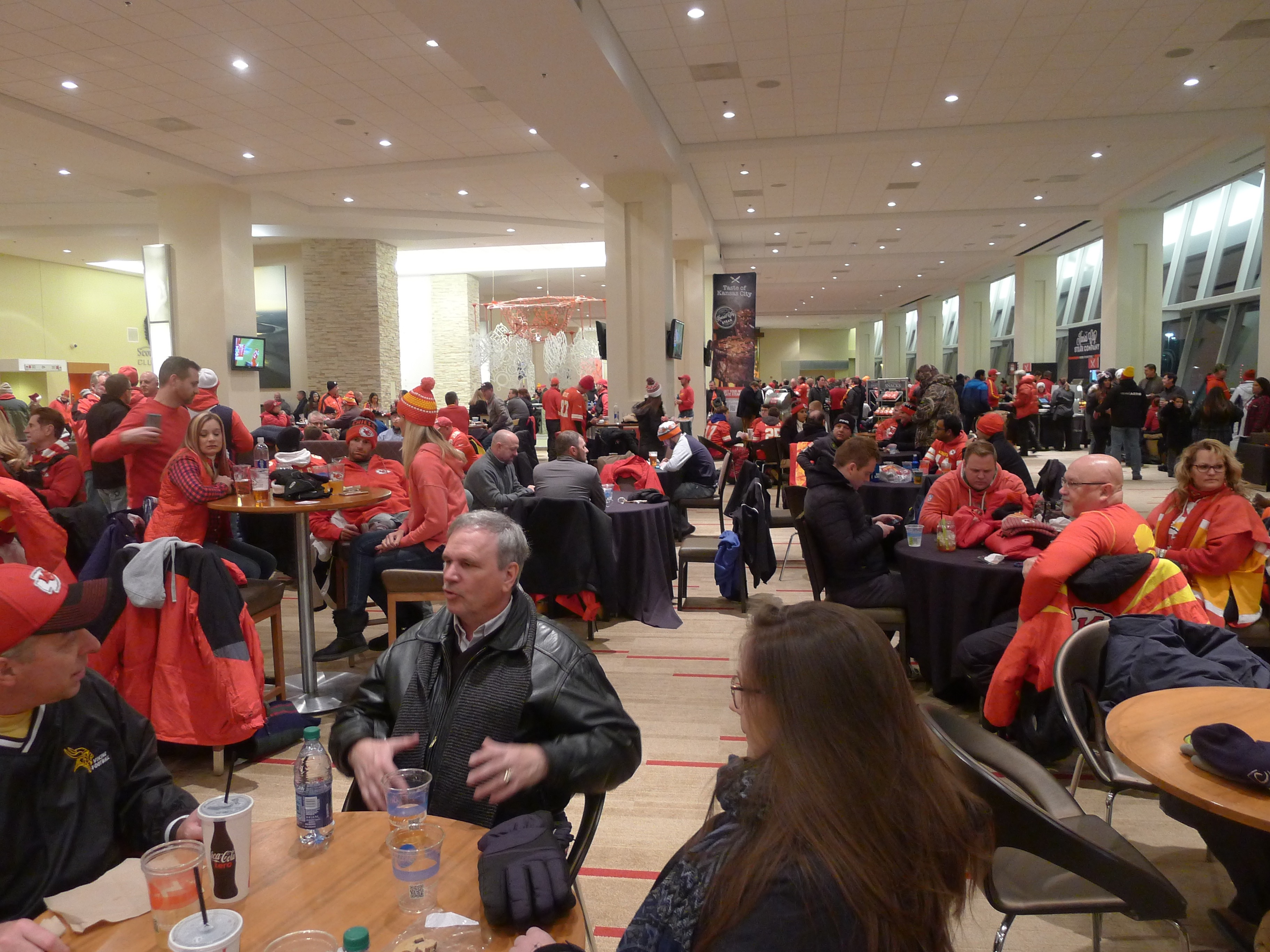
In from the cold.

fur-coat

Not sure what the deal was with these two bros.

me-1

That’s Jack Foster (left), me and our host, David Fowler.

para-commando

Three para commandos dropped in before the game.

game-shot

Second-half action…the Chiefs with the ball.

wolf-man

Next to me for part of the game was a guy I dubbed Wolf Man (see hat). This was one of the few times he didn’t have drinks in both hands. He was a mighty friendly fellow…Why, after the Chiefs scored one first-half touchdown, he put one arm under my left armpit and about lifted me off the ground.