Feeds:
Posts
Comments

Although my grandfather on my father’s side was a tobacco man by trade — he had his own company in later years and sold to countries in Africa and elsewhere — he was a terrific letter writer.

My father inherited the letter-writing gene from him, and between the two of them, it amounted to something of a sacred trust. Letters were not only to be written but also to be preserved. Many of my grandfather’s letters — and some of my father’s — have been preserved. My grandfather, Joseph W. Fitzpatrick, who was born in New York City and later a resident of Louisville, KY, wrote regularly to his five children. My grandmother, Henriette Lloveras Fitzpatrick, also wrote a lot of letters.

I learned recently from my aunt, Nanette Eckert  the only surviving offspring of Joseph and Henriette — that when my grandfather wrote a letter to one child, he would make four carbon copies and send them to the other children. That practice ensured a panoramic flow of information.

Recently, one of my cousins, Josephine (Josie) Fitzpatrick, who lives in Barcelona, sent me electronic files of a passel of letters, many of which were addressed to her father, Joseph Lloveras Fitzpatrick, who died at age 89 last June. (I was lucky enough to spend a few days with him a month earlier, when I was in Louisville for the Kentucky Derby.)
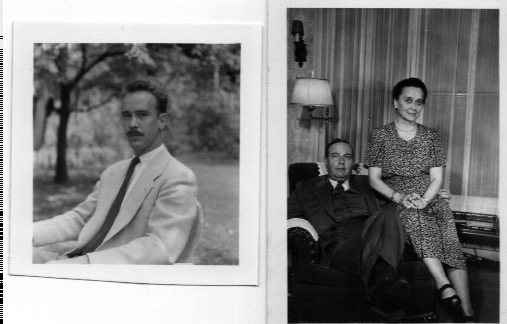
Joey, Mimi, Poppy

My Uncle Joey as a dashing young man and my paternal grandparents, Joseph and Henriette Fitzpatrick.

The letters, typewritten and dating mostly to the early 1940s, are a window into the joys, concerns and daily developments in the lives of the Fitzpatrick family. I think you’ll be interested in some excerpts. The letters I will quote from were written by my grandfather and grandmother to my Uncle Joey, who, at the time, was in the Army Air Corps. He went on to become an outstanding artist and taught art at the college level for many years.

My Uncle Joey was more unpredictable and spontaneous than his two brothers and two sisters. In 1958, for example, he and his girlfriend up and went to New York, where they were married, then traveled to Israel, where they stayed for more than a year.

In the letters, you will see that my grandparents encouraged him and, at the same time, tried to drum personal responsibility into him.

**

Feb. 15, 1944, from my grandfather

“You did not tell us anything about your hours of rising and retiring, also recreation. Would be interested to learn, also, how you are standing the strain of regular exercise and discipline. You are going to find it rather tough, I imagine, but if you go with the tide, instead of trying to buck it, you will get along alright.”

Jan. 28, 1946, from my grandmother…

“Much love to you, dear Joey, from everyone here, which means Daddy, Marie, Bobby (my father), Nanette, Johnny and “Quisette” (the family dog). Aren’t you lucky to have so many people thinking of you? Think of the poor kids who have no one to love them, who never get any letters or anything — it is good to feel that someone is with you in thought, praying for you, is it not? God bless you always. Affectionately yours, Mother.”

Feb. 7, 1946, from my grandmother

“Why on earth did you not telegraph soon after your arrival at Mather Field — even a card or something?????????”

“Since you do not mind at all, I shall write down the words you have mis-spelled in your last letter, with the correct spelling, and I know it will help you to improve…”

Feb. 19, 1946, from my grandmother

“You write you only have left camp once, and went to San Rafael (CA), and so have little news to give us, yet you do not say anything about San Rafael. It would be interesting to know what it is like and whether you like the place or not — and what is there to see or do.”

“Now, do try to be careful with your spelling, Joey. Study some of the corrections I am enclosing. You have a good memory and certainly next time you use these words you will remember how to spell them correctly…I know you do not mind my saying this, being your mother, and it is for your own good, after all.”

March 10, 1946, from my grandfather

“My congratulations on your typing, and I wish I could also compliment you on your spelling. You may not realize it, but it is not improving at all. Even in the case of simple words, as for example “recent,” but spelled in two of your letters as “recient.” I don’t know how you are going to overcome this defect in your writing, but if I remember correctly we sent you a pocket dictionary some time back. I know it is very bothersome when writing to stop to look up the spelling of a word, but I am sure if you do so whenever you are in doubt, you will find within a comparatively short time that your spelling will improve greatly.

“Now for the news. The big event was the arrival Monday at 3:30 A.M. of James Carey Fitzpatrick at St. Joseph’s, where Mary Louise (my mother) and he are getting along very well. At first Bobby (my father) was very disappointed with the looks of his offspring, but yesterday he began to realize that after all, his heir is ‘a very nice looking little fellow.’ “

(Editor’s notes: 1. There’s a saying in journalism when a writer fails to put the most important development first, that the writer “buried the lead.” Well, modesty aside, my grandfather buried the lead in putting his concerns about my uncle’s spelling before the birth of his second grandchild — ME! 2. I’m shocked and appalled to learn my father was initially disappointed in my looks. Wisely, he never told me about his initial assessment.)

March 23, 1946, from my grandfather

“Dear, Joey: Congratulations on your well expressed and typed letter of the 13th, your spelling, and also your unusual promptness in replying to mine of the 10th. Just shows what a man can do when he is put to the test. Keep up the good work, including the use of a dictionary — or did you use one when you were writing?”

**

After reading these letters, I was feeling a bit sorry for my Uncle Joey for the relentless flogging he took about his spelling. Oddly, in all the writings of his that I saw, I don’t remember a single “mis-spelled” word. Like his father and my father, he was an excellent writer, which means, I suppose, the badgering produced results. Also, I’m sure Uncle Joey — a laid-back sort — took the chiding in good humor, accepting his mother’s assurance, “It is for your own good.”


Reading today’s Kansas City Star, I couldn’t help drawing a contrast between people who were the subjects of articles in different sections of the paper.

One story, by sports columnist Vahe Gregorian — perhaps The Star’s most sensitive writer — was about the sister of former Chiefs’ star Otis Taylor, who is in an enervated state, unable to speak or take sustenance on his own.

The concussions and repeated brain jarring from football have stripped him, at 73, of his ability to participate in the collective consciousness of the life and world around him. But he has a lifeline, someone who makes his existence as tolerable as possible. That person is his sister, Florence Odell Taylor, a licensed vocational nurse who is caring for Otis.

As Gregorian reports, Odell Taylor formerly lived in Houston, where she tended to her mother before she died of Alzheimers. Then, about 10 years ago, she left Houston and came to Raytown to care for Otis, who was already deteriorating badly. Here’s how Gregorian described Odell Taylor’s solicitousness toward her brother.

“She just about literally hasn’t left her brother’s side since (arriving 10 years ago). As you read these words, she is next to him or feeding him or bathing him or turning him in his bed or cutting his hair or rubbing his feet or dressing him or otherwise ministering to him.”

According to Gregorian, when Odell sleeps, it’s in a chair beside Otis’ bed.

Before reading the entire story, I was looking for a photo of Odell. There was none, and my first thought was that The Star had blown it and not bothered to get a photo.

But, no, that’s not the case. Odell wouldn’t even consent to an interview. Gregorian didn’t explain why, but it’s very probable she didn’t want any attention bathed on herself. Her focus is on her brother — a brother who just so happens to be one of the most popular players ever to don a Chiefs uniform.

Most of us, when we think of Otis Taylor, picture him in that slow-motion recording from Super Bowl IV…Len Dawson hits him with a short sideline pass; Taylor catches the ball at the Minnesota Vikings’ 41-yard line; breaks a tackle; races powerfully and gracefully down the sideline; jukes another defender and glides into the end zone, sealing the AFL’s first victory over the NFL.

otis

One of the most memorable plays in Kansas City Chiefs’ history — Otis Taylor breaking a tackle attempt by Vikings’ cornerback Earsell Mackbee in Super Bowl IV on Jan. 11, 1970.

I think that’s the memory that Odell Taylor does not want to impinge on. She does not want it disturbed.

…Then, there’s another notable story in today’s paper. It’s the lead editorial, on Page 18A, accompanied by a photo of a man named Scott Tucker. In the photo, Tucker is wearing sunglasses and a race-car driver’s suit. He’s obviously at some sort of race. He’s writing on a legal pad, and people are gathered around him. Even though he’s not smiling, it’s an image of a guy living the good life. Good looks. Prosperity. At least brushing with fame.

tucker

Scott Tucker

But, in fact, Scott Tucker is just a turd. A con man who made millions at the expense of poor people all around the country and then spent lavishly on his own comforts and indulgences.

Tucker, who lives in the Kansas City area, was indicted last week, along with two fellow “businessmen,” on charges of bilking 4.5 million people in a vast payday-lending scheme that Tucker started back in the mid- to late-1990s. He and his co-defendants and some others — including at least three men from prominent Catholic families in Visitation Catholic Parish — operated in the shadows for years and enriched themselves, often by finagling and raiding the bank accounts of people who never even requested loans.

Some of these guys, like Tim Coppinger and Frampton T. Rowland III (how’s that for a name implying “distinguished gentleman”?), used some of their ill-gotten millions to make significant contributions toward construction of a new chapel at St. Ann’s Catholic Church in Prairie Village. Their generosity must have impressed at least some parishioners who didn’t know the score.

I hope indictments soon follow for Coppinger, Rowland and others involved in this cynical undertaking.

…During my many years in the newspaper business, I’d often people whine, “Why don’t they report some good news?” (So as not be be offensive, people usually didn’t frame the question in the second person singular.)

Well, today The Star reported some very good news on two fronts. First, that the government has closed in on some disgusting, self-enriching con men and, second, that we are blessed to have in our midst people like Odell Taylor who dedicate themselves to service for others and do so without seeking a sliver of attention or credit.

As far as I’m concerned it’s a great day in Kansas City. Let’s applaud and be grateful for those who inspire us with their humility and sacrificial spirits. It is they who give us hope and show us that greed and corruption are not overwhelming.

Cuba: Round 2

Judging from the strong response to yesterday’s post, I sense a keen interest in all things Cuban.

And why shouldn’t there be, with Havana being a 37-minute flight away from Miami — and yet a world away?

No McDonald’s, no Costco, no Home Depot. The equivalent, in a way, of our Old West, with its saloons, general stores, hotels and blacksmith shops. One big difference, though, is no one is walking around with a gun on his hip, or in his pocket. In Cuba, the government’s got all the guns. That’s not necessarily good, but it sure makes for safe streets.

Anyway, I got a lot of good photos during our 9-day stay, and I didn’t have room yesterday for all those I really liked. So saddle up and get ready for a second pass…

P1050614

When you arrive at Jose Marti International Airport, there are no jetways; you walk down the steps of the plane and into the terminal. Immediately, you make connection with the ground of a new country.

P1050841

For seven days, our tour guide Roberto and our driver Paqui were our almost-constant companions. Roberto has a brother who lives in the U.S., and his mother is planning to visit Miami this month. Most members of our tour group got the feeling Roberto would be visiting in the near future.

P1050827

Our group of 10 with Kansas City connections was joined by several people from other parts of the country, including Rima (left), a social worker from Brooklyn, and her mother Susan, a family-advocate attorney in Woodstock, NY.

P1050833

…and Bill, a retired Navy and commercial airline pilot from San Diego.

P1050893

Four of us stayed over two days to see more of Havana and environs. I took this last Sunday, when we spent part of the morning and early afternoon on a windswept beach at Guanabo, a town about 12 miles east of Havana…That’s Patty on the right; Martha next to her, and Martha’s sister, Jane, who lives in New Mexico.

P1050662

During the formal tour, musical groups entertained us at many lunches and dinners. This group was the first we encountered — on our first day in Havana Vieja — and one of the best.

P1050650

Like the musicians, street performers work for tips.

P1050667

The Cuban flag added color to this street in Havana Vieja — Old Havana — the heart of the city and the main tourist district.

P1050668

In an unbelievable coincidence, we happened upon this old marble staircase — a photo of which has hung in the hallway of our home the last two or three years. I bought the photo from a local photographer who had visited and photographed Havana…I was dumbstruck after Patty came to an abrupt stop on our walk through Old Havana, pointed to the right and said, “Look!” And there it was, the same staircase.

P1050678

The Malecon, the sea wall that extends along Havana’s shore line for several miles, is a natural and popular gathering place for tourists and locals alike. From the nearby hotels, you can hear the sound of happy voices emanating from the Malecon on calm Gulf Coast nights.

P1050680

We got out into the countryside, too. These red-barked trees are facetiously called Tourist Trees because they resemble many tourists who mire themselves in all-inclusive Cuban resorts and burn their skins to a crisp at the resort swimming pools, never venturing outside the resort confines. (We stayed at one of those places two nights and saw a bunch of Canadians who did exactly that.)

P1050699

At an organic farm, we saw what rich dirt looks like.

P1050700

…and the people who work it.

P1050694

…and how they till the soil.

P1050704

Cuba used to export enormous amounts of sugarcane to Russia in exchange for oil. That came to a crashing halt after the U.S.S.R. collapsed in 1991. Sugarcane, coffee and tobacco remain are still some of the country’s largest crops. Here an organic farm worker strips a sugarcane stalk.

P1050725

Ernest Hemingway had a rich history in Cuba, of course, before committing suicide in Idaho in 1961. In 1940, he purchased Finca Vigia, or “Lookout House,” several miles outside of Havana, and he lived there off and on until his death.

P1050713

The residence, which sits on 15 acres, is now a museum. Visitors cannot go inside, but they can look through the windows.

P1050727

Hemingway’s 38-foot fishing boat Pilar — the nickname of his second wife, Pauline Pfeiffer — is on the property.

P1050767

A bustling, relatively modern town we visited in southwestern Cuba, on the Caribbean side of the island, was Cienfuegos.

P1050768

Many young people in Cienfuegos were fashionably dressed.

P1050770

This fabric store was doing a brisk business.

P1050794

Fifty miles southeast of Cienfuegos is Trinidad, a charming town with cobblestone streets and a lively street life.

P1050783

The busiest place in town was the Telepunto store, where people were lined up, presumably to buy phone-time cards.

P1050784

The Trinidad Post Office.

P1050802

This guy wasn’t begging, but I gave him a Cuban 25-cent piece in exchange for this photo.

P1050811

And wasn’t it inevitable that we would run into a Royals fan somewhere in Cuba? Cubans’ favorite Royal, naturally, is Kendrys Morales, a native of Cuba, who escaped the country on a raft in June 2004. Cuba’s loss was our gain. Opening day is less than two months away!


When we landed in Miami Monday afternoon after nine days in Cuba, one of the first things that popped up on Patty’s phone was the score from Sunday’s Super Bowl game. That was the first we had heard of the result. And that’s a reflection of how different a world we had been in, even though Cuba is just a puddle jump away from the U.S. by plane.

We had talked and dreamed for nearly two years about going to Cuba, and it more than lived up to our expectations.

On the one hand, Cuba is a place of charm, beauty and energetic, resourceful people. On the other, it’s a place of crumbling infrastructure, abject poverty and totalitarian government that keeps the populace firmly under its heel. In any event, it’s an eye-opening, enthralling place to visit.

For the first seven days we were on an organized, educational tour operated by a company called Cuba Explorer and sanctioned by the U.S. government. The sanctioning meant we had visas — good for 30 days — and health certificates that qualified us for hospital treatment had any of us experienced a medical emergency. (Fortunately, we all stayed healthy.)

The organized tour consisted of 19 people, including 10 in our immediate group and nine other Americans from various places. The tour took us to Cienfuegos and Trinidad in southwestern Cuba (see map), as well as Havana. At the end of the tour, four of us — Patty and I and a good friend of ours and her sister — stayed on for two more days to explore Havana on our own. The sisters are conversant in Spanish, which helped immensely.

cuba map

By category, and with accompanying photos, here are some of the highlights of our trip…

The Car is King

Everyone has heard, of course, how the Cubans are able to keep their old, mostly American-made cars chugging along. Some have been restored and are in excellent condition, but many are rattletraps that are nursed along through ingenuity and jerry-rigged equipment. Car ownership bestows status in Cuba. That’s because they are big revenue producers. In addition to official state-operated cab services and private taxis, some car owners use their vehicles as informal, communal taxis, known as almendrones. Standing curbside with hands extended, people flag down these vehicles, quickly discuss destinations and rates and either jump in or send the driver on his way. (I saw very few women drivers.) Often, several people going to different places ride in the same vehicle…It’s a cheap and efficient way to go, and we never worried about our safety. For the first few days, we took private taxis, but on our last full day, Sunday, we twice flagged down almendrones, getting cheap rides and cheap thrills.

People who give rides — whether in official taxis, tourist taxis or almendrones — earn much more money than the average, government-paid Cuban worker, including doctors. Other high earners are those in the hospitality industry, like musicians, waiters, bellmen and tour guides — basically anyone who works for tips. From the looks of things, even the banos attendants, who are just about everywhere, take in more money than doctors, who reportedly make about $50 a month. (They’re also leaving Cuba, understandably, in droves.)

P1050949

This is the way many people arrange rides — quick conversations with drivers of communal cabs, called almendrones.

P1050954

And while there are a lot of restored classic cars, you see more of this variety…These guys were replacing a muffler and tail pipe.

P1050730

One night, our entire group of 10 got a ride into Havana Vieja (Old Havana) in this tourist taxi. Our driver was Jose.

P1050747

The cab seated eight people on two bench seats in the back and two people up front.

P1050746

Truly a beauty, that car.

Money

There are two types of currency in Cuba: the one the residents use, the national peso, and the one that tourists use — the Cuban Convertible peso, C.U.C., phonetically referred to as “kooks.” The ratio is about 25 national pesos to one kook.

And while the kook is essentially the equivalent of the U.S. dollar, Americans get outrageously hosed when exchanging dollars for kooks. Right off the top, the government takes a 10 percent surcharge, compliments of Raul and Fidel, I’m sure. Then there’s an exchange fee of three to four percent, which means every kook is actually worth about 86 or 87 cents.

The best way to go, like I did, is to exchange dollars for Euros before leaving the States and then exchange the Euros for kooks in Cuba. Euros and other foreign currency are not subject to the surcharge, so you’re gaining 10 cents on every dollar.


P1050636

Fifty C.U.C., or 50 “kooks.”

Accommodations and (in)conveniences

If you let TripAdvisor hotel reviews be your guide, you’d never go to Cuba. That’s because the hotels are government owned and not up to American standards. The beds are narrow, so make sure you get a room with two beds, and the plumbing is unreliable. For example, the toilet paper doesn’t go in the toilets but in trash receptacles next to them. There are no wash cloths, either, so bring your own, if you absolutely need them. (At one point, I converted my eyeglass-cleaning rag into a wash cloth.)

It’s amazing, though, how fast you adjust to the conditions if you just relax, focus on having fun and making do with what you’ve got.

Oh, and because Cuba has a monumental trash problem (no regular pickup, as far as I could tell), the banos in restaurants and bars are not equipped with paper towels or hand towels, and most of the automatic dryers don’t work. Usually, you find yourself shaking off your hands and letting evaporation do the job. In many cases, hand soap is not available, either…But, like I said, you adjust.

P1050684

Our first hotel was the Copacabana — “the hottest place north of Havana,” as the great Barry Manilow song goes.

P1050624

From our room, we had a view of the Russian embassy — a structure whose tower resembles a sword handle.

P1050630

The hotel wasn’t the greatest, but it offered a beautiful view of the Gulf of Mexico.

P1050958

We spent one night at the Hotel Presidente, about a 10-minute drive from Old Havana.

P1050853

From our room there, we could see the waves crashing against the Malecon — the sea wall — one morning when the wind was high and the sea rough.

Food and Drink

I had my fill of black beans and rice by Day 3. I like black beans and rice, but after two or three consecutive lunches and dinners featuring them, I swore off. I also got tired of the main meat dishes — pork, beef, chicken and lamb. Last Sunday, a driver we had hired for several hours took us to an Italian restaurant where the pizza ranked right up there with Minsky’s. A day earlier, we found — thanks to a recent New York Times travel story — a restaurant that had American-style food, including hamburgers. Although it didn’t particularly look like American hamburger — it was cured, we believed — it was close enough for satisfaction…And by the way, I really liked the Cuban Kola (in photo below); it rivals Coke and Pepsi, in my opinion.

P1050860

I made the mistake of ordering a “super hamburguesa” instead of a regular. I ate one and a half of the three patties and later tossed the rest to a dog on the street.

P1050881

I gave up alcohol about 35 years ago, but this bottle of Cuban rum sure was alluring.

P1050818

At a national park north of Trinidad, on the southern coast, we bought some honey and nut bars that tasted like a combination of peanut brittle and granola bar.

Dancing and Entertainment

On one of our first nights in Havana, we attended a cabaret-type show at the Hotel Nacional, the most prominent building along the sea front. I wasn’t expecting much from the show, but it turned out to be thoroughly entertaining. For me, the highlight was a conga-drum player who won the crowd over as much with his radiant smile and crowd interaction as with his lightning-fast tapping and slapping on the drums.

…Salsa dancing in Cuba is something to behold. Last Sunday, we went to one of two Casa de la Musica establishments in Havana. About 45 minutes before a live band performed, people began dancing to loud, thumping recorded music…I don’t know how these women do it — whether they learn it from formal instruction or it’s in the genes — but they way many of them swish their torsos and roll their hips is spell binding. Many men are great dancers, too; their moves are just more subtle.

P1050754

Hotel Nacional de Cuba

P1050693

A cabaret show at the Hotel Nacional.

P1050915

Above and below…Salsa dancing at Casa de la Musica.

P1050916

**

I could write a lot more and show you many more photos, but even electronic space should not be abused. So, I leave you with this…If you haven’t been to Cuba, try to go. And try to go soon. With American dollars and tourists pouring into the country, it’s going to change. It’s hard to say how long this lost-in-time country will boast the eclectic, authentic flavor it has right now. Maybe five years, maybe 10, maybe more. But the influx of money is bound to bring significant change. While the future is uncertain, for now all is Muy Bien!

P1050618

P1050628

Our group — minus the blogger who had been occupying the empty chair.

Super Bowl frenzy isn’t quite upon us yet, but anticipation is building, and even I am fascinated by the pending match-up between the old sheriff, Peyton Manning, and the young gunslinger, Cam Newton.

I say “even I” because if you’ve been reading this blog a while, you know I have said that I’m through with pro football because of the high incidence of long-term brain injury.

But I’ve found it’s one thing to declare independence from the NFL elixir and another thing to actually set it aside. First, it was impossible to ignore the Chiefs reeling off 10 wins in a row and winning their first playoff game in many years. And then came the match-up between good and evil — Manning on one hand and Tom Brady and Bill Belichik on the other. I watched most of the fourth quarter of that game and was riveted, fearing right up to the Patriots’ unsuccessful two-point conversion attempt that evil would once again prevail.

So, for the last couple of weeks, I found myself back in the quicksand I thought I’d escaped.

But then today, on the front page of The New York Times website, the side of pro football that makes me recoil surfaced again.

It is a heartbreaking story about a 27-year-old former player for the New York Giants, Tyler Sash, who died of an accidental drug overdose at his Iowa home last September.

Sportswriter Bill Pennington recounted Sash suffering “bouts of confusion, memory loss and minor fits of temper” after his playing days. And how he was “unable to seek meaningful employment because he had difficulty focusing long enough to finish a job.”

And then the gut punch…

Last week, representatives from Boston University and the Concussion Legacy Foundation notified the Sash family that C.T.E. (chronic traumatic encephalopathy) had been diagnosed in Tyler’s brain and that the disease…had advanced to a stage rarely seen in someone his age.

Twenty-seven…

Think about that. He was on the very front end of adulthood — a year older than my son Charlie, who is on the way to getting a master’s degree this year — and his brain was well on the way to mush.

Sash had been cut by the Giants in 2013 after suffering at least his fifth concussion. Listen to this description of a concussion he suffered in a 2011 playoff game with the San Francisco 49ers:

“Sash, who was 215 pounds, was blindsided by a brutal and borderline late hit on a punt return by a 281-pound defensive lineman.”

Can you imagine? Even if there had been a mattress between him and the other guy, his brain would have rattled around inside his head and helmet.

sash

Tyler Sash

When Sash got back to Iowa, “he increasingly displayed surprising and irregular behavior,” Pennington wrote. He was arrested for public intoxication after fleeing from police on a motorized scooter and then running into a wooded area.

Plus, he was in unrelenting pain from football injuries to both shoulders. His mother, Barnetta Sash, told Pennington her son couldn’t sleep on either side and would sometimes go two days without sleeping. She said he realized something was wrong with his brain but couldn’t identify it

You can feel a mother’s aching pain in this quote: “He was such a good person, and it’s sad that he struggled so with this — not knowing where to go with it.”

At 27, he was hopelessly lost in a fog of confusion and pain.

…I can relate somewhat to the fog part. In 2002, I suffered an inner-ear concussion after a quack of an oral surgeon did some “tapping” on an upper left tooth bone as the first step in an implant.

It took a few months and a visit to an otologist — a doctor who specializes in ear problems — to just get an accurate diagnosis. Then, I was in a fog for more than a year. Not knowing if I would ever get better, I sank into clinical depression. Fortunately, with time and treatment the fog and depression passed. But I still tend to relate things to whether they happened prior to or after June 2002, a seminal month in my life.

So, my heart goes out to the Sash family. And it doesn’t surprise me a bit that Tyler’s mother has a different view of football than she did several years ago. And that his older brother Josh probably won’t recommend that his two young sons play football when they’re older.

Particularly at the pro level, football is a nasty business. To me, it’s the ultimate incongruity: how a sport so destructive can be so intoxicating. If Sunday football went away, millions of fans would be absolutely lost.

And, yes, I admit, I’m having trouble putting aside the Kool-Aid. But I’m well into the weaning. The stars I’m familiar with, like Manning and Brady, are nearing the end of their careers. And where I used to know just about every starter for the Chiefs on offense and defense, I’m now familiar with the names of just a handful of players.

Like I said, I’m mildly interested in the Super Bowl. But, alas, I’ll be out of the country and won’t be watching a week from Sunday. It’s just as well. At game time, I’ll try to think about Tyler Sash and how his mother would still be enjoying his company if he’d never started playing football.

Maybe you’ve heard about this movie the Walt Disney Co. has out. It’s called Star Wars: The Force Awakens.

Seems like it’s doing pretty well at the box office.

Did I see it? No.

Why? Well, for one thing, I just never turned my attention to any of the Star Wars movies, so I had no particular reason to go to the new one. But more important…I don’t give a shit about the Walt Disney Co.

Let me tell you three reasons I loathe the company:

Eisner

Michael Eisner

First, my longtime employer, The Kansas City Star, was owned by Disney for a forgettable year, straddling 1996 and 1997. After the purchase, then-CEO Michael Eisner came into The Star’s newsroom and said Disney had no plans to sell The Star and three other dailies it had obtained as part of its purchase of ABC/CapCities.

A year later, all four papers were up for sale.

Second, during the time Disney owned The Star, Eisner got rid of his second in command, a former talent agent named Michael Ovitz, and gave him a severance package valued at $38 million in cash and an estimated $100 million in stock.

Third, about a year ago, Disney fired more than 200 American IT workers at Walt Disney World after forcing the workers to train foreign workers, certainly with lower salaries, to replace them.

On Monday, two of those dismissed workers, Leo Parrero, 42, and Dena Moore, 53, sued Disney and two global consulting companies that brought in the foreign workers who replaced them. Parrero and Moore contend the companies colluded to break the law by using temporary H-1B visas to bring in immigrant workers, planning all the while to replace the American workers. In the New York Times story reporting the lawsuit, Moore was quoted as saying Disney was “just doing things to save a buck, and it’s making Americans poor.”

The separate but similar Perrero and Moore lawsuits seek class-action status, meaning many of the other fired Americans could potentially gain standing. By late Monday, The Times’ story had drawn more than 650 reader comments, including this one posted by Jack Meoph of Santa Barbara, CA:

H-1B has been exploited by corporations since it’s inception to displace American workers. There is no lack of experienced workers, just a complete lack of morals by the corporations who have used this dodge to bring over cheap labor. There are seminars dedicated to the H-1B dodge/scam. If I hadn’t promised my granddaughter that I would take her to Disneyland this year, I would never go again. The Mouse has become an evil empire, and Walt spins in his grave.

Dena Moore told The Times she has 13 grandchildren and that one of the perks that went away with her job were passes that allowed her to take them to Disney World at no cost.

I remember that, too. It seemed like we had the world by the tail when Patty and I took Brooks and Charlie to Disney World on passes when they were about 9 and 8 years old respectively. (I particularly remember buying Charlie a stuffed replica of the python character Kaa and then watching the two kids rip stitching from Kaa’s jaw as they engaged in a bitter tug of war minutes after we left the park.)

Iger

Robert Iger

I tell you, though, that feeling of getting a sweet deal passed quickly after Eisner dumped The Star. Just as current CEO Robert Iger knew he was going to fire those American workers once he had them dig their own graves (training their successors), so Eisner knew when he entered The Star’s the newsroom all those years ago he was going to sell the paper, even while his lips were saying, “No, we don’t buy properties to sell them.”

No, I won’t be going to see Star Wars or any other Disney movie that comes along. And I hope Mr. Parrero and Ms. Moore are successful in getting a class-action suit established and that all the dismissed American workers get big, fat judgments for the hosing the company gave them.

Often when you see the word “forgiveness” in the title of a newspaper story profiling someone, you know that somewhere along the line the person being written about made some significant mistakes or committed some terrible deeds.

Such is the case with Lamar Hunt Jr., 59-year-old son of the founder of the American Football League and the Dallas Texans/Kansas City Chiefs.

Like almost everyone else in the Kansas City area, I greatly admired Hunt Sr. and appreciate what he did for Kansas City. I also got to meet him and spend an afternoon with him at Arrowhead Stadium in the course of writing a story about him.

I never knew a lot about his family background, however, and during the 35-plus years I was with The Star, the paper never delved deeply into his personal or family life. And that, typically, is the way The Star covers most high-profile people — keeping the emphasis on whatever dimension of people has made them extraordinary.

But in today’s profile of Hunt Jr., who owns the Missouri Mavericks hockey team, The Star was obliged to dabble in the messiest part of his life. And that was, as The Star adroitly phrased it, “a sexual encounter he had with a sister-in-law” many years ago.

I’ve got to tell you, that line really took me by surprise and had me riveted to the ensuing paragraphs.

The writer, Eric Adler, who has been at the paper about 30 years, went on to relate the gist of the sordid situation, saying…

— that Hunt “doesn’t deny the encounter”

— that he and his then-wife Jocelyn, with whom he had seven children, split up

— that his action became “the crux of a lawsuit”

— and that the case ended in a settlement “for undisclosed millions of dollars.”

Whew! There’s a lot there, but, damn, it sure raises a lot of questions, doesn’t it?

Adler so underplayed the matter — and, again, I understand why he and his editors handled it that way — that it would provoke almost anyone with a grain of curiosity to want to learn more.

And, so, for those of you either didn’t read the story or who read the story but didn’t act on your curiosity, I’m here to tell you the other key elements, which a Google search quickly revealed.

Lamar Hunt Jr.

Lamar Hunt Jr., owner of the Missouri Mavericks

First: “sister-in-law.” Hmmm, I wondered when I first read the story, would that possibly be the spouse of a brother or sister?

Oh, no. Hunt Jr. lurched into the most dangerous of territory — having sex with his wife’s sister.

Second: “a sexual encounter.” Hmmm, I wondered…really, just once?

Well, no. A 1999 Associated Press story that appeared in the Lubbock (Texas) Avalanche-Journal said the verboten deeds occurred “on consecutive nights.” It doesn’t say how many nights, but certainly more than one.

And then the shocker: His sister-in-law had significant mental disabilities.

Oh, my…And not only did Hunt not deny the encounters, it turns out he also wrote a letter — cited in the lawsuit — to Jocelyn titled “Confessions of a Sex Addict.”

In May 2000, an Associated Press story quoted a Dallas Morning News story that said the case was settled for about $2 million.

Now, The Star’s story focuses, as it should, on Hunt’s redemption and his return to the role of solid citizen: For example, Adler writes about how Hunt’s faith in God helped him cope and how he went on to what appears to be a successful second marriage.

…Let me assure you, I don’t put forth this information out of prurient interest. I’m just a news hound who sometimes senses there’s more to a story than meets the eye, and my deeply instilled journalistic curiosity often compels me to dig deeper. I want to know the full story — whether it’s political, criminal, sexual or whatever else in nature — even though the newspaper has no particular obligation to satisfy that curiosity in a story like the one on Lamar Hunt Jr.

But I think a lot of readers share my instinct and want to know the full story, too. So, for today, there it is.

Three good developments and a somber one to report today:

** Congratulations to Councilwoman Teresa Loar for taking the lead in generating a bold, far-reaching and fairly economical proposal for renovating at least one of the existing three KCI terminals.

The Star’s City Hall reporter, Lynn Horsley, laid it all out in a long front-page story today. It’s a must read.

Loar

Teresa Loar

Loar, a Northland resident, has been active on airport matters in two stints on the City Council — the current one and one from 1995-2003. As a member of the council’s Aviation Committee — and also as a smart politician who recognizes widespread voter resistance to tearing down the three terminals and building a new single one — she recruited a local engineering firm to develop a new plan that would retain much of the convenience of the existing airport.

What Crawford Architects came up with, in conjunction with several engineering and aviation firms, is a proposal to double the width of Terminal A to provide more space for ticketing, retail and baggage return. The plan also would reduce the number of security checkpoints from four to two, and more parking levels would be added.

Crawford estimates the expansion and renovation to cost about $336 million — about a third of the estimated cost of building a new single terminal. If demand and customer growth was sufficient, a second terminal could be renovated in similar manner and at roughly the same cost, not considering inflation.

The city’s airport consultants will review the proposal and cost estimates and get back to the council next month.

If the numbers hold up, this could be the compromise that breaks the stand-off. As you know, I’m a strong advocate for a new single terminal. I say it’s time to get rid of the circular terminals and get a new single terminal with straight-line concourses that stretch out from the terminal hub. Like many people, I also want more retail and much better restaurant and fast-food options. At the same time, I’m a realist and understand that resistance to razing the three terminals and starting anew is probably not acceptable to a majority of Kansas City voters.

So, let’s see what the city’s consultants and Aviation Department leaders have to say after their review.

Whatever happens, we should all be grateful to Ms. Loar for spearheading an effort that could result in a modernized airport with a reasonable price tag.

** Another round of congratulations is in order for the Jackson County Legislature, which on Tuesday adopted a resolution urging the Royals to extend the safety netting at Kauffman Stadium to the far end of both dugouts. Major League Baseball is encouraging teams to extend the netting, but most teams probably will take it only to the near end — the home plate side — of the dugout.

Although the county owns the stadiums, it cannot require the Royals to extend the safety netting, but I’m very glad to see the Legislature inject itself into the situation. It wouldn’t surprise me if former Royals star Frank White, who recently succeeded Mike Sanders as county executive, pushed for the resolution. Several years ago, I heard him say on either radio or TV that whenever he attends games, he sits behind the netting.

I like to sit back there, too, but I don’t often get the chance because the Royals converted the area directly behind home plate to premium seating, with food and beverage service.

Whenever I go to games on someone else’s tickets and sit close to the field and down the first- or third-base line, it’s hard for me to relax, for fear of screaming foul balls.

It’s definitely time to take the netting much farther down the line, but it’s probably going to take a few more years — and several more seriously injured fans — for it to happen at all stadiums.

rustin

Rustin Dodd

** Another baseball-related development: Rustin Dodd, a Kansas City Star sportswriter who has been covering KU athletics, has been promoted to be the primary reporter covering the Royals. He succeeds Andy McCullough, who is going to the Los Angeles Times to cover the Dodgers. Dodd has worked his way up the ladder on The Star’s sports desk, and I expect he’ll do a great job. The Star has a history of outstanding Royals’ beat writers.

swaney

Anne Swaney

** On a bleak note, I was very sorry to learn of the violent death of Anne Swaney, a 39-year-old Chicago journalist, who grew up in Platte City and graduated from Platte County High School in 1994.

Swaney, executive producer of online operations at WLS-TV, was found floating in a river last Friday morning near a horse farm in western Belize, where she was vacationing. It appeared to be a crime of opportunity and possibly passion.

She was due to go on a group horseback riding excursion Thursday but stayed behind to do yoga because there weren’t enough horses. Her belongings were found on the dock where she was doing yoga…Police in Belize have detained a “person of interest” but have released few details. Anne was a niece of the late Evert Asjes, a former Kansas City councilman. She will be buried in Platte City.

Her obituary ran in today’s Star. Here it is.

A lot of attention has been focused recently on multi-millionaire developer Shirley Helzberg and her proposed TIF project in the Crossroads District. An upstart group, consisting largely of Kansas City School District parents, has brought the issue of public subsidies for Crossroads projects into sharp relief by waging a successful petition drive that could scuttle the project or, at the very least, put it to a public vote.

But while that project has been under the spotlight, another big Crossroads project has been sailing along under the aegis of a state-authorized agency that can dole out tax breaks without going through the traditional, local-government process. That process involves reviews by the Tax Increment Financing Commission and a City Council subcommittee and, ultimately, approval by the City Council.

The agency is called Port KC, which until last May was the Port Authority of Kansas City.

It’s an agency that, in my opinion, needs to be watched closely. 

logoPort KC — the subject of a long editorial in Sunday’s Kansas City Star — will oversee a $42 million redevelopment of the Corrigan Building at 19th and Walnut streets. Like Helzberg’s proposed project — redeveloping a vacant building for the BNIM architectural firm — the so-called “Corrigan Station” will get significant property-tax breaks. The Star editorial said taxing entities including the city, the county, the Kansas City Public Library and the Kansas City School District will lose out on $3 million in taxes they would otherwise get without tax breaks.

This should be a big concern to Kansas Citians. Not just in the redevelopment of the Corrigan building but because of what it portends down the road: A possible spate of development or redevelopment projects going through Port KC, circumventing the traditional city-approved process…Why would developers want to put themselves through the high-profile process that the Helzberg proposal has been subjected to when they could quietly work out tax-abatement deals with Port KC?

The Star’s editorial quoted Calvin Williford, a top Jackson County official, as saying that the tactic of taking tax-abatement projects through Port KC, instead of the City Council, “appears to be designed to expedite approvals and exclude public comment.”

**

You might wonder: What the hell is Port KC doing in the Crossroads?

With its name, you would think the agency’s focus would be on development around and adjacent to the Missouri River. To some extent it is, but its reach is much longer.

…Pardon a  brief digression here. My experience with the Port Authority was limited to covering its approval of a casino operation at the foot of Grand Avenue in the 1990s. Two companies, Hilton Hotels and Boyd Gaming, were battling tooth and nail for the right to build a casino at the foot of Grand. At the end of a long, tense meeting, the Port Authority gave the nod to Hilton by one vote. Later, Dan Margolies, then a reporter with the Kansas City Business Journal, exposed an indirect payoff between Hilton and Port Authority Chairman Elbert Anderson, who cast the deciding vote. Anderson was later convicted of bribing public officials to direct business to his public relations firm…By the way, the casino — now the Isle of Capri — was never built at the foot of Grand. It was built over by the I-35 bridge because officials wisely determined a casino was very unlikely to succeed in the confined space at the bottom of Grand. I remember one Port Authority member, who voted for the Boyd proposal, saying, “I’m not going to send it (the casino) down to that hole.”

In any event, as Port KC’s website says, it is granted broad governmental and economic development powers, including the ability to:

— Acquire, own, construct, redevelop, lease, maintain, and conduct land reclamation, residential development, commercial and mixed-use development, industrial parks and facilities and terminals, terminal facilities and any other type of port facility.

— Promote and expand inland and river port commercial throughput of cargo and freight.

— Identify and pursue redevelopment opportunities at blighted and historic preservation sites.

— Redevelop the Downtown Kansas City Riverfront to promote and develop new opportunities for residence, commerce and leisure.

— Promote the full integration of multi-modal transportation assets to increase commercial opportunities locally, nationally and internationally.

I believe development of the streetcar line is nominally what is allowing Port KC to get its nose under the tent in the Crossroads. The streetcar line qualifies, of course as a “multi-modal transportation asset.” For all I know, however, Port KC can operate anywhere in the city it chooses.

Like I say, this is an agency that needs to be monitored; it has the appearance of an operation that could run amok by virtue of its broad statutory power.

wolf_george

George E. Wolf

Fortunately, the city has some control over Port KC. The agency is governed by a nine-member board of commissioners, who are appointed by the mayor, with, I believe, the consent of the City Council. The current chairman is a man named George E. Wolf, a partner in the Shook, Hardy, Bacon law firm. I don’t know Wolf, but I believe he is the son of George “Ed” Wolf, who was Kansas City public works director during some of the years I covered City Hall (1985-1995).

The Star’s editorial said, “At some point, if the city decides Port KC is getting too lavish with its tax breaks, (Mayor Sly) James…should step in to try to halt it.”

The next paragraph, however, quoted James as saying he had never considered what he might do if Port KC began, in his opinion, to overreach. That’s worrisome. Of course, this is the same mayor who is 100 percent behind the BNIM project.

So, then, who’s going to be watching to see if the camel tries to get its whole body inside the Big Tent?

For all the ground that The Kansas City Star has lost in terms of print circulation in recent years, the situation is not nearly as bad as it is in St. Louis, where the Post-Dispatch has seen its Sunday circulation fall off a cliff.

Not only does The Star sell more nearly 20,000 more Sunday print editions than the Post-Dispatch, but it sells nearly an equal number of daily papers — and that in a metro area that is 40 percent smaller than its cross-state rival.

Over the last decade, the papers have strong parallels: Each was purchased by a newspaper conglomerate that was guilty of overreaching; each has lost significant print circulation; and each is in the stranglehold of corporations that are drowning in debt.

The Star, of course, is owned by McClatchy Co., Sacramento, whose debt is about $966 million, largely from paying way too much for The Star and about 20 other Knight Ridder papers in 2006.

The Post-Dispatch is owned by Lee Enterprises of Davenport, IA, which overpaid for the Post-Dispatch and Pulitzer Inc.’s 13 other daily papers in 2005. Lee Enterprises’ debt is $726 million.

Despite being on similar economic arcs, some differences are particularly disturbing from the St. Louis point of view. For example, The Post-Dispatch’s print Sunday circulation dropped 24 percent — from 249,873 to 190,881 — between March 2013 and March 2015. The Star’s fell, too, but by only 14 percent — from 244,057 to 209,947. Both papers sell about 115,000 print editions Monday through Friday — both down more than 20 percent from 2013.

To put The Star’s loss of daily print editions in perspective, in the late 1990s, when daily circulation was in the mid-200,000s, The Star launched a promotional campaign with the goal of bumping daily sales up to 300,000 a day by the year 2000. “Three hundred thousand by 2000” was the theme…But we didn’t come close, and the numbers soon started dropping, instead of rising.

Two other differences are worth noting: The Post-Dispatch’s longtime headquarters building at 900 N. Tucker Blvd. in downtown St. Louis is now up for sale, and the company-paid pension was frozen in 2010. (My understanding of a pension freeze is that the company stops contributing to employees’ pension plans; the company continues to pay what is owes retirees and what it has agreed to pay current employees when they retire, but that’s it. The faucet is turned off.)

In Kansas City, The Star building at 18th and Grand is not for sale, although it wouldn’t be surprising to see that happen. Also, as far as a I know, McClatchy is still contributing to employees’ pension plans. (My pension has not been affected, and I’ve never heard intimations that retiree pensions are in jeopardy.)

Another sign of distress at the Post-Dispatch is that for several months recently, the editorial page was down to two people, including Kevin Horrigan, a reporter at The Star in the 1970s. The good news is a new editorial page editor either has started or is starting soon, and Post-Dispatch Editor Gilbert Bailon has said the paper will return to having three editorial-page writers.

In Kansas City, by contrast, The Star has four editorial page writers: Barbara Shelly, Lewis Diuguid, Yael Abouhalkah and editorial page editor Steve Paul. That’s down one from when former editorial page editor Miriam Pepper retired in 2014.

One area in which I think the Post-Dispatch is superior to The Star is honesty and transparency with its customers. Both papers sometimes use “outsourced” editorials — purchased from a service — and while the Post-Dispatch identifies outsourced editorials, The Star does not.

In addition, Bailon, the Post-Dispatch editor, seems more forthcoming and accessible than Mike Fannin, editor of The Star. Fannin is rarely quoted publicly, and the only time I heard or saw him on a local radio or TV show last year was an interview on KCUR-FM. And then he was insipid and uninformative.

bailon

Gilbert Bailon, editor, St. Louis Post-Dispatch

In a lengthy story this week in the Gateway Journalism Review, an online publication based at Southern Illinois University, Bailon candidly addressed staff morale and the state of his newspaper.

“I think there is always some level of concern in our business because it’s changing and we’ve had things like buyouts and layoffs and cutbacks and jobs that didn’t get filled…For the most part, I think there is a resounding feeling that we are valuable. I think (coverage of) Ferguson helped with that. What we do individually matters and because of that, that helps puts the focus on the right things.”

Finally, I don’t know how the Post-Dispatch handles circulation matters, but with The Star it has been a shell game for customers:

— A change in the delivery system a few months ago resulted in many people not getting their papers

— Subscription prices have been raised with little or no notice and often without comparison to old, or current, prices

— Subscriber calls about delivery problems are routed overseas, leaving many people frustrated and disillusioned, not only with the long-range dealings but with the lack of resolution to their concerns and problems.

Along with many other Star readers and subscribers, I am hoping we’ll start seeing significant improvements on all fronts — news, opinion, circulation and advertising — with this week’s appointment of Tony Berg as publisher. Although he’s only 38, he has a lot of experience on the advertising side, which is where the revenue is. If he’s smart, Berg will open the doors and windows down at 18th and Grand and let in some sun and fresh air. That would help generate not only badly needed goodwill but also more revenue.