Feeds:
Posts
Comments

It’s not often that we here at the paragraph-stacking factory stop what we’re doing and offer you a special edition.

But today is such a day…

Julius Karash, a former Kansas City Star colleague (and still close friend) saw a recent online story in the St. Louis Post-Dispatch telling readers that the Post-Dispatch headquarters building in downtown St. Louis was being put up for sale by the paper’s owner, Lee Enterprises of Davenport, IA.

A longtime business reporter with a keen eye for development stories, Julius recognized that the Post-Dispatch situation, although 250 miles away, held intimations for Kansas City. Here’s his perspective.

***

By Julius A. Karash

     The recent news that the St. Louis Post-Dispatch downtown headquarters has gone up for sale makes me wonder how long it will be before the Kansas City Star sells its iconic headquarters building at 18th & Grand.

As much as I hate to see it happen, I think a “For Sale” sign will land on this building in the near future. Because of fewer employees due to cutbacks and technological advancements, The Star and other newspapers don’t need nearly as much space as they used to.

This trend is occurring around the country. McClatchy, the Sacramento-based owner of The Star, has sold off newspaper headquarters buildings in Miami and Fort Worth during the past several years. In North Carolina, it was reported in May that a sale was about to close on the McClatchy-owned Charlotte Observer’s building, and the McClatchy-owned Raleigh News & Observer reportedly has been exploring the sale of its downtown headquarters.

kansas-city-star1

Kansas City Star building

Other newspapers that have gone this route in recent years include The Philadelphia Inquirer and the Star Tribune in Minneapolis. It makes economic sense for newspapers to sell their grand old edifices, pocket the cash and move into space that better fits their needs in today’s slimmed-down media world.

Those wielding a sharp pencil can make a compelling case for selling The Star’s headquarters. The building that once housed more than 2,000 employees now employs several hundred. The Star could probably create office space for quite a few of those employees in its spacious printing-plant complex across McGee Street and/or move them into leased space.

At one time, The Star and Jimmy and Joe’s “The Pub” — also across McGee — were neighborhood anchors. No more. “The Pub” has been reconstituted as “The Brick,” and the 18th and Grand building is now surrounded by numerous other bars, restaurants, condos and apartments that have flooded the Crossroads, converting the area into a “happening destination” for young people looking for fun, food and a hip place to live.

The KC Downtown Streetcar, which is scheduled to start running between the River Market and Crown Center/Union Station next year, will accelerate this trend.

The super-charged pace of development in the Crossroads and Downtown makes 18th & Grand an attractive property. It’s a beautiful, historic structure, built in 1909-11 and designed by Jarvis Hunt, the famous Chicago architect who also designed Kansas City’s Union Station. The site would be a great location for a business, residences or a combination of the two.

The 18th & Grand building holds a special place in the hearts of most people who have worked there, including me. The building resounds with history and conjures up former inhabitants such as Ernest Hemingway. If you worked at 18th & Grand, you felt like you were part of that history.

I was part of that history for 21 years until I was laid off from The Star in 2008, along with many co-workers. Today, as a freelance public relations person, I subscribe to The Star seven days a week and depend on it as my primary source of local news. My clients want their news to be in The Star, and I pitch their story and column ideas to former colleagues of mine at the paper. When I drop in from time to time at 18th & Grand, it feels like visiting the home folks.

I hope The Star will continue to cover Kansas City for years to come. And when 18th & Grand is sold, I hope the building will be emblazoned with an etched plaque that says “Kansas City Star Square” — regardless of what the grand old structure may be used for next.

***

20150521_131947

Julius A. Karash is a freelance writer, editor and public relations person based in Kansas City. His work involves topics such as transportation infrastructure, real estate development, entrepreneurship and health care. His 30-plus year newspaper career included stints at the Daytona Beach News-Journal, Fort Myers News-Press, Fort Worth Star-Telegram, the Kansas City Times and Kansas City Star. He co-authored the book TWA: Kansas City’s Hometown Airline. He is a graduate of the University of Missouri School of Journalism.
I’ve written several posts about the tragic case of Brandon Ellingson, the 20-year-old Iowa man who drowned in the Lake of the Ozarks because of a Missouri Highway Patrol officer’s negligence, and I have believed from the start that no criminal charges will ever be filed in the case.

The Star’s Laura Bauer, who has exposed Water Patrol Officer Anthony Piercy’s lackadaisical effort to save Brandon, had a one-year anniversary story Saturday about Brandon’s death, and it captured the frustration of the Ellingson family.

“There’s no one holding anyone accountable,” Bauer quoted Sherry Ellingson, Brandon’s mother, as saying.

The person who has avoided accountability is Trooper Anthony Piercy, who had arrested Brandon on suspicion of boating while intoxicated. While taking Brandon to a patrol station and operating the boat recklessly, Piercy managed to eject Ellingson, who was in the water anywhere from three to five minutes before drowning with his hands cuffed behind his back.

…What the highway patrol, a country county coroner and two special prosecutors have put the Ellingsons through during the last year can best be summed up in three words: The Ozarks Shuffle.

Conveniently, Piercy’s onboard camera wasn’t working because it didn’t have a microchip. Absent video and close-up witnesses, overwhelming evidence of Piercy’s negligence is in short supply.

The hazy circumstances enabled the Highway Patrol, the county coroner and two special prosecutors to engage in what amounts to a stonewalling conspiracy.

Then, there’s the fact that Piercy, who is in his early 40s, has a relatively high profile in Morgan County, partly because he has been a member of Morgan County R-II district school board since 2012.

I hate to tell the Ellingson family this — although by now they undoubtedly have a pretty good idea — but Piercy will never face felony charges in connection with this sorry episode.

The whitewash has been well underway for a year, and all that remains is for the second special prosecutor (more about that in a minute) to announce that he found no grounds for criminal charges…I don’t know when that’s coming, but I would bet it won’t be for a few more months, to allow the case to recede a bit further into the general public’s memory.

Here are some of the main farcical elements of this debacle so far…

:: On Sept. 8, a little more than three months after the drowning, Morgan County Coroner M.B. Jones conducted “a coroner’s inquest,” presenting evidence to a jury of six Ozarkians.

:: One of the chief witnesses was Highway Patrol Cpl. Eric Stacks, the lead investigator, who knew how fast Piercy had been traveling that afternoon but didn’t tell the jury…The patrol boat’s GPS showed Piercy was traveling between 39 and 44 miles an hour just before Brandon went overboard.

stacks

Cpl. Eric Stacks


m.b. jones

M.B. Jones


:: After about eight minutes of deliberation, the jury came back with a ruling that Brandon’s death was the result of an accident.

:: Four days later, a special prosecutor, Amanda Grellner, Osage County prosecutor, said she had come to the same conclusion after investigating the case.

:: Last December, Grellner told me in a phone interview that she had reopened her investigation based on new information. She didn’t elaborate but said a witness whom she had interviewed earlier had come forward with “more thorough” information.

:: Nearly three months passed, and then, in March, Grellner said she was stepping aside because of “a conflict that developed recently.” She asked the Circuit Court judge who appointed her to name a new special prosecutor. The judge named William Seay, a former Crawford County prosecutor, to succeed Grellner.

All three of the counties involved — Morgan, Osage and Crawford — are in the Ozarks, with Morgan being southwest of Jefferson City and Osage and Crawford southeast.

Bauer, of The Star, has dutifully reported Grellner’s coming and going and Seay’s appointment as her successor. Something she has not reported, however, is why Grellner recused herself.

grellner

Amanda Grellner

On March 26, the Lake News Online, a newspaper in Camdenton, Missouri, reported that Grellner’s conflict of interest revolved around an earlier Highway Patrol investigation of Grellner’s son. The prosecutor’s son was ultimately cleared of whatever he was being investigated for, but the Highway Patrol’s Water Patrol Division apparently objected to Grellner’s involvement in the Piercy case, given the earlier investigation of her son.

That is certainly a valid objection to raise, in my opinion, and I don’t fault Grellner for recusing herself.

Where I find serious fault with Grellner, however, is for not disclosing the investigation of her son before she accepted the special-prosecution assignment.

Shouldn’t common sense have told her to apprise the judge?

Isn’t the “conflict-of-interest” issue drilled into students during law school and at every step of their careers thereafter? It’s as clearcut as a political officeholder prospectively voting on a project in which he or she has a vested interest.

But, then, like I said, it’s the Ozarks. It’s different down there, and it shouldn’t surprise anyone that after an outsider lost his life at the hands of an insider, a protective circle quickly formed and law enforcement officials fiddled and diddled for months.

The dance that the insiders have been doing for the last year — and will continue doing until the case dribbles away — is The Ozarks Shuffle. I tell you, somebody ought to put it to music.

If you’re like me, you read about Nebraska repealing the death penalty and said, “How the hell did that happen?”

It was, indeed, a head scratcher, at least on the surface.

Nebraska is one of the most conservative states in the union. You can always count on U.S. senators from Nebraska and Oklahoma, another regressive state, to take some eye-rollingly ridiculous positions.

For example, Deb Fischer, one of Nebraska’s two Republican (of course) senators, has signed the Taxpayer Protection Pledge, promising not to raise taxes on individual and businesses. I guess that means no new taxes ever.

She is also unrelentingly “pro-life” — except, of course, for those people who kill other people and should be put to death right away. (Because, you know, the Bible says that’s the way it should be.)

Also, in her 2012 campaign materials, she declared, “The EPA must be reformed and possibly eliminated.”

So, out of a state that elected a person with views like that came a successful drive to repeal the death penalty.

How did it happen, then?

The answer is rooted in a decision that Nebraska residents made 81 years ago, in 1934, when they voted overwhelmingly to switch from a bicameral (two-house), partisan state legislature to a unicameral, nonpartisan Legislature.

The state now has a 49-member Legislature whose members do not run under party labels. In that way, it is like the Kansas City, Missouri, City Council, which has 13 members, including the mayor, who also do not run under party banners. That system, by the way, is a big reason that Kansas City has had relatively good government (except for the crooks) over the years: The elected officials do not get caught up in liberal/conservative standoffs.

(In the last 50 years, our decidedly Democratic city has had at least two excellent mayors who are/were Republican — Ilus W. Davis and Richard Berkley. They might not have gotten elected with partisan municipal elections.)

Nebraska is the only state in the union that has a unicameral, nonpartisan Legislature. With 49 members, the Nebraska Legislature is also the smallest state legislature.

Nebraska has just shown the country that it is easier to get things done — to make a radical policy change — when the conservative/liberal and Republican/Democratic labels are out of the picture and when the body is nimble enough to effect a major policy change on the power of 30 votes, which is exactly the number of legislators who voted to repeal.

petey

Ricketts

Gov. Pete Ricketts, who, like other statewide officeholders, does run on a party label, said he was “appalled” (he sounded even apoplectic) at Wednesday’s override.

With the action, Nebraska became the 19th state, plus the District of Columbia, to ban the death penalty.

A front-page story in today’s New York Times said death-penalty opponents in Nebraska “were able to build a coalition that spanned the ideological spectrum by winning the support of Republican legislators who said they believed capital punishment was inefficient, expensive and out of place with their party’s values.”

ernie

Sen. Ernie Chambers

State Sen. (the legislators are called senators) Ernie Chambers of Omaha, who introduced the repeal bill, said: ‘There has been a confluence of individuals groups and circumstances that have put Nebraska on the threshold of stepping into history, on the right side of history.”

In my opinion, however, Nebraska would not have ended up on the right side of history if the “Republican legislators” The Times referred to had to run for re-election under party labels. the party leadership, including the governor, would have pilloried them. Ricketts might end up campaigning against those who voted to override, but it just won’t carry the weight that it would in a partisan situation.

In addition to its front-page story, The Times also had an editorial about the development in Nebraska. I thought the editorial was right on target when it said:

“The Nebraska vote — passed by a coalition of Republicans, Democrats and independents, many newly elected — is an acknowledgment by reasonable people of all political ideologies that capital punishment is an abhorrent and indefensible practice.”

The sentence immediately following, however, gave me pause.

It read, “If that realization can happen in the deep-red heart of America, it can happen anywhere.”

That’s a stretch. Do you see any chance of that happening in Missouri or Kansas, for example?

No way…Populated by people with entrenched, partisan philosophies, Republican majorities in the Missouri General Assembly and the Kansas Legislature wouldn’t give 10 seconds’ consideration to bills banning the death penalty.

Hell, even the Democratic governor in Missouri, rural-rooted Jay Nixon is for the death penalty! What a state…

He was five days short of his 21st birthday.

According to his Facebook page, he liked camping, and his favorite sports teams were the Chiefs and the Chicago Bulls. He read everything Stephen King wrote.

He had graduated from Blue Valley Northwest in 2012 and was finishing his junior year at Northwestern University, where he was studying electrical engineering.

And, blurring that otherwise normal and perfect picture, he suffered from clinical depression.

That was Jason Aaron Arkin, of Overland Park, who died Tuesday at a hospital in Evanston, Illinois.

I didn’t know Jason. Never heard of him until I read his obit in Saturday’s Kansas City Star.

It was one of the most painful and touching obits I’ve ever read. I’m sure many of you saw it and pored over it, as I did. It must have pierced the hearts of thousands of Kansas City area residents.

The obit was written by a former girlfriend of Jason. (See comment from Jason’s mother, Karen Arkin.)

jason arkin

Jason

When most of us look at the obit of a young person — particularly when it is accompanied by a photo of the subject smiling and looking happy — the first thing we want to know is: How did he (she) die?

Sometimes the obit gives no indication; sometimes it says, “after a brief illness…”; sometimes the tipoff is the name of the organization to which donations should be directed.

But I have never read anything like this…

Jason struggled with clinical depression and ultimately passed due to his illness. Jason was one of many young adults suffering with mental illnesses in a time when mental illness remains stigmatized and misunderstood.

…ultimately passed due to his illness.”

What a gentle, loving way to let the world know how Jason was robbed of his future and wrenched away from his parents, his sister, his three living grandparents, his aunts, uncles, cousins and friends.

One of the greatest gifts of this obit is that it probably got many readers thinking differently about depression and the toll it can take.

In the online Guest Book accompanying Jason’s obituary, one of the writers, Krystal Schmelig of Olathe, wrote:

“I was privileged to have such an amazing student in my very first 3rd grade class. Even more special were the silly, fun summers I spent with him and his sister. I admired Karen and Steve as parents and hoped that someday my own children would have hearts as big as Jason and Jennifer. They were such a special part of my life, I was honored to have them in my wedding. Jason was the sweetest ring bearer. I will hold those memories dear. Thank you, sincerely, for being advocates for the seriousness of mental health.”

The family suggested contributions to the National Alliance of Mental Illness at NAMI.org.

The obit ended with these words from the late Steve Jobs:

“Almost everything — all external expectations, all pride, all fear of embarrassment or failure — these things just fall away in the face of death, leaving only what is truly important.”

What is important to Jason’s relatives and friends are the memories of his good, short life.

For me, it’s impossible to read this obit and not project what might have been for him…He was a few years from launching into a career, probably as an electrical engineer. Maybe he would have stayed in Chicago. Maybe he would have come back to Kansas City.

But depression came along and got so bad that he not only couldn’t see a year or two ahead, he couldn’t even see tomorrow. And everything but his pain and anguish fell away.

…Dear God, be with Jason’s family and help ease their pain in these, their darkest days.

Kansas City Star Editor Mike Fannin was on KCUR’s “Central Standard” show yesterday, and the uncomfortable subject was The Star’s future.

Fannin did a reasonably good job of spotlighting the paper’s bright spots — that it remains the strongest news-gathering organization in the region and its much-diminished staff is very talented and working hard — but he shied away from specifics about the changing newspaper landscape.

At one point, for example, he referred to the newspaper industry’s decade-long, downward spiral as a “disruption.”

It is not a disruption when the industry’s advertising revenue goes from $49.4 billion in 2005 to less than half that in 2011. (And it’s still falling several percentage points a year, by the way.)

And it isn’t a disruption when your local reporting staff goes from more than 50 to less than 20. Or when the company goes from more than 2,000 employees to about 500 or 600.

No, that is called the new normal.

It was obvious from Fannin’s tentative tone and overall lack of energy in his responses to host Gina Kaufmann’s questions that he understands the new normal. (Here’s the link to that interview.) It’s just that he doesn’t particularly want to talk about it. (Reminds me of Warren Beatty’s great line in “McCabe and Mrs. Miller,” when drunk and talking about the difficulty of dealing with women, he mutters, ” “Money and pain. Pain and money…money…pain.”)

I can’t blame Fannin for not wanting to address it head on, but since it’s not a blip and not a temporary annoyance, he should.

And, in my opinion, the way he and publisher Mi-Ai Parrish should attack the situation is with energy and enthusiasm…even if they have to fake it.

You’ve heard the saying, of course, that the best defense is a good offense. Coming from a sports-reporting background, Fannin should have picked up on that by now. But he hasn’t.

At one point in yesterday’s interview, Kauffman asked him point blank, “Do you think that The Star has credibility?”

Fannin’s initial response was a meek, “Really?”

He warmed up to that absurd challenge and ended up giving a decent answer, citing the “instant credibility” that The Star got from its scoop about former Missouri House Speaker John Diehl’s “sexting” with a college intern. But Fannin should have gone ballistic and said something like: “What are you talking about? The Star has been the most powerful and influential news and editorial force in this city for the last 135 years, and I expect it to stay that way for the next 135 years.”

Hell, it might be gone in 25 years, but he should have kicked back hard, anyway; he’s got history on his side.

Alongside Fannin in his bunker mentality is Parrish, the publisher. I’ve said this before: She should be out there in the community, pushing and shoving for the paper and calling it to people’s attention every day. Past publishers, including Jim Hale and Art Brisbane, made their voices heard in civic circles, and the newspaper benefitted from their relatively high public profiles.

Under them, the paper was a sponsor, along with other big local companies, of some of the city’s major arts organizations. No longer. The Star’s name is conspicuously absent from sponsorship lists. To me, that’s frustrating and disappointing. Even though McClatchy, The Star’s owner is $1 billion in debt, I think it should encourage its papers to shell out money to attach their names to arts organizations, which are sources of community pride and beacons of optimism.

I’m told Parrish is the sort who shuns the limelight and keeps her nose to the grindstone, looking high and low for ways to generate more revenue for The Star. That’s fine, but I don’t think either she or Fannin understands that sometimes you have to invest money to make money.

Another investment The Star should make is in a marketing campaign. They haven’t had one in decades, and the newspaper’s profile has ebbed significantly. It isn’t enough to have your product out there in the market; you’ve got to promote it constantly, keep reminding people you’re still there and still relevant.

An advertising campaign might not draw tons of new digital subscriptions from the 20-to-35 set, but I bet it would get the attention of a lot of people in the 40-to-60 range…And that’s where the money is.

This whole damn thing…this standing back and watching while this great company and this once-great newspaper dwindle and shrivel is just maddening to me.

Come on, Fannin! Come on, Parrish! Come on, McClatchy! Let’s see you fight. Let’s hear you fight. Stop the damn whimpering and wound licking. Come out from your caves and make some noise!

Like the great Frank Sinatra said in his fabulous song from the movie of the same name, “Come Blow Your Horn”…

Make like a Mister Milquetoast and you’ll get shut out,
Make like a Mister Meek and you’ll get cut out,
Make like a little lamb, and wham, you’re shorn,
I tell ya, chum, it’s time to come blow your horn.

I vividly remember being enthralled by the “Tonight Show” with Johnny Carson, as I sat on a wooden chair in my family’s small kitchen/breakfast room in Louisville back in the early 1960s.

Back then, the show started about 11:30 (eastern time) and went on until 1 a.m. My parents were usually in bed, and I would tilt back on that chair, putting dimples in the linoleum floor, being transfixed by comics and singers and Johnny’s distinctive interviews with famous people.

I watched the show off and on over the years and felt a deep sense of loss when Johnny retired in 1992. But it was a relatively seamless transition to David Letterman, whose “Late Night” show then followed Carson on NBC. (After Jay Leno succeeded Carson, CBS hired Letterman and started the “Late Show.”) Although Letterman had a different style than Johnny, he was almost equally entertaining.

I’ve watched that show off and on over the years — more off than on in recent years — and now, tonight, David is doing his last Late Show with David Letterman.

On Monday, his main guest was actor Tom Hanks. Relaxed and jovial, Hanks regaled David and the TV and studio audiences with stories and jokes for 23 minutes. (You can see Hanks’ appearance here.)

On tonight’s final show, the guests will be Bill Murray and Bob Dylan.

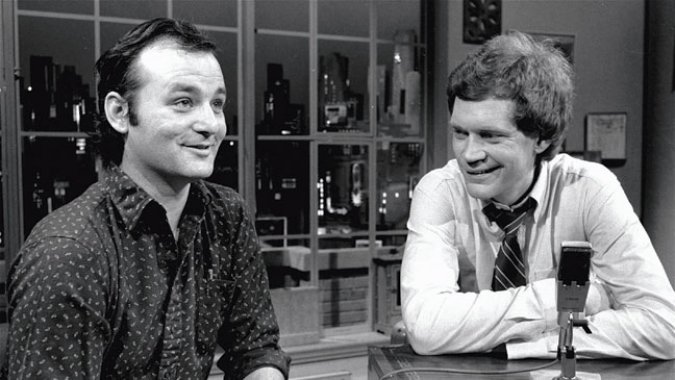
lettermurray_a

Bill Murray, on David Letterman’s first Late Show in 1982.

Last week, The New York Times had an excellent op-ed story on Letterman. It was written by Richard Zoglin, a contributing editor for Time magazine and the author of a biography about Bob Hope.

Zoglin had a perceptive take on what set Carson and Letterman apart from all other pretenders, including Leno and now the current crop of frenetic late-night hosts, like Jimmy Fallon and Conan O’Brien.

Here’s what Zoglin said about Carson’s show…

“Here was a place where show-business celebrities could drop at least some of their public persona and give us a glimpse of what they were ‘really’ like. Sure, that glimpse was always a little stage-managed — the conversational topics screened, the anecdotes carefully baked. But those nightly sessions on the ‘Tonight Show’ guest couch were a relaxed, human-scale refuge in a hype-filled showbiz world.”

Letterman continued in the same vein, Zoglin said, adding:

“(H)e took the interviews seriously. He asked real questions and actually listened to the answers. He rarely fawned, or let his guests off the hook. He poked their sensitive spots and cut through the phoniness.”

When Letterman talked to everyday people, like dog owners with their stupid pet tricks, Zoglin said, “he was naturally curious, engaged and winning.”

In other words, like Carson, he understood that the key to being interesting was to be relaxed and let his inherent talent flow naturally.

Contrast Carson and Letterman with the latter-day late nighters, Zoglin said, and you’ve got shows that are almost all “performance.”

Jimmy Fallon has turned the “Tonight Show” into a festival of YouTube-ready comedy bits — lip-syncing contests, slow-jams of the news, musical impressions, games of Pictionary and egg Russian roulette. His interviews, meanwhile, have resurrected the kind of Merv Griffin-style celebrity gush that Mr. Letterman thought he had stamped out years ago.

It’s a lousy state of affairs, if you ask me, but it mirrors much of modern life, with its “entertain-me-right-now” madness and its fixation with electronic devices that rob many of us of the power of conversation with those across from us.

Toward the end of his appearance last night, Hanks turned to Letterman and said:

“Much like your audience, on Thursday I’m pulling the plug. I’m cuttin’ the cord. I’m going off the grid. There’s no reason for that idiot box in the seven rooms of my house any longer.”

I feel the same way…Of course, the idiot box will stay. Gotta have my Royals baseball, golf tournaments, women’s college basketball, and Mystery on PBS.

But I doubt if I will watch any more than snippets of any late-night talk show ever again. Maybe, but I seriously doubt it.

One king of late-night TV is dead, and the other is walking away tonight. It’s receding into history fast, but what a half century of entertainment it has been.

Living between Ward Parkway and State Line Road, I had an up-close view yesterday of the first Cycle in the City event.

It proved, in my view, to be an event well worth the inconvenience of not being able to drive on Ward Parkway, for several hours, from Meyer Circle to Gregory. And, by the way, Gregory was open to traffic all the while, as was 63rd Street, just north of Meyer.

I’ve got a nice cruising bike with a high handlebar and comfortable seat. I don’t ride it often — just when the mood strikes, mostly — but it was ideal for Cycle in the City. I dusted it off, filled the tires with air and shortly after the official 2 p.m. start of the event, I peddled about 50 yards from my driveway to the parkway.

Of course, I had my camera around my neck, and here’s some of what I saw…

P1040905

Lots of bikes, of course…

P1040934

Many activities and games were offered, including a bean-bag toss.

P1040928

The “moon bounce” catapulted this boy into a state of ecstasy.

P1040944

Golf…without cups.

P1040896

I saw plenty of people I knew, including longtime friends G. Fred and Rosanne Wickman. (Like me, both are former KC Star employees.)

P1040897

…neighbor Henry Lane


P1040922

…our “block captain,” A.J. Miller, and her Great Dane, Rocky

P1040886

Before the event, as Kansas City Public Works and Parks Department employees were making preparations, I happened to meet Deb Ridgway, the city’s bicycle pedestrian coordinator. The event was her idea.

P1040916

Back to the action…The BMX exhibition was pretty amazing. These guys — professionals — took our breath away.

P1040918

These four boys volunteered to lie on the ground for a stunt…and one mom gave her son what could have been a final squeeze of the hand.

P1040921

Made it! The boys lived to tell about it, as did one final volunteer — one of the demonstrators, who positioned himself at the end of the row of bodies.

P1040932

But a lot of this event was simply about chatting and enjoying an afternoon on the parkway, without that annoying traffic.

P1040940

The “linchpin” of our neighborhood is Meyer Circle Fountain…I say, let’s make Cycle in the City an annual event.


From my ranch house near Meyer Circle, I swear I can hear cheering from the area of Visitation Catholic Church, more than a mile away at 51st and Main.

More faintly, I also hear the echo of whoops and hollers from the area of St. Thomas More Church at 118th and Holmes.

The reason for the spontaneous celebrations?

Archbishop Joseph Naumann, interim leader of the Kansas City-St. Joseph Diocese, announced today that he was pulling the plug on several extremely controversial priest reassignments that former Bishop Robert Finn announced shortly before Pope Francis asked for and got his resignation.

Here is the upshot of the changes, which, according to a diocesan news release, Naumann made “after prayerful deliberation and consultation with his advisors.”

:: Rev. Don Farnan, pastor at St. Thomas More, will stay on for a year instead of taking a leave of absence. Before resigning, Finn informed Farnan he would be transferred to parishes in Gallatin and Hamilton, Missouri. Farnan said he would go but only after taking a leave of absence, which, he told me, he has wanted for a long time. Farnan and Finn are far apart on the Catholic political spectrum, with Finn being ideologically rigid and Farnan being flexible and moderate.

:: Rev. Richard Rocha, a Finn ally who had previously been announced as the new pastor at St. Thomas More, will remain as diocesan director of vocations. (Rocha and Finn were so tight that a former diocesan chancellor — a layman — used to call Rocha “Finn’s wife.” Ouch!)

:: Rev. Pat Rush, who had been set to retire after several years as pastor at Visitation, will delay his retirement and remain at Visitation for a year, when the next round of priest transfers probably will be made.

:: Rev. Vincent Rogers, another Finn compatriot, who had been announced as new pastor at Visitation, will remain at St. Andrew the Apostle Church, Gladstone, where he has spent the last four and a half years.

fr_don_color

Farnan


rogers

Rogers

In a phone conversation this evening, Farnan said he was happy he would be staying at St. Thomas More but that, in the bigger picture, he had “mixed emotions” about the state of the diocese.

“People are hurting so badly,” he said. “There’s a real sense that it’s time to rebuild. A lot of repairs need to take place.”

In that vein, he said, he was picking up on Pope Francis’ goal of “repairing” the church as a whole.

Farnan said that Naumann has been encouraging diocesan priests to help him give Finn’s successor “a church that’s healthier, holier and more wholesome.”

**

The proposed reassignments had prompted volcanic-level opposition among parishioners at Visitation and St. Thomas More, two of the most prosperous parishes in the diocese.

At first, Naumann determined to stand behind Finn’s assignments. That’s understandable on the surface, because Naumann shares Finn’s conservative philosophy and obviously wanted to honor Finn’s last major action.

On the other hand, digging in on the reassignments was unwise, with Finn receding in the rearview mirror and outrage swelling among the faithful.

Reacting to today’s news, Janet Redding, a St. Thomas More parishioner, sent me a one-word email: “Hallelujah!”

In a phone conversation later, Janet, a longtime friend, said: “I personally think a lot of Father Don, both as a person and a spiritual leader. He’s just been so great for this community. I’m glad he’s going to be with us a while longer.”

She also noted that last year Farnan donated a kidney to a young man he had never met…did so because he could and it was something he felt he needed to do.

“That’s the kind of role model he is,” Janet said.

Gerard Grimaldi, a member of St. Thomas More for about 18 years, said Farnan is the perfect blend of priest and pastor.

“Father Don has a special gift for relating to all in the parish,” Grimaldi said, “from the youth to the elderly.”

At Visitation, Rush sent an email to parishioners saying he had met with Naumann — at Naumann’s request — on Wednesday.

Archbishop Naumann said that he had received many communications from parishioners, both pro and con, regarding the pastoral appointments made by Bishop Finn and, in the case of Visitation, he thought the present climate could be an obstacle to the success of Father Rogers’ leadership.

The Archbishop stated that I could still move to the apartment I have leased in Fairway and commute the two miles to Visitation.  He said there would probably be a priest-in-residence (one who works full time elsewhere but may help with some parish Masses) living in the priest residence here.

rush

Rush

A Visitation parishioner who declined to be quoted by name because he didn’t want to take sides publicly said the announced transfer of Rogers had been “very polarizing.” The parishioner applauded Naumann for reversing Finn’s most controversial reassignments, saying, “It was a prudent decision.”

As a former Catholic, a former Visitation parishioner and a longtime admirer of Don Farnan, I second that emotion.

In my view, it’s a good day for the Diocese of Kansas City-St. Joseph. It’s a positive and important first step toward mending a diocese that a rogue bishop figuratively hacked apart with a cleaver.

And it’s an even better day for the good and faithful parishioners at Visitation and St. Thomas More.

Yes, hallelujah!

News that B.B. King died last night in Las Vegas brought back some great memories from the ’70s.

When I came to Kansas City in 1969, I was in the Army Reserve and had to transfer from a Louisville, Ky., unit.

I found one that had openings in KCK, 78th and State Street, and joined up. It was easy duty — I was the payroll clerk — and we had some good times. In that unit, I met the only two guys who, to this day, I call “my ol’ Army buddies.”

They are Richard Arthur and Joe MacCracken, and we have lunch at Planet Sub on Main just about every Friday, including today.

Richard and I were single (so was Joe but he didn’t hang out with us much after duty hours), and we were always looking for places to go and girls to chase. One of the places Richard, a Kansas City native, knew about and liked was the Inferno Lounge, on Troost at about 42nd Street.

Boy, did we love that place. It was dark and, as I recall, had a lot of red adornments, giving it the look of an inferno. It had live bands — our favorite was The Stoned Circus — and also played juke-box or d.j. music.

Our recorded song was B.B. King’s “Why I Sing the Blues,” which opened with a guitar lead-in and B.B. uttering the immortal words, “E-e-e-e-e-verybody wanna know why I sing the blues…”

When the first notes of the lead-in started, just about everybody in the place would jump to their feet and head to the dance floor.

The dance of choice? The one and only “Funky Chicken.”

Most of you probably don’t remember The Funky Chicken. It involved three main moves: 1) jutting your head out and back while keeping your neck as still as possible, 2) flapping your arms and elbows as if you were trying to take flight, and 3) pumping one leg up and down a couple of times, then switching to the other.

(For those of you who would like a professional primer on the Funky Chicken, see demonstration here.)

I will readily admit I have always been “dance challenged” — no rhythm whatsoever — but that was the one dance where I think I actually looked like I knew what I was doing…At least I was able to reasonably simulate what the people around me were doing.

The song lasted more than eight minutes, including B.B.’s long solo on “Lucille,” his beloved guitar, and it took a lot of endurance to make it through the entire song on the dance floor. But we were young and highly motivated to impress the girls and not about to slough off.

…The Inferno closed a few years later, giving way to places on Broadway and in the Plaza area. Richard was discharged from Reserve before I did, and the Funky Chicken era passed without notice.

**

My other B.B. King story also dates to the early 70s. Some of you may remember the days when flowered, polyester shirts and leisure suits were the rage in men’s fashions…I wasn’t about to be left behind, so I got myself a pair of pink, cotton pants; a deep-green, flowered shirt with some pink swirls or something; and a wide-brimmed, banded straw I purchased at The Landing shopping center, 63rd and Troost.

The first time I wore that outfit was to pick up a girl on a blind date. I don’t recall who fixed me up, where she lived or where we went. All I remember is putting on that outfit, looking in the mirror and thinking, “Damn, boy, you look good!”

When I arrived at the young lady’s house, I went up to the door and knocked. She opened it, looked at me and got sort of wide eyed and her mouth opened just slightly.

She already had been thrown for a loop, but I added another layer of confoundment, saying…

“Hi, I’m a friend of Jim Fitzpatrick. He sent me to check you out.”

“What?” she said.

“Just kidding,” I said with a big grin. “I’m him.”

…Like I say, that’s all I remember about that date. There was no second date.

I realized pretty soon that I had overestimated the charm of that outfit, and I put it in the closet, never to be worn by me again.

At that point, I lived with a few other guys in a rental house in Brookside. (Our landlady was Florence “Flo” Stevens, owner of the Patricia Stevens Modeling Agency.) One of my roommates, Bart Strother, was a huge B.B. King fan and never missed a B.B. King concert. (B.B. played Kansas City dozens of times during his long career.)

On one occasion, B.B. was performing with Bobby “Blue” Bland, another of Bart’s favorites, and Bart mentioned that he wanted a “special” outfit for the occasion.

“I’ve got it,” I said.

From the back of the closet, out came the pink pants, the flowered shirt and the big-brimmed hat.

Bart took one look at it and said, “Perfect.”

The pants were a little tight on him, but otherwise he was as well turned out as I was the night I knocked on the door of that unsuspecting young lady.

As I recall, Bart and his buddies rented a limo to go to the B.B. King/Bobby “Blue” Bland show.

Next day, Bart reported that, as best he could recall, the outfit was the best at the event…by far.

Too wet to play golf today, so I’ll indulge in my other main interest — writing this blog…

Predictably, disgraced Missouri House Speaker John Diehl has resigned in response to political and public pressure to do so as a result of his dalliance with 19-year-old college freshman who was doing an internship at the state Capitol.

The resignation had to happen very quickly because the legislature has only this afternoon and tomorrow to accomplish any meaningful business before the session ends tomorrow evening.

diehl

Diehl, apparently outside his home in Town and Country, MO, in western St. Louis County

It’s a sacred Jeff City tradition that legislators don’t push themselves away from the lobbyists’ trough and get down to business until the last few days of the session. This year, even the session’s end was disrupted.

The Star’s Jason Hancock — who got the Diehl story — reports that the House came into session at 10 a.m. today, with Diehl not present, and quickly recessed until this afternoon. As Hancock noted, that is “highly  unusual…for the second-to-last day of the legislative session.”

This, while several key initiatives are floating in the wind, including a badly needed two-cent-per-gallon gas-tax increase and an ethics bill that would put a $25 limit on gifts and meals that legislators could accept from lobbyists.

In truth, neither of those was probably going to pass anyway, but the Diehl dilemma nevertheless shines a brighter light on what’s not getting done.

**

What struck me as curious about The Star’s report yesterday was that the paper broke it on the website, not in yesterday’s printed edition.

Hancock obviously has been working on the story for at least a few days, and had to have been at least very close to pinning it down Tuesday night.

Perhaps he had a loose end or two, or maybe he didn’t have a response — even a no comment — from Diehl until yesterday morning.

Sometimes the paper — or another news organization — that is working feverishly on a big story is forced to pop it a little sooner than planned because reporters or editors get wind that another news outlet is preparing to run something, or perhaps has just published something.

That’s what I thought might have occurred yesterday, but when I looked around on the Web, I didn’t see any indication of that. The Post-Dispatch didn’t have it first; their story credited The Star.

This morning I put in a call to Greg Farmer, KC Star metro editor, and left a message, saying I was curious as to why the paper ran the story on the web yesterday morning and not in the printed edition.

Alas, I haven’t heard back. Well, maybe Greg is off; maybe he’s taking a long lunch; maybe he checked with editor Mike Fannin and Fannin said, “Don’t talk to him.”

Yeah, that’s undoubtedly it; they’re scared of me. Scared of the massive JimmyCsays operation, with its phalanx of reporters and editors and its thousands of readers.

Well, I take that back. It’s in the thousands only when I write about a Catholic bishop getting bounced.