Feeds:
Posts
Comments

For years, Gov. Jay Nixon was able to hide in his office, push papers around and mostly ride the fence and try to avoid making political enemies. And then came Ferguson.

He was weak and fairly ineffectual in his response to the initial violence and demonstrations in Ferguson, and now, as the nation awaits the grand jury’s verdict in the Michael Brown case, Nixon is looking even worse.

This morning, an appalling St. Louis Post-Dispatch story was posted on the Kansas City Star’s website.

The story started out like this:

“On a Monday night conference call with journalists from around the country to discuss his state-of-emergency declaration in Ferguson, Gov. Jay Nixon was asked: ‘Does the buck ultimately stop with you?’

“He answered, in part:

” ‘We’re, um, you know, it uh, it uh, you know, our goal here is to, is to, you know, keep the peace and allow folks’ voices to, uh, uh, to be heard. Um, and in that balance, I’m attempting, you know I am, using the resources we have to marshal to be predictable, uh, for both those pillars. I, I don’t, I’m more … I, I have to say I don’t spend a tremendous amount of time personalizing this vis-a-vis me.’ ”

“He continued: ‘I’m trying to make sure that, uh, um, that, that we move forward in a predictable, peaceful manner that plans for all contingencies that might occur so that people of a disparate group of opinions and actions can, can be heard while at the same time the property and, and persons, personal, persons of people in the St. Louis region are protected. So, that, I mean, uh, I’d, I’d prefer not to be a commentator on it.’ ”

“I’d prefer not to be a commentator on it….” Huh?

“…vis-a-vis me.” What?

Appropriately, the national and, in some cases, international press skewered Nixon for that performance. Yesterday, the governor held another news conference in St. Louis, and by then Nixon was able to put together a few cogent sentences.

In his second run at the who’s-in-charge question, Nixon said. “You’re governor…The buck always stops with me. But it’s important to note it’s a team effort.”

Even that wording is tortured — “You’re governor” —  and it makes you (me?) want to call a cab and have him immediately shipped back to his hometown of De Soto, MO.

Come to think of it, maybe the fact that he’s from a town of 6,400 people (it’s south of St. Louis) is part of the problem. I don’t think Nixon was ever ready for the big time; he somehow managed to slink his way up the ladder.

And now, here he is, looking like a fool at a time when we desperately need our top elected official to project confidence and leadership. His weakness doesn’t necessarily mean that Ferguson — and perhaps a wider area — is in for more trouble than it would have been with a governor who projected at least the appearance of leadership. But it certainly doesn’t project an air of control and decisiveness.

Fortunately, it appears that a proven, tested leader is on the way to the governor’s office in 2017. U.S. Sen. Claire McCaskill made her intentions pretty clear recently when she refused to support Sen. Harry Reid’s bid to become Senate minority leader.

She explained her position on that by saying: “I think this (election) was a message from the American people. Our party got walloped, and I think they’re saying need to change what we’re doing. I think change starts leadership, that’s just common sense, it’s not complicated.”

Now, that didn’t necessarily take a lot of courage, in light of the fact that she has been thinking about running for governor for some time, but, still, that’s a strong stand to take against business as usual.

**

As regrettable as the entire Ferguson affair has been, we can be grateful that it has helped clarify the highest level of Missouri’s political landscape:

It has exposed Nixon as completely in over his head, and it also helped expose Attorney General Chris Koster, another Democratic imposter, as a first-degree opportunist. (The New York Times finished him off as a serious 2016 gubernatorial contender when, in a recent investigative story, it depicted Koster as a pawn of special interests.)

If things continue to go in the direction they are headed, Missouri will have, in about two years, the first strong governor we have had since Mel Carnahan, who died in an October 2000 plane crash, three months before the end of his second term as governor.

Of course, even if McCaskill is elected, it doesn’t mean that better times are on the way for Missouri. After all, a Neanderthal, rural-dominated General Assembly appears to be glacierized in Jefferson City.

The road to visionary government in the Show-Me State remains long and narrow.
Every few months, I get together with Dan Margolies, a former KC Star reporter who now is health editor at KCUR-FM, and we talk about a wide array of subjects. Journalism is always among them.

Earlier this evening, we met at 75th Street Brewery, and at one point Dan asked me what I had thought about KC Star reporter Judy L. Thomas’ jailhouse interviews with F. Glenn Miller Jr., the avowed white supremacist who earlier this year killed three people outside the Jewish Community Center and Village Shalom care center.

Miller is in a Johnson County detention center, and Thomas interviewed him several times by phone. The conversations resulted in a lengthy story that led The Star’s front page on Sunday.

**

It was fortuitous that Dan brought up the Miller story because when I had opened the paper yesterday, I zeroed in on that story. I had instant misgivings about it but read most of it anyway. I even toyed with the idea of writing a post about it yesterday, but I let the thought pass.

But Dan’s question made me refocus and reflect on the story because it goes to the heart of an issue that journalists struggle with periodically. The issue is the news-worthiness of jailhouse interviews with screwball killers — often serial killers — whose depraved actions cannot be justified or rationalized in any sane way.

I told Dan that, in general, I did not see any significant value in such stories, and I said that was how I essentially felt about the Miller story. He agreed, saying that whatever Miller had to say would not serve any useful purpose or open any new window on the murders.

One reason that I am not unequivocally opposed to such stories, however, is that many years ago, I wrote a similar story myself after getting a jailhouse interview with a Kansas City serial killer. I don’t recall if I got any positive feedback on that story, but I remember that I was quite proud of it. More about that in a minute, but back to Thomas’ story…

The seminal quote that Thomas got from Miller also served as the main headline for the story: “Every Jew in the world knows my name now.”

Along with everything else Miller told Thomas, that statement serves just one purpose — to advance Miller’s goal of calling attention to himself and the “cause” that prompted him to kill three people, none of whom, as it turned out, was Jewish.

Reinforcing his worthlessness as a human being, Miller said that while he regretted killing 14-year-old Reat Underwood — “the young white boy,” as he called him — he had nothing to say to Reat’s family.

Now there’s a guy whose story you long to hear, huh?

**

I noted that I don’t believe stories like the one about Miller have value in general.

But there is another side of the issue. And that is that enterprising reporters, like Thomas, will always seek interviews with serial killers and other perpetrators of shocking crimes simply because the reporters want to know what was going on in the minds of the criminals and because they firmly believe that the interviews will help “advance” the story in some way, even if it is difficult to express exactly how.

The desire to get “the other side of the story” — that is, the perpetrator’s side — courses through reporters’ bloodstreams. It is hard to resist that pull, and that’s true not only for reporters. Most editors also want “the scoop,” even though it is incumbent on the editors to weigh very carefully whether such a story serves the public interest.

It is apparent that Thomas’ editor — and undoubtedly Thomas herself — struggled with that question. Thomas’ story devoted several paragraphs to rationalizing why the story merited publication.

The justifying began even before the “jump,” that is before the story left the front page and continued inside the “A” section. In the fourth paragraph, Thomas paraphrased Leonard Zeskind, president of the Kansas City-based Institute for Research and Education on Human Rights, as saying the public needed to pay attention to “those who promote racist and violent views to understand what motivates them and to prevent future tragedies.”

The justifying continued several paragraphs later, when Thomas quoted Zeskind as saying:

“Learning about them (white supremacists) is our responsibility so that we may be better equipped to tackle this ongoing problem. Ignoring it, quarantining it, shutting our eyes, closing our ears, hasn’t stopped any Nazi killers. Opening our eyes, joining with others, taking public stands against racism, anti-Semitism and bigotry of the type displayed by Glenn Miller for decades is the best guarantee of building a truly open, democratic society.”

Well, that is very eloquently stated, but I just don’t see how giving Glenn Miller a platform to express his twisted, ridiculous views — or to recount how he advanced on innocent people and shot them — helps advance a democratic society. I mean, how helpful is it to hear racists explain why they think black people are inferior to whites? Is there any additional insight to be gained by hearing from people like that? I’m pretty sure NOT!

**

And yet, as I said earlier, many years ago I interviewed a serial killer and wrote a story that was in the same vein as that of Judy Thomas.

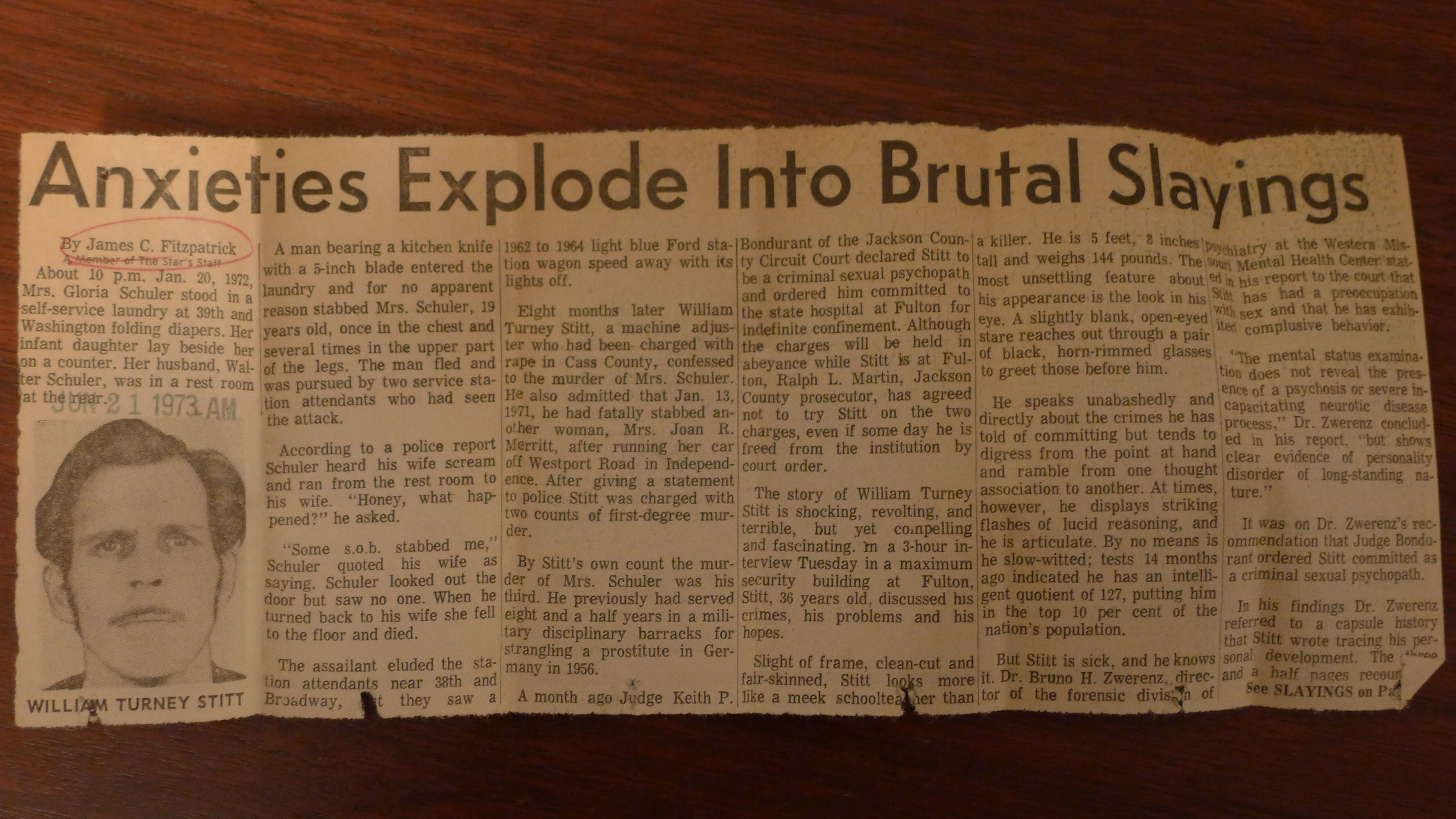
The subject of my story was a guy named William Turney Stitt, who had fatally stabbed two women, for no apparent reason, a year apart. The story ran on the front page of The Kansas City Times (then the morning edition of The Star) on Thursday, June 21, 1973.

Stitt killed one woman, 19-year-old Gloria Schuler, after spotting her in a self-service laundry at 39th and Washington, a block west of Broadway. While Schuler’s husband was in the restroom, Stitt parked his car, ran inside and stabbed Schuler several times with a kitchen knife he was carrying. He fled, and, then, when Schuler’s husband got back to her, she said (and these words made a lifelong impression on me) “Some son of a bitch stabbed me.”

Those were her last words.

A year earlier, Stitt fatally stabbed a woman named Joan R. Merritt after running her car off Westport Road in Independence.

Clearly, William Turney Stitt was a no-good son of a bitch. But I wanted to know what was behind his impulse to kill those women and why he had done so. (He previously had served eight-plus years in a military disciplinary barracks for strangling a prostitute in Germany in 1956.)

He provided me with the answer to why he had done what he did: He had a “destructive fantasy” that was intertwined with thoughts of sexual aggression.  I also reported that a psychiatrist at Western Missouri Mental Health Center had diagnosed him with a “personality disorder of longstanding nature.”

…So, did my story serve the public interest more than Judy Thomas’ story? Hard to say, isn’t it? Certainly, the families of Stitt’s three victims didn’t give a shit what was going through Stitt’s mind when he stabbed, or strangled, the women. And I doubt that my story shed any light on the subject of longstanding personality disorder.

But, like Thomas, I was determined to find out what the hell that goofball was thinking.

And the editors turned me loose.

**

Before the advent of The Star’s electronic library, in the early ’90s, The Star maintained staff by-lined stories in distinctive, dull-gold, business-size envelopes that were stacked vertically in dozens of metal file drawers on the third floor of The Star building at 18th and Grand.

The librarians had a surgically precise method of folding those stories so that very long stories folded up like road maps and fit snugly into those gold envelopes.

I tell you all that because, as you can see below, the story about William Stitt is one that I kept (one of only about 20) when the librarians gave each of us our by-line files after the electronic library was in place.

So, you see, I have a hard time being extremely critical of Judy Thomas and her Glenn Miller story. Who knows? She might even clip that story out with a pair of scissors and put it in an envelope to show people decades from now.


P1040247


Here are a few things to think about while we wait for the temperature to get back in the 50s. (I’ve got a bad case of golf withdrawal!)

:: It’s hard for me to see how something good is going to come of the Kemper Arena/American Royal situation. Yes, the arena is a singular design and is very eye-catching from a distance, but the closer you get the less appealing the building becomes.

First, it’s in a giant hole; that’s why they call it the Bottoms. As I’ve said before, I never did like going to Kemper Arena. You frequently had to slosh through gravelly areas, and sometimes mud, to get to the arena, and the interior was colorless and unwelcoming.

So, tear it down for all I care. On the other hand, the American Royal bigwigs, like Mariner Kemper and Neal Patterson, are asking for the city to pony up $30 million for a new building at the site, as well as $1 million a year in additional support for 30 years.

The city has countered with $20 million for the new building and $1 million in annual operating subsidy for 20 years.

The American Royal is a big name in our community, and it pulls at our nostalgic heartstrings. But the event itself has been sliding downhill for many years.

While Kemper Arena and the American Royal beckon us down memory lane, Sprint Center and the Power & Light District sound the call of the present and future.

Maybe the city should just demolish Kemper Arena and see if anyone comes up with a plan they think will pay for itself, without city subsidy.

:: What a weird case, that fatal shooting on Wednesday outside a municipal parking lot at 11th and Oak. A man named Jai T. Scott was shot to death after he dropped his wife off at City Hall and then got into an argument with a 24-year-old man who kicked one of Scott’s car tires. Yes, kicked the tire of his car. I have no idea what triggered the disagreement — maybe it was a “disrespect” thing — but if somebody kicks my car tire, I’m going to smile and say, “Sorry, I hope you didn’t scuff your shoe.”

It just doesn’t pay to go to battle with strangers who give you a hard time. Out there on the streets, anger runneth amok.

:: Another ridiculous, but farther-reaching, set of events resulted in the drive-by shooting of Angel Hooper at 106th and Blue Ridge. It all started the morning or afternoon of Oct. 17 when two women met to fight at 72nd and Indiana. Apparently the fight didn’t settle it, then some boyfriends got involved and the next thing you know a completely innocent 6-year-old girl lay dead outside a convenience store. It sounds like the police did an excellent job of putting the puzzle together; now a 19-year-old man and a 21-year-old man are charged with second-degree murder.

(Pop quiz: What do those two events appear to have in common? This…”Don’t even think of fucking with me, mother fucker!”)

:: Yael Abouhalkah of The Star sounded the death knell today for Mayor Sly James’ proposal to cut the maximum property-tax-abatement rate to 50 percent for redevelopment projects. Instead of 100 percent.

Curiously, I couldn’t find a news story about James’ proposal in The Star’s electronic library, which makes me wonder how big a deal he made of it in the first place. I did find an editorial written about it — probably by Abouhalkah — on Oct. 14, but nothing in the news columns.

At any rate, the developers and the development attorneys — who provide lots and lots of campaign funds for City Council candidates, including current council members — stomped on it like it was an irritating cockroach.

Longtime development lawyer Jerry Riffel, a former councilman who started out years ago as a Legal Aid attorney, I’m pretty sure, called the plan a “simplistic approach.”

Downtown Council president Bill Dietrich said the plan “sends a strong negative message” to prospective developers.

So, down the drain does this proposal flow.

It sounds to me like the mayor was never fully committed to it, that he just wagged his finger in the air to see how strong the wind was blowing.

Too bad, because he’s never been in a stronger position to push for a shake-up of the status quo. He’s extremely popular and will be re-elected next year in a landslide. He could have drawn a line in cement on this issue, and the public would have backed him all the way.

I’m guessing that he’s looking farther down the road, thinking about what he might run for after his second term as mayor. “Hmmm,” he must be thinking. “I’ll probably be needing the development crowd in the future.”

I wish he would have stifled that thought and shown some guts.

The signs are that Ferguson Police Officer Darren Wilson isn’t going to be indicted in the slaying of Michael Brown.

Gov. Jay Nixon and top law enforcement officers are mounting an all-hands-on-deck preparedness plan for when the St. Louis County grand jury returns its verdict, which could be in a matter of days.

It’s a damn shame that Ferguson and the St. Louis area will almost certainly be subjected to more rancor and possible violence. None of it had to happen, and wouldn’t have, if Officer Wilson had only approached Michael Brown and his friend Dorian Johnson in a professional manner on Aug. 9.

“Young men, for your own safety, please get out of the street.”

That’s what Wilson should have said, or something like it. But, no, he was part of Ferguson’s Caucasian Cowboy Patrol and undoubtedly used to barking commands and trying to intimidate young black men.

So, his admonition to Brown and Johnson was, “Get the fuck on the sidewalk!”

Nice start to a citizen-police encounter.

And it ended, as we know, with the cops leaving the young man’s body in a pool of blood for hours while they “investigated” the crime scene.

**

In Wilson’s defense, of course, a lot more information about the nature of the encounter has emerged. For example, Brown apparently reached inside the door of the patrol car and grabbed Wilson’s gun. We know from the video of the convenience store robbery minutes earlier that Brown was full of himself — and maybe under the influence — when he roughed up the convenience store owner and marched away triumphantly with a box of cigarillos that he had appropriated.

We can safely assume that Brown was cocky and feeling invincible when Wilson cut loose verbally on him and Johnson.

What ensued was a clash between a high-handed, arrogant young police officer and an agitated member of a racial group that had long been relegated to second-class status in a white-governed city.

Thankfully, because of what unfolded that August day and all that has occurred since, things are changing in Ferguson and maybe other suburban cities like it.

In my first post on this subject, I predicted that Wilson would be charged with voluntary manslaughter and that he would be convicted and sentenced to 10 years in prison. Obviously, that’s not going to happen. I do hope, however, that as more of these “cop-shooting-unarmed-people cases” come under closer public scrutiny, political leaders and law enforcement agencies will start asking why law enforcement’s first reaction should be to shoot to kill at the first sign of possible bodily harm.

**

Years ago, when I was living on East 56th Street, the cops one day entered a house on the corner of 56th and Main and shot to death a very troubled young man who was standing in the family living room holding a knife. The cops told him to drop the knife; he didn’t; and they shot.

The young man’s mother, who had called police, was outside. The cops came out and, I guess, told her they had shot her son. Instead of getting help, she got a funeral for her son.

I have never gotten over that incident. It was crystal clear to me and the other neighbors that the cops easily could have defused the situation by backing out of the living room. The boy was not between them and the door, and the cops could have called for back-up and simply waited a few minutes. About the worst that could have happened was the kid would have knifed himself. If he’d come running out of the house, toward them, brandishing the knife, then they could have fired away.

But the mindset that day, as well as on Aug. 9 in Ferguson, was confrontation…

“He could hurt me!”

That’s where the thinking has to change…

Yes, he could hurt me, but if I present him with an alternative where no one has to die, maybe he will take it.

Let’s get to talking along those lines.

Quick follow-up on Sprint…with a parallel story about The Kansas City Star.

It turns out, according to a story posted the kansascity.com website today that Sprint’s workforce reduction this fall will actually come in at about 3,700 people, not the 2,700 the company indicated earlier.

Two days ago, on Monday, Marcelo Claure, Sprint’s new c.e.o., said that Sprint would reduce its workforce by an additional 2,000 people, over and above 687 people whom it downsized in October. Today, however, the company acknowledged that the 687-figure had actually mushroomed to about 1,700, putting the October-to-end-of-the-year cuts at about 3,700.

KC Star business reporter Mark Davis paraphrased Sprint spokesman Doug Duvall as saying that Sprint was offering voluntary buyouts to reach at least part of the 2,000 jobs left to be cut. If that didn’t get the job done, so to speak, layoffs would follow.

Davis also reported that employment in the Kansas City area will end this week at about 6,800, where it had been 7,500 earlier this year.

To put all this in perspective, The Star ran a chart on Monday, showing that in January 2007 — less than eigh0t years ago — Sprint had about 65,000 employees. In mid-September, the number was down to 33,000. Take away the new 3,700 and the company will have slightly less than 30,000 employees by the end of this year.

Of course, Sprint isn’t the only major Kansas City company taking the gas as a result of circumstances in and out of its control.

About the same time that Sprint had 65,000 employees, The Star had more than 2,000 employees. That’s now down to well under 1,000.

I’m betting now that The Star will be around, as a company called The Kansas City Star, longer than Sprint Corp. I think the Japanese company SoftBank, which owns 80 percent of Sprint, will probably offload at some point.

Among other tangents of a Sprint unraveling, I think we can look for the Sprint Center to get a name change within the next few years.

claure

Claure

And what’s the deal with this fellow Claure, a reputed Miami billionaire who reportedly has moved, or is moving, his family to the Kansas City area as part of his effort to revive Sprint?

Claure’s main push since taking over three months ago has been to oversee a goal (or, more likely, implement a SoftBank demand) that Sprint reduce its annual budget by $1.5 billion.

It looks to me like Inspector Claure is a glorified hatchet man. I expect him and his family to be back on South Beach within a year.

There’s another KC Star corollary here…Not long after Capital Cities Inc. bought the employee-owned paper in 1977, Jim Hale, the man whom Cap Cities sent in as publisher, hired a guy named Gerald Garcia as executive editor. Like Hale, Garcia hailed from Texas, as I recall. Garcia walked around the newsroom with a perverse, snarling, grin pasted on one side of his face.

One day, Garcia summoned 20 or more highly paid employees in a conference room — most of them had made a lot of money in the $2-for-$1 stock sale — and told them they were finished. Just like that…pack up, it’s time to go.

Not long after that, Garcia left the paper and went off to points unknown. The executioner’s job was finished, too.

I wonder what is going to become of Sprint Corp., which now is down to — or getting to — about half of its one-time high number of about 63,000 employees.

What’s going to happen with that ugly, sprawling campus out by Town Center?

What is SoftBank Corp., the Japanese company that owns 80 percent of Sprint, going to do with this property, which is looking more and more like deadwood?

If you’ve been watching, more bad news surfaced about Sprint yesterday and today. Although Sprint’s total number of customers was up at the end of the third quarter (Sept. 30), it lost 336,000 prime customers, those who sign contracts. In addition, Marcelo Claure, Sprint’s new c.e.o. (as of three months ago), said Sprint would lay off 2,000 more employees, over and above a recently announced 687-person layoff.

Today, not surprisingly, investors hammered Sprint’s stock price, knocking it down by more than 18 percent before the market closed. (The company’s stock is down by more than 50 percent for the year.)

A positive step that Claure announced, in my opinion, was the reopening of a customer-service call center call at Sprint headquarters in Overland Park. He decided that was a good move, he said, after listening to customer service calls and determined that Sprint had “offshored” too much of the customer support business.

To me, that’s another way of saying he heard too many conversations where U.S. customers were having difficulty communicating effectively with non-native English speakers. That might sound politically incorrect, but, tell me, how many times have you called a big company’s customer service center and hoped that a native English speaker would take your call?

So, that’s a good move, and I hope it helps improve company fortunes.

To me, however, the biggest step that Claure could take would be to overhaul Sprint’s retail stores and how they serve customers.

The problems I encountered at those stores eventually ran me off as a Sprint customer.

For many years, I was part of our “family plan” and proudly told people I supported the “hometown company.” But with every visit to a retail store (I usually went to Ward Parkway) I found it increasingly difficult to get a satisfactory result. Every time I went in, it seemed, I saw a completely different cast of customer service reps.

And I never liked the front-desk check-in, where a rep would enter your name and problem and then add you to the electronic queue, which you would then sit and painfully watch on monitors suspended from the ceiling. It always took a long time, and then, when my name would be called, more often than not I got a rep who was either overly ebullient or completely bored.

It all came to a head about a year and a half ago, when I took in a recently purchased, low-end phone that gave me very poor reception. I had been in earlier with the same complaint and another rep had suggested that I call another Sprint division and ask to be sent an antenna system. Always game for an attempted fix, I did that, but the antenna system didn’t help.

So, there I was back at the store with the same problem I’d had a few weeks earlier. I told the rep I wanted a new phone. Sorry, he informed me, I had had the phone for more than 30 days and they couldn’t do an exchange. I tried to reason with the fellow, but it became clear that not only couldn’t they do an exchange, they absolutely wouldn’t.

Finally, totally frustrated, I told the guy, “I want a divorce. How much is it going to cost me?

Slightly curling one side of his face, he went into his computer to find the answer.

“Three hundred dollars,” he said.

“Done,” I said. “Cut me out of the family plan.”

I then walked over to the Verizon store about 50 yards away and was immediately and professionally assisted by a young man, who, I believe, was a manager or co-manager. No general check in and no looking for my name on a monitor, like I was being sorted and chuted in a customer-service bull pen.

I didn’t have to sign a contract, but I did have to buy a new phone, which I am paying off as part of my monthly bill. The phone I bought was an LG flip model, which serves my purposes just fine. Reception is good, and on the few occasions I have had to return to a Verizon retail store, someone has approached me within about a minute and either addressed the problem then and there or advised me to stand by for a few minutes.

Yes, I am paying a lot more per month than if I had stayed with the Sprint family plan. But, you know, sometimes family members have to go in different directions. My wife Patty thought I was crazy to bolt, and I have explained to her several times that cellphone peace of mind was more important to me than the money. And that’s all I have to say about that.

So, I strongly suggest that Marcelo Claure look deeper into the customer service issue and revamp his retail operation. He could start by following Verizon’s lead.

I have a love/hate relationship with billboards.

Before 2013, I had no use for them whatsoever, but, I began to see their value when I headed a campaign committee that worked against Jackson County’s proposed half-cent sales-tax increase for medical research. We stopped the proposal dead in its tracks — 84 percent “no” to 16 percent “yes” — and I attribute the margin partly to four billboards my “Stop a Bad Cure” campaign committee purchased around the county.

Then, earlier this year, a campaign committee I was working with bought — at my suggestion — a $2,500 billboard on Noland Road to attack the state’s proposed one-cent sales tax for transportation projects. We won handily — 54 percent to 46 percent — and, again, I believe that billboard got our side a lot of votes. On the west side of Noland Road, north of I-70 and across from Truman High School, it gets about 90,000 “impressions” a week.

In general, though, billboards are an eyesore, and it’s hard to root for maintaining billboards that stand in the way of progress.

And that’s just the type of battle currently being waged over a very large billboard on the north end of the Main Street viaduct, at 20th Street.

Maybe you read Lynn Horsley’s front-page story about the issue in today’s KC Star.

The city has moved to condemn the billboard — contending that the area is “blighted” — to make way for a $19 million hotel at the entrance to the booming Crossroads district. but Lamar outdoor advertising has sued to try to stop the removal.

For obvious reasons, Lamar wants to keep the board. I say obvious because when you are headed north on Main Street as you approach 20th Street, the big board looms right in front of you. You can’t miss it, and there are no other billboards in the area. Like the billboard I have bought twice now on Noland Road, it commands a captive audience. Plus, it’s a two-sided board, and I would bet it gets 150,000 to 200,000 total impressions a week.

P1040227

Looking north, from the Main Street viaduct, where the ramp to Walnut Street veers off to the east. The city is planning to remove the ramp, which is closed.

The Lamar vs. Kansas City case has now gone to trial in Jackson County Circuit Court, and testimony began last Friday.

As Horsley reported, condemnation would clear the way for Sunflower Development Group to build a 5-story, 110-room hotel, which would operate as the first Hilton Home2Suites property in the area.

Jim Bowers, a formidable land-use attorney who is representing Lamar, contends that the $19 million hotel and the billboard could peacefully coexist…Well, yeah, I guess there’s a way the hotel could be built without taking down the billboard, but obviously the hotel operators want their sign, brandishing the Hilton flag, to be the prominent image at the intersection, not a big ad for Sprint or some other company.

P1040234

Looking south, from near the parking lot where the hotel presumably would be built. The former Western Auto building is off to the left.

**

I took a good look at the area today, and I would think the city has a good chance to get the “blight” declaration. For one thing, the area directly below the billboard is a parking lot, situated between Main and Walnut. Also, immediately north of the billboard is the vacant lot that was the home of the Hereford House before co-owner Rod Anderson hired a couple of guys to torch it in 2008. (Anderson and the two arsonists were convicted. He got a 15-year-sentence, as did one of the arsonists. The other arsonist got a 20-year term.)

As I looked at that site, the signs of progress and potential were all around. Two sets of streetcar tracks — one for southbound cars and one for northbound cars — are being laid on the east and west sides of the thoroughfare, and the streetcar’s southern terminus, Union Station, is about two blocks away, at Pershing Road. Just south of there, of course, is the Liberty Memorial and Crown Center.

It’s easy to envision thousands of people — many of them tourists and some of them staying at the HiltonHome2Suites — riding up and down Main Street and going to various attractions, including Union Station, the Liberty Memorial, the Kauffman Center for the Performing Arts, Sprint Center and the Power & Light District.

This is what former Mayor Kay Barnes envisioned when she pushed for what she called a “Downtown-Crown-Plaza” corridor of attractions and activity. At the time, I thought it was a bit silly, but with the passage of time, the picture has become increasingly clear.

So, let’s hope that after testimony is completed in Circuit Court, Judge Margene Burnett rules that the city can go ahead and tear down the big board that impedes the view, not only of specific buildings, but also of progress in the heart of our city.


A month of tension, drama, joy and agony at our house came to a somber end last night when Salvy Perez made the last World Series out after swinging at three pitches out of the strike zone.

It was a maddening way to end a tremendous run for the Royals. But, then again, they might not have been playing for the last month had Perez not driven in the winning run — on another pitch out of the strike zone — in that unbelievably wild Wild Card playoff game against the Oakland A’s on Sept. 30.

Perez’ futile, final attempt to tie Game 7 will stay with me a long time, but there are three other images that are also seared into my head.

1) Kansas City’s (well, Prairie Village’s) own Joyce DiDonato singing the National Anthem before Game 7. Joyce, 45, is obviously a tremendous singer, but in addition she has a powerful and stunning presence.

joyce

On Wednesday morning, on Steve Kraske’s “Up to Date” show, Joyce had talked about how she would approach the song and the moment.

“It’ something that I want to make sure I stay really present for, so that I enjoy every note, every word — hopefully, the right words — and just the entire atmosphere of this because it’s really a once-in-a-lifetime thing.”

…You did it, Joyce. It was, by far, the most expressive, soul-stirring rendition I’ve ever heard of “The Star Spangled Banner.”

Here it is, readers. I invite you to watch and listen again. https://www.youtube.com/watch?v=ciDE-3p4hNQ

2) Before Game 4 in San Francisco, the Giants had a very special person deliver the “Play Ball!” cry at home plate. He is Bryan Stow, the former paramedic and Giants fan who was beaten in a Dodger Stadium parking lot after opening day of the 2011 season.

bryan

Bryan Stow with Giants coach Tim Flannery

He suffered brain damage and is now in a wheelchair. Giants’ relief pitcher Jeremy Affeldt, who got his start with the Royals, has become a friend and benefactor of the Stow family, and third-base coach Tim Flannery has played concerts to help defray the cost of his extensive care.

Earlier this year, I saw video clips of the sentencing of the assailants, Louie Sanchez and Marvin Norwood. The main attacker, Sanchez, not only showed no remorse but actually smirked during part of the hearing.

smirker

Sanchez

Months earlier, in a recorded jailhouse conversation, Sanchez apologized to Norwood for involving him in the attack. Norwood replied:

“That happens, bro. I mean, what kind of man would I have been if I hadn’t jumped in and tried to help you?”

What kind of man? Just as cowardly as he was by jumping in.

Sanchez was sentenced to eight years in prison; Norwood to four. 

3) The final image that will haunt me — as well as tens of thousands of other Royals fans — is that of Giants’ rookie second-baseman Joe Panik making his diving stop of Eric Hosmer’s hard-hit ground ball up the middle of the field last night and then his glove flip of the ball to shortstop Brandon Crawford. Crawford stepped on the bag to force Lorenzo Cain going to second and then threw to first to double up Hosmer. The play at first was so close that it had to be settled by video replay.

mlb_a_pank_300x300

“The Flip”

If the ball had gone through to center field, as appeared almost certain, the Royals would have had runners on first and third with no one out. Instead, it was two out, bases empty. Relatively early in the game though it was, that was the dagger in the gut.

Panik even surprised himself, telling reporters after the game he had never made a glove flip from the prone position.

“Once in a while in practice or B.P., I’ll do a glove flip standing up, but nothing like that on my belly. It was just instinctual. I couldn’t get my bare hand to the glove because it was Lorenzo Cain running and I’m like, ‘He’s fast,’ so I just tried to get it” to Crawford.

**

It was the Panik play that kept going through my mind between restless bouts of sleep last night.

Today, though, I’m going to try to put it behind me. I’m going to focus, instead, on that beautiful blond opera star from Prairie Village and her soaring voice, which brought tears to my eyes last night.

Thank you, Joyce! And congratulations, KC Royals, on a stupendous season!

A letter writer in today’s Kansas City Star dishes out perhaps the most lavish praise I have ever seen or heard for the paper, lauding it for “in-depth reporting to be of worldwide quality.”

I don’t know about worldwide quality, but, yes, The Star is a damn good paper…even in its much diminished, basement-budget state.

Still, the number of people who share letter writer Stewart Grant’s sky-high opinion of The Star is obviously dwindling, as the most recent circulation figures clearly indicate.

According to the Alliance for Audited Media — formerly the Audit Bureau of Circulations — The Star’s circulation, like that of many other metropolitan dailies, continues to slip badly.

And that’s the case even when digital subscriptions are included.

The Star’s average Sunday circulation went from 254,111 in the fall of 2013 to 242,583 as of the end of last month.

Over the last five years, the Sunday drop-off has been a startling 27 percent — from 307,794 in 2009 to the current 242,583.

It’s just about the same story for average Monday-Friday circulation, which fell from 216,226 to 155,465 — 28 percent — between 2009 and this year.

The situation is even worse in St. Louis, where average Sunday circulation for the Post-Dispatch has plunged 43 percent over the last five years — from 401,427 to 228,703. (Average daily circulation fell 29 percent, from 213,472 to 150,835.)

…As a side note, it is puzzling to me that The Star, in a metropolitan area of about 2 million people, has a larger circulation than the Post-Dispatch, which is in a market of about 2.8 million. But, then again, maybe that speaks to the difference in quality between the two papers. It seems to me — and from what I’ve heard — the quality of the Post-Dispatch has suffered more than that of The Star since both were sold in the mid-2000s.

**

One problem for traditional newspapers, of course, has been the proliferation of free news and opinion outlets. But another problem, in my view, is that a defeatist attitude has set in at the corporate offices of chains, like McClatchy and Lee Enterprises, the owners, respectively, of The Star and the Post-Dispatch.

mcclatchyMcClatchy, based in Sacramento, and Lee, based in the Davenport, IA, made big mistakes by expanding when powerhouse operations like KnightRidder (owner of The Star and others) and Pulitzer (the Post-Dispatch and others) saw the writing on the wall and realized it was time to get out.

Now, those upstarts-turned-suckers are licking their wounds, mired in huge debt and paralyzed by fiscal fear.

They don’t dare invest more in their properties because, being publicly owned, it might well cut further into the value of their stock.

If I was calling the shots at McClatchy, however (and willing to put my neck on the line), I would roll the dice and get aggressive. I think that investing in the product — bolstering the editorial side by hiring more editorial employees and embarking on well-developed marketing campaigns — could beget turnarounds in some markets, including Kansas City and St. Louis.

leeThese are tremendous markets, and their respective newspapers represent, by far, the most powerful news-gathering organizations in their respective regions. I don’t see any reason why they couldn’t gain ground and sell a lot more subscriptions, particularly digital.

The reality, however, is that the chances of significant, renewed investment by McClatchy are infinitesimal. The only hope for resuscitation is a change of ownership — and not ownership by another chain.

As an example of what can happen, look at The Washington Post. Jeff Bezos, founder of Amazon, bought the paper in 2013, taking it private. At first everyone was wondering what he would do with the paper and if he would take it in some new, crazy direction.

He didn’t. He stuck with what has worked best for newspapers over centuries. This year, he gave the green light to the hiring of more than 100 new employees. The resulting editorial revival and financial stability have catapulted The Post back into national prominence.

(Two recent stories The Post broke were how deeply into the White House the first fence jumper made it and how a security contractor with a gun managed to get an elevator with President Obama during a trip to Atlanta.)

Again, The Post has been able to recapture lost ground through the emergence of a wise and wealthy purchaser who was willing to invest in the product. With McClatchy and Lee, on the other hand, we can expect them to sit on their hands and watch their properties continue to atrophy.

It’s not a happy prospect. But let’s hold out hope that a Midwestern version of Jeff Bezos recognizes what a golden opportunity exists in our community and decides to free The Star from the clutches of its sodden Sacramento owner.

Same for the Post-Dispatch; it’s too good of a property in too good of a market to be stuck in the hands of Lee Enterprises. It, too, needs and deserves rescuing by someone who recognizes value and has the money to pull it off.

As most of you know, I wrote last week about the problem that many men have picking out suitable attire, if they don’t have a female fashion consultant, be it a wife, girlfriend, sister or just plain friend — someone, anyone who doesn’t want you to look ridiculous.

Today I want to cite an example of someone who not only needs a fashion consultant but also needs to — as the old saying goes — get a life.

I speak of “Marlins Man,” the goofball who has sat in the first of second row of each World Series game, wearing an orange Florida Marlins jersey and an orange Marlins visor, which he usually wears cocked to one side.

This guy is strictly an exhibitionist, who is paying thousands of dollars per game to be seen on national TV.

He’s a lower-key version of “Rainbow Man,” who, in the ’70s and ’80s wore a rainbow, Afro-style wig and held up signs reading “John 3:16” at various sporting events.

That guy, Rollen Stewart, was a certified nut case, who now is serving three consecutive life sentences in prison on kidnapping charges.

marlins man“Marlins Man,” on the other hand, is just a guy with too much money and much time on his hands. His name is Laurence Leavy, and he’s a 58-year-old Miami attorney.

He has attended major sporting events for years, but I presume it’s just this year that he has begun to seek out the cameras in a major way.

Here’s how he explains his odd obsession.

“I never had any kids, nor have any wife. You don’t have to pay for a wife and kids, so you have money in the bank.”

See what I mean? No wife, almost certainly no girlfriend…no guidepost…no social compass.

After the World Series ends and he goes back to Miami, about the best thing Laurence Leavy will have is TV recordings of himself sitting in the first row at Kauffman Stadium and the second row at AT&T Park. Wow. What a thrill.

**

Critical as I am of Mr. Leavy, I have to admit that I have my own fashion fixation — one that I’m not particularly proud of but that I just can’t and won’t give up.

I speak of plaid pants.

Over the years, after having been out shopping on my own, I have come home with various pairs of plaid pants — some sublime and some outrageous.

Each and every time, Patty has rolled her eyes and shaken her head. And whenever I get bold and put on plaid pants to go out to an event with Patty, she immediately waves me back to the bedroom for redressing.

So, we have come up with a deal of sorts: She will not object if I wear plaid pants on the golf course, or maybe to a Halloween party.

Of the three pairs of plaid pants that I own, my favorite is the enviable, eye-catching pair of golf pants that you see below. After I bought them and took them to the tailor shop in Brookside for alteration, the shop owner’s wife — a seamstress who happens to be a blond bombshell — gave the pants an enthusiastic endorsement. I’m sure you can see why!

A few weeks ago, though, I had a big scare: I went to the closet to get out the pants for a round of golf, but I couldn’t find them. I looked everywhere (well, almost everywhere), including going to the cleaners to see if I might have left them there after the last cleaning. No luck.

I had just about written them off, when, one day, I looked in the bottom of my closet and saw the blue laundry bag where I put the clothes that are going to the cleaners on my next trip. I noticed that the bag had a slight lump, and when I opened it up — hooray! — there were my golf pants.

The only thing I can compare my relief to was a certain night in the spring of 2006. I was lying in bed in an Oklahoma motel, thinking about my future and listening to “country legends” music. All of a sudden, it hit me: it was time for me to retire from The Star.

…That’s how relieved I was to find those pants in the bottom of my closet.

P1040223