Feeds:
Posts
Comments

Archive for 2017

“Stunning.”

That’s how Fox4 News is describing The Star’s big story, which went up online yesterday afternoon, about former Jackson County Executive Mike Sanders’ alleged involvement in a kickback scheme that supposedly went on for at least three years.

Indeed, it is a stunning story…And, by the way, Fox4 is the only one of the four local TV stations, as far as I can tell, to have followed up on it — which tells me how useless the other three stations are.

Just reading this 44-column-inch-long story, it would appear the FBI and the U.S. Attorney’s Office have the goods on Sanders. Somehow, reporters Mike Hendricks and Steve Vockrodt got the central figure in the drama, a Northland resident named Steve Hill, to open up about how the scheme worked. It went like this: Sanders would have checks drawn on the account of a political committee he controlled, then would give the checks to Hill, who would cash them, keep some of the proceeds and give the rest to Sanders.

It looks cut and dried…But you can bet it won’t be. Seldom is it easy to prove a kickback scheme against prominent and influential political figures. They usually have money, and they always get top-notch attorneys.

But that’s not the only reason this is unlikely to be a prosecutorial slam dunk. The Star’s story contains two direct suggestions of the difficulty the government is facing, and there are other signals between the lines.

Take a look.

Four years

That’s how long the FBI has been investigating this case. It’s right there in black and white: “The arrangement is the subject of a federal investigation that may be coming to a close after more than four years, The Star has learned.”

If that is correct, it tells you one of two things: The FBI has been moving at an absolute snail’s pace or it’s a lot more complicated than Sanders giving a guy checks and divvying up the proceeds between himself and the stooge. For the FBI’s sake I’m going to assume the latter — more complicated than it appears — and suggest that authorities do not have an iron-clad case.

While we’re on the subject of the length of the investigation, I want to add a journalistic comment: If The Star still had a reporter going to U.S. District Court every day, checking with officials and working sources, it would not have taken four years to discover that a former county executive was being investigated. Hendricks and Vockrodt are two of the best reporters The Star has, but they function primarily as at-large troubleshooters, responding to whatever they hear, wherever. Because of staff cutbacks, The Star has largely abandoned the longstanding, tried-and-true “beat” system, where reporters are assigned to narrow coverage areas and work those areas relentlessly. As a result, The Star doesn’t break nearly as many stories as it did before it started laying off editorial staff members in 2008.

Sanders might not be the only target

Two other people who conceivably could be in trouble are named in the story. One is Calvin Williford, Sanders’ former chief of staff. The other is J. Martin Kerr, an Independence attorney and friend of Sanders, who was treasurer of the political committee that was being used as the cash conduit. Interestingly, Kerr was an assistant Jackson County prosecutor in the 1970s. Both Williford and Kerr have hired attorneys. (I love it when an attorney has to hire his own attorney.) The possibility that at least four people were involved in some manner could lead to a lot of finger-pointing and messiness.

Main witness credibility

The Star’s story does not tell us a lot about Steve Hill, except that he lives north of the river, has been a friend of Sanders since high school, and has used a wheelchair since he suffered a broken neck during an assault 30 years ago. The dearth of information about Hill raises questions, including whether he has ever been convicted of a crime and why he decided to tell The Star his story before charges have even been filed.

If he has been convicted of a crime, or has a history of lying, it would damage his credibility. That’s a given, and I wish Hendricks and Vockrodt would have addressed that.

Regarding his decision to talk to Hendricks and Vockrodt, the story says he came forward “because he wanted the truth to be known and discovered.” I seriously doubt that is the sole reason. I suspect self-preservation is also a major factor. I don’t think he would have gone to The Star unless he felt it would benefit him in some way.

The FBI and the U.S. Attorney’s Office cannot be happy with this turn of events. Investigators and prosecutors strongly encourage witnesses to keep their mouths shut until charges are filed and cases go to trial. They want the damning testimony to come from the witness stand, not from the front page of the daily paper.

A final, significant complicating factor for the government is that unless Hill’s account in the newspaper coincides perfectly — step by step, offense by offense — with what he testifies to in court, a defense attorney will be able to use any disparities to “impeach” his testimony.

In any event, Steve Hill’s credibility is going to be called into question. The easy part was talking to The Star and its very receptive reporters. It’s going to be a whole different story if and when a defense attorney pounces on him like a junkyard dog.

Read Full Post »

I don’t know what the editors are thinking about down at The Kansas City Star these days, but they certainly appear to be losing their grip on timely news.

At 1:15 p.m. today, The Star posted on its website a headline “Ozarks man used racial slur, tried to run over black traveler at Wal-Mart, police say.”

Not all stories The Star carries under the “Latest News” category are local, but when stories are written by Star staff members, I think it’s reasonable to expect them to be local.

I got a surprise on that front when I clicked on the Ozarks story, which was under the by-line of Star staff member Max Londberg. As I started reading the story, I immediately had questions. The first sentence was, “An Ozarks man targeted an out-of-town truck driver in a racially fueled attack, police records indicate.”

What town? Kansas City? Independence?

The second sentence didn’t help much: “Steve Pennington of Conway, Mo., allegedly tried to run over a black man multiple times with his SUV and then pulled out a knife and pursued him on foot, Lebanon police and several witnesses reported.”

The Lebanon reference was the first indication this was not a local story. Londberg didn’t say where either Conway or Lebanon is, but I checked and they are northeast of Springfield.

So, this incident occurred a long way from Kansas City.

Londberg then went on to describe what happened — Pennington, an obvious racist and loon, tried to run down the black man, whom he’d never met, in a Wal-Mart parking lot after accusing him of stealing some items from the store.

The biggest surprise in this story, however, came in the 12th paragraph — third from the end — when I found the incident occurred in September!

Actually, it occurred on Sept. 3, but Londberg didn’t report that because, I assume, he realized people would quickly compute that the story was more than three months old. In “breaking news” time, that’s synonymous with antiquity.

Not only was Londberg writing about history, then, he was also writing about an incident that occurred 175 miles from Kansas City!

Another galling aspect of this misadventure is that Londberg put his byline on the story, as if he did the original reporting and writing. Not so. A quick Google search showed that Londberg merely rewrote a Springfield News-Leader story from Sept. 7. No way he deserved a by-line. The whole thing is a sham.

**

The ultimate wonder about all this, obviously, is why the hell is The Star wasting time on an outdated, downstate story when there aren’t nearly enough reporters to cover what’s going on in the Kansas City area?

Besides City Hall, The Star has stopped covering other local governments regularly, and its coverage of local school districts is just about zilch. (I can’t remember the last time I saw a story about the Kansas City School Board, which used to be covered religiously.) Crime coverage is haphazard and, for the most part, superficial, and the paper seldom covers appearances by noteworthy authors and national newsmakers.

The focus now is on targeted, in-depth stories, like the secrecy in Kansas series. That’s certainly a valid way to go in the absence of a hefty reporting staff, but it makes it especially curious that editors gave one of their precious few local reporters — Londberg — a couple of hours to waste on a story so old it should be on parchment.

If The Star plans on continuing to dredge up old news and try to pass it off as current, it should at least come clean and put it under a new heading. I suggest this: “Old News, Perhaps of Passing Interest.”

**

Note: Minutes after I published this post, The Star removed the Ozarks story from the “latest news” category and put it under the more general “News” heading.

Read Full Post »

Why did they have to kill him?

For God’s sake, why did they have to kill him?

He and a companion had handed over their cell phones and wallets Sunday night, and one of the robbers shot him anyway.

I am both angry and heartsick about the senseless death of 24-year-old Zach Pearce, who was accosted while walking to his apartment at 40th and Walnut after a night in Westport.

Zach Pearce

Zach and his friend were within several yards of his building when they were accosted by three occupants of a maroon SUV. A woman was driving. One of the robbers got out of the vehicle and, after the victims had handed over their possessions, the robber who was outside the vehicle shot Pearce. Bang! Down he went…and died on the street.

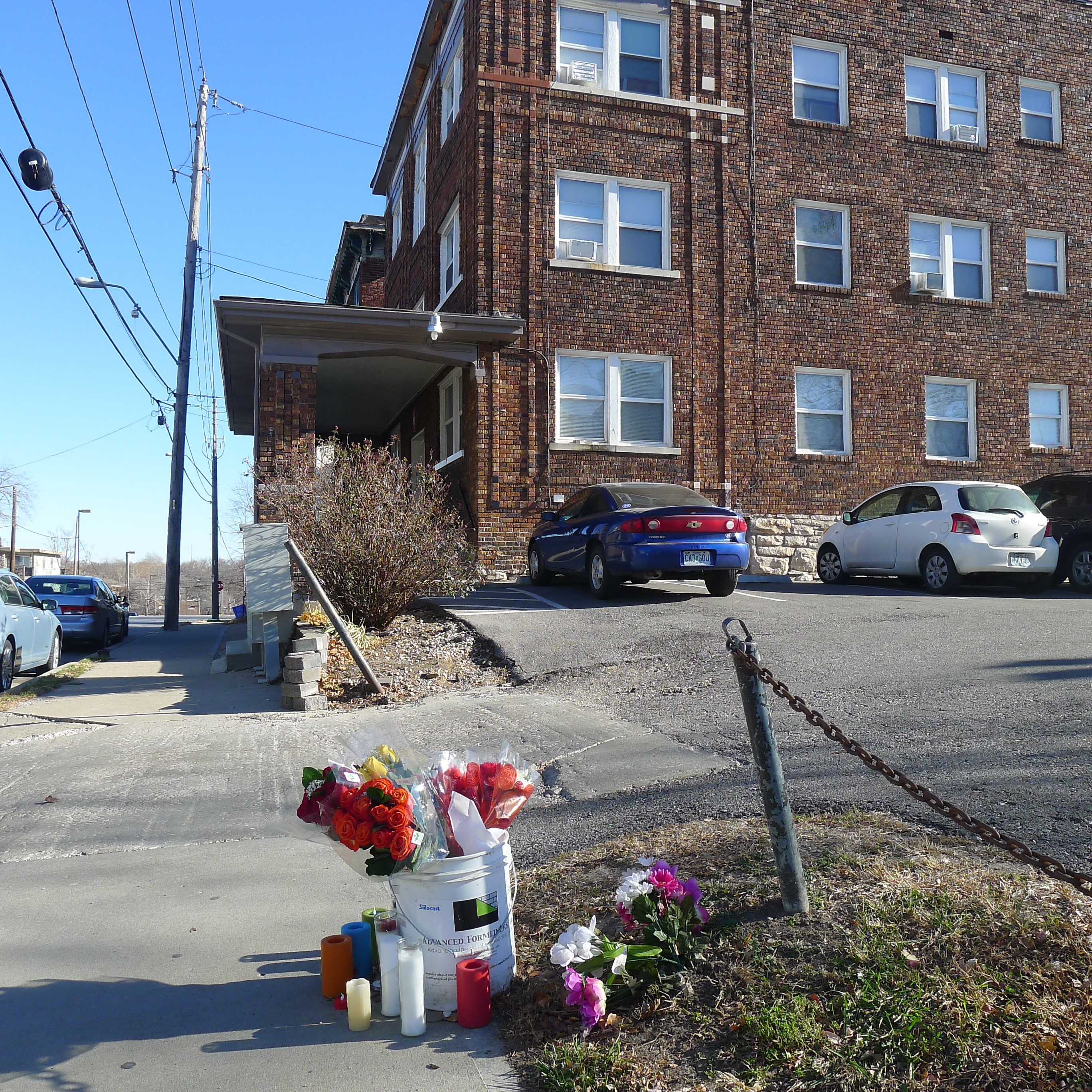
He had his life ahead of him. I’m guessing he had moved into the city, and out of Blue Springs, to be closer to the urban “action.” But in the blink of an eye, on Kansas City’s mean streets, his parents, Joe and Cora Pearce of Blue Springs, lost a son. He had an older brother. He had a lot of close friends, many of whom attended a candlelight vigil Monday night outside his apartment building, where friends have left candles and flowers in a makeshift memorial.

Attached to a dozen yellow roses in the memorial is a handwritten note from women named Ashley and Hannah. It says: “Zach — I hope these serve as a little reminder of the bright beautiful person that you were. We love you & always will.”

**

The heart of a big city has a special allure for many young people. When I moved here in 1969 from Louisville, I wanted to be in the city. I remember looking at an apartment way out south, somewhere in the Red Bridge area, and thinking, “No way.” I ended up renting a sparsely furnished apartment at Armour and Cherry and being thrilled to be close to The Star and close to singles bars like the Red Apple and Sneaky Pete’s (both long gone) on Broadway.

I never walked to those bars, but scores of times I parked my car on Armour or a side street late at night and made the short walk to my apartment. I was never particularly worried about my safety, but I knew I was vulnerable. Sometimes I was drunk. I would have been an easy target. But I was lucky…

After several months, I moved into a house in Brookside with four other guys. We split the $250-a-month rent five ways. And it was a much safer area. By then I was going to Westport regularly, and I never had a problem. I do remember one night when I was with Patty, probably in the mid-’80s, crossing paths with a couple of men in the Westport Bank parking lot and being very relieved when we were well past them. One of those guys, his eyes…mean, threatening, narrowly focused.

Just as the city called to me, it called to Zach Pearce. Joe Pearce, his father, told a KSHB reporter: “My wife was repeatedly…riding him to move out of the city. She was begging for him to move out of the city, and he would say that he felt safe there and it would be fine if anyone wanted to rob him, he would cooperate fully so he would be fine.”

He should have been fine. He should have been able to feel safe in the city. But American society is fucked up, has been for a long time, and very few of us are safe. Maybe if you’re in Loch Lloyd or Hallbrook and you never leave home…but I don’t know.

Zach Pearce’s apartment building on 40th Street, a block east of Main

I believe the perpetrators will get caught in fairly short order. They may well run their mouths. Maybe the plan was never to fire the weapon, and one of the two who did not shoot will come forward in order to save his or her own skin. If just one of the two comes forward, I would bet on the woman. She, particularly, must be scared to death. Maybe she has told, or will tell, her mother.

It’s just a crying shame, heartbreaking, that Zach will never be able to talk to his mother or father again. And that they will never be able to talk to him again, to hold him, to tell him they love him. God, it’s awful.

Read Full Post »

You need a scorecard to keep track of the four legal cases pending against David Jungerman, and I’ve decided to give you one.

There is, of course, the pending criminal case in Barton County — attempted burglary and harassment — that could go to trial yet this year, but more likely early next year. Then there are three civil damage cases, including the one in which the murdered attorney Thomas Pickert represented a homeless man whom Jungerman shot and badly injured in September 2012.

In the Pickert murder, Jungerman is famously “not a suspect at this time” in the official lingo of the KCPD. That wording has scared off much of the local media, including The Kansas City Star, which has not written a word about the case in more than three weeks.

But I’m on it, as you know, and here’s the lineup of cases and their current status:

State of Missouri vs. David Jungerman

Jungerman is charged with a felony count of attempted burglary and one or two misdemeanor harassment counts for barging into a tenant’s home near Nevada, MO, last year and demanding to know — while brandishing a handgun in his waistband — when his tenant was going to vacate the premises. (His exact words were, “When are you getting out of here, you mother fucker?”)

A pre-trial hearing is scheduled for Dec. 14 in Lamar, MO, the seat of Barton County. The case was originally filed in Vernon County but was transferred to Barton County last year. At different times, two different attorneys have represented Jungerman in this case. His first lawyer withdrew earlier this year, and the second withdrew six days after after Pickert was shot to death outside his Brookside home on Oct. 25.

Since early last month, Jungerman, a multi-millionaire, has been representing himself, but he has told the judge he has been attempting to hire a lawyer. Judge David Munton effectively told Jungerman he would be better off with just about any lawyer than representing himself.

Another interesting development in this case is that on Nov. 22, Vernon County Prosecutor Brandi McInroy filed a motion to endorse as a witness in the case KCPD Detective Nicholas Sola. In her motion, McInroy said she wanted Sola to testify “for sentencing purposes,” that is, assuming a jury convicts Jungerman. Sola is assigned to missing persons and cold cases, and I don’t know if he has played any role in the Pickert investigation. In any event, it would be interesting to hear what he has to say, if Jungerman is convicted. He could be sentenced, upon conviction, to seven years in prison for attempted burglary, and I have every reason to believe McInroy will be doing everything she can to get the maximum sentence. She’s already told the Judge Munton she doesn’t want Jungerman standing near her in the courtroom.

Jeffery Harris vs. David Jungerman

This is the case in which Pickert gained a $5.75 million verdict in favor of his client, a homeless man whom Jungerman shot with an assault rifle on Sept. 25, 2012, at a building he owns in northeast Kansas City. Harris was hit in the leg and had to have it amputated above the knee.

Jungerman represented himself in this case, but a lawyer named Jonathan Sternberg filed an appeal on his behalf on Sept. 22. Jungerman did not post an appeal bond, however, which allowed court officials to begin taking steps to seize enough of Jungerman’s property to satisfy the $5.75 million judgment.

Unwisely, Jungerman represented himself in the Harris case, and after the jury returned the verdict, he directed an “angry outburst” at Pickert and other court officials. I don’t know if he threatened Pickert, but I’m sure police know exactly what was said.

Robert Wallace vs. David Jungerman

Wallace is the other man whom Jungerman shot on Sept. 25, 2012. A Kansas City lawyer named L. Benjamin Mook filed suit on behalf of Wallace on Sept. 22 of this year. The petition alleges that Jungerman “ambushed the men” and shot both with an assault rifle “from inside the building as they stood outside on or near a covered loading dock.”

On Nov. 8, exactly two weeks after Pickert was murdered, Mook filed a motion to withdraw from the case. No one else has entered an appearance on behalf of Wallace, and the future of this case in doubt.

Justin Baker vs. David Jungerman

You would think that after shooting two trespassers in September 2012, Jungerman would have learned it’s better to call police and let them deal with trespassers. But that’s not Jungerman’s style. Less than a month later, on Oct. 21, 2012, he came upon two more trespassers — this time they were apparently inside his building — and he unloaded on them with a shotgun. Kansas City attorney Jarrett A. Johnson filed suit on behalf of Baker, one of the men shot, on Oct. 20, five days before Pickert was murdered.

Justin Baker

Baker got some press early last month when he recounted his story to a Fox4 News reporter. Last week, the court clerk filed a motion to dismiss the case because some paperwork was not filed on a timely basis, but Johnson told me today the case is alive and well and that he continues to actively represent Baker.

I will be updating these cases as developments occur.

Read Full Post »

I know you wouldn’t want me to forget about the irresponsible asshole who barreled down the 23rd Street ramp off I-435 in September, killed two people and left a third with a brain injury.

Don’t worry. I haven’t forgotten. I’ve been waiting patiently for the case to go from the Kansas City Police Department to the Jackson County Prosecutor’s Office, and that has now happened.

The case was at the police department for more than two months — the crash occurred Sept. 17 — while investigators awaited the results of toxicology tests. The toxicology report came back recently, and police sent the case file on to Jean Peters Baker’s office.

Mike Mansur, spokesman for the prosecutor’s office, told me prosecutors would be reviewing the case as soon as this week.

The toxicology report is not a matter of public record at this point, but I will not be surprised if it shows the driver of the black pick-up truck that rammed an SUV and triggered a four-vehicle collision was under the influence of illegal drugs, prescription drugs, alcohol or a combination of those elements.

Investigators have not released the name of the driver, but he is 35-year-old Terry A. Gray of Independence.

Gray’s name appears in Jackson County Circuit Court records as the defendant in two civil damage suits filed recently by people apparently related to 3-year-old Ryan Hampel, who was killed in the chain-reaction crash.

Fox4 News has identified one of the plaintiffs, Jaime Hampel, as Ryan’s mother. The plaintiff in the other case is Matthew Hampel, who could be Ryan’s father. (Jaime and Matthew do not share the same address, so I presume if they were married, they no longer are.)

I expect the prosecutor’s office to bring some serious criminal charges against Gray soon. Usually, the maximum charge that can be brought against a reckless driver in a fatality case is involuntary manslaughter, but state law provides for second-degree murder charges when a driver is drunk or impaired.

That was the case with James Leroy Green, the drunk driver who killed David and Jennifer Beaird’s two children on Labor Day 2016 on I-70 at Adams Dairy Parkway. Green is now serving a 25-year prison term after pleading guilty to two counts of second-degree murder. (As regular readers know, I have followed that case closely and have stayed in contact with the Beairds, who were preparing to move from Warrenton, MO, to upper New York State the last time I was in contact.)

In the 23rd Street case, cell phone video taken by a bystander shows that after the crash, the driver — Gray — walked aimlessly around his truck, picking up pieces and finally kicking a piece that had come off. Fox4 reported that during the entirety of the 12-minute video, the driver never left the immediate vicinity of the truck, even though victims in nearby vehicles were dead or dying. It is a shocking and disgusting display of self-absorption and disregard for the welfare of others.

Witnesses said the pick-up had been speeding northbound on I-435, weaving in and out of traffic, before hurtling down the 23rd Street ramp. There it plowed into an SUV, which, in turn, hit two other vehicles as it flew into the intersection. Ryan Hampel was in one of the two vehicles struck by the SUV. Also killed was 16-year-old Samantha Raudales, a passenger in the SUV. Her father, Geovanny Raudales, suffered a serious brain injury.

The pick-up and the SUV continued through all four lanes of 23rd Street and ended up next to a rock wall on the north side of the intersection. The video shows vehicles strewn about and bystanders crowding around them, while Gray stews about the remains of his truck.

Samantha Raudales

I have exchanged Facebook messages with Evelyn Raudales, a daughter of Geovanny Raudales. The last time I heard from Evelyn, her father was in a rehab hospital in Johnson County and was making progress. She said she didn’t know if he would make a full recovery.

It’s frustrating to know that the Terry A. Gray has been free the last two and a half months, but I believe his days as a free man are soon coming to an end.

Read Full Post »

One of the most eye-opening aspects of the civil trial in which David Jungerman was found liable for shooting a homeless man is the amount of the judgment the Jackson County Circuit Court jury awarded the victim: $5.75 million.

The jury first considered compensatory damages and awarded Jeffrey Harris, who lost a leg because of the shooting, $750,000 — a significant sum by itself.

But then, after additional testimony in the second phase of the trial, the jury came back with a whopping $5 million judgement for punitive damages. As the term implies, a punitive award is meant to punish someone for wrongdoing.

I think there are three main reasons for the huge award:

First, Harris’ lead attorney, Thomas Pickert, must have done an outstanding job of presenting evidence and exposing Jungerman’s recklessness. (Pickert, of course, was murdered a day after court officials notified Jungerman some of his property would be seized and sold to satisfy the jury award.)

Second, Jungerman chose to represent himself, with help from a lawyer, rather than paying a lawyer to handle the case top to bottom, start to finish.

Third, Jungerman came off as arrogant and remorseless.

Of those three points, the third merits the most analysis.

Arrogance:

Before the trial, Pickert deposed Jungerman, that is, took sworn testimony from him, a common procedure. In the deposition, Pickert observed that Jungerman fired five times and struck Harris with three bullets from an assault rifle.

To that, Jungerman replied: “That’s pretty good from the hip isn’t it? That’s lucky shooting, isn’t it?”

I’m not 100 percent sure that exchange got into the court record during the trial, but I assume it did. And it certainly would have had an impact on the jury.

I know for sure the jury heard testimony about two other incidents involving Jungerman and guns. Less than a month after shooting Harris and a companion at a building he owns in northeast Kansas City, Jungerman shot two other men he caught there stealing copper. And many years ago, he held four youths at gunpoint after catching them trespassing on lake property he owns in Raytown. So, the jury was well aware of his unilateral, vigilante way of dealing with trespassers.

Lack of remorse:

The transcript from the final day of trial testimony indicates Jungerman never apologized for shooting Harris on Sept. 25. 2012 at the northeast Kansas City building where Jungerman manufactures baby high chairs.

At one point during the final day of trial, Pickert asked Jungerman if he had ever told Harris he was sorry for the shooting, which resulted in Harris having a leg amputated above the knee. This exchange followed:

Jungerman: “If he hadn’t chose to commit to trespass on my property and hid around the building, he would have never got shot. He chose to be where he was. I chose to defend myself. So that’s the end of it.”

Pickert: “You’re not at all sorry for what you did to Mr. Harris, are you?”

Jungerman: “I was forced to do it.”

A while later, Brian Gepford, the attorney who was helping Jungerman, attempted to extract some semblance of an apology from Jungerman.

Gepford: “In no way whatsoever did you want the kind of outcome either for yourself or for Mr. Harris that resulted from what happened in 2012, did you?”

Jungerman: “No, no. I certainly had no intentions of injuring someone like that…And it was a situation that happened, like I’ve indicated, in a matter of seconds. And I certainly — there was never the intent to injure someone like that. The intent was to protect myself from being injured.”

**

Astonishingly, Jungerman not only refused to apologize, he actually attempted to paint himself as the true victim.

Questioned by Gepford about how much the lawsuit had affected his life, Jungerman replied:

“Tremendously. Since I was sued by these people, they are trying to take away a good portion of what I’ve worked and saved for over the years…And basically — basically, I have been murdered all of the years since 2014 because this thing has been over my head and I couldn’t think about running my business, et cetera, et cetera.”

Interesting choice of words, wouldn’t you agree — “murdered”?

Read Full Post »

David Jungerman’s legal problems have increased exponentially in recent days.

Jungerman, the 79-year-old Raytown man who has been questioned in the murder of Kansas City lawyer Thomas Pickert, is now facing a felony charge of attempted burglary in Barton County, about 120 miles south of Kansas City.

He had been facing only a misdemeanor charge in connection with a breaking-and-entering case filed in 2016, but “amended felony information” was filed last Wednesday.

The misdemeanor case was scheduled to go to trial tomorrow, but with the new developments, both cases have been continued. A pre-trial conference is scheduled for Dec. 14, and Jungerman has told the judge he is looking for an attorney. In the meantime, he is free on bond.

The filing of a felony charge is a significant development in the case of a man who had a strong motive to kill Pickert. Instead of being sentenced to a maximum of a year in jail on a misdemeanor charge, he could be sentenced — if convicted of attempted burglary — to up to seven years in state prison.

Pickert, 39, was shot outside his Brookside home the morning of Oct. 25, after walking his two sons to school. He was talking on his cell phone when shot, perhaps by a rifleman firing from inside or behind a white van parked across the street.

Jungerman

Police immediately focused on Jungerman. Last summer, Pickert represented a plaintiff who won a $5.75 million civil verdict against Jungerman for shooting the man while he was trespassing on property Jungerman owns in northeast Kansas City.

After the jury had left the courtroom, Jungerman leveled an “angry outburst” at Pickert and others still in the courtroom. Police have not said if Jungerman threatened Pickert in that outburst, and the trial transcript ends before it occurred. In addition, the court was moving to seize property of Jungerman’s to satisfy the jury award.

Police and prosecutors have circumstantial evidence against Jungerman in the Pickert murder, but they apparently have been short of physical evidence.

**

The filing of a felony charge dovetails with a prosecutorial strategy a well-connected criminal defense attorney outlined for me recently. The attorney said the Jackson County prosecutor’s office was eager to bring some type of felony charge or charges against Jungerman; get a conviction; get him behind bars and hope he died in prison.

The attorney told me authorities were looking at possible white-collar crimes — perhaps income-tax related — but it apparently turned out that the case pending in southwest Missouri presented the best option.

This morning, I spoke with Mike Mansur, spokesman for Jackson County Prosecutor Jean Peters Baker, and asked him if Baker’s office was aware of the Barton County developments and if Jackson County was collaborating with prosecutors on the burglary case. He said he would speak with the assistant prosecutor assigned to the Pickert murder and get back with me.

The harassment and attempted burglary charges stem from a break-in or attempted break-in that occurred June 28, 2016, in rural Vernon County, due south of Kansas City along Interstate 49. (Jungerman owns thousands of acres of farm land in Vernon County and nearby Bates County.)

A police “probable cause” statement filed in that case says Jungerman was renting a home he owns to a man he wanted out. The probable cause statement says Jungerman kicked in the door of the home and confronted the tenant, demanding to know, “When are you getting out of here you mother fucker?”

The tenant said Jungerman had a handgun in his waistband, and a witness said Jungerman placed his hand on the gun while “yelling and cussing” at the tenant.

A sheriff’s deputy responding to a 9-1-1 call from a witness spoke with Jungerman outside the house. The deputy said he told Jungerman that in order to remove the tenant “he had to go through the legal eviction process.” The deputy also asked Jungerman if he had a firearm, and Jungerman said he had one in the center console of his car.

The deputy then retrieved a .40 caliber Glock, semi-automatic handgun from the console. “There was (stet) a total of 10 hollow point rounds in the Glock,” the deputy wrote in the probably cause statement.

The June 28, 2016, incident came up in the course of last summer’s civil trial in Jackson County. Under questioning by Pickert, Jungerman said he did not kick in the door and denied threatening the renter. He said he wanted the renter out because he had damaged some farm equipment of Jungerman’s.

Jungerman testified: “There was no violence whatsoever there. I carry a gun, sure. And I have a permit to carry that gun. But in no way was it threatened or displayed to him. I do not do that.”

**

The Vernon County case was originally filed as a felony but was reduced somewhere along the way to a misdemeanor. It was also transferred to Barton County, for reasons I could not determine. Vernon County Prosecutor Brandi McInroy is prosecuting the case. This morning, I called McInroy’s office. An assistant said she was in but was meeting with people and could not talk to me.

McInroy has been in a courtroom with Jungerman at some point, perhaps recently. A week ago today, either the judge or a clerk posted this note in the public court record:

“It was evident in court that the prosecutor did not want Defendant to stand next to her and the court did have Defendant stand a short ways away from the prosecutor. The Barton County court always has 3 Bailiffs and sometimes the Sheriff or other officers are present as well. The Defendant at the hearing in Vernon County stated that he has been accused falsely of being involved in the death of an attorney and that would be detrimental to this case. That may have caused some additional concern to make sure that no one disturbs the court proceedings for either side.”

…David Jungerman has dealt with a lot of legal problems in the past, but with this new change of direction, he is up against the most serious charges he has ever faced, by far.

Read Full Post »

My sources on the street tell me the Chiefs lost again today. If that’s true, well then dagnabit! (And, please, pardon my French.)

But fear not, football fans, I’m hear to help you wean yourselves off the brain-busting game many of us grew up loving.

I quit following the Chiefs last year, and this year I gave up college football, even though — as I’ve written before — parting ways with the Marching Jayhawks has been awfully difficult.

Last month I wrote that instead of trying to raise $350 million for improvements to Lawrence’s Memorial Stadium, KU administrators should just drop football and raise a far smaller sum with an eye toward making KU the Marching Band Capital of the Midwest. Yes, of the en-tire Mid-West!

My idea was greeted with hosannas and hip-hip-hoorahs (to the very best of my recollection) from hordes of commenters. Despite the overwhelming response, it was not enough, unfortunately, to move the KU president to do the right thing. All I’ve heard from Lawrence on my Grand Plan is a faintly ringing bell from Campanile hill.

But now that the Chiefs are putting their arrows back in their quivers, I want to expand on my KU idea; I want to take it to a whole new level.

The New Grand Plan is three-pronged. (And let me warn you, don’t get in the way or you could get hurt.)

Step One: Disgruntled Chiefs fans rise up in a chorus that is louder than any “Home of the Chiefs” refrain during the singing of the National Anthem at Arrowhead and demand that owner Clark Hunt move the team out of Kansas City.

Hey, the team has had a nice 55-year run here in KC, and just like that 45-year-old airport we’ve got up in Platte County, it’s time for a change. So, out with the Chiefs. I don’t really care where they go, but how sweet would it be if they up and went to Oakland, where the Raiders are about to bail out? Why, those crazy fans out there could start dressing up in Indian garb instead of as Hells Angels members. Everybody would get a change of scenery!

Step Two: Reconfigure Arrowhead into a horseshoe-shaped field that would accommodate up to three marching bands at once — one on each side and one at the bottom of the “shoe.” (Besides being excellent “band width,” the conformation would let devotees of the current KCI keep memories of the beloved A/B/C terminals close to their hearts.)

I had envisioned KU’s Memorial Stadium being converted to host The Annual Great Midwest Marching Band Championships, but with Arrowhead available, we could alternate between Kansas City and Lawrence. Alternating would be a bit unusual, I realize, but those of you old enough to recall the old Kansas City-Omaha Kings of the NBA know that bifurcation of high-level competition is nothing new to Kansas City. On days when they were the Kansas City Kings, the team played at Kemper Arena, and on days when they were the Omaha Kings, they played in an arena somewhere up I-29. It was a bea-U-ti-ful thing, indeed, until the team’s general manager was fired after being caught reusing marked postage stamps (I shit you not) and the team moved to Sacramento.

Step Three: Here’s what seals the deal. Instead of $60 for game-day parking, the parking fee goes to $6. That’s SIX bucks. Admission will be ten bucks (10), and hot dogs, a “regular” Pepsi and peanuts will be $2.50 each. Too much, you say? What the hell, make it two bucks. We’ll make up in volume what we lose to higher pricing.

And get this: We’re going to have great halftime shows…Flag football! Not just sweaty guys, though — CO-ED flag football. (My heart is racing!) But only for 15 minutes. Then it’s back to the Main Event: The Annual Great…Midwest…Marching…Band…Championships!

Are you with me? Huh? Ok, then!

People, these are revolutionary times and they call for revolutionary remedies to tired old thinking. Now, break huddle and let’s GO!

Read Full Post »

Among the people I thought about yesterday — people whose Thanksgivings did not match up to the stereotypical “perfect day” — were Dr. Emily Riegel and her two young sons.

Dr. Riegel was recently widowed, and her children de-fathered, by a cruel, calloused individual who shot and killed 39-year-old lawyer Thomas Pickert — outside the Pickert/Riegel home the morning of Oct. 25.

It is for Dr. Riegel and those boys that public pressure must be brought to bear on the Kansas City Police Department and Jackson County Prosecutor Jean Peters Baker, until charges are filed and a conviction is achieved.

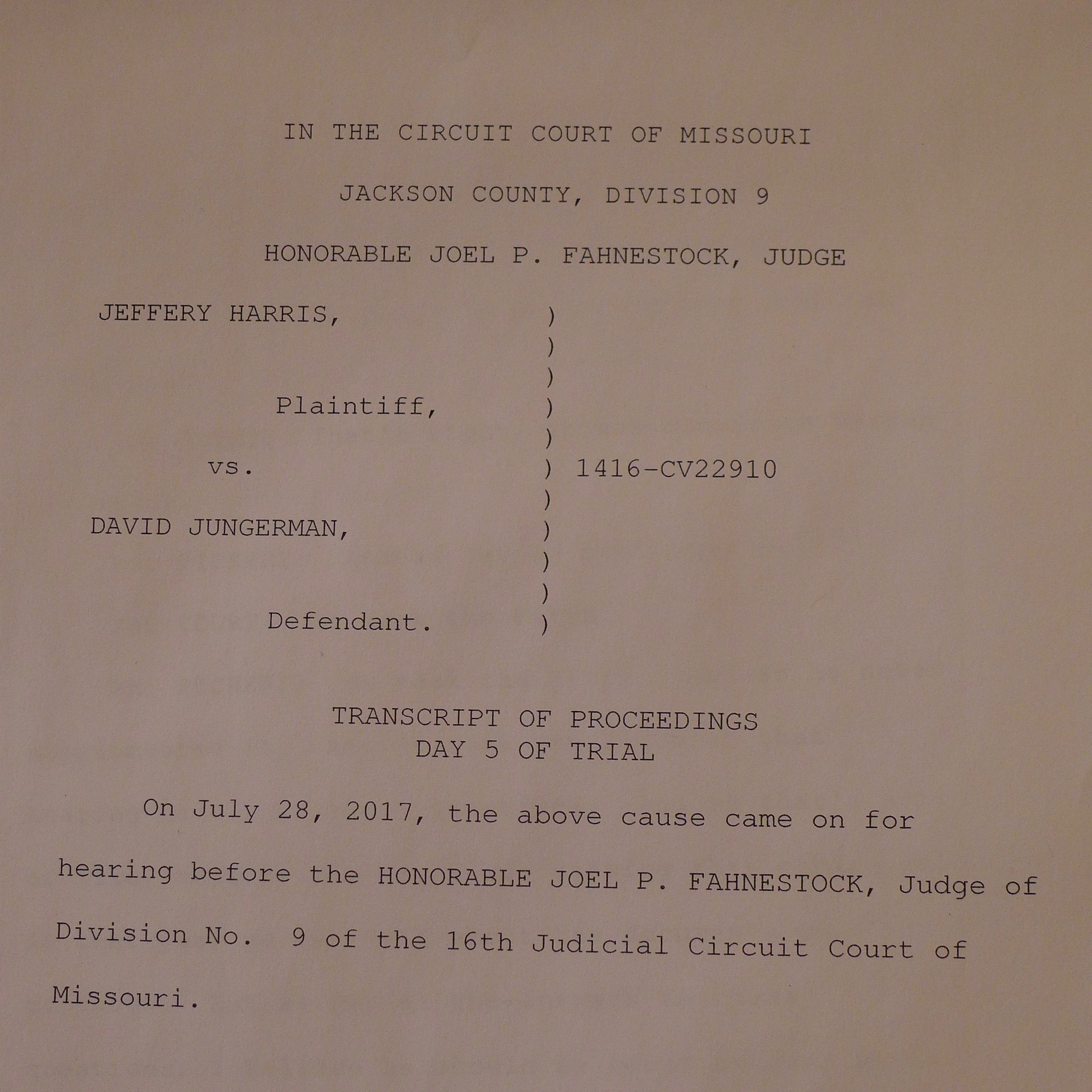
In that vein, I obtained the transcript of the last day of the five-day trial that resulted in Pickert winning a $5.75 million civil judgment against the man who seemingly had the strongest motive — combined with a propensity for gun violence — to kill Pickert.

Police have said that man, 79-year-old David Jungerman of Raytown, is “not a suspect at this time.” I don’t believe it. A lawyer with close ties to the prosecutor’s office has told me Jungerman is, indeed, the prime suspect, and a second well-connected lawyer told me earlier this week that the police department’s careful public statements about Jungerman “could be some very skillful misinformation just to get him comfortable.”

There’s a lot of interesting material in the 109 pages of proceedings from that last day of trial, July 28, and I will be bringing the highlights to you today and in days to come.

One of the main reasons I wanted that transcript is that police said in a warrant application for Jungerman’s white van — similar to one spotted at the murder scene on Oct. 25 — that after the verdict was announced in the civil case, “Jungerman had an outburst in the courtroom where he cursed and yelled in a loud voice at court personnel, including the victim.”

Obviously, that could be a very strong piece of circumstantial evidence, particularly if Jungerman threatened Pickert.

I’m sure the police know exactly what Jungerman said in court that day, but, unfortunately, the outburst occurred after the judge had dismissed the jury and after the judge and other key court personnel, including the court reporter, had left the room.

The last words uttered by the judge and recorded by the court reporter were:

“Now, I’m going to release the jury…If there’s nothing further, we will be adjourned…All right. Thank you.”

So much for my hopes of hearing exactly what Jungerman said to Pickert a few minutes later.

**

Another thing I was looking for in the transcript, particularly, was any indication of ill-will and tension between Pickert and Jungerman.

Stupidly, Jungerman, a multi-millionaire who could have afforded a top-notch lawyer, chose to represent himself. (He did go half-in, however, hiring a lawyer named Brian Gepford to advise and assist him.)

His decision to represent himself insured that there’d be plenty of interaction between himself and Pickert, the main attorney representing a homeless man, Jeffrey Harris, whom Jungerman had shot with an assault rifle after he caught Harris and another man trespassing on his property on Sept. 25, 2012. (While the two men were standing on a loading dock outside a building Jungerman owns, Jungerman shot them with an assault rifle. Harris was hit in the leg, which later had to be removed above the knee.)

Tension and tone often don’t come through in a transcript, and I could not detect a high level of tension between Pickert and Jungerman from Pickert’s questioning of the defendant on Day 5 of the trial. At only one point in that last day’s testimony was there an indication of a possible history of friction between Pickert and Jungerman.

That point came when Gepford questioned the defendant about hiring him to help with advice. The following exchange took place before the jury:

Gepford: You asked me as a lawyer to assist you in representing yourself in this case?

Jungerman: Yes, I did.

Gepford: But there’s been a long, and number of periods of time when you were…

Jungerman: And I would like to give the reason. The reason I contacted Mr. Gepford was the plaintiffs…

At this point, Pickert interrupted: Your honor…

The judge: Hang on just a moment. Let’s approach (the bench). You can come on up, Mr. Jungerman.

A conference was then held at the bench outside the jury’s hearing.

Pickert: I have no idea what he is going to say, but he’s started to accuse me and this has nothing to do with — this is totally irrelevant to this stage of why he chose to hire him as an attorney.

The judge upheld Pickert’s objection, and when questioning before the jury resumed, Gepford went in a completely different direction.

**

As I said earlier, testimony from that last day in court reveals much interesting information, including Jungerman’s propensity to resolve problems with guns…like a rogue sheriff without commission, training or concern for the safety of others.

Another interesting aspect of the case is that Jungerman never expressed remorse about shooting Harris and the other man on Sept. 25, 2012. Not only that; more than once on Day 5 he insisted he — not Harris or his companion — was the real victim.

…More to come.

Read Full Post »

A misdemeanor criminal case against a Raytown man who supposedly is “not a suspect at this time” in the Oct. 25 murder of Thomas Pickert is suddenly getting a lot of attention from authorities.

Within the last week or so, the last year’s worth of entries in a Barton County case against 79-year-old David Jungerman have disappeared from public records.

Those records were on the Missouri casenet website,  last week. But when I went back to the Jackson County Courthouse today to check for new developments, all entries entered after Oct. 13, 2016 — when the case was transferred from Vernon County to nearby Barton County — were gone.

This afternoon, I called Barton County Circuit Court Clerk Janet Maupin and asked her about the case.  She said she couldn’t give me any information. When I pressed for a reason, she replied, “The security level has been raised.”

Vernon County Prosecutor Brandi McInroy is handling the case. A woman who answered the phone in McInroy’s office today said McInroy was out of the office until Monday. Two other numbers I found in WhitePages.com did not turn her up.

I also left a message for Mike Mansur, a spokesman in the Jackson County Prosecutor’s Office, hoping to ask him if Jackson and Vernon counties were collaborating on the misdemeanor case. I have not heard back.

I tell you this: Whatever is going on, you can be sure that if David Jungerman was not a suspect in the murder of Thomas Pickert, the security level of the misdemeanor case would have not have been raised…I would not be surprised to see the misdemeanor case dismissed and the case refiled with felony charges.

…More about that case in a minute, but I also picked up two new pieces of information in regard to the Pickert case.

:: A longtime criminal defense attorney — an attorney I had not talked with before this week — said Pickert was shot with a rifle. Police have not identified the type of weapon, other than to say he was shot. The attorney said police found shell casings from a rifle near the scene.

My take: If Pickert was shot with a rifle, it seems more likely the shots could have been fired from inside a vehicle parked on the street or behind the vehicle, instead of up close. Before the shooting, a white van was seen parked across from Pickert’s home on West 66th Terrace, near Brookside Road.

Shots from a rifle would also help explain why Pickert might not have realized for several seconds that he was being fired at. After a first “loud noise,” as police put it in a search-warrant application, Pickert’s wife went to a front window and asked Pickert, who was talking on his cell phone, if he knew what the sound was. “No,” he replied. She told him to come in, but before he did, or could, there was another “loud noise.” His wife, a physician at the University of Kansas Health System, went outside and saw her husband on the ground and a white van leaving the scene.

::  Pickert fell in the grass in his yard, not, apparently, on his sidewalk or on his front porch, as earlier reports had it…A man who lives within a few doors of the shooting told me yesterday that he and his wife went out for breakfast on Wednesday, Oct. 25, and when they returned home, dozens of yards of crime-scene ribbon extended along both sides of the street. The neighbor saw Pickert’s covered body in the grass in his front yard, about midway between the front sidewalk and the home.

Like Pickert’s puzzled reaction to the first “loud noise,” the position of his body would also tend to support the plausibility of a rifle being the killer’s weapon of choice.

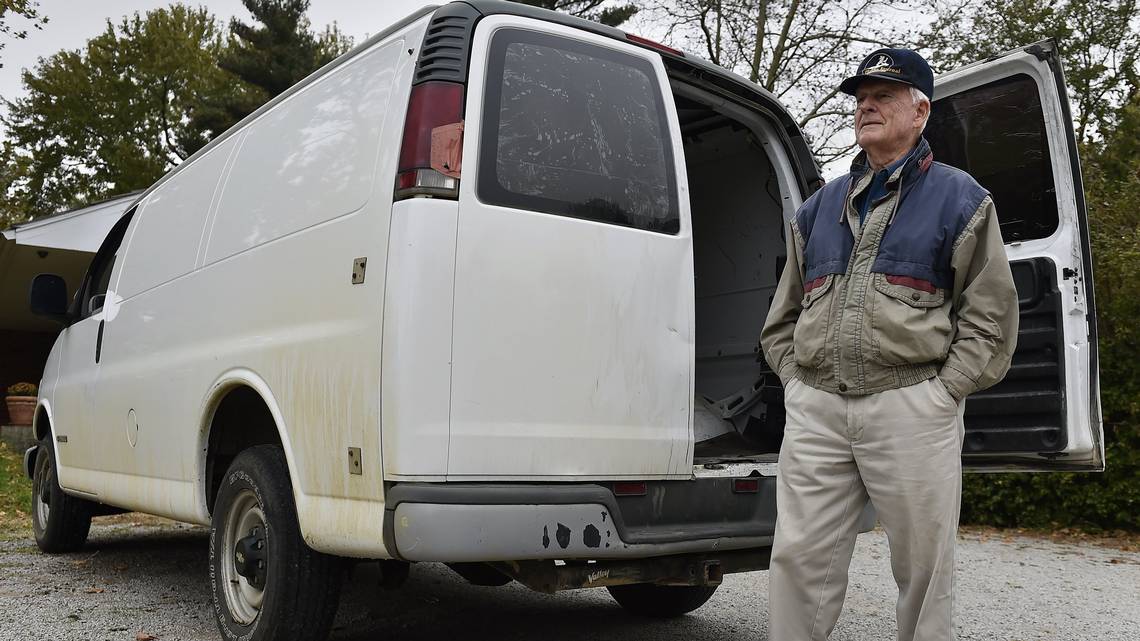
David Jungerman and his white van, which police searched for possible evidence in the Thomas Pickert murder case. Kansas City Star photo.

I wrote about the misdemeanor case earlier this month. It stems from a June 28, 2016, incident in rural Vernon County, where Jungerman is alleged to have broken into the home of a tenant of his, Jerry Doyle, and cursed at him while displaying a .40-caliber Glock, semi-automatic handgun in his waistband.

A police “probable cause” statement alleges Jungerman kicked in the door of the home, confronted the tenant and said, “When are you getting out of here you mother fucker?”

A witness, a state employee who was at the home at the time, said Jungerman placed his hand on the gun while “yelling and cussing” at the tenant.

Jungerman was initially charged with one or more felonies, but from my reading of the records, it apparently was reduced to a misdemeanor somewhere along the way.

The case came up in the course of a Jackson County Circuit Court civil trial last summer in which Pickert represented a homeless man whom Jungerman shot in the leg on Sept. 25, 2012. Jungerman caught the homeless man, Jeffrey Harris, and another man on the loading dock of a baby-furniture manufacturing plant he owns in northeast Kansas City. Instead of calling the police after being notified by an alarm company, Jungerman, armed with an assault rifle and a handgun, drove to the building and opened fire. Harris had to have a leg amputated because of his injuries.

(About a month later, Jungerman shot two more trespassers — men who had broken into the building and were attempting to steal copper pipes.)

After a three-day trial in the Harris case, the jury awarded Harris $750,000 in compensatory damages and $5 million in punitive damages.

Jungerman, in a move that he must now regret, chose to represent himself — “pro se” is the legal term — although he did have a lawyer giving him advice.

In the course of the trial, it came out that in addition to shooting the four trespassers within the space of a month, Jungerman had also pulled a gun on four teenagers many years ago after he caught them on property he owns in Raytown. He made a “citizen’s arrest,” but later he, not the youths, were convicted of a crime — a misdemeanor firearms violation.

In the Vernon County case, although Jungerman did not pull a gun on the tenant, it was in plain view during the incident.

At the civil trial, under questioning by Pickert, Jungerman said at one point, “I’m always armed.”

At another point, he said: “I carry a gun, sure. And I have a permit to carry that gun.”

Pickert and Jungerman later had this exchange:

Pickert: What I want to know is whether or not you threatened Mr. Doyle in any way about getting out (of the rental house)?

Jungerman: In no way did I threaten him.

Pickert: Did you, sir, tell Mr. Doyle when are you getting out, mother fucker?

Jungerman: That’s correct.

Pickert: But you weren’t trying to intimidate at all, were you?

Jungerman: “No.”

Read Full Post »

« Newer Posts - Older Posts »